


 |
市場調查報告書
商品編碼
2061961
基於代理的人工智慧框架:市場佔有率分析、行業趨勢和統計數據、成長預測(2026-2031 年)Agentic AI Frameworks - Market Share Analysis, Industry Trends & Statistics, Growth Forecasts (2026 - 2031) |
||||||

※ 本網頁內容可能與最新版本有所差異。詳細情況請與我們聯繫。
根據 Mordor Intelligence 預測,基於代理商的 AI 框架市場規模預計將從 2025 年的 29.9 億美元成長到 2026 年的 41.1 億美元,然後從 2026 年到 2031 年以 36.3% 的複合年成長率成長,到 20312 億美元達到 193.33.
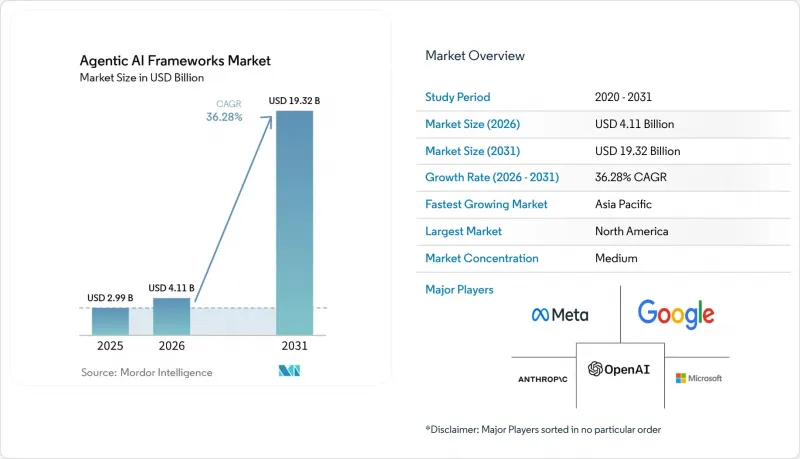
本報告按框架類型(開放原始碼框架和專有框架)、部署模式(雲端託管等)、組織規模(大型企業和中小企業)、最終用戶行業(資訊通訊技術和軟體開發、醫療保健和生命科學、零售和電子商務等)以及地區進行細分。市場預測以美元計價。
全球基於代理的人工智慧框架市場趨勢及洞察
企業工作流程中對自主代理的需求日益成長
企業對基於代理的人工智慧框架的需求正從孤立的聊天機器人部署試點階段轉向能夠協調跨團隊工作的生產系統。 2026年5月,IBM報告稱,82%的高階主管認為職能孤島是人工智慧價值創造的主要障礙,60%的高階主管計劃推出下一代產品,讓人工智慧代理協調跨職能工作流程。這種轉變也正在改變企業的採購行為,因為企業現在尋求將記憶體、工具使用、批准和升級路徑整合到一個統一的、可管理的流程中。當代理人能夠管理部門間的迭代交接,而不是逐一回應提示時,其價值才能最大化。此外,這一趨勢促使企業在部署前重新設計工作流程,因為代理商的效能取決於任務、上下文和職責在組織內部的流動方式。由於在不變的流程中添加代理的專案存在很高的失敗風險,因此在基於代理的人工智慧框架市場中,工作流程架構的重要性幾乎與框架選擇不相上下。
生成式人工智慧模型能力的快速發展
模型技術的快速發展正在拓展基於代理的人工智慧框架市場的營運範圍。前沿模型結合了更強大的工具利用率和更長的上下文窗口,減少了人工提示的需求,從而避免了部署到生產環境的速度減慢。微軟表示,將於2026年4月在Microsoft Foundry上發布的GPT-5.5旨在實現更可靠的代理執行、更強大的長文本上下文推理以及更高的令牌效率。微軟也在Foundry上推出了Claude Opus 4.6,其上下文視窗可達100萬個令牌,適用於編碼、代理開發和企業工作流程。這些進步意義重大,因為它們使多階段編配更加穩定,並減輕了以往限制代理管道僅限於有限先導計畫的成本負擔。 Google DeepMind 指出,2012 年至 2018 年間,用於最大規模訓練運行的運算資源增加了約 30 萬倍,並且到 2024 年將繼續以每年約 4 倍的速度成長。這有助於解釋為什麼能力和效率的上限會同步提高。
人們持續擔憂人工智慧的安全性和一致性問題。
安全性和一致性仍然是基於代理的人工智慧框架市場面臨的結構性限制因素,因為多代理錯誤會透過記憶、工具和級聯決策而疊加。世界經濟論壇指出,評估和管治人工智慧代理仍然需要更強大的基礎,尤其是在系統在業務流程中變得更加自主的情況下。風險不僅限於錯誤的答案;代理可能會提升權限、洩露數據,或觸發在多次交接後難以追蹤的操作。這迫使受監管的買家在擴展部署規模之前,必須專注於審計追蹤、人工監督和運行時控制。將於2026年8月生效的歐盟人工智慧法案中的高風險條款,將要求需要合規文件和事件記錄的公司更加謹慎。在安全團隊能夠像監控其他企業系統一樣自信地監控代理行為之前,基於代理的人工智慧框架市場中的一些高價值部署將落後於技術本身的進步。
細分市場分析
截至2025年,開放原始碼框架在基於代理的AI框架市場佔據了63.81%的佔有率。這一主導地位源於開發者對可配置性、可審計性以及跨模型、向量儲存和企業資料系統的廣泛整合的偏好。 2025年10月,LangChain宣布其LangChain和LangGraph的月度總下載量已達到9000萬次,並且35%的財富500強企業正在使用其服務。此次更新也提及了大型企業生產環境中的使用情況,這有助於解釋為什麼即使用戶之後購買了商業支持,開放原始碼工具仍然能夠持續構成工程標準。
開放原始碼的主導並不能消除自身的摩擦,因為快速的發布週期和破壞 API 相容性的變更可能會導致已經在生產環境中運行的團隊進行內部返工。這種不穩定性是縮小生產環境與專有供應商之間差距的因素之一,預計到 2031 年,專有框架的複合年成長率將達到 36.68%。微軟已宣布,其 Foundry Agent Service 將在單一的管治運行環境中支援 LangGraph、Claude Agent SDK 和 OpenAI Agents SDK,這表明企業供應商如何在受控環境中打包其框架的柔軟性。實際上,基於代理的 AI 框架市場正在分裂為兩部分:一部分是主導實驗的開放原始碼工具,另一部分是正在崛起的專有平台,後者滿足了買家對服務等級、可審計性和集中控制的需求。
到 2025 年,雲端託管部署將佔基於代理程式的 AI 框架市場 71.32% 的佔有率。託管服務仍然是首選,因為它們可以縮短設定時間,快速存取前沿模型,並能適應代理工作負載的波動。 2026 年 4 月,Google雲端發布了 Gemini 企業代理平台,其中包括 Agent Studio、Agent Development Kit、Agent Runtime、Agent Identity 和 Agent Gateway,展示了供應商如何將開發和管治打包成單一服務。微軟也同樣擴展了其在 Foundry 和 Microsoft 365 中的代理工具,鞏固了其在雲端領域快速迭代開發和標準業務工作流程的領先地位。
預計到2031年,面向本地和邊緣部署的基於代理的AI框架市場將以36.63%的複合年成長率成長。這一成長反映了公共雲端無法完全滿足的需求,例如資料主權、低延遲推理和專有工作流程的保護。小規模、更針對特定任務的模型和量化變體正在縮小本地部署和託管部署之間的功能差距,從而消除了邊緣採用的傳統障礙之一。因此,企業正日益實現架構多樣化,在雲端維護開發和日常工作流程,同時將敏感或時間敏感型用例遷移到本地或邊緣環境。
區域分析
到2025年,北美將佔據全球基於代理的人工智慧框架市場佔有率的37.51%。美國仍然是最大的單一市場,這得益於其最充裕的企業人工智慧預算、最高的供應商集中度以及與超大規模資料中心業者生態系統最緊密的整合。這在基礎模型供應商、雲端平台和企業買家之間形成了一個快速的反饋循環,使該地區能夠比其他地區更快地將新的編配工具部署到生產環境中。加拿大正透過人工智慧叢集深化探索,而墨西哥作為雙語營運工作流程的近岸部署中心,其重要性日益凸顯。
到2025年,歐洲將在全球基於代理的人工智慧框架市場佔據重要佔有率。德國、英國和法國的需求主要集中在工業流程、企業軟體工作流程和受監管業務功能的生產級編配。資料主權、私有雲端部署和可審計文件在該地區採購中至關重要,促使買家選擇結構化程度更高的平台。雖然即將訂定的高風險人工智慧法規不會消除需求,但它們正在推動支出轉向能夠記錄營運、控制和人工監督,同時最大限度地減少客製化的框架。
預計到2031年,亞太地區基於代理的人工智慧框架市場將以37.28%的複合年成長率成長。中國正透過國家層級的人工智慧代理普及和產業部署目標加速其應用,而日本則利用其將於2026年5月生效的《人工智慧促進法》,支持以風險為導向、以創新為驅動的生產部署路徑。印度的優勢在於其先進的軟體工程技術和大規模的服務基礎設施,這些優勢正在推動開放原始碼在外包和金融工作流程中的應用。中東地區正透過阿拉伯聯合大公國和沙烏地阿拉伯的國家人工智慧計畫獲得發展動力,而巴西和阿根廷則作為南美洲的早期進入點發揮核心作用。在全部區域,主權法規和本地營運需求不僅是障礙,更是推動基於代理的人工智慧框架市場向更具可審計性和本地化適應性的部署模式發展的驅動力。
其他好處:
- Excel格式的市場預測(ME)表
- 3個月的分析師支持
目錄
第1章:引言
- 研究假設和市場定義
- 調查範圍
第2章:調查方法
第3章執行摘要
第4章 市場狀況
- 市場概覽
- 市場促進因素
- 企業工作流程中對自主代理的需求日益成長
- 生成式人工智慧模型能力的快速發展
- 來自大型科技公司和創業投資。
- 框架無關工具的可擴展性優勢
- 人工智慧函數呼叫標準的出現
- 將基於代理的框架整合到低程式碼平台中
- 市場限制因素
- 人們持續擔憂人工智慧的安全性和一致性問題。
- 缺乏能夠處理多智慧體編配的熟練人員
- 大規模智慧體模擬中高額的運算成本
- 由於對快速工程表達方法的不同而產生的分歧
- 宏觀經濟因素對市場的影響
- 產業價值鏈分析
- 監理情勢
- 技術展望
- 波特五力分析
第5章 市場規模與成長預測
- 按框架類型
- 開放原始碼框架
- 專有框架
- 部署模式
- 雲端託管
- 本地部署和邊緣運算
- 按組織規模
- 大公司
- 小型企業
- 按最終用戶行業分類
- 資訊通訊技術和軟體開發
- 金融服務
- 醫療保健和生命科學
- 製造業和工業
- 零售與電子商務
- 媒體與娛樂
- 按地區
- 北美洲
- 美國
- 加拿大
- 墨西哥
- 南美洲
- 巴西
- 阿根廷
- 其他南美國家
- 歐洲
- 英國
- 德國
- 法國
- 義大利
- 西班牙
- 其他歐洲國家
- 亞太地區
- 中國
- 日本
- 印度
- 韓國
- 其他亞太國家
- 中東和非洲
- 中東
- 阿拉伯聯合大公國
- 沙烏地阿拉伯
- 其他中東國家
- 非洲
- 南非
- 埃及
- 其他非洲國家
- 中東
- 北美洲
第6章 競爭情勢
- 市場集中度
- 策略趨勢
- 市佔率分析
- 公司簡介
- OpenAI LLC
- Microsoft Corporation
- Google LLC
- Anthropic PBC
- Meta Platforms Inc.
- Amazon.com Inc.
- Hugging Face Inc.
- NVIDIA Corporation
- IBM Corporation
- Salesforce Inc.
- Cohere Inc.
- Adept AI Labs Inc.
- Replit Inc.
- Pinecone Systems Inc.
- LangChain Inc.
- Inflection AI Inc.
- Mistral AI SAS
- LangFuse GmbH
- Conductor Technologies Inc.
- Cerebras Systems Inc.
第7章 市場機會與未來展望
According to Mordor Intelligence, the agentic AI frameworks market size is expected to grow from USD 2.99 billion in 2025 to USD 4.11 billion in 2026 and is forecast to reach USD 19.32 billion by 2031 at 36.3% CAGR over 2026-2031.
This report is Segmented by Framework Type (Open-Source Frameworks, and Proprietary Frameworks), Deployment Mode (Cloud-Hosted, and More), Organization Size (Large Enterprises, and Small and Medium Enterprises), End-User Industry (ICT and Software Development, Healthcare and Life Sciences, Retail and E-Commerce, and More), and Geography. The Market Forecasts are Provided in Terms of Value (USD).
Global Agentic AI Frameworks Market Trends and Insights
Growing Demand for Autonomous Agents in Enterprise Workflows
Enterprise demand in the agentic AI frameworks market has moved beyond isolated chatbot pilots and into production systems that coordinate work across teams. IBM reported in May 2026 that 82% of C-suite executives identified functional silos as the main barrier to AI value extraction, and 60% planned next-generation delivery structures in which AI agents coordinate workflows across departments. That shift changes buying behavior because enterprises now want memory, tool use, approvals, and escalation paths in one governed flow. The value case is strongest where agents can manage repetitive handoffs between departments instead of answering one prompt at a time. This is also pushing organizations to redesign workflows before deployment, since agent performance depends on how tasks, context, and accountability move across the business. Projects that add agents to unchanged processes face a higher cancellation risk, so workflow architecture is becoming nearly as important as framework selection in the agentic AI frameworks market.
Rapid Advances in Generative AI Model Capabilities
Rapid model progress is widening the production scope of the agentic AI frameworks market. Frontier models now combine stronger tool use with longer context windows, reducing the manual prompting required to slow production deployment. Microsoft said its April 2026 release of GPT-5.5 on Microsoft Foundry was designed for more reliable agentic execution, stronger long-context reasoning, and better token efficiency. Microsoft also made Claude Opus 4.6 available in Foundry, with a 1-million-token context window for coding, agents, and enterprise workflows. These gains matter because they make multi-step orchestration more stable and lower the cost penalty that once limited agent pipelines to narrow pilots. Google DeepMind noted that compute available for the largest training runs rose by around 300,000x between 2012 and 2018 and continued to grow at an annual pace of around 4x through 2024, which helps explain why capability ceilings and efficiency are moving together.
Persistent Concerns Around AI Safety and Alignment
Safety and alignment remain a structural brake on the agentic AI frameworks market because multi-agent errors can compound across memory, tools, and chained decisions. The World Economic Forum said that evaluation and governance for AI agents still need stronger foundations, especially as systems operate with greater autonomy within business processes. The risk is not limited to wrong answers, since agents can also escalate privileges, expose data, or trigger actions that are hard to trace after several handoffs. This keeps regulated buyers focused on audit trails, human oversight, and runtime controls before they scale deployment. The August 2026 activation of the EU AI Act high-risk provisions adds another layer of caution for enterprises that need conformity documentation and incident logging. Until security teams can monitor agent behavior with the same confidence they apply to other enterprise systems, some high-value deployments in the agentic AI frameworks market will move more slowly than the technology itself.
Other drivers and restraints analyzed in the detailed report include:
- Rising Investments by Big Tech and Venture Capital
- Scalability Benefits of Framework-Agnostic Tooling
- Lack of Skilled Workforce for Multi-Agent Orchestration
For complete list of drivers and restraints, kindly check the Table Of Contents.
Segment Analysis
Open-source frameworks held 63.81% of the agentic AI frameworks market share in 2025. That lead came from developers' preference for composability, auditability, and broad integration across models, vector stores, and enterprise data systems. LangChain said in October 2025 that LangChain and LangGraph reached 90 million combined monthly downloads and that 35% of Fortune 500 companies used its services. The same update pointed to production use across large enterprises, which helps explain why open-source tools still shape engineering standards even when buyers later purchase commercial support.
Open-source leadership does not remove its own friction, since rapid release cycles and breaking API changes can create internal rework for teams already in production. That instability is helping proprietary vendors close the production gap, and proprietary frameworks are projected to grow at a 36.68% CAGR through 2031. Microsoft said the Foundry Agent Service supports LangGraph, the Claude Agent SDK, and the OpenAI Agents SDKs in a single, governed runtime, demonstrating how enterprise vendors are packaging framework flexibility within managed environments. In practice, the agentic AI frameworks market is separating into open-source tools that lead experimentation and proprietary platforms that gain ground when buyers need service levels, auditability, and centralized controls.
Cloud-hosted deployments held 71.32% of the agentic AI frameworks market in 2025. Cloud remains the default because managed services shorten setup time, provide fast access to frontier models, and scale with variable agent workloads. Google Cloud launched the Gemini Enterprise Agent Platform in April 2026, including Agent Studio, Agent Development Kit, Agent Runtime, Agent Identity, and Agent Gateway, demonstrating how platform vendors are packaging development and governance as a single service. Microsoft made similar moves by expanding Foundry and Microsoft 365 agent tooling, reinforcing its cloud leadership in rapid iteration and standard business workflows.
The agentic AI frameworks market size for on-premises and edge deployments is projected to expand at 36.63% CAGR through 2031. That growth reflects needs that public cloud cannot fully solve, including data sovereignty, low-latency inference, and protection of proprietary workflows. Smaller task-specific models and quantized variants are narrowing the capability gap between local and hosted deployments, reducing one of the old barriers to edge adoption. The result is an architecture split in which enterprises keep development and routine workflows in the cloud, while moving sensitive or time-critical use cases to on-premises and edge environments.
Geography Analysis
North America held 37.51% of the global agentic AI frameworks market share in 2025. The United States remains the single largest national market because it combines the deepest enterprise AI budgets, the highest vendor concentration, and the closest links to hyperscaler ecosystems. This creates a fast feedback loop among foundation model providers, cloud platforms, and enterprise buyers, enabling the region to deploy new orchestration tools to production faster than peers. Canada adds research depth through its AI clusters, while Mexico is gaining relevance as a near-shore deployment base for bilingual operational workflows.
Europe accounted for a substantial share of the global agentic AI frameworks market in 2025. Demand in Germany, the United Kingdom, and France centers on production-grade orchestration for industrial processes, enterprise software workflows, and regulated business functions. Procurement in the region places unusual emphasis on data sovereignty, private cloud deployment, and audit-ready documentation, which pushes buyers toward more structured platform choices. The coming enforcement of high-risk AI rules is not removing demand, but it is redirecting spend toward frameworks that can document actions, controls, and human oversight with less customization.
The agentic AI frameworks market in Asia-Pacific is projected to grow at a 37.28% CAGR through 2031. China is accelerating adoption through national targets for AI agent penetration and industrial deployment, while Japan is using its May 2026 AI Promotion Act to support a risk-based, yet innovation-oriented, path to production. India benefits from deep software engineering expertise and a large services base, which supports open-source adoption in outsourcing and financial workflows. The Middle East is building momentum through national AI programs in the United Arab Emirates and Saudi Arabia, while South America remains centered on Brazil and Argentina as early entry points. Across these regions, sovereignty rules and local operating needs are not simply barriers; they are steering the agentic AI frameworks market toward more auditable and locally adaptable deployment models.
- OpenAI LLC
- Microsoft Corporation
- Google LLC
- Anthropic PBC
- Meta Platforms Inc.
- Amazon.com Inc.
- Hugging Face Inc.
- NVIDIA Corporation
- IBM Corporation
- Salesforce Inc.
- Cohere Inc.
- Adept AI Labs Inc.
- Replit Inc.
- Pinecone Systems Inc.
- LangChain Inc.
- Inflection AI Inc.
- Mistral AI SAS
- LangFuse GmbH
- Conductor Technologies Inc.
- Cerebras Systems Inc.
Additional Benefits:
- The market estimate (ME) sheet in Excel format
- 3 months of analyst support
TABLE OF CONTENTS
1 INTRODUCTION
- 1.1 Study Assumptions and Market Definition
- 1.2 Scope of the Study
2 RESEARCH METHODOLOGY
3 EXECUTIVE SUMMARY
4 MARKET LANDSCAPE
- 4.1 Market Overview
- 4.2 Market Drivers
- 4.2.1 Growing Demand for Autonomous Agents in Enterprise Workflows
- 4.2.2 Rapid Advances in Generative AI Model Capabilities
- 4.2.3 Rising Investments by Big Tech and Venture Capital
- 4.2.4 Scalability Benefits of Framework-Agnostic Tooling
- 4.2.5 Emergence of AI Function Calling Standards
- 4.2.6 Integration of Agentic Frameworks into Low-Code Platforms
- 4.3 Market Restraints
- 4.3.1 Persistent Concerns Around AI Safety and Alignment
- 4.3.2 Lack of Skilled Workforce for Multi-Agent Orchestration
- 4.3.3 High Compute Costs for Large-Scale Agent Simulations
- 4.3.4 Fragmentation Due to Divergent Prompt Engineering Dialects
- 4.4 Impact of Macroeconomic Factors on the Market
- 4.5 Industry Value Chain Analysis
- 4.6 Regulatory Landscape
- 4.7 Technological Outlook
- 4.8 Porter's Five Forces Analysis
- 4.8.1 Bargaining Power of Suppliers
- 4.8.2 Bargaining Power of Buyers
- 4.8.3 Threat of New Entrants
- 4.8.4 Threat of Substitutes
- 4.8.5 Intensity of Competitive Rivalry
5 MARKET SIZE AND GROWTH FORECASTS (VALUE)
- 5.1 By Framework Type
- 5.1.1 Open-Source Frameworks
- 5.1.2 Proprietary Frameworks
- 5.2 By Deployment Mode
- 5.2.1 Cloud-Hosted
- 5.2.2 On-Premises and Edge
- 5.3 By Organization Size
- 5.3.1 Large Enterprises
- 5.3.2 Small and Medium Enterprises
- 5.4 By End-User Industry
- 5.4.1 ICT and Software Development
- 5.4.2 Financial Services
- 5.4.3 Healthcare and Life Sciences
- 5.4.4 Manufacturing and Industrial
- 5.4.5 Retail and E-Commerce
- 5.4.6 Media and Entertainment
- 5.5 By Geography
- 5.5.1 North America
- 5.5.1.1 United States
- 5.5.1.2 Canada
- 5.5.1.3 Mexico
- 5.5.2 South America
- 5.5.2.1 Brazil
- 5.5.2.2 Argentina
- 5.5.2.3 Rest of South America
- 5.5.3 Europe
- 5.5.3.1 United Kingdom
- 5.5.3.2 Germany
- 5.5.3.3 France
- 5.5.3.4 Italy
- 5.5.3.5 Spain
- 5.5.3.6 Rest of Europe
- 5.5.4 Asia-Pacific
- 5.5.4.1 China
- 5.5.4.2 Japan
- 5.5.4.3 India
- 5.5.4.4 South Korea
- 5.5.4.5 Rest of Asia-Pacific
- 5.5.5 Middle East and Africa
- 5.5.5.1 Middle East
- 5.5.5.1.1 United Arab Emirates
- 5.5.5.1.2 Saudi Arabia
- 5.5.5.1.3 Rest of Middle East
- 5.5.5.2 Africa
- 5.5.5.2.1 South Africa
- 5.5.5.2.2 Egypt
- 5.5.5.2.3 Rest of Africa
- 5.5.5.1 Middle East
- 5.5.1 North America
6 COMPETITIVE LANDSCAPE
- 6.1 Market Concentration
- 6.2 Strategic Moves
- 6.3 Market Share Analysis
- 6.4 Company Profiles (includes Global Level Overview, Market Level Overview, Core Segments, Financials as available, Strategic Information, Market Rank/Share, Products and Services, Recent Developments)
- 6.4.1 OpenAI LLC
- 6.4.2 Microsoft Corporation
- 6.4.3 Google LLC
- 6.4.4 Anthropic PBC
- 6.4.5 Meta Platforms Inc.
- 6.4.6 Amazon.com Inc.
- 6.4.7 Hugging Face Inc.
- 6.4.8 NVIDIA Corporation
- 6.4.9 IBM Corporation
- 6.4.10 Salesforce Inc.
- 6.4.11 Cohere Inc.
- 6.4.12 Adept AI Labs Inc.
- 6.4.13 Replit Inc.
- 6.4.14 Pinecone Systems Inc.
- 6.4.15 LangChain Inc.
- 6.4.16 Inflection AI Inc.
- 6.4.17 Mistral AI SAS
- 6.4.18 LangFuse GmbH
- 6.4.19 Conductor Technologies Inc.
- 6.4.20 Cerebras Systems Inc.
7 MARKET OPPORTUNITIES AND FUTURE OUTLOOK
- 7.1 White-Space and Unmet-Need Assessment

 行動遊戲品質保證測試市場:全球市場預測,2026-2032年
 工業人工智慧軟體:市場佔有率分析、產業趨勢與統計、成長預測(2026-2031)
 2035年軟體開發領域生成式人工智慧的全球市場:機會與策略英國人工智慧能源管理軟體:市場佔有率分析、行業趨勢和統計數據以及成長預測(2026-2031 年)
 人工智慧內容生成市場:按內容類型、技術、應用、最終用戶和地區分類軟體開發生命週期中生成式人工智慧的全球市場:機會與策略展望(至2035年)全球人工智慧(AI)內容生成市場:到2035年的機會與策略
 2026-2030年全球工業人工智慧軟體市場人工智慧驅動的軟體測試和品質保證:市場佔有率分析、行業趨勢和統計數據以及成長預測(2026-2031 年)
 2026-2034年全球基於代理的AI框架市場規模、佔有率、趨勢和成長分析報告