


 |
市場調查報告書
商品編碼
2073334
英國人工智慧能源管理軟體:市場佔有率分析、行業趨勢和統計數據以及成長預測(2026-2031 年)United Kingdom AI-Powered Energy Management Software - Market Share Analysis, Industry Trends & Statistics, Growth Forecasts (2026 - 2031) |
||||||

※ 本網頁內容可能與最新版本有所差異。詳細情況請與我們聯繫。
據 Mordor Intelligence 稱,2025 年英國人工智慧能源管理軟體市值為 2.3633 億美元,預計到 2031 年將達到 6.1328 億美元,而 2026 年為 2.7433 億美元,2026 年預測期為 2031 年成長率為 17.46%。
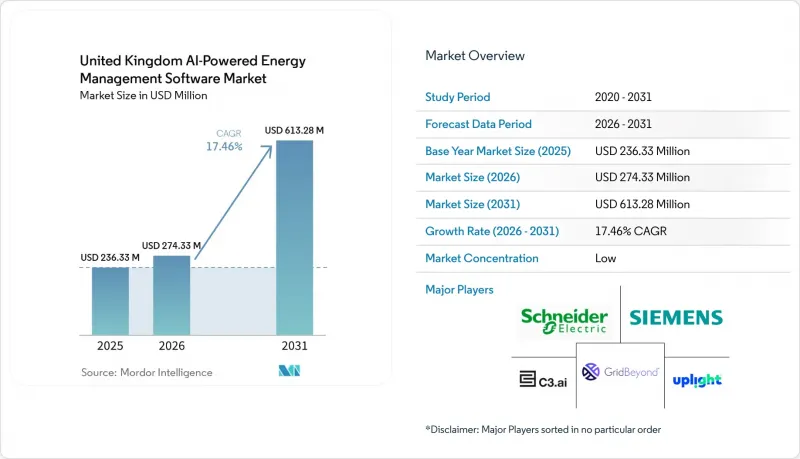
本報告按組件(軟體和服務)、部署模式(雲端、本地部署、混合部署)、應用程式(能源控制、資產性能、智慧電網分析、可再生能源管理等)和最終用戶(公共產業、商業建築、工業設施、住宅)進行細分。市場預測以美元計價。
英國人工智慧能源管理軟體市場趨勢與洞察
人工智慧驅動的即時負載最佳化正在推動對該平台的結構性需求。
隨著分散式資產協調難度的增加,即時負載最佳化正從單純的效能最佳化轉變為電網管理的必要條件,英國人工智慧能源管理軟體市場也因此受益。英國國家電網的「Emerald AI」試點計畫表明,人工智慧資料中心能夠根據電網的即時訊號,在不到一分鐘的時間內將電力需求調整高達40%。 2026年6月,英國科學、創新與技術部指出,清潔能源領域營運部署與試點計畫之間的關鍵差異在於機率性和風險感知最佳化。這一點至關重要,因為許多電網邊緣和工業資產需要在亞秒時限內做出控制決策,這使得那些結合邊緣運算和人工智慧而非僅依賴遠端雲端執行的供應商更具優勢。因此,英國人工智慧能源管理軟體市場的採購標準正轉向本地推理、快速回應以及與控制系統的深度整合。
英國為實現淨零排放所做的努力正在產生政策主導的軟體需求。
英國人工智慧能源管理軟體市場的發展不僅得益於短期成本削減計劃,也得益於永續發展政策的支持。政府於2026年6月發布的《氣候行動更新》支持了擬議的“第七個碳預算”,該預算旨在2038年至2042年間將排放減少87%,重申了在低碳基礎設施決策中進行長期規劃的重要性。 「能源數位化框架」將數位化定位為實現協作互聯能源系統的基礎,並將其與51-66吉瓦靈活發電容量的需求直接連結。這項政策方向可望縮短從策略到採購的流程,因為一旦管治標準和資料規則正式確立,系統投資通常會加快,尤其對於受監管的企業。這將為英國人工智慧能源管理軟體市場奠定政策基礎,使其超越單純的節能範疇,滿足公共產業、基礎設施和大規模商業設施的需求。
整合傳統OT系統和確保資料互通性的複雜性延緩了部署進程。
傳統控制環境仍是英國人工智慧能源管理軟體市場發展的主要障礙。這是因為許多能源資產在設計之初並未考慮互通的資料交換或現代網路安全控制。根據DESNZ對操作技術(OT)漏洞的研究,許多此類系統除了管理它們的IT網路之外,幾乎沒有任何整合保護措施。因此,平台提供者必須在系統上線前處理資料提取、控制邏輯、安全檢驗和合規性稽核等工作,迫使買家承受更長的引進週期。 《2026-2030年能源產業網路安全戰略》指出,將OT工程與網路安全結合是該領域最具挑戰性和最關鍵的問題之一。在通用架構得到更廣泛的應用之前,整合成本將繼續因專案而異,導致英國人工智慧能源管理軟體市場持續落後。
細分市場分析
到2025年,軟體將佔據41.07%的市場佔有率,成為英國人工智慧能源管理軟體市場的主導產品。買家更青睞整合軟體,因為它可以將基準監測、最佳化和報告整合到一個統一的運作層。這對於需要滿足跨多個資產日益成長的可視性和報告要求的商業建築、公共產業和工業設施尤其重要。 SaaS模式也促進了更廣泛的應用,因為它降低了初始合約規模,並允許供應商透過分析模組、連接器和整合層在後期擴展服務。
預計到2031年,服務市場將以19.78%的複合年成長率成長,成為成長最快的細分市場。這一成長反映出,許多買家在購買軟體後,仍需要OT(營運技術)整合、模型重新訓練、控制微調和持續報告等方面的協助。 Trane Technologies進軍BrainBox AI表明,設施和建築系統相關企業正在利用人工智慧軟體的功能,深化能源管理和自主建築控制領域的長期服務價值。事實上,軟體部署與實際成本節約之間的價值差距,正在推動英國人工智慧能源管理軟體市場轉向託管服務和基於結果的服務模式。
到2025年,基於雲端的部署方案將佔英國人工智慧能源管理軟體市場58.15%的佔有率,並持續保持其主導部署模式的地位。許多商業建築營運商更傾向於選擇雲端平台,因為與孤立的本地部署系統相比,雲端平台部署速度更快,基礎設施負擔更輕。此外,雲端平台透過提供跨計量表、資產和用戶資料環境的標準化介面,滿足了更廣泛的互通性需求。這使得雲端部署成為那些集中式分析和整體資產組合視覺性至關重要的應用場景中的可行選擇,尤其是在延遲影響相對較低的場景中。
預計到2031年,混合模式的採用率將以18.67%的複合年成長率成長,其受歡迎程度的提升源於一些控制決策需要在更靠近資產的位置進行。電池儲能、電動車充電、熱泵和智慧逆變器通常需要非常快速的本地決策,而純雲端架構並非總是能滿足這項需求。因此,向混合系統的轉變不僅基於營運需求,也出於對網路安全和資料居住的考慮。隨著英國人工智慧驅動的能源管理軟體市場進一步滲透到公共產業、工業和電網邊緣應用場景,這種集中式分析與本地控制相結合的模式預計將繼續保持混合模式的強勁發展勢頭。
其他好處:
- Excel格式的市場預測(ME)表
- 3個月的分析師支持
目錄
第1章:引言
- 研究假設和市場定義
- 調查範圍
第2章:調查方法
第3章執行摘要
第4章 市場狀況
- 市場概覽
- 市場促進因素
- 利用人工智慧技術對分散式資產組合進行即時負載最佳化。
- 英國面臨遵守淨零排放和碳排放報告要求的壓力
- 電力價格波動加劇以及面臨高峰需求壓力
- 智慧電錶、物聯網和建築自動化數據的發展現況。
- 數位雙胞胎技術在預測性能源控制的應用
- 資料中心、商業房地產和工業領域必須提高能源效率。
- 市場限制因素
- 傳統OT整合與資料互通性的複雜性
- 網路安全和資料主權問題
- 收購中端市場公司的投資回收期尚不明確。
- 人工智慧、能源和控制系統領域人才短缺。
- 產業價值鏈分析
- 宏觀經濟因素對市場的影響
- 監理情勢
- 技術展望
- 波特五力分析
第5章 市場規模與成長預測
- 報價
- 軟體
- 服務
- 部署模式
- 基於雲端的
- 現場
- 混合
- 透過使用
- 最佳化能源消耗和需求
- 資產性能和預測性維護
- 智慧電網與分散式能源(DER)的管理
- 可再生能源預測與整合
- 能源交易、定價和市場訊息
- 最終用戶
- 公用事業
- 商業建築
- 工業設施
- 住宅大樓
第6章 競爭情勢
- 市場集中度
- 策略趨勢
- 市佔率分析
- 公司簡介
- C3.ai, Inc.
- GridBeyond Limited
- Uplight, Inc.
- Bidgely, Inc.
- Copperleaf Technologies Inc.
- BrainBox AI Inc.
- Kaluza Limited
- Verdigris Technologies, Inc.
- EnergyCAP, LLC
- Schneider Electric SE
- Spacewell International NV
- Wattics Limited
- Dexma Sensors, SLU
- Smart Energy Water, Inc.
- Encentiv Energy, Inc.
- Logical Buildings, Inc.
- nZero, Inc.
- Energy Elephant Limited
- Passiv Systems Limited
- EM3
- Greenbyte AB
- Siemens AG
- RetrofitAI, Inc.
- Noda AI Ltd.
- Power Factors, Inc.
第7章 市場機會與未來展望
According to Mordor Intelligence, the united kingdom AI-powered energy management software market size was valued at USD 236.33 million in 2025 and estimated to grow from USD 274.33 million in 2026 to reach USD 613.28 million by 2031, at a CAGR of 17.46% during the forecast period 2026-2031.
This report is Segmented by Component (Software and Services), Deployment Mode (Cloud, On-Premises, and Hybrid), Application (Energy Control, Asset Performance, Smart Grid Analytics, Renewable Energy Management, and More), and End User (Utilities, Commercial Buildings, Industrial Facilities, and Residential). The Market Forecasts are Provided in Terms of Value (USD).
United Kingdom AI-Powered Energy Management Software Market Trends and Insights
AI-Based Real-Time Load Optimization Drives Structural Platform Demand
The United Kingdom AI-powered energy management software market is gaining from the shift in real-time load optimization from a performance feature to a grid management requirement as distributed assets become harder to coordinate. National Grid's Emerald AI trial showed that AI-enabled data centers could flex power demand by up to 40% in under a minute in response to live grid signals. The Department for Science, Innovation and Technology stated in June 2026 that probabilistic and risk-aware optimization is the key feature that separates production-grade deployment from pilot activity in clean energy applications. This matters because many grid-edge and industrial assets need control decisions in sub-second timeframes, which gives an advantage to suppliers that combine edge computing with AI rather than relying only on remote cloud execution. As a result, buying criteria in the United Kingdom AI-powered energy management software market are moving toward local inference, rapid response, and deeper control-system integration.
UK Net-Zero Compliance Generates Policy-Led Software Demand
The United Kingdom AI-powered energy management software market is also supported by policy obligations that are more durable than short-cycle cost-reduction programs. The government's climate action update in June 2026 backed the proposed 7th Carbon Budget, which targets an 87% reduction in emissions across 2038-2042 and reinforces the long planning horizon for low-carbon infrastructure decisions. The Energy Digitalization Framework described digitalization as enabling infrastructure for a coordinated, connected energy system and tied it directly to the need for 51-66 GW of flexible capacity. The same policy direction is likely to shorten the path from strategy to procurement, especially for regulated operators, which typically accelerate system investment once governance standards and data rules are formalized. This gives the UK AI-powered energy management software market a policy base that extends beyond energy savings alone and supports demand in utilities, infrastructure, and larger commercial estates.
Legacy OT Integration And Data Interoperability Complexity Slows Deployment
Legacy control environments remain a major brake on the United Kingdom AI-powered energy management software market because many energy assets were not designed for interoperable data exchange or modern cyber controls. DESNZ research on operational technology vulnerabilities stated that many of these systems have little integrated protection beyond the IT network that manages them. This pushes buyers into longer deployment cycles because platform providers must address data extraction, control logic, safety validation, and compliance review before live operation begins. The Energy Sector Cyber Security Strategy for 2026-2030 calls the bridge between OT engineering and cybersecurity one of the hardest and most important issues in the sector. Until common architectures are more widely established, integration costs will remain uneven across projects and will keep slowing deployment in the United Kingdom AI-powered energy management software market.
Other drivers and restraints analyzed in the detailed report include:
- Rising Electricity Price Volatility Sharpens The Commercial Case
- Smart Meter And IoT Data Readiness Expands AI Use Cases
- Cybersecurity And Data Sovereignty Concerns Constrain Enterprise Adoption Pace
For complete list of drivers and restraints, kindly check the Table Of Contents.
Segment Analysis
Software held 41.07% of the market in 2025, making it the leading offering in the United Kingdom AI-powered energy management software market. Buyers favored integrated software because it could combine baseline monitoring, optimization, and reporting in a single operating layer. This was especially relevant for commercial buildings, utilities, and industrial facilities that needed better visibility across multiple assets and reporting requirements. The SaaS model also supported wider adoption by reducing initial contract size and allowing vendors to expand later through analytics modules, connectors, and integration layers.
Services are projected to expand at a 19.78% CAGR through 2031, making them the fastest-growing segment. This growth reflects the fact that many buyers need help with OT integration, model retraining, controls tuning, and ongoing reporting after the initial software purchase. Trane Technologies' move into BrainBox AI showed how equipment and building-system players are using AI software capabilities to deepen long-term service value in energy management and autonomous building control. In practice, the value gap between software installation and realized savings is pushing more contracts toward managed or outcome-linked services across the UK AI-powered energy management software market.
Cloud-based deployment accounted for 58.15% of the United Kingdom AI-powered energy management software market size in 2025, which kept it as the dominant deployment model. Many commercial building operators preferred cloud platforms because they offered faster onboarding and lower infrastructure burden than isolated on-premises systems. Cloud platforms also fit well with broader interoperability goals because they can expose standardized interfaces across meter, asset, and consumer data environments. This made cloud deployment a practical choice in less latency-sensitive use cases where central analytics and portfolio-wide visibility mattered most.
Hybrid deployment is projected to expand at a 18.67% CAGR through 2031 and is gaining popularity because some control decisions must be made close to the asset. Battery storage, EV charging, heat pumps, and smart inverters often need very fast local decision-making, which pure cloud architectures cannot always deliver. The push toward hybrid systems is therefore based on operational need as much as on cyber assurance or data residency concerns. This balance between central analytics and local control is likely to keep hybrid adoption strong as the UK AI-powered energy management software market moves deeper into utility, industrial, and grid-edge use cases.
Complete Report Scope:
- By Offering
- Software
- Services
- By Deployment Mode
- Cloud-Based
- On-Premises
- Hybrid
- By Application
- Energy Consumption and Demand Optimization
- Asset Performance and Predictive Maintenance
- Smart Grid and Distributed Energy Resource (DER) Management
- Renewable Energy Forecasting and Integration
- Energy Trading, Pricing and Market Intelligence
- By End User
- Utilities
- Commercial Buildings
- Industrial Facilities
- Residential Buildings
List of Companies Covered in this Report:
- C3.ai, Inc.
- GridBeyond Limited
- Uplight, Inc.
- Bidgely, Inc.
- Copperleaf Technologies Inc.
- BrainBox AI Inc.
- Kaluza Limited
- Verdigris Technologies, Inc.
- EnergyCAP, LLC
- Schneider Electric SE
- Spacewell International N.V.
- Wattics Limited
- Dexma Sensors, S.L.U.
- Smart Energy Water, Inc.
- Encentiv Energy, Inc.
- Logical Buildings, Inc.
- nZero, Inc.
- Energy Elephant Limited
- Passiv Systems Limited
- EM3
- Greenbyte AB
- Siemens AG
- RetrofitAI, Inc.
- Noda AI Ltd.
- Power Factors, Inc.
Additional Benefits:
- The market estimate (ME) sheet in Excel format
- 3 months of analyst support
TABLE OF CONTENTS
1 INTRODUCTION
- 1.1 Study Assumptions and Market Definition
- 1.2 Scope of the Study
2 RESEARCH METHODOLOGY
3 EXECUTIVE SUMMARY
4 MARKET LANDSCAPE
- 4.1 Market Overview
- 4.2 Market Drivers
- 4.2.1 AI-Based Real-Time Load Optimization Across Distributed Assets
- 4.2.2 United Kingdom Net-Zero Compliance and Carbon Reporting Pressure
- 4.2.3 Rising Electricity Price Volatility and Peak Demand Exposure
- 4.2.4 Smart Meter, IoT, and Building Automation Data Readiness
- 4.2.5 Digital Twin Adoption for Predictive Energy Control
- 4.2.6 Data Center, Commercial Property, and Industrial Efficiency Mandates
- 4.3 Market Restraints
- 4.3.1 Legacy OT Integration and Data Interoperability Complexity
- 4.3.2 Cybersecurity and Data Sovereignty Concerns
- 4.3.3 Unclear Payback Period for Mid-Market Buyers
- 4.3.4 Shortage of AI, Energy, and Controls Talent
- 4.4 Industry Value Chain Analysis
- 4.5 Impact of Macroeconomic Factors on the Market
- 4.6 Regulatory Landscape
- 4.7 Technological Outlook
- 4.8 Porter's Five Forces Analysis
- 4.8.1 Threat of New Entrants
- 4.8.2 Bargaining Power of Buyers
- 4.8.3 Bargaining Power of Suppliers
- 4.8.4 Threat of Substitutes
- 4.8.5 Competitive Rivalry
5 MARKET SIZE AND GROWTH FORECASTS (VALUE)
- 5.1 By Offering
- 5.1.1 Software
- 5.1.2 Services
- 5.2 By Deployment Mode
- 5.2.1 Cloud-Based
- 5.2.2 On-Premises
- 5.2.3 Hybrid
- 5.3 By Application
- 5.3.1 Energy Consumption and Demand Optimization
- 5.3.2 Asset Performance and Predictive Maintenance
- 5.3.3 Smart Grid and Distributed Energy Resource (DER) Management
- 5.3.4 Renewable Energy Forecasting and Integration
- 5.3.5 Energy Trading, Pricing and Market Intelligence
- 5.4 By End User
- 5.4.1 Utilities
- 5.4.2 Commercial Buildings
- 5.4.3 Industrial Facilities
- 5.4.4 Residential Buildings
6 COMPETITIVE LANDSCAPE
- 6.1 Market Concentration
- 6.2 Strategic Moves
- 6.3 Market Share Analysis
- 6.4 Company Profiles (includes Global Level Overview, Market Level Overview, Core Segments, Financials as available, Strategic Information, Market Rank/Share, Products and Services, Recent Developments)
- 6.4.1 C3.ai, Inc.
- 6.4.2 GridBeyond Limited
- 6.4.3 Uplight, Inc.
- 6.4.4 Bidgely, Inc.
- 6.4.5 Copperleaf Technologies Inc.
- 6.4.6 BrainBox AI Inc.
- 6.4.7 Kaluza Limited
- 6.4.8 Verdigris Technologies, Inc.
- 6.4.9 EnergyCAP, LLC
- 6.4.10 Schneider Electric SE
- 6.4.11 Spacewell International N.V.
- 6.4.12 Wattics Limited
- 6.4.13 Dexma Sensors, S.L.U.
- 6.4.14 Smart Energy Water, Inc.
- 6.4.15 Encentiv Energy, Inc.
- 6.4.16 Logical Buildings, Inc.
- 6.4.17 nZero, Inc.
- 6.4.18 Energy Elephant Limited
- 6.4.19 Passiv Systems Limited
- 6.4.20 EM3
- 6.4.21 Greenbyte AB
- 6.4.22 Siemens AG
- 6.4.23 RetrofitAI, Inc.
- 6.4.24 Noda AI Ltd.
- 6.4.25 Power Factors, Inc.
7 MARKET OPPORTUNITIES AND FUTURE OUTLOOK
- 7.1 White-space and Unmet-Need Assessment

 行動遊戲品質保證測試市場:全球市場預測,2026-2032年
 工業人工智慧軟體:市場佔有率分析、產業趨勢與統計、成長預測(2026-2031)
 2035年軟體開發領域生成式人工智慧的全球市場:機會與策略
 人工智慧內容生成市場:按內容類型、技術、應用、最終用戶和地區分類軟體開發生命週期中生成式人工智慧的全球市場:機會與策略展望(至2035年)基於代理的人工智慧框架:市場佔有率分析、行業趨勢和統計數據、成長預測(2026-2031 年)全球人工智慧(AI)內容生成市場:到2035年的機會與策略
 2026-2030年全球工業人工智慧軟體市場人工智慧驅動的軟體測試和品質保證:市場佔有率分析、行業趨勢和統計數據以及成長預測(2026-2031 年)
 2026-2034年全球基於代理的AI框架市場規模、佔有率、趨勢和成長分析報告