


 |
市場調查報告書
商品編碼
2119553
教育科技行銷服務:市場佔有率分析、產業趨勢與統計、成長預測(2026-2031)EdTech Marketing Services - Market Share Analysis, Industry Trends & Statistics, Growth Forecasts (2026 - 2031) |
||||||

※ 本網頁內容可能與最新版本有所差異。詳細情況請與我們聯繫。
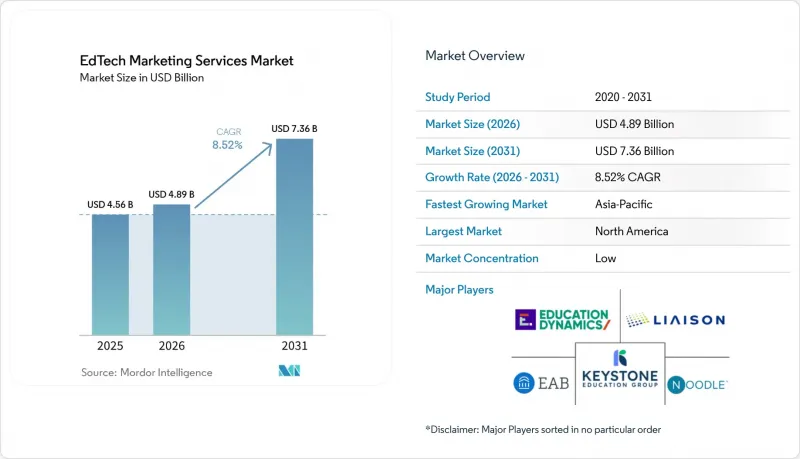
根據 Mordor Intelligence 預測,教育科技行銷服務市場規模將從 2025 年的 45.6 億美元和 2026 年的 48.9 億美元成長到 2031 年的 73.6 億美元,2026 年至 2031 年的複合年成長率為 8.52%。
本報告按服務類型(學生獲取與效果行銷、內容與搜尋引擎最佳化服務、影響者與社交媒體行銷、生命週期與留存行銷以及策略、分析與行銷技術 (MarTech) 整合)和地區(北美、南美、歐洲、亞太地區以及中東和非洲)進行細分。市場預測以美元 (USD) 計價。
全球教育科技行銷服務市場趨勢與洞察
人工智慧驅動的個人化和行銷自動化已被廣泛應用。
在2025年至2026年間,人工智慧驅動的個人化已成為高等教育行銷的核心營運重點。高等教育行銷研究指出,數據驅動的細分、預測性招生管理、個人化溝通、數位化學生體驗以及管治是相互關聯的實踐領域。研究表明,人工智慧的應用不僅影響宣傳活動的效率,也影響機構的課責和學費收入規劃。在教育科技行銷服務市場,這正在擴大策略、分析和行銷技術整合團隊的角色。院校需要能夠審核其資料管理實務、將已核准的資料流與招生工作流程整合、培訓員工掌握新流程並避免新增未整合工具的服務合作夥伴。 2026年4月,NMIMS大學在其整個招生流程中實施了Salesforce Agentforce行銷和教育解決方案,充分利用了即時資料整合和個人化數位互動。能夠將預測性招生分析與客戶關係管理(CRM)工作流程整合的服務提供者,可以提供比僅專注於媒體運營的機構更全面的服務。
對可衡量的學生獲取效率的需求日益成長
教育機構面臨的媒體成本上漲和預算限制,正促使其關注點從「諮詢量」轉向「每次招生成本」。根據 EducationDynamics 的報告,2025 年非品牌付費搜尋的每次點擊成本較去年同期成長 30.9%。該報告還顯示,到 2026 年,「隱形申請者」將佔申請者總數的 9.7%(2020 年這一比例為 1%)。這意味著傳統的基於線索的報告可能無法提供全面的分析。由於這些學生在進入諮詢流程之前會進行自主研究,教育機構需要了解搜尋、內容、品牌曝光和直接訪問等各種管道各自的作用。教育科技行銷服務市場對歸因分析計畫的需求日益成長,這些計畫能夠識別跨多個管道的早期研究訊號,並將其轉化為申請和入學。能夠追蹤學習者研究路徑並最佳化轉換流程的機構,可以提供超越簡單付費媒體管理的服務。
對學生資料的使用提出了更嚴格的隱私和同意要求。
學生資料的限制正在限制許多教育行銷計畫賴以進行的定向和使用者畫像分析。 2025年1月,美國聯邦貿易委員會 (FTC) 最終敲定了《兒童網路隱私權保護條例》(COPPA) 的修訂案。該修訂案要求,在向第三方揭露兒童資料(包括用於定向廣告)時,必須獲得家長的單獨同意。此外,該條例還要求對兒童資料的特定用途獲得家長的單獨同意,從而限制了可用於K-12受眾群體建立活動的資料。為美國和歐洲學生提供服務的教育機構在資料處理方面也必須遵守《家庭教育權利和隱私法案》(FERPA) 和《一般資料保護規則》(GDPR) 的要求。教育科技行銷服務市場必須支援同意管理、經批准的資料流、存取限制以及關於學生資訊使用的明確課責。這些要求增加了交付成本,延長了宣傳活動準備時間,並為法律和技術資源有限的小規模機構帶來了合規障礙。
細分市場分析
至2025年,學生獲取和效果行銷將佔教育科技行銷服務市場34.08%的佔有率。這一佔有率反映了教育機構長期以來對能夠將行銷活動與招生結果(例如每次諮詢和入學成本)聯繫起來的服務的需求。由於許多教育機構仍然將學生獲取行銷視為可直接衡量的營運成本,因此該細分市場仍佔有重要地位。然而,不斷上漲的廣告成本和日益成長的學生主導型研究正在降低傳統線索產生報告的全面性。這提升了將付費學生獲取與更廣泛的歸因和轉化分析相結合的服務的價值。
預計到2031年,「策略、分析和行銷技術整合」細分市場將以9.16%的複合年成長率(CAGR)實現最高成長。此細分市場中教育科技行銷服務市場規模的成長主要受整合資料系統需求的驅動,以取代分散的行銷工具。一項針對印尼大學的調查顯示,基於人工智慧的建議和互動品質會影響申請意向,而對教育機構的信任則在其中扮演中介角色。卡內基高等教育機構在2026年對教育機構的審計報告中指出,人工智慧可見度的平均得分僅35%。這一差距推動了對可視化答案引擎和諮詢服務的需求,這些服務整合了內容、分析和招生管理系統。此外,內容和搜尋服務不僅需要考慮傳統的關鍵字排名,還需要考慮人工智慧驅動的生成式搜尋結果。
區域分析
2025年,北美將佔據教育科技行銷服務市場40.13%的佔有率。該地區擁有大規模的美國公立和私立大學體系、成熟的招生機構、基於績效的服務合約以及一批成熟的技術供應商。教育機構通常需要外部援助,才能將行銷課程與招生管理系統整合,並在整個招生過程中衡量成效。國際教育協會(IIE)在其2026年春季發布的「簡介IIE.ORG」調查中證實,在585家參與調查的美國教育機構中,招收國際學生仍然是他們的優先事項。加拿大的情況則有所不同,加拿大統計局預計,2025年至2026年間,加拿大的國際學生人數將下降26%。這可能導致教育機構將預算轉向招收國內學生、推廣計畫和品牌管理,同時仍需要專業的服務。
預計到2031年,亞太地區的複合年成長率將達到9.23%,是所有地區中最高的。該地區在教育科技行銷服務市場中的地位與其大規模的數位化學習群體、日益成長的跨境招生興趣以及高等教育和職業教育中數位化管道的廣泛應用密切相關。每個教育機構都必須應對全部區域不同的語言要求、媒體平台、招生期望和學習者偏好。 2026年4月,NMIMS大學實施了Salesforce工具,以實現從潛在學生到正式錄取整個流程的個人化互動。此類實施催生了對資料整合、系統實施、宣傳活動管理和績效評估服務的相關需求。本地專業知識至關重要,因為在亞太國家行之有效的方案可能並不適用於其他國家所使用的平台和溝通方式。
在歐洲,隨著教育機構競相吸引國際學生,多語言教育行銷的需求日益成長。歐洲教育科技行銷服務市場的規模得益於需要在地化內容、媒體規劃和溝通的課程,這些課程都需根據各國的具體情況量身定做。當目標學生來自多個國家和語言群體時,教育機構將利用更廣泛的招生管道。服務提供者需要了解當地的法規、內容要求和學生的決策流程。南美和中東及非洲的市場規模較小,但私立教育活動的活性化和數位廣告的日益普及為其提供了支撐。這些市場需要適合當地訪問環境、語言和平台條件的課程。
其他好處:
- Excel格式的市場預測(ME)表
- 3個月的分析師支持
目錄
第1章:引言
- 研究假設和市場定義
- 調查範圍
第2章:調查方法
第3章執行摘要
第4章 市場狀況
- 市場概覽
- 市場促進因素
- 拓展線上和混合式學習服務
- 對可衡量的學生獲取效率的需求日益成長
- 擴大國際學生招生規模,擴大跨國學生接收範圍
- 人工智慧驅動的個人化和行銷自動化已被廣泛應用。
- AI 答案引擎的可見性正成為捕捉需求的新途徑。
- 創作者主導的信任訊號有助於提高教育相關產品的購買轉換率,而這類產品通常需要較長的考慮期。
- 市場限制因素
- 對學生資料的使用提出了更嚴格的隱私和同意要求。
- 教育廣告領域媒體成本不斷上漲,關鍵字競爭日益激烈。
- 零點擊搜尋和人工智慧摘要正在減少網路流量。
- 分散的客戶關係管理 (CRM) 和學生資料堆疊限制了生命週期啟動。
- 產業價值鏈分析
- 監理情勢
- 技術展望
- 宏觀經濟因素對市場的影響
- 波特五力分析
第5章 市場規模與成長預測
- 按服務類型
- 學生招生和績效行銷
- 內容和搜尋引擎最佳化服務
- 影響者和社群媒體行銷
- 生命週期和留存行銷
- 策略、分析和行銷技術的整合
- 按地區
- 北美洲
- 美國
- 加拿大
- 墨西哥
- 南美洲
- 巴西
- 阿根廷
- 智利
- 其他南美國家
- 歐洲
- 德國
- 英國
- 法國
- 義大利
- 西班牙
- 其他歐洲國家
- 亞太地區
- 中國
- 日本
- 印度
- 韓國
- 澳洲
- 其他亞太國家
- 中東
- 阿拉伯聯合大公國
- 沙烏地阿拉伯
- 卡達
- 其他中東國家
- 非洲
- 南非
- 埃及
- 奈及利亞
- 其他非洲國家
- 北美洲
第6章 競爭情勢
- 市場集中度
- 策略趨勢
- 市佔率分析
- 公司簡介
- EAB Global, Inc.
- Keystone Education Group
- EducationDynamics, LLC
- Liaison International, Inc.
- Noodle Partners, LLC
- Carnegie Dartlet LLC
- Archer Education, Inc.
- OHO Interactive, LLC
- SimpsonScarborough, LLC
- Search Influence, LLC
- Everspring, Inc.
- Keypath Education
- ApplyBoard Inc.
- Element451, Inc.
- Encoura, LLC
- Intead LLC
第7章 市場機會與未來展望
According to Mordor Intelligence, the edTech marketing services market size is projected to expand from USD 4.56 billion in 2025 and USD 4.89 billion in 2026 to USD 7.36 billion by 2031, registering a CAGR of 8.52% between 2026 and 2031.
This report is Segmented by Service Type (Student Acquisition and Performance Marketing, Content and SEO Services, Influencer and Social Media Marketing, Lifecycle and Retention Marketing, and Strategy, Analytics and Martech Integration) and Geography (North America, South America, Europe, Asia-Pacific, Middle East, and Africa). The Market Forecasts are Provided in Terms of Value (USD).
Global EdTech Marketing Services Market Trends and Insights
Greater Adoption of AI-Powered Personalization and Marketing Automation
AI-powered personalization became a core operating priority in higher education marketing during 2025 and 2026. Research on higher education marketing identified data-based segmentation, predictive enrollment management, personalized communication, digital student journeys, and governance as linked areas of practice. The research shows that AI use affects institutional accountability and tuition-revenue planning, rather than serving only as a campaign efficiency tool. Within the EdTech marketing services market, this expands the role of strategy, analytics, and marketing technology integration teams. Institutions need service partners that can audit data practices, connect approved data flows with enrollment workflows, train staff on new processes, and avoid adding disconnected tools. In April 2026, NMIMS University deployed Salesforce Agentforce Marketing and Education solutions across its admissions process, using real-time data integration and personalized digital engagement. Providers that connect predictive enrollment intelligence with customer relationship management workflows can offer a more complete service than agencies focused only on media execution.
Rising Need for Measurable Student Acquisition Efficiency
Rising media costs and constrained institutional budgets are shifting attention from inquiry volume toward cost per enrollment. EducationDynamics reported that non-brand paid-search cost per click rose 30.9% year over year in 2025. The same report found that stealth applicants accounted for 9.7% of applications in 2026, compared with 1% in 2020, making conventional lead-based reporting less complete. These students conduct independent research before entering an inquiry funnel, so institutions need to understand the contribution of search, content, brand exposure, and direct visits. The EdTech marketing services market has a greater need for attribution programs that identify early research signals across multiple channels and link them to application and enrollment outcomes. Agencies that trace a learner's research path and improve conversion processes can distinguish their work from basic paid media management.
Tightening Privacy and Consent Requirements for Student Data Use
Student-data rules limit the targeting and profiling practices that support many education marketing programs. In January 2025, the Federal Trade Commission finalized changes to the Children's Online Privacy Protection Rule that require separate parental consent for the disclosure of children's data to third parties, including for targeted advertising. The rule also requires parents to separately consent to certain uses of children's data, which narrows the data available for K-12 audience-building activities. Institutions serving U.S. and European learners also need to address requirements under FERPA and the General Data Protection Regulation in their data practices. The EdTech marketing services market must support consent management, approved data flows, limited access controls, and clear accountability for the use of student information. These requirements raise delivery costs, lengthen campaign preparation, and create a compliance barrier for smaller agencies with limited legal and technical resources.
Other drivers and restraints analyzed in the detailed report include:
- Growth in Online and Hybrid Learning Offerings
- Expansion of International Student Recruitment and Cross-Border Enrollment
- Rising Media Costs and Keyword Competition in Education Advertising
For complete list of drivers and restraints, kindly check the Table Of Contents.
Segment Analysis
Student Acquisition and Performance Marketing commanded a 34.08% share of the EdTech marketing services market in 2025. Its position reflects long-standing institutional demand for services that connect marketing activity with admissions outcomes, including cost per inquiry and cost per enrollment. The segment remains important because many institutions still treat enrollment marketing as a directly measured operating cost. Higher advertising prices and independent student research behavior, however, make conventional lead-generation reporting less complete. This has increased the value of services that combine paid acquisition with broader attribution and conversion work.
Strategy, Analytics, and Martech Integration is projected to record the highest CAGR of 9.16% through 2031. The EdTech marketing services market size for this segment is supported by demand for connected data systems that replace fragmented marketing tools. Research on Indonesian universities found that the quality of AI-based recommendations and interactions can affect application intention, with institutional trust mediating the effect. Carnegie Higher Ed reported an average AI visibility score of 35% in its 2026 institutional audits. This gap supports demand for answer-engine visibility work and for advisory services that align content, analytics, and enrollment systems. Content and search services also need to account for generative AI retrieval rather than only traditional keyword rankings.
Complete Report Scope:
- By Service Type
- Student Acquisition and Performance Marketing
- Content and SEO Services
- Influencer and Social Media Marketing
- Lifecycle and Retention Marketing
- Strategy, Analytics and Martech Integration
- By Geography
- North America
- United States
- Canada
- Mexico
- South America
- Brazil
- Argentina
- Chile
- Rest of South America
- Europe
- Germany
- United Kingdom
- France
- Italy
- Spain
- Rest of Europe
- Asia-Pacific
- China
- Japan
- India
- South Korea
- Australia
- Rest of Asia-Pacific
- Middle East
- United Arab Emirates
- Saudi Arabia
- Qatar
- Rest of Middle East
- Africa
- South Africa
- Egypt
- Nigeria
- Rest of Africa
- North America
Geography Analysis
North America held 40.13% of the EdTech marketing services market share in 2025. The region is supported by a large base of U.S. public and private universities, established enrollment agencies, performance-based service contracts, and a mature group of technology suppliers. Institutions often need external support to connect marketing programs with admissions systems and to measure results through the enrollment process. The Institute of International Education confirmed that international recruitment remained a priority for the 585 U.S. institutions represented in its Spring 2026 Snapshot IIE.ORG. Canada faced a different situation, with Statistics Canada estimating a 26% decline in international students in 2025-2026. This can redirect institutional budgets toward domestic recruitment, program messaging, and brand management while retaining a need for specialized services.
Asia-Pacific is projected to grow at a 9.23% CAGR through 2031, the fastest rate among the regions. The region's position in the EdTech marketing services market is linked to large digital learner populations, growing interest in cross-border enrollment, and the increasing use of digital channels across higher education and professional learning. Institutions must manage different language requirements, media platforms, admission expectations, and learner preferences across the region. In April 2026, NMIMS University deployed Salesforce tools for personalized engagement across its lead-to-admission process. Such adoption creates related demand for data integration, implementation, campaign management, and performance measurement services. Local expertise is important because a program that works in one Asia-Pacific country may not align with the platforms or communication practices used in another.
Europe is developing greater demand for multilingual education marketing as institutions compete for international learners. The EdTech marketing services market size in Europe is supported by programs that need localized content, media planning, and communications that reflect different national settings. Institutions may use a wider range of recruitment channels when their target learners are spread across countries and language groups. Service firms need to understand local regulation, content requirements, and student decision processes. South America, the Middle East, and Africa have smaller positions, supported by private education activity and the increasing use of digital advertising. These markets need programs that fit local access, language, and platform conditions.
- EAB Global, Inc.
- Keystone Education Group
- EducationDynamics, LLC
- Liaison International, Inc.
- Noodle Partners, LLC
- Carnegie Dartlet LLC
- Archer Education, Inc.
- OHO Interactive, LLC
- SimpsonScarborough, LLC
- Search Influence, LLC
- Everspring, Inc.
- Keypath Education
- ApplyBoard Inc.
- Element451, Inc.
- Encoura, LLC
- Intead LLC
Additional Benefits:
- The market estimate (ME) sheet in Excel format
- 3 months of analyst support
TABLE OF CONTENTS
1 INTRODUCTION
- 1.1 Study Assumptions and Market Definition
- 1.2 Scope of the Study
2 RESEARCH METHODOLOGY
3 EXECUTIVE SUMMARY
4 MARKET LANDSCAPE
- 4.1 Market Overview
- 4.2 Market Drivers
- 4.2.1 Growth In Online and Hybrid Learning Offerings
- 4.2.2 Rising Need for Measurable Student Acquisition Efficiency
- 4.2.3 Expansion of International Student Recruitment and Cross-Border Enrollment
- 4.2.4 Greater Adoption of AI-Powered Personalization and Marketing Automation
- 4.2.5 AI Answer-Engine Visibility Becoming a New Demand-Capture Layer
- 4.2.6 Creator-Led Trust Signals Improving Conversion in High-Consideration Education Purchases
- 4.3 Market Restraints
- 4.3.1 Tightening Privacy and Consent Requirements for Student Data Use
- 4.3.2 Rising Media Costs and Keyword Competition In Education Advertising
- 4.3.3 Zero-Click Search and AI Summaries Reducing Attributable Web Traffic
- 4.3.4 Fragmented CRM and Student Data Stacks Limiting Lifecycle Activation
- 4.4 Industry Value Chain Analysis
- 4.5 Regulatory Landscape
- 4.6 Technological Outlook
- 4.7 Impact of Macroeconomic Factors on the Market
- 4.8 Porter's Five Forces Analysis
- 4.8.1 Threat of New Entrants
- 4.8.2 Bargaining Power of Buyers
- 4.8.3 Bargaining Power of Suppliers
- 4.8.4 Threat of Substitutes
- 4.8.5 Industry Rivalry
5 MARKET SIZE AND GROWTH FORECASTS (VALUE)
- 5.1 By Service Type
- 5.1.1 Student Acquisition and Performance Marketing
- 5.1.2 Content and SEO Services
- 5.1.3 Influencer and Social Media Marketing
- 5.1.4 Lifecycle and Retention Marketing
- 5.1.5 Strategy, Analytics and Martech Integration
- 5.2 By Geography
- 5.2.1 North America
- 5.2.1.1 United States
- 5.2.1.2 Canada
- 5.2.1.3 Mexico
- 5.2.2 South America
- 5.2.2.1 Brazil
- 5.2.2.2 Argentina
- 5.2.2.3 Chile
- 5.2.2.4 Rest of South America
- 5.2.3 Europe
- 5.2.3.1 Germany
- 5.2.3.2 United Kingdom
- 5.2.3.3 France
- 5.2.3.4 Italy
- 5.2.3.5 Spain
- 5.2.3.6 Rest of Europe
- 5.2.4 Asia-Pacific
- 5.2.4.1 China
- 5.2.4.2 Japan
- 5.2.4.3 India
- 5.2.4.4 South Korea
- 5.2.4.5 Australia
- 5.2.4.6 Rest of Asia-Pacific
- 5.2.5 Middle East
- 5.2.5.1 United Arab Emirates
- 5.2.5.2 Saudi Arabia
- 5.2.5.3 Qatar
- 5.2.5.4 Rest of Middle East
- 5.2.6 Africa
- 5.2.6.1 South Africa
- 5.2.6.2 Egypt
- 5.2.6.3 Nigeria
- 5.2.6.4 Rest of Africa
- 5.2.1 North America
6 COMPETITIVE LANDSCAPE
- 6.1 Market Concentration
- 6.2 Strategic Moves
- 6.3 Market Share Analysis
- 6.4 Company Profiles (includes Global Level Overview, Market Level Overview, Core Segments, Financials as available, Strategic Information, Market Rank/Share, Products and Services, Recent Developments)
- 6.4.1 EAB Global, Inc.
- 6.4.2 Keystone Education Group
- 6.4.3 EducationDynamics, LLC
- 6.4.4 Liaison International, Inc.
- 6.4.5 Noodle Partners, LLC
- 6.4.6 Carnegie Dartlet LLC
- 6.4.7 Archer Education, Inc.
- 6.4.8 OHO Interactive, LLC
- 6.4.9 SimpsonScarborough, LLC
- 6.4.10 Search Influence, LLC
- 6.4.11 Everspring, Inc.
- 6.4.12 Keypath Education
- 6.4.13 ApplyBoard Inc.
- 6.4.14 Element451, Inc.
- 6.4.15 Encoura, LLC
- 6.4.16 Intead LLC
7 MARKET OPPORTUNITIES AND FUTURE OUTLOOK
- 7.1 White-Space and Unmet-Need Assessment

 線上教育科技服務市場規模、佔有率和成長分析:按服務類型、交付模式、部署方式、最終用戶、收入模式和地區分類 - 2026-2033 年行業預測
 領導力教練市場:全球市場預測,2026-2032年
 電子競技教育
 高階主管教練與領導力發展:市場佔有率分析、產業趨勢與統計及成長預測(2026-2031)
 2034年創業教育市場預測-全球學習形式、課程類型、傳遞模式、學習者類型、應用領域、最終使用者和區域分析2034年幼兒教育科技市場預測-按組件、部署模式、學習模式、技術、應用、最終用戶和地區分類的全球分析2034年中等教育市場預測-按教育機構類型、學習形式、課程類型、所有權和地區分類的全球分析國際教育市場預測至2034年-按教育程度、學習形式、課程類型、學生類型、資金來源和地區分類的全球分析教育考試服務市場預測至2034年-按考試類型、交付方式、服務類型、最終用戶和地區分類的全球分析機器人教育市場預測至2034年—按組件、教育程度、學習方式、機器人類型、最終用戶和地區分類的全球分析