


 |
市場調查報告書
商品編碼
2125735
高階主管教練與領導力發展:市場佔有率分析、產業趨勢與統計及成長預測(2026-2031)Executive Coaching And Leadership Development - Market Share Analysis, Industry Trends & Statistics, Growth Forecasts (2026 - 2031) |
||||||

※ 本網頁內容可能與最新版本有所差異。詳細情況請與我們聯繫。
據 Mordor Intelligence 稱,高階主管教練和領導力發展市場預計到 2026 年價值 1,129.8 億美元,高於 2025 年的 1,035.6 億美元,預計到 2031 年將達到 1,745.3 億美元。
預計 2026 年至 2031 年的複合年成長率為 9.11%。
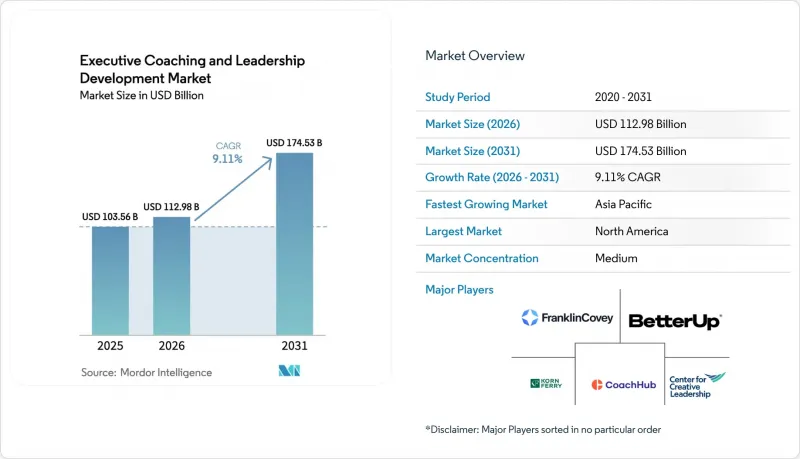
本報告按產品類型(線上學習、面對面學習)、最終用戶(管理/領導、財務/會計、其他)、組織規模(大型企業、中小企業)和地區(北美、亞太、南美、歐洲、中東和非洲)對產業進行分類。
全球高階主管教練與領導力發展市場趨勢與洞察
專業學習生態系的快速數位化
企業培訓正從一次性的課堂活動轉向基於雲端的平台,將人工智慧驅動的個人化培訓與人類專業知識相結合。 2025年3月,富蘭克林柯維公司發布了「AI教練」平台,該平台利用專有內容和先進的語言模型,提升早期用戶技能習得的效率。人工智慧在專業學習領域的應用率正以每年40%的速度成長,由此產生的網路效應正在加速高階主管教練和領導力發展市場對「數位化優先」的需求。整合的分析功能揭示了教練投資與銷售、創新和員工留任等關鍵績效指標之間的關聯,從而能夠證明其有效性,而這是傳統研討會無法實現的。雖然這些進步減輕了差旅費用和日程安排的負擔,但將新工具整合到日常工作流程中需要對變革管理進行投入。在採購過程中,能夠與人力資源資訊系統(HRIS)平台無縫整合的供應商比獨立解決方案更受青睞。
領導力發展項目對可衡量的投資報酬率的需求日益成長。
財務總監(CFO) 如今強烈要求領導力預算能帶來可量化的回報。一項 2025 年基準研究預測,採用結構化輔導的組織將比同業取得 25% 更好的業務成果。為此,各平台紛紛整合儀錶板,將輔導課程與生產力、員工敬業度和專案週期指標關聯起來,進而提高贊助商的透明度。北美和亞太地區的客戶最快地採用了這些分析功能,這反映了他們嚴格的預算管理和技術準備。這些成果正在推動規模大規模、期限更長的合約簽訂,並擴大能夠提供豐富、數據驅動型洞察的供應商的高階主管輔導和領導力發展市場。缺乏數位化實證數據的傳統顧問公司面臨合約續約率下降的風險,因為買家正在轉向具備分析功能的平台。
認證和品質保證標準的細分
目前存在超過12個認證機構,但缺乏統一的標準,這給採購團隊帶來了困擾。儘管國際教練聯合會(ICF)在2025年4月修訂了其道德準則,並將適用範圍擴大到人工智慧平台,但尚未建立全球「黃金標準」。跨國公司需要逐案對教練資格進行全面評估。這種細緻的篩選流程會延長合約簽訂週期,對高階主管教練和領導力發展市場的預期複合年成長率(CAGR)產生一定影響。隨著企業在領導力發展舉措中更加重視品質和與策略目標的契合度,此類細緻的評估變得日益重要。擁有多位認證教練的大型供應商正在贏得更多信任,而規模較小的參與企業則面臨著不斷增加的合規成本。這種分散化的情況可能會持續下去,直到基於績效的指標取代基於時間的認證。
細分市場分析
線上學習預計將以11.64%的複合年成長率成長,縮小與面授形式的差距。 2025年,面授形式將佔據高階主管輔導和領導力發展市場56.62%的佔有率。基於雲端的交付方式顯著降低了差旅和日程安排成本,人工智慧驅動的匹配功能可為領導者匹配最合適的教練。嵌入式虛擬實境模擬能夠還原各種場景的細微差別,而儀錶板則提供透明的投資報酬率數據,為預算分配提供支援。然而,在董事會層面,信任仍然至關重要,面對面的交流仍然不可或缺。服務提供者正逐步將虛擬評估與定期的高階主管務虛會結合,這預示著一種混合模式的出現,而這種模式將決定該領域未來的發展方向。
面對面專案對於提供身臨其境型體驗、非語言溝通和加深關係仍然至關重要。高階主管非正式異地結合了策略規劃和領導力輔導,旨在支持組織在關鍵時刻的行為轉變。然而,永續發展的要求和嚴格的預算審查正促使企業縮短面對面會議的時間,並以數位化工具取代準備和後續工作。這種混合模式使得線上管道在高階主管輔導和領導力發展市場中實現了逐步成長,而面對面會議仍佔據著相當大的佔有率。
區域分析
亞太地區的高階主管教練和領導力發展市場正經歷最快的成長,預計到2031年將維持11.12%的強勁複合年成長率。這一快速成長主要得益於該地區數位經濟的快速發展以及企業領導結構的世代更迭。無論是在新興市場或已開發市場,年輕的主管們都越來越重視持續回饋的文化,這種文化強調適應能力和軟性技能的培養。同時,跨國公司正在將全球教練框架和標準應用於其區域運營,進一步提升行業專業水平。各國科技巨頭和企業集團也都在大力投資領導力發展,將其視為創新、韌性和長期競爭力的關鍵驅動力。
在亞太地區的高階主管教練生態系統中,「在地化」正成為成功的關鍵因素,影響著顧客的接受度和留存率。隨著企業尋求更具相關性和同理心的領導力洞察,能夠跨越文化差異的雙語教練的需求日益成長。市場新進業者正在客製化案例分析和模擬練習,以反映每個地區獨特的商業環境,從而使教練成果更加貼近實際。此外,為了維護信任並滿足資料隱私方面的期望,需要使用符合當地法規的本地資料託管和平台。這些適應性策略的結合,確保了高階主管教練計畫能夠與當地管理文化產生深刻共鳴,同時保持全球卓越的標準。
北美地區持續佔據最大的市場佔有率,預計到2025年將佔全球高階主管教練和領導力發展市場的40.88%。該地區受益於成熟的企業管治結構、強勁的創業投資流入以及對可衡量、數據驅動的教練成果的廣泛承諾。歐洲緊隨其後,嚴格的隱私法規(例如GDPR)雖然增加了採用該技術的門檻,但也為提供透明、演算法驅動型教練平台的公司帶來了機會。同時,中東地區正在努力使其不斷成長的教練需求與各國經濟多元化和人力資本發展所面臨的挑戰相協調。非洲尚處於起步階段,但正在迅速發展,尤其是在快速都市化的大城市,這主要得益於通訊和金融科技領域的成長,並為全球市場的整體發展勢頭提供了支撐。
其他好處
- Excel格式的市場預測(ME)表
- 3個月的分析師支持
目錄
第1章:引言
- 研究假設和市場定義
- 調查範圍
第2章:調查方法
第3章執行摘要
第4章 市場狀況
- 市場概覽
- 市場促進因素
- 專業學習生態系的快速數位化
- 領導力發展項目對可衡量的投資報酬率的需求日益成長。
- 透過縮短企業策略週期來促進持續技能發展。
- 在老化經濟體中,管理職缺接班人短缺的問題日益嚴重。
- 透過人工智慧驅動的教練分析,實現高度個人化的內容。
- 創業投資流入教練市場
- 市場限制因素
- 認證和品質保證標準的細分
- 人均成本高限制了中小企業的採用。
- 人們對會話錄製相關的資料隱私問題感到擔憂
- 某些新興市場對教練的文化偏見
- 價值供應鏈分析
- 監理情勢
- 技術展望
- 波特五力模型
第5章 市場規模與成長預測
- 依產品類型
- 線上學習
- 面授學習
- 最終用戶
- 管理與領導力
- 財會
- 策略領導力與創新
- 行銷與銷售
- 商業營運與創業
- 按組織規模
- 大公司
- 中小企業
- 按地區
- 北美洲
- 加拿大
- 美國
- 墨西哥
- 南美洲
- 巴西
- 秘魯
- 智利
- 阿根廷
- 其他南美國家
- 歐洲
- 英國
- 德國
- 法國
- 西班牙
- 義大利
- 比荷盧經濟聯盟
- 北歐的
- 其他歐洲國家
- 亞太地區
- 印度
- 中國
- 日本
- 澳洲
- 韓國
- 東南亞
- 其他亞太國家
- 中東和非洲
- 阿拉伯聯合大公國
- 沙烏地阿拉伯
- 南非
- 奈及利亞
- 其他中東和非洲國家
- 北美洲
第6章 競爭情勢
- 市場集中度
- 策略趨勢
- 市佔率分析
- 公司簡介
- Korn Ferry
- FranklinCovey
- BetterUp
- CoachHub
- Center for Creative Leadership(CCL)
- DDI(Development Dimensions International)
- BTS Group AB
- Gallup Inc.
- PwC(Strategy&)
- Heidrick & Struggles
- Right Management
- Vistage Worldwide Inc.
- Dale Carnegie & Associates
- SHL
- Randstad RiseSmart
- Lee Hecht Harrison(LHH)
- Blanchard
- NeuroLeadership Institute
- GiANT
第7章 市場機會與未來展望
According to Mordor Intelligence, executive coaching and Leadership Development market size in 2026 is estimated at USD 112.98 billion, growing from 2025 value of USD 103.56 billion with 2031 projections showing USD 174.53 billion, growing at 9.11% CAGR over 2026-2031.
This report Segments the Industry Into by Product Type (Online Learning, In-Person Learning), by End User (Management and Leadership, Finance and Accounting, and Other), by Organization Size ( Large Enterprises and Small & Medium-Sized Enterprises (SMEs) )and by Geography (North America, Asia-Pacific, South America, Europe, Middle East & Africa).
Global Executive Coaching And Leadership Development Market Trends and Insights
Rapid Digitization of Professional Learning Ecosystems
Corporate learning is migrating from one-off classroom events to cloud-based platforms that blend AI personalization with human expertise. FranklinCovey introduced its AI Coach in March 2025, utilizing proprietary content and sophisticated language models to enhance skill-acquisition efficiency among early adopters. Annual AI adoption in professional learning is climbing 40%, creating a network effect that accelerates digital-first demand across the Executive Coaching and Leadership Development market. Integrated analytics now correlate coaching inputs with revenue, innovation, and retention KPIs, providing proof of impact that traditional workshops lacked. These advances reduce travel costs and scheduling friction yet require investment in change management to weave new tools into everyday workflows. Vendors able to integrate seamlessly with HRIS platforms gain procurement preference over point solutions.
Growing Demand for Measurable ROI in Leadership Programs
Chief financial officers now insist that leadership budgets deliver quantifiable returns. Organizations that embed systematic coaching record 25% stronger business outcomes than peers, according to 2025 benchmarking research. Platforms have responded by embedding dashboards that link coaching moments to productivity, engagement, and project-cycle metrics, increasing transparency for sponsors. North American and Asia-Pacific clients adopt these analytics fastest, reflecting tight budget oversight and tech readiness. Outcome evidence supports larger multiyear contracts, expanding the Executive Coaching and Leadership Development market for providers able to deliver data-rich insights. Traditional consultancies without digital proof points risk renewal erosion as buyers migrate to analytics-enabled platforms.
Fragmented Certification & Quality-Assurance Standards
More than a dozen accreditation bodies overlap without a unified benchmark, sowing confusion for procurement teams. The International Coach Federation's April 2025 ethics update expands coverage to AI platforms yet stops short of creating one global gold standard. Multinational corporations are required to conduct a thorough evaluation of coach credentials on a case-by-case basis. This meticulous vetting process contributes to prolonged deal cycles and marginally impacts the projected CAGR of the Executive Coaching and Leadership Development market. Such detailed assessments are becoming increasingly critical as organizations prioritize quality and alignment with strategic objectives in their leadership development initiatives. Large vendors accumulating multi-credentialed coach pools gain credibility, while smaller players face higher compliance costs. Until outcome-based metrics supplant hours-based certification, fragmentation is likely to persist.
Other drivers and restraints analyzed in the detailed report include:
- Shortened Corporate-Strategy Cycles Driving Continuous Upskilling
- Escalating C-Suite Succession Gaps in Ageing Economies
- Cultural Stigma Toward Coaching in Certain Emerging Markets
For complete list of drivers and restraints, kindly check the Table Of Contents.
Segment Analysis
Online learning is expected to log an 11.64% CAGR, narrowing the gap with in-person formats that accounted for 56.62 of % Executive Coaching and Leadership Development market share in 2025. Cloud delivery slashes travel and scheduling costs, while AI-driven matchmaking pairs leaders with best-fit coaches. Embedded VR simulations replicate nuanced scenarios, and dashboards provide transparent ROI evidence, reinforcing budget allocation. Yet board-level coaching still leans on face-to-face interaction where trust is paramount. Providers successively blend virtual diagnostics with periodic executive retreats, illustrating hybrid convergence that defines the segment's future trajectory.
In-person programs remain indispensable for immersive experiences, non-verbal communication, and relationship depth. Executive offsites combine strategic planning with leadership coaching, supporting behaviour change at pivotal organizational moments. Sustainability mandates and budget scrutiny, however, encourage companies to shorten onsite durations and replace pre-work and follow-up with digital tools. This hybridization keeps the in-person share substantial while enabling online channels to capture incremental growth across the Executive Coaching and Leadership Development market.
Complete Report Scope:
- By Product Type
- Online Learning
- In-Person Learning
- By End User
- Management and Leadership
- Finance and Accounting
- Strategic Leadership and Innovation
- Marketing and Sales
- Business Operations and Entrepreneurship
- By Organization Size
- Large Enterprises
- Small & Medium-sized Enterprises (SMEs)
- By Geography
- North America
- Canada
- United States
- Mexico
- South America
- Brazil
- Peru
- Chile
- Argentina
- Rest of South America
- Europe
- United Kingdom
- Germany
- France
- Spain
- Italy
- BENELUX
- NORDICS
- Rest of Europe
- Asia-Pacific
- India
- China
- Japan
- Australia
- South Korea
- South-East Asia
- Rest of Asia-Pacific
- Middle East and Africa
- United Arab Emirates
- Saudi Arabia
- South Africa
- Nigeria
- Rest of Middle East and Africa
- North America
Geography Analysis
The Asia-Pacific region is witnessing the fastest growth in the Executive Coaching and Leadership Development market, advancing at a strong CAGR of 11.12% through 2031. This rapid expansion is primarily fueled by the region's booming digital economy and a generational transition in corporate leadership structures. Younger executives across emerging and developed markets are increasingly embracing continuous feedback cultures that prioritize adaptability and soft-skill enhancement. At the same time, multinational corporations are cascading global coaching frameworks and standards into their regional operations, further professionalizing the industry. Domestic technology giants and conglomerates are also investing heavily in leadership development as a critical driver of innovation, resilience, and long-term competitiveness.
Localization has emerged as a defining success factor across Asia-Pacific's executive coaching ecosystem, influencing both adoption and retention rates among clients. Bilingual coaches who can bridge cultural nuances are increasingly in demand, as organizations seek more relevant and relatable leadership insights. Market players are customizing casework and simulations that reflect region-specific business environments, enhancing the authenticity of coaching outcomes. Additionally, the use of local data hosting and regionally compliant platforms has become essential to maintaining trust and meeting data privacy expectations. These adaptive strategies collectively ensure that executive coaching programs resonate deeply with regional management cultures while maintaining global standards of excellence.
North America continues to hold the largest revenue share, commanding 40.88% of the global Executive Coaching and Leadership Development market in 2025. The region benefits from mature corporate governance systems, robust venture capital inflows, and a widespread commitment to measurable, data-driven coaching outcomes. Europe follows closely, where stringent privacy regulations such as GDPR elevate procurement barriers but reward firms offering transparent, algorithm-driven coaching platforms. Meanwhile, the Middle East is aligning its growing coaching demand with national diversification and human capital development agendas. In Africa, early-stage market traction is emerging within rapidly urbanizing hubs, particularly driven by growth in telecommunications and fintech sectors, sustaining overall global market momentum.
- Korn Ferry
- FranklinCovey
- BetterUp
- CoachHub
- Center for Creative Leadership (CCL)
- DDI (Development Dimensions International)
- BTS Group AB
- Gallup Inc.
- PwC (Strategy&)
- Heidrick & Struggles
- Right Management
- Vistage Worldwide Inc.
- Dale Carnegie & Associates
- SHL
- Randstad RiseSmart
- Lee Hecht Harrison (LHH)
- Blanchard
- NeuroLeadership Institute
- GiANT
Additional Benefits:
- The market estimate (ME) sheet in Excel format
- 3 months of analyst support
TABLE OF CONTENTS
1 Introduction
- 1.1 Study Assumptions & Market Definition
- 1.2 Scope of the Study
2 Research Methodology
3 Executive Summary
4 Market Landscape
- 4.1 Market Overview
- 4.2 Market Drivers
- 4.2.1 Rapid digitisation of professional learning ecosystems
- 4.2.2 Growing demand for measurable ROI in leadership programs
- 4.2.3 Shortened corporate-strategy cycles driving continuous upskilling
- 4.2.4 Escalating C-suite succession gaps in ageing economies
- 4.2.5 AI-assisted coaching analytics unlocking hyper-personalised content
- 4.2.6 Venture-capital funnel into coaching marketplaces
- 4.3 Market Restraints
- 4.3.1 Fragmented certification & quality-assurance standards
- 4.3.2 High average cost per coachee limits SMB adoption
- 4.3.3 Data-privacy anxieties around session recordings
- 4.3.4 Cultural stigma toward coaching in certain emerging markets
- 4.4 Value / Supply-Chain Analysis
- 4.5 Regulatory Landscape
- 4.6 Technological Outlook
- 4.7 Porter's Five Forces
- 4.7.1 Competitive Rivalry
- 4.7.1.1 Threat of New Entrants
- 4.7.1.2 Bargaining Power of Suppliers
- 4.7.1.3 Bargaining Power of Buyers
- 4.7.1.4 Threat of Substitutes
- 4.7.1 Competitive Rivalry
5 Market Size & Growth Forecasts
- 5.1 By Product Type
- 5.1.1 Online Learning
- 5.1.2 In-Person Learning
- 5.2 By End User
- 5.2.1 Management and Leadership
- 5.2.2 Finance and Accounting
- 5.2.3 Strategic Leadership and Innovation
- 5.2.4 Marketing and Sales
- 5.2.5 Business Operations and Entrepreneurship
- 5.3 By Organization Size
- 5.3.1 Large Enterprises
- 5.3.2 Small & Medium-sized Enterprises (SMEs)
- 5.4 By Geography
- 5.4.1 North America
- 5.4.1.1 Canada
- 5.4.1.2 United States
- 5.4.1.3 Mexico
- 5.4.2 South America
- 5.4.2.1 Brazil
- 5.4.2.2 Peru
- 5.4.2.3 Chile
- 5.4.2.4 Argentina
- 5.4.2.5 Rest of South America
- 5.4.3 Europe
- 5.4.3.1 United Kingdom
- 5.4.3.2 Germany
- 5.4.3.3 France
- 5.4.3.4 Spain
- 5.4.3.5 Italy
- 5.4.3.6 BENELUX
- 5.4.3.7 NORDICS
- 5.4.3.8 Rest of Europe
- 5.4.4 Asia-Pacific
- 5.4.4.1 India
- 5.4.4.2 China
- 5.4.4.3 Japan
- 5.4.4.4 Australia
- 5.4.4.5 South Korea
- 5.4.4.6 South-East Asia
- 5.4.4.7 Rest of Asia-Pacific
- 5.4.5 Middle East and Africa
- 5.4.5.1 United Arab Emirates
- 5.4.5.2 Saudi Arabia
- 5.4.5.3 South Africa
- 5.4.5.4 Nigeria
- 5.4.5.5 Rest of Middle East and Africa
- 5.4.1 North America
6 Competitive Landscape
- 6.1 Market Concentration
- 6.2 Strategic Moves
- 6.3 Market Share Analysis
- 6.4 Company Profiles (includes Global level Overview, Market level Overview, Core Segments, Financials as available, Strategic Information, Market Rank/Share for key companies, Products & Services, and Recent Developments)
- 6.4.1 Korn Ferry
- 6.4.2 FranklinCovey
- 6.4.3 BetterUp
- 6.4.4 CoachHub
- 6.4.5 Center for Creative Leadership (CCL)
- 6.4.6 DDI (Development Dimensions International)
- 6.4.7 BTS Group AB
- 6.4.8 Gallup Inc.
- 6.4.9 PwC (Strategy&)
- 6.4.10 Heidrick & Struggles
- 6.4.11 Right Management
- 6.4.12 Vistage Worldwide Inc.
- 6.4.13 Dale Carnegie & Associates
- 6.4.14 SHL
- 6.4.15 Randstad RiseSmart
- 6.4.16 Lee Hecht Harrison (LHH)
- 6.4.17 Blanchard
- 6.4.18 NeuroLeadership Institute
- 6.4.19 GiANT
7 Market Opportunities & Future Outlook
- 7.1 AI-powered personalised coaching at scale
- 7.2 Hybrid-work leadership programs in emerging markets

 電子競技教育
 教育科技行銷服務:市場佔有率分析、產業趨勢與統計、成長預測(2026-2031)
 2034年創業教育市場預測-全球學習形式、課程類型、傳遞模式、學習者類型、應用領域、最終使用者和區域分析2034年幼兒教育科技市場預測-按組件、部署模式、學習模式、技術、應用、最終用戶和地區分類的全球分析2034年中等教育市場預測-按教育機構類型、學習形式、課程類型、所有權和地區分類的全球分析國際教育市場預測至2034年-按教育程度、學習形式、課程類型、學生類型、資金來源和地區分類的全球分析教育考試服務市場預測至2034年-按考試類型、交付方式、服務類型、最終用戶和地區分類的全球分析機器人教育市場預測至2034年—按組件、教育程度、學習方式、機器人類型、最終用戶和地區分類的全球分析軟體開發培訓市場預測至 2034 年——按培訓類型、學習形式、參與者類型、最終用戶和地區分類的全球分析
 幼兒教育市場規模、佔有率和成長分析:按教育類型、提供者類型、交付模式、課程類型、年齡層、最終用戶和地區分類——2026-2033年行業預測