


 |
市場調查報告書
商品編碼
2119383
輪胎抗磨損添加劑:市場佔有率分析、產業趨勢與統計及成長預測(2026-2031)Tire Wear Control Additives - Market Share Analysis, Industry Trends & Statistics, Growth Forecasts (2026 - 2031) |
||||||

※ 本網頁內容可能與最新版本有所差異。詳細情況請與我們聯繫。
根據 Mordor Intelligence 預測,輪胎磨損抑制劑市場規模預計將在 2025 年達到 19.6 億美元,2026 年達到 20.7 億美元,2031 年達到 27.6 億美元,在預測期(2026-2031 年)內複合年成長率為 5.86%。
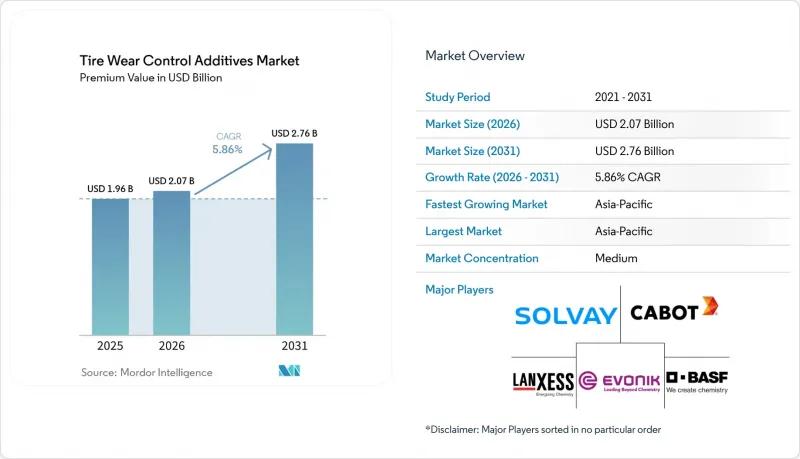
本報告按添加劑類型(二氧化矽、矽烷偶合劑等)、輪胎類型(乘用車輪胎、商用車輪胎等)、橡膠類型(丁苯橡膠 (SBR) 等)、應用領域(胎面膠料等)和地區(亞太地區、北美地區、歐洲地區、南美地區、中東和非洲地區)進行細分。市場預測以美元計價。
全球輪胎磨損減少添加劑市場趨勢及洞察
擴大二氧化矽-矽烷體系在低磨損輪胎胎面上的應用
在低磨損胎面輪胎的研發中,二氧化矽和矽烷化學正逐漸成為標準要求。贏創工業集團(Evonik Industries AG)表示,其矽烷「Si 363」與炭黑填充輪胎相比,可在保持相近耐磨性能的同時,將滾動阻力降低高達35%。高比表面積二氧化矽需要與之相容的矽烷才能發揮指定。這導致輪胎耐磨添加劑市場對二氧化矽和偶聯劑的需求呈上升趨勢。邁圖公司(Momentive)推出了用於卡車和客車子午線輪胎的二氧化矽填充天然橡膠產品“NRX”,旨在解決此類輪胎在耐磨性和滾動阻力平衡方面的難題。隨著這些系統日益普及,傳統的炭黑和標準硫基矽烷的優勢可能會逐漸減弱。
符合歐盟7輪胎磨損性能要求
根據歐盟7排放標準,輪胎磨損性能納入強制性型式認證架構。歐盟法規(EU) 2024/1257規定了各類車輛的磨損限值。根據修訂後的聯合國歐洲經濟委員會第117號條例,製造商必須自2027年1月1日起向型式認證機構報告新型C1輪胎的磨損數據。測試方法的差異仍然為供應商和輪胎製造商帶來不確定性。這種不確定性促使企業儘早投資研發能夠在各種測試程序下均表現優異的輪胎化合物。同時,在2028年新型乘用車輪胎磨損抑制劑市場截止日期到來之前,這種不確定性也推動了對二氧化矽、矽烷偶合劑和劣化抑制劑的需求。
磨損減少、濕地抓地力和滾動阻力之間的權衡。
同時最佳化輪胎磨損降低、濕地抓地力和滾動阻力仍然是一項挑戰。 2026年發表在學術期刊上的一項研究表明,在丁苯橡膠(SBR)中添加0.5份/100份橡膠(phr)的石墨烯奈米微片,可使其耐磨性提高高達26%。其對濕地抓地力和滾動阻力的影響因配方而異。因此,每種新配方都需要根據濕地抓地力和滾動阻力測試規程檢驗。 2024年的一項研究發現,在Lambourn、LAT100、DIN和切割磨損測試中,二氧化矽增強溶液型丁苯橡膠(SBR)的測試結果會因測試方法的不同而有顯著差異。這增加了研發成本,並可能延緩輪胎磨損降低添加劑市場的商業化。此外,目前也越來越傾向於使用多種功能性組分組合,而不是單一的添加劑溶液。
細分市場分析
到2025年,二氧化矽將佔據輪胎磨損抑制劑市場40.18%的佔有率,這反映了其在高性能乘用車胎面膠料中的核心地位。二氧化矽被用於追求低滾動阻力和優異濕地性能的膠料中。邁圖科技(Momentive)推出了「NRX」產品,用於填充二氧化矽的天然橡膠卡車和客車子午線輪胎,取代了先前炭黑佔據主導地位的應用。本產品支援重型車輛胎面膠料中的混合型和全二氧化矽體系。由於每種高分散性二氧化矽等級都需要相應的偶聯化學反應,預計到2031年,矽烷偶合劑的複合年成長率將達到6.72%。
矽烷偶合劑作為輪胎磨損抑制劑的市場規模正受益於胎面規格要求的不斷提高。監管機構對N-(1,3-二甲基丁基)-N'-苯基-對苯二胺(通常稱為6PPD)的關注正在影響抗氧化劑和臭氧抑制劑的選擇。朗盛公司報告稱,其6PPD替代品Vulkanox 4060已做好商業化生產的準備,併計劃從2026年中期開始,根據《化學品註冊、評估、授權和限制》(REACH)法規註冊該產品,年產量超過1000公噸。贏創工業集團於2025年將其矽烷功能化聚丁二烯的最終生產流程在地化至上海,以擴大其在亞洲的產能。雖然傳統炭黑仍然具有成本競爭力,但用於增強、加工助劑、增強樹脂和硫化添加劑的再生炭正成為循環利用的高性能替代品。
到2025年,乘用車輪胎將佔據57.34%的市場佔有率,這反映了其產量以及現代胎面系統中複雜的添加劑配方。電動車輪胎由於扭矩和品質的影響,可能加速胎面磨損,因此需要特別耐用的配方。預計到2031年,商用車輪胎市場將以6.18%的複合年成長率成長。車隊對更長使用壽命的需求不斷成長,推動了先進偶聯劑和功能性聚合物的價值提升。這正逐步促使輪胎磨損抑制劑添加劑市場的產品配方日益複雜。
電動卡車的出現催生了對輪胎磨損抑制劑的新需求。一項在2025年「重型車輛運輸技術論壇」上發表的研究表明,與柴油車輛相比,純電動卡車具有更高的牽引扭矩和不同的軸荷分佈。為了滿足這些條件,需要採用專門設計的胎面配方,而不是簡單地沿用現有卡車輪胎的規格。越野輪胎需要更高的增強樹脂含量,以及針對採礦、採石和建築等應用場景的特定功能性彈性體。此外,在印度和東南亞,電氣化帶來的性能提升正促使摩托車和三輪車輪胎擴大採用沉澱二氧化矽。
區域分析
預計到2025年,亞太地區將佔據輪胎抗磨添加劑市場42.78%的佔有率,並在2031年之前以6.48%的複合年成長率持續成長。中國強大的輪胎生產基地和特殊化學品供應網路鞏固了該地區的主導地位,而電動車的普及也推動了胎面配方的重新評估。索爾維公司計劃於2026年將其青島和山脈的二氧化矽工廠改造為經認證的廢砂基系統,將增強該地區循環二氧化矽的供應。此次改造將協助製造商實現2030年永續材料含量超過40%的目標。在日本,高性能輪胎和OEM輪胎的需求旺盛,住友橡膠工業株式會社於2025年與NEC公司合作,利用人工智慧技術探索新型材料。
歐洲仍然是輪胎抗磨損添加劑市場的監管和技術中心。歐盟7排放標準、修訂後的聯合國歐洲經濟委員會第117號條例以及歐盟輪胎標籤框架正在加強對輪胎製造商的合規要求。贏創工業集團將於2026年6月在土耳其阿達帕扎爾開始商業化生產其ULTRASIL eCO產品,該產品已獲得國際永續碳認證PLUS。大陸集團報告稱,其輪胎中永續材料的比例將從2024年的26%上升至2025年的28%。在北美,車輛更換需求不斷成長,電動車普及,人們對更耐用的輪胎化合物的需求也日益增加。
南美洲、中東和非洲在輪胎磨損抑制劑添加劑市場中所佔佔有率相對較小。這些地區的成長更與國內輪胎製造能力相關,而非突破性的添加劑創新。在南美,由於進口成本高昂,價格敏感使得以炭黑為基礎的配方更容易被接受,因此採用特種二氧化矽和矽烷的門檻更高。供應商可以透過提供本地技術支援、本地生產所需的原料以及投資沙烏地阿拉伯和南非等市場來彌補這一差距。
其他好處:
- Excel格式的市場預測(ME)表
- 3個月的分析師支持
目錄
第1章:引言
- 研究假設和市場定義
- 調查範圍
第2章:調查方法
第3章執行摘要
第4章 市場狀況
- 市場概覽
- 市場促進因素
- 擴大矽矽烷材料在低磨損輪胎胎面上的應用
- 歐7輪胎磨損合規性要求
- 電動車的扭力和車輛品質要求
- 可回收和生物基增強材料
- 關注輪胎壽命對車隊總擁有成本 (TCO) 的影響
- 數據驅動的化合物開發和磨損測試
- 市場限制因素
- 磨損減少、濕地抓地力和滾動阻力之間的權衡。
- 小規模輪胎製造商的混煉和分散技術高度複雜
- 二氧化矽、矽、碳和特種化學品等原料價格波動。
- 目前測量輪胎磨損的方法沒有統一標準,重型車輛的數據也不夠充分。
- 價值鏈分析
- 波特五力分析
第5章 市場規模與成長預測
- 按添加劑類型
- 二氧化矽
- 矽烷偶合劑
- 功能化聚合物
- 其他類型的添加劑(加工助劑、增強樹脂、抗氧化劑和臭氧抑制劑、硫化和固化添加劑、碳基增強材料)
- 按輪胎類型
- 乘用車輪胎
- 商用車輛輪胎
- 非公路(OTR)輪胎
- 其他輪胎類型(摩托車和三輪車輪胎、特殊輪胎、賽車輪胎)
- 不同類型的橡膠
- 苯乙烯-丁二烯橡膠(SBR)
- 天然橡膠
- 丁二烯橡膠(BR)
- 其他類型的橡膠(鹵化丁基橡膠、功能性合成彈性體、其他彈性體)
- 透過使用
- 胎面膠料
- 側壁化合物
- 用於傳送帶和汽車胎體的化合物
- 其他應用(內襯、輪胎邊緣和頂點化合物)
- 按地區
- 亞太地區
- 中國
- 印度
- 日本
- 韓國
- 東南亞國協
- 其他亞太國家
- 北美洲
- 美國
- 加拿大
- 墨西哥
- 歐洲
- 德國
- 英國
- 法國
- 義大利
- 北歐國家
- 其他歐洲國家
- 南美洲
- 巴西
- 阿根廷
- 其他南美國家
- 中東和非洲
- 沙烏地阿拉伯
- 南非
- 其他中東和非洲國家
- 亞太地區
第6章 競爭情勢
- 市場集中度
- 策略趨勢
- 市佔率和排名分析
- 公司簡介
- Arkema
- BASF
- Birla Carbon
- Cabot Corporation
- Dow
- Evonik Industries AG
- Jiangxi Chenguang New Materials Co., Ltd.
- Jiangxi Hungpai NEW MATERIAL CO., LTD
- LANXESS
- Momentive
- Orion SA
- Shin-Etsu Chemical Co., Ltd.
- SI Group, Inc.
- Solvay
- Wacker Chemie AG
第7章 市場機會與未來展望
According to Mordor Intelligence, the tire wear control additives market was valued at USD 1.96 billion in 2025 and is estimated to grow from USD 2.07 billion in 2026 to reach USD 2.76 billion by 2031, at a CAGR of 5.86% during the forecast period (2026-2031).
This report is Segmented by Additive Type (Silica, Silane Coupling Agents, and More), Tire Type (Passenger Car Tires, Commercial Vehicle Tires, and More), Rubber Type (Styrene-Butadiene Rubber (SBR), and More), Application (Tread Compounds, and More), and Geography (Asia-Pacific, North America, Europe, South America, and Middle-East and Africa). The Market Forecasts are Provided in Terms of Value (USD).
Global Tire Wear Control Additives Market Trends and Insights
Rising Adoption of Silica-Silane Systems for Low-Wear Tire Treads
Silica-silane chemistry is becoming a standard requirement in low-wear tread development. Evonik Industries AG stated that its Si 363 silane could reduce rolling resistance by up to 35% against carbon-black-filled tires while maintaining comparable wear performance. High-surface-area silica needs a matched silane to deliver its intended performance. This creates a linked demand pattern for silica and coupling agents within the tire wear control additives market. Momentive introduced NRX for silica-filled natural rubber in truck and bus radial tires, where the balance between wear and rolling resistance had been difficult to achieve. The wider use of these systems can reduce the advantage of conventional carbon black and standard sulfur silanes.
Euro 7 Tire Abrasion Compliance Requirements
Euro 7 places tire abrasion performance within a mandatory type-approval framework. Regulation (EU) 2024/1257 includes abrasion limits for vehicle categories. Under the amended United Nations Economic Commission for Europe Regulation No. 117, manufacturers must communicate abrasion data for new C1 tire types to type-approval authorities from January 1, 2027. Different test approaches still create uncertainty for suppliers and tire manufacturers. This uncertainty is encouraging earlier investment in compounds that can perform across testing protocols. It also supports demand for silica, silane coupling agents, and antidegradants in the tire wear control additives market before the 2028 deadline for new passenger-car types.
Trade-Off Between Abrasion Reduction, Wet Grip, and Rolling Resistance
Abrasion reduction, wet grip, and rolling resistance remain difficult to optimize at the same time. A 2026 journal study found that graphene nanoplatelets improved Styrene-Butadiene Rubber wear resistance by up to 26% at 0.5 parts per hundred rubber (phr) loading. The effects on wet grip and rolling resistance varied with the formulation. Each new compound, therefore, requires verification under wet-grip and rolling-resistance protocols. A 2024 study found that Lambourn, LAT100, DIN, and cut-and-chip abrasion tests could produce materially different outcomes for silica-reinforced solution Styrene-Butadiene Rubber. This increases development cost and can delay commercialization in the tire wear control additives market. It also encourages the use of several functional ingredients rather than a single additive solution.
Other drivers and restraints analyzed in the detailed report include:
- Electric Vehicle Torque and Vehicle-Mass Demands
- Fleet Total-Cost-of-Ownership Focus on Tire Life
- Volatility in Silica, Silicon, Carbon, and Specialty Chemical Feedstocks
For complete list of drivers and restraints, kindly check the Table Of Contents.
Segment Analysis
Silica held 40.18% of the tire wear control additives market share in 2025, reflecting its central role in high-performance passenger-car tread compounds. It is used in compounds that seek lower rolling resistance and strong wet performance. Momentive introduced NRX for silica-filled natural rubber truck and bus radial tires, where carbon black had traditionally been more common. This supports hybrid and full-silica systems in heavy-duty treads. Silane coupling agents are projected to advance at a 6.72% CAGR through 2031 because each highly dispersible silica grade requires suitable coupling chemistry.
The tire wear control additives market size for silane coupling agents benefits from more demanding tread specifications. Regulatory attention to N-(1,3-Dimethylbutyl)-N'-phenyl-p-phenylenediamine, commonly known as 6PPD, is affecting the selection of antioxidants and antiozonants. LANXESS reported commercial-scale readiness for Vulkanox 4060, an alternative to 6PPD, with Registration, Evaluation, Authorisation and Restriction of Chemicals registration planned for volumes above 1,000 metric tons per year from mid-2026. Evonik Industries AG localized the final production step for POLYVEST ST-E 60 in Shanghai during 2025 to expand silane-functionalized polybutadiene capacity in Asia. Conventional carbon black remains cost-competitive, while recycled reinforcing carbon, processing aids, reinforcing resins, and vulcanization additives provide circular and performance alternatives.
Passenger car tires held 57.34% of the market share in 2025, reflecting production volumes and complex additive packages in modern tread systems. Electric vehicle fitments require particularly durable compounds because torque and mass can accelerate tread wear. Commercial vehicle tires are projected to advance at a 6.18% CAGR through 2031. Fleet demand for longer service life is raising the value of advanced coupling agents and functionalized polymers. This is gradually increasing compound sophistication in the tire wear control additives market.
Electric trucks add another source of demand for the tire wear control additives market. Research presented to the Heavy Vehicle Transport Technology Forum in 2025 found that battery-electric trucks have higher traction torque and different axle-load distribution than diesel vehicles. These conditions require purpose-designed tread compounds rather than direct adaptations of existing truck tire specifications. Off-the-road tires require higher reinforcing resin loadings and tailored functionalized elastomers for mining, quarrying, and construction uses. Two-wheeler and three-wheeler tires are also adopting more precipitated silica in India and Southeast Asia as electrification raises performance requirements.
Complete Report Scope:
- By Additive Type
- Silica
- Silane Coupling Agents
- Functionalized Polymers
- Other Additive Types (Processing Aids, Reinforcing Resins, Antioxidants and Antiozonants, Vulcanization and Curing Additives, Carbon-Based Reinforcing Materials)
- By Tire Type
- Passenger Car Tires
- Commercial Vehicle Tires
- Off-the-Road (OTR) Tires
- Other Tire Types (Two- and Three-Wheeler Tires, Specialty and Racing Tires)
- By Rubber Type
- Styrene-Butadiene Rubber (SBR)
- Natural Rubber
- Butadiene Rubber (BR)
- Other Rubber Types (Halobutyl Rubber, Functionalized Synthetic Elastomers, Other Elastomers)
- By Application
- Tread Compounds
- Sidewall Compounds
- Belt and Carcass Compounds
- Other Applications (Inner Liner Compounds, Bead and Apex Compounds)
- By Geography
- Asia-Pacific
- China
- India
- Japan
- South Korea
- ASEAN Countries
- Rest of Asia-Pacific
- North America
- United States
- Canada
- Mexico
- Europe
- Germany
- United Kingdom
- France
- Italy
- NORDIC Countries
- Rest of Europe
- South America
- Brazil
- Argentina
- Rest of South America
- Middle-East and Africa
- Saudi Arabia
- South Africa
- Rest of Middle-East and Africa
- Asia-Pacific
Geography Analysis
Asia-Pacific held 42.78% of the tire wear control additives market share in 2025 and is projected to advance at a 6.48% CAGR through 2031. China's tire production base and specialty-chemical supply network supported the region's leading position, while electric vehicle adoption is encouraging tread reformulation. Solvay's 2026 conversion of its Qingdao and Gunsan silica plants to certified waste-sand feedstocks strengthens regional circular silica availability. The conversion supports manufacturers pursuing more than 40% sustainable-material content by 2030. Japan has high-performance and original-equipment tire demand, and Sumitomo Rubber Industries worked with NEC in 2025 on artificial intelligence-supported material discovery.
Europe remains the regulatory and technology center for the tire wear control additives market. Euro 7, the amended United Nations Economic Commission for Europe Regulation No. 117, and the European Union tire labeling framework are increasing tire-producer compliance requirements. Evonik Industries AG commenced commercial production of International Sustainability and Carbon Certification PLUS-certified ULTRASIL eCO in AdapazarI, Turkey, in June 2026. Continental reported that sustainable materials represented 28% of its tires in 2025, compared with 26% in 2024. North America benefits from fleet replacement demand, electric vehicle penetration, and interest in longer-lasting compounds.
South America and Middle-East and Africa account for smaller parts of the tire wear control additives market. Growth is tied more closely to domestic tire manufacturing capacity than to frontier additive innovation. South America faces higher barriers to specialty silica and silane adoption because import costs can sustain carbon-black-led formulations in price-sensitive applications. Suppliers can address this gap through local technical support, locally produced precursors, and investment in markets such as Saudi Arabia and South Africa.
- Arkema
- BASF
- Birla Carbon
- Cabot Corporation
- Dow
- Evonik Industries AG
- Jiangxi Chenguang New Materials Co., Ltd.
- Jiangxi Hungpai NEW MATERIAL CO., LTD
- LANXESS
- Momentive
- Orion S.A.
- Shin-Etsu Chemical Co., Ltd.
- SI Group, Inc.
- Solvay
- Wacker Chemie AG
Additional Benefits:
- The market estimate (ME) sheet in Excel format
- 3 months of analyst support
TABLE OF CONTENTS
1 Introduction
- 1.1 Study Assumptions and Market Definition
- 1.2 Scope of the Study
2 Research Methodology
3 Executive Summary
4 Market Landscape
- 4.1 Market Overview
- 4.2 Market Drivers
- 4.2.1 Rising Adoption of Silica-Silane Systems for Low-Wear Tire Treads
- 4.2.2 Euro 7 Tire Abrasion Compliance Requirements
- 4.2.3 Electric Vehicle Torque and Vehicle-Mass Demands
- 4.2.4 Circular and Bio-Based Reinforcing Materials
- 4.2.5 Fleet Total-Cost-of-Ownership Focus on Tire Life
- 4.2.6 Data-Driven Compound Development and Abrasion Testing
- 4.3 Market Restraints
- 4.3.1 Trade-Off Between Abrasion Reduction, Wet Grip, and Rolling Resistance
- 4.3.2 High Formulation and Dispersion Complexity for Smaller Tire Producers
- 4.3.3 Volatility in Silica, Silicon, Carbon, and Specialty Chemical Feedstocks
- 4.3.4 Inconsistent Tire-Wear Measurement Methods and Incomplete Heavy-Duty Data
- 4.4 Value Chain Analysis
- 4.5 Porter's Five Forces Analysis
- 4.5.1 Threat of New Entrants
- 4.5.2 Bargaining Power of Suppliers
- 4.5.3 Bargaining Power of Buyers
- 4.5.4 Threat of Substitutes
- 4.5.5 Competitive Rivalry
5 Market Size and Growth Forecasts (Value)
- 5.1 By Additive Type
- 5.1.1 Silica
- 5.1.2 Silane Coupling Agents
- 5.1.3 Functionalized Polymers
- 5.1.4 Other Additive Types (Processing Aids, Reinforcing Resins, Antioxidants and Antiozonants, Vulcanization and Curing Additives, Carbon-Based Reinforcing Materials)
- 5.2 By Tire Type
- 5.2.1 Passenger Car Tires
- 5.2.2 Commercial Vehicle Tires
- 5.2.3 Off-the-Road (OTR) Tires
- 5.2.4 Other Tire Types (Two- and Three-Wheeler Tires, Specialty and Racing Tires)
- 5.3 By Rubber Type
- 5.3.1 Styrene-Butadiene Rubber (SBR)
- 5.3.2 Natural Rubber
- 5.3.3 Butadiene Rubber (BR)
- 5.3.4 Other Rubber Types (Halobutyl Rubber, Functionalized Synthetic Elastomers, Other Elastomers)
- 5.4 By Application
- 5.4.1 Tread Compounds
- 5.4.2 Sidewall Compounds
- 5.4.3 Belt and Carcass Compounds
- 5.4.4 Other Applications (Inner Liner Compounds, Bead and Apex Compounds)
- 5.5 By Geography
- 5.5.1 Asia-Pacific
- 5.5.1.1 China
- 5.5.1.2 India
- 5.5.1.3 Japan
- 5.5.1.4 South Korea
- 5.5.1.5 ASEAN Countries
- 5.5.1.6 Rest of Asia-Pacific
- 5.5.2 North America
- 5.5.2.1 United States
- 5.5.2.2 Canada
- 5.5.2.3 Mexico
- 5.5.3 Europe
- 5.5.3.1 Germany
- 5.5.3.2 United Kingdom
- 5.5.3.3 France
- 5.5.3.4 Italy
- 5.5.3.5 NORDIC Countries
- 5.5.3.6 Rest of Europe
- 5.5.4 South America
- 5.5.4.1 Brazil
- 5.5.4.2 Argentina
- 5.5.4.3 Rest of South America
- 5.5.5 Middle-East and Africa
- 5.5.5.1 Saudi Arabia
- 5.5.5.2 South Africa
- 5.5.5.3 Rest of Middle-East and Africa
- 5.5.1 Asia-Pacific
6 Competitive Landscape
- 6.1 Market Concentration
- 6.2 Strategic Moves
- 6.3 Market Share (%)/Ranking Analysis
- 6.4 Company Profiles (includes Global Overview, Market Overview, Core Segments, Financials as available, Strategic Information, Products and Services, and Recent Developments)
- 6.4.1 Arkema
- 6.4.2 BASF
- 6.4.3 Birla Carbon
- 6.4.4 Cabot Corporation
- 6.4.5 Dow
- 6.4.6 Evonik Industries AG
- 6.4.7 Jiangxi Chenguang New Materials Co., Ltd.
- 6.4.8 Jiangxi Hungpai NEW MATERIAL CO., LTD
- 6.4.9 LANXESS
- 6.4.10 Momentive
- 6.4.11 Orion S.A.
- 6.4.12 Shin-Etsu Chemical Co., Ltd.
- 6.4.13 SI Group, Inc.
- 6.4.14 Solvay
- 6.4.15 Wacker Chemie AG
7 Market Opportunities and Future Outlook
- 7.1 White-Space and Unmet-Need Assessment

 全球電熱板市場規模、佔有率、趨勢和成長分析報告(2026-2034)
 功能性添加劑市場預測至2034年-按添加劑類型、化學性質、物理形態、性能功能、最終用戶和地區分類的全球分析
 聚對苯二甲酸乙二醇酯(PET)添加劑市場-2026-2032年全球市場預測陶瓷添加劑市場:按材料、形態、陶瓷類型、功能和應用分類-2026-2032年全球市場預測
 電熱板市場機會、成長要素、產業趨勢分析及2026-2035年預測。
 添加劑市場規模、佔有率和成長分析:按產品類型、功能、原料、最終用途產業和地區分類-2026-2033年產業預測
 建築用卡波姆市場規模、佔有率和成長分析:依產品等級、功能、配方類型、應用、最終用途產業、分銷管道和地區分類-2026-2033年產業預測
 複合添加劑:市場佔有率分析、行業趨勢和統計數據、成長預測(2026-2031)
 2026年全球機能飲料添加劑市場報告鹽添加劑市場:按類型、形態、等級、應用和分銷管道分類-2026-2032年全球市場預測