


 |
市場調查報告書
商品編碼
2101911
電熱板市場機會、成長要素、產業趨勢分析及2026-2035年預測。Hot Plates Market Opportunity, Growth Drivers, Industry Trend Analysis, and Forecast 2026 - 2035 |
||||||

全球電熱板市場預計到 2025 年將達到 15 億美元,年複合成長率為 6%,到 2035 年將達到 27 億美元。
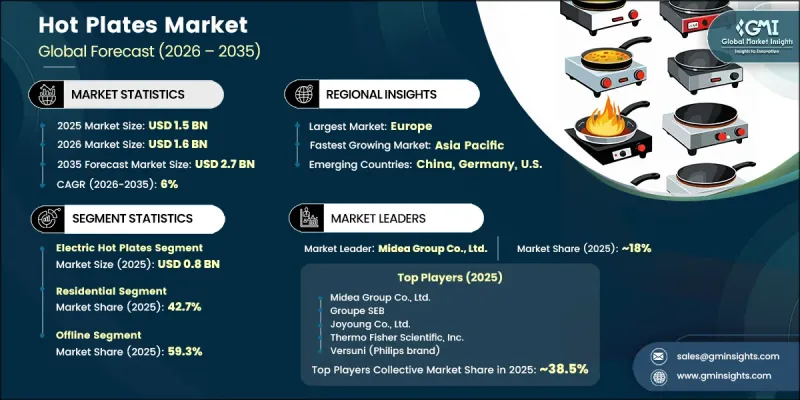
受都市化、家庭結構變化以及對靈活烹飪解決方案日益成長的需求等因素的推動,電熱爐市場正經歷穩步成長,這些因素持續影響著全球消費者的購買行為。亞太、非洲和拉丁美洲的快速城市化推動了對緊湊型攜帶式炊具的需求,尤其是在生活空間有限的都市區中,傳統烹飪設施並非總是實用。同時,已開發地區單身人士和小家庭的增加也支撐了對桌上型電熱爐的需求,這種電熱爐為住宅和商用用戶提供了便捷的加熱選擇。此外,雲端食品服務模式的擴展和以配送為主的廚房營運模式的普及,為商用電熱爐的應用創造了新的機會。這些企業需要高效、便攜且節省空間的烹飪設備,以適應最佳化的廚房佈局。隨著烹飪方式的不斷演變,預計在預測期內,攜帶式烹飪解決方案將在多個終端用戶領域保持強勁的需求。
| 市場範圍 | |
|---|---|
| 開始年份 | 2025 |
| 預測期 | 2026-2035 |
| 初始市場規模 | 15億美元 |
| 預測金額 | 27億美元 |
| 複合年成長率 | 6% |
預計到2025年,電熱板市場銷售額將達8億美元。電熱板市場依然佔據領先地位,涵蓋了眾多面向住宅、商用和實驗室用途的產品。其強大的市場地位得益於其豐富的產品線,涵蓋了從面向注重成本的消費者的經濟型線圈式產品到專業環境使用的先進固態元件和陶瓷加熱器型號,價格區間廣泛。該細分市場持續受益於其多功能性、可靠性和對各種應用需求的適應性。
到2025年,住宅市場將佔據42.7%的市場。這一市場的成長主要得益於都市區成長、對小型廚房電器需求的增加以及成熟市場的更換需求。住宅電熱板正日益成為一種便捷的烹飪解決方案,尤其適用於需要靈活加熱方式的家庭,例如小型居住空間、臨時住所、戶外活動以及備用烹飪場所。隨著消費者尋求經濟實惠且實用的傳統炊具替代品,這一市場持續擴張。
美國電熱板市場預計到2025年將達到3億美元,並在2026年至2035年間以5.7%的複合年成長率成長。美國是北美市場成長的主要貢獻者,這主要得益於住宅和商業場所對攜帶式烹飪設備的需求不斷成長。住宅趨勢受到都市區住宅人數增加、學生宿舍需求以及人們對便利廚房設備日益成長的偏好。商用市場則受益於成熟的餐飲服務和酒店業,電熱板在這些行業中被廣泛用於滿足各種營運需求,包括輔助烹飪、保溫以及在商業場所進行臨時烹飪。
目錄
第1章:調查方法和範圍
第2章執行摘要
第3章 行業洞察
- 產業生態系分析
- 原料供應商(金屬、陶瓷、電子元件)
- 零件製造商和原始設備製造商
- 電熱板製造商和組裝
- 分銷和零售通路
- 最終用戶(住宅、商業、研究設施)
- 供應商情況
- 影響價值鏈的因素
- 價值鏈各階段的利潤率分析
- 中斷
- 未來展望
- 影響產業的因素
- 促進因素
- 市場比較傳統羅茨式/羅茨式技術更節能的工業鼓風機解決方案的需求日益成長。
- 全球擴大市政和工業廢水處理基礎設施
- 嚴格的環境和噪音排放法規正在推動技術變革。
- 市場限制因素
- 高昂的初始資本投入阻礙了中小企業和新興市場採用新技術。
- 偏遠地區和二、三線工業區缺乏技術熟練的維修技師。
- 市場機遇
- 將物聯網、智慧感測器和預測性維護技術整合到鼓風機組件中
- 擴大通風技術在水產養殖和園藝的應用。
- 促進因素
- 成長潛力分析
- 未來市場趨勢
- 技術與創新展望
- 最新科技趨勢
- 新興技術
- 智慧互聯電熱板技術
- 能源效率創新與生態設計趨勢
- 價格分析
- 對過去價格趨勢的分析
- 依球員類型分類的定價策略(高級球員、超值球員、成本加成球員)
- 監理情勢
- 安全性和性能標準(UL、CE、BIS、PSE)
- 能源效率法規(美國能源局家用電器標準、歐盟生態設計指令)
- 實驗室設備合規標準(ISO、GLP)
- 貿易數據分析
- 主要貿易路線及關稅的影響
- 貿易政策與區域貿易協定的變化
- 供應鏈分析
- 原物料採購
- 製造地與地理集中度
- 供應鏈脆弱性與風險緩解策略
- 人工智慧和生成式人工智慧對市場的影響
- 利用人工智慧改造現有經營模式
- 按細分市場分類的生成式人工智慧用例和部署藍圖
- 風險、限制和監管考量
- 目前分銷基礎設施和通路滲透情況
- 按地區和業務類型(現代貿易、傳統零售、線上)分類的管道覆蓋範圍
- 缺乏最後一公里基礎設施和不斷變化的管道
- 波特五力分析
- PESTLE分析
第4章 競爭情勢
- 介紹
- 企業市佔率分析
- 按地區
- 企業矩陣分析
- 主要市場公司的競爭分析
- 競爭定位矩陣
- 主要進展
- 併購
- 夥伴關係和聯盟
- 新產品發布
- 業務拓展計劃
第5章 市場估算與預測:依產品分類,2022-2035年
- 電熱板
- IH 熱板
- 瓦斯電熱板
第6章 市場估計與預測:依材料分類,2022-2035年
- 陶瓷製品
- 玻璃
- 金屬
- 鑄鐵
- 不銹鋼
- 塑膠
- 其他(聚四氟乙烯塗層、複合材料)
第7章 市場估計與預測:依瓦特數分類,2022-2035年
- 小於800瓦
- 800W~1,200W
- 1,200W~1,500W
- 1,500W~2,000W
- 2000瓦或以上
第8章 市場估算與預測:依價格區間分類,2022-2035年
- 低的
- 中等的
- 高的
- 優質的
第9章 市場估計與預測:依最終用途分類,2022-2035年
- 住宅
- 附小廚房的公寓
- 學生宿舍和臨時住宅
- 戶外和露營用途
- 商業的
- 餐廳/快餐店(QSR)
- 飯店及餐飲業
- 餐飲和活動服務
- 幽靈廚房/雲廚房
- 研究所
- 學術研究機構
- 製藥和生物技術公司
- 食品飲料檢驗實驗室
- 環境檢測實驗室
第10章 市場估價與預測:依通路分類,2022-2035年
- 線上
- 電子商務平台
- 品牌官方網站
- 離線
- 大賣場和超級市場
- 廚房及家用電器專賣店
- 科學實驗設備銷售代理
- 其他
第11章 市場估價與預測:按地區分類,2022-2035年
- 北美洲
- 美國
- 加拿大
- 歐洲
- 英國
- 德國
- 法國
- 義大利
- 西班牙
- 亞太地區
- 中國
- 印度
- 日本
- 韓國
- 澳洲
- 拉丁美洲
- 巴西
- 墨西哥
- 中東和非洲
- 南非
- 沙烏地阿拉伯
- UAE
第12章:公司簡介
- 世界公司
- Midea Group Co., Ltd.
- Groupe SEB
- Joyoung Co., Ltd.
- Thermo Fisher Scientific, Inc.
- Versuni(Philips brand)
- 本地公司
- IKA Works GmbH & Co. KG
- Aroma Housewares Co.
- Breville Group Limited
- Hamilton Beach Brands
- NuWave LLC
- Electrolux Professional AB
- Cadco, Ltd.
- Corning Incorporated
- Heidolph Instruments GmbH & Co. KG
- Cole-Parmer Instrument Company, LLC
- Cuisinart
- 新興企業
- VELP Scientifica Srl
- Holmarc Opto-Mechatronics Pvt. Ltd.
- Weibang Co., Ltd.
- Zhongshan Fengye Electrical Appliance Co., Ltd.
- Grant Instruments(Cambridge)Ltd.
The Global Hot Plates Market was valued at USD 1.5 billion in 2025 and is estimated to grow at a CAGR of 6% to reach USD 2.7 billion by 2035.
The hot plates market is witnessing steady growth as urbanization, changing household structures, and increasing demand for flexible cooking solutions continue to influence consumer purchasing patterns worldwide. Rapid urban development across Asia Pacific, Africa, and Latin America is increasing the need for compact and portable cooking appliances, particularly among urban households adopting smaller living spaces where conventional cooking setups may not always be practical. At the same time, the growing number of single-person and small-family households in developed regions is supporting demand for countertop hot plates that provide convenient heating options for residential and commercial users. The expansion of cloud-based foodservice models and delivery-focused kitchen operations is also creating new opportunities for commercial hot plate adoption. These businesses require efficient, portable, and space-saving cooking equipment that can support optimized kitchen layouts. As food preparation models continue to evolve, portable cooking solutions are expected to maintain strong demand across multiple end-use sectors throughout the forecast period.
| Market Scope | |
|---|---|
| Start Year | 2025 |
| Forecast Year | 2026-2035 |
| Start Value | $1.5 Billion |
| Forecast Value | $2.7 Billion |
| CAGR | 6% |
The electric hot plates segment accounted for generating USD 0.8 billion in 2025. The electric hot plates segment remains dominant as it includes a broad range of products designed for residential, commercial, and laboratory applications. Its strong market position is supported by widespread availability across different pricing categories, ranging from affordable coil-based units for cost-conscious consumers to advanced solid element and ceramic heating models used in professional environments. The segment continues to benefit from its versatility, reliability, and suitability across diverse application requirements.
The residential segment held 42.7% share in 2025. Growth in this segment is supported by increasing urban populations, rising demand for compact cooking appliances, and replacement demand in established markets. Residential hot plates are increasingly used as convenient cooking solutions in households requiring flexible heating options, including smaller living environments, temporary housing arrangements, outdoor activities, and backup cooking applications. The segment continues to expand as consumers seek affordable and practical alternatives to traditional cooking equipment.
U.S. Hot Plates Market captured USD 300 million in 2025 and is expected to grow at a CAGR of 5.7% from 2026 to 2035. The country represents a major contributor to North American market growth, supported by increasing demand for portable cooking appliances across residential and commercial applications. Residential adoption is influenced by urban housing trends, student accommodation requirements, and the growing preference for convenient kitchen appliances. The commercial segment benefits from established foodservice and hospitality industries, where hot plates are used for various operational needs, including food preparation support, warming applications, and temporary cooking requirements in commercial facilities.
Major players operating in the global hot plates market include: Breville Group Limited, Midea Group Co., Ltd., Hamilton Beach Brands, Groupe SEB, Thermo Fisher Scientific, Inc., Versuni (Philips brand), Aroma Housewares Co., IKA Works GmbH & Co. KG, Joyoung Co., Ltd., NuWave LLC, Electrolux Professional AB, Cadco, Ltd., Cuisinart, Corning Incorporated, Heidolph Instruments GmbH & Co. KG, Cole-Parmer Instrument Company, LLC, VELP Scientifica Srl, Holmarc Opto-Mechatronics Pvt. Ltd., Weibang Co., Ltd., Zhongshan Fengye Electrical Appliance Co., Ltd., and Grant Instruments (Cambridge) Ltd. Companies operating in the hot plates market are strengthening their competitive position through product innovation, portfolio expansion, strategic partnerships, and improvements in manufacturing efficiency. Market participants are focusing on developing energy-efficient, compact, and technologically advanced hot plates to meet changing consumer expectations. Companies are also investing in enhanced heating technologies, improved safety features, and user-friendly designs to differentiate their offerings. Expanding distribution networks, strengthening online sales channels, and targeting emerging markets are additional strategies being adopted to increase market reach.
Table of Contents
Chapter 1 Methodology and Scope
- 1.1 Market scope and definition
- 1.2 Research design
- 1.2.1 Research approach
- 1.2.2 Data collection methods
- 1.3 Data mining sources
- 1.3.1 Global
- 1.3.2 Regional/Country
- 1.4 Base estimates and calculations
- 1.4.1 Base year calculation
- 1.4.2 Key trends for market estimation
- 1.5 Primary research and validation
- 1.5.1 Primary sources
- 1.6 Forecast model
- 1.7 Research assumptions and limitations
Chapter 2 Executive Summary
- 2.1 Industry 360° synopsis
- 2.2 Key market trends
- 2.3 Regional
- 2.4 Product
- 2.5 Material
- 2.6 Wattage
- 2.7 Price range
- 2.8 End use scale
- 2.9 Distribution channel
Chapter 3 Industry Insights
- 3.1 Industry Ecosystem Analysis
- 3.1.1 Raw material suppliers (metals, ceramics, electronic components)
- 3.1.2 Component manufacturers & OEMs
- 3.1.3 Hot plate manufacturers & assemblers
- 3.1.4 Distribution & retail channels
- 3.1.5 End users (residential, commercial, laboratory)
- 3.1.6 Supplier landscape
- 3.1.7 Factor affecting the value chain
- 3.1.8 Profit margin analysis by value chain stage
- 3.1.9 Disruptions
- 3.1.10 Future outlook
- 3.2 Industry impact forces
- 3.2.1 Growth drivers
- 3.2.1.1 Rising demand for energy-efficient industrial blower solutions over conventional lobe/roots technology
- 3.2.1.2 Expanding municipal & industrial wastewater treatment infrastructure globally
- 3.2.1.3 Stringent environmental & noise emission regulations driving technology shift
- 3.2.2 Market Restraints
- 3.2.2.1 High initial capital investment deterring SME & emerging-market adoption
- 3.2.2.2 Shortage of skilled service technicians in remote & tier-II/III industrial regions
- 3.2.3 Market Opportunities
- 3.2.3.1 Integration of IoT, smart sensors & predictive maintenance technologies in blower packages
- 3.2.3.2 Expanding applications in aquaculture & horticulture aeration
- 3.2.1 Growth drivers
- 3.3 Growth potential analysis
- 3.4 Future market trends
- 3.5 Technology and innovation landscape
- 3.5.1 Current technological trends
- 3.5.2 Emerging technologies
- 3.5.3 Smart & connected hot plate technologies
- 3.5.4 Energy efficiency innovations & eco-design trend
- 3.6 Pricing analysis (driven by primary research)
- 3.6.1 Historical price trend analysis
- 3.6.2 Pricing strategy by player type (premium / value / cost-plus)
- 3.7 Regulatory landscape
- 3.7.1 Safety & performance standards (UL, CE, BIS, PSE)
- 3.7.2 Energy efficiency regulations (DOE Appliance Standards, EU EcoDesign Directive)
- 3.7.3 Laboratory equipment compliance standards (ISO, GLP)
- 3.8 Trade data analysis (driven by paid database) (HS Code- 84145930)
- 3.8.1 Key trade corridors & tariff impact
- 3.8.2 Trade policy changes & regional trade agreements
- 3.9 Supply chain analysis
- 3.9.1 Raw material sourcing
- 3.9.2 Manufacturing hubs & geographic concentration
- 3.9.3 Supply chain vulnerabilities & risk mitigation strategies
- 3.10 Impact of AI & generative AI on the market
- 3.10.1 AI-driven disruption of existing business models
- 3.10.2 GenAI use cases & adoption roadmap by segment
- 3.10.3 Risks, limitations & regulatory considerations
- 3.11 Distribution infrastructure & channel penetration landscape (driven by primary research)
- 3.11.1 Channel coverage by region & format (modern trade vs. Traditional trade vs. Online) (driven by primary research)
- 3.11.2 Last-mile infrastructure gaps & emerging channel shifts
- 3.12 Porter's five forces analysis
- 3.13 PESTEL analysis
Chapter 4 Competitive Landscape, 2025
- 4.1 Introduction
- 4.2 Company market share analysis
- 4.2.1 By region
- 4.2.1.1 North America
- 4.2.1.2 Europe
- 4.2.1.3 Asia Pacific
- 4.2.1.4 Latin America
- 4.2.1.5 Middle East and Africa
- 4.2.1 By region
- 4.3 Company matrix analysis
- 4.4 Competitive analysis of major market players
- 4.5 Competitive positioning matrix
- 4.6 Key developments
- 4.6.1 Mergers & acquisitions
- 4.6.2 Partnerships & collaborations
- 4.6.3 New product launches
- 4.6.4 Expansion plans
Chapter 5 Market Estimates & Forecast, By Product, 2022-2035 (USD Billion) (Thousand Units)
- 5.1 Key trends
- 5.2 Electric hot plates
- 5.3 Induction hot plates
- 5.4 Gas hot plates
Chapter 6 Market Estimates & Forecast, By Material, 2022-2035 (USD Billion) (Thousand Units)
- 6.1 Key trends
- 6.2 Ceramic
- 6.3 Glass
- 6.4 Metal
- 6.4.1 Cast iron
- 6.4.2 Stainless steel
- 6.5 Plastic
- 6.6 Others (PTFE-coated, composite)
Chapter 7 Market Estimates & Forecast, By Wattage, 2022-2035 (USD Billion) (Thousand Units)
- 7.1 Key trends
- 7.2 Below 800W
- 7.3 800W - 1,200W
- 7.4 1,200W - 1,500W
- 7.5 1,500W - 2,000W
- 7.6 Above 2,000W
Chapter 8 Market Estimates & Forecast, By Price Range, 2022-2035 (USD Billion) (Thousand Units)
- 8.1 Key trends
- 8.2 Low
- 8.3 Medium
- 8.4 High
- 8.5 Premium
Chapter 9 Market Estimates & Forecast, By End Use, 2022-2035 (USD Billion) (Thousand Units)
- 9.1 Key trends
- 9.2 Residential
- 9.2.1 Apartments & small kitchens
- 9.2.2 Dormitories & temporary housing
- 9.2.3 Outdoor & camping use
- 9.3 Commercial
- 9.3.1 Restaurants & quick service restaurants (QSR)
- 9.3.2 Hotels & hospitality
- 9.3.3 Catering & event services
- 9.3.4 Ghost kitchens & cloud kitchens
- 9.4 Laboratory
- 9.4.1 Academic & research institutes
- 9.4.2 Pharmaceutical & biotechnology companies
- 9.4.3 Food & beverage testing laboratories
- 9.4.4 Environmental testing laboratories
Chapter 10 Market Estimates & Forecast, By Distribution Channel, 2022-2035 (USD Billion) (Thousand Units)
- 10.1 Key trends
- 10.2 Online
- 10.2.1 E-commerce platforms
- 10.2.2 Brand websites
- 10.3 Offline
- 10.3.1 Hypermarkets & supermarkets
- 10.3.2 Specialty kitchen & appliance stores
- 10.3.3 Scientific & laboratory equipment distributors
- 10.3.4 Other retail formats
Chapter 11 Market Estimates & Forecast, By Region, 2022-2035 (USD Billion) (Thousand Units)
- 11.1 Key trends
- 11.2 North America
- 11.2.1 U.S.
- 11.2.2 Canada
- 11.3 Europe
- 11.3.1 UK
- 11.3.2 Germany
- 11.3.3 France
- 11.3.4 Italy
- 11.3.5 Spain
- 11.4 Asia Pacific
- 11.4.1 China
- 11.4.2 India
- 11.4.3 Japan
- 11.4.4 South Korea
- 11.4.5 Australia
- 11.5 Latin America
- 11.5.1 Brazil
- 11.5.2 Mexico
- 11.6 MEA
- 11.6.1 South Africa
- 11.6.2 Saudi Arabia
- 11.6.3 UAE
Chapter 12 Company Profiles
- 12.1 Global Players
- 12.1.1 Midea Group Co., Ltd.
- 12.1.2 Groupe SEB
- 12.1.3 Joyoung Co., Ltd.
- 12.1.4 Thermo Fisher Scientific, Inc.
- 12.1.5 Versuni (Philips brand)
- 12.2 Regional Players
- 12.2.1 IKA Works GmbH & Co. KG
- 12.2.2 Aroma Housewares Co.
- 12.2.3 Breville Group Limited
- 12.2.4 Hamilton Beach Brands
- 12.2.5 NuWave LLC
- 12.2.6 Electrolux Professional AB
- 12.2.7 Cadco, Ltd.
- 12.2.8 Corning Incorporated
- 12.2.9 Heidolph Instruments GmbH & Co. KG
- 12.2.10 Cole-Parmer Instrument Company, LLC
- 12.2.11 Cuisinart
- 12.3 Emerging Players
- 12.3.1 VELP Scientifica Srl
- 12.3.2 Holmarc Opto-Mechatronics Pvt. Ltd.
- 12.3.3 Weibang Co., Ltd.
- 12.3.4 Zhongshan Fengye Electrical Appliance Co., Ltd.
- 12.3.5 Grant Instruments (Cambridge) Ltd.

 全球電熱板市場規模、佔有率、趨勢和成長分析報告(2026-2034)
 輪胎抗磨損添加劑:市場佔有率分析、產業趨勢與統計及成長預測(2026-2031)
 功能性添加劑市場預測至2034年-按添加劑類型、化學性質、物理形態、性能功能、最終用戶和地區分類的全球分析
 聚對苯二甲酸乙二醇酯(PET)添加劑市場-2026-2032年全球市場預測陶瓷添加劑市場:按材料、形態、陶瓷類型、功能和應用分類-2026-2032年全球市場預測
 添加劑市場規模、佔有率和成長分析:按產品類型、功能、原料、最終用途產業和地區分類-2026-2033年產業預測
 建築用卡波姆市場規模、佔有率和成長分析:依產品等級、功能、配方類型、應用、最終用途產業、分銷管道和地區分類-2026-2033年產業預測複合添加劑:市場佔有率分析、行業趨勢和統計數據、成長預測(2026-2031)
 2026年全球機能飲料添加劑市場報告鹽添加劑市場:按類型、形態、等級、應用和分銷管道分類-2026-2032年全球市場預測