


 |
市場調查報告書
商品編碼
2119297
實體人工智慧平台:市場佔有率分析、產業趨勢與統計、成長預測(2026-2031)Physical AI Platforms - Market Share Analysis, Industry Trends & Statistics, Growth Forecasts (2026 - 2031) |
||||||

※ 本網頁內容可能與最新版本有所差異。詳細情況請與我們聯繫。
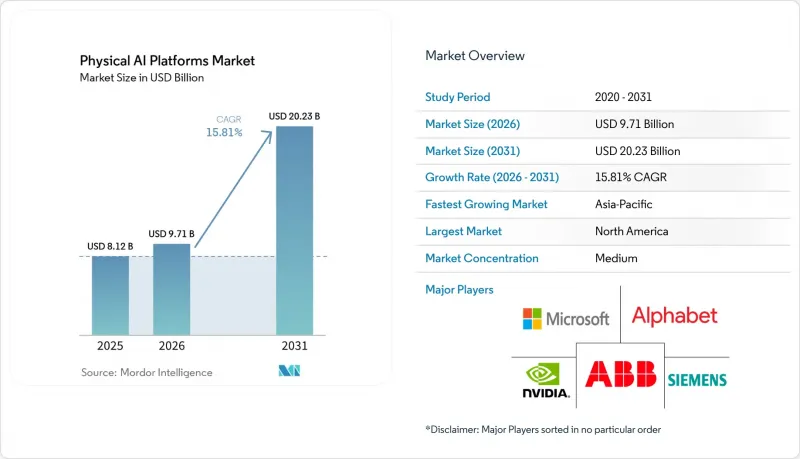
據 Mordor Intelligence 稱,2025 年實體 AI 平台市值為 81.2 億美元,從 2026 年的 97.1 億美元成長到 2031 年的 202.3 億美元,預計 2026 年至 2031 年預測期內的複合年成長率為 15.81%。
本報告按組件(硬體、軟體、服務)、平台產品(機器人軟體平台等)、部署模式(設備端、雲端)、應用(製造和工業自動化、倉儲自動化和物流等)、終端用戶產業(汽車製造商等)以及地區進行細分。市場預測以價值(美元)表示。
全球實體人工智慧平台市場趨勢及洞察
人形機器人、自主移動機器人和協作機器人的商業化
人形機器人、自主移動機器人 (AMR) 和協作機器人 (cobot) 的商業應用是實體人工智慧平台市場的主要需求來源。 2024 年至 2025 年間,開發人員從研究原型轉向在倉庫、物流中心和輕工業領域進行早期展示。部署仍然集中在少數公司,並且僅限於搬運週轉箱和物料搬運等重複性任務。這一趨勢意味著,當前的商業機會更依賴技術先進的早期用戶,而不是廣泛的工廠級部署。 NVIDIA Jetson Thor 已被 Boston Dynamics 的「Atlas」和 Agility Robotics 的「Digit」採用,並將計算層與模擬、建模和安全工具的選擇整合在一起。
對自適應製造和自主物流的需求
固定式自動化系統難以應對產品配置、廠房佈局和供應鏈的變化。實體人工智慧平台使機器能夠適應錯位的零件、陌生的產品以及不斷變化的工作區域,而無需進行大規模的重新編程。這使得其價值提案不再僅限於縮短週期時間,而是提升整個工廠和倉庫的營運柔軟性。 ABB、 FANUC、KUKA 和安川電機正在利用 NVIDIA Omniverse 庫和 Isaac 框架,透過數位孿生技術測試應用程式,並將 Jetson 模組連接到控制器以進行本地人工智慧推理。倉庫負責人在考慮自動化投資時,越來越重視提高處理能力上限,而不僅僅是降低人事費用。這使得採購的邏輯轉向對供應鏈的資本投資,從而拓寬了能夠支援實體人工智慧平台市場的專案範圍。
高昂的整合成本和漫長的試運行週期
將實體人工智慧整合到生產現場不僅僅是購買機器和處理器那麼簡單。客製化夾具、感測器校準、安全檢驗、網路改造和員工培訓等環節,在複雜的環境中可能會將試運行週期延長至 12-18 個月以上。雖然先進的人形機器人系統成本在 15 萬至 50 萬美元之間,但主流製造業的成本僅為 2 萬至 5 萬美元。驅動組件佔總材料清單(BOM) 的 40% 至 60%。此外,整合工作的風險主要由系統整合商承擔,但在許多地區,認證合作夥伴仍然有限。工業客戶通常要求 99.99% 的運轉率,但通用人形機器人目前只能在執行有限且重複性任務時才能達到目標。
細分市場分析
預計到2025年,實體人工智慧平台市場中,硬體將佔據45.12%的市場。這主要是因為處理器、執行器和感測器佔據了初始部署成本的大部分。邊緣推理系統是該領域競爭激烈的焦點。 NVIDIA Jetson Thor憑藉其本地人工智慧處理能力和安全意識強的架構,為正在進行的人形機器人和自主移動機器人專案提供支援。高通驍龍平台和英特爾模組則滿足了對低功耗和低成本部署的需求。硬體需求與在製造業、物流業和其他受控環境中商業部署的機器人數量密切相關。
預計到2031年,軟體市場將以17.16%的複合年成長率成長,成為實體人工智慧平台市場中成長最快的細分領域。基礎模型、模擬軟體、車隊管理和機器人控制系統可以在已部署的大規模硬體基礎設施中重複使用。這種重複使用創造了持續的商機,這些機會並不完全依賴新設備的購買。服務包括系統整合、機器人即服務 (RaaS)、遠端監控和生命週期支援。買家越來越傾向於選擇即用型系統,而不是獨立的功能。因此,儘管硬體支出在實體人工智慧 (AI) 平台市場仍佔據重要地位,但軟體和服務才是長期價值的來源。
到2025年,機器人軟體平台將佔據實體人工智慧平台市場的29.87%。這一佔有率反映了中間件、運動規劃、機器人操作系統和車隊管理應用程式的廣泛部署。這些工具應用於工業設施和物流中心,在這些場所,機器之間的可預測協調至關重要。成熟的軟體平台還支援與現有控制器和操作流程的整合。即使在設備和機械供應商混雜的環境中,客戶也需要可靠的編配,因此這些平台的角色仍然至關重要。這個成功案例為供應商提供了一個堅實的基礎,使他們能夠在不中斷現有系統的情況下添加人工智慧功能。
預計到2031年,人工智慧模型開發平台將以19.02%的複合年成長率成長。視覺、語言和動作模型需要工具來進行訓練、評估、部署以及在整個機器上更新策略。 NVIDIA整合了Isaac GR00T和Hugging Face的LeRobot,透過開放原始碼環境連接了機器人和人工智慧開發團體。模擬和數位孿生平台幫助使用者在實際部署前檢驗自主堆高機和其他移動系統。凱傲集團、Accenture和西門子利用NVIDIA Mega Omniverse Blueprint為GXO進行了與倉庫數位孿生相關的作業。邊緣平台適用於雲端推理受延遲、連接性或資料儲存位置限制的環境。其他產品類型包括雲端平台、機器人中間件以及協調邊緣和雲端資源的作業系統。
區域分析
到2025年,北美將佔據實體人工智慧平台市場34.58%的佔有率。該地區擁有眾多平台開發商、成熟的雲端基礎設施、先進的機器人專案以及不斷擴大的國防採購。 NVIDIA、Figure AI和Agility Robotics等公司以及許多模擬和機器人軟體開發人員均位於美國。美國2026財政年度預算中為自主系統撥款134億美元,設立了專門的聯邦支出配額。 NVIDIA的Isaac和GR00T生態系統受益於其龐大的開發者群體,這些開發者將機器人開發與基礎模型研究相結合。加拿大支持汽車產業的整合和應用機器人研究。在墨西哥,隨著跨境製造和供應鏈本地化的推進,部署基礎也在不斷發展。
歐洲在實體人工智慧平台市場佔據了穩固地位,德國在工業自動化領域擁有堅實的基礎,該地區正在大力投資自主人工智慧運算。庫卡在2026年NVIDIA GTC大會上發布了其AMP平台,並在KTPO位於俄亥俄州的Jeep Wrangler和Gladiator車身製造廠部署了該平台的早期版本,共使用了285台機器人。於利希研究中心開發了“自動機引擎”,這是一款採用低位元精度處理的邊緣人工智慧晶片,用於確定性機器人推理。 NEURA Robotics宣佈在2026年6月完成C輪融資,籌集了14億美元,其總合累積訂單和戰略部署管道總額超過10億美元。 ISO 10218:2025和歐洲機械法規正在提升為CE認證產品設計的安全架構的價值。英國、法國、義大利和西班牙正在支援航太、物流和醫療機器人領域的相關活動。由於地緣政治形勢和出口限制,俄羅斯的參與仍然有限。
預計到2031年,亞太地區將以17.24%的複合年成長率成長,成為實體人工智慧平台市場成長最快的地區。日本和中國是該地區成長的主要驅動力。在日本,川崎重工、OMRON、富士通和Softbank Corporation已採用英偉達的實體人工智慧技術棧,應用於製造業、運輸和基礎設施領域。安川電機也於2026年7月與英偉達合作,檢驗從雲端到邊緣的策略工作流程。日本製造業、資訊科技和醫療保健產業的人手不足,除了直接的成本因素外,也推動了實體人工智慧技術的應用。騰訊於2026年7月發布了其Hy-Embodied基礎模型系列和升級版的Tairos具身人工智慧平台。雖然實體人工智慧技術已在韓國的電子和汽車生產領域得到應用,但在印度、澳洲、新加坡、南美以及中東和非洲等地區,其在工業、農業、採礦和基礎設施領域的應用仍處於起步階段。
其他好處:
- Excel格式的市場預測(ME)表
- 3個月的分析師支持
目錄
第1章:引言
- 研究假設和市場定義
- 調查範圍
第2章:調查方法
第3章執行摘要
第4章 市場狀況
- 市場概覽
- 市場促進因素
- 人形機器人、自主移動機器人和協作機器人的商業化
- 對自適應製造和自主物流的需求
- 邊緣人工智慧推理與多模態感知技術的成熟
- 模擬優先開發和數位孿生的引入
- 非例行體力勞動者短缺
- 在國防和基礎設施等安全至關重要的領域,自主技術的擴展應用日益廣泛。
- 市場限制因素
- 整合成本高,試運行週期長
- 認證、責任和功能安全的複雜性
- 非標準化的硬體和軟體介面
- 現實世界中缺乏 3D 訓練資料以及極端情況下的可靠性問題
- 產業價值鏈分析
- 監理情勢
- 技術展望
- 波特五力分析
第5章 市場規模與成長預測
- 按組件
- 硬體
- 軟體
- 服務
- 按平台產品
- 機器人軟體平台
- 模擬與數位孿生平台
- 人工智慧模型開發平台
- 邊緣人工智慧平台
- 其他平台產品(基於雲端的實體人工智慧平台、機器人中間件框架、自主機器作業系統)
- 不同的發展
- 裝置端
- 基於雲端的
- 透過使用
- 製造和工業自動化
- 倉儲自動化與物流
- 自動駕駛汽車和移動出行
- 醫療保健和醫療機器人
- 農業和農業機器人
- 航太、國防與安全
- 其他應用領域(能源、採礦和公共產業、建築和基礎設施、零售、酒店和智慧建築、消費和家用機器人)
- 按最終用戶行業分類
- 汽車製造商
- 電子和半導體製造商
- 物流/倉儲營運商
- 醫療服務提供方
- 其他終端用戶產業(政府和國防機構、能源和礦業公司、中小企業)
- 按地區
- 北美洲
- 美國
- 加拿大
- 墨西哥
- 南美洲
- 巴西
- 阿根廷
- 智利
- 其他南美國家
- 歐洲
- 德國
- 英國
- 法國
- 義大利
- 西班牙
- 俄羅斯
- 其他歐洲國家
- 亞太地區
- 中國
- 日本
- 韓國
- 印度
- 澳洲
- 新加坡
- 其他亞太國家
- 中東
- 沙烏地阿拉伯
- 阿拉伯聯合大公國
- 以色列
- 土耳其
- 其他中東國家
- 非洲
- 南非
- 埃及
- 其他非洲國家
- 北美洲
第6章 競爭情勢
- 市場集中度
- 策略趨勢
- 市佔率分析
- 公司簡介
- NVIDIA Corporation
- Microsoft Corporation
- Alphabet Inc.
- ABB Ltd.
- Siemens AG
- Amazon Web Services, Inc.
- Rockwell Automation, Inc.
- Qualcomm Technologies, Inc.
- Scale AI, Inc.
- Intel Corporation
- FANUC Corporation
- Yaskawa Electric Corporation
- KUKA AG
- Boston Dynamics, Inc.
- Figure AI, Inc.
- Agility Robotics, Inc.
- Physical Intelligence, Inc.
- Covariant, Inc.
- NEURA Robotics GmbH
- Teradyne, Inc.
- OMRON Corporation
- Hexagon AB
第7章 市場機會與未來展望
According to Mordor Intelligence, the physical AI platforms market size was valued at USD 8.12 billion in 2025 and estimated to expand from USD 9.71 billion in 2026 to reach USD 20.23 billion by 2031, at a CAGR of 15.81% during the forecast period 2026-2031.
This report is Segmented by Component (Hardware, Software, and Services), Platform Product (Robotics Software Platforms, and More ), Deployment (On-Device, and Cloud-Based), Application (Manufacturing and Industrial Automation, Warehouse Automation and Logistics, and More), End-User Industry (Automotive Manufacturers, and More), and Geography. The Market Forecasts are Provided in Terms of Value (USD).
Global Physical AI Platforms Market Trends and Insights
Commercialization of Humanoid Robots, AMRs, and Cobots
Commercial use of humanoid robots, autonomous mobile robots, and collaborative robots is a major source of demand for the Physical AI Platforms Market. Developers moved from research prototypes to early pilots in warehouses, logistics sites, and light manufacturing during 2024 and 2025. Deployment remained concentrated among a small group of companies and in repetitive tasks such as tote handling and material transport. This pattern makes the current opportunity more dependent on technically capable early users than on broad deployment across factories. NVIDIA Jetson Thor was adopted by Boston Dynamics for Atlas and by Agility Robotics for Digit, linking the compute layer with the choice of simulation, models, and safety tools.
Demand for Adaptive Manufacturing and Autonomous Logistics
Fixed automation is less suited to changes in product mix, floor layouts, and supply conditions. Physical AI platforms allow machines to respond to misaligned parts, unfamiliar products, and changing work areas without extensive reprogramming. This changes the value proposition from cycle-time reduction alone to operating flexibility across the factory and warehouse. ABB, FANUC, KUKA, and Yaskawa use NVIDIA Omniverse libraries and Isaac frameworks to test applications through digital twins and connect Jetson modules to controllers for local AI inference. Warehouse buyers increasingly consider the ability to increase throughput ceilings, not only direct labor replacement, when reviewing automation investments. This shifts the purchase case toward supply-chain capital spending and broadens the set of projects that can support the Physical AI Platforms Market.
High Integration Costs and Long Commissioning Cycles
Integrating physical AI into production sites requires more than buying machines and processors. Custom fixtures, sensor calibration, safety validation, network changes, and staff training can extend commissioning beyond 12 to 18 months in complex settings. Advanced humanoid systems had unit prices between USD 150,000 and USD 500,000, while mainstream manufacturing economics require costs between USD 20,000 and USD 50,000. Actuation components represented 40% to 60% of the total bill of materials. Integration risk also falls heavily on systems integrators, while certified partners remain limited in many locations. Industrial customers often require 99.99% uptime, a standard that general-purpose humanoids have mainly demonstrated in narrow and repetitive work.
Other drivers and restraints analyzed in the detailed report include:
- Maturation of Edge AI Inference and Multimodal Perception
- Simulation-First Development and Digital Twin Adoption
- Certification, Liability, and Functional Safety Complexity
For complete list of drivers and restraints, kindly check the Table Of Contents.
Segment Analysis
Hardware accounted for 45.12% of the Physical AI Platforms Market share in 2025 because processors, actuators, and sensors accounted for a large share of early deployment costs. Edge inference systems are an important area of competition within this category. NVIDIA Jetson Thor supports current humanoid and autonomous mobile robot programs with local AI processing and a safety-capable architecture. Qualcomm Snapdragon platforms and Intel modules address lower-power and more cost-sensitive deployments. Hardware demand remains linked to the number of robots entering commercial use across manufacturing, logistics, and other controlled environments.
Software is projected to expand at a 17.16% CAGR through 2031, making it the fastest-growing component in the Physical AI Platforms Market. Foundation models, simulation software, fleet management, and robot control systems can be reused across larger installed hardware bases. This reuse supports recurring revenue opportunities that do not depend entirely on new machine purchases. Services include systems integration, robotics-as-a-service offerings, remote monitoring, and lifecycle support. Buyers increasingly seek deployment-ready systems rather than standalone capabilities. The Physical Artificial Intelligence (AI) Platforms Market therefore has a longer-term value pool in software and services, even while hardware spending remains substantial.
Robotics Software Platforms accounted for 29.87% of the Physical Artificial Intelligence Platforms Market share in 2025. Their position reflects the broad installed base of middleware, motion planning, robot operating systems, and fleet-management applications. These tools are used in industrial facilities and logistics sites where machines need predictable coordination. Established software platforms also support integration with existing controllers and operating processes. Their role remains important because customers need reliable orchestration across mixed fleets and equipment suppliers. This installed base provides a durable starting point for suppliers that can add AI capabilities without disrupting deployed systems.
AI Model Development Platforms are projected to expand at a 19.02% CAGR through 2031. Vision-language-action models require tools for training, evaluation, deployment, and policy updates across machines. NVIDIA integrated Isaac GR00T and Hugging Face LeRobot to connect robotics and AI developer communities through an open-source environment. Simulation and digital twin platforms help users validate autonomous forklifts and other mobile systems before physical deployment. KION Group, Accenture, and Siemens used NVIDIA Mega Omniverse Blueprint in work related to warehouse digital twins for GXO. Edge platforms serve deployments where latency, connectivity, or data residency limit cloud inference. Other product types include cloud platforms, robotics middleware, and operating systems that coordinate edge and cloud resources.
Complete Report Scope:
- By Component
- Hardware
- Software
- Services
- By Platform Product
- Robotics Software Platforms
- Simulation and Digital Twin Platforms
- AI Model Development Platforms
- Edge AI Platforms
- Other Platform Products (Cloud-Based Physical AI Platforms, Robotics Middleware Frameworks, Autonomous Machine Operating Systems)
- By Deployment
- On-Device
- Cloud-Based
- By Application
- Manufacturing and Industrial Automation
- Warehouse Automation and Logistics
- Autonomous Vehicles and Mobility
- Healthcare and Medical Robotics
- Agriculture and Agricultural Robotics
- Aerospace, Defense, and Security
- Other Applications (Energy, Mining, and Utilities, Construction and Infrastructure, Retail, Hospitality, and Smart Buildings, Consumer and Household Robotics)
- By End-User Industry
- Automotive Manufacturers
- Electronics and Semiconductor Manufacturers
- Logistics and Warehousing Operators
- Healthcare Providers
- Other End-User Industries (Government and Defense Organizations, Energy and Mining Companies, Small and Medium-Sized Enterprises)
- By Geography
- North America
- United States
- Canada
- Mexico
- South America
- Brazil
- Argentina
- Chile
- Rest of South America
- Europe
- Germany
- United Kingdom
- France
- Italy
- Spain
- Russia
- Rest of Europe
- Asia-Pacific
- China
- Japan
- South Korea
- India
- Australia
- Singapore
- Rest of Asia-Pacific
- Middle East
- Saudi Arabia
- United Arab Emirates
- Israel
- Turkey
- Rest of Middle East
- Africa
- South Africa
- Egypt
- Rest of Africa
- North America
Geography Analysis
North America accounted for 34.58% of the Physical AI Platforms Market in 2025. The region brings together platform developers, mature cloud infrastructure, advanced robotics programs, and growing defense procurement. NVIDIA, Figure AI, and Agility Robotics are based in the United States, as are many developers of simulation and robotics software. The USD 13.4 billion US FY2026 autonomy budget created a dedicated federal spending line for autonomous systems. NVIDIA's Isaac and GR00T ecosystems benefit from a developer base that bridges robotics development and foundation-model work. Canada supports automotive integration and applied robotics research. Mexico offers a developing deployment base as cross-border manufacturing and supply-chain localization advance.
Europe has a strong position in the Physical Artificial Intelligence Platforms Market because Germany has a deep industrial automation base, and the region is investing in sovereign AI computing. KUKA launched its AMP platform at NVIDIA GTC 2026 and deployed an alpha version at KTPO's 285-robot Jeep Wrangler and Gladiator body shop in Ohio. Forschungszentrum Julich developed the Automaton Engine, an edge AI chip that uses low-bit precision processing for deterministic robotics inference. NEURA Robotics raised to USD 1.4 billion in the June 2026 Series C round and reported an order book and strategic deployment pipeline exceeding USD 1 billion. ISO 10218:2025 and the European Machinery Regulation raise the value of safety architectures designed for CE-marked products. The United Kingdom, France, Italy, and Spain support activity in aerospace, logistics, and healthcare robotics. Russia's participation remains limited by geopolitical conditions and export controls.
Asia-Pacific is projected to expand at a 17.24% CAGR through 2031, the fastest rate in the Physical AI Platforms Market. Japan and China are the leading engines of regional growth. Kawasaki Heavy Industries, OMRON, Fujitsu, and SoftBank adopted NVIDIA's physical AI stack for manufacturing, mobility, and infrastructure uses in Japan. Yaskawa Electric also validated cloud-to-edge policy workflows with NVIDIA in July 2026. Japan's labor shortages in manufacturing, information technology, and healthcare encourage adoption beyond direct cost considerations. Tencent released the Hy-Embodied foundation model series and an updated Tairos embodied AI platform in July 2026. South Korea is applying physical AI in electronics and automotive production, while India, Australia, Singapore, South America, the Middle East, and Africa remain earlier-stage locations for industrial, agriculture, mining, and infrastructure use cases.
- NVIDIA Corporation
- Microsoft Corporation
- Alphabet Inc.
- ABB Ltd.
- Siemens AG
- Amazon Web Services, Inc.
- Rockwell Automation, Inc.
- Qualcomm Technologies, Inc.
- Scale AI, Inc.
- Intel Corporation
- FANUC Corporation
- Yaskawa Electric Corporation
- KUKA AG
- Boston Dynamics, Inc.
- Figure AI, Inc.
- Agility Robotics, Inc.
- Physical Intelligence, Inc.
- Covariant, Inc.
- NEURA Robotics GmbH
- Teradyne, Inc.
- OMRON Corporation
- Hexagon AB
Additional Benefits:
- The market estimate (ME) sheet in Excel format
- 3 months of analyst support
TABLE OF CONTENTS
1 INTRODUCTION
- 1.1 Study Assumptions and Market Definition
- 1.2 Scope of the Study
2 RESEARCH METHODOLOGY
3 EXECUTIVE SUMMARY
4 MARKET LANDSCAPE
- 4.1 Market Overview
- 4.2 Market Drivers
- 4.2.1 Commercialization of Humanoid Robots, AMRs, and Cobots
- 4.2.2 Demand for Adaptive Manufacturing and Autonomous Logistics
- 4.2.3 Maturation of Edge AI Inference and Multimodal Perception
- 4.2.4 Simulation-First Development and Digital Twin Adoption
- 4.2.5 Scarcity of Labor for Unstructured Physical Work
- 4.2.6 Expansion of Safety-Critical Autonomy in Defense and Infrastructure
- 4.3 Market Restraints
- 4.3.1 High Integration Costs and Long Commissioning Cycles
- 4.3.2 Certification, Liability, and Functional Safety Complexity
- 4.3.3 Non-Standardized Hardware and Software Interfaces
- 4.3.4 Insufficient Real-World 3D Training Data and Edge-Case Reliability
- 4.4 Industry Value-Chain Analysis
- 4.5 Regulatory Landscape
- 4.6 Technological Outlook
- 4.7 Porter's Five Forces Analysis
- 4.7.1 Intensity of Competitive Rivalry
- 4.7.2 Threat of New Entrants
- 4.7.3 Bargaining Power of Suppliers
- 4.7.4 Bargaining Power of Buyers
- 4.7.5 Threat of Substitutes
5 MARKET SIZE AND GROWTH FORECASTS (VALUE)
- 5.1 By Component
- 5.1.1 Hardware
- 5.1.2 Software
- 5.1.3 Services
- 5.2 By Platform Product
- 5.2.1 Robotics Software Platforms
- 5.2.2 Simulation and Digital Twin Platforms
- 5.2.3 AI Model Development Platforms
- 5.2.4 Edge AI Platforms
- 5.2.5 Other Platform Products (Cloud-Based Physical AI Platforms, Robotics Middleware Frameworks, Autonomous Machine Operating Systems)
- 5.3 By Deployment
- 5.3.1 On-Device
- 5.3.2 Cloud-Based
- 5.4 By Application
- 5.4.1 Manufacturing and Industrial Automation
- 5.4.2 Warehouse Automation and Logistics
- 5.4.3 Autonomous Vehicles and Mobility
- 5.4.4 Healthcare and Medical Robotics
- 5.4.5 Agriculture and Agricultural Robotics
- 5.4.6 Aerospace, Defense, and Security
- 5.4.7 Other Applications (Energy, Mining, and Utilities, Construction and Infrastructure, Retail, Hospitality, and Smart Buildings, Consumer and Household Robotics)
- 5.5 By End-User Industry
- 5.5.1 Automotive Manufacturers
- 5.5.2 Electronics and Semiconductor Manufacturers
- 5.5.3 Logistics and Warehousing Operators
- 5.5.4 Healthcare Providers
- 5.5.5 Other End-User Industries (Government and Defense Organizations, Energy and Mining Companies, Small and Medium-Sized Enterprises)
- 5.6 By Geography
- 5.6.1 North America
- 5.6.1.1 United States
- 5.6.1.2 Canada
- 5.6.1.3 Mexico
- 5.6.2 South America
- 5.6.2.1 Brazil
- 5.6.2.2 Argentina
- 5.6.2.3 Chile
- 5.6.2.4 Rest of South America
- 5.6.3 Europe
- 5.6.3.1 Germany
- 5.6.3.2 United Kingdom
- 5.6.3.3 France
- 5.6.3.4 Italy
- 5.6.3.5 Spain
- 5.6.3.6 Russia
- 5.6.3.7 Rest of Europe
- 5.6.4 Asia-Pacific
- 5.6.4.1 China
- 5.6.4.2 Japan
- 5.6.4.3 South Korea
- 5.6.4.4 India
- 5.6.4.5 Australia
- 5.6.4.6 Singapore
- 5.6.4.7 Rest of Asia-Pacific
- 5.6.5 Middle East
- 5.6.5.1 Saudi Arabia
- 5.6.5.2 United Arab Emirates
- 5.6.5.3 Israel
- 5.6.5.4 Turkey
- 5.6.5.5 Rest of Middle East
- 5.6.6 Africa
- 5.6.6.1 South Africa
- 5.6.6.2 Egypt
- 5.6.6.3 Rest of Africa
- 5.6.1 North America
6 COMPETITIVE LANDSCAPE
- 6.1 Market Concentration
- 6.2 Strategic Moves
- 6.3 Market Share Analysis
- 6.4 Company Profiles (includes Global Level Overview, Market Level Overview, Core Segments, Financials as available, Strategic Information, Market Rank/Share, Products and Services, Recent Developments)
- 6.4.1 NVIDIA Corporation
- 6.4.2 Microsoft Corporation
- 6.4.3 Alphabet Inc.
- 6.4.4 ABB Ltd.
- 6.4.5 Siemens AG
- 6.4.6 Amazon Web Services, Inc.
- 6.4.7 Rockwell Automation, Inc.
- 6.4.8 Qualcomm Technologies, Inc.
- 6.4.9 Scale AI, Inc.
- 6.4.10 Intel Corporation
- 6.4.11 FANUC Corporation
- 6.4.12 Yaskawa Electric Corporation
- 6.4.13 KUKA AG
- 6.4.14 Boston Dynamics, Inc.
- 6.4.15 Figure AI, Inc.
- 6.4.16 Agility Robotics, Inc.
- 6.4.17 Physical Intelligence, Inc.
- 6.4.18 Covariant, Inc.
- 6.4.19 NEURA Robotics GmbH
- 6.4.20 Teradyne, Inc.
- 6.4.21 OMRON Corporation
- 6.4.22 Hexagon AB
7 MARKET OPPORTUNITIES AND FUTURE OUTLOOK
- 7.1 White-Space and Unmet-Need Assessment

 物理人工智慧生態系統:市場佔有率分析、產業趨勢與統計、成長預測(2026-2031)
 實體人工智慧:機器人平台模式的發展趨勢以及半導體和雲端供應商的策略考量
 實體人工智慧市場:按技術、基礎設施、應用和產業分類(2026-2032 年)物理人工智慧:市場佔有率分析、行業趨勢和統計數據、成長預測(2026-2031)
 全球物理人工智慧市場(2027-2040 年)全球實體人工智慧市場:按組件、載體、技術、自主等級、應用和最終用戶分類-市場規模、產業動態、機會分析和預測(2026-2035 年)
 全球實體人工智慧市場(至2032年):按產品、機器人類型、自主等級、產業和地區分類
 2026-2030年全球實體人工智慧和機器人即服務(RaaS)市場
 實體人工智慧市場規模、佔有率和趨勢分析報告:按組件、技術、應用、地區和細分市場預測(2026-2033 年)