


 |
市場調查報告書
商品編碼
2099066
物理人工智慧:市場佔有率分析、行業趨勢和統計數據、成長預測(2026-2031)Physical AI - Market Share Analysis, Industry Trends & Statistics, Growth Forecasts (2026 - 2031) |
||||||

※ 本網頁內容可能與最新版本有所差異。詳細情況請與我們聯繫。
根據 Mordor Intelligence 預測,實體人工智慧市場規模將從 2025 年的 50.6 億美元和 2026 年的 71.1 億美元成長到 2031 年的 348.9 億美元,2026 年至 2031 年的年複合成長率(CAGR)為 37.46%。
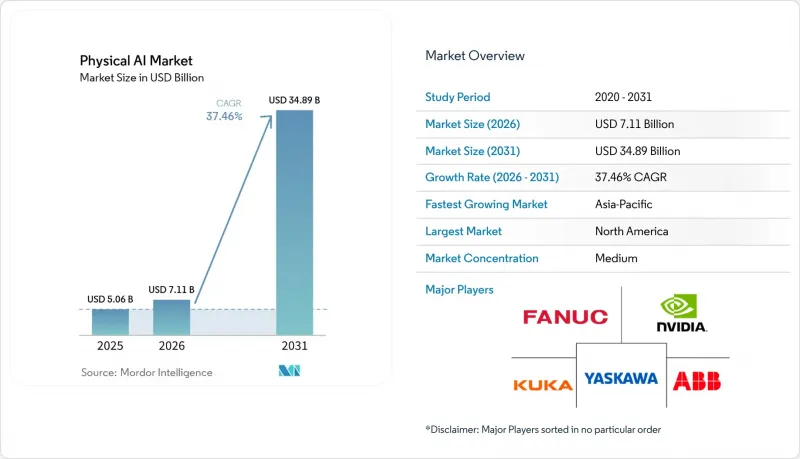
本報告按組件(硬體、軟體、服務)、機器人類型(工業機器人、商用服務機器人、個人/家用服務機器人等)、部署模式(設備端、雲端、混合)、終端用戶產業(物流/供應鏈、製造業、醫療保健、汽車、農業等)和地區進行細分。市場預測以美元計價。
全球物理人工智慧市場趨勢與洞察
物流和製造業對實際自動化的需求日益成長。
預計到2025年,美國工業機器人的部署數量將達到38,000台,年增11%,顯示無論汽車產業的經濟週期如何,買家都在持續擴展其自動化能力。光是食品業預計部署的機器人數量就將成長30%,達到3,000台,這顯示即使在自動化普及率歷來較低的產業,自動化應用也正在加速發展。這對實體人工智慧市場意義重大,因為需求不再局限於固定式工廠機器人,而是擴展到結合了移動系統、機械臂和更靈活的控制層的混合型機器人群。隨著企業追求的是整個工作流程的整合,而非單一硬體的採購,軟體協調和叢集管理在採購決策中變得越來越重要。這種轉變正在推動實體人工智慧市場的發展,因為每一次新的部署都越來越依賴能夠跨不同類型機器運行的感知、規劃和控制軟體。
邊緣人工智慧推理在低延遲機器人決策中的成熟度
Jetson AGX Thor 的全面上市表明,需要即時本地推理的機器人嵌入式運算能力正在飛速提升。據 NVIDIA 稱,該平台可提供 2,070 兆次浮點運算/秒 (FP4 teraflops) 的效能,與上一代產品相比,AI 運算能力提升了 7.5 倍,並支援機器級即時多模態處理。波士頓動力公司已將該平台整合到 Atlas 機器人中,Agility Robotics 也將其應用於第六代 Digit 機器人。這表明,晶片的選擇正逐漸成為一項策略性設計決策,而不僅僅是可互換組件的問題。在實體 AI 市場,設計階段選擇的邊緣處理器通常會在運作生命週期中使用,從而與供應商建立長期合作關係。因此,硬體(負責在本地做出時間受限的決策)與軟體層(透過更新、編配和模型改進持續增值)之間的界限更加清晰。
系統整合成本高昂,試運行週期長
儘管機器人硬體的經濟性正在改善,但高昂的部署成本仍然是實體人工智慧市場發展的一大阻礙,因為整個專案通常包括模具、安全系統、整合工作、基礎設施升級和培訓。研究表明,即使在操作人員開始評估大規模重複性之前,中型協作機器人單元的部署成本可能高達 5 萬至 9 萬美元。每小時 100 至 140 美元的整合工作成本、1 萬至 2.5 萬美元的額外安全措施成本以及 1.2 萬至 2 萬美元的培訓成本等因素,解釋了為什麼部署仍然更像是一個系統項目,而不僅僅是購買產品。如果問題在工廠測試中被遺漏,並在現場驗收期間被發現,情況會更加糟糕,因為每次延誤都可能擾亂生產線的運作和運作計劃。因此,實體人工智慧市場的成長速度並未達到僅由終端用戶需求所預期的水平,尤其是在買家尋求可預測的價值實現時間表,以便從單一地點擴展到多個地點的情況下。
細分市場分析
到2025年,硬體將佔據實體人工智慧市場52.42%的最大佔有率。這是因為所有部署仍然始於計算模組、執行器、感測器和機器人本體本身。已部署的硬體基礎架構是決定哪些模型可以在本地運行、系統響應速度以及隨著功能改進需要進行多少重新設計的關鍵因素。即使到了2025年,物理人工智慧市場在組件層面的規模仍然會嚴重偏向硬體,這反映了機器人必須在真實環境和軟體環境下運行,因此具有資本密集的特點。波士頓動力公司已將NVIDIA Jetson AGX Thor整合到其「Atlas」機器人中,Agility Robotics也在其第六代「Digit」機器人中採用了相同的平台。這顯示早期硬體決策如何影響與供應商的長期合作關係。這些設計選擇也會影響可維護性、功耗、熱限制和升級路徑。簡而言之,硬體仍然決定整個系統堆疊的運作邊界。
軟體市場預計到 2031 年將以 40.43% 的複合年成長率成長,這表明物理人工智慧市場的大部分長期價值將轉移到軟體領域。這種轉變與世界基礎模型、模擬框架和叢集管理工具密切相關,這些工具能夠在不更換實體資產的情況下提升整個已部署機器的效能。在 2026 年 GTC 大會上,NVIDIA 發布了 GR00T N1.7 的早期商業存取權限,將軟體授權定位為一項真正的收入來源,而不僅僅是硬體銷售的附加功能。隨著叢集分佈在多個地點並包含來自不同 OEM 廠商的機器,整合、試運行、訓練和最佳化變得更加複雜,因此服務仍然至關重要。因此,實體人工智慧產業正在轉向一種新的結構:硬體固然是關鍵,但隨著效能透過更新和編配不斷提升,軟體和服務層將構成持續價值的更大組成部分。
到2025年,工業機器人將佔據58.23%的市場佔有率,這反映了它們在汽車、電子和半導體行業的大規模運作。這一地位為實體人工智慧市場奠定了堅實的基礎,因為買家可以在成熟的硬體上添加更智慧的感知和控制層,而無需更換整個系統。此外,成熟的應用意味著即使是漸進式的人工智慧升級也能影響到各種生產環境,尤其是在那些對產量、品質和勞動力柔軟性要求極高的環境。同時,隨著倉庫和履約中心對兼具移動性、靈活性和環境響應能力的機器的需求日益成長,工業機器人和服務機器人之間的界限也變得模糊不清。這也改變了供應商對產品類型的定義方式,因為在倉庫通道中運作的機器可能同時具備工業機械手臂和服務機器人的特性。
預計到2031年,商用服務機器人將以39.72%的複合年成長率成長,成為實體人工智慧市場中成長最快的機器人類型。這一成長主要由物流、醫療保健和零售等行業的應用所驅動。這些產業需要能夠處理佈局變更、移動物體以及完成以往需要人工判斷的任務的機器人。此外,人形機器人和移動機械手臂平台正在擴展到處理不同材質物體的領域,這也解釋了為什麼專業服務機器人是通用系統商業化的理想切入點。該領域的資金集中度也印證了供應商和投資者對廣泛應用場景的預期,他們希望這些應用場景能超越有限的試點計畫。儘管出於確保資訊資訊來源可靠性的考慮,本文省略了部分基於特定交易的數據。因此,物理人工智慧產業正在成熟的產業基礎與快速發展的服務機器人領域之間尋求平衡,後者正將應用場景的範圍遠遠擴展到固定的工廠作業之外。
區域分析
到2025年,北美將佔據31.82%的市場佔有率,成為全球最大的實體人工智慧區域市場。這一領先地位反映了人工智慧基礎設施供應商的集中、強勁的商業部署市場以及國防環境對自主技術持續投入的支持。預計到2025年,美國工業機器人部署量將成長11%,達到3.8萬台,凸顯了該地區自動化發展勢頭強勁,而不僅限於軟體相關領域。美國自動化促進協會(AAVI)也在推動聯邦機器人局(FRA)的成立和國家機器人戰略的製定,表明政策討論正朝著支持部署、協調採購政策和更新安全標準的方向發展。加拿大和墨西哥透過汽車和電子產品生產不斷鞏固其區域基礎,隨著跨境部署模式從早期採用國家擴展到更廣泛的供應鏈,兩國也將從中受益。
預計到2031年,亞太地區將以43.04%的複合年成長率成長,成為實體人工智慧市場成長最快的地區。該地區兼具製造業規模、機器人密度和政策支持,為供應商提供了本地需求和生產深度。分析指出,中國2026年至2030年的「十五」規劃以及韓國2026年每萬名製造業工人擁有1220台機器人的機器人密度是推動這一加速成長的因素,表明這種成長是結構性的而非暫時性的。此外,中國將在2024年部署29.5萬台工業機器人,佔同年全球佔有率的54%,展現了該地區機器人基礎設施的規模,足以支援未來人工智慧的多層級應用。在實體人工智慧市場,這意味著亞太地區不僅是需求中心,而且日益塑造供應經濟、零件生態系統和部署速度。
在歐洲、南美洲以及中東和非洲,實體人工智慧市場的應用路徑日益多元化,其結果與產業結構、投資環境和標準成熟度密切相關。到2024年,德國將有278,900台工業機器人運作中,佔歐盟工廠機器人總數的40%。另一方面,預計2025年機器人和自動化產業的收入將下降10%,隨後將出現復甦。在歐洲,即使在技術較為先進的地區,也存在著更謹慎的態度,因為可靠性和標準仍然是商業部署決策的重要考量。同時,南美和中東及非洲地區仍處於發展初期,物流自動化和偵測機器人是推動實體人工智慧更廣泛應用的關鍵切入點。
其他好處:
- Excel格式的市場預測(ME)表
- 3個月的分析師支持
目錄
第1章:引言
- 研究假設和市場定義
- 調查範圍
第2章:調查方法
第3章執行摘要
第4章 市場狀況
- 市場概覽
- 宏觀經濟因素對市場的影響
- 市場促進因素
- 物流和製造業等行業對實際環境中的自動化需求日益成長。
- 邊緣人工智慧推理在低延遲機器人決策中的成熟度
- 在高度可變的工作流程中實現人機協作
- “仿真到現實”數位孿生管道可降低部署風險。
- 在國防和安全領域,安全至關重要,因此對自動駕駛技術的需求日益成長。
- 非正規體力勞動環境的勞動力短缺
- 市場限制因素
- 系統整合成本高,試運行週期長
- 認證、責任和功能安全的複雜性
- 異質機器人組之間互通性的差距
- 非結構化環境中極端情況的可靠性限制
- 產業價值鏈分析
- 技術展望
- 系統自主性水平
- 電腦視覺
- 機器學習和深度學習
- 自然語言處理
- 強化學習與控制系統
- 波特五力分析
第5章 市場規模與成長預測
- 按組件
- 硬體
- 軟體
- 服務
- 按機器人類型
- 工業機器人
- 商用服務機器人
- 個人與家庭服務機器人
- 其他類型的機器人
- 不同的發展
- 裝置端
- 基於雲端的
- 混合
- 按最終用戶行業分類
- 物流和供應鏈
- 製造業
- 衛生保健
- 國防與安全
- 車
- 農業
- 其他終端用戶產業
- 按地區
- 北美洲
- 美國
- 其他北美國家
- 歐洲
- 德國
- 法國
- 其他歐洲國家
- 亞太地區
- 中國
- 日本
- 韓國
- 印度
- 其他亞太國家
- 南美洲
- 中東和非洲
- 北美洲
第6章 競爭情勢
- 市場集中度
- 策略趨勢
- 市佔率分析
- 公司簡介
- NVIDIA Corporation
- ABB Ltd
- FANUC Corporation
- Yaskawa Electric Corporation
- KUKA AG
- Boston Dynamics, Inc.
- Agility Robotics, Inc.
- Figure AI, Inc.
- NEURA Robotics GmbH
- Universal Robots A/S
- Teradyne, Inc.
- OMRON Corporation
- Dexterity, Inc.
- Covariant, Inc.
- Siemens AG
第7章 市場機會與未來展望
According to Mordor Intelligence, the physical AI market size is projected to expand from USD 5.06 billion in 2025 and USD 7.11 billion in 2026 to USD 34.89 billion by 2031, registering a CAGR of 37.46% between 2026 to 2031.
This report is Segmented by Component (Hardware, Software, and Services), Robot Type (Industrial Robots, Professional Service Robots, Personal and Household Service Robots, and More), Deployment (On-Device, Cloud-Based, and Hybrid), End-User Verticals (Logistics and Supply Chain, Manufacturing, Healthcare, Automotive, Agriculture, and More), and Geography. The Market Forecasts are Provided in Terms of Value (USD).
Global Physical AI Market Trends and Insights
Rising Demand for Real-World Automation in Logistics and Manufacturing
Industrial robot installations in the United States rose 11% year over year to 38,000 units in 2025, showing that buyers were still adding automation capacity even outside a purely automotive cycle. The food industry alone posted a 30% increase to 3,000 installations, which showed that sectors with lower historical automation density were also moving faster. In the physical AI market, that matters because demand is no longer tied only to fixed factory robots; it is now spreading into mixed fleets that combine mobile systems, robot arms, and more adaptive control layers. Once operators pursue full workflow orchestration instead of isolated hardware purchases, software coordination and fleet management become more central to buying decisions. That shift supports the physical AI market because each new deployment increasingly depends on perception, planning, and control software that can work across different machine types.
Edge AI Inference Maturity for Low-Latency Robot Decision-Making
The release of the Jetson AGX Thor into general availability shows how quickly embedded compute capabilities are improving for robots that need immediate local reasoning. NVIDIA stated that the platform delivers 2,070 FP4 teraflops and 7.5 times the AI compute of its predecessor, which supports real-time multimodal processing at the machine level. Boston Dynamics is integrating the platform into Atlas, and Agility Robotics has adopted it for the sixth generation of Digit, which shows how silicon choices are becoming strategic design decisions rather than replaceable components. In the physical AI market, this creates long-term vendor relationships because edge processors selected during design often remain in place throughout an operating life. The result is a more defined split between hardware that executes time-critical decisions locally and software layers that continue to gain value through updates, orchestration, and model improvements.
High System Integration Cost and Long Commissioning Cycles
High deployment costs still slow the physical AI market even as robot hardware economics improve, because the full project typically includes tooling, safety systems, integration labor, infrastructure updates, and training. The input placed a mid-range collaborative robot cell at USD 50,000 to USD 90,000 before operators even begin to judge repeatability at scale. Integration labor of USD 100 to USD 140 per hour, added safety spending of USD 10,000 to USD 25,000, and training expense of USD 12,000 to USD 20,000 show why installation still feels like a system project rather than a product purchase. The problem becomes more serious when issues escape factory testing and appear during site acceptance, because every delay can disrupt line output or go-live schedules. This keeps the physical AI market from moving as fast as end demand alone would suggest, especially when buyers want a predictable time-to-value before expanding from one site to many.
Other drivers and restraints analyzed in the detailed report include:
- Human-Robot Collaboration in High-Variability Workflows
- Labor Scarcity in Unstructured Physical Work Environments
- Certification, Liability, and Functional Safety Complexity
For complete list of drivers and restraints, kindly check the Table Of Contents.
Segment Analysis
Hardware held a 52.42% share in 2025, giving it the largest position in the physical AI market, as every deployment still starts with compute modules, actuators, sensors, and the robot body itself. The installed hardware base matters because it determines which models can run locally, how quickly a system can respond, and how much redesign is needed as capabilities improve. The physical AI market size at the component level still leaned toward hardware in 2025, reflecting the capital-intensive nature of robots that must operate in real environments rather than solely in software. Boston Dynamics integrated NVIDIA Jetson AGX Thor into Atlas, and Agility Robotics adopted the same platform for the sixth generation of Digit, demonstrating how early hardware decisions shape long-term supplier relationships. These design choices also affect serviceability, power consumption, thermal limits, and upgrade paths, meaning hardware still sets the operating boundaries for the rest of the stack.
Software is projected to grow at a 40.43% CAGR through 2031, indicating where more of the long-run value in the physical AI market is likely to shift. The shift is tied to world foundation models, simulation frameworks, and fleet management tools that improve performance across deployed machines without replacing physical assets. NVIDIA released GR00T N1.7 in early commercial access at GTC 2026, pointing to software licensing as a real revenue stream rather than only a feature embedded inside hardware sales. Services remain important because integration, commissioning, training, and optimization become more complex as fleets spread across sites and include machines from different OEMs. The physical AI industry is therefore moving toward a structure where hardware opens the door, but software and service layers capture more of the recurring value as performance improves through updates and orchestration.
Industrial robots held a 58.23% share in 2025, reflecting the large installed base already operating in automotive, electronics, and semiconductor settings. That position gave the physical AI market a strong foundation, as buyers could add smarter perception and control layers to proven hardware rather than replace entire systems. The established installed base also meant that even incremental AI upgrades could influence a wide set of production environments where throughput, quality, and labor flexibility matter. At the same time, the line between industrial and service robots is becoming less rigid, as warehouses and fulfillment sites now need machines that combine mobility, manipulation, and situational response. This is changing how suppliers define product categories, because a machine working in a warehouse aisle may now share traits with both an industrial arm and a service robot.
Professional service robots are projected to grow at a 39.72% CAGR through 2031, making them the fastest-growing robot type in the physical AI market. Growth is being driven by logistics, healthcare, and retail applications where operators want robots that can handle changing layouts, moving objects, and tasks that once required human judgment. The input also noted that humanoid and mobile manipulator platforms are moving into mixed-material handling, which explains why professional service robots have become a favored commercial entry point for general-purpose systems. Funding concentration around this category reinforces the view that suppliers and investors expect broader use beyond narrow pilots, even though the source-backed figures for some transactions were excluded here for source hygiene reasons. The physical AI industry is therefore balancing a mature industrial base with a faster-moving service robot segment that is expanding the addressable use case range well beyond fixed factory work.
Complete Report Scope:
- By Component
- Hardware
- Software
- Services
- By Robot Type
- Industrial Robots
- Professional Service Robots
- Personal and Household Service Robots
- Other Robot Types
- By Deployment
- On-Device
- Cloud-Based
- Hybrid
- By End-User Verticals
- Logistics and Supply Chain
- Manufacturing
- Healthcare
- Defense and Security
- Automotive
- Agriculture
- Other End-User Verticals
- By Geography
- North America
- United States
- Rest of North America
- Europe
- Germany
- France
- Rest of Europe
- Asia-Pacific
- China
- Japan
- South Korea
- India
- Rest of Asia-Pacific
- South America
- Middle East and Africa
- North America
Geography Analysis
North America held a 31.82% share in 2025, making it the largest regional market for physical AI. That lead reflected the concentration of AI infrastructure suppliers, strong commercial deployment sectors, and a defense environment that continues to support autonomy spending. U.S. industrial robot installations rose 11% to 38,000 units in 2025, reinforcing the region's broad automation momentum beyond software headlines. The Association for Advancing Automation has also pushed for a Federal Robotics Office and a national robotics strategy, indicating that policy discussions are moving toward deployment support, procurement alignment, and updated safety standards. Canada and Mexico add to the regional base through automotive and electronics production, and they benefit when cross-border deployment models spread from early adopters into broader supply chains.
Asia-Pacific is projected to grow at a 43.04% CAGR through 2031, making it the fastest-growing region in the physical AI market. The region combines manufacturing scale, robotics density, and policy support in a way that gives suppliers both local demand and production depth. The input linked this acceleration to China's 15th Five-Year Plan for 2026 to 2030 and to South Korea's robot density of 1,220 units per 10,000 manufacturing workers in 2026, which framed growth as structural rather than temporary. China also recorded 295,000 industrial robot installations in 2024 and held a 54% global share in that year, showing the scale of the regional robot base supporting future AI layering. For the physical AI market, this means Asia-Pacific is not only a demand center, it is also increasingly shaping supply economics, component ecosystems, and deployment speed.
Europe, South America, and Middle East and Africa show more varied adoption paths in the physical AI market, with performance tied to industrial structure, investment conditions, and standards maturity. Germany had 278,900 active industrial robots in 2024, or 40% of the EU factory robot base, yet the input also pointed to a projected 10% robotics and automation revenue decline in 2025 before a later recovery. Europe appears more deliberate because reliability and standards still weigh heavily on commercial rollout decisions in advanced settings. South America and Middle East and Africa remain earlier-stage opportunities, where logistics automation and inspection robotics are acting as the main entry points for wider physical AI adoption.
- NVIDIA Corporation
- ABB Ltd
- FANUC Corporation
- Yaskawa Electric Corporation
- KUKA AG
- Boston Dynamics, Inc.
- Agility Robotics, Inc.
- Figure AI, Inc.
- NEURA Robotics GmbH
- Universal Robots A/S
- Teradyne, Inc.
- OMRON Corporation
- Dexterity, Inc.
- Covariant, Inc.
- Siemens AG
Additional Benefits:
- The market estimate (ME) sheet in Excel format
- 3 months of analyst support
TABLE OF CONTENTS
1 INTRODUCTION
- 1.1 Study Assumptions and Market Definition
- 1.2 Scope of the Study
2 RESEARCH METHODOLOGY
3 EXECUTIVE SUMMARY
4 MARKET LANDSCAPE
- 4.1 Market Overview
- 4.2 Impact of Macroeconomic Factors on the Market
- 4.3 Market Drivers
- 4.3.1 Rising Demand for Real-World Automation in Logistics and Manufacturing
- 4.3.2 Edge AI Inference Maturity for Low-Latency Robot Decision-Making
- 4.3.3 Human-Robot Collaboration in High-Variability Workflows
- 4.3.4 Sim-to-Real Digital Twin Pipelines Lower Deployment Risk
- 4.3.5 Safety-Critical Autonomy Demand in Defense and Security
- 4.3.6 Labor Scarcity in Unstructured Physical Work Environments
- 4.4 Market Restraints
- 4.4.1 High System Integration Cost and Long Commissioning Cycles
- 4.4.2 Certification, Liability, and Functional Safety Complexity
- 4.4.3 Interoperability Gaps Across Heterogeneous Robot Fleets
- 4.4.4 Edge Case Reliability Limits in Unstructured Environments
- 4.5 Industry Value Chain Analysis
- 4.6 Technological Outlook
- 4.6.1 Autonomy Level of Systems
- 4.6.2 Computer Vision
- 4.6.3 Machine Learning and Deep Learning
- 4.6.4 Natural Language Processing
- 4.6.5 Reinforcement Learning and Control Systems
- 4.7 Porter's Five Forces Analysis
- 4.7.1 Bargaining Power of Suppliers
- 4.7.2 Bargaining Power of Buyers
- 4.7.3 Threat of New Entrants
- 4.7.4 Threat of Substitutes
- 4.7.5 Industry Rivalry
5 MARKET SIZE AND GROWTH FORECASTS (VALUE)
- 5.1 By Component
- 5.1.1 Hardware
- 5.1.2 Software
- 5.1.3 Services
- 5.2 By Robot Type
- 5.2.1 Industrial Robots
- 5.2.2 Professional Service Robots
- 5.2.3 Personal and Household Service Robots
- 5.2.4 Other Robot Types
- 5.3 By Deployment
- 5.3.1 On-Device
- 5.3.2 Cloud-Based
- 5.3.3 Hybrid
- 5.4 By End-User Verticals
- 5.4.1 Logistics and Supply Chain
- 5.4.2 Manufacturing
- 5.4.3 Healthcare
- 5.4.4 Defense and Security
- 5.4.5 Automotive
- 5.4.6 Agriculture
- 5.4.7 Other End-User Verticals
- 5.5 By Geography
- 5.5.1 North America
- 5.5.1.1 United States
- 5.5.1.2 Rest of North America
- 5.5.2 Europe
- 5.5.2.1 Germany
- 5.5.2.2 France
- 5.5.2.3 Rest of Europe
- 5.5.3 Asia-Pacific
- 5.5.3.1 China
- 5.5.3.2 Japan
- 5.5.3.3 South Korea
- 5.5.3.4 India
- 5.5.3.5 Rest of Asia-Pacific
- 5.5.4 South America
- 5.5.5 Middle East and Africa
- 5.5.1 North America
6 COMPETITIVE LANDSCAPE
- 6.1 Market Concentration
- 6.2 Strategic Moves
- 6.3 Market Share Analysis
- 6.4 Company Profiles (includes Global Level Overview, Market Level Overview, Core Segments, Financials as available, Strategic Information, Market Rank/Share, Products and Services, Recent Developments)
- 6.4.1 NVIDIA Corporation
- 6.4.2 ABB Ltd
- 6.4.3 FANUC Corporation
- 6.4.4 Yaskawa Electric Corporation
- 6.4.5 KUKA AG
- 6.4.6 Boston Dynamics, Inc.
- 6.4.7 Agility Robotics, Inc.
- 6.4.8 Figure AI, Inc.
- 6.4.9 NEURA Robotics GmbH
- 6.4.10 Universal Robots A/S
- 6.4.11 Teradyne, Inc.
- 6.4.12 OMRON Corporation
- 6.4.13 Dexterity, Inc.
- 6.4.14 Covariant, Inc.
- 6.4.15 Siemens AG
7 MARKET OPPORTUNITIES AND FUTURE OUTLOOK
- 7.1 White-Space and Unmet-Need Assessment

 實體人工智慧平台:市場佔有率分析、產業趨勢與統計、成長預測(2026-2031)物理人工智慧生態系統:市場佔有率分析、產業趨勢與統計、成長預測(2026-2031)
 實體人工智慧:機器人平台模式的發展趨勢以及半導體和雲端供應商的策略考量
 實體人工智慧市場:按技術、基礎設施、應用和產業分類(2026-2032 年)
 全球物理人工智慧市場(2027-2040 年)全球實體人工智慧市場:按組件、載體、技術、自主等級、應用和最終用戶分類-市場規模、產業動態、機會分析和預測(2026-2035 年)
 全球實體人工智慧市場(至2032年):按產品、機器人類型、自主等級、產業和地區分類
 2026-2030年全球實體人工智慧和機器人即服務(RaaS)市場
 實體人工智慧市場規模、佔有率和趨勢分析報告:按組件、技術、應用、地區和細分市場預測(2026-2033 年)