


 |
市場調查報告書
商品編碼
2119233
人工智慧搜尋可見性服務:市場佔有率分析、行業趨勢和統計數據、成長預測(2026-2031 年)AI Search Visibility Services - Market Share Analysis, Industry Trends & Statistics, Growth Forecasts (2026 - 2031) |
||||||

※ 本網頁內容可能與最新版本有所差異。詳細情況請與我們聯繫。
根據 Mordor Intelligence 預測,人工智慧搜尋可見性服務市場規模將從 2025 年的 37.1 億美元和 2026 年的 43.9 億美元成長到 2031 年的 107.2 億美元,2026 年至 2031 年的年複合成長率(CAGR)為 19.55%。
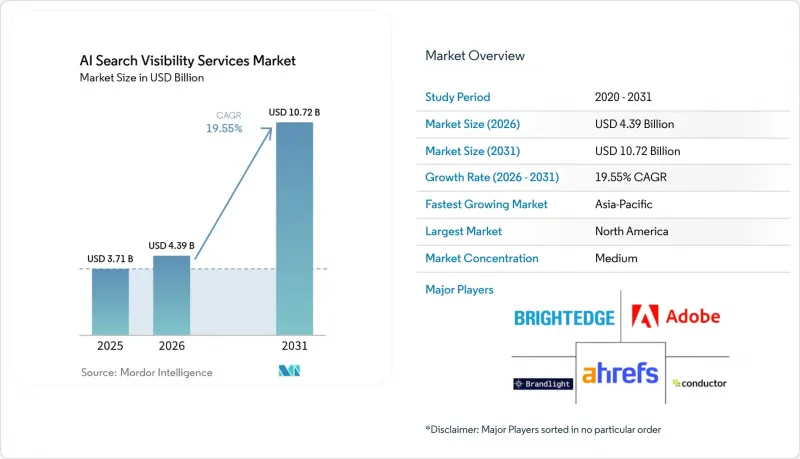
本報告按服務類型(人工智慧搜尋策略和諮詢服務、人工智慧內容最佳化服務、人工智慧搜尋最佳化服務、人工智慧引文和知識管理服務及其他)、最終用戶(零售和電子商務、媒體和娛樂、IT和電信、醫療保健和生命科學及其他)以及地區進行細分。市場預測以美元計價。
全球人工智慧搜尋可見性服務市場趨勢與洞察
增加零點擊發現和人工智慧驅動的購買流程
人工智慧答案引擎正在改變人們的發現過程,它允許品牌在客戶訪問傳統搜尋結果頁面、閱讀產品頁面或提交諮詢之前就得到評估。 2026 年頭四個月,美國Google搜尋中零點擊操作的比例達到了 68.01%。到 2026 年中,Google人工智慧概覽將出現在 43% 的搜尋查詢中,高於去年同期的 15%,這凸顯了出現在被引用答案中以及在客戶提出問題時提供答案引擎的重要性。根據 2025 年的一項消費者調查,人工智慧搜尋用戶在尋找資訊時往往更依賴人工智慧而非傳統搜尋。這將使人工智慧搜尋可見性服務市場在購買漏斗中的地位高於傳統排名服務,因為可見度會影響消費者首先考慮的品牌範圍。對於那些需要跨多個供應商比較和評估產品的公司來說,早期可見度也至關重要。
企業正從搜尋引擎最佳化指標轉向人工智慧視覺化關鍵績效指標
企業支出正從傳統的搜尋指標轉向引用頻率、模型佔有率和人工智慧驅動的轉換率等指標。 94%的受訪高階行銷主管計劃在2026年增加對人工智慧搜尋最佳化(AEO)和地理資訊系統最佳化(GEO)的投資,企業平均將12%的數位行銷預算分配給這些活動。此外,65%的受訪企業領導者計劃在2026年將至少25%的行銷預算分配給人工智慧搜尋最佳化,這顯示這些專案正從實驗階段轉向計畫階段。然而,衡量能力仍不足;上述2025年的調查發現,只有16%的品牌系統性地追蹤人工智慧搜尋表現。這種差距催生了對能夠建立可操作的報告方法、定義有意義的基準並將可見性工作轉化為商業性成果的服務提供者的需求。這也使得教育、實施支援和分析在人工智慧搜尋可見性服務市場中發揮核心作用。
不透明的模型行為與歸因盲點
人工智慧驅動的引用往往會對使用者產生影響,但卻無法清晰記錄可衡量的網站訪問量或底層資訊來源的選擇,這使得衡量成為短期內的主要限制因素。劍橋大學一項針對約 14,000 個真實 LLM 對話的研究發現,92% 的 Gemini 回應缺乏可點擊的來源資訊。該研究還表明,該系統可能更重視與其引用的頁面相關的頁面,從而降低了對支援回應的資訊來源的可見性,並限制了發布者識別其貢獻的能力。此外,來自伺服器端人工智慧代理程式的請求可以繞過 JavaScript,並且超出傳統分析工具的偵測範圍。這使得企業無法將最終點擊歸因應用於人工智慧回覆產生的所有商業性影響。當買家無法將引用與後續收入聯繫起來,或無法將結果與熟悉的網路分析指標進行比較時,價值證明週期可能會被延長。
細分市場分析
2025年,人工智慧內容最佳化服務佔據了人工智慧搜尋可見性服務市場佔有率的34.80%。此類別包括模式實施、可抓取性審核和實體解析工作流程,旨在幫助人工智慧系統存取和解讀數位內容。這些服務通常是企業專案的起點,因為其他活動依賴可存取的頁面和一致、結構化的資訊。技術審查可以識別阻塞路徑、不完整的標記以及實體之間不清晰的關係,這些都會降低品牌可見度。隨著企業需要將生成式搜尋引擎最佳化 (GEO) 工作與其現有的搜尋、內容和分析團隊整合,人工智慧搜尋策略和諮詢服務仍然至關重要。人工智慧內容最佳化服務還可以幫助組織調整現有材料以支援人工智慧驅動的搜尋。 2026年5月,Semrush宣布將其人工智慧可見性資料庫擴展到32個國家/地區,資料庫包含2.61億個LLM提示。這清楚地表明了用於跨市場監測的數據基礎設施的規模。隨著企業追蹤跨多個答案引擎的引用訊息,人工智慧搜尋監測和分析服務的重要性日益凸顯。
預計從2026年到2031年,人工智慧引文和知識管理服務將以19.96%的複合年成長率成長。這一成長反映了管理代理在評估品牌、產品及其權威性時所使用的結構化事實的需求。模型上下文協定 (MCP) 可以幫助代理商存取品牌管理的資料表面,而無需持久會話的開銷。 2026年7月,Agentic AI 基金會發布了 MCP 2026-07-28 規格更新,為此建立了一個無狀態的、HTTP 原生架構。 Adobe 的「目錄代理」在2026年也專注於LLM機器人可以抓取的結構化產品資訊。將實體管理與代理商可存取的內容相結合的提供者可以幫助那些需要在與人工智慧互動過程中獲得可靠資訊的組織。這個服務類別為人工智慧搜尋可見性服務市場指明了方向,使其朝著持續的資料管治營運邁進。它也促使人們的關注點從單一頁面轉向企業資訊環境的品質和一致性。
區域分析
2025年,北美地區佔全球銷售額的44.51%。該地區企業數位行銷預算集中度高,搜尋營運成熟,這使得服務提供者更容易與精通搜尋效果管理的團隊合作。美國企業較早採用者地理位置最佳化(GEO)項目,並隨著答案引擎在搜尋發現中扮演越來越重要的角色,迅速過渡到人工智慧(AI)可見性指標。 2026年,企業平均將12%的數位行銷預算分配給人工智慧最佳化(AEO)和地理位置最佳化(GEO)活動。北美人工智慧搜尋可見性服務市場仍然十分重要,因為買家擁有足夠的預算和成熟的營運能力,可以藉助專業服務提供者的力量,試行新的報告方法,並在大規模的數位產品組合中部署相關項目。
在歐洲,商業應用和內容管治的需求正在塑造市場格局。德國、英國和法國是關鍵市場,因為這些國家的公司正在為更廣泛地採用人工智慧搜尋做準備,並且必須考慮當地的語言、監管和內容管理要求。 2026年初,Google人工智慧概覽在德國15%到25%的搜尋查詢中出現。隨著歐盟人工智慧法案的《Google人工智慧行為準則》(GPAI Code of Conduct)於2026年8月2日生效,負責任的人工智慧內容管治受到了更多關注,這進一步加強了歐洲企業專案中人工智慧搜尋可見性服務市場的合規性基礎。
預計到2031年,亞太地區將以20.12%的複合年成長率成長。這一成長主要得益於行動優先的人工智慧應用、在地化模型的擴展以及多元化的搜尋引擎環境,在這種環境下,單一的全球方法效果不佳。印度的情況較為複雜,搜尋引擎。因此,亞太地區的人工智慧搜尋可見性服務市場可以從跨多個市場的監控中獲益。同時,南美洲和中東及非洲地區仍處於發展初期,Semrush計劃於2026年5月將阿根廷、智利、沙烏地阿拉伯和南非納入其人工智慧可見性資料庫。
其他好處
- Excel格式的市場預測(ME)表
- 三個月的分析師支持
目錄
第1章:引言
- 研究假設和市場定義
- 調查範圍
第2章:調查方法
第3章執行摘要
第4章 市場狀況
- 市場概覽
- 市場促進因素
- 零點擊發現和人工智慧驅動的購買流程的興起
- 企業從搜尋引擎最佳化指標轉向人工智慧可見性關鍵績效指標
- 透過人工智慧提升存取轉換率
- 結構化內容、模式和實體最佳化的普及。
- 品牌接點快速擴展,方便行銷合作夥伴和代理商使用。
- 不同引擎在在地化方面的差異正在推動多個市場對監控的需求。
- 市場限制因素
- 不透明的模型行為與歸因盲點
- 不同人工智慧引擎的資訊來源優先順序和指標標準存在差異
- 由於爬蟲到點擊的不平衡,發布商的獎勵降低。
- 與內容管理、授權和爬蟲合規性相關的風險。
- 產業價值鏈分析
- 宏觀經濟因素對市場的影響
- 監理情勢
- 技術展望
- 波特五力分析
第5章 市場規模與成長預測
- 按服務類型
- 人工智慧搜尋策略與諮詢服務
- AI內容最佳化服務
- 人工智慧搜尋最佳化服務
- AI引文與知識管理服務
- 人工智慧搜尋監控與分析服務
- 最終用戶
- 零售與電子商務
- 媒體與娛樂
- 資訊科技/通訊
- BFSI
- 醫療保健和生命科學
- 車
- 其他最終用戶
- 按地區
- 北美洲
- 美國
- 加拿大
- 墨西哥
- 南美洲
- 巴西
- 阿根廷
- 智利
- 其他南美國家
- 歐洲
- 德國
- 英國
- 法國
- 義大利
- 西班牙
- 其他歐洲國家
- 亞太地區
- 中國
- 日本
- 印度
- 韓國
- 澳洲
- 其他亞太國家
- 中東
- 沙烏地阿拉伯
- 阿拉伯聯合大公國
- 卡達
- 其他中東國家
- 非洲
- 南非
- 埃及
- 奈及利亞
- 其他非洲國家
- 北美洲
第6章 競爭情勢
- 市場集中度
- 策略趨勢
- 市佔率分析
- 公司簡介
- Adobe Inc.
- BrightEdge Technologies, Inc.
- Conductor LLC
- Ahrefs Pte. Ltd.
- Brandlight Inc.
- OtterlyAI GmbH
- Scrunch AI, Inc.
- AthenaHQ, Inc.
- Search Atlas LLC
- First Answer, Inc.
- Aethon AI, Inc.
- iGEO, Inc.
- Onsomble, Inc.
- Seerly, Inc.
第7章 市場機會與未來展望
According to Mordor Intelligence, the AI search visibility services market size is projected to expand from USD 3.71 billion in 2025 and USD 4.39 billion in 2026 to USD 10.72 billion by 2031, registering a CAGR of 19.55% between 2026 to 2031.
This report is Segmented by Service Type (AI Search Strategy and Consulting Services, AI Content Optimization Services, AI Search Optimization Services, AI Citation and Knowledge Management Services, and More), End User (Retail and E-Commerce, Media and Entertainment, IT and Telecom, Healthcare and Life Sciences, and More), and Geography. The Market Forecasts are Provided in Terms of Value (USD).
Global AI Search Visibility Services Market Trends and Insights
Rising Zero-Click Discovery and AI-Mediated Buying Journeys
AI answer engines are changing the discovery process because a brand can be evaluated before a customer reaches a conventional results page, reads a product page, or submits an inquiry. Zero-click behavior reached 68.01% of U.S. Google searches in the first 4 months of 2026. Google AI Overviews appeared in 43% of search queries by mid-2026, up from 15% a year earlier, underscoring the importance of appearing in cited responses and being available to answer engines when a question is asked. AI search users also placed more weight on AI than traditional search when seeking information, according to the 2025 consumer research. This puts the AI search visibility services market closer to the top of the buying funnel than conventional ranking services because visibility can shape the initial set of brands considered. It also makes early visibility important for companies whose products require comparison and consideration across several vendors.
Enterprise Shift from SEO Metrics to AI Visibility KPIs
Enterprise spending is moving from traditional search metrics toward measures such as citation frequency, share of model, and AI referral conversion. 94% of surveyed senior marketing leaders planned to increase AEO and GEO investment in 2026, while enterprises allocated an average 12% of digital marketing budgets to these activities. It also stated that 65% of surveyed enterprise leaders allocated at least 25% of their 2026 marketing budget to AI search optimization, indicating that these programs are becoming a planned rather than experimental activity. Measurement remains incomplete, as only 16% of brands systematically tracked AI search performance in the cited 2025 survey. This gap creates demand for providers that can establish practical reporting methods, define meaningful baselines, and connect visibility activity to commercial outcomes. It also makes education, implementation support, and analytics central to the AI search visibility services market.
Opaque Model Behavior and Attribution Blind Spots
Measurement is the main near-term constraint because AI citations often influence users without producing a measurable website visit or a clear record of the underlying source selection. Research from Cambridge University examining nearly 14,000 real-world LLM conversations found that Gemini did not provide a clickable citation in 92% of its answers. The same research showed that a system may evaluate more relevant pages than it cites, reducing the visibility of the sources that informed an answer and limiting a publisher's ability to identify its contribution. Server-side AI agent requests can also avoid JavaScript and remain outside the scope of conventional analytics tools. This prevents firms from applying last-click attribution to all commercial influence generated by AI answers. Longer proof-of-value cycles can follow when buyers cannot connect citations to downstream revenue or compare results to familiar web analytics metrics.
Other drivers and restraints analyzed in the detailed report include:
- Higher Conversion Quality From AI-Referred Visits
- Growing Adoption of Structured Content, Schema, and Entity Optimization
- Fragmented AI Engine Source Preferences and Measurement Standards
For complete list of drivers and restraints, kindly check the Table Of Contents.
Segment Analysis
AI Content Optimization Services held 34.80% of the AI search visibility services market share in 2025. The category includes schema implementation, crawlability audits, and entity resolution workflows that help AI systems access and interpret digital content. These services are often the starting point for an enterprise program because other activities depend on accessible pages and consistent, structured information. Technical reviews can identify blocked paths, incomplete markup, and unclear entity relationships that reduce a brand's visibility. AI Search Strategy and Consulting Services remain important because enterprises must integrate GEO work with existing search, content, and analytics teams. AI Content Optimization Services also support organizations that need to adapt existing material for AI-assisted discovery. In May 2026, Semrush expanded its AI Visibility Database to 32 countries and reported a database of 261 million LLM prompts, illustrating the scale of the data infrastructure used for cross-market monitoring. Monitoring and Analytics Services are becoming increasingly relevant as companies track citations across multiple answer engines
AI Citation and Knowledge Management Services are projected to grow at a CAGR of 19.96% from 2026 to 2031. This growth reflects the need to manage the structured facts that agents use when assessing a brand, its products, and its authority. The Model Context Protocol can support agent access to brand-controlled data surfaces without persistent session overhead. The Agentic AI Foundation released the MCP 2026-07-28 specification update in July 2026, which established a stateless, HTTP-native architecture for this purpose. Adobe's Catalog Agent in 2026 also focused on the structured product information that LLM bots can crawl. Providers that combine entity management with agent-accessible content can support organizations that need reliable information across AI interactions. This service category gives the AI search visibility services market a path toward recurring data governance work. It also shifts attention from isolated pages toward the quality and consistency of a company's information environment.
Complete Report Scope:
- By Service Type
- AI Search Strategy and Consulting Services
- AI Content Optimization Services
- AI Search Optimization Services
- AI Citation and Knowledge Management Services
- AI Search Monitoring and Analytics Services
- By End User
- Retail and E-commerce
- Media and Entertainment
- IT and Telecom
- BFSI
- Healthcare and Life Sciences
- Automotive
- Other End Users
- By Geography
- North America
- United States
- Canada
- Mexico
- South America
- Brazil
- Argentina
- Chile
- Rest of South America
- Europe
- Germany
- United Kingdom
- France
- Italy
- Spain
- Rest of Europe
- Asia-Pacific
- China
- Japan
- India
- South Korea
- Australia
- Rest of Asia-Pacific
- Middle East
- Saudi Arabia
- United Arab Emirates
- Qatar
- Rest of Middle East
- Africa
- South Africa
- Egypt
- Nigeria
- Rest of Africa
- North America
Geography Analysis
North America held 44.51% of revenue in 2025. The region has a large concentration of enterprise digital marketing budgets and mature search operations, which gives providers access to teams already familiar with search performance management. U.S. organizations were early adopters of GEO programs and moved quickly toward AI visibility measures as answer engines gained a larger role in discovery. Enterprises allocated an average 12% of digital marketing budgets to AEO and GEO activities in 2026. The AI search visibility services market in North America remains important because buyers have both the budget and the operational maturity to use specialized providers, test new reporting methods, and extend programs across large digital portfolios.
Europe is shaped by commercial adoption and the need for content governance. Germany, the United Kingdom, and France are important markets because enterprises in these countries are preparing for wider AI search adoption and must consider local language, regulatory, and content management requirements. Google AI Overviews appeared in 15%-25% of German queries in early 2026. The EU AI Act's GPAI Code of Practice became enforceable from August 2, 2026, increasing attention to responsible AI-accessible content governance and giving the AI search visibility services market a stronger compliance-related rationale in European enterprise programs.
Asia-Pacific is projected to expand at a CAGR of 20.12% through 2031. Growth is supported by mobile-first AI use, expanding local models, and a diverse search engine environment that makes a single global approach less effective. India presents complexity because regional languages and domestic model deployment require a local approach to optimization, content review, and prompt monitoring. China is distinct because Baidu's Ernie Bot, Alibaba's Tongyi Qianwen, and ByteDance's Doubao use localized data and citation patterns that differ from Western engines. The AI search visibility services market in Asia-Pacific can therefore benefit from multi-market monitoring, while South America, the Middle East, and Africa remain earlier-stage regions and Semrush added Argentina, Chile, Saudi Arabia, and South Africa to its AI Visibility Database in May 2026.
- Adobe Inc.
- BrightEdge Technologies, Inc.
- Conductor LLC
- Ahrefs Pte. Ltd.
- Brandlight Inc.
- OtterlyAI GmbH
- Scrunch AI, Inc.
- AthenaHQ, Inc.
- Search Atlas LLC
- First Answer, Inc.
- Aethon AI, Inc.
- iGEO, Inc.
- Onsomble, Inc.
- Seerly, Inc.
Additional Benefits:
- The market estimate (ME) sheet in Excel format
- 3 months of analyst support
TABLE OF CONTENTS
1 INTRODUCTION
- 1.1 Study Assumptions and Market Definition
- 1.2 Scope of the Study
2 RESEARCH METHODOLOGY
3 EXECUTIVE SUMMARY
4 MARKET LANDSCAPE
- 4.1 Market Overview
- 4.2 Market Drivers
- 4.2.1 Rising Zero-Click Discovery and AI-Mediated Buying Journeys
- 4.2.2 Enterprise Shift From SEO Metrics to AI Visibility KPIs
- 4.2.3 Higher Conversion Quality From AI-Referred Visits
- 4.2.4 Growing Adoption of Structured Content, Schema, and Entity Optimization
- 4.2.5 Rapid Expansion of MCP and Agent-Accessible Brand Surfaces
- 4.2.6 Cross-Engine Localization Gaps Driving Multi-Market Monitoring Demand
- 4.3 Market Restraints
- 4.3.1 Opaque Model Behavior and Attribution Blind Spots
- 4.3.2 Fragmented AI Engine Source Preferences and Measurement Standards
- 4.3.3 Crawl-to-Click Imbalance Weakening Publisher Incentives
- 4.3.4 Content Control, Licensing, and Crawler Compliance Risks
- 4.4 Industry Value Chain Analysis
- 4.5 Impact of Macroeconomic Factors on the Market
- 4.6 Regulatory Landscape
- 4.7 Technological Outlook
- 4.8 Porter's Five Forces Analysis
- 4.8.1 Threat of New Entrants
- 4.8.2 Bargaining Power of Buyers
- 4.8.3 Bargaining Power of Suppliers
- 4.8.4 Threat of Substitutes
- 4.8.5 Industry Rivalry
5 MARKET SIZE AND GROWTH FORECASTS (VALUE)
- 5.1 By Service Type
- 5.1.1 AI Search Strategy and Consulting Services
- 5.1.2 AI Content Optimization Services
- 5.1.3 AI Search Optimization Services
- 5.1.4 AI Citation and Knowledge Management Services
- 5.1.5 AI Search Monitoring and Analytics Services
- 5.2 By End User
- 5.2.1 Retail and E-commerce
- 5.2.2 Media and Entertainment
- 5.2.3 IT and Telecom
- 5.2.4 BFSI
- 5.2.5 Healthcare and Life Sciences
- 5.2.6 Automotive
- 5.2.7 Other End Users
- 5.3 By Geography
- 5.3.1 North America
- 5.3.1.1 United States
- 5.3.1.2 Canada
- 5.3.1.3 Mexico
- 5.3.2 South America
- 5.3.2.1 Brazil
- 5.3.2.2 Argentina
- 5.3.2.3 Chile
- 5.3.2.4 Rest of South America
- 5.3.3 Europe
- 5.3.3.1 Germany
- 5.3.3.2 United Kingdom
- 5.3.3.3 France
- 5.3.3.4 Italy
- 5.3.3.5 Spain
- 5.3.3.6 Rest of Europe
- 5.3.4 Asia-Pacific
- 5.3.4.1 China
- 5.3.4.2 Japan
- 5.3.4.3 India
- 5.3.4.4 South Korea
- 5.3.4.5 Australia
- 5.3.4.6 Rest of Asia-Pacific
- 5.3.5 Middle East
- 5.3.5.1 Saudi Arabia
- 5.3.5.2 United Arab Emirates
- 5.3.5.3 Qatar
- 5.3.5.4 Rest of Middle East
- 5.3.6 Africa
- 5.3.6.1 South Africa
- 5.3.6.2 Egypt
- 5.3.6.3 Nigeria
- 5.3.6.4 Rest of Africa
- 5.3.1 North America
6 COMPETITIVE LANDSCAPE
- 6.1 Market Concentration
- 6.2 Strategic Moves
- 6.3 Market Share Analysis
- 6.4 Company Profiles (includes Global Level Overview, Market Level Overview, Core Segments, Financials as available, Strategic Information, Market Rank/Share, Products and Services, Recent Developments)
- 6.4.1 Adobe Inc.
- 6.4.2 BrightEdge Technologies, Inc.
- 6.4.3 Conductor LLC
- 6.4.4 Ahrefs Pte. Ltd.
- 6.4.5 Brandlight Inc.
- 6.4.6 OtterlyAI GmbH
- 6.4.7 Scrunch AI, Inc.
- 6.4.8 AthenaHQ, Inc.
- 6.4.9 Search Atlas LLC
- 6.4.10 First Answer, Inc.
- 6.4.11 Aethon AI, Inc.
- 6.4.12 iGEO, Inc.
- 6.4.13 Onsomble, Inc.
- 6.4.14 Seerly, Inc.
7 MARKET OPPORTUNITIES AND FUTURE OUTLOOK
- 7.1 White-Space and Unmet-Need Assessment

 生成式人工智慧引擎最佳化(GEO)平台市場:按產品類型、部署類型、平台功能、技術類型、應用、最終用戶和地區分類
 創新通路情報:市場佔有率分析、產業趨勢與統計、成長預測(2026-2031)AI創新最佳化服務:市場佔有率分析、產業趨勢與統計、成長預測(2026-2031年)合成媒體行銷服務:市場佔有率分析、產業趨勢與統計、成長預測(2026-2031)
 生成式引擎最佳化(GEO)平台市場:依產品類型、應用、部署類型、技術、平台功能、國家及地區分類-全球產業分析、市場規模、市場佔有率及2026年至2033年預測人工智慧搜尋最佳化軟體:市場佔有率分析、產業趨勢與統計、成長預測(2026-2031)
 內容自動化人工智慧工具市場規模、佔有率和成長分析:按工具功能、部署模式、應用領域、企業規模、銷售管道和地區分類-2026-2033年產業預測
 2026年全球銷售說明摘要工具市場報告2026年Web3.0人工智慧生成內容(AIGC)引擎全球市場報告
 設計領域的人工智慧 (AI) 市場:策略洞察與預測 (2026–2031)