


 |
市場調查報告書
商品編碼
2119060
第一方資料貨幣化服務:市場佔有率分析、產業趨勢與統計、成長預測(2026-2031 年)First-Party Data Monetization Services - Market Share Analysis, Industry Trends & Statistics, Growth Forecasts (2026 - 2031) |
||||||

※ 本網頁內容可能與最新版本有所差異。詳細情況請與我們聯繫。
根據 Mordor Intelligence 預測,第一方資料貨幣化服務市場規模將從 2025 年的 47.4 億美元成長到 2026 年的 56.7 億美元,到 2031 年達到 135.1 億美元,2026 年至 2031 年的複合年成長率為 18.96%。
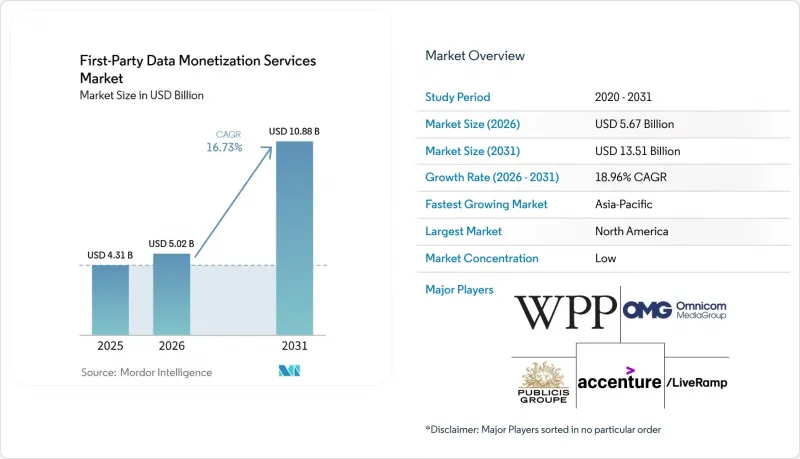
本報告按服務類型(例如,策略和用例設計、資料工程和平台部署)、應用程式(例如,個人化行銷、客戶分析、廣告和受眾洞察)、最終用戶產業(例如,零售和電子商務、醫療保健和生命科學)以及地區進行細分。市場預測以價值(美元)表示。
全球第一方資料變現服務市場趨勢及洞察
零售和商業媒體的擴張增加了對受眾變現的需求。
在第一方資料變現服務市場,零售媒體已成為企業利用已驗證的客戶關係創造價值的實際有效途徑。向非內生類別的拓展正在推動需求超越零售商銷售的品牌本身。零售網路正在開發受眾細分、分析產品和衡量服務,這些服務可以獨立於廣告庫存提供。這正將服務需求轉向資料工程、身分解析以及為合作夥伴準備受眾產品。 2026年1月,Amperity推出了「受眾變現」服務,幫助品牌創建身分解析受眾、實現跨平台廣告投放自動化並應用管治控制。因此,在第一方資料變現服務市場,對能夠將客戶資料與合規的啟動和衡量工作流程相結合的服務的需求日益成長。
第三方訊號的缺失正在加速對專有身分圖譜的需求。
可靠的第三方訊號的持續缺失,提升了專有身分基礎設施在「第一方資料貨幣化服務市場」的價值。瀏覽器設定和行動裝置隱私控制正在降低企業無法直接控制的識別碼的持久性。 「認證受眾」標準更強調雜湊電子郵件地址、登入識別碼和認證會話資料作為可用的啟動輸入。在2026年之前建構確定性認同圖譜的組織,在衡量和客戶活化方面擁有堅實的基礎。許多企業仍然需要進行身份解析和用戶畫像整合,才能使客戶資料支援貨幣化專案。因此,第一方資料貨幣化服務市場不僅對軟體授權的需求不斷成長,而且對建立託管身分圖譜的需求也在成長。
隱私法律碎片化以及同意實施的複雜性
隱私要求的碎片化使得企業難以在其所有營運區域應用統一的同意和管治設計。雖然GDPR要求處理資料必須有書面的法律依據,但加州法規包含選擇退出機制,並對敏感資訊提出了個人化要求。到2026年,美國將有20個州頒布全面的消費者隱私法,這將導致適用閾值和執法方式的差異。此外,中國對個人資料二次使用的同意範圍有著嚴格的限制。因此,服務供應商必須檢驗同意情況、追蹤跨境資料流動並即時評估可用性。雖然這種複雜性推動了對隱私、同意和管治服務的需求,但有時也會減緩第一方資料貨幣化服務在市場上的普及。
細分市場分析
到2025年,「數據協作和無塵室服務」將佔服務類型總收入的28.12%,在第一方數據貨幣化服務市場中佔據領先地位。企業越來越傾向於將託管協作視為一項持續性職能,而非一次性專案。這催生了對查詢設計、合作夥伴配置、衡量指標管治、存取控制和人工智慧工作負載管理的持續需求。 「認證受眾」標準和「統一ID 2.0」框架提供了一個身分基礎,可以減少身分解析和下游協作之間的摩擦。 「受眾商業化和活化服務」也不斷擴展,因為零售網路和第三方市場將已授權的受眾打包提供給非產業合作夥伴和程式化管道。
預計2026年至2031年間,數據協作和無塵室服務領域的第一方數據貨幣化服務市場規模將以20.92%的複合年成長率成長。對於啟動正式貨幣化專案的組織而言,策略和用例設計,以及資料工程和平台實施,仍然是關鍵的切入點。隨著組織從諮詢專案轉向受管治的資料產品和合作夥伴工作流程,這些工作可能需要數年時間。由於在權限、目的和管轄範圍方面建立控制措施之前,資料的使用可能會受到限制,因此對隱私、同意和管治服務的需求日益成長。隨著品牌量化增量收入並滿足對閉合迴路歸因更高的期望,衡量和貨幣化最佳化服務變得越來越重要。
區域分析
到2025年,北美將佔全球收入的40.12%,佔據第一方資料貨幣化服務市場的最大佔有率。這反映了零售媒體的活性化、客戶資料平台部署的成熟以及各州層級隱私保護義務的加強。亞馬遜和沃爾瑪正在美國推動大規模零售媒體運營,從而帶動品牌和代理商對身份解析、潔淨室設計、受眾互動和效果衡量最佳化等方面的需求。在加拿大聯邦層級就數位隱私議題展開討論的同時,墨西哥蓬勃發展的電子商務和金融科技產業也正在為零售商和金融服務機構帶來對客戶資料基礎設施的早期需求。
預計亞太地區在2026年至2031年間將以20.56%的複合年成長率成長,成為第一方數據貨幣化服務市場成長最快的地區。在印度,《數位個人資料保護條例》於2025年11月頒布,並提供了18個月的分階段合規過渡期。這項時間安排鼓勵企業在專案變得更加複雜之前,投資於使用者授權基礎設施、身分解析和更清晰的資料使用管理。在中國,《個人資訊保護法》和資料安全框架正在建構一種更規範的商業資料使用方式,而國家資料資產法規則提高了商業資料交易的透明度。 2025年12月,日本經濟產業省發布了關於透明度和公平性的評估報告;2025年8月,Catalina Marketing Japan推出了零售媒體網路「AOUMI」。預計韓國和澳洲的零售和金融服務公司將透過開發受眾產品和客戶數據項目實現二次成長。
歐洲、南美洲以及中東和非洲佔據了第一方資料貨幣化服務市場的剩餘佔有率。在歐洲,監管主導的需求模式正在興起, 《一般資料保護規則》(GDPR)推動了德國、英國和法國對同意管理、管治、身分管理和無塵室專案的持續投資。南美尚處於早期階段,巴西在《通用資料保護法》(Lei Geral de Protecao de Dados)的指導下發揮著主導作用,而阿根廷和智利的零售商、銀行和電子商務平台正在推出受眾產品化專案。阿拉伯聯合大公國和沙烏地阿拉伯的電信業者和擁有龐大認證用戶群的金融機構對數據貨幣化服務表現出越來越濃厚的興趣,這可能會促進與產業外夥伴關係模式。非洲仍處於起步階段,奈及利亞的一家金融科技平台和南非的零售集團正在推出客戶資料整合專案。
其他好處:
- Excel格式的市場預測(ME)表
- 3個月的分析師支持
目錄
第1章:引言
- 研究假設和市場定義
- 調查範圍
第2章:調查方法
第3章執行摘要
第4章 市場狀況
- 市場概覽
- 市場促進因素
- 第三方訊號的缺失正在加速對專有身分圖譜的需求。
- 零售和商業媒體的擴張正在推動對受眾貨幣化需求的成長。
- 企業對人工智慧 (AI) 和個人化方面的投資正在提升基於客戶同意的數據的價值。
- 擴大隱私保護資料共享範圍並引入潔淨室。
- 互通性標準降低了採用障礙
- 非產業數據夥伴關係正在開闢新的收入來源。
- 市場限制因素
- 隱私法律碎片化以及同意執行的複雜性
- 雲端資料傳輸和查詢成本正在給利潤率帶來壓力。
- 對基礎設施中立性的擔憂正在減緩人們參與生態系統的速度。
- 第一方數據的成熟度有差異,延長了引進週期。
- 宏觀經濟因素對市場的影響
- 產業價值鏈分析
- 科技趨勢
- 監理情勢
- 波特五力分析
第5章 市場規模與成長預測
- 按服務類型
- 設計策略和用例
- 數據工程和平台實施
- ID匹配和個人資料整合
- 隱私、同意和管治相關服務
- 數據協作及潔淨室服務
- 受眾產品化和啟動服務
- 衡量和貨幣化最佳化服務
- 其他服務類型
- 透過使用
- 個性化行銷
- 客戶分析
- 廣告和受眾洞察
- 建議引擎
- 商業智慧
- 客戶體驗管理
- 其他用途
- 按最終用戶行業分類
- 零售與電子商務
- BFSI
- 醫療保健和生命科學
- 媒體與娛樂
- 電訊
- 旅遊與飯店
- 製造業
- 車
- 其他終端用戶產業
- 按地區
- 北美洲
- 美國
- 加拿大
- 墨西哥
- 南美洲
- 巴西
- 阿根廷
- 智利
- 其他南美國家
- 歐洲
- 德國
- 英國
- 法國
- 義大利
- 西班牙
- 其他歐洲國家
- 亞太地區
- 中國
- 日本
- 印度
- 韓國
- 澳洲
- 其他亞太國家
- 中東
- 阿拉伯聯合大公國
- 沙烏地阿拉伯
- 卡達
- 其他中東國家
- 非洲
- 南非
- 埃及
- 奈及利亞
- 其他非洲國家
- 北美洲
第6章 競爭情勢
- 市場集中度
- 策略趨勢
- 市佔率分析
- 公司簡介
- Publicis Groupe SA
- WPP plc
- Dentsu Group Inc.
- Accenture plc
- Acxiom LLC
- Omnicom Group Inc.
- LiveRamp Holdings, Inc.
- Snowflake Inc.
- Adobe Inc.
- Salesforce, Inc.
- Oracle Corporation
- Amazon Web Services, Inc.
- Google LLC
- TransUnion
- Experian plc
- Amperity, Inc.
- BlueConic, Inc.
- Permutive Limited
- Dawex Systems SAS
- Adastra Corporation
第7章 市場機會與未來展望
According to Mordor Intelligence, the first-Party data monetization services market size is expected to increase from USD 4.74 billion in 2025 to USD 5.67 billion in 2026 and reach USD 13.51 billion by 2031, growing at a CAGR of 18.96% over 2026-2031.
This report is Segmented by Service Type (Strategy and Use-Case Design, Data Engineering and Platform Implementation, and More), Application (Personalized Marketing, Customer Analytics, Advertising and Audience Insights, and More), End-User Industry (Retail and E-Commerce, Healthcare and Lifesciences, and More), and Geography. The Market Forecasts are Provided in Terms of Value (USD).
Global First-Party Data Monetization Services Market Trends and Insights
Retail Media and Commerce Media Expansion Increasing Demand for Audience Monetization
Retail media has become a practical route for companies to generate value from authenticated customer relationships in the First-Party Data Monetization Services Market. Its expansion into non-endemic categories is broadening demand beyond brands sold through retailers. Retail networks are developing audience segments, analytical products, and measurement services that can be offered separately from advertising inventory. This shifts service demand toward data engineering, identity resolution, and the preparation of audience products for partner use. Amperity launched Audience Monetization in January 2026 to help brands create identity-resolved audiences, automate marketplace distribution, and apply governance controls. The First-Party Data Monetization Services Market, therefore, has a growing need for services that connect customer data with compliant activation and measurement workflows.
Third-Party Signal Loss Accelerating Demand for Owned Identity Graphs
The continuing loss of reliable third-party signals is increasing the value of owned identity infrastructure in the First-Party Data Monetization Services Market. Browser settings and mobile privacy controls have reduced the durability of identifiers that companies do not control directly. Authenticated Audiences standards place greater emphasis on hashed email addresses, login identifiers, and authenticated session data as usable activation inputs. Organizations that developed deterministic identity graphs before 2026 have a stronger basis for measurement and customer activation. Many enterprises still need identity resolution and profile unification before their customer data can support monetization programs. The First-Party Data Monetization Services Market is consequently seeing demand for managed identity graph construction, not only for software licenses.
Fragmented Privacy Laws and Consent Enforcement Complexity
Fragmented privacy requirements make it difficult for organizations to use one consent and governance design across all operating regions. The GDPR requires a documented lawful basis for processing, while California rules include opt-out mechanisms and separate requirements for sensitive information. By 2026, 20 U.S. states had enacted comprehensive consumer privacy laws, adding different applicability thresholds and enforcement approaches. China also maintains strict limits on the scope of consent for secondary uses of personal information. Service providers must therefore conduct consent validation, map cross-border data flows, and assess activation eligibility in real time. The First-Party Data Monetization Services Market faces slower activation in some cases, even as this complexity supports demand for privacy, consent, and governance services.
Other drivers and restraints analyzed in the detailed report include:
- Enterprise AI and Personalization Investments Raising the Value of Consent-Rich Customer Data
- Growth in Privacy-Safe Data Collaboration and Clean Room Adoption
- Cloud Egress and Query Costs Compressing Monetization Margins
For complete list of drivers and restraints, kindly check the Table Of Contents.
Segment Analysis
Data Collaboration and Clean Room Services captured 28.12% of service-type revenue in 2025 and led the First-Party Data Monetization Services Market share. Enterprises increasingly treat controlled collaboration as an ongoing capability rather than a temporary project. This creates continuing demand for query design, partner provisioning, measurement governance, access controls, and AI workload management. The Authenticated Audiences standards and Unified ID 2.0 framework provide an identity foundation that can reduce friction between identity resolution and downstream collaboration. Audience Productization and Activation Services are also expanding as retail networks and second-party marketplaces package consented audiences for non-endemic partners and programmatic channels.
The First-Party Data Monetization Services Market size for Data Collaboration and Clean Room Services is projected to grow at a 20.92% CAGR between 2026 and 2031. Strategy and Use-Case Design, together with Data Engineering and Platform Implementation, remain the main entry points for organizations beginning formal monetization programs. These engagements can become multiyear work when organizations move from advisory programs to governed data products and partner workflows. Privacy, Consent, and Governance Services are seeing greater demand because activation can be limited until permissions, use purposes, and cross-jurisdiction controls are established. Measurement and Monetization Optimization Services become more important as brands quantify incremental revenue yield and meet higher closed-loop attribution expectations.
Complete Report Scope:
- By Service Type
- Strategy and Use-Case Design
- Data Engineering and Platform Implementation
- Identity Resolution and Profile Unification
- Privacy, Consent, and Governance Services
- Data Collaboration and Clean Room Services
- Audience Productization and Activation Services
- Measurement and Monetization Optimization Services
- Other Service Types
- By Application
- Personalized Marketing
- Customer Analytics
- Advertising and Audience Insights
- Recommendation Engines
- Business Intelligence
- Customer Experience Management
- Other Applications
- By End-user Industry
- Retail and E-commerce
- BFSI
- Healthcare and Lifesciences
- Media and Entertainment
- Telecommunications
- Travel and Hospitality
- Manufacturing
- Automotive
- Other End User Industries
- By Geography
- North America
- United States
- Canada
- Mexico
- South America
- Brazil
- Argentina
- Chile
- Rest of South America
- Europe
- Germany
- United Kingdom
- France
- Italy
- Spain
- Rest of Europe
- Asia-Pacific
- China
- Japan
- India
- South Korea
- Australia
- Rest of Asia-Pacific
- Middle East
- United Arab Emirates
- Saudi Arabia
- Qatar
- Rest of Middle East
- Africa
- South Africa
- Egypt
- Nigeria
- Rest of Africa
- North America
Geography Analysis
North America held 40.12% of revenue in 2025, representing the largest First-Party Data Monetization Services Market share and reflecting retail media activity, mature customer data platform adoption, and state-level privacy obligations. Amazon and Walmart support substantial retail media activity in the United States, creating demand among brands and agencies for identity resolution, clean room design, audience activation, and measurement optimization. Canada is progressing federal digital privacy discussions, while Mexico's expanding e-commerce and financial technology sectors are creating earlier-stage demand for customer data infrastructure among retailers and financial services organizations.
Asia-Pacific is projected to expand at a 20.56% CAGR between 2026 and 2031, making it the fastest-growing geographic area in the First-Party Data Monetization Services Market. India's Digital Personal Data Protection Rules were notified in November 2025, creating an 18-month phased compliance window. This timing has encouraged enterprises to invest in consent infrastructure, identity resolution, and clearer data-use controls before programs become more complex. China's Personal Information Protection Law and data security framework are shaping more formal approaches to commercial data use, while national data asset rules are adding clarity to commercial data transactions. Japan's Ministry of Economy, Trade, and Industry published its Transparency and Fairness evaluation in December 2025, and Catalina Marketing Japan launched the AOUMI retail media network in August 2025. South Korea and Australia add secondary growth through retail and financial services organizations that are developing audience products and customer data programs.
Europe, South America, the Middle East, and Africa account for the remaining share of the First-Party Data Monetization Services Market. Europe has a regulation-led pattern of demand, with the GDPR supporting continued investment in consent management, governance, identity controls, and clean room programs across Germany, the United Kingdom, and France. South America is at an earlier stage, led by Brazil under the Lei Geral de Protecao de Dados, while retailers, banks, and e-commerce platforms in Argentina and Chile are beginning audience productization programs. The United Arab Emirates and Saudi Arabia are seeing growing interest from telecom operators and financial institutions with large authenticated subscriber bases that may support non-endemic partnership models. Africa remains at an early stage, with fintech platforms in Nigeria and retail groups in South Africa beginning customer data unification programs.
- Publicis Groupe S.A.
- WPP plc
- Dentsu Group Inc.
- Accenture plc
- Acxiom LLC
- Omnicom Group Inc.
- LiveRamp Holdings, Inc.
- Snowflake Inc.
- Adobe Inc.
- Salesforce, Inc.
- Oracle Corporation
- Amazon Web Services, Inc.
- Google LLC
- TransUnion
- Experian plc
- Amperity, Inc.
- BlueConic, Inc.
- Permutive Limited
- Dawex Systems SAS
- Adastra Corporation
Additional Benefits:
- The market estimate (ME) sheet in Excel format
- 3 months of analyst support
TABLE OF CONTENTS
1 INTRODUCTION
- 1.1 Study Assumptions and Market Definition
- 1.2 Scope of the Study
2 RESEARCH METHODOLOGY
3 EXECUTIVE SUMMARY
4 MARKET LANDSCAPE
- 4.1 Market Overview
- 4.2 Market Drivers
- 4.2.1 Third-Party Signal Loss Accelerating Demand for Owned Identity Graphs
- 4.2.2 Retail Media and Commerce Media Expansion Increasing Demand for Audience Monetization
- 4.2.3 Enterprise Artificial Intelligence and Personalization Investments Raising the Value of Consent-Rich Customer Data
- 4.2.4 Growth in Privacy-Safe Data Collaboration and Clean Room Adoption
- 4.2.5 Interoperability Standards Lowering Activation Friction
- 4.2.6 Non-Endemic Data Partnerships Unlocking New Revenue Pools
- 4.3 Market Restraints
- 4.3.1 Fragmented Privacy Laws and Consent Enforcement Complexity
- 4.3.2 Cloud Egress and Query Costs Compressing Monetization Margins
- 4.3.3 Infrastructure Neutrality Concerns Slowing Ecosystem Participation
- 4.3.4 Uneven First-Party Data Maturity Extending Implementation Cycles
- 4.4 Impact of Macroeconomic Factors on the Market
- 4.5 Industry Value-Chain Analysis
- 4.6 Technology Outlook
- 4.7 Regulatory Landscape
- 4.8 Porter's Five Forces Analysis
- 4.8.1 Threat of New Entrants
- 4.8.2 Bargaining Power of Suppliers
- 4.8.3 Bargaining Power of Buyers
- 4.8.4 Threat of Substitutes
- 4.8.5 Intensity of Competitive Rivalry
5 MARKET SIZE AND GROWTH FORECASTS (VALUE)
- 5.1 By Service Type
- 5.1.1 Strategy and Use-Case Design
- 5.1.2 Data Engineering and Platform Implementation
- 5.1.3 Identity Resolution and Profile Unification
- 5.1.4 Privacy, Consent, and Governance Services
- 5.1.5 Data Collaboration and Clean Room Services
- 5.1.6 Audience Productization and Activation Services
- 5.1.7 Measurement and Monetization Optimization Services
- 5.1.8 Other Service Types
- 5.2 By Application
- 5.2.1 Personalized Marketing
- 5.2.2 Customer Analytics
- 5.2.3 Advertising and Audience Insights
- 5.2.4 Recommendation Engines
- 5.2.5 Business Intelligence
- 5.2.6 Customer Experience Management
- 5.2.7 Other Applications
- 5.3 By End-user Industry
- 5.3.1 Retail and E-commerce
- 5.3.2 BFSI
- 5.3.3 Healthcare and Lifesciences
- 5.3.4 Media and Entertainment
- 5.3.5 Telecommunications
- 5.3.6 Travel and Hospitality
- 5.3.7 Manufacturing
- 5.3.8 Automotive
- 5.3.9 Other End User Industries
- 5.4 By Geography
- 5.4.1 North America
- 5.4.1.1 United States
- 5.4.1.2 Canada
- 5.4.1.3 Mexico
- 5.4.2 South America
- 5.4.2.1 Brazil
- 5.4.2.2 Argentina
- 5.4.2.3 Chile
- 5.4.2.4 Rest of South America
- 5.4.3 Europe
- 5.4.3.1 Germany
- 5.4.3.2 United Kingdom
- 5.4.3.3 France
- 5.4.3.4 Italy
- 5.4.3.5 Spain
- 5.4.3.6 Rest of Europe
- 5.4.4 Asia-Pacific
- 5.4.4.1 China
- 5.4.4.2 Japan
- 5.4.4.3 India
- 5.4.4.4 South Korea
- 5.4.4.5 Australia
- 5.4.4.6 Rest of Asia-Pacific
- 5.4.5 Middle East
- 5.4.5.1 United Arab Emirates
- 5.4.5.2 Saudi Arabia
- 5.4.5.3 Qatar
- 5.4.5.4 Rest of Middle East
- 5.4.6 Africa
- 5.4.6.1 South Africa
- 5.4.6.2 Egypt
- 5.4.6.3 Nigeria
- 5.4.6.4 Rest of Africa
- 5.4.1 North America
6 COMPETITIVE LANDSCAPE
- 6.1 Market Concentration
- 6.2 Strategic Moves
- 6.3 Market Share Analysis
- 6.4 Company Profiles (includes Global Level Overview, Market Level Overview, Core Segments, Financials as available, Strategic Information, Market Rank/Share, Products and Services, Recent Developments)
- 6.4.1 Publicis Groupe S.A.
- 6.4.2 WPP plc
- 6.4.3 Dentsu Group Inc.
- 6.4.4 Accenture plc
- 6.4.5 Acxiom LLC
- 6.4.6 Omnicom Group Inc.
- 6.4.7 LiveRamp Holdings, Inc.
- 6.4.8 Snowflake Inc.
- 6.4.9 Adobe Inc.
- 6.4.10 Salesforce, Inc.
- 6.4.11 Oracle Corporation
- 6.4.12 Amazon Web Services, Inc.
- 6.4.13 Google LLC
- 6.4.14 TransUnion
- 6.4.15 Experian plc
- 6.4.16 Amperity, Inc.
- 6.4.17 BlueConic, Inc.
- 6.4.18 Permutive Limited
- 6.4.19 Dawex Systems SAS
- 6.4.20 Adastra Corporation
7 MARKET OPPORTUNITIES AND FUTURE OUTLOOK
- 7.1 White-Space and Unmet-Need Assessment

 2026-2030年全球數據貨幣化市場
 6G技術在企業商業化戰略的潛力
 全球電信業者市場追蹤報告(2026年第二季):營運商將在不損害利潤率的前提下擴大資本支出
 生技智慧財產權(IP)貨幣化平台市場規模、佔有率和成長分析:按平台類型、部署模式、應用、最終用戶和地區分類-2026-2033年產業預測
 資料貨幣化:市場佔有率分析、產業趨勢與統計、成長預測(2026-2031)
 數據貨幣化市場-2026-2032年全球市場預測通訊業者資料貨幣化市場:按服務類型、定價模式、部署模式、客戶類型和產業分類-2026-2032年全球市場預測電信資料貨幣化:市場佔有率分析、產業趨勢與統計、成長預測(2026-2031)
 資料貨幣化市場規模、佔有率、趨勢和預測:按方法論、組織規模、最終用途和地區分類,2026-2034 年
 數據貨幣化市場:按組件、部署方式、組織規模、產業和地區分類