


 |
市場調查報告書
商品編碼
2118892
內容策略服務:市場佔有率分析、產業趨勢與統計、成長預測(2026-2031)Content Strategy Services - Market Share Analysis, Industry Trends & Statistics, Growth Forecasts (2026 - 2031) |
||||||

※ 本網頁內容可能與最新版本有所差異。詳細情況請與我們聯繫。
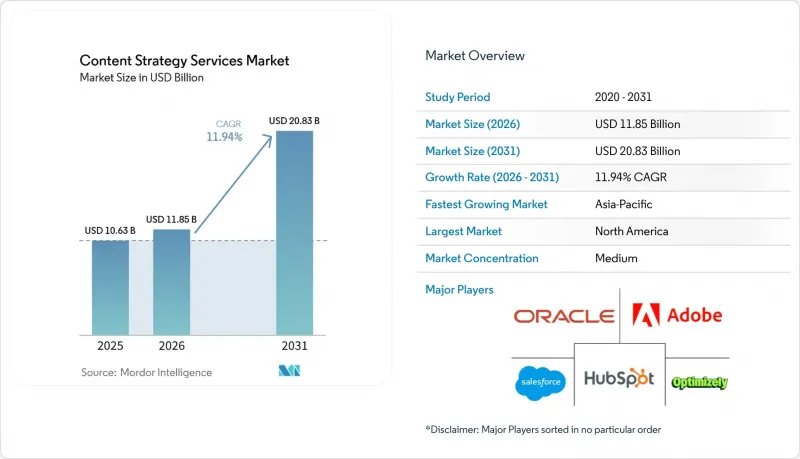
根據 Mordor Intelligence 預測,內容策略服務市場規模將從 2025 年的 106.3 億美元和 2026 年的 118.5 億美元成長到 2031 年的 208.3 億美元,2026 年至 2031 年的年複合成長率(CAGR)為 11.94%。
本報告按組件(平台和軟體等)、部署模式(雲端、本地部署、混合部署)、組織規模(大型企業等)、應用程式(內容規劃和編輯工作流程、受眾研究和細分等)、行業(零售和電子商務等)以及地區進行細分。市場預測以美元計價。
全球內容策略服務市場趨勢與洞察
個人化全通路內容的需求日益成長
儘管企業如今能夠觸及的管道比以往任何時候都多,但許多企業卻難以按時為每個管道製作符合受眾需求的個人化內容。 Salesforce的報告顯示,到 2025 年,75% 的行銷機構將至少利用一種人工智慧技術來實現內容個人化。然而,跨五個或更多管道客製化個人化訊息的能力仍然有限,這給服務供應商帶來了營運上的挑戰。內容行銷協會 (Content Marketing Institute) 的一項研究發現,B2B負責人在聯繫銷售人員之前平均會瀏覽 13.4 篇內容。這項需求凸顯了內容策略服務市場對協調內容製作、分發和效果評估工作流程的需求。如果品牌無法維護通路專屬內容,則可能在潛在客戶與供應商直接互動之前就失去市場地位。我們需要的不僅僅是更多的內容,而是一種可複製的方法,能夠將已通過核准的資訊適配到每個受眾和管道,同時避免產生自相矛盾的訊息。這項需求凸顯了內容規劃、工作流程設計和效果資料共用的重要性。此外,對於那些能夠平衡宣傳活動速度和品牌一致性的服務提供者而言,新的機會正在湧現。
用於內容規劃和最佳化的生成式人工智慧
根據銷售團隊 的報告,到 2026 年,行銷領域企業對生成式人工智慧的採用率將達到 94%。然而,如果內容流程缺乏審核和管治控,廣泛採用並不能保證取得更好的效果。 2026 年 4 月,Adobe 推出了「品牌智慧」(Brand Intelligence),該功能利用核准歷史記錄和回饋來輔助人工智慧驅動的內容產生。這種方法解釋了為什麼供應商除了產生工具之外,還要添加管治功能。在監管嚴格的行業中,缺乏管治的內容可能會帶來品牌風險;在競爭激烈的領域,內容的獨特性也可能受到損害。隨著歐盟《人工智慧法案》第 50 條規定的透明度義務於 2026 年 8 月 2 日生效,歐洲對合規的人工智慧內容流程的需求日益成長。
實施和工作流程重新設計相關的成本很高。
企業實施成本包括許可費、工作流程重新設計、變更管理、整合工作和員工培訓。這些活動的成本可能超過平臺本身的直接投資,並可能延遲實現實際營運效益。根據 LeanData 的報告,51% 的負責產品上市時間的領導者認為,整合複雜性和工作流程轉型是技術成熟度的主要限制阻礙因素。沒有專門內容營運團隊的組織在編輯流程變更的過渡期內可能會面臨 12-18 個月的生產力低落。對於中小型企業而言,這種負擔更為沉重,而這些企業也是內容策略服務市場的成長領域。供應商可以透過將實施支援與軟體捆綁在一起或提供檢驗的工作流程範本來緩解這種摩擦。分階段實施使組織能夠優先考慮業務需求最明確的流程,然後再擴展到更多團隊。培訓和爭取內部促進者也至關重要,因為內容角色和審核流程在實施過程中經常會改變。這些實際挑戰將決定新系統能否融入日常營運。對於那些難以接觸專業人員的買家來說,這一點尤其重要。
細分市場分析
到2025年,平台和軟體將佔據內容策略服務市場57.62%的佔有率。這一佔有率反映了科技在跨通路內容創作、管治、分發和效果評估方面的重要作用。平台可以作為團隊管理大量已通過核准內容的記錄系統。它們也能提供多個團隊共同參與內容專案時所需的共用工作流程。預計服務板塊將成為各組成部分中成長最快的,到2031年年複合成長率(CAGR)將達到12.54%。這表明,僅靠軟體功能無法取得成效,還需要實施、管治和持續最佳化。 Bloomreach於2026年6月正式發布了其“Loomi行銷代理商”,實現了將單一簡報轉化為個人化宣傳活動工作流程的功能。
此次發布展示了供應商如何添加更貼近傳統服務營運的功能。雖然這些工具可以減少人工工作量,但並不能消除配置內容規則或分析效能的必要性。企業仍需要支援才能將平台整合到其營運模式中。僅簽訂平台合約可能會導致衡量和管治的不足。因此,在內容策略服務市場,多種元件的組合既能滿足持續的軟體支出,又能滿足對專業服務的需求。服務團隊可以將平台的廣泛功能轉化為符合客戶優先順序的編輯規則、衡量計畫和營運流程。他們還可以解決部署後出現的流程缺陷,而不是將實施過程視為單一的已完成專案。隨著人工智慧工具帶來新的審核、培訓和管治需求,這種持續的支援尤其重要。
截至2025年,雲端採用率已佔內容策略服務市場規模的61.72%。此外,預計到2031年,雲端採用率將以12.63%的最高年成長率持續成長。這些因素表明,從傳統內容系統向雲端的遷移尚未完成。雲端原生系統支援持續交付、分散式協作和人工智慧功能,這些功能在單體環境中難以實現。對於需要跨區域共用數據和最新數據的團隊而言,這些功能至關重要。因此,雲端採用率仍然是平台選擇的核心因素。在對資料主權要求嚴格的行業中,本地部署仍然繼續存在。例如,歐洲金融服務機構和公共機構可以將敏感資產保存在受控環境中,以滿足隱私和資料居住要求。
混合部署方案允許在內部控制高度敏感內容的同時,利用雲端服務進行分析和人工智慧處理。歐盟人工智慧法規和GDPR進一步強調了清晰的資料管理對歐洲買家的重要性。買家必須評估其內容、受眾數據和人工智慧輸出的儲存和處理位置。這些限制確保了混合配置在內容策略服務市場中持續發揮作用。採用混合模式使團隊能夠在不將所有資訊遷移到現有管理結構之外的情況下,利用基於雲端的編配。當組織無法一次取代舊有系統時,混合模式也支援分階段現代化。這對於必須在保持業務永續營運的同時提升內容能力的買家至關重要。因此,部署方法的選擇很大程度上取決於流程、管治和資料需求,以及技術偏好。提供清晰整合和安全選項的供應商更有能力滿足這些需求。
區域分析
2025年,北美佔據了內容策略服務市場37.62%的佔有率。該地區聚集了許多企業技術採用者、平台供應商和成熟的內容營運團隊。據HubSpot稱,2026年4月,其客戶的自然流量年減了27%,而人工智慧驅動的推薦流量則增加了兩倍。這種轉變促使人們更加關注答案引擎和生成式引擎最佳化。隨著《加州消費者隱私法案》(CCPA)的實施和第三方追蹤的減少,第一方資料管治變得至關重要。由於數位商務的成長和跨境在地化需求的增加,墨西哥的需求正在不斷擴大。在該地區營運的公司可能需要根據不同市場調整語言、產品資訊和宣傳活動素材。這提升了可重複使用內容元件和集中式品牌標準的價值。北美買家也越來越重視人工智慧驅動的搜尋,更加重視結構化資訊和更清晰的績效數據。因此,該地區的商業機會既包括成熟企業的轉型,也包括在地化的中端市場應用。這兩種模式都支援對廣泛的內容管理能力的需求。
預計到2031年,亞太地區的複合年成長率將達到13.54%。其發展主要受創作者電商、行動優先消費和不斷擴張的數位零售的驅動。該地區的內容電商模式將短影片、直播和社交購物整合於單一平台。因此,針對該地區最佳化的「行動優先」內容營運模式是整個亞太地區內容策略服務市場的主要需求。內容團隊需要根據語言、平台、購買行為和創作者格式的差異來調整內容。為以桌面端為中心的西方通路配置設計的方案可能無法直接應用於這些市場。因此,服務提供者需要將可重複使用的中央標準與區域部署的柔軟性結合。最大的商機在於幫助企業在不損害品牌或績效控制的前提下適應這些差異。這也是該地區有望超越其他區域市場成長的原因之一。此外,該地區的成長還取決於服務提供者能否在不強制所有市場採用相同製作流程的情況下支援本地團隊。
建立一致的元資料、核准規則和指標,既能實現針對特定市場的實施,又能維持通用的控制結構。這在內容創作者主導的環境中尤其重要,因為內容會在電商平台和社交平臺之間快速流動。隨著該地區買家群體的擴大,幫助團隊建立這些操作規則的服務將促進軟體的普及。歐洲在內容策略服務市場佔據第二大佔有率。 GDPR 和歐盟人工智慧法案可能會減緩人工智慧的普及速度,但同時也會增加對治理管治的內容平台的需求。歐盟人工智慧法案第 50 條規定的透明度義務已於 2026 年 8 月 2 日生效。這將促進金融服務、醫療保健和政府部門的採購活動。以巴西和阿根廷為首的南美洲地區,其需求仍處於起步階段。中東市場與沙烏地阿拉伯的「2030 願景」計畫以及非洲企業數位基礎設施的發展相契合,也出現了早期應用,主要集中在零售、金融服務和政府數位化領域。
其他好處:
- Excel格式的市場預測(ME)表
- 3個月的分析師支持
目錄
第1章:引言
- 研究假設和市場定義
- 調查範圍
第2章:調查方法
第3章執行摘要
第4章 市場狀況
- 市場概覽
- 市場促進因素
- 個人化全通路內容的需求日益成長
- 用於內容規劃和最佳化的生成式人工智慧
- 需要可衡量的內容投資報酬率和歸因
- 擴展結構化和模組化內容業務
- 答案引擎最佳化和LLM引用支持
- 利用第一方資料的受眾研究工作流程
- 市場限制因素
- 高昂的實施成本和工作流程重新設計成本
- 在分散的行銷技術堆疊中,整合的複雜性不容忽視。
- 人工智慧搜尋中的測量差距和歸因盲點
- 未經管理的AI內容所帶來的品牌可靠性風險
- 產業價值鏈分析
- 宏觀經濟因素對市場的影響
- 監理情勢
- 技術展望
- 波特五力分析
第5章 市場規模與成長預測
- 按組件
- 平台和軟體
- 服務
- 按部署模式
- 雲
- 現場
- 混合
- 按組織規模
- 大公司
- 小型企業
- 透過使用
- 內容規劃與編輯工作流程
- 目標受眾研究與細分
- 通訊與品牌管治
- 全通路分銷與復興
- 個性化和性能最佳化
- 按行業
- 零售與電子商務
- 媒體與娛樂
- 醫療保健和生命科學
- 旅遊與飯店
- 消費品
- 其他行業部門
- 按地區
- 北美洲
- 美國
- 加拿大
- 墨西哥
- 南美洲
- 巴西
- 阿根廷
- 其他南美國家
- 歐洲
- 德國
- 英國
- 法國
- 義大利
- 西班牙
- 俄羅斯
- 其他歐洲國家
- 亞太地區
- 中國
- 日本
- 印度
- 韓國
- 澳洲和紐西蘭
- 其他亞太國家
- 中東
- 沙烏地阿拉伯
- 阿拉伯聯合大公國
- 土耳其
- 其他中東國家
- 非洲
- 南非
- 奈及利亞
- 埃及
- 其他非洲國家
- 北美洲
第6章 競爭情勢
- 市場集中度
- 策略趨勢
- 市佔率分析
- 公司簡介
- Adobe Inc.
- HubSpot, Inc.
- Optimizely, Inc.
- Salesforce, Inc.
- Oracle Corporation
- Acquia, Inc.
- Sitecore Corporation A/S
- Contentful GmbH
- Bloomreach, Inc.
- Progress Software Corporation
- Sprinklr, Inc.
- Acrolinx GmbH
- Aprimo US LLC
- Contently, Inc.
- CoSchedule LLC
- Automattic Inc.
- Open Text Corporation
- Papirfly AS
第7章 市場機會與未來展望
According to Mordor Intelligence, the content strategy services market size is projected to expand from USD 10.63 billion in 2025 and USD 11.85 billion in 2026 to USD 20.83 billion by 2031, registering a CAGR of 11.94% between 2026 and 2031.
This report is Segmented by Component (Platforms and Software, and More), Deployment Model (Cloud, On-Premises, and Hybrid), Organization Size (Large Enterprises, and More), Application (Content Planning and Editorial Workflow, Audience Research and Segmentation, and More), Industry Verticals (Retail and E-Commerce, and More), and Geography. The Market Forecasts are Provided in Terms of Value (USD).
Global Content Strategy Services Market Trends and Insights
Rising Demand for Personalized Omnichannel Content
Organizations can reach more channels than before, but many cannot produce enough audience-specific material for each channel at the needed pace. Salesforce reported that 75% of marketing organizations used at least 1 form of AI for content personalization in 2025. Coordinating personalized messages across 5 or more channels remains a limited capability, leaving service providers with an operational gap. The Content Marketing Institute found that the average B2B buyer consumed 13.4 pieces of content before contacting sales. That requirement supports demand for connected production, distribution, and performance workflows in the content strategy services market. Brands that cannot maintain channel-specific content may lose visibility before a prospect begins a direct vendor conversation. The requirement is not simply more material. It is a repeatable method for adapting approved information to each audience and channel without creating conflicting messages. That requirement raises the importance of content planning, workflow design, and shared performance data. It also creates opportunities for providers that can coordinate campaign speed with brand consistency.
Generative AI for Content Planning and Optimization
Salesforce reported that enterprise generative AI adoption in marketing reached 94% in 2026. Broad use does not guarantee better outcomes when content processes lack review and governance controls. Adobe introduced Brand Intelligence in April 2026 to use approval history and feedback within AI-assisted content generation. This approach shows why vendors are adding governance functions alongside generation tools. Ungoverned material can create brand risk in regulated sectors and can make content less distinct in crowded categories. The EU AI Act's Article 50 transparency obligations take effect on August 2, 2026, which increases the need for compliant AI content processes in Europe.
High Implementation and Workflow Redesign Costs
Enterprise deployment costs include workflow redesign, change management, integration work, and employee training in addition to licensing. These activities can exceed the direct platform investment and can delay visible operating gains. LeanData reported that 51% of go-to-market leaders identified integration complexity and workflow transformation as primary limits on technology maturity. Organizations without a dedicated content operations team can face a 12-18-month productivity trough during changes to editorial processes. This burden is heavier for mid-market and smaller organizations, even though they are a growth area for the content strategy services market. Vendors can reduce friction by bundling implementation support with software and offering tested workflow templates. A phased implementation can help an organization prioritize the processes with the clearest business need before expanding to more teams. Training and internal sponsorship also matter because content roles and review paths often change during deployment. These practical issues can determine whether a new system becomes part of daily work. They are especially important for buyers with limited specialist resources.
Other drivers and restraints analyzed in the detailed report include:
- Need for Measurable Content ROI and Attribution
- Expansion of Structured and Modular Content Operations
- Integration Complexity Across Fragmented Martech Stacks
For complete list of drivers and restraints, kindly check the Table Of Contents.
Segment Analysis
Platforms and software held 57.62% of the content strategy services market in 2025. Their position reflected the role of technology in controlling creation, governance, distribution, and measurement across channels. A platform can act as the system of record for teams that manage large volumes of approved material. It also provides the shared workflows needed when many groups contribute to a content program. Services are projected to record the fastest component growth at a 12.54% CAGR through 2031. This shows that software capability alone does not produce results without implementation, governance, and continuous optimization. Bloomreach made Loomi marketing agent generally available in June 2026, enabling a single brief to be turned into a personalized campaign workflow.
The release illustrates how vendors are adding functions that sit close to traditional service work. These tools can reduce manual effort, but they do not remove the need to set content rules or interpret performance. Organizations still need support to connect a platform to their operating model. Platform-only engagements can leave gaps in measurement and governance. The component mix therefore supports both recurring software spending and specialist service demand in the content strategy services market. Service teams can translate broad platform functions into editorial rules, measurement plans, and operating routines that fit a buyer's priorities. They can also resolve process gaps that emerge after implementation, rather than treating deployment as a single completed project. This continued support is particularly relevant where AI tools create new review, training, and governance requirements.
Cloud deployment accounted for 61.72% of the content strategy services market size in 2025. It is also projected to grow at the highest rate of 12.63% through 2031. This combination indicates that migration from legacy content systems remains incomplete. Cloud-native systems support continuous delivery, distributed collaboration, and AI functions that are harder to run in monolithic environments. These capabilities are important for teams that require current data and shared access across regions. Cloud adoption, therefore, remains central to platform decisions. On-premises deployments continue in sectors that have strict data sovereignty requirements. European financial services and public organizations can keep sensitive assets in controlled environments to meet privacy and data-residency requirements.
Hybrid deployment can keep sensitive content under internal control while using cloud services for analytics and AI processing. The EU AI Act and GDPR strengthen the importance of clear data controls for European buyers. Buyers must assess where content, audience data, and AI outputs are stored and processed. These constraints preserve a role for hybrid configurations in the content strategy services market. A hybrid model can give teams access to cloud-based orchestration without requiring all information to move outside established controls. It can also support phased modernization when organizations cannot replace legacy systems at once. This is relevant to buyers that must maintain business continuity while improving content capabilities. Deployment selection consequently depends on process, governance, and data requirements as much as on technical preference. Providers that offer clear integration and security options can better address these requirements.
Complete Report Scope:
- By Component
- Platforms and Software
- Services
- By Deployment Model
- Cloud
- On-Premises
- Hybrid
- By Organization Size
- Large Enterprises
- Small and Medium-Sized Enterprises
- By Application
- Content Planning and Editorial Workflow
- Audience Research and Segmentation
- Messaging and Brand Governance
- Omnichannel Distribution and Activation
- Personalization and Performance Optimization
- By Industry Verticals
- Retail and E-commerce
- Media and Entertainment
- Healthcare and Life Sciences
- Travel and Hospitality
- Consumer Goods
- Other Industry Verticals
- By Geography
- North America
- United States
- Canada
- Mexico
- South America
- Brazil
- Argentina
- Rest of South America
- Europe
- Germany
- United Kingdom
- France
- Italy
- Spain
- Russia
- Rest of Europe
- Asia-Pacific
- China
- Japan
- India
- South Korea
- Australia and New Zealand
- Rest of Asia-Pacific
- Middle East
- Saudi Arabia
- United Arab Emirates
- Turkey
- Rest of Middle East
- Africa
- South Africa
- Nigeria
- Egypt
- Rest of Africa
- North America
Geography Analysis
North America held 37.62% of the content strategy services market share in 2025. The region has a high concentration of enterprise technology adopters, platform vendors, and mature content operations teams. HubSpot reported that its customers saw a 27% year-over-year decline in organic traffic while AI referral traffic tripled in April 2026. This change is shifting attention toward answer engine optimization and generative engine optimization. First-party data governance is important because of CCPA enforcement and the decline of third-party tracking. Mexico is an emerging demand area as digital commerce grows and cross-border localization needs increase. Organizations serving the region may need to adapt language, product information, and campaign assets for each market. This raises the value of reusable content components and centrally managed brand standards. North American buyers are also responding to the growing importance of AI discovery, which favors structured information and clearer performance data. The regional opportunity, therefore, includes both mature enterprise transformation and localized mid-market adoption. These two patterns sustain demand for a range of content operating capabilities.
Asia-Pacific is projected to grow at a 13.54% CAGR through 2031. Its development is supported by creator commerce, mobile-first consumption, and expanding digital retail. The region has content-commerce models that combine short video, live streaming, and social shopping in single-platform environments. Localized, mobile-first content operations are therefore a major need across the content strategy services market in the region. Content teams must adapt material for different languages, platforms, shopping behaviors, and creator formats. A program designed for a desktop-led Western channel mix may not transfer directly to these markets. Providers must therefore combine reusable central standards with flexibility for local activation. The strongest opportunity lies in helping organizations coordinate these differences without losing control over brand and performance. This helps explain why the region is forecast to outpace other geographic segments. Regional growth also depends on whether providers can support local teams without forcing every market into the same production process.
Consistent metadata, approval rules, and measurement definitions can provide shared control while allowing market-specific execution. This is particularly relevant in creator-led environments where content moves rapidly across commerce and social platforms. Services that help teams build those operating rules can support software adoption as the regional buyer base develops. Europe held the second-largest position in the content strategy services market. GDPR and the EU AI Act can slow AI deployment, while also increasing demand for governed content platforms. The EU AI Act's Article 50 transparency obligations took effect on August 2, 2026. This supports procurement in financial services, healthcare, and public administration. South America, led by Brazil and Argentina, is an earlier-stage demand area. Middle East markets aligned with Saudi Arabia's Vision 2030 program and Africa's developing enterprise digital infrastructure also show early adoption, primarily in retail, financial services, and government digitization.
- Adobe Inc.
- HubSpot, Inc.
- Optimizely, Inc.
- Salesforce, Inc.
- Oracle Corporation
- Acquia, Inc.
- Sitecore Corporation A/S
- Contentful GmbH
- Bloomreach, Inc.
- Progress Software Corporation
- Sprinklr, Inc.
- Acrolinx GmbH
- Aprimo US LLC
- Contently, Inc.
- CoSchedule LLC
- Automattic Inc.
- Open Text Corporation
- Papirfly AS
Additional Benefits:
- The market estimate (ME) sheet in Excel format
- 3 months of analyst support
TABLE OF CONTENTS
1 INTRODUCTION
- 1.1 Study Assumptions and Market Definition
- 1.2 Scope of the Study
2 RESEARCH METHODOLOGY
3 EXECUTIVE SUMMARY
4 MARKET LANDSCAPE
- 4.1 Market Overview
- 4.2 Market Drivers
- 4.2.1 Rising Demand for Personalized Omnichannel Content
- 4.2.2 Generative AI for Content Planning and Optimization
- 4.2.3 Need for Measurable Content ROI and Attribution
- 4.2.4 Expansion of Structured and Modular Content Operations
- 4.2.5 Answer Engine Optimization and LLM Citation Readiness
- 4.2.6 First-Party Data-Led Audience Research Workflows
- 4.3 Market Restraints
- 4.3.1 High Implementation and Workflow Redesign Costs
- 4.3.2 Integration Complexity Across Fragmented Martech Stacks
- 4.3.3 AI Search Measurement Gaps and Attribution Blind Spots
- 4.3.4 Brand-Liability Risks from Ungoverned AI Content
- 4.4 Industry Value Chain Analysis
- 4.5 Impact of Macroeconomic Factors on the Market
- 4.6 Regulatory Landscape
- 4.7 Technological Outlook
- 4.8 Porter's Five Forces Analysis
- 4.8.1 Threat of New Entrants
- 4.8.2 Bargaining Power of Suppliers
- 4.8.3 Bargaining Power of Buyers
- 4.8.4 Threat of Substitutes
- 4.8.5 Competitive Rivalry
5 MARKET SIZE AND GROWTH FORECASTS (VALUE)
- 5.1 By Component
- 5.1.1 Platforms and Software
- 5.1.2 Services
- 5.2 By Deployment Model
- 5.2.1 Cloud
- 5.2.2 On-Premises
- 5.2.3 Hybrid
- 5.3 By Organization Size
- 5.3.1 Large Enterprises
- 5.3.2 Small and Medium-Sized Enterprises
- 5.4 By Application
- 5.4.1 Content Planning and Editorial Workflow
- 5.4.2 Audience Research and Segmentation
- 5.4.3 Messaging and Brand Governance
- 5.4.4 Omnichannel Distribution and Activation
- 5.4.5 Personalization and Performance Optimization
- 5.5 By Industry Verticals
- 5.5.1 Retail and E-commerce
- 5.5.2 Media and Entertainment
- 5.5.3 Healthcare and Life Sciences
- 5.5.4 Travel and Hospitality
- 5.5.5 Consumer Goods
- 5.5.6 Other Industry Verticals
- 5.6 By Geography
- 5.6.1 North America
- 5.6.1.1 United States
- 5.6.1.2 Canada
- 5.6.1.3 Mexico
- 5.6.2 South America
- 5.6.2.1 Brazil
- 5.6.2.2 Argentina
- 5.6.2.3 Rest of South America
- 5.6.3 Europe
- 5.6.3.1 Germany
- 5.6.3.2 United Kingdom
- 5.6.3.3 France
- 5.6.3.4 Italy
- 5.6.3.5 Spain
- 5.6.3.6 Russia
- 5.6.3.7 Rest of Europe
- 5.6.4 Asia-Pacific
- 5.6.4.1 China
- 5.6.4.2 Japan
- 5.6.4.3 India
- 5.6.4.4 South Korea
- 5.6.4.5 Australia and New Zealand
- 5.6.4.6 Rest of Asia-Pacific
- 5.6.5 Middle East
- 5.6.5.1 Saudi Arabia
- 5.6.5.2 United Arab Emirates
- 5.6.5.3 Turkey
- 5.6.5.4 Rest of Middle East
- 5.6.6 Africa
- 5.6.6.1 South Africa
- 5.6.6.2 Nigeria
- 5.6.6.3 Egypt
- 5.6.6.4 Rest of Africa
- 5.6.1 North America
6 COMPETITIVE LANDSCAPE
- 6.1 Market Concentration
- 6.2 Strategic Moves
- 6.3 Market Share Analysis
- 6.4 Company Profiles (includes Global Level Overview, Market Level Overview, Core Segments, Financials as available, Strategic Information, Market Rank/Share, Products and Services, Recent Developments)
- 6.4.1 Adobe Inc.
- 6.4.2 HubSpot, Inc.
- 6.4.3 Optimizely, Inc.
- 6.4.4 Salesforce, Inc.
- 6.4.5 Oracle Corporation
- 6.4.6 Acquia, Inc.
- 6.4.7 Sitecore Corporation A/S
- 6.4.8 Contentful GmbH
- 6.4.9 Bloomreach, Inc.
- 6.4.10 Progress Software Corporation
- 6.4.11 Sprinklr, Inc.
- 6.4.12 Acrolinx GmbH
- 6.4.13 Aprimo US LLC
- 6.4.14 Contently, Inc.
- 6.4.15 CoSchedule LLC
- 6.4.16 Automattic Inc.
- 6.4.17 Open Text Corporation
- 6.4.18 Papirfly AS
7 MARKET OPPORTUNITIES AND FUTURE OUTLOOK
- 7.1 White-Space and Unmet-Need Assessment

 業務永續營運管理解決方案市場規模、佔有率和成長分析:按組件、部署類型、組織規模、解決方案類型、最終用戶和地區分類-2026-2033 年產業預測
 基礎模型:市場佔有率分析、產業趨勢與統計、成長預測(2026-2031 年)
 調查管理市場:依產品類型、調查類型、調查方法、調查模式、實施模式及產業分類-2026-2032年全球市場預測政府和公共部門的IT服務管理:市場佔有率分析、行業趨勢和統計數據以及成長預測(2026-2031年)
 2026-2030年全球業務永續營運管理解決方案市場網路彈性與業務永續營運:市場佔有率分析、產業趨勢與統計及成長預測(2026-2031 年)
 企業財務風險與策略諮詢市場規模、佔有率及成長分析:依服務類型、客戶類型、產業、合約類型、組織架構及地區分類-2026-2033年產業預測
 2026年全球業務永續營運市場報告
 業務永續營運管理市場 - 全球產業規模、佔有率、趨勢、機會、預測:按產品/服務、組織規模、應用、產業、地區和競爭對手分類,2021-2031 年2026年全球業務永續營運管理解決方案市場報告