


 |
市場調查報告書
商品編碼
2099457
基礎模型:市場佔有率分析、產業趨勢與統計、成長預測(2026-2031 年)Foundation Model - Market Share Analysis, Industry Trends & Statistics, Growth Forecasts (2026 - 2031) |
||||||

※ 本網頁內容可能與最新版本有所差異。詳細情況請與我們聯繫。
根據 Mordor Intelligence 預測,基礎模型市場規模預計將從 2025 年的 217.2 億美元和 2026 年的 312 億美元成長到 2031 年的 1192.9 億美元,2026 年至 2031 年的複合年成長率為 30.76%。
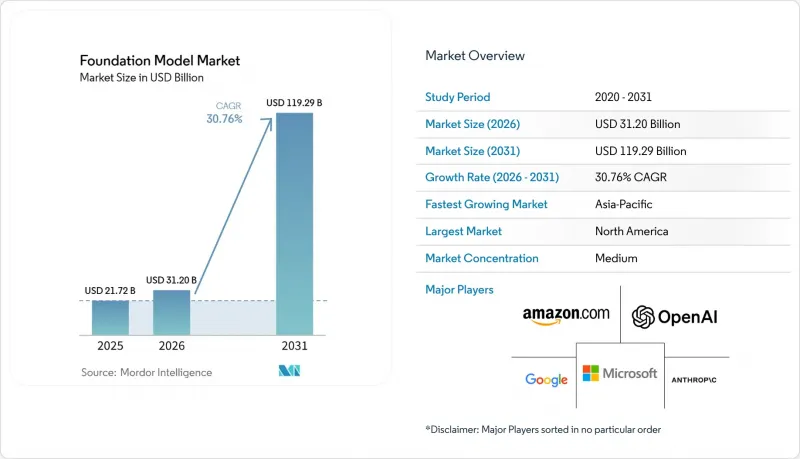
本報告按模型類型(例如,大規模語言模型、多模態模型)、部署模式(雲端和本地部署)、企業規模(大型企業和中小企業)、應用領域(例如,內容生成、客戶支援和虛擬助理)、最終用戶(例如,銀行、金融服務和保險 (BFSI)、醫療保健)以及地區進行細分。市場預測以美元 (USD) 為單位。
全球基礎模型市場趨勢與洞察
企業對多模態和推理模型的需求正在推動架構升級。
企業不再僅僅為了產生草稿而採購模型;他們現在尋求的是能夠在同一工作流程中處理文件、影像、音訊和結構化記錄的系統。這正在改變整個基礎模型市場的採購標準,買家越來越期望模型能夠支援多步驟推理和可靠的任務執行。在醫療保健、國防和媒體等領域,多模態能力的重要性進一步凸顯,因為輸入資料以多種格式出現,而純文字系統無法有效處理。依賴在生成操作和建議之前連結記錄、視覺資訊和指令的應用場景也在不斷增強。蘋果公司的第三代基礎模型系列體現了這一趨勢,它結合了設備端和伺服器端的變體,用於在硬體受限的環境中進行語言和影像理解。隨著這些架構的成熟,基礎模型市場正從獨立的文本工具轉向更廣泛的推理系統。
快速向特定領域平台模式的轉變正在改變高風險產業的採購重點。
基於廣泛網路資料訓練的通用模型在需要準確性、可追溯性和領域脈絡的工作流程中正逐漸失去效力。在金融領域,發表於 IEEE CSCloud 的研究表明,利用模組化 LoRa 對金融資料集進行領域自適應後訓練,使得一個參數量僅為 70 億的精簡模型在特定金融基準測試中超越了 GPT-4。在醫療保健領域,基於 HL7 FHIR 標準化臨床數據進行微調的 EHR 基礎模型在六項關鍵臨床預測任務中取得了進展,凸顯了專用架構的興起。這促使高度監管環境下的公司傾向於選擇規模小規模、目標更明確的系統,而非需要更多監管的通用模式。此外,當微調已調整的的模型能夠在託管基礎設施中運行,而無需透過付費的 Frontier API 發送所有任務時,也能降低整體營運成本。在基礎模型市場,這種轉變正在推動價值鏈的更新,使其不再局限於模型本身,而是擴展到支援微調、整合和管治的供應商。
對 GPU 的高度依賴以及底層模型的訓練成本正在縮小競爭格局。
由於訓練基礎模型仍需要大量的資本投入,對GPU的高度依賴仍是基礎模型市場最明顯的結構性限制因素之一。目前,運行最新一代的前緣訓練程序成本通常超過1億美元,預計2024年單次運行成本將接近3.9億美元。因此,真正的前沿開發仍然集中在少數幾家擁有超大規模資料中心業者支援、且具備足夠資本和基礎設施來應對反覆訓練週期的機構手中。這種影響不僅限於訓練,因為取得先進硬體也會影響推理規模、發佈時間和長期服務的經濟效益。對先進半導體的出口限制進一步加劇了不同司法管轄區之間的獲取差距,限制了哪些公司能夠在尖端技術領域實現規模化發展。在基礎模型市場,這些因素共同縮小了能夠長期維持模型性能領先地位的公司範圍。
細分市場分析
按模型類型分類,2025 年基礎模型市場佔有率中,大規模語言模型佔 59.11%,繼續保持其作為以文本為中心的部署的主要商業基礎的地位。預計到 2031 年,多模態將以 31.34% 的複合年成長率成長,因為買家越來越需要能夠跨整合工作流程處理文字、影像、音訊和結構化資料的單一系統。視覺模型在基礎模型市場中仍然是一個小眾但重要的類別,尤其是在影像理解至關重要的環境中,例如檢查、放射學分診和視覺搜尋。其他模型類型,包括語音模型、音訊模型和特定領域模型,在通用架構由於語音介面、延遲或專業術語等原因不適用的情況下也越來越受到關注。從細分市場組成來看,基礎模型市場正在從單模態工具轉向能夠在更複雜的企業環境中運作的更廣泛的推理系統。
如今,許多主流模型都支援在同一工作流程中處理文件、圖像和程式碼,大規模語言模型和多模態模型之間的界限正變得日益模糊。蘋果的第三代基礎模型系列正是這一趨勢的體現,它提供了設備端和伺服器端兩種版本,將語言和圖像理解能力相結合,以適應硬體受限的環境。因此,在基礎模型領域,能夠兼顧模型廣度、更有效率的推理能力和簡易部署的供應商,無疑將備受青睞。
到 2025 年,基於雲端的部署將佔據基礎模型市場 66.39% 的佔有率,這主要得益於 AWS、Azure 和 Google Cloud 等託管服務降低了模型託管的維運負擔。預計到 2031 年,本地部署將以 39.90% 的複合年成長率成長,這反映出敏感環境中對安全性、控制和本地管理基礎設施的需求日益成長。這一趨勢表明,基礎模型市場並非僅僅是某種部署模式優於其他模式的問題,因為買家的優先順序現在會根據資料敏感度、工作負載類型和內部管治需求而有所不同。開放的生態系統透過增加企業部署模式的自由度來支援這種轉變,使企業無需過度依賴供應商或受限於固定的、僅限雲端的維運模式。事實上,儘管雲端仍然是許多組織的預設選擇,但隨著高價值用例比例的增加,本地部署正成為一種策略性需求。
此外,雲端環境和本地環境並非涇渭分明地相互取代。許多大型企業現在採用混合架構,根據風險和資料類別分類工作負載。高度敏感的推理處理通常在內部基礎設施上運行,而敏感度較低、資料量大的任務則繼續透過外部 API 運行。蘋果第三代基礎架構模型系列(涵蓋設備端和伺服器端兩種版本)表明,混合部署正成為實用的設計方案,而非特例。這表明,目前普遍認為雲端佔據主導地位的觀點可能低估了本地部署能力在基礎架構模型市場的重要性。政府和國防部門的採用也印證了這一點,因為安全且空氣間隙的環境通常需要配備專門支援的硬體駐留模型。
區域分析
到2025年,北美將佔據基礎模型市場39.37%的佔有率,成為最大的區域收入來源。該地區受益於尖端人工智慧研究實驗室、超大規模資料中心業者中心總部以及強大的企業軟體基礎設施的集中,這些都推動了新模型的快速商業化。美國繼續保持這一地位,憑藉其在模型開發方面的領先地位、強大的雲端交付系統和積極的企業採購,鞏固了北美的地位。加拿大則憑藉著與多倫多和蒙特婁人工智慧生態系統相關的研究能力,為市場增添了深度,這些生態系統持續支持人才供給和學術影響力。在基礎模型市場,南美洲仍處於早期發展階段,目前更依賴美國和歐洲供應商提供的雲端API,而非本地的尖端模型開發。
歐洲在基礎模型市場擁有最嚴格的合規要求,文件、透明度和測試義務決定了供應商如何發布和維護其模型。儘管如此,市場需求仍然強勁,德國、英國、法國、義大利和西班牙的金融服務和工業製造業仍是主要的採購中心。這導致了區域趨勢的兩極化:採用率不斷提高,但為了適應新的營運法規,與管治相關的支出也在增加。中東的重要性也日益凸顯,隨著各國制定人工智慧基礎設施計畫並擴大採用本地託管,中東作為區域部署中心的角色也愈發突出。
預計到2031年,亞太地區將以32.89%的複合年成長率成長,成為基礎模型市場成長最快的區域板塊。中國的OpenWait生態系統正在快速擴張;根據阿里巴巴統計,截至2025年4月,Qwen系列模型版本已超過300個,下載量超過3億次,衍生微調模型超過10萬個。中國石油天然氣集團公司(中石油)的基礎模型「崑崙」截至2026年5月已達到152個部署場景,這表明亞太地區基礎模型市場正在將模型開發與大規模工業應用案例結合。韓國的《人工智慧發展框架法》於2026年1月生效,對在韓國營運的外國人工智慧公司提出了正式的合規要求。印度和日本也在快速發展,但非洲地區,尤其是南非,仍處於起步階段,多語言設計和行動優先交付對於更廣泛的部署至關重要。
其他好處:
- Excel格式的市場預測(ME)表
- 3個月的分析師支持
目錄
第1章:引言
- 研究假設和市場定義
- 調查範圍
第2章:調查方法
第3章執行摘要
第4章 市場狀況
- 市場概覽
- 市場促進因素
- 對多模態和推理模型的需求穩定
- 快速過渡到特定領域平台模型
- 降低開放權重生態系的推理成本
- 在整個核心業務流程中實施人工智慧代理。
- 雲端原生模型託管和託管式人工智慧平台
- 對模式微調、防護措施與管治層的需求
- 市場限制因素
- 對GPU的高度依賴以及尖端技術的訓練成本
- 受監管工作流程中的「幻覺」風險
- 資料主權與跨境模型託管的限制因素
- 模型、資料和部署層面上的合規負擔分散。
- 產業價值鏈分析
- 技術展望
- 監理情勢
- 波特五力分析
- 價格分析
- 宏觀經濟因素對市場的影響
第5章 市場規模與成長預測
- 按型號
- 大規模語言模型
- 多模態模型
- 願景模型
- 其他模型類型(語音/音訊模型、特定領域模型等)
- 部署模式
- 基於雲端的
- 現場
- 按公司規模
- 大公司
- 小型企業
- 透過使用
- 內容生成
- 客戶支援和虛擬助手
- 知識管理
- 網路安全和詐欺偵測
- 商業智慧與分析
- 其他用途(軟體開發、藥物發現等)
- 最終用戶
- BFSI
- 衛生保健
- 資訊科技/通訊
- 製造業
- 政府/國防
- 其他終端使用者(零售/電子商務、媒體/娛樂、教育等)
- 按地區
- 北美洲
- 美國
- 加拿大
- 南美洲
- 巴西
- 阿根廷
- 其他南美國家
- 歐洲
- 德國
- 英國
- 法國
- 義大利
- 西班牙
- 其他歐洲國家
- 亞太地區
- 中國
- 印度
- 日本
- 韓國
- 其他亞太國家
- 中東
- 沙烏地阿拉伯
- 阿拉伯聯合大公國
- 其他中東國家
- 非洲
- 南非
- 其他非洲國家
- 北美洲
第6章 競爭情勢
- 市場集中度
- 策略性措施(策略合作、推出新車型、公佈開放重量規格、雲端分發、併購等)
- Market Positioning Analysis
- 公司簡介
- OpenAI LLC
- Microsoft Corporation
- Google LLC
- Amazon Web Services, Inc.
- Meta Platforms, Inc.
- Anthropic PBC
- NVIDIA Corporation
- IBM Corporation
- Oracle Corporation
- Salesforce, Inc.
- Hugging Face, Inc.
- Mistral AI SAS
- Cohere Inc.
- Databricks, Inc.
- Baidu, Inc.
- Alibaba Cloud(Alibaba Group Holding Limited)
- Tencent Holdings Limited
- Huawei Technologies Co., Ltd.
- AI21 Labs Ltd.
- xAI Corp.
- DeepSeek(Hangzhou DeepSeek Artificial Intelligence Co., Ltd.)
第7章 市場機會與未來展望
According to Mordor Intelligence, the foundation model market size is projected to expand from USD 21.72 billion in 2025 and USD 31.20 billion in 2026 to USD 119.29 billion by 2031, registering a CAGR of 30.76% from 2026 to 2031.
This report is Segmented by Model Type (Large Language Models, Multimodal Models, and More), Deployment Mode (Cloud-Based and On-Premise), Enterprise Size (Large Enterprises and Small and Medium Enterprises), Application (Content Generation, Customer Support and Virtual Assistants, and More), End User (BFSI, Healthcare, and More), and Geography. The Market Forecasts are Provided in Terms of Value (USD).
Global Foundation Model Market Trends and Insights
Enterprise Demand for Multimodal and Reasoning Models Drives Architecture Upgrades
Enterprises are no longer buying models mainly for draft generation, because they now want systems that can process documents, images, audio, and structured records inside the same workflow. This is changing procurement standards across the foundation model market, where buyers increasingly expect models to support multi-step reasoning and dependable task execution. Multimodal capability matters more in sectors such as healthcare, defense, and media, where input data arrives in multiple formats and cannot be handled effectively by text-only systems. It also strengthens use cases that depend on connecting records, visuals, and instructions before producing an action or recommendation. Apple's third-generation foundation model family reflects this direction by combining on-device and server-based variants for language and image understanding in hardware-constrained environments. As these architectures mature, the foundation model market is shifting toward broader reasoning systems rather than standalone content tools.
Rapid Shift to Domain-Tuned Foundation Models Changes Buying Priorities in High-Stakes Verticals
General-purpose models trained on broad internet data are becoming less effective in workflows that need precision, traceability, and domain context. In finance, research presented through IEEE CSCloud showed that domain-adaptive post-training with modular LoRA on financial datasets enabled compact 7-billion-parameter models to outperform GPT-4 on selected financial benchmarks. In healthcare, EHR foundation models fine-tuned on HL7 FHIR-standardized clinical data have demonstrated progress across 6 major clinical forecasting tasks, underscoring why specialized architectures are gaining ground. This is pushing enterprises in regulated settings to prefer smaller, more targeted systems over broader models that require greater supervision. It also lowers total operating cost when a fine-tuned model can run inside controlled infrastructure instead of sending every task through a premium frontier API. In the foundation model market, that shift is moving value toward vendors that support fine-tuning, integration, and governance rather than only raw model access.
High GPU Dependency and Frontier Training Costs Compress the Competitive Field
High GPU dependency remains one of the clearest structural restraints on the foundation model market, as frontier model training still requires substantial capital commitments. Current-generation frontier training runs now regularly exceed USD 100 million, and the largest single run in 2024 reached nearly USD 390 million. This keeps true frontier development concentrated among a very small group of hyperscaler-backed organizations with the capital and infrastructure to absorb repeated training cycles. The effect is not limited to training, because access to advanced hardware also shapes inference scale, release timing, and long-term service economics. Export controls on advanced semiconductors add another layer of uneven access across jurisdictions, which affects who can scale at the leading edge. In the foundation model market, that combination narrows the field of firms that can sustain model-performance leadership over time.
Other drivers and restraints analyzed in the detailed report include:
- Inference Cost Compression from Open-Weight Ecosystems Reshapes Deployment Economics
- AI Agent Deployment Across Core Business Workflows Embeds Models in Revenue-Critical Systems
- Hallucination Risk Slows Adoption in Regulated Workflows Despite Wider Deployment
For complete list of drivers and restraints, kindly check the Table Of Contents.
Segment Analysis
Large language models accounted for 59.11% of the foundation model market share in 2025 by model type, maintaining text-centric deployments as the primary commercial base. Multimodal models are projected to expand at a 31.34% CAGR through 2031, as buyers increasingly seek a single system that can process text, images, audio, and structured data across connected workflows. Vision models remain a focused but important category in the foundation model market, especially in inspection, radiology triage, and visual search environments where image understanding is central. Other model types, including speech, audio, and domain-specific models, are also gaining traction where voice interfaces, latency, or technical vocabularies create a poor fit for broad architectures. The segment mix shows that the foundation model market is moving from single-modality tools toward broader reasoning systems that can operate across more complex enterprise contexts.
The boundary between large language models and multimodal models is already becoming less clear, as many leading releases now support documents, images, and code within the same workflow. Apple's third-generation foundation model family reflects this trend with on-device and server-based variants that combine language and image understanding for hardware-constrained environments. The foundation model industry is therefore likely to reward vendors that can combine model breadth with more efficient inference and simpler deployment.
Cloud-based deployment accounted for 66.39% of the foundation model market in 2025, as managed services from AWS, Azure, and Google Cloud reduce the operational burden of model hosting. On-premise deployment is projected to expand at a 39.90% CAGR through 2031, reflecting stronger demand for security, control, and locally managed infrastructure in sensitive environments. This pattern shows that the foundation model market is not simply favoring one mode over another, because buyer priorities now differ by data sensitivity, workload type, and internal governance needs. The open-weight ecosystem supports that shift by giving enterprises more freedom to deploy models without tight vendor lock-in or fixed cloud-only operating models. In practice, cloud remains the default for many organizations, but local deployment has become a strategic requirement for an increasing share of high-value use cases.
Cloud and on-premise setups are also not replacing each other in a clean line, because many large organizations now use hybrid architectures that split workloads by risk and data class. Sensitive inference often runs on internal infrastructure, while non-sensitive, high-volume tasks continue to run through external APIs. Apple's third-generation foundation model family, spanning on-device and server-based variants, shows that hybrid deployment is becoming a practical design choice rather than an edge case. This means reported cloud leadership can understate the importance of internal deployment capability in the foundation model market. Government and defense adoption reinforces that point, because secure, air-gapped environments often require hardware-resident models and tailored support for them.
Complete Report Scope:
- By Model Type
- Large Language Models
- Multimodal Models
- Vision Models
- Other Model Types (Speech and Audio Models, Domain-Specific Models, etc.)
- By Deployment Mode
- Cloud-Based
- On-Premise
- By Enterprise Size
- Large Enterprises
- Small and Medium Enterprises
- By Application
- Content Generation
- Customer Support and Virtual Assistants
- Knowledge Management
- Cybersecurity and Fraud Detection
- Business Intelligence and Analytics
- Other Applications (Software Development, Drug Discovery, etc.)
- By End User
- BFSI
- Healthcare
- IT and Telecommunications
- Manufacturing
- Government and Defense
- Other End Users (Retail and E-Commerce, Media and Entertainment, Education, etc.)
- By Geography
- North America
- United States
- Canada
- South America
- Brazil
- Argentina
- Rest of South America
- Europe
- Germany
- United Kingdom
- France
- Italy
- Spain
- Rest of Europe
- Asia-Pacific
- China
- India
- Japan
- South Korea
- Rest of Asia-Pacific
- Middle East
- Saudi Arabia
- United Arab Emirates
- Rest of the Middle East
- Africa
- South Africa
- Rest of Africa
- North America
Geography Analysis
North America accounted for 39.37% of the foundation model market in 2025, making it the largest regional revenue pool. The region benefits from the co-location of frontier AI labs, hyperscaler headquarters, and a deep enterprise software base that helps commercialize new models quickly. The United States remains the main anchor of this position because it combines model development leadership with strong cloud distribution and enterprise procurement activity. Canada adds depth through research strength linked to the Toronto and Montreal AI ecosystems, which continue to support talent supply and academic influence. In the foundation model market, South America remains earlier in adoption and more dependent on cloud APIs from U.S. and European providers than on local frontier model development.
Europe presents the most compliance-heavy operating environment in the foundation model market, because documentation, transparency, and testing obligations shape how providers launch and maintain models. That does not stop demand, as financial services and industrial manufacturing remain important buying centers across Germany, the United Kingdom, France, Italy, and Spain. The result is a two-track regional pattern in which deployment moves ahead, while governance spending also rises to meet new operating rules. The Middle East is also gaining relevance, as sovereign AI infrastructure plans and local hosting ambitions create a clearer role for regional deployment hubs.
Asia-Pacific is projected to expand at a 32.89% CAGR through 2031, making it the fastest-growing regional block in the foundation model market. China's open-weight ecosystem is scaling quickly, and Alibaba reported that the Qwen series had exceeded 300 model versions, 300 million downloads, and 100,000 derivative fine-tuned models by April 2025. China National Petroleum's Kunlun foundation model had reached 152 deployment scenarios by May 2026, which shows how the foundation model market in Asia-Pacific is linking model development with large industrial use cases. South Korea's Framework Act on Artificial Intelligence Development took effect in January 2026 and added a formal compliance layer for foreign AI companies operating in the country. India and Japan are also scaling quickly, while Africa, led by South Africa, remains at an earlier stage where multilingual design and mobile-first delivery are important for broader deployment.
- OpenAI LLC
- Microsoft Corporation
- Google LLC
- Amazon Web Services, Inc.
- Meta Platforms, Inc.
- Anthropic PBC
- NVIDIA Corporation
- IBM Corporation
- Oracle Corporation
- Salesforce, Inc.
- Hugging Face, Inc.
- Mistral AI SAS
- Cohere Inc.
- Databricks, Inc.
- Baidu, Inc.
- Alibaba Cloud (Alibaba Group Holding Limited)
- Tencent Holdings Limited
- Huawei Technologies Co., Ltd.
- AI21 Labs Ltd.
- xAI Corp.
- DeepSeek (Hangzhou DeepSeek Artificial Intelligence Co., Ltd.)
Additional Benefits:
- The market estimate (ME) sheet in Excel format
- 3 months of analyst support
TABLE OF CONTENTS
1 INTRODUCTION
- 1.1 Study Assumptions and Market Definition
- 1.2 Scope of the Study
2 RESEARCH METHODOLOGY
3 EXECUTIVE SUMMARY
4 MARKET LANDSCAPE
- 4.1 Market Overview
- 4.2 Market Drivers
- 4.2.1 Enterprise Demand for Multimodal and Reasoning Models
- 4.2.2 Rapid Shift to Domain-Tuned Foundation Models
- 4.2.3 Inference Cost Compression from Open-Weight Ecosystems
- 4.2.4 AI Agent Deployment Across Core Business Workflows
- 4.2.5 Cloud-Native Model Hosting and Managed AI Platforms
- 4.2.6 Demand for Model Fine-Tuning, Guardrails, and Governance Layers
- 4.3 Market Restraints
- 4.3.1 High GPU Dependency and Frontier Training Costs
- 4.3.2 Hallucination Risk in Regulated Workflows
- 4.3.3 Data Sovereignty and Cross-Border Model Hosting Constraints
- 4.3.4 Fragmented Compliance Burden Across Model, Data, and Deployment Layers
- 4.4 Industry Value Chain Analysis
- 4.5 Technological Outlook
- 4.6 Regulatory Landscape
- 4.7 Porter's Five Forces Analysis
- 4.7.1 Bargaining Power of Suppliers
- 4.7.2 Bargaining Power of Buyers
- 4.7.3 Threat of New Entrants
- 4.7.4 Threat of Substitutes
- 4.7.5 Competitive Rivalry
- 4.8 Pricing Analysis
- 4.9 Impact of Macroeconomic Factors on the Market
5 MARKET SIZE AND GROWTH FORECASTS (VALUE)
- 5.1 By Model Type
- 5.1.1 Large Language Models
- 5.1.2 Multimodal Models
- 5.1.3 Vision Models
- 5.1.4 Other Model Types (Speech and Audio Models, Domain-Specific Models, etc.)
- 5.2 By Deployment Mode
- 5.2.1 Cloud-Based
- 5.2.2 On-Premise
- 5.3 By Enterprise Size
- 5.3.1 Large Enterprises
- 5.3.2 Small and Medium Enterprises
- 5.4 By Application
- 5.4.1 Content Generation
- 5.4.2 Customer Support and Virtual Assistants
- 5.4.3 Knowledge Management
- 5.4.4 Cybersecurity and Fraud Detection
- 5.4.5 Business Intelligence and Analytics
- 5.4.6 Other Applications (Software Development, Drug Discovery, etc.)
- 5.5 By End User
- 5.5.1 BFSI
- 5.5.2 Healthcare
- 5.5.3 IT and Telecommunications
- 5.5.4 Manufacturing
- 5.5.5 Government and Defense
- 5.5.6 Other End Users (Retail and E-Commerce, Media and Entertainment, Education, etc.)
- 5.6 By Geography
- 5.6.1 North America
- 5.6.1.1 United States
- 5.6.1.2 Canada
- 5.6.2 South America
- 5.6.2.1 Brazil
- 5.6.2.2 Argentina
- 5.6.2.3 Rest of South America
- 5.6.3 Europe
- 5.6.3.1 Germany
- 5.6.3.2 United Kingdom
- 5.6.3.3 France
- 5.6.3.4 Italy
- 5.6.3.5 Spain
- 5.6.3.6 Rest of Europe
- 5.6.4 Asia-Pacific
- 5.6.4.1 China
- 5.6.4.2 India
- 5.6.4.3 Japan
- 5.6.4.4 South Korea
- 5.6.4.5 Rest of Asia-Pacific
- 5.6.5 Middle East
- 5.6.5.1 Saudi Arabia
- 5.6.5.2 United Arab Emirates
- 5.6.5.3 Rest of the Middle East
- 5.6.6 Africa
- 5.6.6.1 South Africa
- 5.6.6.2 Rest of Africa
- 5.6.1 North America
6 COMPETITIVE LANDSCAPE
- 6.1 Market Concentration
- 6.2 Strategic Moves (Strategic Partnerships, Model Launches, Open-Weight Releases, Cloud Distribution, and M&A)
- 6.3 Market Positioning Analysis
- 6.4 Company Profiles (includes Global Level Overview, Market Level Overview, Core Segments, Financials as available, Strategic Information, Market Rank/Share, Products and Services, Recent Developments)
- 6.4.1 OpenAI LLC
- 6.4.2 Microsoft Corporation
- 6.4.3 Google LLC
- 6.4.4 Amazon Web Services, Inc.
- 6.4.5 Meta Platforms, Inc.
- 6.4.6 Anthropic PBC
- 6.4.7 NVIDIA Corporation
- 6.4.8 IBM Corporation
- 6.4.9 Oracle Corporation
- 6.4.10 Salesforce, Inc.
- 6.4.11 Hugging Face, Inc.
- 6.4.12 Mistral AI SAS
- 6.4.13 Cohere Inc.
- 6.4.14 Databricks, Inc.
- 6.4.15 Baidu, Inc.
- 6.4.16 Alibaba Cloud (Alibaba Group Holding Limited)
- 6.4.17 Tencent Holdings Limited
- 6.4.18 Huawei Technologies Co., Ltd.
- 6.4.19 AI21 Labs Ltd.
- 6.4.20 xAI Corp.
- 6.4.21 DeepSeek (Hangzhou DeepSeek Artificial Intelligence Co., Ltd.)
7 MARKET OPPORTUNITIES AND FUTURE OUTLOOK
- 7.1 White-Space and Unmet-Need Assessment

 內容策略服務:市場佔有率分析、產業趨勢與統計、成長預測(2026-2031)
 業務永續營運管理解決方案市場規模、佔有率和成長分析:按組件、部署類型、組織規模、解決方案類型、最終用戶和地區分類-2026-2033 年產業預測
 調查管理市場:依產品類型、調查類型、調查方法、調查模式、實施模式及產業分類-2026-2032年全球市場預測政府和公共部門的IT服務管理:市場佔有率分析、行業趨勢和統計數據以及成長預測(2026-2031年)
 2026-2030年全球業務永續營運管理解決方案市場網路彈性與業務永續營運:市場佔有率分析、產業趨勢與統計及成長預測(2026-2031 年)
 企業財務風險與策略諮詢市場規模、佔有率及成長分析:依服務類型、客戶類型、產業、合約類型、組織架構及地區分類-2026-2033年產業預測
 2026年全球業務永續營運市場報告
 業務永續營運管理市場 - 全球產業規模、佔有率、趨勢、機會、預測:按產品/服務、組織規模、應用、產業、地區和競爭對手分類,2021-2031 年2026年全球業務永續營運管理解決方案市場報告