


 |
市場調查報告書
商品編碼
2098589
網路彈性與業務永續營運:市場佔有率分析、產業趨勢與統計及成長預測(2026-2031 年)Cyber Resilience and Business Continuity - Market Share Analysis, Industry Trends & Statistics, Growth Forecasts (2026 - 2031) |
||||||

※ 本網頁內容可能與最新版本有所差異。詳細情況請與我們聯繫。
根據 Mordor Intelligence 預測,網路彈性和業務永續營運市場規模預計將在 2025 年達到 93.7 億美元,2026 年達到 104.7 億美元,到 2031 年達到 207.5 億美元,2026 年至 2031 年的複合年成長率為 14.66%。
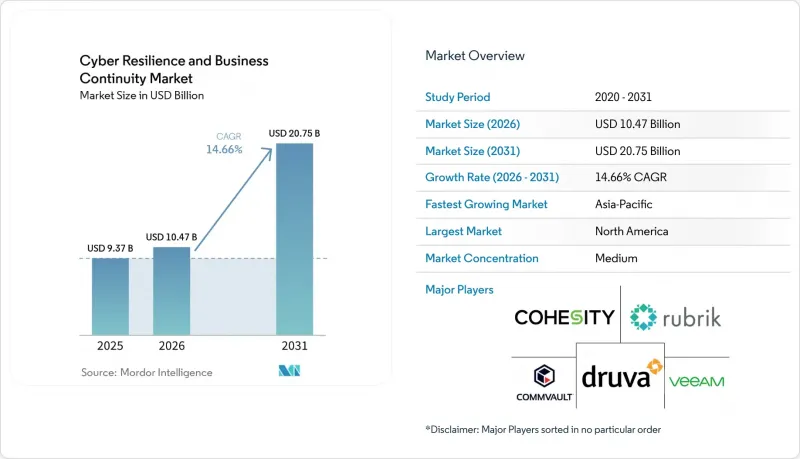
本報告按元件(軟體、服務)、部署方式(雲端、本地部署、混合部署)、企業規模(大型企業、中小企業)、應用領域(業務永續營運管理等)、最終用戶行業(銀行、金融服務和保險、醫療保健和生命科學等)以及地區進行細分。市場預測以美元計價。
全球網路彈性與業務永續營運市場趨勢及洞察
增加勒索軟體復原預算的分配
如今,許多組織不僅將復原能力視為技術附加功能,更將其視為財務安全網,網路彈性與業務永續營運市場正從勒索軟體復原預算中直接受益。 IBM 的一份報告顯示,到 2025 年,勒索軟體或敲詐勒索事件的平均總成本將達到 508 萬美元,這為董事會提供了一個清晰的基準,用於評估停機時間、補救措施和監管風險。 Veeam 的一項研究發現,94% 的組織正在增加勒索軟體復原預算,這表明預算規劃正迅速轉向準備和復原能力。 Sophos 的一項研究也表明,對於備份未受損的組織,恢復成本中位數為 37.5 萬美元,而對於備份受損的組織,恢復成本中位數則高達 300 萬美元,這清楚地表明了實施更強大的備份架構和隔離措施的經濟意義。網路彈性與業務永續營運市場也從中受益。由於威脅行為者現在會在攻擊鏈的早期階段就將目標對準備份儲存庫,因此,不可變儲存、乾淨的復原點和復原檢驗的重要性已經超過了單純的備份容量。這一趨勢也在改變買家的期望。如今,企業不僅需要證明其恢復資產能夠在乾淨的實驗室環境下運行,還需要證明其能夠抵禦攻擊並在對抗性條件下恢復業務。
監管機構對檢驗的恢復和業務永續營運計劃施加壓力
此外,隨著越來越多的行業和地區將經過檢驗的復原計畫作為合規要求,網路彈性與業務永續營運市場正在不斷擴大。歐盟的《數位營運彈性法案》(Digital Operational Resilience Act)於2025年1月17日對金融機構生效,該法案強制要求制定書面的ICT業務永續營運政策、經過檢驗的災害復原計劃,並在發生大規模故障後迅速發出事件通知。 NIS2指令將類似的義務擴展到關鍵產業,迫使許多組織超越靜態的業務永續營運文檔,轉而採用能夠支持證據、測試記錄和跨職能協作的系統。 SANS在其2026年報告中發現,95%的組織表示“法律規範正在影響網路安全人員配備方面的決策”,這一比例高於2025年的40%,表明合規壓力正在影響招聘和平台投資。因此,在受監管的行業中,網路彈性與業務永續營運市場的採購週期正在縮短。這是因為買家需要的是能夠證明檢驗充分準備的系統,而不僅僅是政策意圖。這一趨勢也有利於那些能夠使營運工作流程與既定標準和監管要求保持一致的供應商,尤其是在金融服務、醫療保健和關鍵基礎設施領域。
傳統安全技術棧與現代安全技術棧之間高階整合的複雜性。
由於許多公司同時使用各種傳統工具、雲端系統和專用安全產品,網路彈性與業務永續營運市場仍面臨著整合複雜性所帶來的挑戰。 IBM 和 Palo Alto Networks 在 2025 年初透露,每個組織平均管理來自 29 家供應商的 83 個安全解決方案。這凸顯了許多復原團隊在實際事件發生時將不得不應對的碎片化程度。 Versa Networks 在 2026 年宣布,73% 的組織報告稱,由於整合複雜性,關鍵項目被推遲或停滯;35% 的組織報告稱,由於網路和安全工具之間的差距,發生了安全漏洞。這在網路彈性與業務永續營運市場至關重要,因為復原的成功取決於備份系統、身分管理工具、事件回應工作流程、通訊平台和生產環境之間順暢的資料流。整合工作通常是阻礙擁有大量舊有系統的行業(例如銀行、金融和保險 (BFSI)、醫療保健和其他行業)採用新技術的一個因素。在這些行業中,替換現有系統可能會引發營運和審計方面的擔憂。隨著各組織擴大採用自動化和人工智慧工具,對可靠互通性的需求也日益成長,因為在關鍵情況下連接故障可能會擾亂整個恢復過程。
細分市場分析
在2025年的網路彈性與業務永續營運市場中,軟體佔比高達59.72%。這表明買家仍然傾向於選擇將恢復編配、報告和合規性追蹤整合到單一操作層的平台。隨著企業努力減少工具數量,並簡化複雜事件期間的恢復行動協調,這一趨勢正在加劇。軟體主導的採購趨勢也反映了產品的成熟度,因為許多現有平台在策略設定、清晰的復原點識別和容錯移轉序列的自動化方面,比以往的備份產品更有效率。儘管軟體領域在2025年仍是網路彈性與業務永續營運市場的核心收入來源,但預計從2026年到2031年,服務領域將以15.71%的複合年成長率成長,因為買家擴大尋求外部支援來應對設計、測試和日常營運。這種組合表明,客戶並非僅僅在軟體和服務之間做出選擇。這是因為許多客戶在內部資源有限的情況下,正在尋找一種能夠將強大的平台與託管交付相結合的解決方案。
這項服務正蓬勃發展,因為中型企業、公共部門使用者和小規模IT 團隊通常需要他們無法持續內部維護的復原專業知識。因此,在網路彈性和業務永續營運市場,那些將常規平台收入與諮詢支援、託管備份和復原執行支援相結合的供應商正在取得成功。 Veeam 於 2026 年 5 月發布的 DataAI Command Platform 表明,軟體供應商在將彈性、AI管治和資料可靠性基礎設施整合到單一解決方案中方面的作用日益增強。雖然 Acronis、Arcserve、Datto 和 Unitrends 仍然服務於該細分市場的不同領域,但買家的興趣正從有限的功能清單轉向檢驗的恢復結果。從長遠來看,那些既能滿足大型企業的複雜性需求,又能提供通路主導的中型企業產品,且無需為每個客戶群建立單獨營運模式的供應商,很可能保持最強的市場地位。
預計到 2025 年,基於雲端的部署將佔網路彈性與業務永續營運市場 52.84% 的佔有率,這反映出市場對更快配置、更低的基礎設施開銷和訂閱主導部署的強勁需求。雲端部署在網路彈性與業務永續營運市場佔有率不斷成長的另一個原因是,許多組織傾向於在初期階段擴大復原範圍,同時避免大規模的硬體引進週期。然而,混合部署預計到 2031 年將以 15.82% 的複合年成長率成長,因為許多組織無法依賴單一環境來處理受監管的工作負載和業務關鍵型系統。醫療保健、金融服務和關鍵基礎設施領域的使用者通常需要能夠同時涵蓋本地儲存庫、私有環境和公共雲端復原目標的架構。因此,對於既需要資料儲存管理又需要靈活恢復執行的使用者而言,混合模式是一個切實可行的選擇。
網路彈性和業務永續營運市場中混合部署的日益普及,源於真正的挑戰並非資料儲存位置,而是如何在互聯環境中快速恢復業務服務。處於空氣間隙的工業環境、國防相關營運或受長期資料保存法規約束的組織仍然維護著本地資產,但擴大將其連接到基於雲端的復原編配。在此背景下,災難復原即服務 (DRaaS) 的重要性日益凸顯,因為它為組織提供了一個備用復原環境,而無需完全複製其資料中心。 Zerto 對持續資料保護和極低恢復點目標 (RPO) 的重視,恰好滿足了這一需求,尤其是在對延遲敏感的應用程式中,任何重大資料遺失都是不可接受的。 Spanning 2025 調查揭示了感知恢復速度與實際恢復速度之間的差距,這也表明僅僅選擇部署方法是不夠的,經過測試的編配和演練仍然至關重要。因此,買家開始評估部署模型時,不僅考慮他們對雲端的偏好,還考慮檢驗的復原效能。
區域分析
到2025年,北美將佔據網路彈性與業務永續營運市場31.07%的佔有率,成為最大的區域市場,遙遙領先其他地區。美國仍然是主要的支出中心。這是因為大型企業面臨著許多因素的共同作用,包括資訊揭露法規、保險公司的審查以及股東壓力,使得它們難以將停機和網路恢復僅僅視為IT問題。該地區的網路彈性與業務永續營運市場也受益於銀行、金融和保險(BFSI)、醫療保健和政府部門的強勁需求,這些部門已將業務永續營運計劃融入營運模式和合規流程中。 Splunk在2026年報告中估計,全球2,000家公司每年將因意外停機而平均損失3億美元,並在重大事件發生後股價平均下跌3.4%。這解釋了為什麼該地區的董事會越來越重視彈性預算。加拿大和墨西哥也在推動區域需求,跨國商業風險以及與美國的監管一致性尤其有助於加強業務永續營運管理。
歐洲仍然是網路彈性和業務永續營運第二大區域市場,其需求趨勢日益受到法規的影響,這些法規要求提供證據、進行測試並制定正式的事件回應流程。將於2025年1月生效的《資料保護條例》(DORA) 繼續推動金融機構增加支出,要求其製定書面的ICT業務永續營運計劃、經過測試的恢復程序以及按時報告事件。 《網路資訊系統2》(NIS2) 將類似的義務擴展到關鍵產業,迫使企業用輔助協調、證據收集和監督的工具取代手動業務永續營運文件。德國、英國、法國、義大利和西班牙仍然是重要的國內市場,這得益於其大規模的監管行業、對更嚴格執法的預期以及更成熟的供應商生態系統。
亞太地區預計將以17.12%的複合年成長率成長,成為網路彈性與業務永續營運市場中成長最快的區域市場。這一成長主要受雲端運算普及、勒索軟體攻擊日益增多以及大中型企業對保護數位化營運的需求不斷成長的推動。日本國內網路安全市場規模已達1,9471億日圓,以2025年平均外匯(1美元=149.9日圓)計算,約129.9億美元。這一成長部分歸功於企業將網路安全作為其業務永續營運計劃的基礎。根據Marsh的報告,2025年上半年日本的勒索軟體攻擊數量較2024年同期增加了40%,網路保險索賠額較2022年同期增加了57%。這表明,企業在支出決策中正迅速反映出業務中斷風險。印度、韓國、中國和澳洲各自透過雲端擴張、合規要求和資料管理需求等獨特因素,為區域成長做出貢獻。南美洲仍然是一個新興的機會市場,主要由金融服務和零售公司推動,但預算限制和舊有系統整合的挑戰正在減緩該地區部分地區的採用速度。中東和非洲也在持續成長,沙烏地阿拉伯和阿拉伯聯合大公國(阿拉伯聯合大公國)正在投資加強小規模基礎設施的韌性,而南非則佔據了非洲需求的很大一部分。
其他好處:
- Excel格式的市場預測(ME)表
- 3個月的分析師支持
目錄
第1章:引言
- 研究假設和市場定義
- 調查範圍
第2章:調查方法
第3章執行摘要
第4章 市場狀況
- 市場概覽
- 市場促進因素
- 增加勒索軟體復原預算的分配
- 監管機構對檢驗的恢復和業務永續營運計劃施加壓力
- 透過依賴雲端和SaaS來促進持續恢復系統的發展。
- 經營團隊關注因營運中斷造成的損失
- 與網路保險相關的承保要求及韌性措施
- 人工智慧驅動的事件編配和自動化回應。
- 市場限制因素
- 傳統安全技術棧與現代安全技術棧之間高階整合的複雜性。
- 缺乏具備韌性、復原和事件回應能力的熟練人員。
- 中小型企業在實施過程中面臨的預算挑戰
- 不成熟組織在恢復測試方面缺乏紀律性
- 產業價值鏈分析
- 監理情勢
- 技術展望
- 波特五力分析
第5章 市場規模與成長預測
- 按組件
- 軟體
- 服務
- 介紹
- 雲
- 現場
- 混合
- 按公司規模
- 大公司
- 小型企業
- 透過使用
- 業務永續營運管理
- 災害復原和網路復原
- 事件管理
- 危機管理溝通與緊急呼叫
- 業務永續營運管理
- 風險與韌性管理
- 合規與管治管理
- 業務影響分析與復原計劃
- 按最終用戶行業分類
- BFSI
- 醫療保健和生命科學
- 資訊科技/通訊
- 零售與電子商務
- 工業製造
- 政府/公共部門
- 其他
- 按地區
- 北美洲
- 美國
- 加拿大
- 墨西哥
- 南美洲
- 巴西
- 阿根廷
- 其他南美國家
- 歐洲
- 德國
- 英國
- 法國
- 義大利
- 西班牙
- 俄羅斯
- 其他歐洲國家
- 亞太地區
- 中國
- 印度
- 日本
- 韓國
- 澳洲
- 其他亞太國家
- 中東和非洲
- 中東
- 沙烏地阿拉伯
- 阿拉伯聯合大公國
- 其他中東國家
- 非洲
- 南非
- 奈及利亞
- 其他非洲國家
- 中東
- 北美洲
第6章 競爭情勢
- 市場集中度
- 策略趨勢
- 市佔率分析
- 公司簡介
- Cohesity, Inc.
- Rubrik, Inc.
- Commvault Systems, Inc.
- Veeam Software Group GmbH
- Druva Inc.
- Zerto Ltd.
- Acronis International GmbH
- Arcserve LLC
- Datto, Inc.
- Unitrends, Inc.
- Recovery Point Systems, Inc.
- Semperis, Inc.
- Everbridge, Inc.
- Riskonnect, Inc.
- Fusion Risk Management, Inc.
- Quantivate, LLC
- Castellan Solutions, Inc.
- LogicManager, Inc.
- ServiceNow
- Onspring Technologies, LLC
第7章 市場機會與未來展望
According to Mordor Intelligence, the cyber resilience and business continuity market size is projected to be USD 9.37 billion in 2025, USD 10.47 billion in 2026, and reach USD 20.75 billion by 2031, growing at a CAGR of 14.66% from 2026 to 2031.
This report is Segmented by Component (Software and Services), Deployment (Cloud, On-Premises, and Hybrid), Enterprise Size (Large Enterprises, and Small and Medium Enterprises), Application (Business Continuity Management, and More), End-User Industry (BFSI, Healthcare and Life Sciences, and More), and Geography. The Market Forecasts are Provided in Terms of Value (USD).
Global Cyber Resilience and Business Continuity Market Trends and Insights
Rising Ransomware Recovery Budget Allocation
The cyber resilience and business continuity market is gaining direct support from ransomware recovery budgets because many organizations now treat recovery readiness as a financial safeguard rather than a technical add-on. IBM reported that the average all-in cost of a ransomware or extortion incident reached USD 5.08 million in 2025, providing boards with a clear reference point for downtime, remediation, and regulatory exposure. Veeam found that 94% of organizations increased their ransomware recovery budgets, indicating how quickly budget planning has shifted toward preparedness and restoration capabilities. Sophos also showed that organizations with uncompromised backups reduced median recovery costs to USD 375,000, compared with USD 3 million when backups were compromised, which sharpened the economic case for stronger backup architecture and isolation practices. The cyber resilience and business continuity market is also benefiting, as threat actors now target backup repositories early in the attack chain, making immutable storage, clean recovery points, and recovery verification more important than backup volume alone. This pattern is changing buyer expectations, as organizations now want proof that recovery assets can withstand an attack and restore operations under hostile conditions rather than in a clean-lab environment.
Regulatory Pressure for Tested Recovery and Continuity Plans
The cyber resilience and business continuity market is also rising as tested recovery plans are becoming a compliance requirement across more sectors and regions. The European Union Digital Operational Resilience Act became enforceable for financial entities on January 17, 2025, and it requires documented ICT business continuity policies, tested disaster recovery plans, and rapid incident notification after major disruptions. The NIS2 Directive is expanding similar obligations across critical sectors, pushing many organizations to move beyond static continuity documents into systems that support evidence, testing records, and cross-functional coordination. SANS reported in 2026 that 95% of organizations said regulatory frameworks now shape cybersecurity staffing decisions, up from 40% in 2025, indicating that compliance pressure is influencing both hiring and platform investment. The cyber resilience and business continuity market is therefore seeing shorter procurement cycles in regulated industries, as buyers need systems that can demonstrate tested readiness rather than just policy intent. This also favors vendors that can align operational workflows with established standards and supervisory expectations, especially in financial services, healthcare, and critical infrastructure.
High Integration Complexity Across Legacy and Modern Security Stacks
The cyber resilience and business continuity market still faces friction due to integration complexity, as many enterprises operate large mixes of legacy tools, cloud systems, and specialized security products. IBM and Palo Alto Networks found in early 2025 that organizations managed an average of 83 security solutions from 29 vendors, underscoring the scale of the fragmentation many recovery teams must navigate during a live incident. Versa Networks reported in 2026 that 73% of organizations had a critical project delayed or derailed by integration complexity, and 35% reported a security breach linked to gaps between networking and security tools. In the cyber resilience and business continuity market, this matters because recovery success depends on clean data flows between backup systems, identity tools, incident workflows, communications platforms, and production environments. Integration work often slows deployments in BFSI, healthcare, and other legacy-heavy sectors, where replacing incumbent systems can raise operational and audit concerns. As organizations add more automation and AI tooling, the need for reliable interoperability becomes even more important, because a failed connection during a crisis can disrupt the entire restoration sequence.
Other drivers and restraints analyzed in the detailed report include:
- Cloud And SaaS Dependency Requiring Continuous Recovery Readiness
- Board-Level Focus on Operational Downtime Losses
- Shortage of Skilled Resilience, Recovery, and Incident Response Talent
For complete list of drivers and restraints, kindly check the Table Of Contents.
Segment Analysis
Software accounted for 59.72% of the cyber resilience and business continuity market in 2025, indicating that buyers continue to favor platforms that bring recovery orchestration, reporting, and compliance tracking into a single operating layer. This preference has strengthened as organizations seek to reduce tool sprawl and make recovery actions easier to coordinate during complex incidents. Software-led buying also reflects product maturity, because many current platforms automate policy setup, clean recovery point identification, and failover sequencing more effectively than earlier backup products. The cyber resilience and business continuity market for software remained the core revenue base in 2025, while services are projected to expand at a 15.71% CAGR from 2026 to 2031 as buyers seek outside help with design, testing, and day-to-day operations. That combination shows that customers are not strictly choosing between software and services, because many want a strong platform paired with managed delivery where internal capacity is limited.
Services are gaining momentum because mid-market companies, public-sector users, and lean IT teams often need recovery expertise they cannot maintain in-house continuously. The cyber resilience and business continuity market is therefore rewarding vendors that combine recurring platform revenue with advisory support, managed backup, and execution support for recovery. Veeam's May 2026 launch of the DataAI Command Platform demonstrated how software vendors are broadening their role by integrating resilience, AI governance, and data trust infrastructure into a single offering. Acronis, Arcserve, Datto, and Unitrends still address distinct parts of this segment, but buyer attention is shifting toward verifiable recovery outcomes rather than narrow feature lists. Over time, the strongest positions are likely to remain with vendors that can support both the complexity of large enterprises and channel-driven mid-market delivery without creating separate operating models for each customer tier.
Cloud-based deployment accounted for 52.84% of the cyber resilience and business continuity market in 2025, reflecting strong demand for faster provisioning, lower infrastructure overhead, and subscription-led adoption. The cyber resilience and business continuity market share in cloud deployments also benefited from the fact that many organizations preferred to avoid large upfront hardware cycles while still improving recovery coverage. Even so, hybrid deployment is projected to grow at a 15.82% CAGR through 2031, as many organizations cannot rely on a single environment for regulated workloads and business-critical systems. Healthcare, financial services, and critical infrastructure users often need architectures that span on-premises vaults, private environments, and public cloud restoration targets simultaneously. This makes hybrid models a practical choice for buyers who need both data residency control and flexible recovery execution.
The cyber resilience and business continuity market is seeing hybrid adoption rise because the real issue is not where data sits, but how quickly business services can return across connected environments. Organizations with air-gapped industrial settings, defense-linked operations, or long data retention rules still maintain on-premises assets, but increasingly connect them to cloud-based recovery orchestration. Disaster Recovery as a Service has become more relevant in this context because it provides organizations with a secondary recovery environment without the cost of a fully duplicated data center. Zerto's focus on continuous data protection and very low recovery point objectives fits this need, especially for latency-sensitive applications that cannot tolerate large data loss windows. The Spanning 2025 findings on the gap between perceived and actual recovery speed also underline that deployment choice alone does not create readiness, because tested orchestration and rehearsal remain essential. As a result, buyers are beginning to evaluate deployment models through the lens of verified recovery performance rather than cloud preference alone.
Complete Report Scope:
- By Component
- Software
- Services
- By Deployment
- Cloud
- On-Premises
- Hybrid
- By Enterprise Size
- Large Enterprises
- Small and Medium Enterprises
- By Application
- Business Continuity Management
- Disaster Recovery and Cyber Recovery
- Incident Management
- Crisis Communication and Emergency Notification
- Operational Resilience Management
- Risk and Resilience Management
- Compliance and Governance Management
- Business Impact Analysis and Recovery Planning
- By End-user Industry
- BFSI
- Healthcare and Life Sciences
- Information Technology and Telecom
- Retail and E-commerce
- Industrial Manufacturing
- Government and Public Sector
- Other End-user Industries
- By Geography
- North America
- United States
- Canada
- Mexico
- South America
- Brazil
- Argentina
- Rest of South America
- Europe
- Germany
- United Kingdom
- France
- Italy
- Spain
- Russia
- Rest of Europe
- Asia-Pacific
- China
- India
- Japan
- South Korea
- Australia
- Rest of Asia-Pacific
- Middle East and Africa
- Middle East
- Saudi Arabia
- United Arab Emirates
- Rest of Middle East
- Africa
- South Africa
- Nigeria
- Rest of Africa
- Middle East
- North America
Geography Analysis
North America held 31.07% of the cyber resilience and business continuity market in 2025, making it the largest regional segment by a wide margin. The United States remained the main spending center because large enterprises face a mix of disclosure rules, insurance scrutiny, and shareholder pressure that makes downtime and cyber recovery hard to treat as a narrow IT issue. The cyber resilience and business continuity market in the region also benefits from strong demand in BFSI, healthcare, and government, where continuity programs are already embedded in operating models and compliance processes. Splunk reported in 2026 that Global 2000 companies lost an average of USD 300 million annually to unplanned downtime and saw an average 3.4% stock price decline after a material incident, which helps explain why resilience budgets receive board-level attention in this region. Canada and Mexico add to regional demand, especially where cross-border business exposure and regulatory alignment with the United States encourage stronger continuity controls.
Europe remained the second-largest regional market for cyber resilience and business continuity, and its demand profile is increasingly shaped by rules requiring evidence, testing, and formal incident handling. DORA has been in force since January 2025 and continues to shape spending by financial entities that need documented ICT continuity plans, tested recovery procedures, and time-bound disruption reporting. NIS2 is expanding similar obligations across critical sectors, pushing organizations to replace manual continuity documentation with tools that support coordination, evidence capture, and oversight. Germany, the United Kingdom, France, Italy, and Spain remain important national markets because they combine large regulated sectors with stronger enforcement expectations and more mature supplier ecosystems.
Asia-Pacific, projected to grow at a 17.12% CAGR, is the fastest-growing regional segment in the cyber resilience and business continuity market, driven by cloud adoption, rising ransomware incidents, and a greater need to protect digital operations across large enterprises and mid-market organizations. Japan's domestic cybersecurity market reached JPY 1.9471 trillion, which was equivalent to USD 12.99 billion at the 2025 average exchange rate of JPY 149.9 per USD, and this growth was tied in part to enterprises treating cybersecurity as a foundation for business continuity planning. Marsh reported that ransomware attacks in Japan rose 40% in the first half of 2025 compared with 2024, and that cyber insurance claims in Japan rose 57% from 2022 to 2024, indicating how quickly disruption risk is translating into spending decisions. India, South Korea, China, and Australia each contribute to regional growth through their own mix of cloud expansion, compliance expectations, and data control requirements. South America remains an emerging opportunity, led by larger enterprises in financial services and retail, but budget constraints and legacy integration issues continue to slow adoption in parts of the region. The Middle East and Africa are also growing from a smaller base, with Saudi Arabia and the UAE investing in critical infrastructure resilience, while South Africa anchors a significant share of African demand.
- Cohesity, Inc.
- Rubrik, Inc.
- Commvault Systems, Inc.
- Veeam Software Group GmbH
- Druva Inc.
- Zerto Ltd.
- Acronis International GmbH
- Arcserve LLC
- Datto, Inc.
- Unitrends, Inc.
- Recovery Point Systems, Inc.
- Semperis, Inc.
- Everbridge, Inc.
- Riskonnect, Inc.
- Fusion Risk Management, Inc.
- Quantivate, LLC
- Castellan Solutions, Inc.
- LogicManager, Inc.
- ServiceNow
- Onspring Technologies, LLC
Additional Benefits:
- The market estimate (ME) sheet in Excel format
- 3 months of analyst support
TABLE OF CONTENTS
1 INTRODUCTION
- 1.1 Study Assumptions and Market Definition
- 1.2 Scope of the Study
2 RESEARCH METHODOLOGY
3 EXECUTIVE SUMMARY
4 MARKET LANDSCAPE
- 4.1 Market Overview
- 4.2 Market Drivers
- 4.2.1 Rising Ransomware Recovery Budget Allocation
- 4.2.2 Regulatory Pressure for Tested Recovery And Continuity Plans
- 4.2.3 Cloud and SaaS Dependency Requiring Continuous Recovery Readiness
- 4.2.4 Board-Level Focus On Operational Downtime Losses
- 4.2.5 Cyber Insurance Underwriting Requirements For Resilience Controls
- 4.2.6 AI-Enabled Incident Orchestration And Response Automation
- 4.3 Market Restraints
- 4.3.1 High Integration Complexity Across Legacy And Modern Security Stacks
- 4.3.2 Shortage Of Skilled Resilience, Recovery, And Incident Response Talent
- 4.3.3 Budget Friction In Mid-Market And SME Adoption
- 4.3.4 Limited Recovery Testing Discipline In Low-Maturity Organizations
- 4.4 Industry Value-Chain Analysis
- 4.5 Regulatory Landscape
- 4.6 Technological Outlook
- 4.7 Porter's Five Forces Analysis
- 4.7.1 Bargaining Power of Buyers
- 4.7.2 Bargaining Power of Suppliers
- 4.7.3 Threat of New Entrants
- 4.7.4 Threat of Substitutes
- 4.7.5 Intensity of Competitive Rivalry
5 MARKET SIZE AND GROWTH FORECASTS (VALUE)
- 5.1 By Component
- 5.1.1 Software
- 5.1.2 Services
- 5.2 By Deployment
- 5.2.1 Cloud
- 5.2.2 On-Premises
- 5.2.3 Hybrid
- 5.3 By Enterprise Size
- 5.3.1 Large Enterprises
- 5.3.2 Small and Medium Enterprises
- 5.4 By Application
- 5.4.1 Business Continuity Management
- 5.4.2 Disaster Recovery and Cyber Recovery
- 5.4.3 Incident Management
- 5.4.4 Crisis Communication and Emergency Notification
- 5.4.5 Operational Resilience Management
- 5.4.6 Risk and Resilience Management
- 5.4.7 Compliance and Governance Management
- 5.4.8 Business Impact Analysis and Recovery Planning
- 5.5 By End-user Industry
- 5.5.1 BFSI
- 5.5.2 Healthcare and Life Sciences
- 5.5.3 Information Technology and Telecom
- 5.5.4 Retail and E-commerce
- 5.5.5 Industrial Manufacturing
- 5.5.6 Government and Public Sector
- 5.5.7 Other End-user Industries
- 5.6 By Geography
- 5.6.1 North America
- 5.6.1.1 United States
- 5.6.1.2 Canada
- 5.6.1.3 Mexico
- 5.6.2 South America
- 5.6.2.1 Brazil
- 5.6.2.2 Argentina
- 5.6.2.3 Rest of South America
- 5.6.3 Europe
- 5.6.3.1 Germany
- 5.6.3.2 United Kingdom
- 5.6.3.3 France
- 5.6.3.4 Italy
- 5.6.3.5 Spain
- 5.6.3.6 Russia
- 5.6.3.7 Rest of Europe
- 5.6.4 Asia-Pacific
- 5.6.4.1 China
- 5.6.4.2 India
- 5.6.4.3 Japan
- 5.6.4.4 South Korea
- 5.6.4.5 Australia
- 5.6.4.6 Rest of Asia-Pacific
- 5.6.5 Middle East and Africa
- 5.6.5.1 Middle East
- 5.6.5.1.1 Saudi Arabia
- 5.6.5.1.2 United Arab Emirates
- 5.6.5.1.3 Rest of Middle East
- 5.6.5.2 Africa
- 5.6.5.2.1 South Africa
- 5.6.5.2.2 Nigeria
- 5.6.5.2.3 Rest of Africa
- 5.6.5.1 Middle East
- 5.6.1 North America
6 COMPETITIVE LANDSCAPE
- 6.1 Market Concentration
- 6.2 Strategic Moves
- 6.3 Market Share Analysis
- 6.4 Company Profiles (includes Global Level Overview, Market Level Overview, Core Segments, Financials as available, Strategic Information, Market Rank/Share, Products and Services, Recent Developments)
- 6.4.1 Cohesity, Inc.
- 6.4.2 Rubrik, Inc.
- 6.4.3 Commvault Systems, Inc.
- 6.4.4 Veeam Software Group GmbH
- 6.4.5 Druva Inc.
- 6.4.6 Zerto Ltd.
- 6.4.7 Acronis International GmbH
- 6.4.8 Arcserve LLC
- 6.4.9 Datto, Inc.
- 6.4.10 Unitrends, Inc.
- 6.4.11 Recovery Point Systems, Inc.
- 6.4.12 Semperis, Inc.
- 6.4.13 Everbridge, Inc.
- 6.4.14 Riskonnect, Inc.
- 6.4.15 Fusion Risk Management, Inc.
- 6.4.16 Quantivate, LLC
- 6.4.17 Castellan Solutions, Inc.
- 6.4.18 LogicManager, Inc.
- 6.4.19 ServiceNow
- 6.4.20 Onspring Technologies, LLC
7 MARKET OPPORTUNITIES AND FUTURE OUTLOOK
- 7.1 White-Space and Unmet-Need Assessment

 內容策略服務:市場佔有率分析、產業趨勢與統計、成長預測(2026-2031)
 業務永續營運管理解決方案市場規模、佔有率和成長分析:按組件、部署類型、組織規模、解決方案類型、最終用戶和地區分類-2026-2033 年產業預測基礎模型:市場佔有率分析、產業趨勢與統計、成長預測(2026-2031 年)
 調查管理市場:依產品類型、調查類型、調查方法、調查模式、實施模式及產業分類-2026-2032年全球市場預測政府和公共部門的IT服務管理:市場佔有率分析、行業趨勢和統計數據以及成長預測(2026-2031年)
 2026-2030年全球業務永續營運管理解決方案市場
 企業財務風險與策略諮詢市場規模、佔有率及成長分析:依服務類型、客戶類型、產業、合約類型、組織架構及地區分類-2026-2033年產業預測
 2026年全球業務永續營運市場報告
 業務永續營運管理市場 - 全球產業規模、佔有率、趨勢、機會、預測:按產品/服務、組織規模、應用、產業、地區和競爭對手分類,2021-2031 年2026年全球業務永續營運管理解決方案市場報告