


 |
市場調查報告書
商品編碼
2099130
政府和公共部門的IT服務管理:市場佔有率分析、行業趨勢和統計數據以及成長預測(2026-2031年)ITSM In Government and Public Sector - Market Share Analysis, Industry Trends & Statistics, Growth Forecasts (2026 - 2031) |
||||||

※ 本網頁內容可能與最新版本有所差異。詳細情況請與我們聯繫。
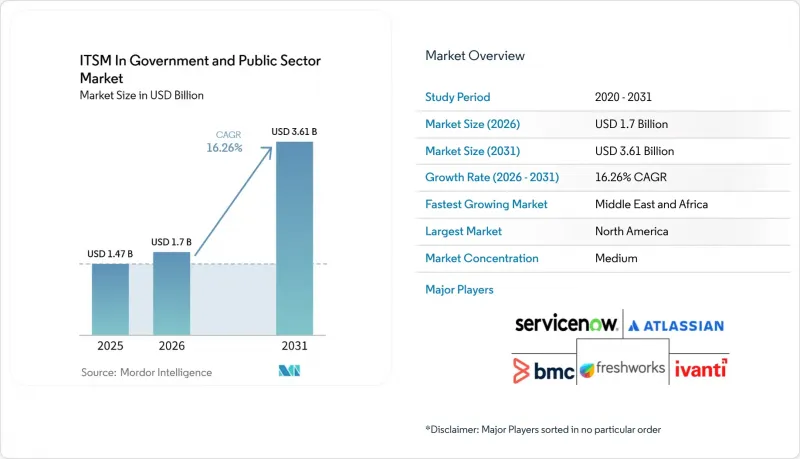
據 Mordor Intelligence 稱,政府和公共部門的 ITSM 市場預計將從 2025 年的 14.7 億美元成長到 2026 年的 17 億美元,到 2031 年達到 36.1 億美元,預計 2026 年至 2031 年的複合年成長率為 16.26%。
本報告按元件(解決方案和服務)、部署模式(雲端、本地、混合)、應用程式(服務台和事件管理、資產和配置管理等)、企業規模(大型企業和中小企業)以及地區進行細分。市場預測以美元計價。
全球IT服務管理市場趨勢及政府及公共部門洞察
採用「雲端優先」方法實現公共部門現代化
政府對雲端運算的採用正從政策層面轉向實際採購政策,政府和公共部門的IT服務管理(ITSM)市場已率先受益,因為服務管理平台是日常IT營運和工作流程管理的核心。加拿大共享服務部在其2025-2026會計年度產業計畫中宣布,計畫在2026-2027會計年度完成剩餘服務合作夥伴與企業ITSM工具的整合,並將工單資料的自動即時同步確定為交付過程中的關鍵里程碑。此類項目表明,雲端優先現代化不再局限於狹義的基礎設施決策,因為各機構正在尋求一個能夠集中管理跨部門服務請求、事件和營運報告的單一營運層。德國也在2026年5月強化了類似的趨勢,當時德國聯邦國防軍國防安全局(BMDS)簽署了一份價值2.5億歐元(2.78億美元)的「主權人工智慧雲」契約,將零信任、開放原始碼和關鍵主權要求融入聯邦政府使用的架構中。因此,由於組織機構面臨合規風險和現代化投資之間的直接權衡,繼續使用不受支援的本地部署工具變得越來越難以令人信服。這種強制性的替換週期是IT服務管理(ITSM)在政府和公共部門市場持續擴張的主要原因,即便在整體預算核准依然謹慎的環境下也是如此。
人工智慧驅動的服務台查詢轉發和自助服務自動化
由於公共部門的工單處理具有重複性和規則性,且規模龐大,無需改變底層服務模式即可實現顯著的自動化效益,因此人工智慧正在政府服務台快速部署。 Atlassian 報告稱,到 2025 年,93% 的組織將受益於人工智慧帶來的效率提升,98% 的組織將以某種形式使用人工智慧,從而支援服務工作流程和知識管理中更廣泛的應用模式。 ServiceNow 的公共部門產品組合已圍繞數位化服務、案例管理、工作流程自動化和安全服務交付構建,因此,人工智慧驅動的查詢轉移是現有營運模式的直接延伸,而非一個獨立的專案。 2026 年 2 月,ServiceNow 的 Moveworks 獲得了 FedRAMP 中等認證,進一步擴展了聯邦和公共部門組織在託管雲端環境中可使用的安全互動式人工智慧工具的範圍。隨著各機構將已解決的事件轉化為搜尋的知識、指導性回應和可重複使用的工作流程,政府和公共部門市場中 ITSM 自助服務的擴展將得到促進。正因如此,在許多公共環境中,知識庫自動化正從一項實驗性工作轉變為一項實際的操作要求。
傳統採購週期會延緩平台更換。
政府採購運作仍然依賴多年預算核准和競標流程,即使現代化政策已經制定,這些流程也常常延誤實際實施。 2025年2月,美國政府責任署(GAO)報告稱,在2019年確定的10個關鍵聯邦舊有系統中,只有3個完成了現代化改造,其餘7個中有兩個仍未確定完成日期。這一差距對政府和公共部門的IT服務管理(ITSM)市場有著重大影響,因為使用最老舊平台的機構往往無法快速完成替換。在許多公共專案中,年度預算撥款、強制性競爭性競標以及謹慎的變更管理都會延長從專案批准到運作的時間。即使資金獲得批准,系統更新周期也常常滯後於供應商的發布計劃和人工智慧(AI)功能的開發,這不僅降低了需求水平,也減緩了實施速度。因此,這種限制與其說是源自於各機構是否需要現代化的ITSM,不如說是源自於許多機構從政策意圖到實際運作的轉變速度太慢。
細分市場分析
到2025年,解決方案將佔據政府和公共部門IT服務管理(ITSM)市場佔有率的64.40%。這反映出市場對整合事件管理、組態管理資料庫(CMDB)、變更編配和自助服務等功能的平台有著強烈的偏好,這些功能都整合在單一的授權框架下。這種偏好使得軟體收入更加集中,因為機構通常會先部署核心工作流程,然後隨著使用者在各部門的採用,逐步擴展到相鄰模組。對於許多公共機構而言,單一的整合平台比各種獨立工具的組合更容易管理,尤其是在保持報告、核准、審計追蹤和服務定義一致性方面。解決方案層也受益於較長的配置生命週期,因為一旦部署完成,過程模式、服務目錄和資產記錄就會深度整合到日常營運中。這種整合特性是政府和公共部門ITSM市場即使預算分階段謹慎分配,仍傾向於平台主導採購的原因之一。
服務是成長最快的組成部分,政府和公共部門的IT服務管理(ITSM)市場預計將在2026年至2031年間以15.70%的複合年成長率成長。各機構日益體認到,僅靠軟體本身無法取得成效,還需要實施規劃、人才能力建構、強而有力的管治和定期最佳化等支援。隨著人工智慧(AI)能力的日益普及,服務營運的重要性進一步提升,因為即使在運作之後,也需要主動管理自動化規則、資料品管、整合邏輯和知識設計。此外,由於公共機構各部門的流程存在差異,因此需要持續的諮詢和管理支持,而不是一次性的實施。正因如此,系統整合商和專業合作夥伴繼續發揮著至關重要的作用,尤其是在政府和公共部門的ITSM產業,對於各機構穩定和現代化其服務運作而言,他們是不可或缺的。
至2025年,雲端將佔政府和公共部門IT服務管理(ITSM)市場63.10%的佔有率,預計到2031年,雲端採用率將以16.10%的複合年成長率成長。這一雙重趨勢表明,從本地部署到雲端的遷移尚未完成,許多機構仍在進行中。政府機構尋求更快的升級速度、更簡化的工作流程擴展以及更廣泛的AI賦能功能,同時避免維護大規模的本地堆疊,這推動了該領域「雲端優先」的採購策略。加拿大共享服務部的企業部署計畫也提出了一種模型,其中通用服務工具可以支援更廣泛的行政協調和更統一的工單資料流。 BMDS授予的主權雲端合約進一步表明,政府部門的雲端採用正在擴展到能夠直接滿足管理和主權要求的關鍵任務工作負載。
在共用SaaS模式無法滿足政策要求的敏感、國防相關或主權敏感環境中,本地部署和混合部署仍然具有價值。這意味著部署決策不再只是「雲端與本地部署」的二元選擇,因為機構通常會根據其保密性、管理和審計需求,在不同的環境中部署不同的工作負載。在許多競標中,授權狀態比功能差異更為重要,因為機構在比較工作流程深度或介面設計之前,需要經過認證的運作條件。因此,能夠提供雲端柔軟性和安全隔離相結合的供應商在更廣泛的公共部門用例中更有利於訂單。雖然雲端的成長預計將繼續推動政府和公共部門的IT服務管理(ITSM)市場,但成功的模式仍將以合規性主導,而非純粹以功能為主導。
區域分析
2025年,北美佔據了政府和公共部門IT服務管理(ITSM)市場40.20%的佔有率。這得歸功於大規模的聯邦現代化預算、眾多認證供應商以及能夠整合各機構需求的採購結構。美國之所以能保持主導地位,主要原因在於其企業採購結構比許多其他地區更加規範,這得益於其認證的雲端環境和特定任務的合規標準。 2025年9月,美國聯邦服務管理局(GSA)透過與ServiceNow達成的「OneGov」協議進一步鞏固了這一地位,為符合條件的聯邦客戶提供ITSM Pro和Pro Plus套餐,最高可享70%的折扣,有效期至2028年9月。加拿大也積極推動一項合作服務和工具採用計劃,加拿大共享服務部計劃在2026-2027會計年度之前將剩餘的合作機構整合到其企業ITSM工具中。這些發展,再加上預算規模、採購影響力以及以合規為導向的採用方案,使北美始終處於政府和公共部門 ITSM 市場的前沿。
歐洲仍是政府和公共部門IT服務管理(ITSM)市場的主要區域集團,其成長並非由單一的通用模式所驅動,而是由各國主權法規、採購架構和公共雲端設計選擇共同塑造。德國就是一個最典型的例子,其主權雲的發展與聯邦政府的數位現代化以及對金鑰、基礎設施和平台設計的公共控制直接相關。由IT規劃委員會制定的「德國行政雲」(Deutsche Verwaltungscloud)目標架構,也將服務管理功能納入更廣泛的國家雲端框架,從而在架構層面正式確立了標準化。簡而言之,儘管歐洲的需求強勁,但在評估產品廣度或介面品質之前,平台選擇越來越受到資料居住、合規性和公共控制要求的限制。因此,儘管歐洲在政府和公共部門ITSM市場仍然佔據重要地位,但能夠平衡現代化和主權而非僅僅追求速度的供應商越來越受到重視。
中東和非洲地區是成長最快的地區,預計2026年至2031年間,政府和公共部門的IT服務管理(ITSM)市場規模將以16.05%的複合年成長率成長。根據發表在《歐洲科學期刊》上的研究,沙烏地阿拉伯政府機構憑藉其較高的ITSM成熟度,在系統運作和公民滿意度方面取得了顯著提升,這為在該地區持續投資提供了明確的營運依據。在衣索比亞,非洲首個整合數位服務應用MESOB於2026年6月推出,透過將多個政府機構的服務整合到一個平台上,樹立了一個引人注目的公共典範。亞太地區是政府和公共部門ITSM市場的第二大成長區域,這主要得益於政府雲端計畫以及中國「十五」規劃中提出的跨行政層級整合化、人工智慧驅動的數位管治需求。中國對跨部門資料共用和統一數位平台的重視,也為其他地區推動現代化進程提供了相同的服務管理邏輯。在這兩個地區,政府都在建構統一的數位服務層,這意味著結構化服務管理在日常公共服務中扮演越來越重要的角色。儘管各國採購成熟度仍存在顯著差異,但這一通用方向將使政府和公共部門的IT服務管理市場保持強勁成長。
其他好處:
- Excel格式的市場預測(ME)表
- 3個月的分析師支持
目錄
第1章:引言
- 研究假設和市場定義
- 調查範圍
第2章:調查方法
第3章執行摘要
第4章 市場狀況
- 市場概覽
- 市場促進因素
- 採用「雲端優先」方法實現公共部門現代化
- 服務運作中的網路安全和合規壓力
- 共享服務和跨機構工作流程的標準化
- 為市民及員工服務提供零接觸式請求處理
- 公共部門硬體和軟體資產的生命週期管理
- 人工智慧驅動的服務台查詢轉發和自助服務自動化
- 市場限制因素
- 傳統的採購週期正在減緩平台更新的速度。
- 資料居住要求和主權限制限制了雲端技術的採用。
- 分散的機構管理模式阻礙了流程標準化。
- ITSM自動化和CMDB管治的技能差距
- 產業價值鏈分析
- 監理情勢
- 技術展望
- 波特五力分析
- 宏觀經濟因素對市場的影響
第5章 市場規模與成長預測
- 按組件
- 解決方案
- 服務
- 不同的發展
- 雲
- 現場
- 混合
- 透過使用
- 服務台和事件管理
- 資產和配置管理
- 變更和發布管理
- 服務請求管理
- 知識管理
- 其他用途
- 按公司規模
- 大公司
- 中小企業
- 按地區
- 北美洲
- 美國
- 加拿大
- 墨西哥
- 南美洲
- 巴西
- 阿根廷
- 其他南美國家
- 歐洲
- 德國
- 英國
- 法國
- 俄羅斯
- 西班牙
- 其他歐洲國家
- 亞太地區
- 中國
- 日本
- 印度
- 韓國
- 東南亞
- 其他亞太國家
- 中東和非洲
- 中東
- 沙烏地阿拉伯
- 阿拉伯聯合大公國
- 土耳其
- 其他中東國家
- 非洲
- 南非
- 奈及利亞
- 埃及
- 其他非洲國家
- 中東
- 北美洲
第6章 競爭情勢
- 市場集中度
- 策略趨勢
- 市佔率分析
- 公司簡介
- ServiceNow, Inc.
- BMC Software, Inc.
- Atlassian Corporation Plc
- Ivanti, Inc.
- Freshworks Inc.
- Open Text Corporation
- ManageEngine
- IBM Corporation
- Broadcom Inc.
- SolarWinds Corporation
- TOPdesk Nederland BV
- SysAid Technologies Ltd.
- EasyVista, Inc.
- Matrix42 AG
- TeamDynamix
- Halo Service Solutions
- Hornbill
- SAP
- Unisys
第7章 市場機會與未來展望
According to Mordor Intelligence, the ITSM in government and public sector market size is expected to increase from USD 1.47 billion in 2025 to USD 1.7 billion in 2026 and reach USD 3.61 billion by 2031, growing at a CAGR of 16.26% over 2026-2031.
This report is Segmented by Component (Solutions and Services), Deployment (Cloud, On-Premise, and Hybrid), Application (Service Desk and Incident Management, Asset and Configuration Management, and More), Enterprise Size (Large Enterprises and Small and Mid-Size Enterprises (SME)), and Geography. The Market Forecasts are Provided in Terms of Value (USD).
Global ITSM In Government and Public Sector Market Trends and Insights
Cloud-First Public Sector Modernization
Government cloud adoption has shifted from policy language to practical procurement direction, and the ITSM in the government and public sector market benefits early because service management platforms sit at the center of daily IT operations and workflow control. Shared Services Canada stated in its 2025-26 Departmental Plan that it plans to complete onboarding of remaining service partners to its enterprise ITSM tool by 2026-27, with automated real-time synchronization of ticketing data identified as a core delivery milestone. That kind of program shows that cloud-first modernization is no longer a narrow infrastructure decision, because agencies want one operating layer for service requests, incidents, and operational reporting across departments. Germany reinforced the same direction in May 2026 when the BMDS awarded a sovereign AI cloud contract worth EUR 250 million (USD 278 million), with zero-trust, open-source, and key-sovereignty requirements built into the architecture for federal use. The practical effect is that unsupported on-premise tools are becoming harder to justify, because agencies face a direct tradeoff between compliance exposure and modernization spending. This forced replacement cycle is a major reason the ITSM in government and public sector market continues to expand even in environments where overall budget approval remains cautious.
AI-Powered Service Desk Deflection and Self-Service Automation
AI is moving quickly into government service desks because public-sector ticket volumes are repetitive, rules-based, and large enough to support meaningful automation gains without changing the basic service model. Atlassian reported in 2025 that 93% of organizations saw higher efficiency from AI, and 98% were already using AI in some capacity, which supports broader adoption patterns around service workflows and knowledge handling. ServiceNow's public-sector portfolio is already structured around digital services, case management, workflow automation, and secure service delivery, which makes AI deflection a direct extension of the existing operating model rather than a separate program. In February 2026, Moveworks from ServiceNow achieved FedRAMP Moderate authorization, widening the pool of secure conversational AI tools available to federal and public-sector organizations in controlled cloud environments. As agencies turn resolved incidents into searchable knowledge, guided responses, and reusable workflows, self-service becomes easier to scale across the ITSM in the government and public sector market. This is why knowledge-based automation is moving from optional experimentation to a practical operating requirement in many public environments.
Legacy Procurement Cycles Slow Platform Replacement
Government procurement still runs on multiyear budget approvals and tender processes, and that timing often slows real deployment even when modernization policy is already in place. GAO reported in February 2025 that only 3 of 10 critical federal legacy systems identified in 2019 had been modernized, while 2 of the remaining 7 still had no planned completion date. This gap matters for the ITSM in the government and public sector market because the agencies with the oldest platforms are often the ones least able to execute a fast replacement. Annual appropriations, mandatory competition, and cautious change control extend the period between project approval and operational go-live in many public programs. Even when funding is approved, replacement cycles frequently lag vendor release schedules and AI feature development, which weakens the pace of implementation rather than the level of demand. The restraint is therefore less about whether agencies want modern ITSM, and more about how slowly many of them can move from policy intent to production use.
Other drivers and restraints analyzed in the detailed report include:
- Cybersecurity and Compliance Pressure on Service Operations
- Shared Services and Cross-Agency Workflow Standardization
- Data Residency and Sovereignty Constraints Limit Cloud Adoption
For complete list of drivers and restraints, kindly check the Table Of Contents.
Segment Analysis
Solutions held 64.40% of the ITSM in the government and public sector market share in 2025, reflecting the strong preference for one platform that combines incident management, CMDB, change orchestration, and self-service under a single licensing framework. That preference keeps software revenue concentrated because agencies usually begin with core workflows and then expand into adjacent modules as user adoption grows across departments. In many public organizations, a single integrated platform is easier to govern than a collection of separate tools, especially when reporting, approvals, audit trails, and service definitions need to stay consistent. The solutions layer also benefits from long configuration life cycles, since process models, service catalogs, and asset records become deeply embedded in day-to-day operations once implementation is complete. This embedded role helps explain why the ITSM in the government and public sector market continues to favor platform-led buying behavior even when budgets are carefully staged.
Services are the fastest-growing component, with the ITSM in the government and public sector market size for services projected to expand at a 15.70% CAGR between 2026 and 2031. Agencies increasingly recognize that software alone does not deliver outcomes unless it is supported by implementation planning, workforce enablement, governance discipline, and regular optimization. As AI functions become more common, services work becomes even more important because automation rules, data quality controls, integration logic, and knowledge design need active management after go-live. Public bodies also face process variation across departments, which creates a continuing need for advisory and managed support rather than a one-time deployment exercise. This is why system integrators and specialist partners remain important to the ITSM in government and public sector industry, especially where agencies need to stabilize service operations while modernizing them.
Cloud held 63.10% of the ITSM in the government and public sector market in 2025, and the ITSM in the government and public sector market size for cloud deployment is projected to expand at a 16.10% CAGR through 2031. This dual position shows that the move from on-premise to cloud is still active across many agencies rather than already complete. Cloud-first procurement policies are helping the segment because governments want faster upgrades, simpler workflow scaling, and broader access to AI-enabled features without maintaining large local stacks. Shared Services Canada's enterprise onboarding plan also points to a model in which common service tooling can support wider administrative coordination and more unified ticket data flows. The BMDS sovereign cloud award further shows that cloud adoption in public administration now reaches mission-critical workloads when control and sovereignty requirements are addressed directly.
On-premise and hybrid deployments still hold value in classified, defense-linked, or sovereignty-sensitive environments where shared SaaS models do not meet policy requirements. This means deployment is no longer a simple cloud-versus-on-premise decision, because agencies often place different workloads in different environments according to sensitivity, control, and audit needs. In many tenders, authorization status matters more than feature differences, since agencies need certified operating conditions before they compare workflow depth or interface design. Vendors that can offer cloud flexibility together with secure isolation are therefore better positioned to win across a wider range of public use cases. The ITSM in government and public sector market is likely to keep favoring cloud growth, but the winning model will remain compliance-shaped rather than purely feature-led.
Complete Report Scope:
- By Component
- Solutions
- Services
- By Deployment
- Cloud
- On-premise
- Hybrid
- By Application
- Service Desk and Incident Management
- Asset and Configuration Management
- Change and Release Management
- Service Request Management
- Knowledge Management
- Other Applications
- By Enterprise Size
- Large Enterprises
- Small and Mid-size Enterprises (SME)
- By Geography
- North America
- United States
- Canada
- Mexico
- South America
- Brazil
- Argentina
- Rest of South America
- Europe
- Germany
- United Kingdom
- France
- Russia
- Spain
- Rest of Europe
- Asia-Pacific
- China
- Japan
- India
- South Korea
- Southeast Asia
- Rest of Asia-Pacific
- Middle East and Africa
- Middle East
- Saudi Arabia
- United Arab Emirates
- Turkey
- Rest of Middle East
- Africa
- South Africa
- Nigeria
- Egypt
- Rest of Africa
- Middle East
- North America
Geography Analysis
North America held 40.20% of the ITSM in the government and public sector market share in 2025, supported by large federal modernization budgets, a dense pool of authorized vendors, and procurement structures that can aggregate demand across agencies. The United States remains central to this lead because certified cloud environments and mission-specific compliance standards make enterprise procurement more structured than in many other regions. The GSA strengthened that position in September 2025 through its OneGov agreement with ServiceNow, offering eligible federal customers discounts of up to 70% on ITSM Pro and Pro Plus bundles through September 2028. Canada is also moving through a coordinated service tooling program, with Shared Services Canada working to complete onboarding of remaining partner agencies to its enterprise ITSM tool by 2026-27. Together, these moves keep North America at the front of the ITSM in the government and public sector market by combining budget scale, procurement leverage, and compliance-ready deployment options.
Europe remains a major regional block in the ITSM in government and public sector market, with growth shaped less by one common pattern and more by national sovereignty rules, procurement architecture, and public cloud design choices. Germany is one of the clearest examples, where sovereign cloud development has been tied directly to federal digital modernization and public control of keys, infrastructure, and platform design. The IT-Planungsrat's Deutsche Verwaltungscloud target architecture also embeds service management functions within a broader national cloud framework, which helps formalize standardization at the architecture level. This means European demand is positive, but platform choice is often filtered through residency, compliance, and public-control requirements before agencies assess product breadth or interface quality. The region therefore remains important to the ITSM in government and public sector market, but it rewards vendors that can align modernization with sovereignty rather than speed alone.
The Middle East and Africa is the fastest-growing geography, with the ITSM in government and public sector market size for the region projected to expand at a 16.05% CAGR from 2026 to 2031. Research published in the European Scientific Journal found that Saudi government agencies with stronger ITSM maturity showed materially better system uptime and citizen satisfaction, giving the region a clear operational case for continued investment. Ethiopia added a visible public reference point in June 2026 when MESOB was launched as Africa's first unified digital service application, bringing services from multiple government institutions onto one platform. Asia-Pacific is a secondary growth area in the ITSM in government and public sector market, supported by government cloud programs and by China's 15th Five-Year Plan requirement for integrated, AI-enabled digital governance across administrative layers. China's emphasis on cross-departmental data sharing and unified digital platforms supports the same service-management logic that is shaping modernization elsewhere. Across both regions, governments are building unified digital service layers that make structured service management more relevant to daily public operations. That common direction should keep the ITSM in government and public sector market on a positive path even though procurement maturity still differs widely by country.
- ServiceNow, Inc.
- BMC Software, Inc.
- Atlassian Corporation Plc
- Ivanti, Inc.
- Freshworks Inc.
- Open Text Corporation
- ManageEngine
- IBM Corporation
- Broadcom Inc.
- SolarWinds Corporation
- TOPdesk Nederland B.V.
- SysAid Technologies Ltd.
- EasyVista, Inc.
- Matrix42 AG
- TeamDynamix
- Halo Service Solutions
- Hornbill
- SAP
- Unisys
Additional Benefits:
- The market estimate (ME) sheet in Excel format
- 3 months of analyst support
TABLE OF CONTENTS
1 INTRODUCTION
- 1.1 Study Assumptions and Market Definition
- 1.2 Scope of the Study
2 RESEARCH METHODOLOGY
3 EXECUTIVE SUMMARY
4 MARKET LANDSCAPE
- 4.1 Market Overview
- 4.2 Market Drivers
- 4.2.1 Cloud-First Public Sector Modernization
- 4.2.2 Cybersecurity and Compliance Pressure on Service Operations
- 4.2.3 Shared Services and Cross-Agency Workflow Standardization
- 4.2.4 Zero-Touch Request Fulfillment for Citizen-Facing and Employee-Facing Services
- 4.2.5 Lifecycle Management of Public Sector Hardware and Software Assets
- 4.2.6 AI-Powered Service Desk Deflection and Self-Service Automation
- 4.3 Market Restraints
- 4.3.1 Legacy Procurement Cycles Slow Platform Replacement
- 4.3.2 Data Residency and Sovereignty Constraints Limit Cloud Adoption
- 4.3.3 Fragmented Agency Operating Models Reduce Process Standardization
- 4.3.4 Skills Gaps in ITSM Automation and CMDB Governance
- 4.4 Industry Value Chain Analysis
- 4.5 Regulatory Landscape
- 4.6 Technological Outlook
- 4.7 Porter's Five Forces Analysis
- 4.7.1 Bargaining Power of Suppliers
- 4.7.2 Bargaining Power of Buyers
- 4.7.3 Threat of New Entrants
- 4.7.4 Threat of Substitutes
- 4.7.5 Intensity of Competitive Rivalry
- 4.8 Impact of Macroeconomic Factors on the Market
5 MARKET SIZE AND GROWTH FORECASTS (VALUE)
- 5.1 By Component
- 5.1.1 Solutions
- 5.1.2 Services
- 5.2 By Deployment
- 5.2.1 Cloud
- 5.2.2 On-premise
- 5.2.3 Hybrid
- 5.3 By Application
- 5.3.1 Service Desk and Incident Management
- 5.3.2 Asset and Configuration Management
- 5.3.3 Change and Release Management
- 5.3.4 Service Request Management
- 5.3.5 Knowledge Management
- 5.3.6 Other Applications
- 5.4 By Enterprise Size
- 5.4.1 Large Enterprises
- 5.4.2 Small and Mid-size Enterprises (SME)
- 5.5 By Geography
- 5.5.1 North America
- 5.5.1.1 United States
- 5.5.1.2 Canada
- 5.5.1.3 Mexico
- 5.5.2 South America
- 5.5.2.1 Brazil
- 5.5.2.2 Argentina
- 5.5.2.3 Rest of South America
- 5.5.3 Europe
- 5.5.3.1 Germany
- 5.5.3.2 United Kingdom
- 5.5.3.3 France
- 5.5.3.4 Russia
- 5.5.3.5 Spain
- 5.5.3.6 Rest of Europe
- 5.5.4 Asia-Pacific
- 5.5.4.1 China
- 5.5.4.2 Japan
- 5.5.4.3 India
- 5.5.4.4 South Korea
- 5.5.4.5 Southeast Asia
- 5.5.4.6 Rest of Asia-Pacific
- 5.5.5 Middle East and Africa
- 5.5.5.1 Middle East
- 5.5.5.1.1 Saudi Arabia
- 5.5.5.1.2 United Arab Emirates
- 5.5.5.1.3 Turkey
- 5.5.5.1.4 Rest of Middle East
- 5.5.5.2 Africa
- 5.5.5.2.1 South Africa
- 5.5.5.2.2 Nigeria
- 5.5.5.2.3 Egypt
- 5.5.5.2.4 Rest of Africa
- 5.5.5.1 Middle East
- 5.5.1 North America
6 COMPETITIVE LANDSCAPE
- 6.1 Market Concentration
- 6.2 Strategic Moves
- 6.3 Market Share Analysis
- 6.4 Company Profiles (includes Global Level Overview, Market Level Overview, Core Segments, Financials as available, Strategic Information, Market Rank/Share, Products and Services, Recent Developments)
- 6.4.1 ServiceNow, Inc.
- 6.4.2 BMC Software, Inc.
- 6.4.3 Atlassian Corporation Plc
- 6.4.4 Ivanti, Inc.
- 6.4.5 Freshworks Inc.
- 6.4.6 Open Text Corporation
- 6.4.7 ManageEngine
- 6.4.8 IBM Corporation
- 6.4.9 Broadcom Inc.
- 6.4.10 SolarWinds Corporation
- 6.4.11 TOPdesk Nederland B.V.
- 6.4.12 SysAid Technologies Ltd.
- 6.4.13 EasyVista, Inc.
- 6.4.14 Matrix42 AG
- 6.4.15 TeamDynamix
- 6.4.16 Halo Service Solutions
- 6.4.17 Hornbill
- 6.4.18 SAP
- 6.4.19 Unisys
7 MARKET OPPORTUNITIES AND FUTURE OUTLOOK
- 7.1 White-Space and Unmet-Need Assessment

 內容策略服務:市場佔有率分析、產業趨勢與統計、成長預測(2026-2031)
 業務永續營運管理解決方案市場規模、佔有率和成長分析:按組件、部署類型、組織規模、解決方案類型、最終用戶和地區分類-2026-2033 年產業預測基礎模型:市場佔有率分析、產業趨勢與統計、成長預測(2026-2031 年)
 調查管理市場:依產品類型、調查類型、調查方法、調查模式、實施模式及產業分類-2026-2032年全球市場預測
 2026-2030年全球業務永續營運管理解決方案市場網路彈性與業務永續營運:市場佔有率分析、產業趨勢與統計及成長預測(2026-2031 年)
 企業財務風險與策略諮詢市場規模、佔有率及成長分析:依服務類型、客戶類型、產業、合約類型、組織架構及地區分類-2026-2033年產業預測
 2026年全球業務永續營運市場報告
 業務永續營運管理市場 - 全球產業規模、佔有率、趨勢、機會、預測:按產品/服務、組織規模、應用、產業、地區和競爭對手分類,2021-2031 年2026年全球業務永續營運管理解決方案市場報告