


 |
市場調查報告書
商品編碼
2118885
非洲5G基礎設施:市場佔有率分析、產業趨勢與統計及成長預測(2026-2031年)Africa 5G Infrastructure - Market Share Analysis, Industry Trends & Statistics, Growth Forecasts (2026 - 2031) |
||||||

※ 本網頁內容可能與最新版本有所差異。詳細情況請與我們聯繫。
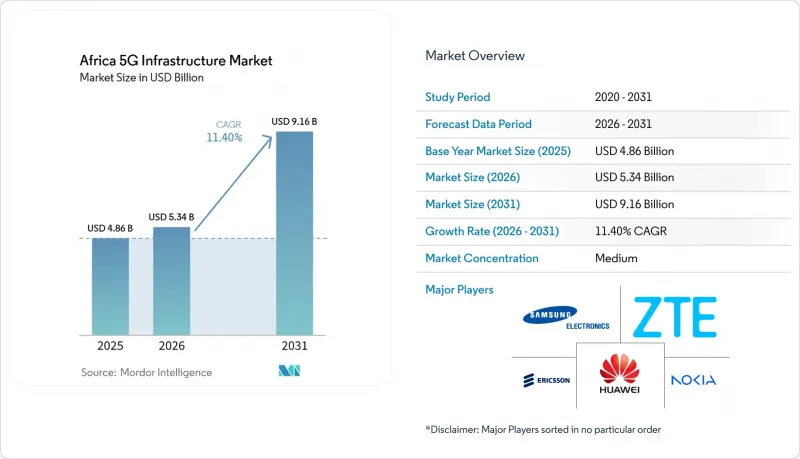
據 Mordor Intelligence 稱,2025 年非洲 5G 基礎設施市場價值為 48.6 億美元,預計到 2031 年將達到 91.6 億美元,而 2026 年為 53.4 億美元,預測期內(2026-2031 年)的複合年成長率預計為 11.40%。
本報告按通訊基礎設施(例如 5G 無線接取網路(RAN))、頻段(例如低頻寬)、網路架構(非獨立網路 (NSA) 和獨立網路技術 (SA))、核心網路技術(例如軟體定義網路 (SDN))、終端用戶產業(例如家用電子電器)和國家進行細分。市場預測以美元 (USD) 計價。
非洲5G基礎設施市場趨勢與洞察
行動數據流量激增與5G覆蓋缺口
非洲5G基礎設施市場日益關注的不僅是長期的技術規劃,還有如何應對現有4G網路容量的壓力。 2025年,撒哈拉以南非洲地區每支活躍智慧型手機的月均數據使用量為5.3GB,預計2031年將達到12GB。受數據流量成長36%的推動,MTN奈及利亞公司2025年的資本支出達到7,574億奈拉(約5.27億美元)。這凸顯了在充滿挑戰的商業環境下,流量負載如何推高網路支出。截至2025年9月,非洲29個市場中僅有53家業者推出了商用5G服務,超過25個市場的4G網路正面臨壓力。如果業者僅將5G用於緩解網路堵塞,除非同時提供企業服務和固定無線存取服務,否則可能難以實現獲利。因此,非洲5G基礎設施市場能否在容量投資和提供能夠產生額外收入的服務之間取得平衡,取決於能否做到這一點。
政府數位經濟計畫和頻率解放的勢頭
頻率政策透過決定電信業者何時可以訂購設備並開始提供商業服務,影響非洲 5G 基礎設施市場的短期發展。埃及國家通訊監理局 (NCIS) 於 2026 年 3 月發布了“2026-2030 年移動頻率藍圖”,新增三個頻段共 410 MHz 的頻譜,並將頻譜分配期限延長至 2039 年。加納國家通訊監理局 (NCIS) 於 2026 年 7 月開始接受 700 MHz、2.3 GHz 和 3 GHz 頻段 5G 頻率的競爭性商業申請。摩洛哥於 2025 年 11 月同時向三家公司——摩洛哥電信 (Maroc Telecom)、Orange 和 inwi——頒發了許可證。根據「數位摩洛哥 2030」計劃,這三家公司有義務在 2026 年前涵蓋 45% 的人口,並在 2030 年前涵蓋 85% 的人口。該策略由一項到 2035 年將投入 800 億摩洛哥迪拉姆(約 80 億美元)的預算支持。許可證發放義務將監理期限轉化為資本投資承諾。為供應商提供更清楚的採購計畫。非洲電信聯盟(ATU)透過推廣技術中立的許可證制度和儘早開放中高頻寬,支持這項進程。
高額資本投入和較長的投資回收期
高網路密度需求和較低的每位用戶平均收入 (ARPU) 正在延長非洲 5G 基礎設施的投資回收期。中頻寬和高頻寬部署所需的基地台數量多於 4G 部署,而許多非洲市場的平均每用戶收入仍低於每月 5 美元。 Airtel Africa 預計 2026 年的資本支出將達到 7.25 億美元至 7.5 億美元,高於 2025 年的 6.7 億美元。由於基礎設施設備通常以美元購買,而營運商的收入以該地貨幣,因此外匯波動風險累計。 MTN Nigeria 計劃以 22 億美元收購 IHS Towers,這表明管理鐵塔基礎設施所需的財務負擔日益加重。這種資金籌措環境可能迫使營運商依賴發展融資和商業債務進行大規模網路投資。
細分市場分析
預計到2025年,5G無線接取網路業務將佔總營收的62.42%,這反映出營運商優先考慮擴大無線介面覆蓋範圍。宏基站部署活動主要集中在南非、奈及利亞、摩洛哥和肯亞。中頻段為許多早期商用部署提供了支持,在覆蓋範圍和容量之間實現了切實可行的平衡。在傳輸和xHaul網路中,在光纖部署有限的地區,微波和毫米波鏈路的使用正在增加。非洲5G基礎設施市場無線存取設備的市場規模仍與站點部署和頻寬可用性密切相關。此外,由於僅靠無線設備升級無法滿足流量成長的需求,營運商也正在擴大回程傳輸容量。這使得無線、傳輸和電力系統在每個部署專案中都成為相互依存的要素。只要覆蓋缺口依然較大,無線層在可預見的未來仍將是最大的投資領域。
預計到2031年,雲端原生5G核心網路將以14.34%的複合年成長率成長,成為通訊基礎設施領域成長最快的細分市場。這一成長主要得益於向容器化、微服務架構的轉變,這種架構能夠實現網路切片和邊緣運算。 MTN南非公司和愛立信於2025年完成了其5G核心網路的現代化改造,並採用了愛立信的雲端原生基礎設施解決方案。華為透過為埃塞俄比亞電信部署雲端原生5.5G核心網,將核心網現代化擴展到了東非地區。雖然核心網投資通常在初始無線覆蓋建設完成後進行,但隨著營運商尋求更高級的企業服務,核心網投資變得至關重要。隨著營運商從非獨立組網(NSA)網路遷移到獨立組網(SA)網路,非洲5G基礎設施市場對雲端原生核心網平台的需求將會增加。這項轉變將使目標設備基礎擴展到無線硬體之外,同時也將增加對軟體整合和維運技能的需求。
2025年,1-6 GHz中頻寬佔總營收的59.89%。由於其覆蓋範圍和資料吞吐量的平衡性,此頻寬成為主要的商用5G頻段。 3.5 GHz頻段已用於埃及、摩洛哥、奈及利亞、南非和肯亞的初始商用服務。此頻寬的廣泛使用簡化了各國市場的設備採購和供應商規劃。低頻寬對於確保農村地區更廣泛的覆蓋範圍變得越來越重要。奈及利亞的「2026-2030年頻率藍圖」優先考慮600 MHz頻段,加納在2026年7月的申請流程中也包含了700 MHz頻段。由於距離和地形的限制,高密度部署基地台成本高昂,因此非洲的5G基礎設施市場依賴這些低頻段。同時,中頻寬將繼續發揮至關重要的作用,作為都市區和郊區高容量公共網路的基礎。
預計到2031年,24GHz以上的高頻寬/毫米波頻段將以16.11%的複合年成長率成長,成為所有頻段中成長最快的頻段。其主要應用領域預計是礦山、港口和工廠的專用網路,而非面向大眾消費者的行動通訊。南非Rain公司和華為於2026年7月啟動了數千個1GHz以下的大規模MIMO 5G部署。雖然此次部署採用了較低頻率配置,但在需要極高容量和極低延遲的場景下,毫米波仍然發揮著至關重要的作用。隨著非洲監管機構更新國家頻率分配計劃,國際頻率框架將成為毫米波許可的基礎。設備供應商可以透過支援多種頻段組合來滿足公共和私有場所的需求。在非洲5G基礎設施市場,頻段的選擇將決定農村地區的覆蓋範圍、都市區的容量以及工業連接的優劣。這將催生出不同的投資案例,而非單一頻段的方案。
其他好處:
- Excel格式的市場預測(ME)表
- 3個月的分析師支持
目錄
第1章:引言
- 研究假設和市場定義
- 調查範圍
第2章:調查方法
第3章執行摘要
第4章 市場狀況
- 市場概覽
- 市場促進因素
- 行動數據流量激增和5G覆蓋區域出現空白
- 政府數位經濟計劃和頻段放鬆管制的舉措
- 固定無線存取是寬頻擴充的捷徑
- 企業對礦業、港口和工業區專用 5G 網路的需求日益成長。
- 在尚未安裝光纖的走廊中,將微波和毫米波回程傳輸進行現代化改造。
- 透過人工智慧無線存取網、網路自動化和節能營運降低營運成本。
- 市場限制因素
- 大筆資本投入和較長的投資回收期
- 頻率分配延遲和監管碎片化
- 高度依賴不可靠的電網供電和柴油發電機備用電源。
- 外匯管制和供應商融資壓力
- 產業價值鏈分析
- 監理情勢
- 技術展望
- 投資和資金籌措趨勢
- 波特五力分析
第5章 市場規模與成長預測
- 透過通訊基礎設施
- 5G無線接取網路(RAN)
- 運輸/跨運輸(去程傳輸、中線運輸、回程傳輸)
- 核心網路(雲端原生 5GC)
- 按頻段
- 低頻段(低於 1 GHz)
- 中頻段(1–6 GHz)
- 高頻段/毫米波(24 GHz 以上)
- 透過網路架構
- 非獨立(NSA)
- 獨立版 (SA)
- 按類型分類的核心網路技術
- 軟體定義網路 (SDN)
- 網路功能虛擬化(NFV)
- 多接入邊緣運算(MEC)
- 網路切片
- 按最終用戶行業分類
- 家用電子產品
- 汽車與出行
- 工業製造
- 醫療保健和生命科學
- 能源公用事業
- 公共安全與國防
- 智慧城市和基礎設施
- 其他終端用戶產業(零售、媒體、農業)
- 國家
- 南非
- 奈及利亞
- 其他非洲國家
第6章 競爭情勢
- 市場集中度
- 策略趨勢
- 市佔率分析
- 公司簡介
- Huawei Technologies Co., Ltd.
- Telefonaktiebolaget LM Ericsson
- Nokia Corporation
- ZTE Corporation
- Samsung Electronics Co., Ltd.
- Cisco Systems, Inc.
- Mavenir Systems, Inc.
- Airspan Networks Holdings Inc.
- Parallel Wireless, Inc.
- NEC Corporation
- Fujitsu Limited
- CommScope Holding Company, Inc.
- Juniper Networks, Inc.
- Ceragon Networks Ltd.
- Comba Telecom Systems Holdings Ltd.
- MTN Group Limited
- Vodacom Group Limited
- Safaricom PLC
第7章 市場機會與未來展望
According to Mordor Intelligence, the Africa 5G infrastructure market size was valued at USD 4.86 billion in 2025 and is estimated to grow from USD 5.34 billion in 2026 to reach USD 9.16 billion by 2031, at a CAGR of 11.40% during the forecast period (2026-2031).
This report is Segmented by Communication Infrastructure (5G Radio Access Network (RAN), and More), Spectrum Band (Low-Band and More), Network Architecture (Non-Standalone (NSA), and Standalone (SA)), Core Network Technology (Software-Defined Networking (SDN), and More), End-User Vertical (Consumer Electronics and More), and Country. The Market Forecasts are Provided in Terms of Value (USD).
Africa 5G Infrastructure Market Trends and Insights
Mobile Data Traffic Surge and 5G Coverage Gaps
The Africa 5G infrastructure market is increasingly responding to pressure on existing 4G capacity rather than only to long-range technology plans. Average monthly data use per active smartphone in Sub-Saharan Africa was 5.3 GB in 2025 and is forecast to reach 12 GB by 2031. MTN Nigeria's capital expenditure reached NGN 757.4 billion (USD 527 million) in 2025, as data traffic rose 36%, underscoring how traffic pressure can increase network spending under difficult operating conditions. Only 53 operators in 29 African markets had launched commercial 5G by September 2025, leaving more than 25 markets facing capacity pressure on 4G networks. Operators that use 5G mainly to ease congestion may face shorter revenue recovery periods unless they also add enterprise and fixed wireless access services. The Africa 5G infrastructure market, therefore, depends on matching capacity investment with services that create additional revenue.
Government Digital Economy Programs and Spectrum Release Momentum
Spectrum policy is shaping the near-term pace of the Africa 5G infrastructure market by determining when operators can place equipment orders and begin commercial coverage. Egypt's National Telecommunications Regulatory Authority published its Mobile Spectrum Roadmap 2026-2030 in March 2026, adding 410 MHz across 3 bands with assignments extending through 2039. Ghana's National Communications Authority opened applications in July 2026 for 5G spectrum in the 700 MHz, 2.3 GHz, and 3 GHz bands on a competitive commercial basis. Morocco licensed Maroc Telecom, Orange, and inwi at the same time in November 2025, with coverage obligations of 45% of the population by 2026 and 85% by 2030 under Digital Morocco 2030. The strategy is supported by MAD 80 billion (USD 8 billion) through 2035. License obligations turn regulatory deadlines into capital expenditure commitments and give vendors clearer procurement schedules. The African Telecommunications Union recommends technology-neutral licensing and faster availability of mid-band and high-band spectrum to support this process.
High Capital Expenditure and Long Payback Cycles
High network density requirements and low average revenue per user create long recovery periods for the 5G infrastructure market in Africa. Mid-band and high-band deployments need more sites than 4G deployments, while average revenue per user in many African markets remains below USD 5 per month. Airtel Africa guided FY2026 capital expenditure at USD 725-750 million, up from USD 670 million in FY2025. Infrastructure equipment is generally purchased in USD, while operators earn revenue in local currencies, which increases exposure to foreign exchange movements. MTN Nigeria's planned USD 2.2 billion acquisition of IHS Towers showed the growing balance-sheet commitment required to control tower infrastructure. These funding conditions can leave operators dependent on development finance and commercial debt for large-scale network investment.
Other drivers and restraints analyzed in the detailed report include:
- Fixed Wireless Access as a Fast Path to Broadband Expansion
- Enterprise Demand for Private 5G in Mining, Ports, and Industrial Sites
- Delayed Spectrum Assignment and Regulatory Fragmentation
For complete list of drivers and restraints, kindly check the Table Of Contents.
Segment Analysis
The 5G radio access network segment accounted for 62.42% of total revenue in 2025, reflecting the priority operators placed on expanding air-interface coverage. Macro-site rollout activity centered on South Africa, Nigeria, Morocco, and Kenya. Mid-band spectrum supported many of these initial commercial deployments because it offers a practical balance between coverage and capacity. Transport and xHaul networks increasingly use microwave and millimeter-wave links where fiber is limited. The Africa 5G infrastructure market size for radio access equipment remains closely linked to site deployment and spectrum availability. Operators are also improving backhaul capacity because heavier traffic cannot be handled solely through radio upgrades. This makes radio, transport, and power systems interdependent parts of each rollout program. The radio layer will remain the largest immediate area of spending while coverage gaps remain significant.
Cloud-native 5G core is projected to expand at a 14.34% CAGR through 2031, making it the fastest-growing segment of communication infrastructure. The segment is supported by migration to containerized, microservices-based designs that enable network slicing and edge computing. MTN South Africa and Ericsson completed a 5G core modernization in 2025 using Ericsson Cloud Native Infrastructure Solution. Huawei deployed a cloud-native 5.5G core for Ethio Telecom, extending core modernization into East Africa. Core investment normally follows initial radio coverage, but it becomes essential when operators seek more advanced enterprise services. The Africa 5G infrastructure market will increasingly require cloud-native core platforms as operators move from non-standalone to standalone networks. This shift expands the addressable equipment base beyond radio hardware. It also increases demand for software integration and operational skills.
Mid-band spectrum from 1-6 GHz accounted for 59.89% of total revenue in 2025. It was the main commercial 5G spectrum range because it balances coverage with data throughput. The 3.5 GHz band was used for early commercial activations in Egypt, Morocco, Nigeria, South Africa, and Kenya. Common use of this band can simplify equipment procurement and vendor planning across national markets. Low-band spectrum is gaining importance for wider rural coverage. Nigeria's 2026-2030 Spectrum Roadmap prioritizes the 600 MHz band, while Ghana's July 2026 application process included the 700 MHz band. The Africa 5G infrastructure market depends on these lower frequencies, where distance and terrain make dense site deployment expensive. Mid-band will still anchor capacity-focused public networks in urban and suburban areas.
High-band/mmWave above 24 GHz is projected to expand at a 16.11% CAGR through 2031, the fastest rate among spectrum bands. Its main use is expected to be private networks at mines, ports, and factories rather than broad consumer mobile coverage. Rain South Africa and Huawei initiated a multi-thousand-site sub-1 GHz Massive MIMO 5G deployment in July 2026. The deployment used a low-frequency configuration, while mmWave remains relevant for locations requiring very high capacity and low latency. International spectrum frameworks provide a basis for mmWave licensing as African regulators update national frequency allocation plans. Equipment suppliers can serve both public-network and private-site demand by supporting several band combinations. The Africa 5G infrastructure market will use spectrum choice to differentiate rural coverage, urban capacity, and industrial connectivity. This creates separate investment cases rather than a single spectrum approach.
Complete Report Scope:
- By Communication Infrastructure
- 5G Radio Access Network (RAN)
- Transport / xHaul (Front-, Mid-, Backhaul)
- Core Network (Cloud-Native 5GC)
- By Spectrum Band
- Low-Band (Less Than 1 GHz)
- Mid-Band (1-6 GHz)
- High-Band / mmWave (Above 24 GHz)
- By Network Architecture
- Non-Standalone (NSA)
- Standalone (SA)
- By Core Network Technology
- Software-Defined Networking (SDN)
- Network Function Virtualization (NFV)
- Multi-Access Edge Computing (MEC)
- Network Slicing
- By End-User Vertical
- Consumer Electronics
- Automotive and Mobility
- Industrial Manufacturing
- Healthcare and Life Sciences
- Energy and Utilities
- Public Safety and Defense
- Smart Cities and Infrastructure
- Other End-User Verticals (Retail, Media, Agriculture)
- By Country
- South Africa
- Nigeria
- Rest of Africa
List of Companies Covered in this Report:
- Huawei Technologies Co., Ltd.
- Telefonaktiebolaget LM Ericsson
- Nokia Corporation
- ZTE Corporation
- Samsung Electronics Co., Ltd.
- Cisco Systems, Inc.
- Mavenir Systems, Inc.
- Airspan Networks Holdings Inc.
- Parallel Wireless, Inc.
- NEC Corporation
- Fujitsu Limited
- CommScope Holding Company, Inc.
- Juniper Networks, Inc.
- Ceragon Networks Ltd.
- Comba Telecom Systems Holdings Ltd.
- MTN Group Limited
- Vodacom Group Limited
- Safaricom PLC
Additional Benefits:
- The market estimate (ME) sheet in Excel format
- 3 months of analyst support
TABLE OF CONTENTS
1 INTRODUCTION
- 1.1 Study Assumptions and Market Definition
- 1.2 Scope of the Study
2 RESEARCH METHODOLOGY
3 EXECUTIVE SUMMARY
4 MARKET LANDSCAPE
- 4.1 Market Overview
- 4.2 Market Drivers
- 4.2.1 Mobile Data Traffic Surge and 5G Coverage Gaps
- 4.2.2 Government Digital Economy Programs and Spectrum Release Momentum
- 4.2.3 Fixed Wireless Access as a Fast Path to Broadband Expansion
- 4.2.4 Enterprise Demand for Private 5G in Mining, Ports, and Industrial Sites
- 4.2.5 Microwave and Millimeter-Wave Backhaul Modernization in Fiber-Scarce Corridors
- 4.2.6 AI-RAN, Network Automation, and Energy-Efficient Operations Lowering OPEX
- 4.3 Market Restraints
- 4.3.1 High Capital Expenditure and Long Payback Cycles
- 4.3.2 Delayed Spectrum Assignment and Regulatory Fragmentation
- 4.3.3 Unreliable Grid Power and High Dependence on Diesel Backup
- 4.3.4 Foreign Exchange Constraints and Vendor Financing Pressure
- 4.4 Industry Value Chain Analysis
- 4.5 Regulatory Landscape
- 4.6 Technological Outlook
- 4.7 Investment and Funding Trends
- 4.8 Porter's Five Forces Analysis
- 4.8.1 Bargaining Power of Suppliers
- 4.8.2 Bargaining Power of Buyers
- 4.8.3 Threat of New Entrants
- 4.8.4 Intensity of Competitive Rivalry
- 4.8.5 Threat of Substitute Products
5 MARKET SIZE AND GROWTH FORECASTS (VALUE)
- 5.1 By Communication Infrastructure
- 5.1.1 5G Radio Access Network (RAN)
- 5.1.2 Transport / xHaul (Front-, Mid-, Backhaul)
- 5.1.3 Core Network (Cloud-Native 5GC)
- 5.2 By Spectrum Band
- 5.2.1 Low-Band (Less Than 1 GHz)
- 5.2.2 Mid-Band (1-6 GHz)
- 5.2.3 High-Band / mmWave (Above 24 GHz)
- 5.3 By Network Architecture
- 5.3.1 Non-Standalone (NSA)
- 5.3.2 Standalone (SA)
- 5.4 By Core Network Technology
- 5.4.1 Software-Defined Networking (SDN)
- 5.4.2 Network Function Virtualization (NFV)
- 5.4.3 Multi-Access Edge Computing (MEC)
- 5.4.4 Network Slicing
- 5.5 By End-User Vertical
- 5.5.1 Consumer Electronics
- 5.5.2 Automotive and Mobility
- 5.5.3 Industrial Manufacturing
- 5.5.4 Healthcare and Life Sciences
- 5.5.5 Energy and Utilities
- 5.5.6 Public Safety and Defense
- 5.5.7 Smart Cities and Infrastructure
- 5.5.8 Other End-User Verticals (Retail, Media, Agriculture)
- 5.6 By Country
- 5.6.1 South Africa
- 5.6.2 Nigeria
- 5.6.3 Rest of Africa
6 COMPETITIVE LANDSCAPE
- 6.1 Market Concentration
- 6.2 Strategic Moves
- 6.3 Market Share Analysis
- 6.4 Company Profiles (includes Global Level Overview, Market Level Overview, Core Segments, Financials as available, Strategic Information, Market Rank/Share, Products and Services, Recent Developments)
- 6.4.1 Huawei Technologies Co., Ltd.
- 6.4.2 Telefonaktiebolaget LM Ericsson
- 6.4.3 Nokia Corporation
- 6.4.4 ZTE Corporation
- 6.4.5 Samsung Electronics Co., Ltd.
- 6.4.6 Cisco Systems, Inc.
- 6.4.7 Mavenir Systems, Inc.
- 6.4.8 Airspan Networks Holdings Inc.
- 6.4.9 Parallel Wireless, Inc.
- 6.4.10 NEC Corporation
- 6.4.11 Fujitsu Limited
- 6.4.12 CommScope Holding Company, Inc.
- 6.4.13 Juniper Networks, Inc.
- 6.4.14 Ceragon Networks Ltd.
- 6.4.15 Comba Telecom Systems Holdings Ltd.
- 6.4.16 MTN Group Limited
- 6.4.17 Vodacom Group Limited
- 6.4.18 Safaricom PLC
7 MARKET OPPORTUNITIES AND FUTURE OUTLOOK
- 7.1 White-Space and Unmet-Need Assessment

 網路技術與市場追蹤器網路技術與市場追蹤概況:2026年第三季度
 全球5G基礎設施市場規模、佔有率、趨勢和成長分析報告(2026-2034年)
 5G基礎設施市場:按網路基礎設施、應用和區域分類
 5G基礎設施:市場佔有率分析、產業趨勢與統計、成長預測(2026-2031年)中東5G基礎設施:市場佔有率分析、產業趨勢與統計及成長預測(2026-2031年)亞太地區5G基礎設施:市場佔有率分析、產業趨勢與統計及成長預測(2026-2031年)
 5G基礎設施市場:2026-2032年全球市場預測(按組件、網路架構、部署模型、應用、最終用戶和部署環境分類)
 NTN 連接市場預測—全球分析(按組件、軌道類型、頻段、平台、應用、最終用戶和地區分類)—2034 年5G基礎設施市場預測至2034年-全球組件、通訊基礎設施、網路技術、網路架構、類型、應用和區域分析