


 |
市場調查報告書
商品編碼
2118881
亞太地區5G基礎設施:市場佔有率分析、產業趨勢與統計及成長預測(2026-2031年)Asia-Pacific 5G Infrastructure - Market Share Analysis, Industry Trends & Statistics, Growth Forecasts (2026 - 2031) |
||||||

※ 本網頁內容可能與最新版本有所差異。詳細情況請與我們聯繫。
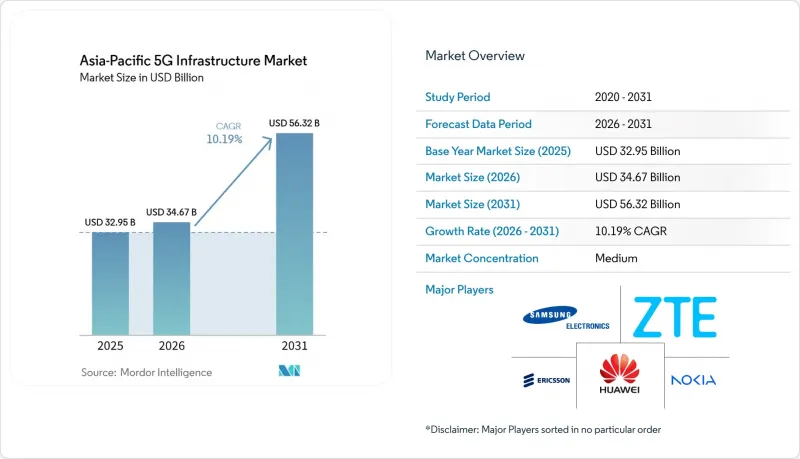
根據 Mordor Intelligence 預測,亞太地區的 5G 基礎設施市場規模將從 2025 年的 329.5 億美元和 2026 年的 346.7 億美元成長到 2031 年的 563.2 億美元,2026 年至 2031 年的複合年成長率為 10.19%。
本報告按通訊基礎設施(例如 5G 無線接取網路(RAN))、頻段(例如低頻寬)、網路架構(非獨立網路 (NSA) 和獨立網路技術 (SA))、核心網路技術(例如軟體定義網路 (SDN))、終端用戶產業(例如家用電子電器)和國家進行細分。市場預測以美元 (USD) 計價。
亞太地區 5G 基礎設施市場趨勢及洞察。
5G流量密度增加以及對低延遲的需求上升
2025年底,中國5G用戶數將超過12.04億,連網行動物聯網設備數量將達28.88億。為了滿足如此龐大的規模,電信業者需要在提升網路容量的同時,升級其獨立網路核心網路。截至2026年3月,中國5G-Advanced服務已覆蓋330個城市,並由能夠管理大規模波束成形的主動天線系統提供支援。高密度無線基地台和獨立組網架構的平行建設縮短了實現低延遲服務的路徑,但同時也增加了供應商和基地台專家的初始投資要求。利用5G和工業網際網路專案的智慧工廠,產品品質提升了20.5%,產能提升了24.7%。這些營運成果凸顯了亞太地區5G基礎設施市場對容量和延遲敏感型工業連接需求的進一步成長。
政府主導的頻率分配和部署計劃
2026年2月,印度電訊管理局建議競標九個頻段共11,789.15 MHz的頻率。該提案設定最低競標價為21兆盧比(約231億美元)。提案也規定,如果新基地台建在服務覆蓋範圍之外的區域,則最低競標價可降低10%,以此鼓勵電信業者將投資轉向服務不足的地區。越南透過政策促進基礎建設投資,為興建2萬個5G基地台的電信業者提供頻率分配折扣和設備成本補貼。韓國強制要求電信業者在2026年前升級到獨立網路系統,並降低了LTE頻率重新分配費用,以支援達到室內覆蓋目標的電信業者。如今,政府措施已不再局限於頻率分配,而是正在影響整個亞太地區5G基礎設施市場網路投資的速度、地點和架構。
高密度基礎設施及光纖回程傳輸設備投資
高密度小型基地台網路需要光纖連接到每個站點,尤其是在營運商使用毫米波頻段或增加容量層的情況下。預計到2025年底,中國的光纖網路總長度將達到7,499萬公里,為大規模5G部署奠定堅實的基礎。同時,東南亞和南亞許多市場缺乏最後一公里光纖,導致高密度部署成本更高、耗時更長。到本世紀末,這一廣大的地區將面臨2,000億美元的基礎設施投資缺口,其中包括回程傳輸資金籌措缺口。缺乏強大光纖網路的營運商被迫在昂貴的無線回程傳輸和延遲的容量擴展之間做出選擇。在印度和印尼等市場,站點選址、電力供應以及與土地所有者的談判可能導致小型基地台部署延遲18至24個月。
細分市場分析
2025年,5G無線接取網路(RAN)在亞太電信基礎設施市場中佔據了60.96%的5G基礎設施市場。隨著營運商在中國、印度、日本和東南亞地區不斷增加基地台密度,RAN仍然是資本投資的重點。到2026年中期,中國鐵塔每年將部署超過90萬個基地台,這將使總站點建設量超過560萬個。如此龐大的營運規模解釋了為什麼無線設備、天線和站點基礎設施仍然佔據大部分支出。傳輸/xHaul是第二大細分市場,因為所有新建的宏基地台和小型基地台都需要去程傳輸、中傳或回程傳輸連結。
預計到2031年,核心網將以14.80%的複合年成長率成長,成為電信基礎設施中成長最快的細分市場。在亞太地區的5G基礎設施市場,雲端原生核心系統的市場規模成長主要得益於傳統封包閘道器的淘汰。據NTT Docomo稱,其商用雲端原生核心網路可將功耗降低70%,為其他業者的營運成本樹立了標竿。諾基亞和TuneTalk於2026年1月完成了在東協地區的雲端原生核心網路部署,並將此架構推廣到新興營運商市場。雲端原生核心網路平台有助於營運商擴展容量、實現網路功能自動化並支援企業服務。 「開放電信生態系統」計劃以及3GPP Release 17和Release 18的要求也影響這些部署中的供應商選擇。
到2025年,中頻段將佔總頻段的69.21%。由於區域監理機關普遍採用3.5 GHz頻段的規劃,此頻寬仍是宏5G網路的主要覆蓋範圍和容量層。此頻寬在傳播距離和網路容量之間實現了良好的平衡。低於1 GHz的低頻寬支援服務涵蓋不足地區的農村和室內服務。在印度和澳大利亞,600 MHz和700 MHz頻段因其能夠將覆蓋範圍擴展到主要城市以外,而被列為政策重點。
高頻寬/毫米波預計到2031年將以17.22%的複合年成長率成長。日本電信業者已開始商用部署28GHz頻段,韓國也頒發了28GHz頻段的企業使用授權。印度也將26GHz頻段納入其未來的頻率競標框架。在亞太地區的5G基礎設施市場,毫米波技術可能會先部署在工廠、體育場館和交通系統等集中區域,而非面向廣大消費者。三星和KDDI聯合開展的一項演示實驗表明,使用人工智慧驅動的「RAN速度最佳化器」可將3.7GHz頻段的吞吐量提升52%。隨著日本和韓國營運經驗的積累,設備成本可能會降低,這將有助於從2027年起在其他區域市場推廣應用。
其他好處:
- Excel格式的市場預測(ME)表
- 3個月的分析師支持
目錄
第1章:引言
- 研究假設和市場定義
- 調查範圍
第2章:調查方法
第3章執行摘要
第4章 市場狀況
- 市場概覽
- 市場促進因素
- 5G流量密度不斷增加以及對低延遲的需求日益成長
- 政府主導的頻率分配和部署計劃
- 工業自動化專用5G的擴展
- 開放式無線接取網路和雲端原生網路的普及速度正在加快。
- 亞太地區半導體供應鏈的跨境多元化
- 邊緣主導的港口、礦業和物流樞紐貨幣化
- 市場限制因素
- 高密度基礎設施和回程傳輸的資本支出 (CAPEX)
- 頻率成本壓力和中波頻段供需不平衡。
- 跨多個供應商的互通性和整合的複雜性
- 高密度城市市場的電力供應狀況與土地徵用限制
- 產業價值鏈分析
- 監理情勢
- 技術展望
- 投資和資金籌措趨勢
- 波特五力分析
第5章 市場規模與成長預測
- 透過通訊基礎設施
- 5G無線接取網路(RAN)
- 運輸/跨運輸(去程傳輸、中線運輸、回程傳輸)
- 核心網路(雲端原生 5G 核心網路)
- 按頻段
- 低頻寬(低於 1 GHz)
- 中頻段(1–6 GHz)
- 高頻段/毫米波(24 GHz 以上)
- 透過網路架構
- 非獨立式(NSA)
- 獨立版 (SA)
- 按類型分類的核心網路技術
- 軟體定義網路 (SDN)
- 網路功能虛擬化(NFV)
- 多接入邊緣運算(MEC)
- 網路切片
- 按最終用戶行業分類
- 家用電子產品
- 汽車與出行
- 工業製造
- 醫療保健和生命科學
- 能源公用事業
- 公共安全與國防
- 智慧城市和基礎設施
- 其他終端用戶產業(零售、媒體、農業)
- 國家
- 中國
- 日本
- 韓國
- 印度
- 澳洲
- 其他亞太國家
第6章 競爭情勢
- 市場集中度
- 策略趨勢
- 市佔率分析
- 公司簡介
- Huawei Technologies Co., Ltd.
- Telefonaktiebolaget LM Ericsson
- Nokia Corporation
- ZTE Corporation
- Samsung Electronics Co., Ltd.
- NEC Corporation
- Fujitsu Limited
- Cisco Systems, Inc.
- Hewlett Packard Enterprise Development LP
- Qualcomm Incorporated
- Intel Corporation
- Juniper Networks, Inc.
- Ciena Corporation
- Mavenir Systems, Inc.
- Rakuten Symphony, Inc.
- CommScope Holding Company, Inc.
- NVIDIA Corporation
- Oracle Corporation
- Broadcom Inc.
- Airspan Networks Inc.
第7章 市場機會與未來展望
According to Mordor Intelligence, the Asia-Pacific 5G infrastructure market size is projected to expand from USD 32.95 billion in 2025 and USD 34.67 billion in 2026 to USD 56.32 billion by 2031, registering a CAGR of 10.19% from 2026 to 2031.
This report is Segmented by Communication Infrastructure (5G Radio Access Network (RAN), and More), Spectrum Band (Low-Band and More), Network Architecture (Non-Standalone (NSA), and Standalone (SA)), Core Network Technology (Software-Defined Networking (SDN), and More), End-User Vertical (Consumer Electronics and More), and Country. The Market Forecasts are Provided in Terms of Value (USD).
Asia-Pacific 5G Infrastructure Market Trends and Insights
Rising 5G Traffic Density and Low-Latency Demand
China had more than 1.204 billion 5G subscriptions and 2.888 billion mobile IoT terminal connections by the end of 2025. This scale requires operators to add capacity while also upgrading their standalone core networks. China's 5G-Advanced service covered 330 cities in March 2026, supported by active antenna systems that can manage beamforming at scale. The parallel buildout of dense radio sites and standalone architecture shortens the path to low-latency services, but it also increases early capital requirements for vendors and site specialists. Smart factories using 5G and industrial internet programs recorded 20.5% gains in product quality and 24.7% gains in production capacity. These operating results support wider demand for capacity and latency-sensitive industrial connectivity in the Asia-Pacific 5G infrastructure market.
Government-Led Spectrum Allocation and Rollout Programs
India's Telecom Regulatory Authority released auction recommendations in February 2026 for 11,789.15MHz across 9 frequency bands. The proposal carried a reserve value of INR 2.10 lakh crore (USD 23.1 billion). It also linked a 10% reduction in the reserve price to new base stations in coverage gaps, directing operator spending toward underserved areas. Vietnam paired spectrum discounts with equipment-cost support for operators that build 20,000 5G base stations, using policy to encourage infrastructure investment. South Korea required standalone upgrades by 2026 and used lower LTE reallocation fees to support operators that meet indoor coverage goals. Government measures now extend beyond spectrum allocation and shape the pace, location, and architecture of network investment across the Asia-Pacific 5G infrastructure market.
High Densification and Fiber Backhaul CAPEX
Dense small-cell networks require fiber links to each site, especially where operators use mmWave spectrum or add capacity layers. China's optical fiber network reached 74.99 million km by the end of 2025, providing a strong foundation for its large 5G rollout. Many Southeast Asian and South Asian markets have less last-mile fiber, which makes densification more expensive and slower to deliver. The wider region faced a USD 200 billion infrastructure investment shortfall through the end of the decade, including gaps in backhaul financing. Operators without strong fiber networks must choose between expensive wireless backhaul and delayed capacity expansion. Site acquisition, power access, and landlord negotiations can add 18-24 months to small-cell rollouts in markets such as India and Indonesia.
Other drivers and restraints analyzed in the detailed report include:
- Expansion of Private 5G for Industrial Automation
- Accelerating Open RAN and Cloud-Native Network Adoption
- Spectrum Cost Pressure and Uneven Mid-Band Availability
For complete list of drivers and restraints, kindly check the Table Of Contents.
Segment Analysis
5G Radio Access Network held 60.96% of the Asia-Pacific 5G infrastructure market share within communication infrastructure in 2025. RAN remains the main destination for capital spending as operators densify base stations across China, India, Japan, and Southeast Asia. China Tower deployed more than 900,000 base stations per year by mid-2026 and had helped build more than 5.6 million sites in total. This operating scale shows why radio equipment, antennas, and site infrastructure continue to account for a large part of spending. Transport/xHaul is the second-largest sub-segment because every new macro site and small cell requires fronthaul, midhaul, or backhaul links.
Core Network is projected to expand at a 14.80% CAGR through 2031, making it the fastest-growing sub-segment of communication infrastructure. The Asia-Pacific 5G infrastructure market size for cloud-native core systems is supported by the shift away from legacy packet gateways. NTT DOCOMO's commercial cloud-native core reduced power consumption by 70%, according to the company, offering an operating-cost benchmark for other operators. Nokia and Tune Talk completed an ASEAN cloud-native core deployment in January 2026, extending this architecture to a developing operator market. Cloud-native core platforms can help operators scale capacity, automate network functions, and support enterprise services. Open Telecom Ecosystem practices and 3GPP Release 17 and Release 18 requirements are also affecting vendor selection for these deployments.
Mid-band spectrum held 69.21% share of the spectrum band segment in 2025. It remains the primary coverage and capacity layer for macro 5G networks because regional regulators have broadly adopted plans for the 3.5 GHz band. The band offers a practical balance between propagation range and network capacity. Low-band spectrum below 1 GHz supports rural coverage and indoor service in countries with extensive underserved areas. India and Australia give policy priority to the 600 MHz and 700 MHz bands because those frequencies can extend coverage beyond major cities.
High-band/mmWave is projected to expand at a 17.22% CAGR through 2031. Japan's operators have commercial 28GHz deployments, while South Korea has enterprise licensing for 28GHz use. India also included 26GHz in its forthcoming spectrum auction framework. The Asia-Pacific 5G infrastructure market is likely to use mmWave first in factories, stadiums, transit facilities, and similar concentrated locations rather than broad consumer coverage. Samsung's live trial with KDDI showed a 52% increase in throughput on the 3.7GHz band using its AI-powered RAN Speed Optimizer. Equipment costs can improve as Japan and South Korea build more operational experience, which could support use in other regional markets after 2027.
Complete Report Scope:
- By Communication Infrastructure
- 5G Radio Access Network (RAN)
- Transport/xHaul (Front-Haul, Mid-Haul, Back-Haul)
- Core Network (Cloud-Native 5G Core)
- By Spectrum Band
- Low-Band (Less Than 1 GHz)
- Mid-Band (1-6 GHz)
- High-Band / mmWave (Above 24 GHz)
- By Network Architecture
- Non-Standalone (NSA)
- Standalone (SA)
- By Core Network Technology
- Software-Defined Networking (SDN)
- Network Function Virtualization (NFV)
- Multi-Access Edge Computing (MEC)
- Network Slicing
- By End-User Vertical
- Consumer Electronics
- Automotive and Mobility
- Industrial Manufacturing
- Healthcare and Life Sciences
- Energy and Utilities
- Public Safety and Defense
- Smart Cities and Infrastructure
- Other End-User Verticals (Retail, Media, Agriculture)
- By Country
- China
- Japan
- South Korea
- India
- Australia
- Rest of Asia-Pacific
List of Companies Covered in this Report:
- Huawei Technologies Co., Ltd.
- Telefonaktiebolaget LM Ericsson
- Nokia Corporation
- ZTE Corporation
- Samsung Electronics Co., Ltd.
- NEC Corporation
- Fujitsu Limited
- Cisco Systems, Inc.
- Hewlett Packard Enterprise Development LP
- Qualcomm Incorporated
- Intel Corporation
- Juniper Networks, Inc.
- Ciena Corporation
- Mavenir Systems, Inc.
- Rakuten Symphony, Inc.
- CommScope Holding Company, Inc.
- NVIDIA Corporation
- Oracle Corporation
- Broadcom Inc.
- Airspan Networks Inc.
Additional Benefits:
- The market estimate (ME) sheet in Excel format
- 3 months of analyst support
TABLE OF CONTENTS
1 INTRODUCTION
- 1.1 Study Assumptions and Market Definition
- 1.2 Scope of the Study
2 RESEARCH METHODOLOGY
3 EXECUTIVE SUMMARY
4 MARKET LANDSCAPE
- 4.1 Market Overview
- 4.2 Market Drivers
- 4.2.1 Rising 5G Traffic Density and Low-Latency Demand
- 4.2.2 Government-Led Spectrum Allocation and Rollout Programs
- 4.2.3 Expansion of Private 5G for Industrial Automation
- 4.2.4 Accelerating Open RAN and Cloud-Native Network Adoption
- 4.2.5 Cross-Border Semiconductor Supply Chain Diversification in Asia-Pacific
- 4.2.6 Edge-Driven Monetization for Ports, Mining, and Logistics Nodes
- 4.3 Market Restraints
- 4.3.1 High Densification and Fiber Backhaul CAPEX
- 4.3.2 Spectrum Cost Pressure and Uneven Mid-Band Availability
- 4.3.3 Multi-Vendor Interoperability and Integration Complexity
- 4.3.4 Power Availability and Site Acquisition Constraints in Dense Urban Markets
- 4.4 Industry Value Chain Analysis
- 4.5 Regulatory Landscape
- 4.6 Technological Outlook
- 4.7 Investment and Funding Trends
- 4.8 Porter's Five Forces Analysis
- 4.8.1 Bargaining Power of Suppliers
- 4.8.2 Bargaining Power of Buyers
- 4.8.3 Threat of New Entrants
- 4.8.4 Intensity of Competitive Rivalry
- 4.8.5 Threat of Substitute Products
5 MARKET SIZE AND GROWTH FORECASTS (VALUE)
- 5.1 By Communication Infrastructure
- 5.1.1 5G Radio Access Network (RAN)
- 5.1.2 Transport/xHaul (Front-Haul, Mid-Haul, Back-Haul)
- 5.1.3 Core Network (Cloud-Native 5G Core)
- 5.2 By Spectrum Band
- 5.2.1 Low-Band (Less Than 1 GHz)
- 5.2.2 Mid-Band (1-6 GHz)
- 5.2.3 High-Band / mmWave (Above 24 GHz)
- 5.3 By Network Architecture
- 5.3.1 Non-Standalone (NSA)
- 5.3.2 Standalone (SA)
- 5.4 By Core Network Technology
- 5.4.1 Software-Defined Networking (SDN)
- 5.4.2 Network Function Virtualization (NFV)
- 5.4.3 Multi-Access Edge Computing (MEC)
- 5.4.4 Network Slicing
- 5.5 By End-User Vertical
- 5.5.1 Consumer Electronics
- 5.5.2 Automotive and Mobility
- 5.5.3 Industrial Manufacturing
- 5.5.4 Healthcare and Life Sciences
- 5.5.5 Energy and Utilities
- 5.5.6 Public Safety and Defense
- 5.5.7 Smart Cities and Infrastructure
- 5.5.8 Other End-User Verticals (Retail, Media, Agriculture)
- 5.6 By Country
- 5.6.1 China
- 5.6.2 Japan
- 5.6.3 South Korea
- 5.6.4 India
- 5.6.5 Australia
- 5.6.6 Rest of Asia-Pacific
6 COMPETITIVE LANDSCAPE
- 6.1 Market Concentration
- 6.2 Strategic Moves
- 6.3 Market Share Analysis
- 6.4 Company Profiles (includes Global Level Overview, Market Level Overview, Core Segments, Financials as available, Strategic Information, Market Rank/Share, Products and Services, Recent Developments)
- 6.4.1 Huawei Technologies Co., Ltd.
- 6.4.2 Telefonaktiebolaget LM Ericsson
- 6.4.3 Nokia Corporation
- 6.4.4 ZTE Corporation
- 6.4.5 Samsung Electronics Co., Ltd.
- 6.4.6 NEC Corporation
- 6.4.7 Fujitsu Limited
- 6.4.8 Cisco Systems, Inc.
- 6.4.9 Hewlett Packard Enterprise Development LP
- 6.4.10 Qualcomm Incorporated
- 6.4.11 Intel Corporation
- 6.4.12 Juniper Networks, Inc.
- 6.4.13 Ciena Corporation
- 6.4.14 Mavenir Systems, Inc.
- 6.4.15 Rakuten Symphony, Inc.
- 6.4.16 CommScope Holding Company, Inc.
- 6.4.17 NVIDIA Corporation
- 6.4.18 Oracle Corporation
- 6.4.19 Broadcom Inc.
- 6.4.20 Airspan Networks Inc.
7 MARKET OPPORTUNITIES AND FUTURE OUTLOOK
- 7.1 White-Space and Unmet-Need Assessment

 網路技術與市場追蹤器網路技術與市場追蹤概況:2026年第三季度
 全球5G基礎設施市場規模、佔有率、趨勢和成長分析報告(2026-2034年)
 5G基礎設施市場:按網路基礎設施、應用和區域分類
 5G基礎設施:市場佔有率分析、產業趨勢與統計、成長預測(2026-2031年)中東5G基礎設施:市場佔有率分析、產業趨勢與統計及成長預測(2026-2031年)非洲5G基礎設施:市場佔有率分析、產業趨勢與統計及成長預測(2026-2031年)
 5G基礎設施市場:2026-2032年全球市場預測(按組件、網路架構、部署模型、應用、最終用戶和部署環境分類)
 NTN 連接市場預測—全球分析(按組件、軌道類型、頻段、平台、應用、最終用戶和地區分類)—2034 年5G基礎設施市場預測至2034年-全球組件、通訊基礎設施、網路技術、網路架構、類型、應用和區域分析