


 |
市場調查報告書
商品編碼
2118884
中東5G基礎設施:市場佔有率分析、產業趨勢與統計及成長預測(2026-2031年)Middle East 5G Infrastructure - Market Share Analysis, Industry Trends & Statistics, Growth Forecasts (2026 - 2031) |
||||||

※ 本網頁內容可能與最新版本有所差異。詳細情況請與我們聯繫。
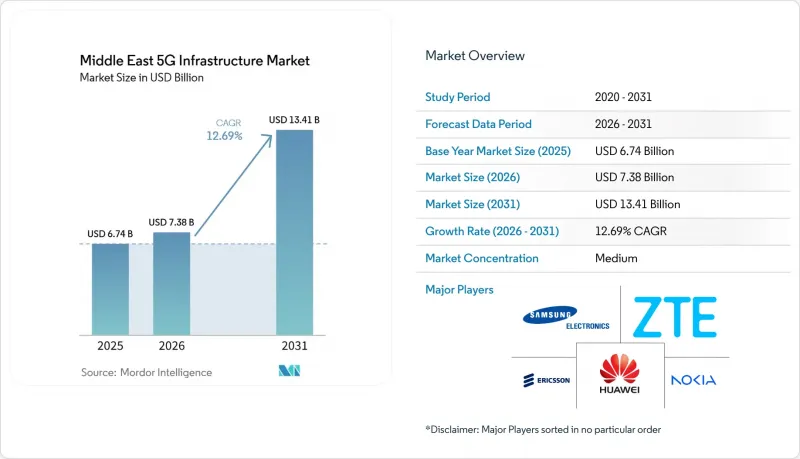
據 Mordor Intelligence 稱,中東 5G 基礎設施市場預計將從 2025 年的 67.4 億美元成長到 2026 年的 73.8 億美元,到 2031 年達到 134.1 億美元,預計 2026 年至 2031 年的複合成長率為 12.69%。
本報告按通訊基礎設施(例如 5G 無線接取網路(RAN))、頻段(例如低頻段)、網路架構(非獨立網路 (NSA) 和獨立組網 (SA))、核心網路技術(例如軟體定義網路 (SDN))、終端用戶產業(例如家用電子電器)以及國家進行細分。市場預測以美元 (USD) 計價。
中東5G基礎設施市場趨勢與洞察
5G終端和物聯網節點密度增加
5G設備和物聯網節點數量的不斷成長正推動現有無線網路流量的增加。這迫使營運商不僅要擴大地理覆蓋範圍,還要提升網路容量。儘管全球5G用戶數在2026年第一季已超過31億,但海灣合作理事會(GCC)國家擁有龐大的消費群體,且數據消耗量龐大。擴增實境(XR)、車載資訊服務和人工智慧推理等技術對行動通訊基地台的負載可能高於標準行動寬頻使用。物聯網也被沙烏地阿拉伯視為其數位經濟策略的關鍵領域,尤其是在工業和智慧城市建設方面。在油田、港口和物流樞紐等營運環境中,設備密度的增加進一步凸顯了利用共用宏無線存取網(MAC-RAN)基礎設施部署專用網路切片的必要性。在這些場所,感測器、車輛、攝影機和工作人員設備通常在同一營運區域內協同工作。由於持續監控和時間緊迫的營運流程,這些場所的連接需求可能與公共行動流量不同。
政府主導的頻率重新分配和競標勢頭
頻率重新分配正在緩解中東5G基礎設施市場5G密度方面面臨的重大限制。沙烏地阿拉伯已分配了3.8-4.0 GHz頻段的頻率,成為歐洲、中東和非洲地區(EMEA)以及國際電信聯盟(ITU)第一區首個分配600 MHz頻段的國家。這種組合使營運商能夠獲得用於覆蓋的低頻寬頻率和用於容量建設的6 GHz以下頻段頻率。它還支援同時實現室內覆蓋和室外廣域基地台部署的網路規劃。土耳其釋放頻段促進了國內大規模網路建設,並延長了區域投資週期。儘管這些措施在確保無線存取網(RAN)和傳輸投資所需的頻段方面取得了進展,但營運商的部署計劃仍然受到商業性優先事項的影響。雖然確保頻段賦予營運商更大的規劃柔軟性,但容量部署的時間仍取決於安裝地點的可用性、設備採購和客戶需求。因此,監管力度正在推動部署,但並不能消除所有實施風險。
建設高密度無線和光纖回程傳輸高成本。
高密度中頻段和毫米波網路既需要無線設備,也需要光纖回程傳輸。這些需求增加了在城市地區和其他擁塞區域部署的資本密集度。利雅德、杜拜和伊斯坦堡需要大量的小型基地台和光纖連接,但這些地區的土木工程准入可能較為困難。因此,營運商可能會優先將資金投入使用率最高的區域,然後再將高密度網路擴展到中等規模的商業區。當多個營運商使用通用的光纖連接無線平台時,基礎設施共用可以降低成本。因此,中東5G基礎設施市場,尤其是在室內設施和高需求都市區,對中立主機模式的興趣可能日益濃厚。共用方案可以減少站點設備和光纖工程的重複建設,尤其是在建築准入和土木工程許可受限的地區。它還可以幫助設施所有者提供一致的通訊覆蓋,而無需為每個營運商提供單獨的基礎設施。
細分市場分析
到2025年,5G無線接取網路(RAN)在中東5G基礎設施市場佔有率中佔比將達到64.23%。這反映了部署大型基地台、升級到大規模MIMO以及安裝多頻段天線的持續成本。隨著營運商需要在現有城市網路中實現更廣泛的覆蓋範圍和更高的容量,RAN仍然至關重要。傳輸和擴展連結(包括去程傳輸、中傳和回程傳輸)已成為第二重要的組成部分。這些鏈路用於將小型基地台叢集和微邊緣設施連接到更廣泛的網路。雲端原生5G核心網預計將在該類別中實現最高的成長率,2026年至2031年的複合年成長率(CAGR)預計為15.21%。這一成長反映了從單體核心系統轉向容器化服務的轉變。此類系統可以支援網路切片和低延遲服務管理。此外,核心網路還負責協調認證、策略和會話控制,因此其現代化將影響整個網路的服務交付。電信業者必須將這一層整合到現有系統中,同時也要確保向消費者提供服務。正因如此,過渡將分階段進行,而非即時。營運商還需要培訓團隊、更新作業流程,並與供應商協調以適應新模式。實際部署速度將取決於這些組織要求和技術的可用性。
隨著電信營運商日益將無線網路升級與核心網路現代化相結合,電信基礎設施的配置正在改變。在中東5G基礎設施市場,由於覆蓋範圍不完整和容量擴展項目仍在進行,無線接取網路(RAN)仍需大量預算。同時,雲端原生核心平台支援一些4G網路無法完全提供的服務。軟體主導的核心網路有助於網路功能更新和自動化。它們還允許營運商將部分成本從初始設備投資轉移到持續的軟體成本和管理服務。多接入邊緣運算(MAEC)由於邊緣站點需要專用連接和運算硬體,因此增加了傳輸需求。千兆專案可能需要無線、傳輸、核心和邊緣的整合部署。最終形成一個更廣泛的基礎設施方案,而僅靠標準大型基地台升級無法實現。雖然無線設備升級可以帶來明顯的覆蓋範圍改善,但其價值取決於每個站點是否有足夠的傳輸容量和核心處理能力。因此,電信業者可能會在多個網路領域中協調其投資決策。隨著數據需求和企業需求的成長,這種方法可以緩解瓶頸問題。
預計大都會圈。 2.6 GHz和1800 MHz頻段的頻率重新分配也促進了在尚未完全建立專用頻率政策的地區部署5G網路。低於1 GHz的低頻寬在確保沙烏地阿拉伯農村地區和阿曼內陸地區的網路覆蓋範圍方面仍然發揮著至關重要的作用。然而,隨著先進天線技術提升中頻寬大型基地台的覆蓋範圍和容量,低頻段的相對重要性正在下降。確保頻率的監管措施仍是中東5G基礎設施市場的重要基礎。沙烏地阿拉伯的頻率重新分配顯示了低頻寬和中頻寬頻率如何能夠結合並加以利用。
預計從2026年到2031年,高頻寬/毫米波頻段的複合年成長率將達到18.34%。此頻段的成長主要受高密度設施、工業連結以及住宅固定無線存取等連接需求的驅動。毫米波雖然吞吐量高,但需要精心選址和更強大的現場施工團隊。在光纖部署困難且交通流量集中的地區,毫米波的作用尤其突出。這項技術可以為家庭提供固定無線接入,並為企業提供最後一公里連接。它還可以服務於資料需求集中的活動場所、交通樞紐和智慧城市走廊。低頻寬、中頻寬和高頻寬資源的共存使營運商能夠利用每個頻段的特性來滿足特定的覆蓋範圍和容量需求。隨著該地區向5G-Advanced服務過渡,這種多層級方法至關重要。低頻頻寬段可以實現更廣泛的服務擴展,中頻寬支援主流都市區交通,而毫米波頻段則用於應對局部交通高峰。由於每個頻寬的傳播特性和容量特性各不相同,因此它們不能直接相互取代。有效的規劃要求電信業者根據當地需求和安裝條件對頻段進行組合。地理地形、建築密度、可用光纖以及預期的使用者和企業流量構成比都會影響這些決策。因此,頻率策略並非一次性的授權事件,而是持續的營運挑戰。
其他好處:
- Excel格式的市場預測(ME)表
- 3個月的分析師支持
目錄
第1章:引言
- 研究假設和市場定義
- 調查範圍
第2章:調查方法
第3章執行摘要
第4章 市場狀況
- 市場概覽
- 市場促進因素
- 5G終端和物聯網節點密度增加
- 在尚未提供服務的地區擴展固定無線接入(FWA)。
- 政府主導的頻率重組和競標的勢頭
- 電信業者向雲端原生開放式無線接取網路轉型
- 工業園區及千兆工程對專用5G的需求
- 5G-Advanced 應用程式場景帶來的網路貨幣化壓力
- 市場限制因素
- 建設高密度無線和光纖回程傳輸網路高成本。
- 對供應商的製裁和採購碎片化
- 毫米波領域現場人員的技能差距與局限性
- 企業網路切片商業化投資報酬延遲。
- 產業價值鏈分析
- 監理情勢
- 技術展望
- 投資和資金籌措趨勢
- 波特五力分析
第5章 市場規模與成長預測
- 透過通訊基礎設施
- 5G無線接取網路(RAN)
- 運輸/跨貨運(前線、中線、回程傳輸)
- 核心網路(雲端原生 5GC)
- 按頻段
- 低頻寬(低於 1 GHz)
- 中頻段(1–6 GHz)
- 高頻段/毫米波(24 GHz 以上)
- 透過網路架構
- 非獨立式(NSA)
- 獨立版 (SA)
- 按類型分類的核心網路技術
- 軟體定義網路 (SDN)
- 網路功能虛擬化(NFV)
- 多接入邊緣運算(MEC)
- 網路切片
- 按最終用戶行業分類
- 家用電子產品
- 汽車與出行
- 工業製造
- 醫療保健和生命科學
- 能源公用事業
- 公共安全與國防
- 智慧城市和基礎設施
- 其他終端用戶產業(零售、媒體、農業)
- 國家
- 沙烏地阿拉伯
- 阿拉伯聯合大公國
- 土耳其
- 其他中東國家
第6章 競爭情勢
- 市場集中度
- 策略趨勢
- 市佔率分析
- 公司簡介
- Huawei Technologies Co., Ltd.
- Telefonaktiebolaget LM Ericsson
- Nokia Corporation
- ZTE Corporation
- Samsung Electronics Co., Ltd.
- Cisco Systems, Inc.
- Broadcom Inc.
- Hewlett Packard Enterprise Company
- Mavenir Systems, Inc.
- NEC Corporation
- CommScope Holding Company, Inc.
- Juniper Networks, Inc.
- Ciena Corporation
- Oracle Corporation
- Airspan Networks Holdings Inc.
- Dell Technologies Inc.
- Radisys Corporation
- Rakuten Symphony, Inc.
- Ribbon Communications Inc.
- Fujitsu Limited
第7章 市場機會與未來展望
According to Mordor Intelligence, the Middle East 5G infrastructure market size is expected to increase from USD 6.74 billion in 2025 to USD 7.38 billion in 2026 and reach USD 13.41 billion by 2031, growing at a CAGR of 12.69% over 2026-2031.
This report is Segmented by Communication Infrastructure (5G Radio Access Network (RAN), and More), Spectrum Band (Low-Band and More), Network Architecture (Non-Standalone (NSA), and Standalone (SA)), Core Network Technology (Software-Defined Networking (SDN), and More), End-User Vertical (Consumer Electronics and More), and Country. The Market Forecasts are Provided in Terms of Value (USD).
Middle East 5G Infrastructure Market Trends and Insights
Rising 5G Device and IoT Node Density
The rising number of 5G devices and IoT nodes is increasing traffic on existing radio networks. This is pushing operators to add capacity rather than only expand geographic coverage. Global 5G subscriptions exceeded 3.1 billion in the first quarter of 2026, while the GCC has a high data-intensity consumer base. Extended reality, vehicle telematics, and AI inference can place more demand on cell sites than standard mobile broadband use. Saudi Arabia's digital economy strategy has also identified IoT as an important area for industrial and smart-city activity. In operational settings such as oil fields, ports, and logistics hubs, greater device density strengthens the case for private network slices that use shared macro RAN infrastructure. These sites often combine sensors, vehicles, cameras, and worker devices within the same operating area. Their connectivity requirements may differ from those of public mobile traffic, as they involve continuous monitoring and time-sensitive operational processes.
State-Led Spectrum Refarming and Auction Momentum
Spectrum refarming is easing a major constraint on 5G densification in the Middle East 5G infrastructure market. Saudi Arabia assigned spectrum in the 3.8-4.0 GHz range and was the first country in EMEA and ITU Region 1 to assign the 600 MHz band. The combination gives operators low-band spectrum for coverage and sub-6 GHz spectrum for capacity. It also allows network plans to address indoor coverage and outdoor macro deployment simultaneously. Turkey's spectrum release broadened the regional investment cycle by adding a large national network buildout. These actions improve the availability of spectrum needed for RAN and transport investment, although operator deployment schedules will still depend on commercial priorities. Spectrum availability gives operators more planning flexibility, but site access, equipment procurement, and customer demand still determine when capacity is installed. Regulatory momentum, therefore, supports deployment without removing every execution risk.
High Cost of Dense Radio and Fiber Backhaul Builds
Dense mid-band and mmWave networks require both radio equipment and fiber backhaul. These requirements raise the capital intensity of deployment in central business districts and other congested locations. Riyadh, Dubai, and Istanbul need many small cells and fiber connections, where access to civil works can be difficult. As a result, operators may focus spending on the busiest locations before extending dense networks to mid-tier commercial areas. Shared infrastructure can reduce costs when several operators use a common fiber-connected radio platform. The Middle East 5G infrastructure market may therefore see stronger interest in neutral-host models for indoor venues and high-demand urban locations. A shared approach can reduce duplicated site equipment and fiber work, especially where building access or civil permits are constrained. It can also help venue owners offer consistent coverage without requiring separate infrastructure from every operator.
Other drivers and restraints analyzed in the detailed report include:
- Fixed Wireless Access Expansion in Underserved Sites
- Carrier Migration Toward Cloud-Native Open RAN
- Vendor Sanctions and Procurement Fragmentation
For complete list of drivers and restraints, kindly check the Table Of Contents.
Segment Analysis
5G RAN accounted for 64.23% of the Middle East 5G infrastructure market share in 2025. This position reflected the continued cost of macro-cell deployment, Massive MIMO upgrades, and multi-band antenna installations. RAN remains central because operators need broader coverage and higher capacity across established urban networks. Transport and xHaul, including fronthaul, midhaul, and backhaul, formed a meaningful secondary component. These links are needed to connect small-cell clusters and micro-edge facilities with the wider network. The cloud-native 5G core is projected to record the highest growth in this category, at a 15.21% CAGR from 2026 to 2031. Its growth reflects the move from monolithic core systems toward containerized services. Such systems can support network slicing and lower-latency service management. The core also coordinates authentication, policy, and session control, so its modernization affects service delivery across the wider network. Operators must integrate this layer with existing systems while keeping consumer services available. This requirement explains why the migration is phased rather than immediate. Operators also need to train teams, update operating procedures, and coordinate vendors around the new model. The practical pace of adoption will reflect these organizational requirements and the availability of technology.
The communications infrastructure mix is changing as operators link radio upgrades more closely to core modernization. The Middle East 5G infrastructure market continues to require large RAN budgets because coverage and capacity projects remain unfinished. At the same time, cloud-native core platforms support services that cannot be fully delivered through a 4G-anchored network. A more software-led core can make network functions easier to update and automate. It can also shift part of the operator cost base from upfront equipment spending toward recurring software and managed services. Multi-access edge computing adds additional transport requirements, as edge sites require dedicated connectivity and computing hardware. Giga projects are likely to require these integrated radio, transport, core, and edge deployments. The result is a broader infrastructure package than a standard macro-cell upgrade alone would provide. Radio upgrades deliver visible coverage improvements, but their value depends on sufficient transport capacity and core processing at each site. Operators are therefore likely to coordinate investment decisions across several network domains. This approach can reduce bottlenecks as data demand and enterprise requirements increase.
Mid-band spectrum, covering 1-6 GHz, held 61.10% of the Middle East 5G infrastructure market share in 2025. Its lead was supported by extensive C-band deployment among GCC operators. Mid-band provides a balance between coverage and capacity for large urban populations. Refarming of 2.6 GHz and 1800 MHz spectrum has also supported 5G deployment, where dedicated spectrum policies were less mature. The low-band spectrum below 1 GHz remains important for coverage in rural Saudi Arabia and in Oman's inland areas. Its relative role is declining as advanced antennas improve the reach and capacity of mid-band macro cells. Regulatory action to make spectrum available remains an important foundation for the Middle East 5G infrastructure market. Saudi Arabia's spectrum assignments show how low-band and mid-band holdings can be used together.
High-band/mmWave is projected to grow at an 18.34% CAGR from 2026 to 2031. This segment is being supported by dense-venue connectivity, industrial links, and residential fixed wireless access. mmWave offers high throughput but requires careful site selection and a stronger field workforce. Its role is most compelling in locations where fiber is difficult to deploy, and high traffic is concentrated. The technology can support fixed wireless access for households and enterprise last-mile connections. It can also serve event venues, transport hubs, and smart-city corridors with concentrated data demand. The coexistence of low-, mid-, and high-band assets allows operators to match spectrum characteristics to specific coverage and capacity needs. This layered approach will be important as the region moves toward 5G-Advanced services. Low-band spectrum can extend services across wider areas, while mid-band supports mainstream urban traffic, and mmWave addresses localized peaks. The bands are not direct substitutes because their propagation and capacity characteristics differ. Effective planning requires operators to combine them according to local demand and site conditions. Geographic terrain, building density, available fiber, and the expected mix of consumer and enterprise traffic influence these decisions. Spectrum strategy is consequently a continuing operating issue rather than a one-time licensing event.
Complete Report Scope:
- By Communication Infrastructure
- 5G Radio Access Network (RAN)
- Transport / xHaul (Front-, Mid-, Back-haul)
- Core Network (Cloud-native 5GC)
- By Spectrum Band
- Low-Band (less than 1 GHz)
- Mid-Band (1-6 GHz)
- High-Band / mmWave (above 24 GHz)
- By Network Architecture
- Non-Standalone (NSA)
- Standalone (SA)
- By Core Network Technology
- Software-Defined Networking (SDN)
- Network Function Virtualization (NFV)
- Multi-access Edge Computing (MEC)
- Network Slicing
- By End-User Vertical
- Consumer Electronics
- Automotive and Mobility
- Industrial Manufacturing
- Healthcare and Life Sciences
- Energy and Utilities
- Public Safety and Defense
- Smart Cities and Infrastructure
- Other End-User Verticals (Retail, Media, Agriculture)
- By Country
- Saudi Arabia
- United Arab Emirates
- Turkey
- Rest of the Middle East
List of Companies Covered in this Report:
- Huawei Technologies Co., Ltd.
- Telefonaktiebolaget LM Ericsson
- Nokia Corporation
- ZTE Corporation
- Samsung Electronics Co., Ltd.
- Cisco Systems, Inc.
- Broadcom Inc.
- Hewlett Packard Enterprise Company
- Mavenir Systems, Inc.
- NEC Corporation
- CommScope Holding Company, Inc.
- Juniper Networks, Inc.
- Ciena Corporation
- Oracle Corporation
- Airspan Networks Holdings Inc.
- Dell Technologies Inc.
- Radisys Corporation
- Rakuten Symphony, Inc.
- Ribbon Communications Inc.
- Fujitsu Limited
Additional Benefits:
- The market estimate (ME) sheet in Excel format
- 3 months of analyst support
TABLE OF CONTENTS
1 INTRODUCTION
- 1.1 Study Assumptions and Market Definition
- 1.2 Scope of the Study
2 RESEARCH METHODOLOGY
3 EXECUTIVE SUMMARY
4 MARKET LANDSCAPE
- 4.1 Market Overview
- 4.2 Market Drivers
- 4.2.1 Rising 5G Device and IoT Node Density
- 4.2.2 Fixed Wireless Access Expansion in Underserved Sites
- 4.2.3 State-Led Spectrum Refarming and Auction Momentum
- 4.2.4 Carrier Migration Toward Cloud-Native Open RAN
- 4.2.5 Private 5G Demand in Industrial Zones and Giga Projects
- 4.2.6 Network Monetization Pressure From 5G-Advanced Use Cases
- 4.3 Market Restraints
- 4.3.1 High Cost of Dense Radio and Fiber Backhaul Builds
- 4.3.2 Vendor Sanctions and Procurement Fragmentation
- 4.3.3 mmWave Skill Gaps and Field-Force Constraints
- 4.3.4 Slow Payback on Enterprise Network-Slicing Monetization
- 4.4 Industry Value Chain Analysis
- 4.5 Regulatory Landscape
- 4.6 Technological Outlook
- 4.7 Investment and Funding Trends
- 4.8 Porter's Five Forces Analysis
- 4.8.1 Bargaining Power of Suppliers
- 4.8.2 Bargaining Power of Buyers
- 4.8.3 Threat of New Entrants
- 4.8.4 Intensity of Competitive Rivalry
- 4.8.5 Threat of Substitute Products
5 MARKET SIZE AND GROWTH FORECASTS (VALUE)
- 5.1 By Communication Infrastructure
- 5.1.1 5G Radio Access Network (RAN)
- 5.1.2 Transport / xHaul (Front-, Mid-, Back-haul)
- 5.1.3 Core Network (Cloud-native 5GC)
- 5.2 By Spectrum Band
- 5.2.1 Low-Band (less than 1 GHz)
- 5.2.2 Mid-Band (1-6 GHz)
- 5.2.3 High-Band / mmWave (above 24 GHz)
- 5.3 By Network Architecture
- 5.3.1 Non-Standalone (NSA)
- 5.3.2 Standalone (SA)
- 5.4 By Core Network Technology
- 5.4.1 Software-Defined Networking (SDN)
- 5.4.2 Network Function Virtualization (NFV)
- 5.4.3 Multi-access Edge Computing (MEC)
- 5.4.4 Network Slicing
- 5.5 By End-User Vertical
- 5.5.1 Consumer Electronics
- 5.5.2 Automotive and Mobility
- 5.5.3 Industrial Manufacturing
- 5.5.4 Healthcare and Life Sciences
- 5.5.5 Energy and Utilities
- 5.5.6 Public Safety and Defense
- 5.5.7 Smart Cities and Infrastructure
- 5.5.8 Other End-User Verticals (Retail, Media, Agriculture)
- 5.6 By Country
- 5.6.1 Saudi Arabia
- 5.6.2 United Arab Emirates
- 5.6.3 Turkey
- 5.6.4 Rest of the Middle East
6 COMPETITIVE LANDSCAPE
- 6.1 Market Concentration
- 6.2 Strategic Moves
- 6.3 Market Share Analysis
- 6.4 Company Profiles (includes Global Level Overview, Market Level Overview, Core Segments, Financials as available, Strategic Information, Market Rank/Share, Products and Services, Recent Developments)
- 6.4.1 Huawei Technologies Co., Ltd.
- 6.4.2 Telefonaktiebolaget LM Ericsson
- 6.4.3 Nokia Corporation
- 6.4.4 ZTE Corporation
- 6.4.5 Samsung Electronics Co., Ltd.
- 6.4.6 Cisco Systems, Inc.
- 6.4.7 Broadcom Inc.
- 6.4.8 Hewlett Packard Enterprise Company
- 6.4.9 Mavenir Systems, Inc.
- 6.4.10 NEC Corporation
- 6.4.11 CommScope Holding Company, Inc.
- 6.4.12 Juniper Networks, Inc.
- 6.4.13 Ciena Corporation
- 6.4.14 Oracle Corporation
- 6.4.15 Airspan Networks Holdings Inc.
- 6.4.16 Dell Technologies Inc.
- 6.4.17 Radisys Corporation
- 6.4.18 Rakuten Symphony, Inc.
- 6.4.19 Ribbon Communications Inc.
- 6.4.20 Fujitsu Limited
7 MARKET OPPORTUNITIES AND FUTURE OUTLOOK
- 7.1 White-Space and Unmet-Need Assessment

 網路技術與市場追蹤器網路技術與市場追蹤概況:2026年第三季度
 全球5G基礎設施市場規模、佔有率、趨勢和成長分析報告(2026-2034年)
 5G基礎設施市場:按網路基礎設施、應用和區域分類
 5G基礎設施:市場佔有率分析、產業趨勢與統計、成長預測(2026-2031年)亞太地區5G基礎設施:市場佔有率分析、產業趨勢與統計及成長預測(2026-2031年)非洲5G基礎設施:市場佔有率分析、產業趨勢與統計及成長預測(2026-2031年)
 5G基礎設施市場:2026-2032年全球市場預測(按組件、網路架構、部署模型、應用、最終用戶和部署環境分類)
 NTN 連接市場預測—全球分析(按組件、軌道類型、頻段、平台、應用、最終用戶和地區分類)—2034 年5G基礎設施市場預測至2034年-全球組件、通訊基礎設施、網路技術、網路架構、類型、應用和區域分析