


 |
市場調查報告書
商品編碼
2118883
北美5G設備:市佔率分析、產業趨勢與統計及成長預測(2026-2031年)North America 5G Device - Market Share Analysis, Industry Trends & Statistics, Growth Forecasts (2026 - 2031) |
||||||

※ 本網頁內容可能與最新版本有所差異。詳細情況請與我們聯繫。
據 Mordor Intelligence 稱,北美 5G 設備市場(按出貨量計算)預計將從 2025 年的 8.2 億台成長到 2026 年的 9.7 億台,到 2031 年達到 17.8 億台,預計 2026 年至 2031 年的複合年成長率為 12.91%。
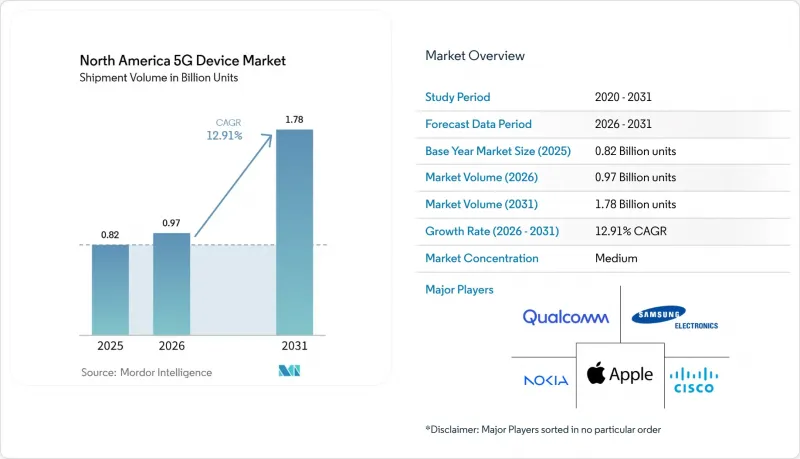
本報告外形規格(智慧型手機、用戶端設備(室內/室外)、其他)、頻譜支援(6 GHz 以下頻段、毫米波、混合頻段(6 GHz 以下頻段和毫米波))、終端用戶行業(消費電子、工業/製造業、其他)、應用(高速通訊(eMBB)、其他)及國家/地區進行細分。市場預測以出貨量(單位)為基礎。
北美5G設備市場趨勢及洞察
營運商將5G智慧型手機與高級套餐捆綁銷售
美國三大業者之間的競爭使得設備補貼成為加速北美5G設備市場升級的關鍵手段。 2026年2月,T-Mobile推出了與「體驗超越」(Experience Beyond)計畫相關的Galaxy S26宣傳活動;同年7月,Verizon透過其「簡易套餐」(Simplicity Plan)推出了Galaxy Z Fold 8和iPhone 17 Pro的捆綁套餐。這些宣傳活動使得符合資格的新用戶幾乎無需預付任何費用即可獲得旗艦設備。這些套餐需要簽訂36個月的合約,費率方案為80至100美元。由此產生的業務收益支持了網路密度的提升和持續的設備購買獎勵,從而以遠超設備正常劣化的速度縮短了更換週期。 Verizon也透過電信商主導的銷售模式,在其「新增線路」(Add-a-Line)促銷活動中捆綁智慧型手機、智慧型手錶和平板電腦,將更多穿戴式裝置和平板電腦推向市場。
企業固定無線接取終端的更換週期
在北美5G設備市場,企業級固定無線接取正在改變客戶終端設備的更換,使其從零散採購轉變為有規劃的基礎設施週期。愛立信在2026年4月發布的報告顯示,所有受訪的北美服務供應商均提供固定無線接取服務,其中89%採用5G作為其交付層。該報告指出,2025年全球客戶終端設備出貨量將達到3,500萬台,較去年同期成長26%,其中57%的出貨量將支援5G。託管廣域網路(WAN)和軟體定義網路(SDN)合約的閘道器更換週期通常為3-5年,比傳統企業路由器常見的7-10年使用壽命短。愛立信於2025年2月發布了Cradlepoint X20 5G路由器,並於2025年4月開始銷售,該產品具備網路切片和多運營商優先級等功能。 PTCRB 和 GCF 認證要求可能會使商業化時間延長 3 到 6 個月,這對已經獲得多運營商批准的現有供應商來說是有利的。
與 4G 同類產品相比,設備的平均售價較高。
在北美5G設備市場,大多數外形規格的5G設備平均售價(ASP)仍高於同類4G產品。雖然營運商補貼可能足以涵蓋高階後付費用戶的初始成本,但預付用戶通常需要自行承擔全部差價。這個問題在墨西哥和對價格敏感的美國消費者中尤其突出。 2025年進口成本的上漲進一步加劇了中階智慧型手機的價格壓力,當5G功能本身不足以支撐更高的售價時,銷售需求就會受到抑制。在模組和物聯網設備領域,如果4G LTE產品能夠以低30-40%的單價滿足企業負責人的營運需求,他們可能會推遲更換。雖然隨著低功耗5G晶片組的價格接近LTE Cat-1水平,這種抑製作用有望緩解,但在可預見的未來,成本仍可能是設備更換的一大障礙。
細分市場分析
2025年,智慧型手機仍將是北美5G設備市場的主要消費品銷售管道,佔據67.40%的市場。蘋果的高階iPhone 17系列,在營運商2025年全年促銷活動的支持下,推動了後付費合約用戶的升級需求。三星的Galaxy A系列滿足了預付合約用戶的需求,而Galaxy S26 Ultra在2026年初發布後,重新燃起了消費者對高階安卓設備的興趣。摩托羅拉在400美元以下價位段的前五大廠商中實現了出貨量成長,由於商店主導的零售管道,來自蘋果和三星的直接競爭有限。隨著營運商補貼的持續,高階機型仍是日常更換的可行選擇,智慧型手機預計仍將是北美5G設備市場的核心。
預計到2031年,穿戴式裝置和XR裝置將以14.35%的複合年成長率成長,在所有外形規格中增速最高。美國食品藥物管理局(FDA)在2026年初發布的指導意見放寬了低風險健康追蹤穿戴裝置的監管障礙,企業應用包括擴增實境(AR)驅動的培訓、現場服務和遠距離診斷。 2026年7月,高通和三星將驍龍平台擴展到智慧眼鏡和智慧型手錶領域,將5G技術整合到非行動電話產品類型中。用戶終端設備、工業路由器和閘道器、模組、筆記型電腦和平板電腦以及熱點構成了出貨量的核心。這些類別受益於固定無線存取、專用網路和企業行動寬頻的並行需求。
預計從2026年到2031年,同時支援Sub-6 GHz和毫米波(mmWave)技術的混合設備將以14.80%的複合年成長率成長。這一成長表明,高階智慧型手機、企業級路由器和固定無線存取閘道器的買家越來越期望設備能夠同時具備廣覆蓋範圍和高吞吐量。毫米波在人口密集的都市區的性能優勢,也使得混合調變解調器在這些部署環境中的高價顯得合理。
2025年,相容6GHz以下頻段的裝置將佔出貨量的61.85%,預計在整個預測期內仍將維持網路覆蓋的基礎地位。中頻段5G在美國、加拿大和墨西哥提供最廣泛、最實用的覆蓋範圍。蘋果針對iPhone 18 Pro系列的策略,在美國採用高通調變解調器以支援毫米波,凸顯了毫米波在北美高階市場的重要性。 T-Mobile、諾基亞和高通使用三星Galaxy S25和驍龍X80處理器,透過6載波聚合技術實現了4.3Gbps的下行速度。使用搭載驍龍X85處理器的設備進行的二次測試達到了6.3Gbps。獨立式毫米波設備仍將是小眾產品,因為其訊號通常僅在距離發射基地台900公尺範圍內可用。大都會圈以外的網路密度限制也限制了其銷量。
其他好處:
- Excel格式的市場預測(ME)表
- 3個月的分析師支持
目錄
第1章:引言
- 研究假設和市場定義
- 調查範圍
第2章:調查方法
第3章執行摘要
第4章 市場狀況
- 市場概覽
- 市場促進因素
- 企業固定無線接取終端的更換週期
- 營運商銷售的 5G 智慧型手機和高級套餐組合。
- 在製造業和物流業引進專用5G網路
- RedCap 和低功耗 5G 設備的普及
- 在人口稠密的都市區。
- 將物聯網設備整合到消費性和工業應用案例中
- 市場限制因素
- 與 4G 同類產品相比,設備的平均售價較高。
- 主要都會區以外的地區,電信業者的頻段和覆蓋範圍有空白區域。
- 身份驗證和互通性要求的變化
- 企業級路由器和模組的更新周期更長
- 產業價值鏈分析
- 監理情勢
- 技術展望
- 波特五力分析
第5章 市場規模與成長預測
- 按外形規格
- 智慧型手機
- 使用者場所設備(室內/室外)
- 工業路由器/閘道器
- 模組
- 筆記型電腦/平板電腦
- 熱點
- 穿戴式裝置和XR設備
- 頻譜支援
- Sub-6 GHz
- 毫米波
- 混合(6GHz 以下和毫米波)
- 按最終用戶行業分類
- 消費性電子產品
- 工業和製造業
- 汽車和交通運輸
- 衛生保健
- 能源與公共產業
- 企業/商業
- 透過使用
- 高速大容量通訊(eMBB)
- 超高可靠性、低延遲通訊(URLLC)
- 多路同時連接(mMTC)
- 固定無線存取
- Vehicle-to-Everything(V2X)
- 國家
- 美國
- 加拿大
- 墨西哥
第6章 競爭情勢
- 市場集中度
- 策略趨勢
- 市佔率分析
- 公司簡介
- Apple Inc.
- Samsung Electronics Co., Ltd.
- Qualcomm Incorporated
- Cisco Systems, Inc.
- Nokia Corporation
- Telefonaktiebolaget LM Ericsson
- T-Mobile US, Inc.
- Verizon Communications Inc.
- AT&T Inc.
- Motorola Mobility LLC
- Netgear, Inc.
- Cradlepoint, Inc.
- Sierra Wireless, Inc.
- Digi International Inc.
- Quectel Wireless Solutions Inc.
- Intel Corporation
- MediaTek Inc.
- Fibocom Wireless Inc.
- Telit Cinterion(Telit IoT Solutions Holding Ltd.)
- Inseego Corp.
第7章 市場機會與未來展望
According to Mordor Intelligence, the North America 5G device market size in terms of shipment volume is expected to increase from 0.82 billion units in 2025 to 0.97 billion units in 2026 and reach 1.78 billion units by 2031, growing at a CAGR of 12.91% over 2026-2031.
This report is Segmented by Form Factor (Smartphones, Customer-Premises Equipment (Indoor/Outdoor), and More), Spectrum Support (Sub-6 GHz, Mmwave, and Hybrid (Sub-6 GHz and MmWave)), End User Industry (Consumer Electronics, Industrial and Manufacturing, and More), Application (Enhanced Mobile Broadband (eMBB), and More), and Country. The Market Forecasts are Provided in Terms of Volume (Units).
North America 5G Device Market Trends and Insights
Carrier Bundling of 5G Smartphones and Premium Plans
Competition among the three national U.S. carriers has made device subsidies a central lever for 5G upgrades in the North America 5G device market. T-Mobile introduced Galaxy S26 offers tied to its Experience Beyond plan in February 2026, and Verizon offered Galaxy Z Fold8 and iPhone 17 Pro bundles through its Simplicity Plan in July 2026. These offers made flagship devices available with no effective upfront payment for eligible new-line customers. They also tied customers to 36-month billing commitments on plans priced from USD 80 to USD 100 per line each month. The resulting service revenue supports network densification and continued device incentives, which shortens replacement cycles beyond normal handset aging. Verizon also combined smartphones, watches, and tablets in add-a-line promotions, bringing more wearables and tablets into carrier-led purchases.
Enterprise Fixed Wireless Access Device Replacement Cycles
Enterprise fixed wireless access is changing customer-premises equipment replacement from an occasional purchase into a planned infrastructure cycle in the North America 5G device market. Ericsson reported in April 2026 that all surveyed North American service providers offered fixed wireless access and that 89% used 5G as the delivery layer. The report cited 35 million global customer-premises equipment shipments in 2025, 26% higher than the prior year, and stated that 57% of shipments were 5G-capable. Managed WAN contracts and software-defined networking agreements commonly tie gateways to 3-5-year refresh cycles, which is shorter than the 7-10-year life often associated with traditional enterprise routers. Ericsson announced the Cradlepoint X20 5G Router in February 2025 and made it available from April 2025 with network slicing and multi-operator prioritization features. PTCRB and GCF certification requirements can add 3-6 months to the path to commercial readiness, favoring established suppliers that already hold multi-operator approvals.
High Device ASPs Versus 4G Alternatives
Average selling prices for 5G-capable devices remain above those for comparable 4G products across most form factors in the North America 5G device market. Carrier subsidies can cover the upfront cost for premium postpaid customers, but prepaid subscribers often pay the full price difference. This issue is especially relevant in Mexico and in budget-focused U.S. customer groups. Higher import-related costs in 2025 added price pressure to mid-range smartphones, limiting unit demand where 5G features did not justify a higher purchase price. In modules and IoT equipment, enterprise buyers may delay replacement when 4G LTE products meet operational needs at a 30-40% lower unit cost. The restraint is expected to ease as lower-power 5G chipsets move closer to LTE Cat-1 pricing, but cost remains a material near-term barrier to device replacement.
Other drivers and restraints analyzed in the detailed report include:
- Private 5G Network Rollouts in Manufacturing and Logistics
- IoT-Enabled Device Convergence Across Consumer and Industrial Use Cases
- Carrier Spectrum and Coverage Gaps Outside Major Urban Corridors
For complete list of drivers and restraints, kindly check the Table Of Contents.
Segment Analysis
Smartphones held 67.40% of the North America 5G device market share in 2025 and remained the main consumer volume base. Apple's premium iPhone 17 range supported postpaid upgrade activity during 2025 through carrier promotions. Samsung's Galaxy A-series supported prepaid-tier demand, while the Galaxy S26 Ultra renewed interest in premium Android devices after its early 2026 launch. Motorola recorded unit-shipment growth among the top 5 vendors through carrier shelf placement in the sub-USD 400 range, where Apple and Samsung have limited direct competition. Smartphones will remain central to the North America 5G device market because carrier subsidies continue to bring premium models into routine replacement decisions.
Wearables and XR devices are projected to grow at a 14.35% CAGR through 2031, the fastest rate among form factors. Early 2026 FDA guidance reduced regulatory barriers for lower-risk health-tracking wearables, while enterprise use includes augmented-reality training, field service, and remote diagnostics. Qualcomm and Samsung expanded the Snapdragon platform into intelligent eyewear and smartwatches in July 2026, embedding 5G across product categories beyond handsets. Customer-premises equipment, industrial routers and gateways, modules, laptops and tablets, and hotspots form the middle of the volume stack. These categories benefit from parallel demand from fixed wireless access, private networks, and enterprise mobile broadband.
Hybrid Sub-6 GHz and mmWave devices are projected to grow at a 14.80% CAGR from 2026 to 2031. The growth shows that premium smartphone, enterprise router, and fixed wireless access gateway buyers increasingly expect both broad-area coverage and high-throughput capability. The performance advantage of mmWave in dense urban locations supports a premium for hybrid modems in these deployments.
Sub-6 GHz devices accounted for 61.85% of volume in 2025 and will remain the foundation of coverage during the forecast period. Mid-band 5G supports the widest usable coverage across the United States, Canada, and Mexico. Apple's reported approach for iPhone 18 Pro variants, using Qualcomm modems in the United States for mmWave compatibility, shows the importance of mmWave in the North American premium tier. T-Mobile, Nokia, and Qualcomm demonstrated 4.3 Gbps downlink speeds using 6-carrier aggregation with a Samsung Galaxy S25 and Snapdragon X80, and a secondary test with a Snapdragon X85 device reached 6.3 Gbps. Standalone mmWave devices will remain specialized because signals are usually usable within 900 meters of a transmission site. Network density constraints outside large metropolitan areas also limit their contribution to volume.
Complete Report Scope:
- By Form Factor
- Smartphones
- Customer-Premises Equipment (Indoor/Outdoor)
- Industrial Grade Routers/Gateways
- Modules
- Laptops/Tablets
- Hotspots
- Wearables and XR Devices
- By Spectrum Support
- Sub-6 GHz
- mmWave
- Hybrid (Sub-6 GHz and mmWave)
- By End User Industry
- Consumer Electronics
- Industrial and Manufacturing
- Automotive and Transportation
- Healthcare
- Energy and Utilities
- Enterprise/Commercial
- By Application
- Enhanced Mobile Broadband (eMBB)
- Ultra-Reliable Low-Latency Comms (URLLC)
- Massive Machine-Type Comms (mMTC)
- Fixed Wireless Access
- Vehicle-to-Everything (V2X)
- By Country
- United States
- Canada
- Mexico
List of Companies Covered in this Report:
- Apple Inc.
- Samsung Electronics Co., Ltd.
- Qualcomm Incorporated
- Cisco Systems, Inc.
- Nokia Corporation
- Telefonaktiebolaget LM Ericsson
- T-Mobile US, Inc.
- Verizon Communications Inc.
- AT&T Inc.
- Motorola Mobility LLC
- Netgear, Inc.
- Cradlepoint, Inc.
- Sierra Wireless, Inc.
- Digi International Inc.
- Quectel Wireless Solutions Inc.
- Intel Corporation
- MediaTek Inc.
- Fibocom Wireless Inc.
- Telit Cinterion (Telit IoT Solutions Holding Ltd.)
- Inseego Corp.
Additional Benefits:
- The market estimate (ME) sheet in Excel format
- 3 months of analyst support
TABLE OF CONTENTS
1 INTRODUCTION
- 1.1 Study Assumptions and Market Definition
- 1.2 Scope of the Study
2 RESEARCH METHODOLOGY
3 EXECUTIVE SUMMARY
4 MARKET LANDSCAPE
- 4.1 Market Overview
- 4.2 Market Drivers
- 4.2.1 Enterprise Fixed Wireless Access Device Replacement Cycles
- 4.2.2 Carrier Bundling of 5G Smartphones and Premium Plans
- 4.2.3 Private 5G Network Rollouts in Manufacturing and Logistics
- 4.2.4 RedCap and Low-Power 5G Device Adoption
- 4.2.5 mmWave Coverage Expansion in Dense Urban Hotspots
- 4.2.6 IoT Enabled Device Convergence Across Consumer and Industrial Use Cases
- 4.3 Market Restraints
- 4.3.1 High Device ASPs Versus 4G Alternatives
- 4.3.2 Carrier Spectrum and Coverage Gaps Outside Major Urban Corridors
- 4.3.3 Fragmented Certification and Interoperability Requirements
- 4.3.4 Slower Enterprise Refresh Cycles for Routers and Modules
- 4.4 Industry Value Chain Analysis
- 4.5 Regulatory Landscape
- 4.6 Technological Outlook
- 4.7 Porter's Five Forces Analysis
- 4.7.1 Bargaining Power of Suppliers
- 4.7.2 Bargaining Power of Buyers
- 4.7.3 Threat of New Entrants
- 4.7.4 Threat of Substitutes
- 4.7.5 Intensity of Competitive Rivalry
5 MARKET SIZE AND GROWTH FORECASTS (VOLUME)
- 5.1 By Form Factor
- 5.1.1 Smartphones
- 5.1.2 Customer-Premises Equipment (Indoor/Outdoor)
- 5.1.3 Industrial Grade Routers/Gateways
- 5.1.4 Modules
- 5.1.5 Laptops/Tablets
- 5.1.6 Hotspots
- 5.1.7 Wearables and XR Devices
- 5.2 By Spectrum Support
- 5.2.1 Sub-6 GHz
- 5.2.2 mmWave
- 5.2.3 Hybrid (Sub-6 GHz and mmWave)
- 5.3 By End User Industry
- 5.3.1 Consumer Electronics
- 5.3.2 Industrial and Manufacturing
- 5.3.3 Automotive and Transportation
- 5.3.4 Healthcare
- 5.3.5 Energy and Utilities
- 5.3.6 Enterprise/Commercial
- 5.4 By Application
- 5.4.1 Enhanced Mobile Broadband (eMBB)
- 5.4.2 Ultra-Reliable Low-Latency Comms (URLLC)
- 5.4.3 Massive Machine-Type Comms (mMTC)
- 5.4.4 Fixed Wireless Access
- 5.4.5 Vehicle-to-Everything (V2X)
- 5.5 By Country
- 5.5.1 United States
- 5.5.2 Canada
- 5.5.3 Mexico
6 COMPETITIVE LANDSCAPE
- 6.1 Market Concentration
- 6.2 Strategic Moves
- 6.3 Market Share Analysis
- 6.4 Company Profiles (includes Global Level Overview, Market Level Overview, Core Segments, Financials as available, Strategic Information, Market Rank/Share, Products and Services, Recent Developments)
- 6.4.1 Apple Inc.
- 6.4.2 Samsung Electronics Co., Ltd.
- 6.4.3 Qualcomm Incorporated
- 6.4.4 Cisco Systems, Inc.
- 6.4.5 Nokia Corporation
- 6.4.6 Telefonaktiebolaget LM Ericsson
- 6.4.7 T-Mobile US, Inc.
- 6.4.8 Verizon Communications Inc.
- 6.4.9 AT&T Inc.
- 6.4.10 Motorola Mobility LLC
- 6.4.11 Netgear, Inc.
- 6.4.12 Cradlepoint, Inc.
- 6.4.13 Sierra Wireless, Inc.
- 6.4.14 Digi International Inc.
- 6.4.15 Quectel Wireless Solutions Inc.
- 6.4.16 Intel Corporation
- 6.4.17 MediaTek Inc.
- 6.4.18 Fibocom Wireless Inc.
- 6.4.19 Telit Cinterion (Telit IoT Solutions Holding Ltd.)
- 6.4.20 Inseego Corp.
7 MARKET OPPORTUNITIES AND FUTURE OUTLOOK
- 7.1 White-Space and Unmet-Need Assessment

 5G設備市場規模、佔有率和成長分析:按設備類型、頻段、應用、最終用戶、分銷管道和地區分類-2026-2033年產業預測
 5G設備:市場佔有率分析、產業趨勢與統計、成長預測(2026-2031年)
 5G設備、智慧型手機和穿戴式裝置研究服務亞太地區5G設備:市佔率分析、產業趨勢與統計及成長預測(2026-2031年)南美洲5G設備:市佔率分析、產業趨勢與統計及成長預測(2026-2031年)歐洲 5G 設備:市場佔有率分析、行業趨勢和統計數據以及成長預測(2026-2031 年)
 2026-2030年全球5G設備市場
 2026年超低成本(ULC)行動電話全球市場報告5G-Advanced 行動裝置、穿戴式裝置和配件5G行動裝置、功能與技術:供應商、趨勢與預測