


 |
市場調查報告書
商品編碼
2118876
亞太地區5G設備:市佔率分析、產業趨勢與統計及成長預測(2026-2031年)Asia-Pacific 5G Device - Market Share Analysis, Industry Trends & Statistics, Growth Forecasts (2026 - 2031) |
||||||

※ 本網頁內容可能與最新版本有所差異。詳細情況請與我們聯繫。
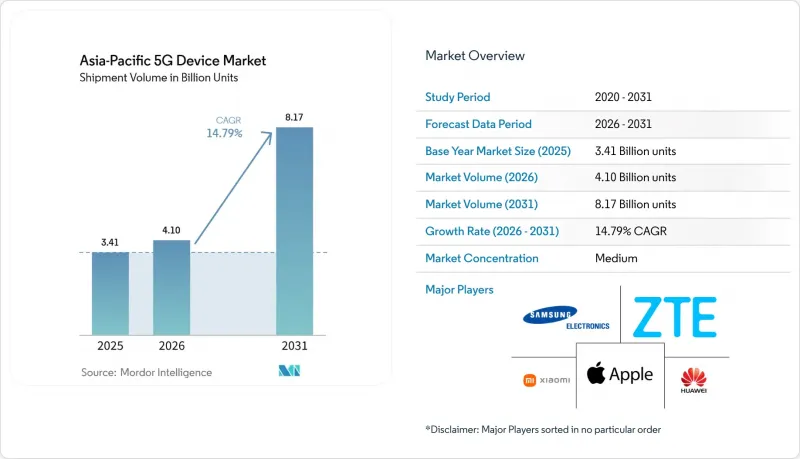
根據 Mordor Intelligence 預測,亞太地區 5G 設備市場(以出貨量計算)預計將從 2025 年的 34.1 億台成長到 2026 年的 41 億台,到 2031 年將達到 81.7 億台,2026 年至 2031 年的複合年成長率為 14.9%。
本報告外形規格(智慧型手機、用戶端設備(室內/室外)等)、頻譜支援(6GHz以下頻段、毫米波頻段、混合頻段(6GHz以下頻段和毫米波頻段))、終端用戶行業(消費電子、工業/製造業等)、應用領域(高速高容量通訊(eMBB)等)以及國家/地區進行細分。市場預測以銷售量(單位)為單位。
亞太地區 5G 設備市場趨勢及洞察。
5G網路部署和設備升級週期
中國龐大的網路規模仍是亞太地區5G終端市場的主要需求來源。截至2025年底,中國已建成483.8萬個5G基地台,至2026年3月底,數字將增加至495.8萬個。到2026年初,5G-Advanced服務將覆蓋中國330個城市,這將催生對能夠支援更先進網路功能的設備的需求。在全部區域,到2025年中期,已有26個國家的69家營運商推出了商用5G服務,13家營運商正在部署網路,另有17家營運商正在規劃服務部署。區域營運商已承諾到2030年投資2,540億美元用於網路基礎設施建設,其中5G是重點。此外,新加坡、印度和紐西蘭等國傳統網路的退役也促使先前被推遲的設備更換決策得以實施,從而帶動了終端設備的採購。
亞太地區中階5G智慧型手機的普及率
印度生動地展現了設備價格下降如何推動亞太地區5G設備市場的發展。 2025年,印度出貨的智慧型手機中超過90%支援5G網路,每月5G數據流量達到12.9Exabyte,較去年同期成長70%。同年,印度近47%的行動寬頻流量透過5G網路傳輸。售價低於100美元的5G設備出貨量成長超過十倍,顯示無線硬體已進入入門級市場。高通公司於2026年5月在印度發表了驍龍6 Gen 5和驍龍4 Gen 5平台,將印度定位為中階和入門級設備研發中心。這個價格區間有望成為推動區域出貨量成長的關鍵因素,因為它既滿足了首次購買5G設備的用戶需求,也滿足了現有設備的更換需求。
5G設備和射頻組件高成本
射頻組件的成本限制了5G硬體在低成本設備中的部署速度。一款旗艦級5G智慧型手機需要15-25美元的FR1射頻組件,以及每個毫米波封裝天線模組20-80美元的成本。因此,射頻前端的總成本為每台設備35-105美元,佔設備組件成本的5-15%。對於售價低於200美元的智慧型手機,記憶體和儲存組件的成本佔組件成本的30%以上。東南亞地區超過60%的設備都屬於此價格區間,因此組件價格上漲可能會影響製造商維持產品價格競爭力的能力和利潤率。預計到2026年,射頻前端的前置作業時間將達到16-26週,隨著人工智慧基礎設施對先進封裝技術和晶圓產能的競爭日益激烈,採購壓力也不斷增加。
細分市場分析
2025年,智慧型手機在全部區域中佔65.40%。這得益於該地區以行動優先為核心的基本客群和行動電話裝置製造能力。截至2025年9月底,中國移動5G用戶數已突破12億人。這龐大的用戶基礎支撐著亞太市場5G設備的出貨量,涵蓋低階、中階和高階市場。就部署速度而言,用戶端設備(CPE)是第二大外形規格來源,因為固定無線服務需要路由器和室外單元。工業路由器、閘道器、模組和熱點設備的出貨量雖然低於主流消費級設備,但單價較高。
預計2026年至2031年間,穿戴式裝置和XR裝置的複合年成長率將達到16.25%。新加坡、韓國、日本和中國的主要城市已覆蓋5G獨立組網(SA)網路,能夠支援低延遲空間運算。軟銀集團、愛立信日本和高通技術公司於2025年12月在東京完成了商用5G SA XR串流媒體的現場試驗。韓國對企業和AR/VR應用的需求也推動設備製造商開發支援毫米波和增強型Sub-6GHz頻段的平台。印度的生產連結獎勵計畫計畫正在吸引對電子組裝產業的投資,從而降低消費性設備的單位成本。
到2025年,Sub-6 GHz頻段的設備將佔亞太地區5G設備市場59.66%的佔有率。此頻段涵蓋範圍廣、整合成本低,且在不同區域市場監管條件寬鬆。在5G覆蓋主要集中在n77和n78頻段的地區,Sub-6 GHz頻段的優勢特別顯著。消費者對價格的敏感度也是毫米波硬體短期潛在客戶群的限制因素。同時支援Sub-6 GHz和毫米波的混合型設備目前主要集中在日本和韓國的高階和企業級應用場景。
毫米波終端市場預計將以16.05%的複合年成長率成長至2031年,而2025年的基數小規模。亞太地區5G設備市場的需求主要來自專用網路、半導體工廠以及需要高吞吐量和低延遲的高密度設施。日月光科技(ASE Technology)宣布了其5G毫米波NR-DC獨立組網智慧工廠的計劃,目標是在2.6 GHz和28 GHz頻段上實現600 Mbps的上行鏈路速率。在日本和韓國,N257和N258頻段的型號認證規則非常嚴格。在這個高階市場,成熟的認證記錄可能對三星電子、高通和索尼集團等公司具有優勢。
其他好處:
- Excel格式的市場預測(ME)表
- 3個月的分析師支持
目錄
第1章:引言
- 研究假設和市場定義
- 調查範圍
第2章:調查方法
第3章執行摘要
第4章 市場狀況
- 市場概覽
- 市場促進因素
- 5G網路部署和設備更換週期
- 亞太地區中階5G智慧型手機的普及率
- 工業5G和專用網路中設備的部署
- 最後一公里寬頻中固定無線存取的替代方案
- 實現 5G RedCap 和低功耗設備
- 具備人工智慧功能的智慧型手機和高階設備的更換需求。
- 市場限制因素
- 5G設備和射頻組件高成本
- 毫米波技術的成本和整合複雜性。
- 對先進半導體供應鏈的依賴
- 跨舊有系統的工業整合複雜性
- 產業價值鏈分析
- 監理情勢
- 技術展望
- 波特五力分析
第5章 市場規模與成長預測
- 按外形規格
- 智慧型手機
- 使用者場所設備(室內/室外)
- 工業路由器/閘道器
- 模組
- 筆記型電腦/平板電腦
- 熱點
- 穿戴式裝置和XR設備
- 頻譜支援
- Sub-6 GHz
- 毫米波
- 混合(6GHz 以下和毫米波)
- 按最終用戶行業分類
- 消費性電子產品
- 工業和製造業
- 汽車和交通運輸
- 衛生保健
- 能源與公共產業
- 企業/商業
- 透過使用
- 高速大容量通訊(eMBB)
- 超高可靠性、低延遲通訊(URLLC)
- 多路同時連接(mMTC)
- 固定無線存取
- Vehicle-to-Everything(V2X)
- 國家
- 中國
- 日本
- 印度
- 韓國
- ASEAN
- 其他亞太國家
第6章 競爭情勢
- 市場集中度
- 策略趨勢
- 市佔率分析
- 公司簡介
- Apple Inc.
- Samsung Electronics Co., Ltd.
- Xiaomi Corporation
- Huawei Technologies Co., Ltd.
- ZTE Corporation
- Sony Group Corporation
- D-Link Corporation
- Nokia Corporation
- Fibocom Wireless Inc.
- Inseego Corp.
- HTC Corporation
- Askey Computer Corp.
- Lenovo Group Limited
- Qualcomm Incorporated
- MediaTek Inc.
- Quectel Wireless Solutions Co., Ltd.
- MeiG Smart Technology Co., Ltd.
- SIMCom Wireless Solutions Co., Ltd.
- OPPO(OPPO Mobile Telecommunications Corp. Ltd.)
- Vivo Mobile Communication Co., Ltd.
第7章 市場機會與未來展望
According to Mordor Intelligence, the Asia-Pacific 5G device market size in terms of shipment volume is expected to grow from 3.41 billion units in 2025 to 4.10 billion units in 2026 and is forecast to reach 8.17 billion units by 2031 at 14.79% CAGR over 2026-2031.
This report is Segmented by Form Factor (Smartphones, Customer-Premises Equipment (Indoor/Outdoor), and More), Spectrum Support (Sub-6 GHz, Mmwave, and Hybrid (Sub-6 GHz and MmWave)), End User Industry (Consumer Electronics, Industrial and Manufacturing, and More), Application (Enhanced Mobile Broadband (eMBB), and More), and Country. The Market Forecasts are Provided in Terms of Volume (Units).
Asia-Pacific 5G Device Market Trends and Insights
5G Network Rollout and Device Upgrade Cycles
China's network scale remains a major source of demand for the Asia-Pacific 5G device market. China had 4.838 million 5G base stations at the end of 2025 and 4.958 million at the end of March 2026. 5G-Advanced service had reached 330 Chinese cities in early 2026, creating demand for devices that can support more advanced network functions. Across the region, 69 operators in 26 countries had launched commercial 5G by mid-2025, with 13 operators deploying networks and 17 planning services. Regional telecom operators have committed USD 254 billion to network infrastructure through 2030, with 5G as the main focus. The retirement of older networks in Singapore, India, and New Zealand has also led to delayed replacement decisions being converted into device purchases.
Mid-Range 5G Smartphone Penetration in Asia-Pacific
India illustrates how lower device prices are expanding the Asia-Pacific 5G device market. More than 90% of smartphones shipped in India in 2025 were 5G-enabled, while monthly 5G data traffic rose 70% year over year to 12.9 exabytes. Nearly 47% of India's mobile broadband traffic was carried on 5G during that year. Shipments of 5G handsets priced below USD 100 increased more than tenfold, indicating that radio hardware has reached the entry-level. Qualcomm introduced Snapdragon 6 Gen 5 and Snapdragon 4 Gen 5 platforms in India in May 2026, placing the country at the center of development for mid-range and entry devices. This price range is likely to shape regional shipment volumes, as it serves both first-time 5G buyers and replacement customers.
High Bill of Materials for 5G Devices and RF Components
The cost of RF components limits how quickly 5G hardware can move into lower-priced devices. A flagship 5G handset requires USD 15 to USD 25 of FR1 RF components and USD 20 to USD 80 for each mmWave antenna-in-package module. The total RF front-end cost can therefore range from USD 35 to USD 105 per device, or 5% to 15% of the handset bill of materials. Memory and storage account for more than 30% of the bill of materials in smartphones priced below USD 200. More than 60% of devices shipped in Southeast Asia fall into this price band, so component inflation can affect affordability and manufacturer margins. RF front-end lead times of 16 to 26 weeks in 2026 add procurement pressure as AI infrastructure competes for advanced packaging and wafer capacity.
Other drivers and restraints analyzed in the detailed report include:
- Industrial 5G and Private Network Device Adoption
- Fixed Wireless Access Substitution for Last-Mile Broadband
- mmWave Cost and Integration Complexity
For complete list of drivers and restraints, kindly check the Table Of Contents.
Segment Analysis
Smartphones held 65.40% of regional device volume in 2025, supported by the region's mobile-first customer base and handset manufacturing capacity. China Mobile's 5G subscriber base exceeded 1.2 billion mobile users at the end of September 2025. This installed base supports shipments of 5G devices across the Asia-Pacific market, including low-cost, mid-range, and premium tiers. Customer-premises equipment is the second-largest form-factor contributor by deployment velocity because fixed wireless services require routers and outdoor units. Industrial routers, gateways, modules, and hotspots have smaller volumes but higher unit values than mainstream consumer devices.
Wearables and XR devices are projected to grow at a 16.25% CAGR from 2026 to 2031. Singapore, South Korea, Japan, and major Chinese cities already have 5G standalone coverage that can support lower-latency spatial computing. SoftBank Corp., Ericsson Japan, and Qualcomm Technologies completed a commercial 5G standalone XR streaming field trial in Tokyo during December 2025. South Korea's enterprise and AR/VR uses are also encouraging device makers to pursue mmWave-capable and enhanced sub-6 GHz platforms. India's production-linked incentive program has attracted investment in electronics assembly and supports lower unit costs for consumer devices.
Sub-6 GHz devices accounted for 59.66% of the Asia-Pacific 5G device market size in 2025. The band provides broad coverage, lower integration cost, and accessible regulatory conditions across diverse regional markets. Its position is particularly durable where 5G coverage is centered on n77 and n78 spectrum. Consumer price sensitivity also limits the near-term addressable base for mmWave hardware. Hybrid devices that support both sub-6 GHz and mmWave remain concentrated in premium and enterprise use cases in Japan and South Korea.
mmWave devices are projected to expand at a 16.05% CAGR through 2031 from a smaller 2025 base. Demand in the Asia-Pacific 5G device market is driven by private networks, semiconductor plants, and high-density venues that require high throughput and low latency. ASE Technology has announced plans for a 5G mmWave NR-DC standalone smart factory targeting a 600 Mbps uplink over 2.6 GHz and 28 GHz links. Japan and South Korea apply strict type-approval rules for the N257 and N258 bands. Established certification records can favor Samsung Electronics, Qualcomm, and Sony Group in this premium tier.
Complete Report Scope:
- By Form Factor
- Smartphones
- Customer-Premises Equipment (Indoor/Outdoor)
- Industrial Grade Routers/Gateways
- Modules
- Laptops/Tablets
- Hotspots
- Wearables and XR Devices
- By Spectrum Support
- Sub-6 GHz
- mmWave
- Hybrid (Sub-6 GHz and mmWave)
- By End-User Industry
- Consumer Electronics
- Industrial and Manufacturing
- Automotive and Transportation
- Healthcare
- Energy and Utilities
- Enterprise/Commercial
- By Application
- Enhanced Mobile Broadband (eMBB)
- Ultra-Reliable Low-Latency Comms (URLLC)
- Massive Machine-Type Comms (mMTC)
- Fixed Wireless Access
- Vehicle-to-Everything (V2X)
- By Country
- China
- Japan
- India
- South Korea
- ASEAN
- Rest of Asia-Pacific
List of Companies Covered in this Report:
- Apple Inc.
- Samsung Electronics Co., Ltd.
- Xiaomi Corporation
- Huawei Technologies Co., Ltd.
- ZTE Corporation
- Sony Group Corporation
- D-Link Corporation
- Nokia Corporation
- Fibocom Wireless Inc.
- Inseego Corp.
- HTC Corporation
- Askey Computer Corp.
- Lenovo Group Limited
- Qualcomm Incorporated
- MediaTek Inc.
- Quectel Wireless Solutions Co., Ltd.
- MeiG Smart Technology Co., Ltd.
- SIMCom Wireless Solutions Co., Ltd.
- OPPO (OPPO Mobile Telecommunications Corp. Ltd.)
- Vivo Mobile Communication Co., Ltd.
Additional Benefits:
- The market estimate (ME) sheet in Excel format
- 3 months of analyst support
TABLE OF CONTENTS
1 INTRODUCTION
- 1.1 Study Assumptions and Market Definition
- 1.2 Scope of the Study
2 RESEARCH METHODOLOGY
3 EXECUTIVE SUMMARY
4 MARKET LANDSCAPE
- 4.1 Market Overview
- 4.2 Market Drivers
- 4.2.1 5G Network Rollout and Device Upgrade Cycles
- 4.2.2 Mid-Range 5G Smartphone Penetration in Asia-Pacific
- 4.2.3 Industrial 5G and Private Network Device Adoption
- 4.2.4 Fixed Wireless Access Substitution for Last-Mile Broadband
- 4.2.5 5G RedCap and Low-Power Device Enablement
- 4.2.6 AI-Ready Handsets and Premium Device Refresh Demand
- 4.3 Market Restraints
- 4.3.1 High Bill of Materials for 5G Devices and RF Components
- 4.3.2 mmWave Cost and Integration Complexity
- 4.3.3 Supply Chain Dependence on Advanced Semiconductors
- 4.3.4 Industrial Integration Complexity Across Legacy Systems
- 4.4 Industry Value Chain Analysis
- 4.5 Regulatory Landscape
- 4.6 Technological Outlook
- 4.7 Porter's Five Forces Analysis
- 4.7.1 Bargaining Power of Suppliers
- 4.7.2 Bargaining Power of Buyers
- 4.7.3 Threat of New Entrants
- 4.7.4 Threat of Substitutes
- 4.7.5 Intensity of Competitive Rivalry
5 MARKET SIZE AND GROWTH FORECASTS (VOLUME)
- 5.1 By Form Factor
- 5.1.1 Smartphones
- 5.1.2 Customer-Premises Equipment (Indoor/Outdoor)
- 5.1.3 Industrial Grade Routers/Gateways
- 5.1.4 Modules
- 5.1.5 Laptops/Tablets
- 5.1.6 Hotspots
- 5.1.7 Wearables and XR Devices
- 5.2 By Spectrum Support
- 5.2.1 Sub-6 GHz
- 5.2.2 mmWave
- 5.2.3 Hybrid (Sub-6 GHz and mmWave)
- 5.3 By End-User Industry
- 5.3.1 Consumer Electronics
- 5.3.2 Industrial and Manufacturing
- 5.3.3 Automotive and Transportation
- 5.3.4 Healthcare
- 5.3.5 Energy and Utilities
- 5.3.6 Enterprise/Commercial
- 5.4 By Application
- 5.4.1 Enhanced Mobile Broadband (eMBB)
- 5.4.2 Ultra-Reliable Low-Latency Comms (URLLC)
- 5.4.3 Massive Machine-Type Comms (mMTC)
- 5.4.4 Fixed Wireless Access
- 5.4.5 Vehicle-to-Everything (V2X)
- 5.5 By Country
- 5.5.1 China
- 5.5.2 Japan
- 5.5.3 India
- 5.5.4 South Korea
- 5.5.5 ASEAN
- 5.5.6 Rest of Asia-Pacific
6 COMPETITIVE LANDSCAPE
- 6.1 Market Concentration
- 6.2 Strategic Moves
- 6.3 Market Share Analysis
- 6.4 Company Profiles (includes Global Level Overview, Market Level Overview, Core Segments, Financials as available, Strategic Information, Market Rank/Share, Products and Services, Recent Developments)
- 6.4.1 Apple Inc.
- 6.4.2 Samsung Electronics Co., Ltd.
- 6.4.3 Xiaomi Corporation
- 6.4.4 Huawei Technologies Co., Ltd.
- 6.4.5 ZTE Corporation
- 6.4.6 Sony Group Corporation
- 6.4.7 D-Link Corporation
- 6.4.8 Nokia Corporation
- 6.4.9 Fibocom Wireless Inc.
- 6.4.10 Inseego Corp.
- 6.4.11 HTC Corporation
- 6.4.12 Askey Computer Corp.
- 6.4.13 Lenovo Group Limited
- 6.4.14 Qualcomm Incorporated
- 6.4.15 MediaTek Inc.
- 6.4.16 Quectel Wireless Solutions Co., Ltd.
- 6.4.17 MeiG Smart Technology Co., Ltd.
- 6.4.18 SIMCom Wireless Solutions Co., Ltd.
- 6.4.19 OPPO (OPPO Mobile Telecommunications Corp. Ltd.)
- 6.4.20 Vivo Mobile Communication Co., Ltd.
7 MARKET OPPORTUNITIES AND FUTURE OUTLOOK
- 7.1 White-Space and Unmet-Need Assessment

 5G設備市場規模、佔有率和成長分析:按設備類型、頻段、應用、最終用戶、分銷管道和地區分類-2026-2033年產業預測
 5G設備:市場佔有率分析、產業趨勢與統計、成長預測(2026-2031年)
 5G設備、智慧型手機和穿戴式裝置研究服務北美5G設備:市佔率分析、產業趨勢與統計及成長預測(2026-2031年)南美洲5G設備:市佔率分析、產業趨勢與統計及成長預測(2026-2031年)歐洲 5G 設備:市場佔有率分析、行業趨勢和統計數據以及成長預測(2026-2031 年)
 2026-2030年全球5G設備市場
 2026年超低成本(ULC)行動電話全球市場報告5G-Advanced 行動裝置、穿戴式裝置和配件5G行動裝置、功能與技術:供應商、趨勢與預測