


 |
市場調查報告書
商品編碼
2118880
南美洲5G設備:市佔率分析、產業趨勢與統計及成長預測(2026-2031年)South America 5G Device - Market Share Analysis, Industry Trends & Statistics, Growth Forecasts (2026 - 2031) |
||||||

※ 本網頁內容可能與最新版本有所差異。詳細情況請與我們聯繫。
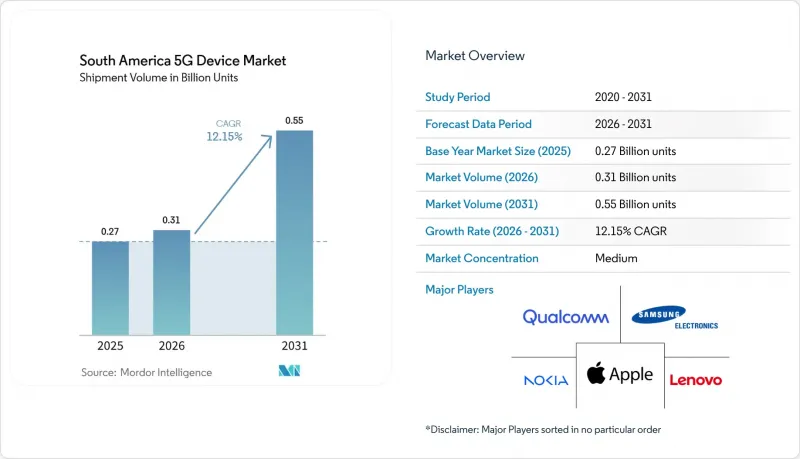
據 Mordor Intelligence 稱,南美 5G 設備市場(按出貨量計算)預計將從 2025 年的 2.7 億台和 2026 年的 3.1 億台成長到 2031 年的 5.5 億台,2026 年至 2031 年的複合年成長率為 12.15%。
本報告外形規格(智慧型手機、用戶端設備(室內/室外)等)、頻譜支援(6GHz以下頻段、毫米波頻段以及混合頻段(6GHz以下頻段和毫米波頻段))、終端用戶行業(消費電子、工業和製造業等)、應用領域(高速高容量通訊(eMBB)等)以及國家/地區進行細分。市場預測以出貨量(單位)為基礎。
南美洲5G設備市場趨勢與洞察
縮短5G智慧型手機的更換週期
隨著5G網路覆蓋範圍的擴大和更多消費者能夠使用該服務,自2024年以來,智慧型手機的更換週期有所縮短。在巴西,2025年新增5G連接1820萬,總數達5810萬,年增46.6%。這一成長不僅源於用戶數量的增加,也顯示在運營商宣傳活動期間,許多用戶從4G設備升級到了5G。 2025年4月,三星與vivo合作推出了Galaxy A06 5G,售價899巴西幣(約157美元),降低了5G設備的基準價格。在營運商大力推動設備升級的同時,摩托羅拉、小米和Jovi等品牌也在中階市場展開競爭。隨著5G設備的普及,網路使用量的增加可能會進一步推動網路投資和資料方案升級。
在尚未提供 5G 服務的地區,對 5G 固定無線存取終端的需求不斷成長。
光纖部署的經濟可行性與人口分佈之間的差距正在推動對固定無線存取(FWA)用戶端設備(CPE)的需求。巴西通訊部與CPQD、高通、Brisanet和Intelbras合作,於2025年7月在北里奧格蘭德州的三所鄉村學校完成了5G FWA戶外CPE的試驗。這些試驗證實,在試驗地點,戶外5G CPE可以達到與光纖連接相當的通訊速度。 2026年3月,Brisanet和高通宣布了一項名為「東北互聯FWA」的聯合項目,旨在向農村地區提供基於SDX62的補貼CPE。阿根廷Claro公司也於2025年在布宜諾斯艾利斯、科爾多瓦和其他州首府推出了商用5G FWA服務。確保教育、醫療保健、農業綜合企業和金融服務等領域的公共連接的目標,正在降低消費者對設備購買決策的依賴性,從而減少對FWA的需求。
5G設備和4G設備的價格差異
5G 和 4G 設備之間的價格差異是價格敏感型消費者接受 5G 設備的主要障礙。根據巴西監管機構的數據,到 2025 年,5G 智慧型手機的價格將比同等配置的 4G 手機高出 40% 到 60%。進口關稅、外匯和品牌定位都是導致價格上漲的原因。這種影響在預付費用戶中最為顯著,而預付用戶佔該地區行動連線用戶的大部分。儘管營運商和製造商正在透過分期付款、補貼和提供價格更低的 5G 機型來應對,但這些努力尚未跟上網路擴張的步伐。這種不匹配正在減緩設備更換,並延遲營運商從 5G 服務計劃中獲得的收入。
細分市場分析
2025年,智慧型手機在南美洲5G設備市場佔有70.80%的佔有率。這反映了該地區以行動優先的連接基礎設施以及老舊4G設備的更換。三星透過在聖保羅州坎皮納斯和亞馬遜州馬瑙斯的本地化生產擴大了出貨量。摩托羅拉和小米在1000巴西幣(約174美元)至3500巴西幣(約609美元)的價格區間內加劇了競爭。 Jovi於2025年6月透過與Claro和TIM的合作進入巴西市場,並透過其營運商套餐以1799巴西幣(約315美元)的價格提供V50 Lite 5G手機。穿戴式裝置、XR裝置、熱點裝置、模組、筆記型電腦和平板電腦的出貨量仍然較低,儘管模組在物聯網和農業自動化設備中的應用有所增加。
預計到2031年,客戶終端設備 (CPE) 將以13.40%的複合年成長率成長,成為所有外形規格中成長最快的。 Brisanet、Claro Argentina 和 Telecom Argentina 等公司擴大固定無線存取 (FWA) 項目,導致2025年CPE供應壓力增加。室內和室外CPE支援在光纖部署不經濟的地區提供寬頻存取。由於企業採購週期較長,工業路由器和閘道器的成長速度較慢。 Usiminas、Gerdau 和雀巢卡卡帕瓦工廠的部署表明,市場對專用工業連接設備的需求日益成長。
2025年,在巴西獨立組網5G網路架構的支援下,Sub-6 GHz頻段設備將佔據南美5G設備市場66.30%的佔有率。巴西5G訊號的分析顯示,截至2024年10月,99%的訊號源自3.5 GHz C頻段。這種網路設計使得市場需求集中在支援Sub-6 GHz頻段的行動電話和CPE(用戶端設備)上。毫米波設備仍僅限於聖保羅、里約熱內盧和巴西利亞等城市的體育場館、機場和會展中心等高密度場所。它們的使用與那些每平方公尺額外容量能夠帶來明顯價值的場所密切相關。
預計到2031年,同時支援Sub-6 GHz和毫米波頻段的混合設備將以13.61%的複合年成長率成長。高階智慧型手機製造商正在其旗艦機型中普及毫米波支持,而私人網路營運商則在探索將該頻段用於工廠和港口自動化。巴西、烏拉圭和智利正在進行毫米波頻段的頻率競標,但其廣泛的商業應用仍然有限。高通和愛立信於2026年3月在聖保羅完成了基於RHINO H1熱點和驍龍X35調變解調器的5G獨立組網RedCap的測試。經濟高效的RedCap模組和CPE正在推動Sub-6 GHz生態系統的需求,而混合產品則滿足更高價值的應用情境。
其他好處:
- Excel格式的市場預測(ME)表
- 3個月的分析師支持
目錄
第1章:引言
- 研究假設和市場定義
- 調查範圍
第2章:調查方法
第3章執行摘要
第4章 市場狀況
- 市場概覽
- 市場促進因素
- 縮短5G智慧型手機的更換週期
- 服務欠缺地區對 5G 固定無線存取終端的需求不斷成長。
- 針對支援 5G 功能的行動電話和 CPE(客戶處方設備)的電信業者的補貼計畫。
- 商業數位化正在推動對 5G 路由器、閘道器和工業設備的需求。
- 市場對具備高效電源管理和長電池續航力的 5G 設備的需求日益成長。
- 家電本地組裝及進口業務多元化
- 市場限制因素
- 5G設備與4G替代設備的價格差異
- 主要都會區以外地區5G網路覆蓋不均勻
- 對價格敏感的消費者難以取得5G設備
- 可用頻段的變化以及終端頻段相容性的限制。
- 產業價值鏈分析
- 監理情勢
- 技術展望
- 波特五力分析
第5章 市場規模與成長預測
- 按外形規格
- 智慧型手機
- 使用者場所設備(室內/室外)
- 工業路由器/閘道器
- 模組
- 筆記型電腦/平板電腦
- 熱點
- 穿戴式裝置和XR設備
- 頻譜支援
- Sub-6 GHz
- 毫米波
- 混合(6GHz 以下和毫米波)
- 按最終用戶行業分類
- 消費性電子產品
- 工業和製造業
- 汽車和交通運輸
- 衛生保健
- 能源與公共產業
- 企業/商業
- 透過使用
- 高速大容量通訊(eMBB)
- 超高可靠性、低延遲通訊(URLLC)
- 多路同時連接(mMTC)
- 固定無線存取
- Vehicle-to-Everything(V2X)
- 國家
- 巴西
- 阿根廷
- 其他南美國家
第6章 競爭情勢
- 市場集中度
- 策略趨勢
- 市佔率分析
- 公司簡介
- Apple Inc.
- Samsung Electronics Co., Ltd.
- Xiaomi Corporation
- Motorola Mobility LLC
- Lenovo Group Limited
- OPPO Mobile Telecommunications Corp. Ltd.
- Vivo Communication Technology Co., Ltd.
- Huawei Technologies Co., Ltd.
- Nokia Corporation
- Qualcomm Incorporated
- MediaTek Inc.
- Ericsson AB
- ZTE Corporation
- TCL Technology Group Corporation
- Intelbras SA
- Realme Technology(Realme Chongqing Mobile Telecommunications Co., Ltd.)
- TP-Link Technologies Co., Ltd.
- CommScope Holding Company, Inc.
- Cisco Systems, Inc.
- Inseego Corp.
第7章 市場機會與未來展望
According to Mordor Intelligence, the South America 5G device market size in terms of shipment volume is projected to expand from 0.27 billion units in 2025 and 0.31 billion units in 2026 to 0.55 billion units by 2031, registering a CAGR of 12.15% from 2026 to 2031.
This report is Segmented by Form Factor (Smartphones, Customer-Premises Equipment (Indoor/Outdoor), and More), Spectrum Support (Sub-6 GHz, Mmwave, and Hybrid (Sub-6 GHz and MmWave)), End User Industry (Consumer Electronics, Industrial and Manufacturing, and More), Application (Enhanced Mobile Broadband (eMBB), and More), and Country. The Market Forecasts are Provided in Terms of Volume (Units).
South America 5G Device Market Trends and Insights
Rising 5G-Enabled Smartphone Replacement Cycles
Smartphone replacement cycles have shortened since 2024 as 5G coverage reached levels that allow more consumers to use the service. Brazil added 18.2 million 5G connections in 2025, bringing its total to 58.1 million and representing 46.6% year-over-year growth. The increase points to upgrades from 4G-capable devices during carrier promotions, rather than subscriber growth alone. Samsung introduced the Galaxy A06 5G with Vivo at BRL 899 (USD 157) in April 2025, setting a lower reference price for 5G handsets. Motorola, Xiaomi, and Jovi have competed in the same mid-range range as operators promote device upgrades. As 5G handset ownership rises, higher network use can support additional network investment and data-plan upgrades.
Expansion of 5G Fixed Wireless Access Device Demand in Underserved Areas
The gap between fiber deployment economics and population distribution is supporting demand for fixed wireless access customer-premises equipment. Brazil's Ministry of Communications completed a 5G FWA outdoor CPE trial at 3 rural schools in Rio Grande do Norte in July 2025, in partnership with CPQD, Qualcomm, Brisanet, and Intelbras. The trial found that outdoor 5G CPE delivered speeds comparable to those of fiber connections at the tested locations. Brisanet and Qualcomm announced the Northeast Connected with FWA collaboration in March 2026 to supply subsidized SDX62-based CPE to rural communities. Claro Argentina also began commercial 5G FWA services in Buenos Aires, Cordoba, and other provincial capitals in 2025. Public connectivity objectives in education, health care, agribusiness, and financial services are making this demand less dependent on consumer handset purchase decisions.
Premium Pricing of 5G Devices Versus 4G Alternatives
The price difference between 5G and 4G devices remains a major limit on adoption in price-sensitive consumer segments. Brazilian regulator data indicated that 5G smartphones cost 40% to 60% more than comparable 4G handsets in 2025. Import duties, exchange-rate effects, and brand positioning add to the retail premium. The impact is strongest among prepaid customers, who account for the majority of mobile connections in the region. Operators and manufacturers have responded with installment plans, subsidies, and lower-priced 5G models, but those actions have not yet kept pace with network expansion. This mismatch delays device upgrades and operator revenue from 5G service plans.
Other drivers and restraints analyzed in the detailed report include:
- Network Operator Subsidy Programs for 5G Handsets and CPE
- Enterprise Digitization Driving 5G Routers, Gateways, and Industrial Devices
- Uneven 5G Network Coverage Outside Major Urban Corridors
For complete list of drivers and restraints, kindly check the Table Of Contents.
Segment Analysis
Smartphones accounted for 70.80% of the South America 5G device market share in 2025, reflecting the region's mobile-first connectivity base and the replacement of legacy 4G handsets. Samsung supported shipments through local production in Campinas, Sao Paulo, and Manaus, Amazonas. Motorola and Xiaomi increased competition in the BRL 1,000 (USD 174) to BRL 3,500 (USD 609) range. Jovi entered Brazil in June 2025 through partnerships with Claro and TIM, offering the V50 Lite 5G at BRL 1,799 (USD 315) via carrier plans. Wearables, XR devices, hotspots, modules, and laptops and tablets had lower volumes, though modules saw increased use in IoT and agricultural automation equipment.
Customer-premises equipment is projected to expand at a 13.40% CAGR through 2031, the fastest rate among form factors. Brisanet, Claro Argentina, and Telecom Argentina have expanded their FWA programs, which created supply pressure on CPE during 2025. Indoor and outdoor CPE is supporting broadband access where fiber deployment is not economical. Industrial-grade routers and gateways have expanded more gradually because enterprise procurement cycles are longer. Deployments by Usiminas, Gerdau, and Nestle's Cacapava facility show a growing need for dedicated industrial connectivity devices.
Sub-6 GHz devices held 66.30% of the South America 5G device market share in 2025, supported by Brazil's standalone 5G network architecture. An analysis of 5G readings in Brazil found that 99% originated from the 3.5 GHz C-band in October 2024. This network design has concentrated demand on Sub-6 GHz-compatible handsets and CPE. mmWave devices remained limited to dense venues such as stadiums, airports, and convention centers in Sao Paulo, Rio de Janeiro, and Brasilia. Their use is linked to locations where additional capacity per square meter has clear value.
Hybrid Sub-6 GHz and mmWave devices are expected to expand at a 13.61% CAGR through 2031. Premium smartphone makers are standardizing mmWave support in flagship models, while private network operators are evaluating the band for factory and port automation. Brazil, Uruguay, and Chile have moved ahead with mmWave spectrum auctions, though broad commercial availability remains limited. Qualcomm and Ericsson completed 5G Standalone RedCap trials in Sao Paulo in March 2026 using the RHINO H1 hotspot and Snapdragon X35 modem. Cost-efficient RedCap modules and CPE can drive demand in the Sub-6 GHz ecosystem, while hybrid products address higher-value use cases.
Complete Report Scope:
- By Form Factor
- Smartphones
- Customer-Premises Equipment (Indoor/Outdoor)
- Industrial Grade Routers/Gateways
- Modules
- Laptops/Tablets
- Hotspots
- Wearables and XR Devices
- By Spectrum Support
- Sub-6 GHz
- mmWave
- Hybrid (Sub-6 GHz and mmWave)
- By End-User Industry
- Consumer Electronics
- Industrial and Manufacturing
- Automotive and Transportation
- Healthcare
- Energy and Utilities
- Enterprise/Commercial
- By Application
- Enhanced Mobile Broadband (eMBB)
- Ultra-Reliable Low-Latency Comms (URLLC)
- Massive Machine-Type Comms (mMTC)
- Fixed Wireless Access
- Vehicle-to-Everything (V2X)
- By Country
- Brazil
- Argentina
- Rest of South America
List of Companies Covered in this Report:
- Apple Inc.
- Samsung Electronics Co., Ltd.
- Xiaomi Corporation
- Motorola Mobility LLC
- Lenovo Group Limited
- OPPO Mobile Telecommunications Corp. Ltd.
- Vivo Communication Technology Co., Ltd.
- Huawei Technologies Co., Ltd.
- Nokia Corporation
- Qualcomm Incorporated
- MediaTek Inc.
- Ericsson AB
- ZTE Corporation
- TCL Technology Group Corporation
- Intelbras SA
- Realme Technology (Realme Chongqing Mobile Telecommunications Co., Ltd.)
- TP-Link Technologies Co., Ltd.
- CommScope Holding Company, Inc.
- Cisco Systems, Inc.
- Inseego Corp.
Additional Benefits:
- The market estimate (ME) sheet in Excel format
- 3 months of analyst support
TABLE OF CONTENTS
1 INTRODUCTION
- 1.1 Study Assumptions and Market Definition
- 1.2 Scope of the Study
2 RESEARCH METHODOLOGY
3 EXECUTIVE SUMMARY
4 MARKET LANDSCAPE
- 4.1 Market Overview
- 4.2 Market Drivers
- 4.2.1 Rising 5G-Enabled Smartphone Replacement Cycles
- 4.2.2 Expansion of 5G Fixed Wireless Access Device Demand in Underserved Areas
- 4.2.3 Network Operator Subsidy Programs For 5G Handsets and CPE
- 4.2.4 Enterprise Digitization Driving 5G Routers, Gateways, and Industrial Devices
- 4.2.5 Growing Demand For 5G Devices with Efficient Power Management and Longer Battery Life
- 4.2.6 Local Assembly and Import Diversification of Consumer Electronics
- 4.3 Market Restraints
- 4.3.1 Premium Pricing of 5G Devices Versus 4G Alternatives
- 4.3.2 Uneven 5G Network Coverage Outside Major Urban Corridors
- 4.3.3 Limited 5G Device Affordability in Price-Sensitive Consumer Segments
- 4.3.4 Fragmented Spectrum Readiness and Device Band Compatibility Constraints
- 4.4 Industry Value Chain Analysis
- 4.5 Regulatory Landscape
- 4.6 Technological Outlook
- 4.7 Porter's Five Forces Analysis
- 4.7.1 Bargaining Power of Suppliers
- 4.7.2 Bargaining Power of Buyers
- 4.7.3 Threat of New Entrants
- 4.7.4 Threat of Substitutes
- 4.7.5 Intensity of Competitive Rivalry
5 MARKET SIZE AND GROWTH FORECASTS (VOLUME)
- 5.1 By Form Factor
- 5.1.1 Smartphones
- 5.1.2 Customer-Premises Equipment (Indoor/Outdoor)
- 5.1.3 Industrial Grade Routers/Gateways
- 5.1.4 Modules
- 5.1.5 Laptops/Tablets
- 5.1.6 Hotspots
- 5.1.7 Wearables and XR Devices
- 5.2 By Spectrum Support
- 5.2.1 Sub-6 GHz
- 5.2.2 mmWave
- 5.2.3 Hybrid (Sub-6 GHz and mmWave)
- 5.3 By End-User Industry
- 5.3.1 Consumer Electronics
- 5.3.2 Industrial and Manufacturing
- 5.3.3 Automotive and Transportation
- 5.3.4 Healthcare
- 5.3.5 Energy and Utilities
- 5.3.6 Enterprise/Commercial
- 5.4 By Application
- 5.4.1 Enhanced Mobile Broadband (eMBB)
- 5.4.2 Ultra-Reliable Low-Latency Comms (URLLC)
- 5.4.3 Massive Machine-Type Comms (mMTC)
- 5.4.4 Fixed Wireless Access
- 5.4.5 Vehicle-to-Everything (V2X)
- 5.5 By Country
- 5.5.1 Brazil
- 5.5.2 Argentina
- 5.5.3 Rest of South America
6 COMPETITIVE LANDSCAPE
- 6.1 Market Concentration
- 6.2 Strategic Moves
- 6.3 Market Share Analysis
- 6.4 Company Profiles (includes Global Level Overview, Market Level Overview, Core Segments, Financials as available, Strategic Information, Market Rank/Share, Products and Services, Recent Developments)
- 6.4.1 Apple Inc.
- 6.4.2 Samsung Electronics Co., Ltd.
- 6.4.3 Xiaomi Corporation
- 6.4.4 Motorola Mobility LLC
- 6.4.5 Lenovo Group Limited
- 6.4.6 OPPO Mobile Telecommunications Corp. Ltd.
- 6.4.7 Vivo Communication Technology Co., Ltd.
- 6.4.8 Huawei Technologies Co., Ltd.
- 6.4.9 Nokia Corporation
- 6.4.10 Qualcomm Incorporated
- 6.4.11 MediaTek Inc.
- 6.4.12 Ericsson AB
- 6.4.13 ZTE Corporation
- 6.4.14 TCL Technology Group Corporation
- 6.4.15 Intelbras SA
- 6.4.16 Realme Technology (Realme Chongqing Mobile Telecommunications Co., Ltd.)
- 6.4.17 TP-Link Technologies Co., Ltd.
- 6.4.18 CommScope Holding Company, Inc.
- 6.4.19 Cisco Systems, Inc.
- 6.4.20 Inseego Corp.
7 MARKET OPPORTUNITIES AND FUTURE OUTLOOK
- 7.1 White-Space and Unmet-Need Assessment

 5G設備市場規模、佔有率和成長分析:按設備類型、頻段、應用、最終用戶、分銷管道和地區分類-2026-2033年產業預測
 5G設備:市場佔有率分析、產業趨勢與統計、成長預測(2026-2031年)
 5G設備、智慧型手機和穿戴式裝置研究服務亞太地區5G設備:市佔率分析、產業趨勢與統計及成長預測(2026-2031年)北美5G設備:市佔率分析、產業趨勢與統計及成長預測(2026-2031年)歐洲 5G 設備:市場佔有率分析、行業趨勢和統計數據以及成長預測(2026-2031 年)
 2026-2030年全球5G設備市場
 2026年超低成本(ULC)行動電話全球市場報告5G-Advanced 行動裝置、穿戴式裝置和配件5G行動裝置、功能與技術:供應商、趨勢與預測