


 |
市場調查報告書
商品編碼
2118878
歐洲 5G 設備:市場佔有率分析、行業趨勢和統計數據以及成長預測(2026-2031 年)Europe 5G Device - Market Share Analysis, Industry Trends & Statistics, Growth Forecasts (2026 - 2031) |
||||||

※ 本網頁內容可能與最新版本有所差異。詳細情況請與我們聯繫。
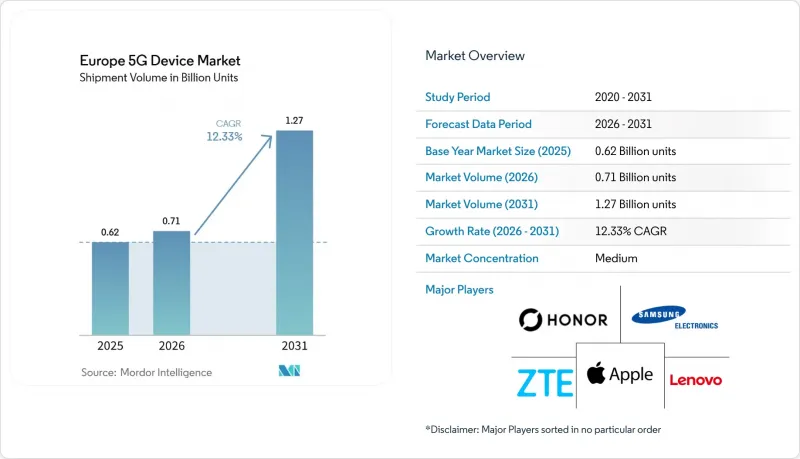
根據 Mordor Intelligence 估計,到 2025 年,歐洲 5G 設備市值將達到 6.2 億台,預計到 2026 年將達到 7.1 億台,到 2031 年將達到 12.7 億台。
預測期(2026-2031 年)的複合年成長率預計為 12.33%。
本報告外形規格(智慧型手機、用戶端設備(室內/室外)、其他)、頻譜支援(6 GHz 以下頻段、毫米波、混合頻段(6 GHz 以下頻段和毫米波))、終端用戶行業(消費電子、工業/製造業、其他)、應用(高速通訊(eMBB)、其他)及國家/地區進行細分。市場預測以出貨量(單位)為基礎。
歐洲5G設備市場的趨勢與洞察
5G獨立組網系統的部署將延長符合條件的設備的升級週期。
向獨立組網(SA)5G的轉變是歐洲5G設備市場的主要驅動力。獨立組網需要相容的終端和用戶端設備,以支援新空口語音(VoNR)、網路切片和更低的延遲。 2025年下半年,Movistar在歐洲營運商中獨立網路使用長度排名第三,獨立網路連線佔用戶5G使用時長的35.4%。截至2026年4月,僅2.8%的歐洲5G連線採用獨立網路架構,與北美32%的佔比形成鮮明對比。 《數位網路法案》旨在實現更統一的頻段許可,這可能會促進非獨立組網終端的部署和更換。此外,隨著獨立組網架構覆蓋範圍的擴大,電池效能下降也將成為消費者更換舊設備的直接原因。
在通訊網路的盲區,對固定無線存取(FWA)的需求正在取代光纖。
固定無線存取 (FWA) 的需求成長獨立於智慧型手機的更換週期。 2023 年 6 月至 2024 年 6 月期間,經合組織 (OECD) 國家的 FWA用戶增加了 17%,其中英國的增幅高達 30.4%。在歐洲,歐盟成員國已商用部署了 108 個 5G FWA 網路。每增加用戶,至少需要一台室內或室外用戶端設備 (CPE)。 「數位十年」的目標將 FWA 定位為到 2030 年為每個家庭提供至少 1 Gbps 通訊速度的手段。此外,由於無線設備和 EN 18031 網路安全法規的實施,2025 年 8 月之前生產的設備將不再適用於新的採購。
射頻前端組件供不應求限制了高階和毫米波設備的供應。
先進的獨立式和毫米波 (mmWave) 設計依賴於射頻前端組件,包括體聲波 (BAW) 和表面聲波 (SAW) 濾波器。這些先進濾波器的供應主要集中在高通、博通、村田製作所和 Skyworks 等公司。這使得歐洲組裝容易受到歐洲以外地區分配決策的影響。鎵的供應限制以及專用矽鍺鉍 (SiGeBi) CMOS 的產能限制對功率放大器、收發器和低雜訊放大器構成風險。供不應求可能會延遲旗艦設備的發布,並限制場館、園區和固定無線存取 (FWA) 的供應。對於高效能、高階和企業級無線配置而言,這種風險尤其嚴重。
細分市場分析
2025年,智慧型手機佔據了歐洲5G設備市場66.51%的佔有率,仍然是歐洲行動用戶的主要連接終端。這一地位反映了龐大的用戶群體和行動資料服務的廣泛使用。營運商的捆綁套餐正促使更多消費者轉向高階5G機型。這也使營運商能夠在用戶整個服務合約期間提供可獨立運行5G網路的設備。 2026年3月11日,三星在全球發表了Galaxy S26系列。 Galaxy S26 Ultra的預購量佔比超過70%。隨著營運商將固定無線存取(FWA)擴展到農村地區,用戶端設備的重要性日益凸顯。
預計2026年至2031年間,穿戴式裝置和XR裝置市場將以13.88%的複合年成長率成長。德國電信已在德國推出適用於Apple Watch Series 11、Apple Watch Ultra 3和Apple Watch SE 3的商用RedCap服務。 2025年9月,美國通用系統管理局(GSA)在全球範圍內確定了六款RedCap晶片組、17款模組和七款商用終端設備。華為、諾基亞、三星、TCL和中興通訊正在擴展其RedCap支援。這項技術使穿戴式裝置能夠提供介於LTE-M和5G NR之間的連接選項。工業路由器、車載資訊服務模組、支援5G的筆記型電腦、平板電腦和熱點設備透過不同的通路銷售。與智慧型手機相比,這些產品的需求受消費者更換週期的影響較小。
到2025年,Sub-6 GHz頻段的設備將佔出貨量的63.10%。這一細分市場受益於3.5 GHz頻段在歐洲市場的廣泛覆蓋。此頻段同時支援智慧型手機和固定無線存取(FWA)服務。德國電信在德國經營超過96,500個5G天線,覆蓋了98%的人口。該公司的網路充分展現了Sub-6 GHz頻段為何是新用戶的標準選擇。 EN 18031網路安全標準對連網無線設備增加了設計審查和測試工作。相較於專用產品,大規模生產的Sub-6 GHz產品線更能滿足這些要求。
毫米波 (mmWave) 設備預計到 2031 年將以 14.24% 的複合年成長率成長。需求主要來自都市區設施、體育場、企業園區和固定無線回程傳輸。在歐洲主要市場,營運商已獲得 26 GHz 頻段的許可,為Gigabit級服務提供了 400 MHz 的頻段。這為營運商部署支援毫米波的用戶終端設備和小型基地台奠定了基礎。混合終端支援在 Sub-6 GHz 和毫米波頻段運作。它們能夠適應未來網路密度,因此在高階智慧型手機和企業路由器中的應用日益廣泛。此外,3GPP 第 17 版和第 18 版 RedCap 還支援高效的工業感測器、穿戴式裝置和監視錄影機。雖然毫米波頻段目前仍主要應用於高密度場所,但這些終端正在擴大其目標市場。
其他好處:
- Excel格式的市場預測(ME)表
- 3個月的分析師支持
目錄
第1章:引言
- 研究假設和市場定義
- 調查範圍
第2章:調查方法
第3章執行摘要
第4章 市場狀況
- 市場概覽
- 市場促進因素
- 5G獨立組網的部署將延長符合條件設備的升級週期。
- 在通訊基礎設施不發達的地區,對固定無線存取的需求正在取代對光纖的需求。
- 私有 5G 園區網路正在推動企業級設備的商業採購。
- 電信業者的補貼和捆綁式設備套餐正在加速高階智慧型手機的普及。
- 相容於 RedCap 的穿戴式設備和低功耗設備正在創造對新型外形規格的需求。
- 網路安全韌性和無線設備合規性正在迫使設備更換週期加快。
- 市場限制因素
- 射頻前端元件的供不應求限制了高階和毫米波設備的供應。
- 營運商認證和現場測試方面的瓶頸正在延緩產品上市時間。
- 成熟市場更換週期放緩正在阻礙消費品銷售量的成長。
- 由於歐洲在組裝和晶片組供應方面依賴亞太地區,因此面臨成本和前置作業時間風險。
- 產業價值鏈分析
- 監理情勢
- 技術展望
- 波特五力分析
第5章 市場規模與成長預測
- 按外形規格
- 智慧型手機
- 客戶家中的設備(室內/室外)
- 工業路由器/閘道器
- 模組
- 筆記型電腦/平板電腦
- 熱點
- 穿戴式裝置和XR設備
- 頻譜支援
- Sub-6 GHz
- 毫米波
- 混合(6GHz 以下和毫米波)
- 按最終用戶行業分類
- 消費性電子產品
- 工業和製造業
- 汽車和交通運輸
- 衛生保健
- 能源與公共產業
- 企業/商業
- 透過使用
- 高速大容量通訊(eMBB)
- 超高可靠性、低延遲通訊(URLLC)
- 多路同時連接(mMTC)
- 固定無線存取
- Vehicle-to-Everything(V2X)
- 國家
- 德國
- 英國
- 法國
- 義大利
- 西班牙
- 俄羅斯
- 其他歐洲國家
第6章 競爭情勢
- 市場集中度
- 策略趨勢
- 市佔率分析
- 公司簡介
- Apple Inc.
- Samsung Electronics Co., Ltd.
- Xiaomi Corporation
- Huawei Technologies Co., Ltd.
- Oppo Mobile Telecommunications Corp. Ltd.
- OnePlus Technology Co. Ltd.
- Google LLC
- Sony Group Corporation
- Motorola Mobility LLC
- HMD Global Oy
- Lenovo Group Ltd.
- HONOR Device Co., Ltd.
- ZTE Corporation
- Cisco Systems, Inc.
- Qualcomm Incorporated
- MediaTek Inc.
- Fibocom Wireless Inc.
- Telit Cinterion SpA
- u-blox Holding AG
- Sierra Wireless, Inc.
第7章 市場機會與未來展望
According to Mordor Intelligence, the Europe 5G device market size in terms of shipment volume was valued at 0.62 billion units in 2025 and is estimated to grow from 0.71 billion units in 2026 to reach 1.27 billion units by 2031, at a CAGR of 12.33% during the forecast period (2026-2031).
This report is Segmented by Form Factor (Smartphones, Customer-Premises Equipment (Indoor/Outdoor), and More), Spectrum Support (Sub-6 GHz, Mmwave, and Hybrid (Sub-6 GHz and MmWave)), End User Industry (Consumer Electronics, Industrial and Manufacturing, and More), Application (Enhanced Mobile Broadband (eMBB), and More), and Country. The Market Forecasts are Provided in Terms of Volume (Units).
Europe 5G Device Market Trends and Insights
5G Standalone Rollout Expands the Addressable Device Upgrade Cycle
The move to standalone 5G is a key driver of the Europe 5G device market. Standalone networks require compatible handsets and customer premises equipment for Voice over New Radio, network slicing, and improved latency. Movistar ranked third among European operators for standalone time on network in late 2025, with subscribers spending 35.4% of their 5G time on standalone connections. Only 2.8% of European 5G connections used a standalone architecture in April 2026, compared with 32% in North America. The Digital Networks Act seeks more consistent spectrum licensing, which could support wider launches and replacements of non-standalone devices. Battery performance can also give consumers a direct reason to replace older devices as standalone coverage expands.
Fixed Wireless Access Demand Replaces Fiber in Coverage Gaps
Fixed wireless access creates demand that is separate from the smartphone replacement cycle. FWA subscriptions across OECD members increased 17% from June 2023 to June 2024, while the UK recorded 30.4% growth. Europe had 108 commercially launched 5G FWA networks across EU member states. Every added subscriber requires at least 1 indoor or outdoor customer premises equipment unit. The Digital Decade objective recognizes FWA as a way to provide every household with at least 1 Gbps by 2030. Radio equipment and EN 18031 cybersecurity rules also make pre-August 2025 equipment less suitable for new procurement.
RF Front End Component Shortages Constrain Premium and mmWave Device Supply
Advanced standalone and mmWave designs rely on RF front-end components, including bulk-acoustic-wave and surface-acoustic-wave filters. The advanced filter supply base is concentrated among Qualcomm, Broadcom, Murata, and Skyworks. This exposes European assemblers to allocation decisions made outside the region. Gallium controls and specialized silicon-germanium bismuth complementary metal-oxide-semiconductor capacity add risk for power amplifiers, transceivers, and low-noise amplifiers. A shortage can delay flagship devices and restrict availability for venues, campuses, and FWA. The risk is most acute in high-performance, premium, and enterprise radio configurations.
Other drivers and restraints analyzed in the detailed report include:
- Private 5G Campus Networks Pull Enterprise Grade Devices into Commercial Procurement
- Operator Subsidies and Bundled Device Plans Accelerate Premium Smartphone Penetration
- Operator Certification and Field Testing Bottlenecks Delay Time To Market
For complete list of drivers and restraints, kindly check the Table Of Contents.
Segment Analysis
Smartphones held 66.51% of Europe's 5G device market share in 2025 and remained the primary connectivity endpoint for European mobile users. Their position reflects large subscriber bases and widespread use of mobile data services. Operator bundles are directing more buyers toward premium 5G models. They also give operators a way to place standalone-capable devices with subscribers over the life of a service contract. Samsung made the Galaxy S26 series available worldwide on March 11, 2026. The Galaxy S26 Ultra accounted for more than 70% of pre-orders. Customer premises equipment is becoming more important as operators extend FWA into rural areas.
Wearables and XR devices are projected to grow at a 13.88% CAGR from 2026 to 2031. Deutsche Telekom launched commercial RedCap services in Germany for Apple Watch Series 11, Apple Watch Ultra 3, and Apple Watch SE 3. GSA identified 6 RedCap chipsets, 17 modules, and 7 commercial end-user devices globally in September 2025. Huawei, Nokia, Samsung, TCL, and ZTE were expanding RedCap support. This technology gives wearables a connection option between LTE-M and full 5G NR. Industrial routers, automotive telematics modules, 5G laptops, tablets, and hotspots are procured through separate channels. Their demand is less exposed to consumer replacement intervals than smartphone demand.
Sub-6 GHz devices accounted for 63.10% of the volume share in 2025. The segment benefits from broad 3.5 GHz coverage across European markets. This spectrum supports both smartphones and FWA services. Deutsche Telekom operated more than 96,500 5G antennas in Germany, covering 98% of the population. Its network shows why sub-6 GHz is the standard choice for new users. EN 18031 cybersecurity requirements have added design review and testing work for internet-connected radio devices. High-volume sub-6 GHz lines can absorb these requirements more easily than specialized products.
mmWave devices are projected to expand at a 14.24% CAGR through 2031. Demand comes from urban venues, stadiums, enterprise campuses, and fixed wireless backhaul. Major European markets have 26 GHz licenses that provide 400 MHz blocks for gigabit-class services. This provides operators with a foundation for mmWave customer-premises equipment and small-cell devices. Hybrid devices support both sub-6 GHz and mmWave operation. They are gaining use in premium smartphones and enterprise routers because they can support future densification. RedCap in 3GPP Releases 17 and 18 also supports efficient industrial sensors, wearables, and surveillance cameras. These devices widen the addressable base even though mmWave remains focused on dense locations.
Complete Report Scope:
- By Form Factor
- Smartphones
- Customer-Premises Equipment (Indoor/Outdoor)
- Industrial Grade Routers/Gateways
- Modules
- Laptops/Tablets
- Hotspots
- Wearables and XR Devices
- By Spectrum Support
- Sub-6 GHz
- mmWave
- Hybrid (Sub-6 GHz and mmWave)
- By End-User Industry
- Consumer Electronics
- Industrial and Manufacturing
- Automotive and Transportation
- Healthcare
- Energy and Utilities
- Enterprise/Commercial
- By Application
- Enhanced Mobile Broadband (eMBB)
- Ultra-Reliable Low-Latency Comms (URLLC)
- Massive Machine-Type Comms (mMTC)
- Fixed Wireless Access
- Vehicle-to-Everything (V2X)
- By Country
- Germany
- United Kingdom
- France
- Italy
- Spain
- Russia
- Rest of Europe
List of Companies Covered in this Report:
- Apple Inc.
- Samsung Electronics Co., Ltd.
- Xiaomi Corporation
- Huawei Technologies Co., Ltd.
- Oppo Mobile Telecommunications Corp. Ltd.
- OnePlus Technology Co. Ltd.
- Google LLC
- Sony Group Corporation
- Motorola Mobility LLC
- HMD Global Oy
- Lenovo Group Ltd.
- HONOR Device Co., Ltd.
- ZTE Corporation
- Cisco Systems, Inc.
- Qualcomm Incorporated
- MediaTek Inc.
- Fibocom Wireless Inc.
- Telit Cinterion S.p.A.
- u-blox Holding AG
- Sierra Wireless, Inc.
Additional Benefits:
- The market estimate (ME) sheet in Excel format
- 3 months of analyst support
TABLE OF CONTENTS
1 INTRODUCTION
- 1.1 Study Assumptions and Market Definition
- 1.2 Scope of the Study
2 RESEARCH METHODOLOGY
3 EXECUTIVE SUMMARY
4 MARKET LANDSCAPE
- 4.1 Market Overview
- 4.2 Market Drivers
- 4.2.1 5G Standalone Rollout Expands the Addressable Device Upgrade Cycle
- 4.2.2 Fixed Wireless Access Demand Replaces Fiber in Coverage Gaps
- 4.2.3 Private 5G Campus Networks Pull Enterprise Grade Devices into Commercial Procurement
- 4.2.4 Operator Subsidies and Bundled Device Plans Accelerate Premium Smartphone Penetration
- 4.2.5 RedCap Enabled Wearables and Low Power Devices Open New Form Factor Demand
- 4.2.6 Cyber Resilience and Radio Equipment Compliance Forces Earlier Replacement Cycles
- 4.3 Market Restraints
- 4.3.1 RF Front End Component Shortages Constrain Premium and mmWave Device Supply
- 4.3.2 Operator Certification and Field Testing Bottlenecks Delay Time To Market
- 4.3.3 Mature Market Replacement Cycles Slow Consumer Volume Growth
- 4.3.4 Dependence on the Asia-Pacific Assembly and Chipset Supply Exposes Europe to Cost and Lead Time Risk
- 4.4 Industry Value Chain Analysis
- 4.5 Regulatory Landscape
- 4.6 Technological Outlook
- 4.7 Porter's Five Forces Analysis
- 4.7.1 Bargaining Power Of Suppliers
- 4.7.2 Bargaining Power Of Buyers
- 4.7.3 Threat Of New Entrants
- 4.7.4 Threat Of Substitutes
- 4.7.5 Intensity Of Competitive Rivalry
5 MARKET SIZE AND GROWTH FORECASTS (VOLUME)
- 5.1 By Form Factor
- 5.1.1 Smartphones
- 5.1.2 Customer-Premises Equipment (Indoor/Outdoor)
- 5.1.3 Industrial Grade Routers/Gateways
- 5.1.4 Modules
- 5.1.5 Laptops/Tablets
- 5.1.6 Hotspots
- 5.1.7 Wearables and XR Devices
- 5.2 By Spectrum Support
- 5.2.1 Sub-6 GHz
- 5.2.2 mmWave
- 5.2.3 Hybrid (Sub-6 GHz and mmWave)
- 5.3 By End-User Industry
- 5.3.1 Consumer Electronics
- 5.3.2 Industrial and Manufacturing
- 5.3.3 Automotive and Transportation
- 5.3.4 Healthcare
- 5.3.5 Energy and Utilities
- 5.3.6 Enterprise/Commercial
- 5.4 By Application
- 5.4.1 Enhanced Mobile Broadband (eMBB)
- 5.4.2 Ultra-Reliable Low-Latency Comms (URLLC)
- 5.4.3 Massive Machine-Type Comms (mMTC)
- 5.4.4 Fixed Wireless Access
- 5.4.5 Vehicle-to-Everything (V2X)
- 5.5 By Country
- 5.5.1 Germany
- 5.5.2 United Kingdom
- 5.5.3 France
- 5.5.4 Italy
- 5.5.5 Spain
- 5.5.6 Russia
- 5.5.7 Rest of Europe
6 COMPETITIVE LANDSCAPE
- 6.1 Market Concentration
- 6.2 Strategic Moves
- 6.3 Market Share Analysis
- 6.4 Company Profiles (includes Global Level Overview, Market Level Overview, Core Segments, Financials as available, Strategic Information, Market Rank/Share, Products And Services, Recent Developments)
- 6.4.1 Apple Inc.
- 6.4.2 Samsung Electronics Co., Ltd.
- 6.4.3 Xiaomi Corporation
- 6.4.4 Huawei Technologies Co., Ltd.
- 6.4.5 Oppo Mobile Telecommunications Corp. Ltd.
- 6.4.6 OnePlus Technology Co. Ltd.
- 6.4.7 Google LLC
- 6.4.8 Sony Group Corporation
- 6.4.9 Motorola Mobility LLC
- 6.4.10 HMD Global Oy
- 6.4.11 Lenovo Group Ltd.
- 6.4.12 HONOR Device Co., Ltd.
- 6.4.13 ZTE Corporation
- 6.4.14 Cisco Systems, Inc.
- 6.4.15 Qualcomm Incorporated
- 6.4.16 MediaTek Inc.
- 6.4.17 Fibocom Wireless Inc.
- 6.4.18 Telit Cinterion S.p.A.
- 6.4.19 u-blox Holding AG
- 6.4.20 Sierra Wireless, Inc.
7 MARKET OPPORTUNITIES AND FUTURE OUTLOOK
- 7.1 White-Space and Unmet-Need Assessment

 5G設備市場規模、佔有率和成長分析:按設備類型、頻段、應用、最終用戶、分銷管道和地區分類-2026-2033年產業預測
 5G設備:市場佔有率分析、產業趨勢與統計、成長預測(2026-2031年)
 5G設備、智慧型手機和穿戴式裝置研究服務亞太地區5G設備:市佔率分析、產業趨勢與統計及成長預測(2026-2031年)北美5G設備:市佔率分析、產業趨勢與統計及成長預測(2026-2031年)南美洲5G設備:市佔率分析、產業趨勢與統計及成長預測(2026-2031年)
 2026-2030年全球5G設備市場
 2026年超低成本(ULC)行動電話全球市場報告5G-Advanced 行動裝置、穿戴式裝置和配件5G行動裝置、功能與技術:供應商、趨勢與預測