


 |
市場調查報告書
商品編碼
2118193
歐洲小麥種子加工:市場佔有率分析、行業趨勢和統計數據、成長預測(2026-2031 年)Europe Wheat Seed Treatment - Market Share Analysis, Industry Trends & Statistics, Growth Forecasts (2026 - 2031) |
||||||

※ 本網頁內容可能與最新版本有所差異。詳細情況請與我們聯繫。
根據 Mordor Intelligence 預測,歐洲小麥種子處理市場規模將從 2025 年的 153 萬美元成長到 2026 年的 159 萬美元,到 2031 年將達到 195 萬美元,2026 年至 2031 年的複合年成長率為 4.14%。
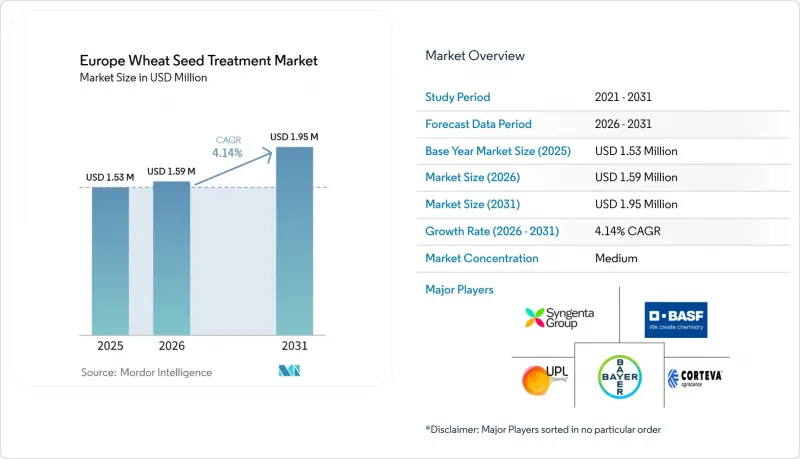
本報告按產品類型(殺蟲劑、殺菌劑、殺線蟲劑等)和地區(德國、英國、法國、義大利、西班牙、俄羅斯及其他歐洲國家)進行細分。市場預測以美元計價。
歐洲小麥種子加工市場的趨勢與洞察
小麥真菌病害威脅日益加劇
在歐洲小麥種子處理劑市場,由於僅靠標準的葉面噴布方案不足以應對真菌病害的威脅,市場需求仍然強勁。一項發表於2025年的研究表明,2024年溫暖潮濕的冬季促進了冬小麥病害的早期發生,導致種植者在播種時重新評估病害防治需求。另一項發表於2025年的研究報告稱,已在歐洲多個地區發現了克服抗性的稈銹病菌株,這進一步強調了在作物出苗前使用強效殺菌劑進行防治的重要性。這一點至關重要,因為種子處理有助於在生長季施藥時機變得關鍵之前抑制種子和土壤傳播的疾病。此外,種植者對覆蓋範圍更廣、多成分的組合藥物的需求也在不斷成長,他們認為這類製劑在病害壓力波動較大的年份更為可靠。
監理政策轉向限制高風險活性成分
歐洲小麥種子處理劑市場受監管驅動,但同樣的監管流程也對現有產品造成了短期衝擊。近期最顯著的例子是,氟啶蟲醯胺於2024年11月被列為內分泌干擾物。這給穀物種子處理劑產品組合帶來了巨大影響,並凸顯了在2026年9月其批准到期前尋找替代品的必要性。 2024年,瓦赫寧根大學研究所指出,核准成本是影響低風險新物質投資決策的重要因素。這意味著大型供應商比小規模新參與企業更容易重新設計配方。這種壓力正在縮小傳統化學品的市場空間,同時提升符合法規要求的替代品的商業性價值。因此,供應商正轉向投資更多資金、採用風險較低的活性成分且市場期限更長的新型包衣系統。
遵守歐盟重新接收和保留標準的負擔。
歐洲小麥種子處理劑市場持續面臨許多限制因素,包括產品重新核准所需的時間和成本。氟啶蟲醯胺的核准決定表明,單一的監管變更可能同時影響多種穀物種子處理劑,這可能會減少生產者短期內可選擇的替代方案。瓦赫寧根大學研究所的一項研究發現,準備申請文件的成本仍然是新型低風險產品面臨的最大障礙之一,這對小規模研發公司而言尤其沉重。即使在農業需求強勁的情況下,這也減緩了產品系列的更新速度。此外,這也進一步強化了大型公司的優勢,因為它們可以將合規成本分攤到眾多產品上。
細分市場分析
殺蟲劑是歐洲小麥種子處理市場中最大的產品類型,預計到2025年將佔50.4%的市場佔有率。歐洲小麥種子處理產業的這一領域仍沿用著長期以來針對土壤害蟲和病毒攜帶昆蟲的商業慣例,主要在種子萌發前進行防治。生產商仍然優先考慮種子階段的防治,因為這樣可以精確控制施藥時間,並保護幼苗早期生長。儘管一些傳統化學品的監管措施並未降低市場需求,反而促使買家轉向更高價值的替代產品。
殺菌劑是歐洲小麥種子處理市場成長最快的產品類型,預計到2031年將以4.7%的年成長率成長。其主要原因是鐮刀菌枯萎病、銹病、黑穗病及相關病害在主要小麥產區日益嚴重的威脅。對氟啶蟲醯胺的重新評估促使配方重新設計變得更加緊迫,促使供應商轉向新的多成分配方和低風險方案。因此,歐洲小麥種子處理產業的這一領域不僅得益於處理面積的擴大,也得益於產品組合的變化。
其他好處:
- Excel格式的市場預測(ME)表
- 3個月的分析師支持
目錄
第1章:引言
- 研究假設和市場定義
- 調查範圍
第2章:調查方法
第3章執行摘要
第4章 市場狀況
- 市場概覽
- 市場促進因素
- 小麥真菌病害風險增加
- 高風險化學活性物質的監管轉變
- 與碳相關的農業獎勵,旨在透過減少投入材料來保護作物。
- 在精準播種和變數施肥中使用種子處理劑
- 小麥種植面積增加
- 種子披衣冷鏈和保存期限的進展
- 市場限制因素
- 遵守歐盟重新驗收和保留標準的負擔
- 先進加工配方和塗層生產線的成本不斷上漲
- 其在不同氣候條件下的有效性可重複性有限。
- 英國脫歐後核准分權
- 監理情勢
- 技術展望
- 波特五力分析
第5章 市場規模與成長預測
- 依產品類型
- 殺蟲劑
- 消毒劑
- 尼馬奇賽德
- 其他類型
- 歐洲
- 德國
- 英國
- 法國
- 義大利
- 西班牙
- 俄羅斯
- 其他歐洲國家
第6章 競爭情勢
- 市場集中度
- 策略趨勢
- 市佔率分析
- 公司簡介
- Bayer AG
- Corteva Agriscience
- Syngenta Group
- UPL Limited
- Sumitomo Chemical Co., Ltd.
- BASF SE
- Albaugh LLC
- FMC Corporation
- Incotec Group BV
- Croda International Plc
- Koppert BV
- Nufarm Limited
- PI Industries Ltd.
- Rovensa Group
- Sipcam Oxon SpA
第7章 市場機會與未來展望
According to Mordor Intelligence, the Europe wheat seed treatment market size is projected to grow from USD 1.53 million in 2025 to USD 1.59 million in 2026 and is forecast to reach USD 1.95 million by 2031 at 4.14% CAGR over 2026-2031.
This report is Segmented by Product Type (Insecticides, Fungicides, Nematicides, and More), and by Geography (Germany, United Kingdom, France, Italy, Spain, Russia, and Rest of Europe). The Market Forecasts are Provided in Terms of Value (USD).
Europe Wheat Seed Treatment Market Trends and Insights
Rising Wheat Fungal Disease Pressure
The Europe wheat seed treatment market is seeing firmer demand because fungal pressure has become harder to manage with standard foliar programs alone. Research published in 2025 showed that warm and moist winter conditions in the 2024 season supported early disease development in winter wheat and changed how growers assessed protection needs at sowing. A second 2025 study also reported resistance-breaking stem rust races across multiple European locations, which raised the value of stronger fungicidal protection before crop emergence. This matters because seed treatment helps limit seed-borne and soil-borne infection before in-season spray timing becomes critical. It also supports demand for broader, multi-active combinations that growers view as more dependable in years with unstable disease pressure.
Regulatory Shift Away From High-Risk Chemical Actives
The Europe wheat seed treatment market is also being pushed forward by regulation, even though the same process creates short-term disruption for existing products. The most important recent example is the November 2024 classification of fludioxonil as an endocrine disruptor, which affected a very large share of cereal seed treatment portfolios and brought attention to replacement needs ahead of the September 2026 approval expiry. Wageningen University and Research showed in 2024 that approval costs carry a heavy weight in investment decisions for new low-risk substances, which means reformulation is easier for large suppliers than for smaller entrants. That pressure is reducing room for older chemistry while raising the commercial value of compliant alternatives. As a result, suppliers are shifting more capital, lower-risk actives, and new coating systems that can stay on the market longer.
Tight EU Re-Approval and Residue Compliance Burden
The Europe wheat seed treatment market still faces a major drag from the time and cost of product re-approval. The fludioxonil decision showed how one regulatory change can affect many cereal seed treatments at the same time and leave growers with fewer short-term substitutes. Wageningen University and Research also found that dossier costs remain one of the largest barriers for new low-risk products, which weighs most heavily on smaller developers. This slows portfolio renewal even when agronomic demand is strong. It also reinforces the advantage of large companies that can spread compliance cost across broader product ranges.
Other drivers and restraints analyzed in the detailed report include:
- Carbon-Linked Agronomy Incentives for Lower-Input Crop Protection
- Seed Treatment Use in Precision Seeding and Variable-Rate Farming
- Higher Cost of Advanced Treatment Formulations and Application Lines
For complete list of drivers and restraints, kindly check the Table Of Contents.
Segment Analysis
Insecticides were the largest product type in the Europe wheat seed treatment market share, with 50.4% share in 2025. This part of the Europe wheat seed treatment industry remains rooted in long-established commercial routines that target soil insects and virus-carrying pests before emergence. Growers continue to value seed-stage control because it offers a clear application window and protects early stand establishment. Restrictions on some legacy chemistries have not reduced demand, as they have shifted buyers toward higher-value replacement products.
Fungicides are the fastest product type in the Europe wheat seed treatment market size and are projected to grow at 4.7% through 2031. The main reason is the heavier pressure from Fusarium, rust, smut, and related diseases across important wheat belts. The fludioxonil review has added urgency to reformulation work, which is pushing suppliers toward new multi-active combinations and lower-risk options. This part of the Europe wheat seed treatment industry is therefore growing through value mix change as much as through area treated.
Complete Report Scope:
- By Product Type
- Insecticides
- Fungicides
- Nematicides
- Other Types
- Europe
- Germany
- United Kingdom
- France
- Italy
- Spain
- Russia
- Rest of Europe
List of Companies Covered in this Report:
- Bayer AG
- Corteva Agriscience
- Syngenta Group
- UPL Limited
- Sumitomo Chemical Co., Ltd.
- BASF SE
- Albaugh LLC
- FMC Corporation
- Incotec Group B.V.
- Croda International Plc
- Koppert B.V.
- Nufarm Limited
- PI Industries Ltd.
- Rovensa Group
- Sipcam Oxon S.p.A.
Additional Benefits:
- The market estimate (ME) sheet in Excel format
- 3 months of analyst support
TABLE OF CONTENTS
1 Introduction
- 1.1 Study Assumptions and Market Definition
- 1.2 Scope of the Study
2 Research Methodology
3 Executive Summary
4 Market Landscape
- 4.1 Market Overview
- 4.2 Market Drivers
- 4.2.1 Rising wheat fungal disease pressure
- 4.2.2 Regulatory shift away from high-risk chemical actives
- 4.2.3 Carbon-linked agronomy incentives for lower-input crop protection
- 4.2.4 Seed treatment use in precision seeding and variable-rate farming
- 4.2.5 Increase in area under cultivation of wheat
- 4.2.6 Cold-chain and shelf-life advances in seed coatings
- 4.3 Market Restraints
- 4.3.1 Tight EU re-approval and residue compliance burden
- 4.3.2 Higher cost of advanced treatment formulations and application lines
- 4.3.3 Limited efficacy consistency across variable climates
- 4.3.4 Brexit-linked approval fragmentation
- 4.4 Regulatory Landscape
- 4.5 Technological Outlook
- 4.6 Porter's Five Forces Analysis
- 4.6.1 Bargaining Power of Suppliers
- 4.6.2 Bargaining Power of Buyers
- 4.6.3 Threat of New Entrants
- 4.6.4 Threat of Substitutes
- 4.6.5 Intensity of Competitive Rivalry
5 Market Size and Growth Forecasts (Value)
- 5.1 By Product Type
- 5.1.1 Insecticides
- 5.1.2 Fungicides
- 5.1.3 Nematicides
- 5.1.4 Other Types
- 5.2 Europe
- 5.2.1 Germany
- 5.2.2 United Kingdom
- 5.2.3 France
- 5.2.4 Italy
- 5.2.5 Spain
- 5.2.6 Russia
- 5.2.7 Rest of Europe
6 Competitive Landscape
- 6.1 Market Concentration
- 6.2 Strategic Moves
- 6.3 Market Share Analysis
- 6.4 Company Profiles (Includes Global Level Overview, Market Level Overview, Core Segments, Financials as Available, Strategic Information, Market Rank/Share for Key Companies, Products and Services, and Recent Developments)
- 6.4.1 Bayer AG
- 6.4.2 Corteva Agriscience
- 6.4.3 Syngenta Group
- 6.4.4 UPL Limited
- 6.4.5 Sumitomo Chemical Co., Ltd.
- 6.4.6 BASF SE
- 6.4.7 Albaugh LLC
- 6.4.8 FMC Corporation
- 6.4.9 Incotec Group B.V.
- 6.4.10 Croda International Plc
- 6.4.11 Koppert B.V.
- 6.4.12 Nufarm Limited
- 6.4.13 PI Industries Ltd.
- 6.4.14 Rovensa Group
- 6.4.15 Sipcam Oxon S.p.A.
7 Market Opportunities and Future Outlook

 種子加工市場報告:趨勢、預測與競爭分析(至2035年)
 北美小麥種子加工:市場佔有率分析、產業趨勢與統計、成長預測(2026-2031 年)
 種子處理市場:2026-2032年全球市場預測(依產品類型、作物類型、配方類型、處理包裝、認證、應用環境、最終用戶和分銷管道分類)印度種子加工:市場佔有率分析、產業趨勢與統計、成長預測(2026-2031)
 種子加工市場:按類型、作物和地區分類
 再生種子處理市場預測至2034年-按產品類型、作物類型、功能、配方、最終用戶、分銷管道和地區分類的全球分析大豆殺菌劑種子處理:市場佔有率分析、產業趨勢與統計、成長預測(2026-2031)美國種子加工:市場佔有率分析、行業趨勢和統計數據、成長預測(2026-2031 年)
 種子處理市場規模、佔有率、趨勢和預測:按類型、應用方法、作物類型、功能和地區分類,2026-2034年
 2026年全球種子處理市場報告