


 |
市場調查報告書
商品編碼
2113587
北美小麥種子加工:市場佔有率分析、產業趨勢與統計、成長預測(2026-2031 年)North America Wheat Seed Treatment - Market Share Analysis, Industry Trends & Statistics, Growth Forecasts (2026 - 2031) |
||||||

※ 本網頁內容可能與最新版本有所差異。詳細情況請與我們聯繫。
據 Mordor Intelligence 稱,北美小麥種子處理市場預計到 2026 年價值 4.6725 億美元,高於 2025 年的 4.374 億美元,預計到 2031 年將達到 6.4876 億美元。
預計從 2026 年到 2031 年,其複合年成長率將達到 6.82%。
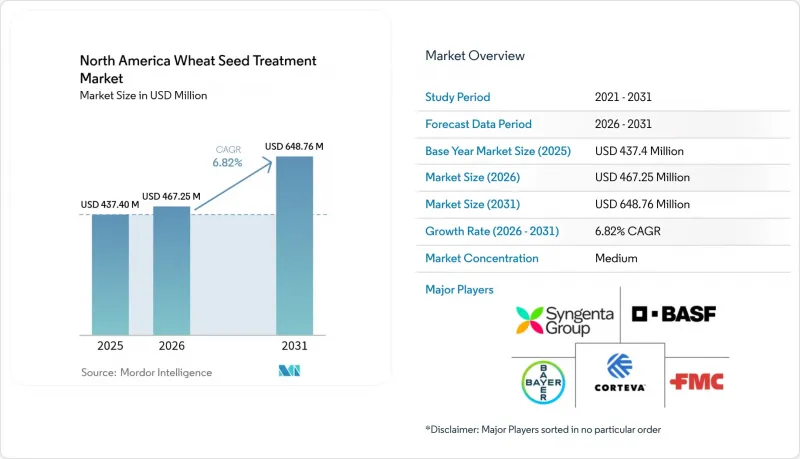
本報告按產品類型(殺蟲劑、殺菌劑、殺線蟲劑等)、劑型(液體、懸浮劑/濃縮液、乾粉等)、應用領域(商業和農業層面)以及地區(美國、加拿大、墨西哥等)進行細分。市場預測以美元(USD)計價。
北美小麥種子加工市場趨勢與洞察
加強土壤和葉面噴布。
在北美小麥種子處理市場,由於授粉昆蟲保護措施的施藥週期縮短以及燃料成本上漲,全田噴灑的實用性正在下降。種子處理產品提供了一種替代方案,由於活性成分留在播種溝內,避免了藥劑漂移和再次進入限制等問題。北達科他州的一項試驗表明,一次種子處理即可達到兩次葉面噴布相同的防治效果,同時也能降低40%的人事費用和燃料成本。參與保護性耕作計畫的種植者往往會避免使用顆粒狀土壤殺蟲劑所帶來的多次犁地,這推動了對種子處理產品的需求。此外,美國72%的小麥面積都參與了保護性耕作項目,進一步提升了種子處理的經濟效益。
小麥產區病蟲害壓力日益增加
預計到2024年,條銹病、黃斑病和鐮刀菌枯萎病將造成18億美元的作物損失,農民為減輕這些毀滅性損失而努力,對殺菌劑的需求也顯著增加。氣候變遷導致冬季氣溫升高,使得黑森麥稈蠅和麥葉蜂等害蟲能夠在以往過於寒冷的地區生存,從而增加了對殺蟲劑的依賴,以保護小麥作物。在墨西哥,作為一項麥稈疫病監測計畫的一部分,州際運輸中必須使用經過處理的種子,這有效地將原本的自願措施轉變為一項法律強制措施,涵蓋範圍積達492,404公頃。這項監管措施旨在遏止麥稈疫病的蔓延,保護小麥生產。
生產者對最佳噴灑劑量缺乏認知。
堪薩斯州立大學(K-State)的一項研究表明,在堪薩斯州和奧克拉荷馬州進行的一項調查顯示,42%的農場噴灑作業中,種子處理劑的使用量存在不足或過量的情況,導致藥效降低,甚至在某些情況下造成植物毒害。同樣,由於農業推廣服務集中在灌溉區,墨西哥的負責人小規模面臨知識匱乏的問題。種子處理劑使用不當會導致過量活性成分滲入地下水,這可能引發更嚴格的監管和產品標籤限制。儘管墨西哥國家農業食品安全局(SENASICA)基於NOM-022標準的培訓計畫旨在提高噴灑標準,但目前全國範圍內只有不到200家獲得認證的培訓機構,難以滿足需求。
細分市場分析
2025年,殺菌劑在北美小麥種子處理市場銷售額中佔比將達到45.60%。這主要歸功於種植者應對條鏽病、黃斑病和鐮刀菌枯萎病等病害的挑戰,這三種病害造成的作物損失總合18億美元。甲氧基丙烯酸酯類和琥珀酸脫氫酶抑制劑的組合可在4-6週的幼苗生長期內提供系統性保護,從而推動了其高普及率。隨著噻菌靈的逐步淘汰,種植者轉而使用高品質的唑菌靈和氟啶蟲醯胺混合物,導致平均每英畝支出增加至5.20美元,並促成了該細分市場規模的持續成長。
殺蟲劑是成長最快的類別,預計到2031年將以7.85%的複合年成長率成長。這主要是由於隨著冬季氣溫升高,黑森麥稈蠅和麥稈蜂等害蟲的分佈範圍不斷擴大。在一些地區,人們對新菸鹼類殺蟲劑的出口仍然十分擔憂,因此Chlorantraniliprole等替代品正受到越來越多的關注。預計到本世紀末,這種策略轉變將擴大北美小麥種子處理市場中殺蟲劑的佔有率。然而,由於單獨使用時效果不穩定,殺線蟲劑仍只佔據小眾市場。
其他好處:
- Excel格式的市場預測(ME)表
- 3個月的分析師支持
目錄
第1章:引言
- 研究假設和市場定義
- 調查範圍
第2章:調查方法
第3章執行摘要
第4章 市場動態
- 市場概覽
- 市場促進因素
- 加強對土壤和葉片施用農藥的監管
- 小麥產區病蟲害威脅日益加劇。
- 對經過認證的種子品質和統一的幼苗培育的需求日益成長。
- 美國和加拿大對重新進入間隔期的更嚴格規定鼓勵了種子處理。
- 利用區塊鏈技術實現加工種子優質穀物的可追溯性
- 受氣候因素影響,北部平原地區冬小麥種植面積擴大
- 市場限制因素
- 生產者對最佳噴灑量了解不足。
- 具有多種抗蟲性狀的小麥雜交品種迅速傳播。
- 零售商施壓要求減少價值鏈認證小麥中的化學殘留
- 由於環保署分階段減少硫胺素的使用,導致活性成分供不應求。
- 監理情勢
- 技術展望
- 波特五力分析
第5章 市場規模與成長預測
- 依產品類型
- 殺蟲劑
- 消毒劑
- 尼馬奇賽德
- 其他產品類型
- 依配方類型
- 流體
- 用於懸浮液的懸浮液溶液
- 乾粉
- 聚合物薄膜塗層
- 透過使用
- 商業
- 農場級別
- 按地區
- 美國
- 加拿大
- 墨西哥
- 其他北美國家
第6章 競爭情勢
- 市場集中度
- 策略趨勢
- 市佔率分析
- 公司簡介
- Bayer AG
- Syngenta Group
- Corteva Agriscience
- BASF SE
- UPL Limited
- Sumitomo Chemical Co. Ltd
- Nufarm Limited
- Albaugh, LLC
- FMC Corporation
- Helena Agri-Enterprises, LLC(Marubeni America Corporation)
- Wilbur-Ellis Company LLC
- Nutrien Ltd.
- Vive Crop Protection, Inc.
- Meristem Crop Performance Group, LLC
第7章 市場機會與未來展望
According to Mordor Intelligence, North America wheat seed treatment market size in 2026 is estimated at USD 467.25 million, growing from 2025 value of USD 437.4 million with 2031 projections showing USD 648.76 million, growing at 6.82% CAGR over 2026-2031.
This report is Segmented by Product Type (Insecticides, Fungicides, Nematicides, and More), by Formulation Type (Liquid Flowable, Suspension Concentrate, Dry Powder, and More), by Application (Commercial, and Farm Level), and by Geography (United States, Canada, Mexico, and More). The Market Forecasts are Provided in Terms of Value (USD).
North America Wheat Seed Treatment Market Trends and Insights
Rising Limitations of Soil and Foliar Pesticide Applications
In the North America wheat seed treatment market, tighter pollinator-protection windows and rising fuel costs have reduced the practicality of broadcast sprays . Seed-applied products offer an alternative by avoiding issues such as drift and re-entry restrictions, as the active ingredient remains confined within the furrow. Trials conducted in North Dakota demonstrated that a single seed treatment can achieve the same efficacy as two foliar sprays, while reducing labor and fuel costs by 40% . Growers participating in conservation programs are moving away from multiple tillage passes associated with granular soil insecticides, increasing the demand for seed treatments. With 72% of wheat acres in the United States under conservation compliance, the economic benefits of seed treatments are further reinforced.
Escalating Insect and Pest Pressure in Wheat-Growing Belts
Stripe rust, tan spot, and Fusarium head blight caused USD 1.8 billion in crop losses in 2024, significantly driving the demand for fungicides as farmers seek to mitigate these substantial losses . Warmer winters, attributed to changing climatic conditions, now enable pests such as Hessian fly and wheat stem sawfly to survive in regions that were previously too cold, resulting in increased reliance on insecticides to protect wheat crops. In Mexico, the Karnal bunt surveillance program has introduced a requirement for treated seed in interstate movement, effectively transforming what was once a voluntary practice into a legally enforced mandate across 492,404 hectares. This regulatory shift aims to contain the spread of Karnal bunt and safeguard wheat production.
Limited Grower Awareness of Optimal Application Rates
Surveys conducted in Kansas and Oklahoma indicate that 42% of farm-level applicators either underdose or overapply seed treatments, reducing their effectiveness and, in some cases, causing phytotoxicity, according to the Kansas State University (K-State). Similarly, smallholders in Mexico encounter knowledge gaps, as extension services are concentrated in irrigated regions. Misapplication of seed treatments can result in excess active ingredients leaching into groundwater, leading to increased regulatory scrutiny and potential restrictions on product labels. Training programs under SENASICA's NOM-022 aim to improve application standards; however, there are fewer than 200 certified providers currently available to meet national demand.
Other drivers and restraints analyzed in the detailed report include:
- Growing Demand for Certified Seed Quality and Uniform Stands
- Blockchain-Enabled Grain Traceability Premiums for Treated Seed
- Retailer Pressure for Lower Chemical Residues in Value-Chain Certified Wheat
For complete list of drivers and restraints, kindly check the Table Of Contents.
Segment Analysis
Fungicides accounted for 45.60% of the North America wheat seed treatment market revenue in 2025, as growers addressed challenges from stripe rust, tan spot, and Fusarium head blight, which collectively resulted in USD 1.8 billion in crop losses. Strobilurin and succinate dehydrogenase inhibitor combinations provided systemic protection for four to six weeks of seedling growth, driving high adoption rates. Following the phase-down of thiram, growers transitioned to premium sedaxane and fludioxonil blends, increasing the average per-acre expenditure to USD 5.20 and contributing to the current market size for this segment.
Insecticides represent the fastest-growing category, with a projected CAGR of 7.85% through 2031, driven by warmer winters that are expanding the range of pests such as the Hessian fly and wheat stem sawfly. Alternatives like chlorantraniliprole are gaining traction in regions where concerns over neonicotinoid exports persist, highlighting a strategic shift projected to expand the insecticide segment of the North America wheat seed treatment market by the end of the decade. Nematicides continue to play a niche role due to their inconsistent standalone efficacy.
Complete Report Scope:
- By Product Type
- Insecticides
- Fungicides
- Nematicides
- Other Product Types
- By Formulation Type
- Liquid Flowable
- Suspension Concentrate
- Dry Powder
- Polymer Film-Coat
- By Application
- Commercial
- Farm Level
- By Geography
- United States
- Canada
- Mexico
- Rest of North America
List of Companies Covered in this Report:
- Bayer AG
- Syngenta Group
- Corteva Agriscience
- BASF SE
- UPL Limited
- Sumitomo Chemical Co. Ltd
- Nufarm Limited
- Albaugh, LLC
- FMC Corporation
- Helena Agri-Enterprises, LLC (Marubeni America Corporation)
- Wilbur-Ellis Company LLC
- Nutrien Ltd.
- Vive Crop Protection, Inc.
- Meristem Crop Performance Group, LLC
Additional Benefits:
- The market estimate (ME) sheet in Excel format
- 3 months of analyst support
TABLE OF CONTENTS
1 Introduction
- 1.1 Study Assumptions and Market Definition
- 1.2 Scope of the Study
2 Research Methodology
3 Executive Summary
4 Market Dynamics
- 4.1 Market Overview
- 4.2 Market Drivers
- 4.2.1 Rising limitations of soil and foliar pesticide applications
- 4.2.2 Escalating insect and pest pressure in wheat-growing belts
- 4.2.3 Growing demand for certified seed quality and uniform stands
- 4.2.4 Stricter United States and Canadian re-entry interval rules favoring seed treatment
- 4.2.5 Blockchain-enabled grain traceability premiums for treated seed
- 4.2.6 Climate-driven expansion of winter-wheat acres in the Northern Plains
- 4.3 Market Restraints
- 4.3.1 Limited grower awareness of optimal application rates
- 4.3.2 Rapid adoption of wheat hybrids with stacked pest-resistant traits
- 4.3.3 Retailer pressure for lower chemical residues in value-chain certified wheat
- 4.3.4 Active-ingredient shortages following the Environmental Protection Agency phase-down of thiram
- 4.4 Regulatory Landscape
- 4.5 Technological Outlook
- 4.6 Porter's Five Forces Analysis
- 4.6.1 Threat of New Entrants
- 4.6.2 Bargaining Power of Consumers
- 4.6.3 Bargaining Power of Suppliers
- 4.6.4 Threat of Substitute Products
- 4.6.5 Intensity of Competitive Rivalry
5 Market Size and Growth Forecasts (Value)
- 5.1 By Product Type
- 5.1.1 Insecticides
- 5.1.2 Fungicides
- 5.1.3 Nematicides
- 5.1.4 Other Product Types
- 5.2 By Formulation Type
- 5.2.1 Liquid Flowable
- 5.2.2 Suspension Concentrate
- 5.2.3 Dry Powder
- 5.2.4 Polymer Film-Coat
- 5.3 By Application
- 5.3.1 Commercial
- 5.3.2 Farm Level
- 5.4 By Geography
- 5.4.1 United States
- 5.4.2 Canada
- 5.4.3 Mexico
- 5.4.4 Rest of North America
6 Competitive Landscape
- 6.1 Market Concentration
- 6.2 Strategic Moves
- 6.3 Market Share Analysis
- 6.4 Company Profiles (Includes Global Level Overview, Market Level Overview, Core Segments, Financials as Available, Strategic Information, Market Rank/Share for Key Companies, Products and Services, and Recent Developments)
- 6.4.1 Bayer AG
- 6.4.2 Syngenta Group
- 6.4.3 Corteva Agriscience
- 6.4.4 BASF SE
- 6.4.5 UPL Limited
- 6.4.6 Sumitomo Chemical Co. Ltd
- 6.4.7 Nufarm Limited
- 6.4.8 Albaugh, LLC
- 6.4.9 FMC Corporation
- 6.4.10 Helena Agri-Enterprises, LLC (Marubeni America Corporation)
- 6.4.11 Wilbur-Ellis Company LLC
- 6.4.12 Nutrien Ltd.
- 6.4.13 Vive Crop Protection, Inc.
- 6.4.14 Meristem Crop Performance Group, LLC
7 Market Opportunities and Future Outlook

 歐洲小麥種子加工:市場佔有率分析、行業趨勢和統計數據、成長預測(2026-2031 年)
 種子加工市場報告:趨勢、預測與競爭分析(至2035年)
 種子處理市場:2026-2032年全球市場預測(依產品類型、作物類型、配方類型、處理包裝、認證、應用環境、最終用戶和分銷管道分類)印度種子加工:市場佔有率分析、產業趨勢與統計、成長預測(2026-2031)
 種子加工市場:按類型、作物和地區分類
 再生種子處理市場預測至2034年-按產品類型、作物類型、功能、配方、最終用戶、分銷管道和地區分類的全球分析大豆殺菌劑種子處理:市場佔有率分析、產業趨勢與統計、成長預測(2026-2031)美國種子加工:市場佔有率分析、行業趨勢和統計數據、成長預測(2026-2031 年)
 種子處理市場規模、佔有率、趨勢和預測:按類型、應用方法、作物類型、功能和地區分類,2026-2034年
 2026年全球種子處理市場報告