


 |
市場調查報告書
商品編碼
2118174
手性消旋化抑制劑:市佔率分析、產業趨勢與統計及成長預測(2026-2031)Chiral Racemization Inhibitors - Market Share Analysis, Industry Trends & Statistics, Growth Forecasts (2026 - 2031) |
||||||

※ 本網頁內容可能與最新版本有所差異。詳細情況請與我們聯繫。
根據 Mordor Intelligence 預測,手性消旋抑制劑的市場規模預計將從 2025 年的 4.2012 億美元成長到 2026 年的 4.5118 億美元,到 2031 年達到 6.5165 億美元,2026 年至 2031 年的複合年成長率為 7.63%。
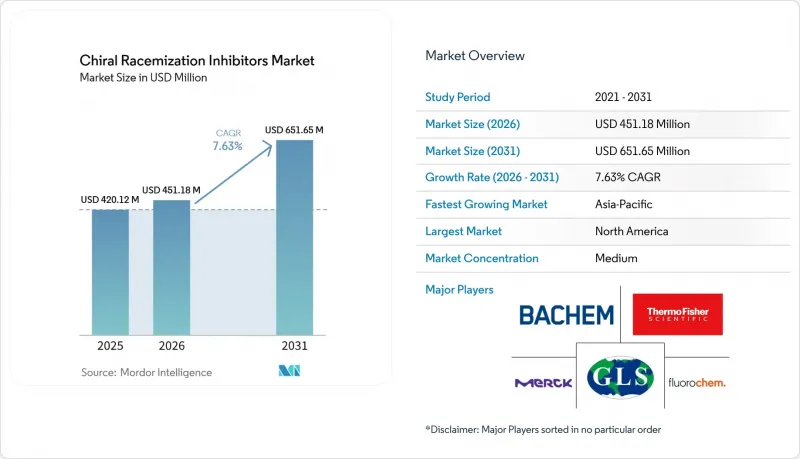
本報告按產品類型(肟類抑制劑、HOBT等)、劑型(粉劑、溶液劑及其他)、應用領域(胜肽合成、活性藥物原料藥(API)合成、生物結合等)和地區(亞太地區、北美地區、歐洲地區、南美地區、中東和非洲地區)進行細分。市場預測以美元(USD)為單位。
全球手性消旋抑制劑市場趨勢及洞察
在藥物原料藥(API)的合成中,對高純度掌性化合物的需求不斷成長。
由於對藥物原料藥(API) 生產中掌性雜質的控制需求日益成長,手性消旋抑制劑市場正獲得穩定成長。 FDA 指南與 ICH 對原料藥 的要求一致,要求企業在整個合成過程中識別並管理可能影響產品品質的立體化學風險。這使得消旋抑制劑成為許多受監管的胜肽和 API 工作流程中的標準成本項目,而不僅僅是用於研究的選項。隨著胜肽鍊長度的增加,這個負擔進一步加重,因為每增加一個胺基酸,就需要控制一個額外的消旋點。這種商業性影響在手性消旋抑制劑市場尤其顯著,因為合成複雜性的增加可能導致需求成長速度超過正在進行的研發項目數量。 ICH Q11 的合規性鞏固了主要監管地區生產實務中的這項要求。
胜肽類藥物(主要是 GLP-1 受體促效劑)的應用日益廣泛。
手性消旋化抑制劑市場也受益於胜肽類藥物(尤其是Glucagon-Like Peptide-1(GLP-1) 受體促效劑)領域的活躍商業化和研發活動。大規模肽類生產並非僅取決於反應器容量;純度控制在每個放大階段都至關重要。檢驗的抑制劑系統有助於降低複雜胜肽合成中重複偶聯循環過程中可能累積的消旋化風險。隨著胜肽類生產領域的科學研究和商業性活動不斷擴展,服務於該領域的供應商正在擴大其認證試劑組合,以滿足研發和臨床需求。 Bachem 報告稱,2025 會計年度臨床開發相關銷售額(以該地貨幣計算)成長了 29.7%,這印證了以下觀點:處於研發階段的胜肽類研究將繼續支撐手性消旋化抑制劑市場的未來需求。
特殊掌性試劑高成本
在成本敏感的生產環境中,手性消旋化抑制劑市場面臨價格障礙。高純度 OxymaPure 及相關新一代產品的價格高於更簡單的偶聯原料,這使得小規模CDMO 的合格和庫存規劃更加困難。 Iris Biotech 以研究規模的價格提供 OxymaPure,這清楚地表明了這種高價策略。大規模原料藥生產商更容易將這部分額外成本納入合規和批次放行保障的考量。而小規模的區域性生產商則往往需要在成本和客戶預算之間權衡,這減緩了產品在監管最嚴格的市場之外的廣泛應用。因此,手性消旋化抑制劑市場在純度風險具有顯著商業性影響且終端用戶能夠證明高價試劑經濟效益的地區成長最為迅速。
細分市場分析
到2025年,肟類抑制劑將佔產品類型組成的34.52%,預計到2031年,手性消旋化抑制劑市場的這一細分領域將以8.41%的複合年成長率成長。其市場佔有率體現了安全性、易操作性和在受監管的合成環境中的性能之間的完美平衡。 Iris Biotech GmbH公司將「OxymaPure」定位為已停產的HOBt和1-羥基-7-氮雜苯並三唑(HOAt)配方的直接替代品。該產品在降低差向異構化的同時,避免了與這些化合物相關的爆炸性分類負擔。這種定位在手性消旋化抑制劑行業至關重要,因為採購部門不僅考慮反應效率,還考慮運輸成本、工人安全和工廠認證要求。最終,該產品組合適用於研發和生產規模,並避免了傳統苯並三唑添加劑帶來的物流障礙。
HOBt 仍用於溶液相合成和碳二亞胺介導的工作流程。在這些領域,成熟的方法、現有的驗證以及價格敏感度仍然是繼續使用傳統系統的理由。 HOAt、HONB 和 HOSu 則繼續用於一些應用範圍較窄的場合,例如需要特定活化行為或 pKa 特性的難處理殘基。美國化學會 (ACS) 綠色化學研究所的藥物圓桌會議正在推動這一轉變,他們認為 OxymaPure 衍生的試劑是胜肽合成中更環保的選擇。 Bachem AG 也將 COMU 和 PyOxim 定位為更廣泛的苯並三唑替代運動的一部分,表明這種替代運動不僅限於單一添加劑,而是涵蓋了整個試劑平台。這使得肟化學在手性消旋抑制劑市場擁有比單純從添加劑層面預期的更廣泛的成長潛力。
區域分析
2025年,北美地區佔了38.62%的銷售額,繼續保持其在手性消旋抑制劑市場的最大區域佔有率。在該地區,胜肽類藥物研發公司、合約研發生產機構(CDMO)以及嚴格的品管系統匯聚於單一的採購基地。美國依然是該市場的核心,FDA的監管和ICH合規要求使得掌性雜質控制成為原料藥)生產的常規要求。因此,該地區的需求不僅關注價格,還關注產品的驗證、文件品質和可靠的供應。加拿大透過研發需求做出貢獻,而墨西哥則透過與學名藥相關的原料藥(活性成分)活動和小規模製造地做出貢獻。從全部區域趨勢來看,手性消旋抑制劑市場在胜肽類藥物規模化生產、法規遵循和採購體系趨於一致的地區表現最為強勁。
預計亞太地區將以8.33%的複合年成長率(CAGR)達到最高成長率,直至2031年。該地區手性消旋抑制劑市場的成長主要得益於中國CDMO(合約研發產量機構)的規模、印度製藥業的擴張以及韓國對胜肽生產能力的需求。中國在區域供應格局中扮演核心角色,其本土生產商既滿足國內需求,也為手性消旋抑制劑和輔料化學領域的出口管道提供產品。蘇州高精生物科技有限公司公佈,2025會計年度銷售額達6.023億元人民幣(約8,300萬美元),其成長主要歸功於GLP-1中間體和小分子核酸試劑。
到2025年,歐洲將繼續保持其第三大市場地位,並在手性消旋抑制劑市場中扮演重要角色,許多領先的試劑和胜肽專家都位於歐洲。 Bachem公司報告稱,2025年的銷售額為6.951億瑞士法郎(約7.79億美元),其中臨床開發相關銷售額以該地貨幣計算成長了29.7%。這反映了市場對胜肽類相關產品的持續強勁需求。德國也是Iris Biotech公司的所在地,該公司於2024年推出了用於二甲基甲醯胺(DMF)無添加胜肽和寡核苷酸合成的「環三葉草-胺」平台,展示了其工作流程設計中如何融入綠色化學概念。南美洲、中東和非洲的商業商業性仍然相對較低,因為這些地區的應用目前更集中在研究機構和區域性學名藥生產,而非大規模肽原料藥生產。
其他好處:
- Excel格式的市場預測(ME)表
- 3個月的分析師支持
目錄
第1章:引言
- 研究假設和市場定義
- 調查範圍
第2章:調查方法
第3章執行摘要
第4章 市場狀況
- 市場概覽
- 市場促進因素
- 對高純度治療性胜肽的需求日益成長
- 固相胜肽合成方法的日益普及
- 擴大胜肽類合約開發和生產組織(CDMO)的生產能力
- 過渡到更安全的非苯並三唑類消旋抑制劑
- 在藥物生產上擴大消旋化抑制劑的使用
- 市場限制因素
- 特殊消旋抑制劑高成本
- 整合耦合試劑系統的可用性
- 某些苯並三唑類添加劑的安全性和監管問題
- 價值鏈分析
- 波特五力分析
第5章 市場規模與成長預測
- 依產品類型
- 氧聚物抑制劑
- HOBt
- HOAt
- HONB
- HOSu
- 其他手性消旋化抑制劑
- 按形式
- 粉末
- 解決方案
- 其他形式
- 透過使用
- 胜肽合成
- 原料藥(API)的合成
- 生物結合
- 寡核苷酸合成
- 學術研究和調查
- 特種化學品和精細化學品的合成
- 其他用途
- 按地區
- 亞太地區
- 中國
- 印度
- 日本
- 韓國
- 其他亞太國家
- 北美洲
- 美國
- 加拿大
- 墨西哥
- 歐洲
- 德國
- 英國
- 法國
- 義大利
- 俄羅斯
- 其他歐洲國家
- 南美洲
- 巴西
- 阿根廷
- 其他南美國家
- 中東和非洲
- 沙烏地阿拉伯
- 南非
- 其他中東和非洲國家
- 亞太地區
第6章 競爭情勢
- 市場集中度
- 策略趨勢
- 市佔率和排名分析
- 公司簡介
- AAPPTec
- AnaSpec, Inc.
- Bachem Inc.
- Biosolve Chimie
- Biosynth
- BLD Pharmatech Ltd.
- Carl Roth GmbH+Co. KG
- CEM Corporation
- Chem-Impex International
- CS Bio Co.
- Enamine Ltd.
- Fluorochem Limited
- FUJIFILM Wako Pure Chemical Corporation
- GL Biochem(Shanghai)Ltd.
- Iris Biotech GmbH
- Merck KGaA
- Santa Cruz Biotechnology, Inc.
- Suzhou Highfine Biotech Co., Ltd.
- Thermo Fisher Scientific Inc.
- Tokyo Chemical Industry Co., Ltd.
第7章 市場機會與未來展望
According to Mordor Intelligence, the chiral racemization inhibitors market size is expected to increase from USD 420.12 million in 2025 to USD 451.18 million in 2026 and reach USD 651.65 million by 2031, and is expected to grow at a CAGR of 7.63% over 2026-2031.
This report is Segmented by Product Type (Oxyma-Based Inhibitors, Hobt, and More), Form (Powder, Solution, and Other Forms), Application (Peptide Synthesis, Pharmaceutical API Synthesis, Bioconjugation, and More), and Geography (Asia-Pacific, North America, Europe, South America, and Middle-East and Africa). The Market Forecasts are Provided in Terms of Value (USD).
Global Chiral Racemization Inhibitors Market Trends and Insights
Rising Demand for High-Purity Chiral Compounds in Pharmaceutical API Synthesis
The chiral racemization inhibitors market is gaining steady support from tighter control of chiral impurities in pharmaceutical API manufacturing. FDA guidance, aligned with ICH drug substance expectations, requires companies to characterize and control stereochemical risk across synthesis steps that may affect product quality. This has made racemization inhibitors a standard cost line in many regulated peptide and API workflows, rather than an optional research purchase. The burden increases further as peptide chains grow longer, because each additional amino acid introduces another point at which racemization must be controlled. The commercial impact is evident in the chiral racemization inhibitors market, as demand can grow faster than the number of active development programs when synthesis complexity increases. Compliance with ICH Q11 keeps this requirement embedded in manufacturing practice across major regulated regions.
Increasing Adoption of Peptide-Based Therapeutics, Led by GLP-1 Receptor Agonists
The chiral racemization inhibitors market is also benefiting from strong commercial and development activity in peptide therapeutics, especially glucagon-like peptide-1 (GLP-1) receptor agonists. Large-scale peptide manufacturing is not driven solely by reactor capacity, as purity control remains central at every scale-up stage. A validated inhibitor system helps suppress the cumulative racemization risk that can build during repeated coupling cycles in complex peptide synthesis. As scientific and commercial activity in peptide manufacturing continues to expand, suppliers serving this field are broadening their qualified reagent portfolios to meet development and clinical needs. Bachem reported 29.7% growth in clinical development revenues in local currencies for fiscal year (FY) 2025, supporting the view that development-stage peptide work continues to feed future demand in the chiral racemization inhibitors market.
High Cost of Specialty Chiral Reagents
The chiral racemization inhibitors market faces a price barrier in cost-sensitive manufacturing environments. High-purity OxymaPure and related next-generation products command premiums over simpler coupling inputs, making qualification and inventory planning more difficult for smaller CDMOs. Iris Biotech lists OxymaPure at research-scale pricing, illustrating this premium positioning. Larger API producers can more easily absorb the additional cost, treating it as part of compliance and batch release protection. Smaller regional manufacturers often weigh the cost against customer budgets, which slows broader adoption outside the most heavily regulated markets. The chiral racemization inhibitors market, therefore, expands fastest where purity risk carries high commercial consequences and where end users can justify premium reagent economics.
Other drivers and restraints analyzed in the detailed report include:
- Shift Toward Safer, Non-Explosive Coupling Chemistry Replacing HOBt and HOAt
- Expansion of Peptide Drug Pipelines and Clinical Trial Activity
- Availability of Integrated Coupling Reagent Packages
For complete list of drivers and restraints, kindly check the Table Of Contents.
Segment Analysis
Oxyma-based inhibitors accounted for 34.52% of the product type mix in 2025, and this segment of the chiral racemization inhibitors market is projected to grow at a CAGR of 8.41% through 2031. Their share reflects an alignment of safety, ease of handling, and performance across regulated synthesis settings. Iris Biotech GmbH positions OxymaPure as a direct replacement for discontinued HOBt and 1-Hydroxy-7-azabenzotriazole (HOAt) formulations, with performance that supports lower epimerization while avoiding the explosive classification burden associated with those compounds. This positioning matters in the chiral racemization inhibitors industry because procurement teams weigh freight, worker safety, and plant qualification alongside reaction efficiency. The result is a product class that fits both research and manufacturing scale without the logistics friction associated with older benzotriazole additives.
HOBt remains in use for solution-phase synthesis and carbodiimide-mediated workflows, where established methods, existing validation, and price sensitivity keep older systems in place. HOAt, HONB, and HOSu continue to serve narrower use cases that require specific activation behavior or pKa characteristics for difficult residues. The American Chemical Society (ACS) Green Chemistry Institute Pharmaceutical Roundtable has reinforced this shift by identifying OxymaPure-derived reagents among greener options for peptide synthesis. Bachem AG also positions COMU and PyOxim as part of a broader move away from the benzotriazole family, indicating that substitution is extending to the reagent platform rather than remaining limited to single additives. This gives Oxyma-based chemistry a wider growth runway in the chiral racemization inhibitors market than a simple additive-level view would suggest.
Complete Report Scope:
- By Product Type
- Oxyma-Based Inhibitors
- HOBt
- HOAt
- HONB
- HOSu
- Other Chiral Racemization Inhibitors
- By Form
- Powder
- Solution
- Other Forms
- By Application
- Peptide Synthesis
- Pharmaceutical API Synthesis
- Bioconjugation
- Oligonucleotide Synthesis
- Academic and Research
- Specialty and Fine Chemical Synthesis
- Other Applications
- By Geography
- Asia-Pacific
- China
- India
- Japan
- South Korea
- Rest of Asia-Pacific
- North America
- United States
- Canada
- Mexico
- Europe
- Germany
- United Kingdom
- France
- Italy
- Russia
- Rest of Europe
- South America
- Brazil
- Argentina
- Rest of South America
- Middle-East and Africa
- Saudi Arabia
- South Africa
- Rest of Middle-East and Africa
- Asia-Pacific
Geography Analysis
North America accounted for 38.62% of revenue in 2025 and held the largest regional share of the chiral racemization inhibitors market. The region brings together peptide developers, CDMOs, and stringent quality systems under a single procurement base. The United States remains the center of this position, with FDA oversight and International Council for Harmonization (ICH)-aligned expectations making chiral impurity control a routine requirement in drug substance work. This keeps regional demand focused on validated products, documentation quality, and dependable supply rather than unit price alone. Canada adds research and development demand, while Mexico contributes through generics-linked API activity and a smaller manufacturing footprint. Across the regional mix, the chiral racemization inhibitors market remains strongest where peptide scale-up, regulatory compliance, and procurement discipline converge.
Asia-Pacific is projected to grow at the fastest CAGR of 8.33% through 2031. Growth in this part of the chiral racemization inhibitors market is driven by China's CDMO scale, India's pharmaceutical manufacturing expansion, and South Korea's interest in peptide capacity. China plays a central role in the regional supply picture, as local producers serve both domestic demand and export channels for inhibitor and additive chemistry. Suzhou Highfine Biotech reported FY2025 revenue of CNY 602.3 million (USD 83 million), with growth linked to GLP-1 intermediates and small nucleic acid reagents.
Europe remained the third-largest geography in 2025 and continues to play an important role in the chiral racemization inhibitors market, as several advanced reagent and peptide specialists are based there. Bachem reported CHF 695.1 million (USD 779 million) in 2025 sales, and its clinical development revenues rose 29.7% in local currencies, reflecting continued strength in peptide-related procurement. Germany also hosts Iris Biotech, which introduced the Cyclover-Amine platform for dimethylformamide (DMF)-free peptide and oligonucleotide synthesis in 2024, demonstrating how green chemistry considerations are entering workflow design. South America, the Middle-East, and Africa remain smaller in commercial weight, as adoption in these regions is still centered more on research institutions and regional generic manufacturing than on large peptide API production.
- AAPPTec
- AnaSpec, Inc.
- Bachem Inc.
- Biosolve Chimie
- Biosynth
- BLD Pharmatech Ltd.
- Carl Roth GmbH + Co. KG
- CEM Corporation
- Chem-Impex International
- CS Bio Co.
- Enamine Ltd.
- Fluorochem Limited
- FUJIFILM Wako Pure Chemical Corporation
- GL Biochem (Shanghai) Ltd.
- Iris Biotech GmbH
- Merck KGaA
- Santa Cruz Biotechnology, Inc.
- Suzhou Highfine Biotech Co., Ltd.
- Thermo Fisher Scientific Inc.
- Tokyo Chemical Industry Co., Ltd.
Additional Benefits:
- The market estimate (ME) sheet in Excel format
- 3 months of analyst support
TABLE OF CONTENTS
1 Introduction
- 1.1 Study Assumptions and Market Definition
- 1.2 Scope of the Study
2 Research Methodology
3 Executive Summary
4 Market Landscape
- 4.1 Market Overview
- 4.2 Market Drivers
- 4.2.1 Rising Demand for High-Purity Therapeutic Peptides
- 4.2.2 Increasing Adoption of Solid-Phase Peptide Synthesis
- 4.2.3 Expansion of Peptide Contract Development and Manufacturing Organizations Capacity
- 4.2.4 Shift Toward Safer Non-Benzotriazole Racemization Inhibitors
- 4.2.5 Growing Use of Racemization-Suppressing Additives in Pharmaceutical Manufacturing
- 4.3 Market Restraints
- 4.3.1 High Cost of Specialty Racemization Inhibitors
- 4.3.2 Availability of Integrated Coupling Reagent Systems
- 4.3.3 Safety and Regulatory Concerns for Certain Benzotriazole-Based Additives
- 4.4 Value Chain Analysis
- 4.5 Porter's Five Forces Analysis
- 4.5.1 Threat of New Entrants
- 4.5.2 Bargaining Power of Suppliers
- 4.5.3 Bargaining Power of Buyers
- 4.5.4 Threat of Substitutes
- 4.5.5 Competitive Rivalry
5 Market Size and Growth Forecasts (Value)
- 5.1 By Product Type
- 5.1.1 Oxyma-Based Inhibitors
- 5.1.2 HOBt
- 5.1.3 HOAt
- 5.1.4 HONB
- 5.1.5 HOSu
- 5.1.6 Other Chiral Racemization Inhibitors
- 5.2 By Form
- 5.2.1 Powder
- 5.2.2 Solution
- 5.2.3 Other Forms
- 5.3 By Application
- 5.3.1 Peptide Synthesis
- 5.3.2 Pharmaceutical API Synthesis
- 5.3.3 Bioconjugation
- 5.3.4 Oligonucleotide Synthesis
- 5.3.5 Academic and Research
- 5.3.6 Specialty and Fine Chemical Synthesis
- 5.3.7 Other Applications
- 5.4 By Geography
- 5.4.1 Asia-Pacific
- 5.4.1.1 China
- 5.4.1.2 India
- 5.4.1.3 Japan
- 5.4.1.4 South Korea
- 5.4.1.5 Rest of Asia-Pacific
- 5.4.2 North America
- 5.4.2.1 United States
- 5.4.2.2 Canada
- 5.4.2.3 Mexico
- 5.4.3 Europe
- 5.4.3.1 Germany
- 5.4.3.2 United Kingdom
- 5.4.3.3 France
- 5.4.3.4 Italy
- 5.4.3.5 Russia
- 5.4.3.6 Rest of Europe
- 5.4.4 South America
- 5.4.4.1 Brazil
- 5.4.4.2 Argentina
- 5.4.4.3 Rest of South America
- 5.4.5 Middle-East and Africa
- 5.4.5.1 Saudi Arabia
- 5.4.5.2 South Africa
- 5.4.5.3 Rest of Middle-East and Africa
- 5.4.1 Asia-Pacific
6 Competitive Landscape
- 6.1 Market Concentration
- 6.2 Strategic Moves
- 6.3 Market Share (%)/Ranking Analysis
- 6.4 Company Profiles (includes Global Overview, Market Overview, Core Segments, Financials as available, Strategic Information, Products and Services, and Recent Developments)
- 6.4.1 AAPPTec
- 6.4.2 AnaSpec, Inc.
- 6.4.3 Bachem Inc.
- 6.4.4 Biosolve Chimie
- 6.4.5 Biosynth
- 6.4.6 BLD Pharmatech Ltd.
- 6.4.7 Carl Roth GmbH + Co. KG
- 6.4.8 CEM Corporation
- 6.4.9 Chem-Impex International
- 6.4.10 CS Bio Co.
- 6.4.11 Enamine Ltd.
- 6.4.12 Fluorochem Limited
- 6.4.13 FUJIFILM Wako Pure Chemical Corporation
- 6.4.14 GL Biochem (Shanghai) Ltd.
- 6.4.15 Iris Biotech GmbH
- 6.4.16 Merck KGaA
- 6.4.17 Santa Cruz Biotechnology, Inc.
- 6.4.18 Suzhou Highfine Biotech Co., Ltd.
- 6.4.19 Thermo Fisher Scientific Inc.
- 6.4.20 Tokyo Chemical Industry Co., Ltd.
7 Market Opportunities and Future Outlook
- 7.1 White-Space and Unmet-Need Assessment

 2026-2034年全球農業化學合成用苯胺和對硝基苯酚市場規模、佔有率、趨勢和成長分析報告
 縮合試劑:市佔率分析、產業趨勢與統計、成長預測(2026-2031)T3P:市場佔有率分析、產業趨勢與統計、成長預測(2026-2031)
 2026年N-(正丙基)硫代磷醯三醯胺(NTTP)尿素酶抑制劑全球市場報告
 苯胺及對硝基苯酚在農藥合成的應用:市場機會、成長要素、產業趨勢分析及2026-2035年預測
 2026年全球4-(2-丙炔-1-基)嗎啉市場研究報告
 高利潤醫藥中間體市場預測——按產品類型、治療應用、合成流程、最終用戶和地區分類的全球分析——2034年
 疊氮乙酯市場規模、佔有率和成長分析:按純度、合成方法、包裝、應用、分銷通路、終端用戶產業和地區分類-2026-2033年產業預測
 陶瓷助劑市場規模、佔有率和成長分析:按產品類型、應用、最終用戶、配方類型、地區和產業預測,2026-2033年
 肥料添加劑市場規模、佔有率和成長分析:按肥料類型、配方、應用、通路和地區分類-2026-2033年產業預測