


 |
市場調查報告書
商品編碼
2099989
T3P:市場佔有率分析、產業趨勢與統計、成長預測(2026-2031)T3P - Market Share Analysis, Industry Trends & Statistics, Growth Forecasts (2026 - 2031) |
||||||

※ 本網頁內容可能與最新版本有所差異。詳細情況請與我們聯繫。
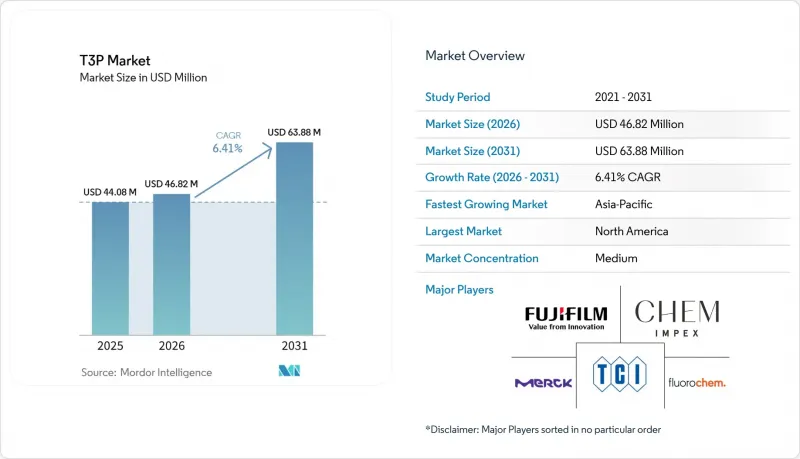
根據 Mordor Intelligence 預測,T3P 市場規模將從 2025 年的 4,408 萬美元和 2026 年的 4,682 萬美元成長到 2031 年的 6,388 萬美元,2026 年至 2031 年的複合年成長率為 6.41%。
本報告按濃度(50%溶液、70%溶液及其他濃度)、溶劑類型(乙酸乙酯、乙腈等)、應用(胜肽合成、藥物原料藥(API)合成等)及地區(亞太地區、北美地區、歐洲地區及世界其他地區)進行細分。市場預測以美元計價。
全球T3P市場趨勢與洞察
對活性藥物成分(API)和胜肽類藥物的生產需求不斷成長。
T3P市場正受惠於胜肽類藥物從專業研發向大規模生產的轉變。這一轉變至關重要,因為製造商不再僅僅為了研究批次而購買耦合試劑,而是將其用於更廣泛、更可預測的工業化生產項目。 T3P能夠滿足這項需求,因為它既能促進醯胺鍵的形成,又能同時產生水溶性副產物,這些副產物比某些競爭系統產生的殘留物更容易去除。隨著製造商努力縮短純化時間、減少溶劑用量並克服其整個商業化原料藥生產線的批次產能限制,這種操作優勢變得日益重要。因此,與幾年前相比,T3P市場在代謝性疾病、腫瘤和心血管藥物的生產中變得更加重要。隨著越來越多的胜肽類藥物計畫從研發階段進入規模化生產階段,預計T3P市場的需求將繼續與主要製藥公司及其委託製造合作夥伴的產能決策密切相關。
在綠色化學框架和大規模良好生產規範 (GMP) 合成中擴大 T3P 的應用。
T3P市場的發展也得益於受監管生產中向更環保、更安全的製程化學方向的廣泛轉變。採購團隊和工廠營運人員在選擇用於大規模生產的耦合試劑時,越來越重視廢棄物產生量、危害特性和易於清除等因素。一項計劃於2026年發表在《有機化學快報》(Organic Letters)上的研究預計將報告,使用T3P進行環三葉草輔助液相肽合成,可使工藝質量強度降低2.7倍,模型肽亮氨酸腦啡肽的分離收率達到93%,這將成為T3P永續性市場討論的技術基準。此結果凸顯了T3P的實用性,因為其環境性能具有商業性意義,降低環境影響可提高產率並減輕製程負擔。此外,T3P以溶液形式存在,這有利於在符合良好生產規範(GMP)的環境中進行操作,避免固體試劑可能帶來的暴露和安全隱患。在 T3P 市場中,綠色化學作為營運選擇標準,會影響合格、工廠工作流程和供應商選擇。
與其他耦合試劑相比,高成本
由於買家通常會將試劑價格與現有替代方案直接比較,因此T3P市場仍面臨成本挑戰。在學名藥生產、研究規模應用和農業化學品生產中,這項挑戰尤其突出,因為在這些領域,控制投入成本對試劑選擇的影響通常大於下游製程的運作效率。 T3P可以降低純化需求、溶劑浪費負擔並縮短週期時間。然而,在做出初步採購決策時,採購團隊並非總是會考慮這些成本節約優勢。即使從長遠來看,T3P在整體擁有成本方面具有優勢,但製程價值與採購價格之間的這種差距仍然阻礙了其推廣應用。在對價格敏感的終端應用中,製造商通常會繼續使用符合檢驗工作流程和預算假設的低成本系統。因此,在純度、速度和合規性至關重要的應用中,T3P市場正在快速成長,而在價值較低的應用中,其推廣速度則有所放緩。
細分市場分析
預計到2025年,「50%溶液」將佔據T3P市場58.72%的佔有率,這反映了其在製程要求和反應性能方面的重要作用。由於其穩定的流動特性和與體積分裝的兼容性,這種形式仍然是自動化合成平台、GMP反應器和常規實驗室工作中的實用標準。當需要在活性試劑的效力和易操作性之間取得平衡時,使用者也更傾向於這種形式。在許多生產環境中,易於控制和操作與略微提高濃度同樣重要。這種操作邏輯確保了50%溶液在T3P市場中仍然佔據核心地位,即使新的胜肽合成專案需要更高的效率。
預計2026年至2031年間,70% T3P市場將以6.93%的複合年成長率成長,成為預測期內成長最快的濃縮形式。其在工業規模胜肽生產中的應用最為廣泛,因為試劑密度的提高可以減少每批的總溶劑用量,有助於實現製程品質效率目標。這一因素在大規模宣傳活動中比在小規模實驗室處理中更為重要,因為隨著規模的擴大,溶劑負荷和反應器容量成為關鍵的成本因素。 2026年發表在《有機快報》(Organic Letters)上的一項研究支持了這一效率趨勢,該研究表明,在最佳化條件下,基於T3P的胜肽工作流程可顯著降低工藝品質強度。其他濃縮形式仍處於小眾市場,更滿足合約合成需求和專業研究項目,而非廣泛的工業需求。雖然整個T3P產業轉向更高濃度形式的轉變是漸進的,但在製程效率能夠帶來成本和永續性的應用中,這一趨勢更為顯著。
50%溶液的優勢還在於其符合GMP檔案和可重複性要求。這是因為一致的分裝降低了批次間差異的風險。在高通量生產中,如果企業已經最佳化了工藝,這種可靠性可能比更高濃度製劑的理論效率優勢更為重要。 T3P市場的買家通常將50%溶液視為合格和放大生產過程中的「低摩擦選擇」。這種定位使得50%溶液的應用記錄良好,尤其是在製藥企業尋求在商業化階段最大限度減少操作變更的情況下。相較之下,70%溶液則較與大規模肽類藥物研發專案的下一階段最佳化工作相關。這些趨勢在T3P市場造成了基於濃度的兩極化,製劑形式製劑形式現有實踐,另一種配方則基於放大生產過程中的效率目標。
區域分析
預計到2025年,北美將佔據T3P市場36.82%的佔有率,成為該地區以金額為準貢獻最大的區域市場。該地區聚集了眾多製藥企業、大型合約研發生產企業(CDMO)以及先進的胜肽生產項目。這種集中度支撐了對試劑的穩定需求,因為從事受監管生產的客戶優先考慮供應商的品質系統、全面的文件記錄和可靠的交貨。 Curia計劃於2025年3月擴建位於阿布奎基市的工廠,預計將增強該地區的供應基礎,以滿足未來的製藥生產需求。因此,北美T3P市場的需求不僅受終端用戶數量的影響,也受認證的嚴格程度和生產集中度的影響。
歐洲在三元化合物(T3P)市場仍佔有重要佔有率,德國、英國、法國和義大利憑藉其製藥和特種化學品業務支撐著市場需求。該地區的工藝化學基礎以及對符合嚴格控制的生產標準的材料的偏好,鞏固了其市場地位。歐洲買家也重視溶劑選擇、可追溯性和供應商審核合規性,這些都是確保符合GMP標準的配方的關鍵要素。因此,鑑於三元化合物市場的區域特點,高純度、資料齊全的供應商比低成本目錄產品更受青睞。
亞太地區是成長最快的區域市場,預計到2031年,T3P市場將以7.13%的複合年成長率成長。中國憑藉其龐大的化學品製造基地以及在製藥和工業合成領域日益成長的重要性,繼續保持其在全部區域銷售量中的核心地位。印度憑藉其出口導向原料藥(API)產業以及更複雜製程化學的廣泛應用,正在推動市場成長。日本擁有完善的GMP試劑基礎,其中包括FUJIFILM和光純藥株式會社於2024年5月擴大的醫藥原料產能。韓國透過其生物製藥開發活動做出貢獻,而世界其他地區的市場規模相對較小,仍處於發展初期。綜上所述,這些趨勢表明,T3P市場目前集中在北美,歐洲的需求以品質為導向,而亞太地區則經歷了最快的成長。
其他好處:
- Excel格式的市場預測(ME)表
- 3個月的分析師支持
目錄
第1章:引言
- 研究假設和市場定義
- 調查範圍
第2章:調查方法
第3章執行摘要
第4章 市場狀況
- 市場概覽
- 市場促進因素
- 對肽類藥物和先進製藥生產的需求不斷成長
- 擴大 T3P 在醫藥原料藥和有機合成領域的應用。
- 藥品研發和生產擴大外包給合約研發生產機構(CDMO)。
- 擴大T3P作為高效、副產物少的耦合試劑的應用。
- 加大對藥物化學和特種化學品合成領域的研發投入。
- 市場限制因素
- 與傳統耦合試劑相比,成本更高
- 可使用HATU、HBTU、COMU和EDC等替代耦合試劑。
- 醫藥級試劑的嚴格法規和品質要求
- 價值鏈分析
- 波特五力分析
- 價格分析
第5章 市場規模與成長預測
- 濃度
- 50%溶液
- 70%溶液
- 其他濃度
- 依溶劑類型
- 乙酸乙酯
- 二甲基甲醯胺(DMF)
- 乙腈
- 其他溶劑
- 透過使用
- 胜肽合成
- 原料藥(API)的合成
- 有機合成
- 精細特種化學品的合成
- 農藥合成
- 製程化學
- 其他用途
- 按地區
- 亞太地區
- 中國
- 印度
- 日本
- 韓國
- 其他亞太國家
- 北美洲
- 美國
- 加拿大
- 歐洲
- 德國
- 英國
- 法國
- 義大利
- 俄羅斯
- 其他歐洲國家
- 世界其他地區
- 南美洲
- 中東和非洲
- 亞太地區
第6章 競爭情勢
- 市場集中度
- 策略趨勢
- 市佔率和排名分析
- 公司簡介
- AAPPTec
- BLD Pharmatech Ltd.
- Carl Roth
- Chem-Impex
- Curia Global, Inc.
- Fluorochem Limited
- FUJIFILM Wako Pure Chemical Corporation
- Infinia Sciences Pvt. Ltd.,
- Iris Biotech GmbH
- Merck KGaA
- Santa Cruz Biotechnology, Inc.
- TargetMol Chemicals Inc.
- Tokyo Chemical Industry Co., Ltd.
第7章 市場機會與未來展望
According to Mordor Intelligence, the T3P market size is projected to expand from USD 44.08 million in 2025 and USD 46.82 million in 2026 to USD 63.88 million by 2031, and is expected to register a CAGR of 6.41% between 2026 and 2031.
This report is Segmented by Concentration (50% Solution, 70% Solution, and Other Concentrations), Solvent Type (Ethyl Acetate, Acetonitrile, and More), Application (Peptide Synthesis, Pharmaceutical API Synthesis, and More), and Geography (Asia-Pacific, North America, Europe, Rest of the World). The Market Forecasts are Provided in Terms of Value (USD).
Global T3P Market Trends and Insights
Growing Demand for Pharmaceutical Active Pharmaceutical Ingredient (API) and Peptide-Based Drug Manufacturing
The T3P market is benefiting from the transition of peptide-based therapies from specialized development to large-volume commercial manufacturing. This shift is significant because manufacturers no longer purchase coupling reagents only for research batches; they now require them for broader and more predictable industrial programs. T3P supports this requirement by enabling amide bond formation while producing a water-soluble byproduct that is easier to remove than residues associated with several competing systems. This operational advantage becomes more relevant as manufacturers work to reduce purification time, solvent use, and batch throughput constraints across commercial API lines. As a result, the T3P market now has greater relevance in the production of metabolic disease, oncology, and cardiovascular drugs than it did a few years ago. As more peptide programs move through development and into scale-up, demand in the T3P market is likely to remain linked to capacity decisions by large pharmaceutical manufacturers and their contract partners.
Increasing Adoption of T3P in Green Chemistry Frameworks and Large-Scale Good Manufacturing Practice (GMP) Synthesis
The T3P market is also gaining support from the broader shift toward greener and safer process chemistry in regulated manufacturing. Procurement teams and plant operators increasingly assess waste generation, hazard profiles, and ease of removal when selecting coupling reagents for large-scale use. A 2026 study in Organic Letters is expected to report that Cyclover-assisted liquid-phase peptide synthesis using T3P achieved a 2.7-fold reduction in process mass intensity and a 93% isolated yield for the model peptide Leu-enkephalin, providing the T3P market with a technical reference point for sustainability discussions. This result supports the practical case for T3P because greener performance has commercial relevance when it links to better yield and a lower process burden. T3P also benefits from its availability in solution form, which improves handling in Good Manufacturing Practice (GMP) settings where solid reagents can create exposure and safety concerns. In the T3P market, green chemistry serves as an operational filter that influences qualification, plant workflows, and supplier preferences.
High Cost Compared to Alternative Coupling Reagents
The T3P market continues to face cost challenges, as buyers often compare reagent prices directly with established alternatives. This challenge is most pronounced in generics manufacturing, research-scale applications, and agrochemical production, where input cost control often influences reagent selection more than downstream operating efficiency. T3P can reduce purification requirements, solvent disposal burdens, and cycle times. However, procurement teams making initial purchasing decisions do not always account for these savings. This gap between process value and purchase price slows adoption, even when the total cost of ownership may favor T3P over time. In price-sensitive end uses, manufacturers often continue to use lower-cost systems that align with their validated workflows and budget assumptions. Therefore, the T3P market grows faster in applications where purity, speed, and compliance are key requirements, while lower-value applications show slower adoption.
Other drivers and restraints analyzed in the detailed report include:
- Rising Outsourcing of Pharmaceutical Manufacturing and Supply Chain Realignment
- Expanding Use of T3P in Agrochemical and Fine & Specialty Chemical Synthesis
- Availability of Alternative Coupling Reagents
For complete list of drivers and restraints, kindly check the Table Of Contents.
Segment Analysis
The 50% solution is expected to hold 58.72% of the T3P market share in 2025, reflecting its role in handling requirements and reaction performance. This format remains the practical standard across automated synthesis platforms, GMP reactors, and routine laboratory work because it provides stable flow properties and supports volumetric dispensing. Users also prefer it when they need to balance active reagent strength with operating convenience. In many production settings, dosing control and lower handling complexity matter as much as marginal gains in concentration. This operating logic keeps the 50% solution central to the T3P market, even as newer peptide programs require higher efficiency.
The T3P market size for the 70% solution is projected to expand at a CAGR of 6.93% between 2026 and 2031, making it the fastest-growing concentration format during the forecast period. Industrial peptide manufacturing shows the strongest adoption, as higher reagent density can reduce total solvent volume per batch and support process mass efficiency targets. This factor matters more in large production campaigns than in small laboratory runs because solvent load and reactor throughput become significant cost drivers at scale. The 2026 Organic Letters study supports this efficiency trend by linking T3P-based peptide workflows with materially lower process mass intensity under optimized conditions. Other concentration formats remain niche and serve custom synthesis needs and specialized research programs rather than broad industrial demand. Across the T3P industry, the shift toward higher-concentration formats remains gradual but is visible in applications where process efficiency delivers cost and sustainability benefits.
The 50% solution also benefits from its alignment with GMP documentation and repeatability requirements, as consistent dispensing reduces the risk of avoidable batch variation. In high-throughput manufacturing, this reliability can outweigh the theoretical efficiency benefits of a more concentrated format when companies have already optimized their processes. Buyers in the T3P market often view the 50% solution as the low-friction option for qualification and scale transfer. This position keeps its installed base strong, especially when pharmaceutical producers aim to limit operational changes during commercial execution. By contrast, the 70% solution is more closely associated with next-stage optimization efforts in large peptide programs. This dynamic creates a concentration split in the T3P market, with one format anchored by installed practice and the other supported by scale-driven efficiency goals.
Complete Report Scope:
- By Concentration
- 50% Solution
- 70% Solution
- Other Concentrations
- By Solvent Type
- Ethyl Acetate
- Dimethylformamide (DMF)
- Acetonitrile
- Other Solvents
- By Application
- Peptide Synthesis
- Pharmaceutical API Synthesis
- Organic Synthesis
- Fine & Specialty Chemical Synthesis
- Agrochemical Synthesis
- Process Chemistry
- Other Applications
- By Geography
- Asia-Pacific
- China
- India
- Japan
- South Korea
- Rest of Asia-Pacific
- North America
- United States
- Canada
- Europe
- Germany
- United Kingdom
- France
- Italy
- Russia
- Rest of Europe
- Rest of the World
- South America
- Middle-East and Africa
- Asia-Pacific
Geography Analysis
North America is expected to hold 36.82% of the T3P market share in 2025, making it the largest regional contributor by value. The region has a high concentration of pharmaceutical manufacturers, large CDMOs, and advanced peptide production programs. This concentration supports steady reagent demand, as customers in regulated manufacturing prioritize supplier quality systems, comprehensive documentation, and reliable delivery. Curia's March 2025 Albuquerque expansion is expected to strengthen the regional supply base to meet future pharmaceutical production needs. As a result, qualification rigor and manufacturing intensity shape North American demand in the T3P market as much as the end-user count.
Europe remains an important part of the T3P market, with Germany, the United Kingdom, France, and Italy supporting demand through pharmaceutical and specialty chemical activity. The region's process-chemistry base and preference for materials that meet tightly controlled manufacturing standards support its position. European buyers also value solvent choice, traceability, and supplier audit readiness, which support GMP-grade formulations. Therefore, the regional profile of the T3P market favors higher-purity, well-documented supply over lower-cost catalog competition.
Asia-Pacific is the fastest-growing regional segment, with the T3P market projected to register a 7.13% CAGR through 2031. China remains the anchor market in regional volume terms due to its broad chemical manufacturing base and growing relevance in pharmaceutical and industrial synthesis. India adds momentum through its export-oriented API sector and increasing use of more complex process chemistry. Japan is supported by an established GMP reagent base, including FUJIFILM Wako Pure Chemical Corporation's May 2024 capacity expansion for pharmaceutical raw materials . South Korea contributes through biopharmaceutical development activity, while the rest of the world remains smaller and at an earlier stage of development. Together, these patterns indicate that the T3P market has a current concentration in North America, quality-led demand in Europe, and the fastest expansion in Asia-Pacific.
- AAPPTec
- BLD Pharmatech Ltd.
- Carl Roth
- Chem-Impex
- Curia Global, Inc.
- Fluorochem Limited
- FUJIFILM Wako Pure Chemical Corporation
- Infinia Sciences Pvt. Ltd.,
- Iris Biotech GmbH
- Merck KGaA
- Santa Cruz Biotechnology, Inc.
- TargetMol Chemicals Inc.
- Tokyo Chemical Industry Co., Ltd.
Additional Benefits:
- The market estimate (ME) sheet in Excel format
- 3 months of analyst support
TABLE OF CONTENTS
1 Introduction
- 1.1 Study Assumptions and Market Definition
- 1.2 Scope of the Study
2 Research Methodology
3 Executive Summary
4 Market Landscape
- 4.1 Market Overview
- 4.2 Market Drivers
- 4.2.1 Growing Demand for Peptide Therapeutics and Advanced Pharmaceutical Manufacturing
- 4.2.2 Increasing Adoption of T3P in Pharmaceutical API and Organic Synthesis
- 4.2.3 Rising Outsourcing of Drug Development and Manufacturing to CDMOs
- 4.2.4 Expanding Use of T3P as a High-Efficiency and Low-Byproduct Coupling Reagent
- 4.2.5 Increasing R&D Investments in Medicinal Chemistry and Specialty Chemical Synthesis
- 4.3 Market Restraints
- 4.3.1 High Cost Compared with Conventional Coupling Reagents
- 4.3.2 Availability of Alternative Coupling Reagents such as HATU, HBTU, COMU, and EDC
- 4.3.3 Stringent Regulatory and Quality Requirements for Pharmaceutical-Grade Reagents
- 4.4 Value Chain Analysis
- 4.5 Porter's Five Forces Analysis
- 4.5.1 Threat of New Entrants
- 4.5.2 Bargaining Power of Suppliers
- 4.5.3 Bargaining Power of Buyers
- 4.5.4 Threat of Substitutes
- 4.5.5 Competitive Rivalry
- 4.6 Pricing Analaysis
5 Market Size and Growth Forecasts (Value)
- 5.1 By Concentration
- 5.1.1 50% Solution
- 5.1.2 70% Solution
- 5.1.3 Other Concentrations
- 5.2 By Solvent Type
- 5.2.1 Ethyl Acetate
- 5.2.2 Dimethylformamide (DMF)
- 5.2.3 Acetonitrile
- 5.2.4 Other Solvents
- 5.3 By Application
- 5.3.1 Peptide Synthesis
- 5.3.2 Pharmaceutical API Synthesis
- 5.3.3 Organic Synthesis
- 5.3.4 Fine & Specialty Chemical Synthesis
- 5.3.5 Agrochemical Synthesis
- 5.3.6 Process Chemistry
- 5.3.7 Other Applications
- 5.4 By Geography
- 5.4.1 Asia-Pacific
- 5.4.1.1 China
- 5.4.1.2 India
- 5.4.1.3 Japan
- 5.4.1.4 South Korea
- 5.4.1.5 Rest of Asia-Pacific
- 5.4.2 North America
- 5.4.2.1 United States
- 5.4.2.2 Canada
- 5.4.3 Europe
- 5.4.3.1 Germany
- 5.4.3.2 United Kingdom
- 5.4.3.3 France
- 5.4.3.4 Italy
- 5.4.3.5 Russia
- 5.4.3.6 Rest of Europe
- 5.4.4 Rest of the World
- 5.4.4.1 South America
- 5.4.4.2 Middle-East and Africa
- 5.4.1 Asia-Pacific
6 Competitive Landscape
- 6.1 Market Concentration
- 6.2 Strategic Moves
- 6.3 Market Share (%)/Ranking Analysis
- 6.4 Company Profiles (includes Global Overview, Market Overview, Core Segments, Financials as available, Strategic Information, Products and Services, and Recent Developments)
- 6.4.1 AAPPTec
- 6.4.2 BLD Pharmatech Ltd.
- 6.4.3 Carl Roth
- 6.4.4 Chem-Impex
- 6.4.5 Curia Global, Inc.
- 6.4.6 Fluorochem Limited
- 6.4.7 FUJIFILM Wako Pure Chemical Corporation
- 6.4.8 Infinia Sciences Pvt. Ltd.,
- 6.4.9 Iris Biotech GmbH
- 6.4.10 Merck KGaA
- 6.4.11 Santa Cruz Biotechnology, Inc.
- 6.4.12 TargetMol Chemicals Inc.
- 6.4.13 Tokyo Chemical Industry Co., Ltd.
7 Market Opportunities and Future Outlook
- 7.1 White-Space and Unmet-Need Assessment

 2026-2034年全球農業化學合成用苯胺和對硝基苯酚市場規模、佔有率、趨勢和成長分析報告
 縮合試劑:市佔率分析、產業趨勢與統計、成長預測(2026-2031)手性消旋化抑制劑:市佔率分析、產業趨勢與統計及成長預測(2026-2031)
 2026年N-(正丙基)硫代磷醯三醯胺(NTTP)尿素酶抑制劑全球市場報告
 苯胺及對硝基苯酚在農藥合成的應用:市場機會、成長要素、產業趨勢分析及2026-2035年預測
 2026年全球4-(2-丙炔-1-基)嗎啉市場研究報告
 高利潤醫藥中間體市場預測——按產品類型、治療應用、合成流程、最終用戶和地區分類的全球分析——2034年
 疊氮乙酯市場規模、佔有率和成長分析:按純度、合成方法、包裝、應用、分銷通路、終端用戶產業和地區分類-2026-2033年產業預測
 陶瓷助劑市場規模、佔有率和成長分析:按產品類型、應用、最終用戶、配方類型、地區和產業預測,2026-2033年
 肥料添加劑市場規模、佔有率和成長分析:按肥料類型、配方、應用、通路和地區分類-2026-2033年產業預測