


 |
市場調查報告書
商品編碼
2101569
苯胺及對硝基苯酚在農藥合成的應用:市場機會、成長要素、產業趨勢分析及2026-2035年預測Aniline and p-Nitrophenol from Pesticide Synthesis Market Opportunity, Growth Drivers, Industry Trend Analysis, and Forecast 2026 - 2035 |
||||||

預計到 2025 年,全球用於農藥合成的苯胺和對硝基苯酚市場規模將達到 4.8 億美元,並以 4.6% 的複合年成長率成長,到 2035 年將達到 7.54 億美元。
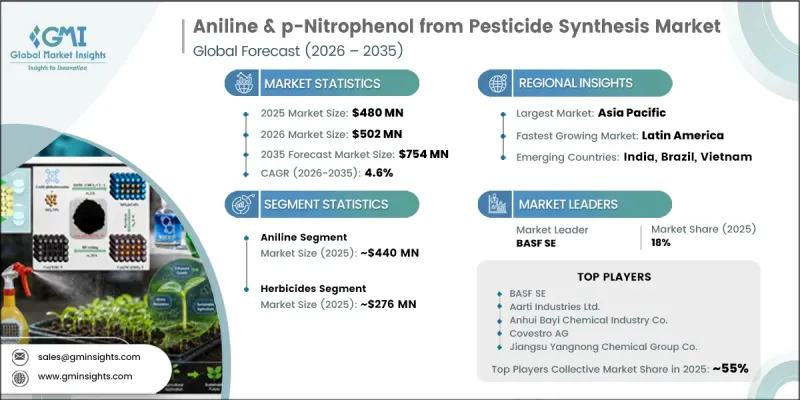
市場成長主要受糧食安全問題日益嚴峻以及開發中國家(尤其是亞太地區和拉丁美洲)作物保護化學品使用量增加的驅動。農業生產擴張帶來的需求成長推動了農藥生產中苯胺類化學中間體的消費量增加,同時農藥生產商也不斷豐富產品系列以適應不斷變化的農業實踐。此外,隨著雜草對傳統除草劑的抗藥性日益增強,對替代雜草控制方案的需求不斷成長,這也對農藥合成用苯胺和對硝基苯酚市場產生了積極影響。這一趨勢推動了現代除草劑生產中芳香族中間體需求的成長,使其消費量保持在歷史平均水平以上。同時,化學合成技術的不斷進步提高了生產效率,保證了產品質量,並幫助生產商最佳化生產流程。這些因素,加上對農業生產力的持續投資和不斷發展的作物保護策略,持續為全球農藥合成用苯胺和對硝基苯酚市場創造了有利的長期成長機會。
| 市場範圍 | |
|---|---|
| 開始年份 | 2025 |
| 預測期 | 2026-2035 |
| 初始市場規模 | 4.8億美元 |
| 預測金額 | 7.54億美元 |
| 複合年成長率 | 4.6% |
預計到2025年,苯胺類產品的銷售額將達到4.4億美元。該領域涵蓋多種產品類型,主要用於農業化學品的合成,其需求主要源於它們作為除草劑、殺菌劑和特種農藥生產中重要的芳香族中間體的作用。農業產量的成長和農藥生產能力的擴大正推動這些產品類型的持續強勁消費。預計到2035年,初級苯胺將對整體需求成長做出最顯著的貢獻,而隨著生產商不斷擴大先進除草劑配方的生產,對硝基苯酚相關中間體預計將實現高於平均水平的成長。
預計到2025年,除草劑市場規模將達到2.76億美元,反映了除草劑生產與苯胺類原料消耗之間的直接關係。由於這些中間體是農藥合成中的基本反應物,因此其需求與除草劑生產活動密切相關。抗性管理計畫的持續擴展、種植面積的增加以及對高效作物保護解決方案日益成長的需求,預計將在整個預測期內推動除草劑應用領域的持續成長。
預計到2025年,北美用於農業化學品合成的苯胺和對硝基苯酚市場規模將達到9,600萬美元。該地區佔全球市場的20%,其中美國仍是最大的貢獻者,這主要基於其消費量及其對整個農業化學品中間體產業的影響力。對國內生產能力的持續投資、已建立的供應合約以及農業化學品製造商的穩定需求,將繼續支撐該地區的市場擴張。預計強大的工業基礎設施和穩定的基本客群將在整個預測期進一步鞏固北美的市場地位。
目錄
第1章:調查方法和範圍
第2章執行摘要
第3章 行業洞察
- 產業生態系分析
- 供應商情況
- 利潤率
- 每個階段增加的價值
- 影響價值鏈的因素
- 中斷
- 影響產業的因素
- 促進因素
- 產業潛在風險與挑戰
- 市場機遇
- 成長潛力分析
- 監理情勢
- 北美洲
- 歐洲
- 亞太地區
- 拉丁美洲
- 中東和非洲
- 波特的分析
- PESTLE分析
- 技術與創新展望
- 最新科技趨勢
- 新興技術
- 價格趨勢
- 按地區
- 依產品類型
- 未來市場趨勢
- 專利趨勢
- 貿易統計
- 主要進口國
- 主要出口國
- 永續性和環境方面
- 永續計劃
- 減少廢棄物策略
- 生產中的能源效率
- 具有環保意識的舉措
第4章 競爭情勢
- 介紹
- 企業市佔率分析
- 按地區
- 北美洲
- 歐洲
- 亞太地區
- LATAM
- 中東和非洲
- 按地區
- 企業矩陣分析
- 主要市場公司的競爭分析
- 競爭定位矩陣
- 主要進展
- 併購
- 夥伴關係和聯盟
- 新產品發布
- 業務拓展計劃
第5章 市場估算與預測:依產品類型分類,2022-2035年
- 苯胺(農藥合成級)
- 初級苯胺(農藥合成級)
- 對硝基苯胺 (PNA) - 農藥中間體途徑
- 鄰硝基苯胺 (ONA) - 特殊農藥應用
- 對硝基苯酚(4-硝基苯酚/PNP)
- 技術級 PNP(98% 或更高)
- 精製/高純度 PNP(99.5% 或更高)
- 工業級 PNP
第6章 市場估計與預測:依農藥施用方法分類,2022-2035年
- 除草劑
- 乙醯苯胺類除草劑
- 苯氧類和Dinitroanilines除草劑
- 其他除草劑用途
- 殺蟲劑
- 有機磷殺蟲劑
- 氨基甲酸酯類殺蟲劑
- 其他殺蟲劑用途
- 消毒劑
- 苯胺基殺菌劑中間體
- 硝基苯酚殺菌劑的途徑
- 其他
第7章 市場估計與預測:依地區分類,2022-2035年
- 北美洲
- 美國
- 加拿大
- 歐洲
- 德國
- 英國
- 法國
- 西班牙
- 義大利
- 其他歐洲國家
- 亞太地區
- 中國
- 印度
- 日本
- 澳洲
- 韓國
- 其他亞太國家
- 拉丁美洲
- 巴西
- 墨西哥
- 阿根廷
- 其他拉丁美洲國家
- 中東和非洲
- 沙烏地阿拉伯
- 南非
- UAE
- 其他中東和非洲國家
第8章:公司簡介
- BASF SE
- Covestro AG
- Lanxess AG
- Sumitomo Chemical Co., Ltd.
- Aarti Industries Ltd.
- Jiangsu Yangnong Chemical Group Co., Ltd.
- Seya Industries Ltd.
- Valiant Organics Ltd.
- Gujarat Narmada Valley Fertilizers &Chemicals Ltd.(GNFC)
- Anhui Bayi Chemical Industry Co., Ltd.
- Deepak Nitrite Limited
- Ningbo Inno Pharmchem Co., Ltd.
- Bodal Chemicals Ltd.
- Crystal Surfactants &Chemicals
- Hemani Global
The Global Aniline & P-Nitrophenol from Pesticide Synthesis Market was valued at USD 480 million in 2025 and is estimated to grow at a CAGR of 4.6% to reach USD 754 million by 2035.
Market growth is supported by rising food security concerns and the increasing use of crop protection chemicals across developing agricultural economies, particularly in Asia Pacific and Latin America. Expanding agricultural production requirements are driving greater consumption of aniline-based chemical intermediates used in pesticide manufacturing, while agrochemical producers continue to diversify product portfolios to address changing farming practices. The aniline & p-nitrophenol from pesticide synthesis market is also benefiting from the growing need for alternative weed management solutions as resistance to conventional herbicide chemistries becomes more widespread. This trend is encouraging higher demand for aromatic intermediates used in the production of modern herbicides, resulting in consumption levels that continue to exceed historical averages. At the same time, ongoing advancements in chemical synthesis technologies are improving manufacturing efficiency, supporting product quality, and enabling producers to optimize production processes. These factors, combined with sustained investment in agricultural productivity and evolving crop protection strategies, continue to create favorable long-term growth opportunities for the global aniline & p-nitrophenol from pesticide synthesis market.
| Market Scope | |
|---|---|
| Start Year | 2025 |
| Forecast Year | 2026-2035 |
| Start Value | $480 Million |
| Forecast Value | $754 Million |
| CAGR | 4.6% |
The aniline segment generated USD 440 million in 2025. The segment includes multiple product categories designed for pesticide synthesis applications, with demand supported by their role as essential aromatic intermediates in herbicide, fungicide, and specialty agrochemical production. Increasing agricultural output and expanding pesticide manufacturing capacity continue to strengthen consumption across these product categories. Among them, primary aniline is expected to contribute the largest increase in absolute demand through 2035, while para-nitrophenol-related intermediates are anticipated to record above-average growth as manufacturers continue to expand production of advanced herbicide formulations.
The herbicides segment was valued at USD 276 million in 2025, reflecting the direct relationship between herbicide manufacturing volumes and the consumption of aniline-based raw materials. Because these intermediates serve as fundamental reactants in pesticide synthesis, demand remains closely aligned with herbicide production activity. Continued expansion of resistance management programs, increasing cultivation acreage, and rising demand for efficient crop protection solutions are expected to support sustained growth across the herbicide application segment throughout the forecast period.
North America Aniline & P-Nitrophenol from Pesticide Synthesis Market generated USD 96 million in 2025. The region accounted for 20% of the global market, with the United States remaining the largest national contributor based on consumption levels and its influence on the broader pesticide intermediate industry. Ongoing investment in domestic manufacturing capabilities, established supply agreements, and consistent demand from agrochemical producers continue to support regional market expansion. Strong industrial infrastructure and a stable customer base are expected to reinforce North America's position throughout the forecast period.
Major companies operating in the global aniline & p-nitrophenol from pesticide synthesis market include BASF SE, Covestro AG, Lanxess AG, Sumitomo Chemical Co., Ltd., Aarti Industries Ltd., Jiangsu Yangnong Chemical Group Co., Ltd., Seya Industries Ltd., Valiant Organics Ltd., Gujarat Narmada Valley Fertilizers & Chemicals Ltd. (GNFC), Anhui Bayi Chemical Industry Co., Ltd., Deepak Nitrite Limited, Ningbo Inno Pharmchem Co., Ltd., Bodal Chemicals Ltd., Crystal Surfactants & Chemicals, and Hemani Global. Companies operating in the aniline & p-nitrophenol from pesticide synthesis market are strengthening their market position by expanding manufacturing capacity, improving process efficiency, and investing in advanced production technologies to enhance product quality and cost competitiveness. Many producers are focusing on portfolio diversification to address evolving agrochemical requirements while increasing investment in research and development to support innovative synthesis processes. Strategic collaborations with agrochemical manufacturers, long-term supply agreements, and geographic expansion initiatives continue to improve market reach and customer retention. Businesses are also emphasizing regulatory compliance, sustainable manufacturing practices, and supply chain optimization to strengthen operational resilience.
Table of Contents
Chapter 1 Methodology & Scope
- 1.1 Market scope and definition
- 1.2 Research design
- 1.2.1 Research approach
- 1.2.2 Data collection methods
- 1.3 Data mining sources
- 1.3.1 Global
- 1.3.2 Regional/Country
- 1.4 Base estimates and calculations
- 1.4.1 Base year calculation
- 1.4.2 Key trends for market estimation
- 1.5 Primary research and validation
- 1.5.1 Primary sources
- 1.6 Forecast model
- 1.7 Research assumptions and limitations
Chapter 2 Executive Summary
- 2.1 Industry 360° synopsis
- 2.2 Key market trends
- 2.2.1 Product Type
- 2.2.2 Pesticide Application
- 2.2.3 Regional
- 2.3 TAM Analysis, 2026-2035
- 2.4 CXO perspectives: Strategic imperatives
- 2.5 Future outlook and strategic recommendations
Chapter 3 Industry Insights
- 3.1 Industry ecosystem analysis
- 3.1.1 Supplier landscape
- 3.1.2 Profit margin
- 3.1.3 Value addition at each stage
- 3.1.4 Factor affecting the value chain
- 3.1.5 Disruptions
- 3.2 Industry impact forces
- 3.2.1 Growth drivers
- 3.2.2 Industry pitfalls and challenges
- 3.2.3 Market opportunities
- 3.3 Growth potential analysis
- 3.4 Regulatory landscape
- 3.4.1 North America
- 3.4.2 Europe
- 3.4.3 Asia Pacific
- 3.4.4 Latin America
- 3.4.5 Middle East & Africa
- 3.5 Porter's analysis
- 3.6 PESTEL analysis
- 3.7 Technology and innovation landscape
- 3.7.1 Current technological trends
- 3.7.2 Emerging technologies
- 3.8 Price trends
- 3.8.1 By region
- 3.8.2 By Product Type
- 3.9 Future market trends
- 3.10 Patent landscape
- 3.11 Trade statistics
- 3.11.1 Major importing countries
- 3.11.2 Major exporting countries
- 3.12 Sustainability and environmental aspects
- 3.12.1 Sustainable practices
- 3.12.2 Waste reduction strategies
- 3.12.3 Energy efficiency in production
- 3.12.4 Eco-friendly initiatives
Chapter 4 Competitive Landscape, 2025
- 4.1 Introduction
- 4.2 Company market share analysis
- 4.2.1 By region
- 4.2.1.1 North America
- 4.2.1.2 Europe
- 4.2.1.3 Asia Pacific
- 4.2.1.4 LATAM
- 4.2.1.5 MEA
- 4.2.1 By region
- 4.3 Company matrix analysis
- 4.4 Competitive analysis of major market players
- 4.5 Competitive positioning matrix
- 4.6 Key developments
- 4.6.1 Mergers & acquisitions
- 4.6.2 Partnerships & collaborations
- 4.6.3 New product launches
- 4.6.4 Expansion plans
Chapter 5 Market Estimates and Forecast, By Product Type, 2022-2035 (USD Million) (Kilo Tons)
- 5.1 Key trends
- 5.2 Aniline (Pesticide Synthesis Grade)
- 5.2.1 Primary Aniline (Pesticide Synthesis Grade)
- 5.2.2 Para-Nitroaniline (PNA) - Pesticide Intermediate Pathway
- 5.2.3 Ortho-Nitroaniline (ONA) - Specialty Pesticide Applications
- 5.3 p-Nitrophenol (4-Nitrophenol / PNP)
- 5.3.1 Technical Grade PNP (≥98%)
- 5.3.2 Refined/High Purity Grade PNP (≥99.5%)
- 5.3.3 Industrial Grade PNP
Chapter 6 Market Estimates and Forecast, By Pesticide Application, 2022-2035 (USD Million) (Kilo Tons)
- 6.1 Key trends
- 6.2 Herbicides
- 6.2.1 Acetanilide Herbicides
- 6.2.2 Phenoxy & Dinitroaniline Herbicides
- 6.2.3 Other Herbicidal Applications
- 6.3 Insecticides
- 6.3.1 Organophosphate Insecticides
- 6.3.2 Carbamate Insecticides
- 6.3.3 Other Insecticidal Applications
- 6.4 Fungicides
- 6.4.1 Aniline-Derived Fungicide Intermediates
- 6.4.2 Nitrophenol-Based Fungicide Pathways
- 6.4.3 Others
Chapter 7 Market Estimates and Forecast, By Region, 2022-2035 (USD Million) (Kilo Tons)
- 7.1 Key trends
- 7.2 North America
- 7.2.1 U.S.
- 7.2.2 Canada
- 7.3 Europe
- 7.3.1 Germany
- 7.3.2 UK
- 7.3.3 France
- 7.3.4 Spain
- 7.3.5 Italy
- 7.3.6 Rest of Europe
- 7.4 Asia Pacific
- 7.4.1 China
- 7.4.2 India
- 7.4.3 Japan
- 7.4.4 Australia
- 7.4.5 South Korea
- 7.4.6 Rest of Asia Pacific
- 7.5 Latin America
- 7.5.1 Brazil
- 7.5.2 Mexico
- 7.5.3 Argentina
- 7.5.4 Rest of Latin America
- 7.6 Middle East and Africa
- 7.6.1 Saudi Arabia
- 7.6.2 South Africa
- 7.6.3 UAE
- 7.6.4 Rest of Middle East and Africa
Chapter 8 Company Profiles
- 8.1 BASF SE
- 8.2 Covestro AG
- 8.3 Lanxess AG
- 8.4 Sumitomo Chemical Co., Ltd.
- 8.5 Aarti Industries Ltd.
- 8.6 Jiangsu Yangnong Chemical Group Co., Ltd.
- 8.7 Seya Industries Ltd.
- 8.8 Valiant Organics Ltd.
- 8.9 Gujarat Narmada Valley Fertilizers & Chemicals Ltd. (GNFC)
- 8.10 Anhui Bayi Chemical Industry Co., Ltd.
- 8.11 Deepak Nitrite Limited
- 8.12 Ningbo Inno Pharmchem Co., Ltd.
- 8.13 Bodal Chemicals Ltd.
- 8.14 Crystal Surfactants & Chemicals
- 8.15 Hemani Global

 2026-2034年全球農業化學合成用苯胺和對硝基苯酚市場規模、佔有率、趨勢和成長分析報告
 縮合試劑:市佔率分析、產業趨勢與統計、成長預測(2026-2031)手性消旋化抑制劑:市佔率分析、產業趨勢與統計及成長預測(2026-2031)T3P:市場佔有率分析、產業趨勢與統計、成長預測(2026-2031)
 2026年N-(正丙基)硫代磷醯三醯胺(NTTP)尿素酶抑制劑全球市場報告
 2026年全球4-(2-丙炔-1-基)嗎啉市場研究報告
 高利潤醫藥中間體市場預測——按產品類型、治療應用、合成流程、最終用戶和地區分類的全球分析——2034年
 疊氮乙酯市場規模、佔有率和成長分析:按純度、合成方法、包裝、應用、分銷通路、終端用戶產業和地區分類-2026-2033年產業預測
 陶瓷助劑市場規模、佔有率和成長分析:按產品類型、應用、最終用戶、配方類型、地區和產業預測,2026-2033年
 肥料添加劑市場規模、佔有率和成長分析:按肥料類型、配方、應用、通路和地區分類-2026-2033年產業預測