


 |
市場調查報告書
商品編碼
2118059
AR內容串流:市場佔有率分析、產業趨勢與統計及成長預測(2026-2031年)AR Content Streaming - Market Share Analysis, Industry Trends & Statistics, Growth Forecasts (2026 - 2031) |
||||||

※ 本網頁內容可能與最新版本有所差異。詳細情況請與我們聯繫。
根據 Mordor Intelligence 預測,AR 內容串流市場將從 2025 年的 46.4 億美元成長到 2026 年的 54.3 億美元,然後在 2031 年達到 128.6 億美元,2026 年至 2031 年的複合年成長率為 18.84%。
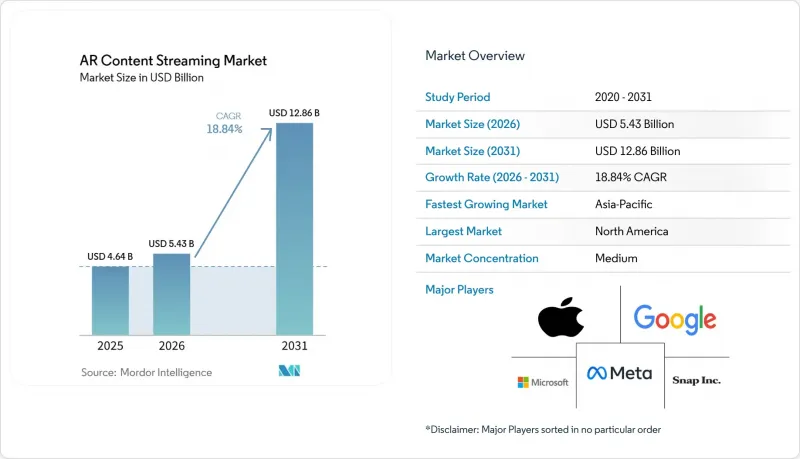
本報告按應用領域(AR行動遊戲、社交AR濾鏡和贊助鏡頭、零售和電商AR、企業級AR內容和遠端輔助串流)和地區(北美、南美、歐洲、亞太地區以及中東和非洲)進行細分。市場預測以美元(USD)為單位。
全球AR內容串流市場趨勢及洞察
電子商務和品牌媒體對身臨其境型產品故事的需求日益成長。
商業正成為擴增實境(AR)內容串流媒體市場的直接需求來源。這是因為產品可見度能夠同時支援銷售和退貨管理目標,而投資的理由也從品牌實驗轉向在購買決策前加深消費者對產品的了解。 Snap 的一項研究表明,AR 零售可以透過向消費者呈現更清晰的尺寸、合身度和空間環境訊息,顯著降低退貨率。這一點至關重要,因為研究指出,線上退貨率高於線下實體店退貨率。 WebXR 設備 API 於 2026 年 6 月 9 日達到候選建議草案(CDR)狀態,透過支援基於瀏覽器的 AR,減少了對應用程式下載的需求。 2026 年 5 月,OTB Group 和 Google Cloud 為 Diesel、Maison Margiela 和 Marni 部署了虛擬試穿功能,使客戶顧問能夠大規模查看服飾。此外,空間互動可以捕捉產品旋轉、縮放和猶豫等行為,為建議系統提供僅憑點擊無法獲得的更詳細的訊號。
擴展 5G 和邊緣串流功能,實現低延遲 AR 播放
儘管5G毫米波網路支援多用戶AR串流播放,但在頻寬有限的網路中,維持必要的品質仍面臨挑戰。 2026年3月,KDDI在日本進行了實況活動演示,透過5G毫米波網路和Mawari的分散式3D分發平台,向智慧眼鏡用戶傳輸了真人大小的虛擬表演者。研究表明,在先進的網路切片條件下,邊緣雲端虛擬化可以將移動AR延遲降低到「運動到光子」的閾值以下。在韓國和海灣合作理事會(GCC)國家,電信業者為企業提供專用網路容量,將有助於AR內容串流媒體市場的發展。這將更清楚地將網路品質、可靠的使用者體驗和優質發送服務的價值連結起來。這種機制將使網路連接從一項基礎公共服務轉變為商業性分發模式不可或缺的一部分。此外,韓國不斷推進的5G網路覆蓋也推動了基礎設施建設的快速發展,超越了需求驅動的部署模式。
設備生態系統片段化以及跨平台相容性不足
平台分散化正在推高整個擴增實境(AR) 內容串流媒體市場的服務成本。 ARKit 和 ARCore 的不同實作需要不同的資源最佳化流程,而根據相關研究,渲染差異可能會使初始專案預算增加 30% 到 40%。雖然 WebXR 提供了一種基於瀏覽器的方案,但截至 2026 年,iPhone 和 iPad 仍無法原生支持,因此需要使用其他替代方案,例如 Apple 的 AR Quick Look。 Android XR、VisionOS、Meta 的頭戴式裝置作業系統以及現有的行動框架都需要額外的認證和硬體最佳化。企業負責人還需要測試來自 RealWear、Vuzix、Lenovo ThinkReality 和 Magic Leap 的眼鏡型設備。大規模平台公司更容易滿足這些技術要求,這可能會進一步增強它們相對於小規模的專業供應商的優勢。
細分市場分析
到2025年,AR行動遊戲將佔據AR內容串流市場32.91%的佔有率,成為最大的應用領域。這一地位得益於應用程式內收費模式、成熟的IP以及基於位置的機制,這些優勢即使在遊戲發布後也能持續帶動用戶消費。 Pokémon GO的累積收入預計到2026年7月將超過91億美元,這充分展現了成熟的基於位置的AR遊戲的巨大盈利潛力。 Niantic的「獎勵式AR廣告」將遊戲內的品牌體驗與實體店的造訪連結起來,從而為應用程式內收費引入了廣告商的資金。社交AR濾鏡和贊助鏡頭預計到2031年將以19.55%的複合年成長率成長,成為所有應用領域中成長最快的。
在基於瀏覽器的可視化和虛擬試穿工具的支援下,零售和商業領域的擴增實境(AR)技術正從小小規模試點階段走向廣泛應用。 WebXR 的標準化是一個里程碑,它降低了下載門檻,從而促進了使用者對瀏覽器原生體驗的參與。研究表明,Shopify 產品頁面上的 3D 內容平均可將轉換率提高 94%,而實施 AR 技術的零售商則報告退貨率降低了高達 40%。 OTB 集團基於 Google Cloud 的部署方案展示了多個奢侈品牌的虛擬試穿功能,顯示時尚集團可以永續地大規模地經營 AR 技術。企業級 AR 內容和遠端輔助串流服務正透過技能管理、工作指導和現場支援採購等方式不斷擴展,而人工智慧驅動的 2D 轉 3D 轉換工具則可以降低小規模部署的初始成本。
區域分析
預計到2025年,北美將佔據AR內容串流媒體市場44.16%的佔有率,凸顯其在該市場的核心地位。蘋果、Meta、Google、Snap、微軟和英偉達等公司以及擁有雄偉軟體預算的企業客戶均在該地區開展業務。美國佔據了該地區遊戲收入、社交鏡頭廣告庫存和雲端渲染投資的大部分佔有率。在加拿大,除了混合實境(MR)的開發活動外,製造業和醫療保健產業的企業應用也不斷推進。基於瀏覽器的零售工具、遠端援助、社交廣告效果衡量和高級雲端渲染等應用程式都推動了該地區的需求成長。
預計亞太地區2026年至2031年的複合年成長率將達到19.41%,在所有地區中增速最高。該地區的AR內容串流媒體市場主要受韓國、中國和日本對先進行動網路的投資以及面向消費者和企業用戶的智慧眼鏡產品開發所驅動。這體現在今年年初全球智慧眼鏡出貨量的強勁成長上,而這又得益於波導顯示裝置的日益普及。在KDDI於2026年舉辦的活動中,示範如何在公共場所向智慧眼鏡傳輸3D內容,而無需裝置端進行GPU處理。中國近眼顯示器的安全標準可能會加快國內認證進程,而印度和東南亞地區預計將受益於5G網路覆蓋範圍的擴大和人工智慧內容創作工具的改進。
到2025年,歐洲將成為全球第三大銷售貢獻者,需求主要集中在製造業、醫療保健和遠距維護領域。在德國,工業工作流程,包括Holo-Light的AR引導組裝和維護應用,正在得到支援;而英國和法國仍然是活躍的消費市場。歐盟人工智慧法規在特定情況下限制了職場的情緒識別,而記錄旁觀者臉部的空間識別設備將受到GDPR資料保護要求的約束。南美洲和中東及非洲展現出不同的發展機遇,而非單一的區域趨勢。沙烏地阿拉伯的「Snap Souq」宣傳活動顯示了人們對商業相關AR的興趣,而阿拉伯聯合大公國的「沙烏地阿拉伯2030願景」和智慧城市投資則支持公共和企業應用場景。在巴西,AR應用正在開發用於醫療培訓和零售視覺化,Orange和Synamedia正在努力擴大非洲的串流媒體容量,以滿足未來的傳輸需求。
其他好處:
- Excel格式的市場預測(ME)表
- 3個月的分析師支持
目錄
第1章:引言
- 研究假設和市場定義
- 調查範圍
第2章:調查方法
第3章執行摘要
第4章 市場狀況
- 市場概覽
- 市場促進因素
- 電子商務和品牌媒體對身臨其境型產品故事的需求日益成長。
- 擴展 5G 和邊緣串流功能,實現低延遲 AR 播放
- 透過社群和零售通路實現創作者主導的AR內容變現
- AR串流媒體在遠距教學和培訓中的企業應用。
- 基於人工智慧的上下文感知情境感知實境體驗個人化
- 推出雲端原生渲染和內容編配。
- 市場限制因素
- 設備生態系統片段化以及跨平台相容性不足
- 即時3D和空間資產的高昂製作成本
- 隱私、生物識別和位置資料的合規性問題十分複雜。
- 始終運作實境串流播放面臨的電池、散熱和網路限制
- 產業價值鏈分析
- 宏觀經濟因素對市場的影響
- 監理情勢
- 技術展望
- 波特五力分析
第5章 市場規模與成長預測
- 透過使用
- AR手機遊戲
- 社群擴增實境濾鏡和贊助鏡頭
- AR在零售和商業領域的應用
- 企業級擴增實境內容與遠端輔助串流媒體
- 按地區
- 北美洲
- 美國
- 加拿大
- 墨西哥
- 南美洲
- 巴西
- 阿根廷
- 其他南美國家
- 歐洲
- 德國
- 英國
- 法國
- 義大利
- 西班牙
- 俄羅斯
- 其他歐洲國家
- 亞太地區
- 中國
- 日本
- 印度
- 韓國
- 澳洲
- 其他亞太國家
- 中東
- 沙烏地阿拉伯
- 阿拉伯聯合大公國
- 土耳其
- 其他中東國家
- 非洲
- 南非
- 埃及
- 其他非洲國家
- 北美洲
第6章 競爭情勢
- 市場集中度
- 策略趨勢
- 市佔率分析
- 公司簡介
- Apple Inc.
- Meta Platforms Inc.
- Google LLC
- Microsoft Corporation
- Snap Inc.
- Qualcomm Technologies Inc.
- Sony Group Corporation
- Samsung Electronics Co. Ltd.
- Unity Technologies
- Niantic Inc.
- PTC Inc.
- Magic Leap Inc.
- Vuzix Corporation
- Lenovo Group Ltd.
- Xiaomi Corporation
- HTC Corporation
- EON Reality
- Blippar Ltd.
- Zappar Ltd.
- RealWear Inc.
- Alibaba Group Holding Ltd.
- Tencent Holdings Ltd.
- NVIDIA Corporation
- Epic Games Inc.
第7章 市場機會與未來展望
According to Mordor Intelligence, the AR content streaming market size is expected to grow from USD 4.64 billion in 2025 to USD 5.43 billion in 2026 and is forecast to reach USD 12.86 billion by 2031 at 18.84% CAGR over 2026-2031.
This report is Segmented by Application (AR Mobile Games, Social AR Filters and Sponsored Lenses, Retail and Commerce AR, and Enterprise AR Content and Remote-Assist Streaming) and Geography (North America, South America, Europe, Asia-Pacific, Middle East, and Africa). The Market Forecasts are Provided in Terms of Value (USD).
Global AR Content Streaming Market Trends and Insights
Rising Demand for Immersive Product Narratives in Commerce and Brand Media
Commerce is becoming a direct source of demand for the AR content streaming market because product visualization can support both sales and return-management goals, changing the case for investment from brand experimentation to a practical way to improve product understanding before checkout. Snap research found that AR-enabled retail can significantly reduce returns when it provides shoppers with a clearer view of size, fit, and spatial context. This matters because the research reported that online returns were higher than those in physical retail. The WebXR Device API reached Candidate Recommendation Draft status on June 9, 2026, supporting browser-based AR and reducing the need for an application download. In May 2026, OTB Group and Google Cloud introduced virtual try-on capabilities for Diesel, Maison Margiela, and Marni, bringing garment visualization to client advisors at scale. Spatial interactions can also provide recommendation systems with more detailed signals than a conventional click, as they capture product rotation, scale adjustments, and hesitation.
Expansion of 5G and Edge Delivery for Low-Latency AR Playback
5G millimeter-wave networks support multi-user AR streaming, where lower-bandwidth networks can struggle to maintain the required quality. In March 2026, KDDI demonstrated a live event in Japan that streamed a full-scale virtual performer to smart-glass users through 5G millimeter-wave and Mawari's distributed 3D delivery platform. Research found that edge-cloud virtualization can reduce mobile AR latency below the motion-to-photon threshold under advanced network-slicing conditions. The AR content streaming market can benefit when telecom providers package dedicated network capacity for enterprise use in South Korea and the GCC, providing a clearer link between network quality, a reliable user experience, and the value of premium delivery services. These arrangements make connectivity part of the commercial delivery model rather than a basic utility. South Korean 5G coverage milestones also support faster infrastructure deployment than demand alone would produce.
Fragmented Device Ecosystems and Cross-Platform Compatibility Gaps
Platform fragmentation raises the cost of serving users across the augmented reality (AR) content streaming market. Different ARKit and ARCore implementations require separate asset-optimization processes, and the supplied research indicated that rendering differences can add 30%-40% to initial project estimates. WebXR provides a browser-based route, but native iPhone and iPad support remains unavailable in 2026, which requires separate Apple AR Quick Look fallback work. Android XR, visionOS, Meta's headset operating system, and established mobile frameworks each add certification and hardware-optimization requirements. Enterprise buyers also must test glasses from RealWear, Vuzix, Lenovo ThinkReality, and Magic Leap. Larger platform companies can more easily absorb these engineering requirements, which may increase their advantage over smaller specialist providers.
Other drivers and restraints analyzed in the detailed report include:
- Creator-Led AR Content Monetization Across Social and Retail Channels
- Enterprise Use of AR Streaming for Remote Guidance and Training
- High Content Production Cost for Real-Time 3D and Spatial Assets
For complete list of drivers and restraints, kindly check the Table Of Contents.
Segment Analysis
AR Mobile Games held 32.91% of the AR content streaming market share in 2025, making gaming the largest application segment. Its position reflects in-app purchase models, established franchises, and location-based mechanics that can sustain spending after a game's launch. Pokemon GO had exceeded USD 9.1 billion in cumulative lifetime revenue by July 2026, which showed the revenue potential of a well-established location-based AR title. Niantic's Rewarded AR Ads also connect in-game branded experiences with physical store visits, adding advertiser funding to in-app purchasing. Social AR Filters and Sponsored Lenses are projected to grow at 19.55% CAGR through 2031, the fastest rate among applications.
Retail and Commerce AR is moving from small pilots to widespread adoption, supported by browser-based visualization and virtual try-on tools. The WebXR standardization milestone reduces a download barrier that had limited engagement for browser-native experiences. The research reported an average 94% conversion lift from 3D content on Shopify product pages and return reductions of up to 40% in AR-enabled retail. OTB Group's deployment with Google Cloud demonstrated virtual try-on across several luxury brands and showed the operational scale available to fashion groups. Enterprise AR Content and Remote-Assist Streaming are expanding through skills management, work instruction, and field support procurement, while AI-supported 2D-to-3D tools can reduce entry costs for smaller deployments.
Complete Report Scope:
- By Application
- AR Mobile Games
- Social AR Filters and Sponsored Lenses
- Retail and Commerce AR
- Enterprise AR Content and Remote-Assist Streaming
- By Geography
- North America
- United States
- Canada
- Mexico
- South America
- Brazil
- Argentina
- Rest of South America
- Europe
- Germany
- United Kingdom
- France
- Italy
- Spain
- Russia
- Rest of Europe
- Asia-Pacific
- China
- Japan
- India
- South Korea
- Australia
- Rest of Asia-Pacific
- Middle East
- Saudi Arabia
- United Arab Emirates
- Turkey
- Rest of Middle East
- Africa
- South Africa
- Egypt
- Rest of Africa
- North America
Geography Analysis
North America held 44.16% of the AR content streaming market share in 2025, underscoring the region's central role in the market. Apple, Meta, Google, Snap, Microsoft, and NVIDIA operate in the region alongside enterprise buyers with substantial software budgets. The United States accounts for much of the region's gaming revenue, social-lens advertising inventory, and cloud-rendering investment. Canada adds mixed-reality development activity and enterprise use in manufacturing and health care. Browser retail tools, remote assistance, social advertising measurement, and premium cloud rendering together support regional demand.
Asia-Pacific is projected to grow at a 19.41% CAGR from 2026 to 2031, the fastest geographic rate. The AR content streaming market in the region is supported by advanced mobile network investment in South Korea, China, and Japan, as well as smart-glass development across consumer and enterprise products, indicating strong global smart-glass delivery growth during the early part of the year, as waveguide display devices gained traction. KDDI's 2026 event demonstrated public-venue delivery of 3D content to smart glasses without device-side GPU processing. China's near-eye display safety standards can speed domestic certification, while India and Southeast Asia can benefit as 5G coverage and AI content-production tools improve.
Europe was the third-largest revenue contributor in 2025, with demand centered on manufacturing, health care, and remote maintenance. Germany supports industrial workflows, including Holo-Light's AR-guided assembly and maintenance applications, while the United Kingdom and France remain active consumer markets. The EU AI Act restricts workplace emotion recognition in specified circumstances, while spatial devices that record bystanders' faces are subject to GDPR data protection requirements. South America, the Middle East, and Africa represent distinct opportunity tiers rather than a single regional pattern. Saudi Arabia's Snap Souq campaign showed interest in commerce-related AR, while Saudi Vision 2030 and UAE smart-city investment support public and enterprise use cases. Brazil is developing AR applications in health care training and retail visualization, and Orange and Synamedia are building African streaming capacity to support future delivery needs.
- Apple Inc.
- Meta Platforms Inc.
- Google LLC
- Microsoft Corporation
- Snap Inc.
- Qualcomm Technologies Inc.
- Sony Group Corporation
- Samsung Electronics Co. Ltd.
- Unity Technologies
- Niantic Inc.
- PTC Inc.
- Magic Leap Inc.
- Vuzix Corporation
- Lenovo Group Ltd.
- Xiaomi Corporation
- HTC Corporation
- EON Reality
- Blippar Ltd.
- Zappar Ltd.
- RealWear Inc.
- Alibaba Group Holding Ltd.
- Tencent Holdings Ltd.
- NVIDIA Corporation
- Epic Games Inc.
Additional Benefits:
- The market estimate (ME) sheet in Excel format
- 3 months of analyst support
TABLE OF CONTENTS
1 INTRODUCTION
- 1.1 Study Assumptions and Market Definition
- 1.2 Scope of the Study
2 RESEARCH METHODOLOGY
3 EXECUTIVE SUMMARY
4 MARKET LANDSCAPE
- 4.1 Market Overview
- 4.2 Market Drivers
- 4.2.1 Rising Demand for Immersive Product Narratives in Commerce and Brand Media
- 4.2.2 Expansion of 5G and Edge Delivery for Low-Latency AR Playback
- 4.2.3 Creator-Led AR Content Monetization Across Social and Retail Channels
- 4.2.4 Enterprise Use of AR Streaming for Remote Guidance and Training
- 4.2.5 AI-Assisted Personalization of Context-Aware AR Experiences
- 4.2.6 Adoption of Cloud-Native Rendering and Content Orchestration
- 4.3 Market Restraints
- 4.3.1 Fragmented Device Ecosystems and Cross-Platform Compatibility Gaps
- 4.3.2 High Content Production Cost for Real-Time 3D and Spatial Assets
- 4.3.3 Privacy, Biometric, and Location Data Compliance Complexity
- 4.3.4 Battery, Thermal, and Network Constraints on Always-On AR Streaming
- 4.4 Industry Value Chain Analysis
- 4.5 Impact of Macroeconomic Factors on the Market
- 4.6 Regulatory Landscape
- 4.7 Technological Outlook
- 4.8 Porter's Five Forces Analysis
- 4.8.1 Threat of New Entrants
- 4.8.2 Bargaining Power of Suppliers
- 4.8.3 Bargaining Power of Buyers
- 4.8.4 Threat of Substitutes
- 4.8.5 Intensity of Competitive Rivalry
5 MARKET SIZE AND GROWTH FORECASTS (VALUE)
- 5.1 By Application
- 5.1.1 AR Mobile Games
- 5.1.2 Social AR Filters and Sponsored Lenses
- 5.1.3 Retail and Commerce AR
- 5.1.4 Enterprise AR Content and Remote-Assist Streaming
- 5.2 By Geography
- 5.2.1 North America
- 5.2.1.1 United States
- 5.2.1.2 Canada
- 5.2.1.3 Mexico
- 5.2.2 South America
- 5.2.2.1 Brazil
- 5.2.2.2 Argentina
- 5.2.2.3 Rest of South America
- 5.2.3 Europe
- 5.2.3.1 Germany
- 5.2.3.2 United Kingdom
- 5.2.3.3 France
- 5.2.3.4 Italy
- 5.2.3.5 Spain
- 5.2.3.6 Russia
- 5.2.3.7 Rest of Europe
- 5.2.4 Asia-Pacific
- 5.2.4.1 China
- 5.2.4.2 Japan
- 5.2.4.3 India
- 5.2.4.4 South Korea
- 5.2.4.5 Australia
- 5.2.4.6 Rest of Asia-Pacific
- 5.2.5 Middle East
- 5.2.5.1 Saudi Arabia
- 5.2.5.2 United Arab Emirates
- 5.2.5.3 Turkey
- 5.2.5.4 Rest of Middle East
- 5.2.6 Africa
- 5.2.6.1 South Africa
- 5.2.6.2 Egypt
- 5.2.6.3 Rest of Africa
- 5.2.1 North America
6 COMPETITIVE LANDSCAPE
- 6.1 Market Concentration
- 6.2 Strategic Moves
- 6.3 Market Share Analysis
- 6.4 Company Profiles (includes Global Level Overview, Market Level Overview, Core Segments, Financials as available, Strategic Information, Market Rank/Share, Products and Services, Recent Developments)
- 6.4.1 Apple Inc.
- 6.4.2 Meta Platforms Inc.
- 6.4.3 Google LLC
- 6.4.4 Microsoft Corporation
- 6.4.5 Snap Inc.
- 6.4.6 Qualcomm Technologies Inc.
- 6.4.7 Sony Group Corporation
- 6.4.8 Samsung Electronics Co. Ltd.
- 6.4.9 Unity Technologies
- 6.4.10 Niantic Inc.
- 6.4.11 PTC Inc.
- 6.4.12 Magic Leap Inc.
- 6.4.13 Vuzix Corporation
- 6.4.14 Lenovo Group Ltd.
- 6.4.15 Xiaomi Corporation
- 6.4.16 HTC Corporation
- 6.4.17 EON Reality
- 6.4.18 Blippar Ltd.
- 6.4.19 Zappar Ltd.
- 6.4.20 RealWear Inc.
- 6.4.21 Alibaba Group Holding Ltd.
- 6.4.22 Tencent Holdings Ltd.
- 6.4.23 NVIDIA Corporation
- 6.4.24 Epic Games Inc.
7 MARKET OPPORTUNITIES AND FUTURE OUTLOOK
- 7.1 White-space and Unmet-Need Assessment

 2026-2030年全球零售業擴增實境市場
 全球空間計算市場規模、佔有率、趨勢和成長分析報告(2026-2034)全球擴增實境(AR)市場規模、佔有率、趨勢和成長分析報告,2026-2034年
 企業級擴增實境:市場佔有率分析、產業趨勢與統計及成長預測(2026-2031 年)擴增實境(AR)包裝全球市場規模、佔有率、趨勢和成長分析報告(2026-2034)
 供應鏈市場中的擴增實境(AR)-2026-2032年全球市場預測擴增實境:市場佔有率分析、產業趨勢與統計、成長預測(2026-2031)擴增實境(AR)市場-2026-2032年全球市場預測數位學習中的擴增實境(AR)市場-2026年至2032年全球市場預測
 全球空間運算市場:機會與策略展望(至2035年)