


 |
市場調查報告書
商品編碼
2117624
行動DRAM:市場佔有率分析、產業趨勢與統計、成長預測(2026-2031年)Mobile DRAM - Market Share Analysis, Industry Trends & Statistics, Growth Forecasts (2026 - 2031) |
||||||

※ 本網頁內容可能與最新版本有所差異。詳細情況請與我們聯繫。
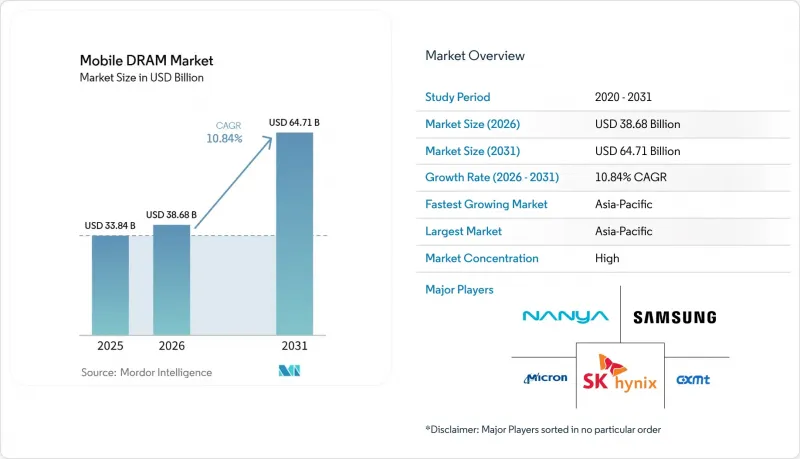
根據 Mordor Intelligence 預測,行動 DRAM 市場規模預計將在 2025 年達到 338.4 億美元,到 2031 年達到 647.1 億美元,2026 年至 2031 年的複合年成長率為 10.84%。
本報告按以下維度進行細分:LPDDR3、LPDDR4 和 LPDDR4X、LPDDR5 和 LPDDR5X、LPDDR6;封裝容量(4GB 以下、4GB 至 8GB、8GB 至 16GB、16GB 以上);封裝結構(獨立 LPDDR 封裝、亞裝疊堆、北美地區)。市場預測以美元 (USD) 為單位。
全球行動DRAM市場趨勢與洞察
人工智慧智慧型手機的普及提高了每台設備對LPDDR的需求。
隨著設備內AI從旗艦功能走向高階智慧型手機的標配,行動DRAM市場對單機記憶體的需求顯著成長。 2025年旗艦機型的平均記憶體容量為12GB,預計到2028年將達到18GB,因為生成式AI任務、即時影像處理和持續運作的神經網路功能需要更大、更快的本地記憶體池。這項轉變意義重大,因為AI功能不僅依賴大容量內存,還依賴持續的高頻寬存取和低功耗。因此,能夠同時提升速度和效率的供應商更有可能獲得高級產品的訂單。 SK海力士宣布,其於2026年3月完成檢驗的1c LPDDR6內存,在超過10.7Gbps的速度下,數據處理速度比LPDDR5X提升了33%,能源效率提升了20%。這直接瞄準了專為設備內AI工作負載設計的智慧型手機和平板電腦。因此,高階 AI 智慧型手機與傳統入門級機型之間的效能和價格差距將會更大,導致行動 DRAM 市場比以往的 DRAM 世代更趨兩極化。
將LPDDR部署到AI伺服器
此外,隨著LPDDR架構被應用於優先考慮頻寬和能源效率而非傳統DDR架構的AI伺服器和加速器設計中,行動DRAM市場正從行動電話設備擴展到更廣泛的領域。 AWS已在其基於Arm架構的Graviton4伺服器晶片中採用了LPDDR5X,微軟也已將其整合到基於Arm架構的Cobalt 100處理器中。這是因為與DDR5相比,LPDDR5X在顯著降低功耗的同時,還能提升頻寬。英特爾的Crescent Island AI推理GPU使用了160GB的LPDDR5X,而高通的AI200和AI250伺服器加速器則支援高達768GB的LPDDR。這表明,行動記憶體設計方面的專業知識正被直接應用於資料中心硬體。預計到2027年,光是NVIDIA的Vera Rubin平台對LPDDR的需求就將達到60億GB,略高於蘋果和三星同年為智慧型手機購買的LPDDR總量。這清晰地顯示了這個新興需求來源的成長速度之快。就在幾年前,主流行動應用規劃中還未出現這項需求來源,導致晶圓分配緊張,並提升了能夠獲得設備和伺服器環境產品認證的供應商的戰略價值。
HBM 和 DDR5 的分配給 LPDDR 晶圓生產能力帶來了壓力。
行動DRAM市場短期內最大的限制因素是HBM和DDR5佔用了原本用於智慧型手機、平板電腦及相關邊緣平台LPDDR生產的晶圓產能。由於HBM生產所需的晶圓產能與標準DRAM相比存在3:1的比例,因此即使LPDDR的名義需求有所改善,HBM產能的每次擴張都會導致LPDDR供應能力的進一步收緊。 SK海力士計劃在2025年底前實現近乎同步的生產和出貨庫存水平,而LPDDR5X在部分供應鏈環節的交付週期為26至39週,這凸顯了可用產能的緊張程度。預計三星平澤新廠的運作以及SK海力士的擴建計畫在2027年之前都無法緩解產能緊張的局面,因此在預測期初期,產能分配壓力可能會持續存在。因此,物價將保持堅挺,出貨量的成長也將緩慢,這意味著行動DRAM市場在以金額為準上的成長速度將快於實際出貨量的成長速度。
細分市場分析
2025年,LPDDR5和LPDDR5X佔據了行動DRAM市場57.8%的佔有率,即使在LPDDR6實現商業化之前,這一代產品仍然是銷售的核心。這一地位反映出,這一代產品已被視為旗艦智慧型手機、AI PC和新興AI伺服器設計中高負載工作頻寬運行頻寬的標竿。 2025年,LPDDR4X也佔據了總比特輸出的42%,但隨著三星停止新的供應,收入中心正從傳統產品轉向新的製程節點。此外,JEDEC框架於2025年8月制定的通用最低合規標準,使得老一代產品難以在高階晶片組藍圖中繼續佔有一席之地。
LPDDR6是成長最快的記憶體層,預計到2031年將以12.9%的複合年成長率成長,這一速度反映出高階裝置和平台設計正努力快速適應記憶體效能的下一代變革。 SK海力士在2026年IEEE ISSCC大會上發布了其首款LPDDR6設計,進一步鞏固了其在下一代旗艦產品認證的先發優勢。設計實現了每腳14.4 Gb/s的傳輸速度,頻寬提升33%,能源效率比LPDDR5X提升20%以上。三星也在同一會議上發布了12nm製程的LPDDR6架構,實現了每引腳12.8 Gb/s的傳輸速度和21%的能效提升,並隨後向高通提供了LPDDR6X樣品。這顯示市場競爭日趨激烈。 LPDDR3 目前的相關性有限,主要體現在傳統嵌入式設備和工業應用場景中,而行動 DRAM 市場正日益被從 LPDDR4X 到 LPDDR5X 再到 LPDDR6 的過渡路徑所定義。
區域分析
預計到2025年,亞太地區將佔據行動DRAM市場61.1%的佔有率,並在2031年之前以11.5%的複合年成長率成長。這將確保該地區在供需方面保持中心地位。韓國憑藉三星平澤工廠和SK海力士的M15X及計畫中的M17擴建項目,仍是核心生產基地。同時,中國正透過CXMT提高LPDDR5X的量產能力和擴大國內認證範圍來強化其市場地位。根據CXMT 2026年IPO招股說明書中的數據,該公司在2025年第四季佔據了全球DRAM市場7.7%的佔有率,凸顯了主要供應商集團底層結構的變化。台灣在封裝領域扮演著至關重要的角色,其生態系統支援全球客戶在先進行動設計中採用PoP和SiP整合方案。 2026年7月,美光公司為其廣島工廠擴建計畫舉行了奠基儀式,該計畫總投資額達1.5兆日圓(約93億美元)。該計畫獲得了日本經濟產業省高達5,000億日圓(約31億美元)的資金支持,這將進一步鞏固日本作為該地區第二大科技中心的地位。
北美在行動DRAM市場的地位更取決於其技術藍圖和超大規模資料中心業者的需求,而非其目前的產量佔有率。美光計畫在2035年向其美國製造地投資超過2500億美元,目標是使其40%的DRAM產量來自美國本土晶圓廠,儘管預計主要的移動相關產品供應要到2027年才會開始。歐洲市場則以需求主導,LPDDR5X被軟體定義汽車和高級駕駛輔助系統(ADAS)應用於集中式駕駛座和運算平台。基於汽車安全和網路安全框架的合規性要求,為歐洲市場的需求提供了比僅依賴消費性電子產品更穩定的基礎。
在世界其他地區,行動DRAM市場的主要驅動力仍然是智慧型手機的普及和5G的部署,而非本地晶片生產。南美、中東和非洲以及南亞部分地區仍然是主要的消費需求中心,這些地區的記憶體需求趨勢很大程度上取決於全球行動電話製造商採購記憶體的價格。 CXMT的LPDDR4X和LPDDR5產品已進入服務這些地區的安卓供應鏈,其中包括在撒哈拉以南非洲地區擁有強大市場佔有率的品牌。此外,在海灣市場,隨著電動車進口的增加,依賴LPDDR5X級車載記憶體的ADAS車型數量也隨之增加,對車載記憶體的需求也開始成長。
其他好處:
- Excel格式的市場預測(ME)表
- 3個月的分析師支持
目錄
第1章:引言
- 研究假設和市場定義
- 調查範圍
第2章:調查方法
第3章執行摘要
第4章 市場狀況
- 市場概覽
- 市場促進因素
- 人工智慧智慧型手機正在增加每台裝置安裝的LPDDR記憶體容量。
- 隨著 5G優質化,LPDDR5 和 LPDDR5X 的採用也不斷推進。
- 將LPDDR部署到AI伺服器和客戶端模組
- 軟體定義車輛 (SDV) 和高級駕駛輔助系統 (ADAS) 正在推動汽車產業的普及應用。
- LPDDR4X 的供不應求正在加速更新換代週期。
- 超薄筆記型電腦和人工智慧電腦正在推動焊接式 LPDDR 記憶體的發展。
- 市場限制因素
- 供應端的高度集中加劇了價格波動的劇烈程度。
- HBM 和 DDR5 的配額分配給行動 DRAM 的供應帶來了壓力。
- 先進節點的良率和認證風險正在減緩 LPDDR6 成本的降低。
- 智慧型手機的價格壓力正在減緩低價和中價位設備的普及速度。
- 產業價值鏈分析
- 監理情勢
- 技術展望
- 宏觀經濟因素對市場的影響
- 波特五力分析
第5章 市場規模與成長預測
- 按世代
- LPDDR3
- LPDDR4 和 LPDDR4X
- LPDDR5 和 LPDDR5X
- LPDDR6
- 因此,按產能計算。
- 4 GB 或更少
- 4 GB~8 GB
- 8 GB~16 GB
- 16 GB 或更多
- 軟體包配置
- 分立式LPDDR封裝
- 包裝上的包裝
- 多晶片封裝(MCP)
- 系統級封裝 (SiP)
- 按地區
- 北美洲
- 歐洲
- 亞太地區
- 中國
- 日本
- 韓國
- 台灣
- 其他亞太國家
- 世界其他地區
第6章 競爭情勢
- 市場集中度
- 策略趨勢
- 市佔率分析
- 公司簡介
- Samsung Electronics Co., Ltd.
- SK hynix Inc.
- Micron Technology, Inc.
- ChangXin Memory Technologies, Inc.
- Nanya Technology Corporation
- Integrated Silicon Solution, Inc.
- Elite Semiconductor Microelectronics Technology Inc.
- AP Memory Technology Corporation
- Etron Technology, Inc.
第7章 市場機會與未來展望
According to Mordor Intelligence, the mobile DRAM market size stood at USD 33.84 billion in 2025 and is forecast to reach USD 64.71 billion by 2031, growing at a CAGR of 10.84% from 2026 to 2031.
This report is Segmented by Generation (LPDDR3, LPDDR4 and LPDDR4X, LPDDR5 and LPDDR5X, and LPDDR6), Package Capacity (Up To 4 GB, 4 GB To 8 GB, 8 GB To 16 GB, and Above 16 GB), Package Configuration (Discrete LPDDR Packages, Package-On-Package, Multi-Chip Packages, and More), and Geography (North America, Europe, Asia-Pacific, and Rest of the World). The Market Forecasts are Provided in Terms of Value (USD).
Global Mobile DRAM Market Trends and Insights
AI Smartphones Increasing Per-Device LPDDR Demand
The mobile DRAM market is seeing a clear rise in per-device memory demand as on-device AI moves from headline features into shipping products across the premium smartphone tier. Flagship configurations averaged 12 GB in 2025, and those same platforms are moving toward 18 GB by 2028 as generative AI tasks, real-time image processing, and always-on neural features require a larger and faster local memory pool. This shift matters because AI features depend on sustained high-bandwidth access and low power draw, not only on raw capacity, so suppliers that improve both speed and efficiency are better placed to capture premium programs. SK hynix said its 1c LPDDR6, validated in March 2026, delivers 33% faster data processing and 20% better power efficiency than LPDDR5X at speeds above 10.7 Gbps, directly targeting smartphones and tablets built for on-device AI workloads. The result is a wider performance and pricing gap between premium AI phones and legacy entry devices, making the mobile DRAM market more polarized than during earlier DRAM generation transitions.
LPDDR Expansion Into AI Servers
The mobile DRAM market is also expanding beyond handsets as LPDDR architectures move into AI server and accelerator designs that prioritize bandwidth and power efficiency over older DDR-centric configurations. AWS adopted LPDDR5X in its Arm-based Graviton4 server chip, and Microsoft integrated LPDDR5X into its Arm-based Cobalt 100 processor because it can materially reduce power use while increasing bandwidth relative to DDR5. Intel's Crescent Island AI inference GPU uses 160 GB of LPDDR5X, and Qualcomm's AI200 and AI250 server accelerators support up to 768 GB of LPDDR, which shows that mobile memory design expertise now has a direct path into data center hardware. Demand from NVIDIA's Vera Rubin platform alone was estimated at 6 billion GB of LPDDR in 2027, slightly above the combined smartphone LPDDR procurement of Apple and Samsung that year, underscoring how quickly this new demand pool is scaling. Because this demand source did not exist in mainstream mobile planning a few years ago, it is tightening wafer allocation and raising the strategic value of suppliers that can qualify products for both device and server environments.
HBM And DDR5 Allocation Crowding Out LPDDR Wafer Capacity
The biggest near-term brake on the mobile DRAM market is that HBM and DDR5 are taking wafer space that would otherwise support LPDDR output for smartphones, tablets, and related edge platforms. HBM production carries a 3-to-1 wafer capacity trade-off compared to standard DRAM, so each incremental HBM push tightens LPDDR availability even as nominal LPDDR demand conditions improve. SK hynix reached near-produce-and-ship inventory status in late 2025, while LPDDR5X delivery times stretched to 26 to 39 weeks across parts of the supply chain, underscoring how narrow the available cushion had become. New fab additions from Samsung's Pyeongtaek complex and SK hynix's expansion pipeline are not expected to bring structural relief before 2027, so the early part of the forecast period remains exposed to allocation pressure. This keeps prices firm and delays volume realization, allowing the mobile DRAM market to grow in value faster than in physical shipments.
Other drivers and restraints analyzed in the detailed report include:
- 5G Premiumization Raising LPDDR Demand
- LPDDR4X Scarcity Forcing Refresh To Higher Generations
- Smartphone Cost Pressure Slowing Upgrade Cycle
For complete list of drivers and restraints, kindly check the Table Of Contents.
Segment Analysis
LPDDR5 and LPDDR5X held 57.8% of the mobile DRAM market size in 2025, which kept this generation at the center of revenue even before LPDDR6 reached commercial scale. Their position reflects the fact that flagship smartphones, AI PCs, and emerging AI server designs already treat this generation as the working bandwidth baseline for advanced workloads. LPDDR4X still accounted for 42% of total bit output in 2025, but Samsung's exit from new supply is shifting the revenue center of gravity away from legacy products and toward newer nodes. The August 2025 JEDEC framework also set a common compliance floor, which made it harder for older generations to stay relevant in premium chipset road maps.
LPDDR6 is the fastest-growing generation at a 12.9% CAGR through 2031, and that pace reflects how quickly high-end device and platform designs are preparing for the next shift in memory performance. SK hynix presented a 1c LPDDR6 design at IEEE ISSCC 2026 with 14.4 Gb/s per pin, 33% higher bandwidth, and more than 20% better energy efficiency than LPDDR5X, which strengthens its early position in the next wave of flagship qualifications. Samsung presented a 12nm-class LPDDR6 architecture at the same conference with 12.8 Gb/s per pin and a 21% power efficiency improvement, and it later sent LPDDR6X samples to Qualcomm, which shows how quickly the competitive bar is moving. LPDDR3 now has only limited relevance in legacy embedded and industrial use cases, so the mobile DRAM market is increasingly defined by the migration path from LPDDR4X to LPDDR5X and then to LPDDR6.
Complete Report Scope:
- By Generation
- LPDDR3
- LPDDR4 and LPDDR4X
- LPDDR5 and LPDDR5X
- LPDDR6
- By Package Capacity
- Up to 4 GB
- 4 GB to 8 GB
- 8 GB to 16 GB
- Above 16 GB
- By Package Configuration
- Discrete LPDDR Packages
- Package-on-Package
- Multi-Chip Packages (MCP)
- System-in-Package (SiP)
- By Geography
- North America
- Europe
- Asia-Pacific
- China
- Japan
- South Korea
- Taiwan
- Rest of Asia-Pacific
- Rest of the World
Geography Analysis
Asia-Pacific held 61.1% of the mobile DRAM market share in 2025 and is projected to grow at an 11.5% CAGR through 2031, which keeps the region at the center of both supply and demand. South Korea remains the core production base through Samsung's Pyeongtaek complexes and SK hynix's M15X and planned M17 expansion path, while China is building its role through CXMT's LPDDR5X ramp and wider domestic qualification. CXMT reached a 7.7% share of the global DRAM market in the fourth quarter of 2025, according to data cited in its 2026 IPO prospectus, which confirmed a structural change below the leading supplier group. Taiwan adds a critical packaging layer because its ecosystem supports both Package-on-Package and System-in-Package integration programs for global customers across advanced mobile designs. Micron broke ground on a JPY 1.5 trillion (USD 9.3 billion) Hiroshima expansion in July 2026, and the project included up to JPY 500 billion (USD 3.1 billion) in support from Japan's Ministry of Economy, Trade and Industry, which reinforces Japan's role as a secondary regional anchor.
North America's position in the mobile DRAM market is shaped more by technology road maps and hyperscaler demand than by current production share. Micron said it plans to invest more than USD 250 billion in United States manufacturing through 2035 and aims for 40% of its DRAM output to come from domestic fabs, although major new mobile-relevant supply will arrive after 2027. Europe is more demand driven, with software-defined vehicles and advanced driver assistance systems pulling LPDDR5X into centralized cockpit and compute platforms. Compliance requirements under automotive safety and cybersecurity frameworks give European demand a steadier base than consumer electronics cycles alone.
In the rest of the world, the mobile DRAM market remains tied mainly to smartphone adoption and 5G rollout rather than to local chip production. South America, the Middle East and Africa, and parts of South Asia are still consumer demand centers, so their memory content trend depends heavily on what global handset brands can source at workable price points. CXMT's LPDDR4X and LPDDR5 products have already entered Android supply chains that serve these regions, including brands with strong positions in sub-Saharan Africa. Gulf markets are also starting to add automotive memory demand as electric vehicle imports bring more ADAS-equipped models that rely on LPDDR5X-class in-vehicle memory.
- Samsung Electronics Co., Ltd.
- SK hynix Inc.
- Micron Technology, Inc.
- ChangXin Memory Technologies, Inc.
- Nanya Technology Corporation
- Integrated Silicon Solution, Inc.
- Elite Semiconductor Microelectronics Technology Inc.
- AP Memory Technology Corporation
- Etron Technology, Inc.
Additional Benefits:
- The market estimate (ME) sheet in Excel format
- 3 months of analyst support
TABLE OF CONTENTS
1 INTRODUCTION
- 1.1 Study Assumptions and Market Definition
- 1.2 Scope of the Study
2 RESEARCH METHODOLOGY
3 EXECUTIVE SUMMARY
4 MARKET LANDSCAPE
- 4.1 Market Overview
- 4.2 Market Drivers
- 4.2.1 AI Smartphones Increasing Per-Device LPDDR Content
- 4.2.2 5G Premiumization Raising LPDDR5 and LPDDR5X Adoption
- 4.2.3 LPDDR Expansion Into AI Servers and Client Modules
- 4.2.4 Software-Defined Vehicles and ADAS Raising Automotive Design-Ins
- 4.2.5 LPDDR4X Scarcity Forcing Refresh Cycles
- 4.2.6 Ultra-Thin Notebooks and AI PCs Favoring Soldered LPDDR
- 4.3 Market Restraints
- 4.3.1 High Supplier Concentration Amplifying Pricing Volatility
- 4.3.2 HBM and DDR5 Allocation Crowding Out Mobile DRAM Supply
- 4.3.3 Advanced Node Yield and Qualification Risk Delaying LPDDR6 Cost Down
- 4.3.4 Smartphone Cost Pressure Slowing Penetration in Low and Mid-Tier Devices
- 4.4 Industry Value Chain Analysis
- 4.5 Regulatory Landscape
- 4.6 Technological Outlook
- 4.7 Impact of Macroeconomic Factors on the Market
- 4.8 Porter's Five Forces Analysis
- 4.8.1 Bargaining Power of Suppliers
- 4.8.2 Bargaining Power of Buyers
- 4.8.3 Threat of New Entrants
- 4.8.4 Threat of Substitutes
- 4.8.5 Intensity of Competitive Rivalry
5 MARKET SIZE AND GROWTH FORECASTS (VALUE)
- 5.1 By Generation
- 5.1.1 LPDDR3
- 5.1.2 LPDDR4 and LPDDR4X
- 5.1.3 LPDDR5 and LPDDR5X
- 5.1.4 LPDDR6
- 5.2 By Package Capacity
- 5.2.1 Up to 4 GB
- 5.2.2 4 GB to 8 GB
- 5.2.3 8 GB to 16 GB
- 5.2.4 Above 16 GB
- 5.3 By Package Configuration
- 5.3.1 Discrete LPDDR Packages
- 5.3.2 Package-on-Package
- 5.3.3 Multi-Chip Packages (MCP)
- 5.3.4 System-in-Package (SiP)
- 5.4 By Geography
- 5.4.1 North America
- 5.4.2 Europe
- 5.4.3 Asia-Pacific
- 5.4.3.1 China
- 5.4.3.2 Japan
- 5.4.3.3 South Korea
- 5.4.3.4 Taiwan
- 5.4.3.5 Rest of Asia-Pacific
- 5.4.4 Rest of the World
6 COMPETITIVE LANDSCAPE
- 6.1 Market Concentration
- 6.2 Strategic Moves
- 6.3 Market Share Analysis
- 6.4 Company Profiles (includes Global Level Overview, Market Level Overview, Core Segments, Financials as available, Strategic Information, Market Rank/Share, Products and Services, Recent Developments)
- 6.4.1 Samsung Electronics Co., Ltd.
- 6.4.2 SK hynix Inc.
- 6.4.3 Micron Technology, Inc.
- 6.4.4 ChangXin Memory Technologies, Inc.
- 6.4.5 Nanya Technology Corporation
- 6.4.6 Integrated Silicon Solution, Inc.
- 6.4.7 Elite Semiconductor Microelectronics Technology Inc.
- 6.4.8 AP Memory Technology Corporation
- 6.4.9 Etron Technology, Inc.
7 MARKET OPPORTUNITIES AND FUTURE OUTLOOK
- 7.1 White-Space and Unmet-Need Assessment

 特種DRAM市場:全球市場預測,2026-2032年
 2026-2030年全球DRAM模組及組件市場DRAM模組及組件市場-2026-2032年全球市場預測
 伺服器DRAM:市場佔有率分析、產業趨勢與統計、成長預測(2026-2031年)CXL連接的DRAM模組:市佔率分析、產業趨勢與統計數據、成長預測(2026-2031)用於DRAM的矽晶圓:市場佔有率分析、行業趨勢和統計數據以及成長預測(2026-2031年)
 DRAM市場預測至2034年-按類型、容量、外形規格、製程節點、應用、通路和地區分類的全球分析
 自旋傳輸矩MRAM市場機會、成長要素、產業趨勢分析及2026-2035年預測
 動態隨機存取記憶體 (DRAM) 市場規模、佔有率、趨勢和預測:按類型、技術、最終用戶和地區分類,2026-2034 年
 隨機存取記憶體(RAM)市場:按類型、產品類型和地區分類