


 |
市場調查報告書
商品編碼
2117513
伺服器DRAM:市場佔有率分析、產業趨勢與統計、成長預測(2026-2031年)Server DRAM - Market Share Analysis, Industry Trends & Statistics, Growth Forecasts (2026 - 2031) |
||||||

※ 本網頁內容可能與最新版本有所差異。詳細情況請與我們聯繫。
據 Mordor Intelligence 稱,2025 年伺服器 DRAM 市值為 378.8 億美元,預計到 2031 年將達到 985.7 億美元,而 2026 年為 444.3 億美元,預測期(2026-2031 年)的複合年成長率為 17.28%。
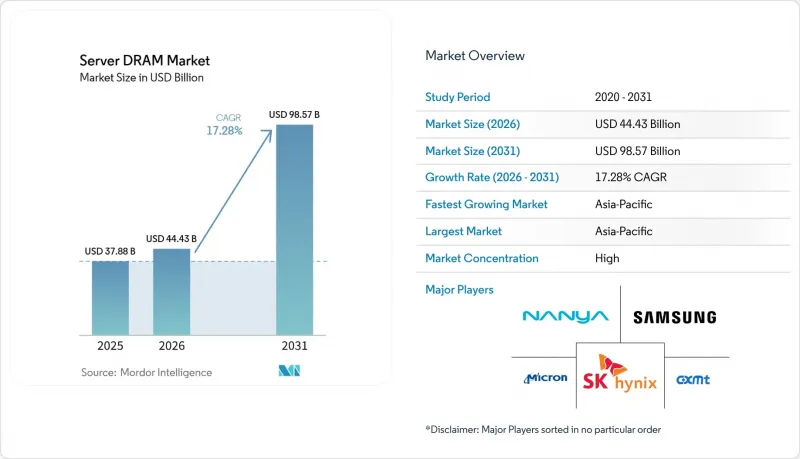
本報告按記憶體技術(DDR4 伺服器 DRAM、DDR5 伺服器 DRAM 等)、單模組容量(最高 32GB、32GB-128GB、128GB-256GB 等)、伺服器類型(通用伺服器、邊緣伺服器、營運商伺服器等)、最終用戶(超大規模雲端服務供應商、企業資料中心等)和地區細分。市場預測以美元計價。
全球伺服器DRAM市場趨勢與洞察
AI伺服器每個節點的記憶體佔用量正在增加。
隨著人工智慧伺服器架構的不斷演進,伺服器DRAM市場中每個節點所需的CPU連接DRAM容量也不斷成長。隨著生成式人工智慧工作負載從訓練轉向持續推理,鍵值快取(KV快取)的需求往往超過了片上HBM的容量,越來越多的記憶體負載轉移到了主機系統內的高容量DDR5 RDIMM記憶體上。在長上下文工作負載中,這種趨勢更為顯著,KV快取需求與上下文長度和批次大小成正比成長。據美光科技稱,將KV快取遷移到1.5TB的CPU連接內存,可將「首次令牌到達時間」(Time-to-First-Token)縮短高達98%,並將長上下文即時推理中並發請求的批處理大小提高了一倍。這一事實意義重大,因為它表明記憶體不僅支援模型執行,而且越來越決定推理伺服器的實際吞吐量特性。因此,伺服器 DRAM 市場不僅受到專用加速器叢集的推動,而且受到越來越多承擔 AI 記憶體負載的 CPU 伺服器的推動。
企業從DDR4過渡到DDR5的更新週期
從DDR4到DDR5的平台過渡已超越早期採用階段,如今正在整個伺服器DRAM市場形成廣泛的企業級更新周期。英特爾至強6和AMD EPYC Turin伺服器系列均採用DDR5專用記憶體介面,這意味著下一代伺服器配置將不再向下相容DDR4。根據JEDEC標準,DDR5的頻寬為3200 MT/s,是DDR4的1.7到2.1倍,並採用雙32位子通道架構,從而提高了片上ECC和突發傳輸效率。考慮到2024年和2025年的部署規模,北美和歐洲在未來幾年仍有升級空間,因為許多金融服務、醫療保健和政府資料中心仍然採用較長的硬體升級週期。一個不太為人所知的影響是模組組裝層面的不匹配日益加劇,因為上游晶片供應正被致力於大規模部署DDR5的超大規模超大規模資料中心業者所吸收,而DDR4庫存可能會停滯不前。此外,JEDEC 的互通性標準消除了對專有生態系統的依賴,從而減少了客戶的猶豫,並加速了伺服器 DRAM 市場信心的建立。
擴大HBM產能將導致伺服器DRAM供應短缺。
伺服器DRAM市場短期內最大的限制因素是,大部分晶圓產能被轉移到了HBM(高密度金屬-雙金屬)晶片的生產。因此,分配給標準DDR5 RDIMM和LPDRAM伺服器模組的產能正在減少。三星、SK海力士和美光等廠商都在進一步加大對HBM的投入,因為他們的AI記憶體產品定價更高,並且受到主流加速器平台的強勁戰略需求。儘管晶圓廠的整體投資持續成長,但這種產能分配選擇降低了伺服器記憶體整體供應的柔軟性。因此,非超大規模資料中心的買家面臨著高容量伺服器模組供應緊張的局面,這使得他們難以維持最初的採購預算和進度。這可能導致企業更新換代決策延遲、計畫部署數量減少,以及買家繼續使用舊配置的時間超出預期。這種限制因素可能會持續存在,直到HBM產能進一步擴大,整個記憶體供應鏈中新的前端產能開始放緩運作為止。
細分市場分析
到2025年,DDR5將佔據伺服器DRAM市場佔有率的53.2%,成為超大規模和企業級伺服器升級的主流技術。基於LPDRAM的伺服器模組是成長最快的技術類別,預計從2026年到2031年將以19.21%的複合年成長率成長,因為採用SOCAMM2封裝的LPDDR5X在AI CPU伺服器設計中將越來越普及。 2025年10月,JEDEC宣布JESD328 SOCAMM2標準即將完工。這意義重大,因為OEM廠商和超大規模資料中心業者在決定平台級採用之前,都在尋求跨多個供應商的互通性。 DDR4仍然用於傳統升級週期和一些CXL擴展應用,這使得伺服器DRAM市場的「長尾」持續時間比之前預測的要長。
美光將於2026年3月推出256GB LPDRAM SOCAMM2模組,顯示LPDRAM正從小眾市場走向主流,成為某些高容量伺服器架構的平台選項。此模組為每個8通道CPU提供2TB的LPDRAM,與同等RDIMM配置相比,功耗和面積均降低了三分之一。這對於機架密度和散熱預算緊張的環境至關重要。美光也表示,用於KV快取卸載的SOCAMM2模組可以將首端到達時間縮短高達98%,並將並發請求批次大小提高一倍。因此,伺服器DRAM市場正日益細分,針對不同的工作負載,DDR5 RDIMM更受頻寬密集型HPC和分析伺服器的青睞,而LPDRAM則在專注於推理的CPU伺服器設計中佔據越來越大的市場佔有率。這種兩極化很可能導致主要供應商繼續積極部署這兩種產品線,從而降低伺服器DRAM產業中一種技術完全取代另一種技術的可能性。
到2025年,32GB至128GB容量範圍將佔伺服器DRAM市場規模的46.8%,這反映了其作為企業資料中心、雲端基礎設施和通用伺服器部署標準記憶體容量範圍的地位。 256GB以上的容量範圍成長最快,預計從2026年到2031年將以19.86%的複合年成長率成長,因為人工智慧和高效能運算(HPC)工作負載將超過128GB配置的實際上限。向32Gb單晶片的轉變是主要的技術驅動力。這是為了支援128GB和256GB RDIMM,無需穿透矽通孔(TSV),從而提高功率密度和製造效率。 2025年12月,SK海力士的256GB DDR5 RDIMM獲得了英特爾資料中心認證。與傳統的基於 16Gb 的 256GB 模組相比,該產品的推理效能提高了 16%,功耗降低了 18%。
英特爾的認證架構透過降低OEM廠商和終端用戶的平台整合風險,協助伺服器DRAM市場快速轉型為高容量模組。 2024年5月,美光率先在業界檢驗並交付了採用32Gb 1B技術的128GB DDR5 RDIMM內存條,其位密度較競爭對手的3DS TSV產品提升了45%,能源效率提升了22%。 32GB及以下容量的記憶體仍然服務於邊緣伺服器、通訊基礎設施和輕量級企業工作負載,雖然並非主要成長動力,但需求基礎依然穩定。 128GB至256GB容量範圍也日益受到重視,成為運行專家模型(MoE)和記憶體內分析混合模型的AI增強型企業伺服器的標準配置。在整個預測期內,由於每位元成本的降低和認證範圍的擴大,中階和超高容量模組之間的差距預計將在整個伺服器DRAM市場中穩步縮小。
區域分析
亞太地區是成長最快的區域市場,預計到2025年將佔伺服器DRAM市場規模的43.9%,並預計到2031年將以18.27%的複合年成長率成長。韓國仍是全球DRAM製造中心,SK海力士位於龍仁的Y1工廠投資31兆韓元(約228億美元),預計2027年初投產。同時,清州M15X工廠計畫在2026年底將產能擴大到每月7萬片晶圓。日本也仍佔據重要地位,受人工智慧和資料中心需求的推動,半導體相關企業累計2025年將實現創紀錄的合併淨利。在中國,隨著國內雲端服務供應商不斷擴大其人工智慧資料中心的容量,中國在伺服器DRAM市場的佔有率也不斷成長。此外,2026年第一季,CXMT的全球DRAM市佔率年增,從3%提升至8%,主要得益於其對國內DDR4伺服器市場的供應。同時,在印度和亞太其他地區,隨著自主雲端計畫和政府支持的國家人工智慧基礎設施項目的推進,市場需求也不斷成長。
北美是全球第二大伺服器DRAM市場,其龐大的超大規模雲端平台和許多領先的AI雲端叢集推動了對高容量DDR5 RDIMM和LPDRAM模組的需求。美國營運商持續擴展全球一些最大的AI伺服器集群,從而支撐了加速器叢集和推理最佳化型CPU伺服器組對128GB和256GB模組的強勁需求。美光科技於2026年5月在其位於維吉尼亞馬納薩斯的工廠開始生產1-alpha DRAM,標誌著商業性意義的美國國內DRAM生產的啟動,並與一項價值2000億美元的更廣泛的美國多站點製造計劃相契合。加拿大正在加強其在安大略省和魁北克省的雲端基礎設施走廊建設,而隨著北美供應鏈的轉移,墨西哥正在崛起為相對低容量資料中心營運的近岸外包中心。由於AI部署和企業升級對高階記憶體配置的偏好,該地區也擁有最高的單機架收入。
歐洲伺服器DRAM市場主要受企業資料中心現代化、金融服務和製造業雲端運算應用以及德國、法國和英國資料主權法規的推動。德國的超大規模項目和英國金融服務業的更新週期在2025年支撐了銷售成長,而義大利和其他市場則受益於歐盟支持的數位基礎設施項目。包括中東、非洲和南美在內的世界其他地區,由於政府主導的人工智慧資料中心專案和超大規模建設為伺服器DRAM創造了新的需求來源,因此市場正在從小規模的基數成長。由於供應鏈較長且本地直接生產能力仍然有限,歐洲和世界其他地區的伺服器DRAM價格仍高於亞太地區。
其他好處:
- Excel格式的市場預測(ME)表
- 3個月的分析師支持
目錄
第1章:引言
- 研究假設和市場定義
- 調查範圍
第2章:調查方法
第3章執行摘要
第4章 市場狀況
- 市場概覽
- 市場促進因素
- AI伺服器的每個節點記憶體使用量正在增加。
- 各公司正在將記憶體更新周期從DDR4過渡到DDR5。
- 32GB晶片支援128GB和256GB RDIMM記憶體條。
- CXL連接的記憶體擴充和池化
- 擴展針對人工智慧和高效能運算平台的 MRDIMM頻寬
- 現在已有基於 LPDRAM 的伺服器模組可用於推理伺服器。
- 市場限制因素
- HBM產能的擴張導致伺服器DRAM供應短缺。
- 伺服器DRAM價格飆升,長期供應短缺
- MRDIMM生態系的不成熟與平台集中度
- CXL軟體的開銷和延遲阻礙了其廣泛應用。
- 產業價值鏈分析
- 監理情勢
- 技術展望
- 波特五力分析
- 宏觀經濟因素對市場的影響
第5章 市場規模與成長預測
- 透過儲存技術
- DDR4 伺服器 DRAM
- DDR5 伺服器 DRAM
- 基於LPDRAM的伺服器模組
- 每個模組的容量
- 最高可達 32GB
- 32GB~128GB
- 128GB~256GB
- 256GB 或以上
- 按伺服器類
- 通用企業和雲端伺服器
- 人工智慧和高速運算伺服器
- 高效能運算和分析伺服器
- 儲存和資料基礎設施伺服器
- 面向邊緣運算和電信業者的伺服器
- 其他伺服器類
- 最終用戶
- 超大規模雲端供應商
- 企業資料中心
- 電信營運商和網路營運商
- 政府、國防機構、研究機構
- 託管和託管基礎設施提供商
- AI基礎設施和GPU雲端供應商
- 其他最終用戶
- 按地區
- 北美洲
- 歐洲
- 亞太地區
- 中國
- 日本
- 韓國
- 台灣
- 其他亞太國家
- 世界其他地區
第6章 競爭情勢
- 市場集中度
- 策略趨勢
- Vendor Positioning Analysis
- 公司簡介
- Samsung Electronics Co., Ltd.
- SK hynix Inc.
- Micron Technology, Inc.
- Nanya Technology Corporation
- ChangXin Memory Technologies
- SMART Modular Technologies, Inc.
- Kingston Technology Company, Inc.
- ADATA Technology Co., Ltd.
- Innodisk Corporation
- Apacer Technology Inc.
- Transcend Information, Inc.
- ATP Electronics, Inc.
- Virtium LLC
- Netlist, Inc.
- Rambus Inc.
- Renesas Electronics Corporation
- Montage Technology Co., Ltd.
- Astera Labs, Inc.
- Marvell Technology, Inc.
第7章 市場機會與未來展望
According to Mordor Intelligence, the server DRAM market size was valued at USD 37.88 billion in 2025 and is estimated to grow from USD 44.43 billion in 2026 to reach USD 98.57 billion by 2031, at a CAGR of 17.28% during the forecast period (2026-2031).
This report is Segmented by Memory Technology (DDR4 Server DRAM, DDR5 Server DRAM, and More), Capacity Per Module (Up To 32GB, 32GB - 128GB, 128GB - 256GB, and More), Server Class (General-Purpose, Edge and Telco Server, and More), End User (Hyperscale Cloud Provider, Enterprise Data Center, and More), and Geography (North America, Asia-Pacific, and More). The Market Forecasts are Provided in Terms of Value (USD).
Global Server DRAM Market Trends and Insights
AI Server Memory Intensity Rising Per Node
Each new generation of AI server architecture is raising the amount of CPU-attached DRAM needed per node in the server DRAM market. As generative AI workloads shift from training to sustained inference, KV cache requirements often exceed on-chip HBM capacity, shifting more of the memory burden to high-capacity DDR5 RDIMMs in host systems. Long-context workloads deepen this effect because KV cache demand scales with both context length and batch size. Micron reported that moving KV cache to 1.5TB of CPU-attached memory reduced time-to-first-token by up to 98% and supported 2x larger concurrent request batch sizes in long-context real-time inference. That evidence matters because it shows that memory is not only supporting model execution, but it is increasingly setting the usable throughput profile of inference servers. As a result, the server DRAM market is being lifted not only by dedicated accelerator clusters, but also by a growing class of CPU server deployments that now carry AI memory loads.
Enterprise Refresh Cycle Shifting From DDR4 To DDR5
The DDR4-to-DDR5 platform transition has moved beyond early adopters and is now shaping a broad enterprise refresh cycle across the server DRAM market. Intel Xeon 6 and AMD EPYC Turin server families standardize on DDR5-only memory interfaces, which removes backward compatibility with DDR4 in next-generation server configurations. JEDEC states that DDR5 provides 1.7x to 2.1x the bandwidth of DDR4 at 3,200MT/s, along with on-die ECC and dual 32-bit sub-channel architecture that improves burst efficiency. The installed base from 2024 and 2025 gives North America and Europe a multi-year refresh runway because many financial services, healthcare, and government data centers still operate on longer hardware replacement cycles. A less visible effect is the growing mismatch at the module assembly layer, where DDR4 inventory can become stranded while upstream die supply is absorbed by hyperscalers that are locking in DDR5 volume. JEDEC interoperability standards also reduce customer hesitation because the transition does not depend on a proprietary ecosystem, which supports faster confidence building in the server DRAM market.
HBM Capacity Crowd-Out Tightening Server DRAM Supply
The biggest near-term constraint on the server DRAM market is that more wafer capacity is being directed toward HBM, which leaves less output available for standard DDR5 RDIMMs and LPDRAM server modules. Samsung, SK hynix, and Micron have all leaned further into HBM because AI memory products carry stronger pricing and stronger strategic pull from major accelerator platforms. That allocation choice reduces the flexibility of supply for ordinary server memory even while overall fab investment continues to rise. The direct result is that non-hyperscale buyers face a tighter supply environment for high-capacity server modules and have less room to hold to earlier procurement budgets or timelines. This can delay enterprise refresh decisions, reduce planned build volumes, and keep buyers in legacy configurations for longer than expected. The restraint is likely to remain in place while HBM ramps further and new front-end capacity comes online more gradually across the memory supply base.
Other drivers and restraints analyzed in the detailed report include:
- 32GB Dies Enabling 128GB And 256GB RDIMMs
- CXL-Attached Memory Expansion And Pooling
- Server DRAM Price Spikes And Long-Term Supply Lockups
For complete list of drivers and restraints, kindly check the Table Of Contents.
Segment Analysis
DDR5 held 53.2% of the server DRAM market share in 2025, which marked the point at which it became the majority technology across hyperscale and enterprise server refreshes. LPDRAM-based server modules are the fastest-growing technology category and are projected to expand at 19.21% CAGR from 2026 to 2031 as LPDDR5X in SOCAMM2 form factors gains acceptance in AI CPU server designs. JEDEC said in October 2025 that the JESD328 SOCAMM2 standard was nearing completion, which matters because OEMs and hyperscalers want interoperability across multiple suppliers before committing to platform-scale adoption. DDR4 still ships into legacy refresh cycles and into some CXL expansion uses, which gives the server DRAM market a longer tail than earlier deprecation expectations suggested.
Micron's March 2026 launch of a 256GB LPDRAM SOCAMM2 module showed that LPDRAM is moving beyond a niche role and becoming a platform option for select high-capacity server builds. The module provides 2TB of LPDRAM per 8-channel CPU and uses one-third the power and one-third the footprint of equivalent RDIMM configurations, which is meaningful where rack density and thermal budgets are tight. Micron also reported that SOCAMM2 modules used for KV cache offload can cut time-to-first-token by up to 98% and support 2x larger concurrent request batch sizes. That makes the server DRAM market more workload-specific, with DDR5 RDIMMs favored in bandwidth-heavy HPC and analytics servers, and LPDRAM gaining share in inference-focused CPU server designs. This split should keep both product tracks active across major suppliers and limit full substitution of one technology by the other in the server DRAM industry.
The 32GB-128GB tier accounted for 46.8% of the server DRAM market size in 2025, which reflected its position as the standard memory range for enterprise data centers, cloud infrastructure, and general server deployments. The above 256GB segment is growing fastest and is projected to record 19.86% CAGR from 2026 to 2031 as AI and HPC workloads move beyond the practical ceiling of 128GB configurations. The move to 32Gb monolithic dies is the key technical enabler because it supports 128GB and 256GB RDIMMs without through-silicon via stacking, which improves power density and manufacturing efficiency. SK hynix completed Intel Data Center Certification for a 256GB DDR5 RDIMM in December 2025, and that product delivered 16% higher inference performance and 18% lower power use than earlier 16Gb-based 256GB modules.
Intel's certification framework is helping the server DRAM market move more quickly toward larger modules because it reduces platform integration risk for OEMs and end buyers. Micron became the first supplier to validate and ship a 128GB DDR5 RDIMM using 32Gb 1B technology in May 2024, and it reported 45% higher bit density and 22% improved energy efficiency over competitive 3DS TSV products. The up to 32GB segment still serves edge servers, telecom infrastructure, and lighter enterprise workloads, which keeps its demand base stable even if it is not the main growth engine. The above 128GB-256GB range is also gaining ground as a standard fit for AI-augmented enterprise servers running mixture-of-experts models and in-memory analytics. Over the forecast period, lower cost per bit and wider certification coverage should steadily narrow the gap between mid-tier and ultra-high-capacity modules across the server DRAM market.
Complete Report Scope:
- By Memory Technology
- DDR4 Server DRAM
- DDR5 Server DRAM
- LPDRAM-based Server Modules
- By Capacity per Module
- Up to 32GB
- 32GB to 128GB
- 128GB to 256GB
- Above 256GB
- By Server Class
- General-Purpose Enterprise and Cloud Servers
- AI and Accelerated Computing Servers
- High-Performance Computing and Analytics Servers
- Storage and Data Infrastructure Servers
- Edge and Telco Servers
- Other Server Classes
- By End User
- Hyperscale Cloud Providers
- Enterprise Data Centers
- Telecom and Network Operators
- Government, Defense, and Research Institutions
- Colocation and Managed Infrastructure Providers
- AI Infrastructure and GPU Cloud Providers
- Other End Users
- By Geography
- North America
- Europe
- Asia-Pacific
- China
- Japan
- South Korea
- Taiwan
- Rest of Asia-Pacific
- Rest of the World
Geography Analysis
Asia-Pacific represented 43.9% of the server DRAM market size in 2025 and is also the fastest-growing regional market, with 18.27% CAGR projected through 2031. South Korea remains the center of global DRAM manufacturing, and SK hynix's Yongin Y1 fab, a KRW 31 trillion investment equal to USD 22.8 billion, is expected to begin operations in early 2027 while the M15X Cheongju site ramps toward 70,000 wafers per month by the end of 2026. Japan also remains important because semiconductor-related companies posted record combined net profits in fiscal year 2025, supported by AI and data center demand. China is increasing its role in the server DRAM market as domestic cloud service providers expand AI data center capacity, and CXMT lifted its global DRAM share from 3% to 8% year over year in Q1 2026 while mainly supplying the domestic DDR4 server segment. India and the rest of Asia-Pacific are also adding demand through sovereign cloud programs and government-backed national AI infrastructure projects.
North America is the second-largest server DRAM market and sets the demand pace for high-capacity DDR5 RDIMMs and LPDRAM modules because it hosts the largest hyperscale cloud platforms and several major AI cloud fleets. U.S.-based operators continue to scale some of the world's largest AI server fleets, which supports strong demand for 128GB and 256GB modules in both accelerator clusters and inference-optimized CPU server groups. Micron began 1-alpha DRAM production at its Manassas, Virginia facility in May 2026, which marked the start of commercially meaningful domestic DRAM output and aligned with a broader USD 200 billion multi-site U.S. manufacturing program. Canada is strengthening cloud infrastructure corridors in Ontario and Quebec, while Mexico is emerging as a nearshoring location for lighter data center operations tied to North American supply-chain changes. The region also carries the highest revenue per rack because AI deployments and enterprise refreshes favor premium memory configurations.
Europe's server DRAM market is being supported by enterprise data center modernization, cloud adoption in financial services and manufacturing, and sovereign data mandates in Germany, France, and the United Kingdom. German hyperscale projects and United Kingdom financial services refresh cycles supported 2025 revenue growth, while Italy and other markets benefited from EU-backed digital infrastructure programs. The Rest of the World region, which includes the Middle East, Africa, and South America, is growing from a smaller base as sovereign-backed AI data center projects and hyperscale buildouts create new demand pools for the server DRAM market. Europe and the Rest of the World continue to carry pricing premiums over Asia-Pacific because supply chains are longer and direct manufacturing remains limited.
- Samsung Electronics Co., Ltd.
- SK hynix Inc.
- Micron Technology, Inc.
- Nanya Technology Corporation
- ChangXin Memory Technologies
- SMART Modular Technologies, Inc.
- Kingston Technology Company, Inc.
- ADATA Technology Co., Ltd.
- Innodisk Corporation
- Apacer Technology Inc.
- Transcend Information, Inc.
- ATP Electronics, Inc.
- Virtium LLC
- Netlist, Inc.
- Rambus Inc.
- Renesas Electronics Corporation
- Montage Technology Co., Ltd.
- Astera Labs, Inc.
- Marvell Technology, Inc.
Additional Benefits:
- The market estimate (ME) sheet in Excel format
- 3 months of analyst support
TABLE OF CONTENTS
1 INTRODUCTION
- 1.1 Study Assumptions and Market Definition
- 1.2 Scope of the Study
2 RESEARCH METHODOLOGY
3 EXECUTIVE SUMMARY
4 MARKET LANDSCAPE
- 4.1 Market Overview
- 4.2 Market Drivers
- 4.2.1 AI Server Memory Intensity Rising per Node
- 4.2.2 Enterprise Refresh Cycle Shifting from DDR4 to DDR5
- 4.2.3 32GB Dies Enabling 128GB and 256GB RDIMMs
- 4.2.4 CXL-Attached Memory Expansion and Pooling
- 4.2.5 MRDIMM Bandwidth Ramp for AI and HPC Platforms
- 4.2.6 LPDRAM-Based Server Modules Emerging for Inference Servers
- 4.3 Market Restraints
- 4.3.1 HBM Capacity Crowd-Out Tightening Server DRAM Supply
- 4.3.2 Server DRAM Price Spikes and Long-Term Supply Lockups
- 4.3.3 MRDIMM Ecosystem Immaturity and Platform Concentration
- 4.3.4 CXL Software and Latency Overheads Slowing Broad Deployment
- 4.4 Industry Value Chain Analysis
- 4.5 Regulatory Landscape
- 4.6 Technological Outlook
- 4.7 Porter's Five Forces Analysis
- 4.7.1 Bargaining Power of Suppliers
- 4.7.2 Bargaining Power of Buyers
- 4.7.3 Threat of New Entrants
- 4.7.4 Threat of Substitute Products
- 4.7.5 Intensity of Competitive Rivalry
- 4.8 Impact of Macroeconomic Factors on the Market
5 MARKET SIZE AND GROWTH FORECASTS (VALUE)
- 5.1 By Memory Technology
- 5.1.1 DDR4 Server DRAM
- 5.1.2 DDR5 Server DRAM
- 5.1.3 LPDRAM-based Server Modules
- 5.2 By Capacity per Module
- 5.2.1 Up to 32GB
- 5.2.2 32GB to 128GB
- 5.2.3 128GB to 256GB
- 5.2.4 Above 256GB
- 5.3 By Server Class
- 5.3.1 General-Purpose Enterprise and Cloud Servers
- 5.3.2 AI and Accelerated Computing Servers
- 5.3.3 High-Performance Computing and Analytics Servers
- 5.3.4 Storage and Data Infrastructure Servers
- 5.3.5 Edge and Telco Servers
- 5.3.6 Other Server Classes
- 5.4 By End User
- 5.4.1 Hyperscale Cloud Providers
- 5.4.2 Enterprise Data Centers
- 5.4.3 Telecom and Network Operators
- 5.4.4 Government, Defense, and Research Institutions
- 5.4.5 Colocation and Managed Infrastructure Providers
- 5.4.6 AI Infrastructure and GPU Cloud Providers
- 5.4.7 Other End Users
- 5.5 By Geography
- 5.5.1 North America
- 5.5.2 Europe
- 5.5.3 Asia-Pacific
- 5.5.3.1 China
- 5.5.3.2 Japan
- 5.5.3.3 South Korea
- 5.5.3.4 Taiwan
- 5.5.3.5 Rest of Asia-Pacific
- 5.5.4 Rest of the World
6 COMPETITIVE LANDSCAPE
- 6.1 Market Concentration
- 6.2 Strategic Moves
- 6.3 Vendor Positioning Analysis
- 6.4 Company Profiles (includes Global level Overview, Market level overview, Core Segments, Financials as available, Strategic Information, Market Rank/Share for key companies, Products & Services, and Recent Developments)
- 6.4.1 Samsung Electronics Co., Ltd.
- 6.4.2 SK hynix Inc.
- 6.4.3 Micron Technology, Inc.
- 6.4.4 Nanya Technology Corporation
- 6.4.5 ChangXin Memory Technologies
- 6.4.6 SMART Modular Technologies, Inc.
- 6.4.7 Kingston Technology Company, Inc.
- 6.4.8 ADATA Technology Co., Ltd.
- 6.4.9 Innodisk Corporation
- 6.4.10 Apacer Technology Inc.
- 6.4.11 Transcend Information, Inc.
- 6.4.12 ATP Electronics, Inc.
- 6.4.13 Virtium LLC
- 6.4.14 Netlist, Inc.
- 6.4.15 Rambus Inc.
- 6.4.16 Renesas Electronics Corporation
- 6.4.17 Montage Technology Co., Ltd.
- 6.4.18 Astera Labs, Inc.
- 6.4.19 Marvell Technology, Inc.
7 MARKET OPPORTUNITIES AND FUTURE OUTLOOK
- 7.1 White-Space and Unmet-Need Assessment

 特種DRAM市場:全球市場預測,2026-2032年
 2026-2030年全球DRAM模組及組件市場DRAM模組及組件市場-2026-2032年全球市場預測
 行動DRAM:市場佔有率分析、產業趨勢與統計、成長預測(2026-2031年)CXL連接的DRAM模組:市佔率分析、產業趨勢與統計數據、成長預測(2026-2031)用於DRAM的矽晶圓:市場佔有率分析、行業趨勢和統計數據以及成長預測(2026-2031年)
 DRAM市場預測至2034年-按類型、容量、外形規格、製程節點、應用、通路和地區分類的全球分析
 自旋傳輸矩MRAM市場機會、成長要素、產業趨勢分析及2026-2035年預測
 動態隨機存取記憶體 (DRAM) 市場規模、佔有率、趨勢和預測:按類型、技術、最終用戶和地區分類,2026-2034 年
 隨機存取記憶體(RAM)市場:按類型、產品類型和地區分類