


 |
市場調查報告書
商品編碼
2099406
CXL連接的DRAM模組:市佔率分析、產業趨勢與統計數據、成長預測(2026-2031)CXL Attached DRAM Module - Market Share Analysis, Industry Trends & Statistics, Growth Forecasts (2026 - 2031) |
||||||

※ 本網頁內容可能與最新版本有所差異。詳細情況請與我們聯繫。
根據 Mordor Intelligence 預測,CXL 連接的 DRAM 模組市場規模預計將在 2025 年達到 12.7 億美元,2026 年達到 15.9 億美元,到 2031 年達到 63.1 億美元,2026 年至 2031 年的複合年成長率為 31.74%。
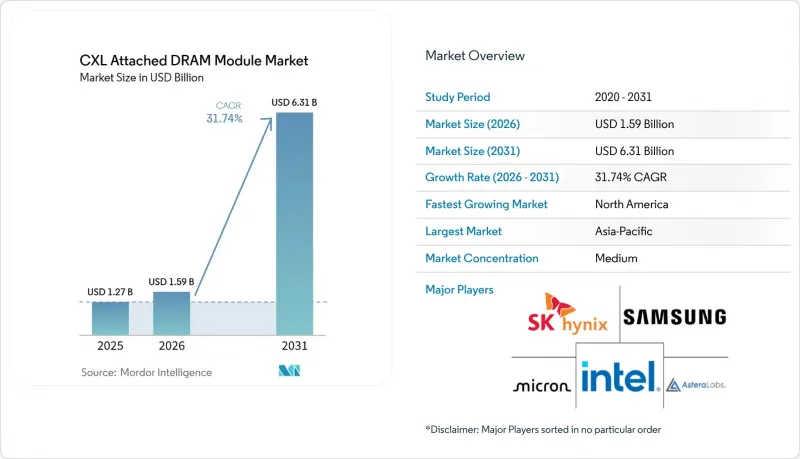
本報告按產品類型(例如,CXL DRAM 記憶體擴充模組)、外形尺寸(例如,基於 EDSFF 的 CXL DRAM 模組)、DRAM 技術(例如,基於 DDR5 的 CXL DRAM 模組)、容量(例如,高達 256 GB、1 TB 以上)、區域資料市場預測以美元 (USD) 為單位。
全球CXL連接DRAM模組市場趨勢及洞察
人工智慧基礎設施中快速成長的記憶體密度需求
AI訓練與推理工作負載暴露出GPU擴展能力與每個節點DRAM可用性之間的直接差距,從而持續推動CXL連接DRAM模組市場的需求。處理長文本上下文的大規模語言模型推理需要鍵值快取容量,而鍵值快取容量會隨著上下文長度的增加成比例成長,這使得記憶體容量成為許多運作AI叢集的運行瓶頸。在GTC 2026大會上,Astera Labs展示了基於Leo的CXL部署方案,該方案透過將鍵值快取保留在DDR5記憶體上而非僅使用高頻寬內存,實現了3.6倍的內存容量擴展,並提高了GPU利用率。阿里雲的Beluga架構也透過交換結構將GPU鍵值快取存取路由到CXL池內存,從而相比基於RDMA的池化方案,展現出更高的響應速度。這意義重大,因為它允許負責人在無需重新設計整個計算堆疊的情況下,支援大規模的模型和更持久的會話。此外,多重模式並發性的提高也帶來了更高的利用率,並推動了CXL連接DRAM模組市場的短期需求。
超大規模記憶體池化以減少過剩容量
由於伺服器級採用靜態記憶體分配,大量已安裝的DRAM記憶體未被充分利用,凸顯了CXL連接DRAM模組市場中記憶體池化的吸引力。機架級共用記憶體架構允許營運商根據實際需求即時分配容量,而無需像傳統架構那樣調整每個節點的容量以匹配尖峰需求。微軟研究院透過其Octopus計畫證明,即使在稀疏的CXL拓撲結構下,記憶體池也能在無需昂貴的全網狀交換器設計的情況下進行擴展。這種架構降低了部署成本,並提高了記憶體池化在超大規模環境中的經濟效益。隨著DRAM供應短缺和HBM主導的分配壓力迫使營運商延長現有平台的使用壽命,這些優勢將在2025年和2026年進一步放大。隨著實用化從實驗室試點擴展到更廣泛的領域,記憶體池化正逐漸成為CXL連接DRAM模組市場的標準基礎設施選項。
與原生DDR5記憶體相比,延遲增加
與本地連接的DDR5記憶體75-85奈秒的往返延遲相比,CXL連接的記憶體仍然存在200-400奈秒的往返延遲。這仍然是CXL連接DRAM模組市場某些應用場景的直接限制因素。在ASPLOS 2025會議上發表的研究也發現,在高負載並發存取下,記憶體存在不公平的排隊行為,DDR頻寬下降高達81%。微軟研究院的研究表明,在扁平記憶體模式下,硬體管理的記憶體分層可以將超過82%的工作負載的效能下降降低到5%以內,儘管在某些特殊情況下,效能下降仍然高達34%。這意味著服務等級的可預測性以及平均延遲對於企業認證至關重要。目前的解決方案之一是將熱頁保留在本地DDR5記憶體中,並將冷頁移至CXL層。雖然這種方法對某些資料庫和AI推理模式有效,但它需要應用層級的效能分析,這減緩了整個CXL連接DRAM模組市場的普及速度。
細分市場分析
到2025年,CXL DRAM記憶體擴充模組將佔據CXL連接DRAM模組市場54.55%的佔有率,成為最大的產品類型。其主導地位源自於其簡單的部署方式,支援單主機擴展,無需交換結構,並可與現有的PCIe 5.0伺服器基礎架構無縫整合。較低的硬體複雜度也讓伺服器OEM廠商能夠採用更為熟悉的檢驗流程。基於CXL Type 3型號和JEDEC標籤標準的互通性工作進一步降低了CXL連接DRAM模組市場這一細分領域的准入門檻。此外,該細分領域還具有成本優勢,因為它允許在不更換整個伺服器的情況下增加記憶體容量。
預計到2031年,CXL DRAM記憶體池模組的複合年成長率將達到32.11%,成為CXL連接DRAM模組市場中成長最快的產品類型。其吸引力正促使買家從單一伺服器容量擴展轉向服務多個運算節點的共用記憶體架構。三星的CMM-B池化設備已展現了這一發展方向,該設備可提供高達2TB的共用CXL容量,頻寬高達60GB/s,適用於人工智慧、記憶體內和分析等應用場景。雖然擴充卡產品作為連接傳統平台的橋樑仍然十分重要,但隨著整合度的提高以及買家對集中管理記憶體池的需求在整個CXL連接DRAM模組行業中不斷成長,基於控制器的模組和擴展設備預計將獲得更大的市場佔有率。
預計到2025年,基於EDSFF的CXL連接DRAM模組將佔據CXL連接DRAM模組市場46.43%的佔有率,使EDSFF成為主流外形尺寸。這一主導地位源自於其與標準伺服器硬碟托架的高度相容性,尤其是E3.S和E3.L佈局,無需對底盤進行重大重新設計。熱插拔維護功能也至關重要,因為負責人希望在不完全關閉系統的情況運作中管理其資料中心環境。 E3.S 2T規格支援雙埠連接,可在生產系統中實現容錯移轉和高可用性配置。美光CZ120和SK海力士CMM-DDR5是目前展示此外形尺寸在商業部署中有效性的產品範例。
機架級 CXL DRAM 擴展系統預計到 2031 年將以 32.76% 的複合年成長率成長,成為 CXL 連接 DRAM 模組市場中成長最快的領域。買家越來越傾向於集中式記憶體設備,這類設備能夠從單一機架級記憶體池為眾多運算節點提供服務。 PCIe擴充卡模組在現有傳統系統中仍然有用,但隨著 EDSFF 平台在新採購週期中成為標準配置,其相對重要性預計將會下降。 CMM-D 格式也日益受到重視,它將 DRAM 晶片和專用 CXL 控制器整合在單塊基板,從而促進了 CXL 連接 DRAM 模組行業大規模超大規模項目的部署。
區域分析
到2025年,亞太地區將佔據CXL連接DRAM模組市場43.44%的佔有率,成為最大的區域市場。該地區兼具DRAM製造的充足產能和人工智慧基礎設施擴張帶來的不斷成長的需求。韓國仍是核心市場,三星電子和SK海力士為大多數商用CXL模組專案提供DDR5內存,兩家公司也持續開發專用的CXL產品線。隨著市場從簡單的擴展架構轉向池化架構,控制器晶片成為關鍵的差異化因素,台灣也扮演著至關重要的角色。 Montage Technology將於2025年9月開始提供CXL 3.1記憶體擴充控制器的樣品,顯示亞太地區正在積極研發控制器,以滿足日益成長的模組需求。
預計北美將以 32.73% 的複合年成長率成長,成為 CXL DRAM 模組市場成長最快的地區。該地區受益於最大的超大規模雲端服務供應商的存在,這些提供者是首批能夠大規模部署這種新型記憶體架構的買家。 Astera Labs 在 Microsoft Azure M 系列虛擬機器上的生產部署就是將 CXL 記憶體擴展擴展到公共雲端生產環境的有力例證。 PNNL 的 Crete 測試平台透過展示科學 AI 系統如何在記憶體密集型運算環境中利用 Micron 的記憶體和客製化 CXL 控制器板,正在將需求擴展到商業雲端之外。該地區也受益於 Intel 和 AMD 在標準化方面的積極參與,以及 Marvell 和 Astera Labs 等本地交換器和控制器供應商的支持,這些都有助於 CXL DRAM 模組市場更快地從檢驗過渡到運作。
歐洲在CXL連接DRAM模組市場佔據第三大佔有率,主要得益於愛爾蘭、荷蘭和德國超大規模資料中心的擴張,以及這些國家超級運算中心的高效能運算(HPC)採購。該地區對能源效率和整體擁有成本(TCO)管理的重視與記憶體池化理念高度契合,因為利用共用架構可以減少整個系統生態系統中冗餘DRAM的部署。因此,隨著認證門檻的降低,歐洲很可能成為可組合機架架構的長期有利市場。雖然世界其他地區的CXL連接DRAM模組市場仍處於起步階段,但海灣國家主導的人工智慧基礎設施建設正在為高容量記憶體的普及創造一條切實可行的短期路徑。
其他好處:
- Excel格式的市場預測(ME)表
- 3個月的分析師支持
目錄
第1章:引言
- 研究假設和市場定義
- 調查範圍
第2章:調查方法
第3章執行摘要
第4章 市場狀況
- 市場概覽
- 宏觀經濟因素對市場的影響
- 市場促進因素
- 人工智慧基礎設施中快速成長的記憶體密度需求
- 超大規模記憶體池化以減少過剩容量
- CXL 2.0、CXL 3.0 和 CXL 3.1 的標準化和生態系統發展現狀
- 用於雲端伺服器和企業伺服器現代化改造的機架級可組合性
- 高效能運算和科學運算中日益成長的記憶體擴展需求
- 對記憶體內資料庫和記憶體密集型虛擬化的需求日益成長
- 市場限制因素
- 延遲增加與原生DDR5記憶體的比較
- 軟體編配與層級結構的複雜性
- 初始部署階段平台和整合成本較高
- 整個 CPU、記憶體、交換器和軟體堆疊的生態系統認證出現延誤。
- 產業價值鏈分析
- 監理情勢
- 技術展望
- 波特五力分析
第5章 市場規模與成長預測
- 依產品類型
- CXL DRAM 記憶體擴充模組
- CXL DRAM 記憶體池模組
- CXL DRAM擴充卡
- CXL DRAM 擴充設備/系統
- 配備 CXL DRAM 控制器的記憶體模組
- 按外形規格
- 基於EDSFF的CXL DRAM模組
- PCIe擴充卡CXL DRAM 模組
- CXL 記憶體模組 - DRAM/CMM - D 型模組
- 機架級 CXL DRAM 擴充系統
- 透過DRAM技術
- 基於DDR5的CXL DRAM模組
- 基於DDR4的CXL DRAM模組
- 先進/下一代基於DRAM的CXL模組
- 按產能
- 256 GB 或更少
- 256 GB~512 GB
- 512 GB~1 TB
- 1 TB 或以上
- 透過使用
- 人工智慧基礎設施
- 雲端資料中心
- 超大規模資料中心
- 高效能運算
- 企業伺服器
- 其他用途,記憶體內和分析、記憶體密集型虛擬化工作負載
- 按地區
- 北美洲
- 歐洲
- 亞太地區
- 中國
- 日本
- 韓國
- 台灣
- 其他亞太國家
- 世界其他地區
第6章 競爭情勢
- 市場集中度
- 策略趨勢
- 市佔率分析
- 公司簡介
- Samsung Electronics Co., Ltd.
- SK hynix Inc.
- Micron Technology, Inc.
- Intel Corporation
- Marvell Technology, Inc.
- Astera Labs, Inc.
- Advanced Micro Devices, Inc.
- NVIDIA Corporation
- Google LLC
- Amazon.com, Inc.
- Microsoft Corporation
- Meta Platforms, Inc.
- Dell Technologies Inc.
- Super Micro Computer, Inc.
- Montage Technology Co., Ltd.
- OPENEDGES Technology, Inc.
- Panmnesia Co., Ltd.
- FADU, Inc.
- TLB Co., Ltd.
- Korea Circuit Co., Ltd.
- OKins Electronics Co., Ltd.
第7章 市場機會與未來展望
According to Mordor Intelligence, the CXL attached DRAM module market size is projected to be USD 1.27 billion in 2025, USD 1.59 billion in 2026, and reach USD 6.31 billion by 2031, growing at a CAGR of 31.74% from 2026 to 2031.
This report is Segmented by Product Type (CXL DRAM Memory Expansion Modules, and More), Form Factor (EDSFF-Based CXL DRAM Modules, and More), DRAM Technology (DDR5-Based CXL DRAM Modules, and More), Capacity (Up To 256 GB, Above 1 TB, and More), Application (AI Infrastructure, Cloud Data Centers, Enterprise Servers, and More), and Geography. The Market Forecasts are Provided in Terms of Value (USD).
Global CXL Attached DRAM Module Market Trends and Insights
Surging AI Infrastructure Memory Density Requirements
AI training and inference workloads are exposing a direct gap between GPU scale and per-node DRAM availability, which is creating sustained demand in the CXL attached DRAM module market. Long-context large language model inference requires key-value cache capacity that rises with context length, so memory capacity is becoming the operational limit in many production AI clusters. Astera Labs showed at GTC 2026 that Leo-based CXL deployments delivered 3.6x memory expansion and improved GPU utilization by keeping key-value cache on DDR5 instead of using only high-bandwidth memory. Alibaba Cloud's Beluga architecture also showed that routing GPU key-value cache access to CXL-pooled memory through a switch fabric improved response behavior versus RDMA-based pooling. That matters because operators can support larger models and more persistent sessions without redesigning the full compute stack. It also supports higher multi-model concurrency, which improves utilization and strengthens near-term demand across the CXL attached DRAM module market.
Hyperscale Memory Pooling to Reduce Stranded Capacity
Static memory allocation at the server level still leaves a meaningful share of installed DRAM unused, and that is making pooling more attractive in the CXL attached DRAM module market. A rack-scale shared memory fabric lets operators assign capacity where it is needed in real time instead of sizing every node for peak demand. Microsoft Research showed through its Octopus work that sparse CXL topologies can scale pooling pods without requiring expensive full-mesh switch designs. That architecture lowers deployment cost and improves the economic case for pooled memory at hyperscale. The case became stronger in 2025 and 2026 as tight DRAM supply and HBM-led allocation pressure pushed operators to extend the useful life of existing platforms. As production interest broadened beyond lab pilots, memory pooling moved closer to a standard infrastructure decision within the CXL attached DRAM module market.
Higher Latency Versus Native DDR5 Memory
CXL attached memory still introduces round-trip latency of 200-400 nanoseconds versus 75-85 nanoseconds for locally attached DDR5, and that remains a direct limit on some use cases in the CXL attached DRAM module market. Research presented at ASPLOS 2025 also found unfair queuing behavior and DDR bandwidth degradation of up to 81% under heavy concurrent loads. Microsoft Research showed that hardware-managed tiering in Flat Memory Mode held degradation within 5% for more than 82% of workloads, but some outlier cases still saw performance fall by up to 34%. That means service-level predictability matters as much as average latency in enterprise qualification. The current mitigation is to keep hot pages in local DDR5 and move colder pages to the CXL tier. That works for several database and AI inference patterns, but it requires application-level profiling and slows deployment across the CXL attached DRAM module market.
Other drivers and restraints analyzed in the detailed report include:
- Standardization Around CXL 2.0, CXL 3.0, And CXL 3.1 Ecosystem Readiness
- Rack-Scale Composability for Cloud and Enterprise Server Modernization
- Software Orchestration and Tiering Complexity
For complete list of drivers and restraints, kindly check the Table Of Contents.
Segment Analysis
CXL DRAM Memory Expansion Modules held 54.55% of the CXL attached DRAM module market in 2025, which made them the largest product category. Their lead came from a simple adoption path because they support single-host expansion, require no switch fabric, and fit existing PCIe 5.0 server infrastructure. That lower hardware complexity also gives server OEMs a more familiar qualification path. Interoperability work under the CXL Type 3 model and JEDEC labeling standards has further reduced adoption friction for this part of the CXL attached DRAM module market. The segment also benefits from a direct cost case because it lets buyers increase memory headroom without replacing the full server.
CXL DRAM Memory Pooling Modules are projected to grow at a 32.11% CAGR through 2031, which makes them the fastest-growing product type in the CXL attached DRAM module market. Their appeal is shifting buyer attention from one-server capacity expansion to shared memory fabrics that serve multiple compute nodes. Samsung demonstrated this direction through the CMM-B pooling appliance, which delivered up to 2 TB of shared CXL capacity at up to 60 GB/s bandwidth for AI, in-memory database, and analytics use cases. Add-in card products still matter as a bridge for legacy platforms, while controller-based modules and expansion appliances are likely to gain share as integration improves and buyers seek centrally managed memory pools across the broader CXL attached DRAM module industry.
EDSFF-based CXL DRAM modules captured 46.43% of the CXL attached DRAM module market size in 2025, which made EDSFF the leading form factor. Their lead reflects strong fit with standard server drive bays, especially E3.S and E3.L layouts that avoid major chassis redesign. Hot-plug serviceability also matters because operators want to manage live data center environments without full system shutdowns. The E3.S 2T format adds support for dual-port connectivity, which supports failover and higher-availability configurations in production systems. Micron's CZ120 and SK Hynix's CMM-DDR5 are current product examples that validate this form factor in commercial deployments.
Rack-Level CXL DRAM Expansion Systems are projected to grow at a 32.76% CAGR through 2031, giving them the fastest growth profile in the CXL attached DRAM module market. Buyers are increasingly looking at centralized memory appliances that can serve many compute nodes from one rack-scale pool. PCIe add-in card modules remain useful for older installed systems, but they are likely to lose relative weight as EDSFF-ready platforms become standard in new procurement cycles. The CMM-D format is also gaining ground because it combines DRAM chips and a dedicated CXL controller on one board, which supports cleaner deployment paths for large-scale hyperscale programs in the CXL attached DRAM module industry.
Complete Report Scope:
- By Product Type
- CXL DRAM Memory Expansion Modules
- CXL DRAM Memory Pooling Modules
- CXL DRAM Add-in Cards
- CXL DRAM Expansion Appliances / Systems
- CXL DRAM Controller-Based Memory Modules
- By Form Factor
- EDSFF-Based CXL DRAM Modules
- PCIe Add-in Card CXL DRAM Modules
- CXL Memory Module - DRAM / CMM-D Type Modules
- Rack-Level CXL DRAM Expansion Systems
- By DRAM Technology
- DDR5-Based CXL DRAM Modules
- DDR4-Based CXL DRAM Modules
- Advanced / Next-Generation DRAM-Based CXL Modules
- By Capacity Class
- Up to 256 GB
- 256 GB-512 GB
- 512 GB-1 TB
- Above 1 TB
- By Application
- AI Infrastructure
- Cloud Data Centers
- Hyperscale Data Centers
- High-Performance Computing
- Enterprise Servers
- Other Applications, In-Memory Databases and Analytics, Memory-Intensive Virtualization Workloads
- By Geography
- North America
- Europe
- Asia Pacific
- China
- Japan
- South Korea
- Taiwan
- Rest of Asia Pacific
- Rest of the World
Geography Analysis
Asia-Pacific held 43.44% of the CXL attached DRAM module market share in 2025, which made it the largest regional segment. The region combines supply strength in DRAM manufacturing with growing demand from AI infrastructure buildouts. South Korea remains central because Samsung Electronics and SK Hynix supply the DDR5 memory used across a large share of commercial CXL module programs, and both companies continue to advance dedicated CXL product lines. Taiwan also matters because controller silicon is becoming a key differentiator as the market moves from simple expansion to pooled architectures. Montage Technology's sampling of its CXL 3.1 Memory eXpander Controller in September 2025 showed that controller readiness in Asia-Pacific is advancing alongside module demand.
North America is projected to grow at a 32.73% CAGR, which gives it the fastest regional trajectory in the CXL attached DRAM module market. The region benefits from the presence of the largest hyperscale cloud operators, which are the first buyers able to absorb new memory architectures at scale. Astera Labs' production deployment on Microsoft Azure M-series virtual machines is a strong reference point because it moved CXL memory expansion into a public cloud production setting. PNNL's Crete testbed broadens demand beyond commercial cloud by showing how scientific AI systems can use Micron memory and custom CXL controller boards in high-memory computing environments. The region is also supported by strong standards involvement from Intel and AMD and by local switch and controller suppliers such as Marvell and Astera Labs, which helps the CXL attached DRAM module market move faster from validation into production.
Europe held the third-largest position in the CXL attached DRAM module market, with demand tied to hyperscale expansion in Ireland, the Netherlands, and Germany and to HPC procurement at national supercomputing centers. The region's focus on power efficiency and total cost control fits well with the logic of memory pooling because shared fabrics can reduce redundant DRAM provisioning across fleets. That makes Europe a good long-term fit for composable rack architectures as qualification barriers fall. Rest of the World remains an earlier-stage opportunity in the CXL attached DRAM module market, but sovereign AI buildouts in the Gulf are creating a credible near-term path for high-capacity memory deployments.
- Samsung Electronics Co., Ltd.
- SK hynix Inc.
- Micron Technology, Inc.
- Intel Corporation
- Marvell Technology, Inc.
- Astera Labs, Inc.
- Advanced Micro Devices, Inc.
- NVIDIA Corporation
- Google LLC
- Amazon.com, Inc.
- Microsoft Corporation
- Meta Platforms, Inc.
- Dell Technologies Inc.
- Super Micro Computer, Inc.
- Montage Technology Co., Ltd.
- OPENEDGES Technology, Inc.
- Panmnesia Co., Ltd.
- FADU, Inc.
- TLB Co., Ltd.
- Korea Circuit Co., Ltd.
- OKins Electronics Co., Ltd.
Additional Benefits:
- The market estimate (ME) sheet in Excel format
- 3 months of analyst support
TABLE OF CONTENTS
1 INTRODUCTION
- 1.1 Study Assumptions and Market Definition
- 1.2 Scope of the Study
2 RESEARCH METHODOLOGY
3 EXECUTIVE SUMMARY
4 MARKET LANDSCAPE
- 4.1 Market Overview
- 4.2 Impact of Macroeconomic Factors on the Market
- 4.3 Market Drivers
- 4.3.1 Surging AI Infrastructure Memory Density Requirements
- 4.3.2 Hyperscale Memory Pooling to Reduce Stranded Capacity
- 4.3.3 Standardization Around CXL 2.0, CXL 3.0, and CXL 3.1 Ecosystem Readiness
- 4.3.4 Rack-Scale Composability for Cloud and Enterprise Server Modernization
- 4.3.5 Accelerating HPC and Scientific Computing Memory Expansion Needs
- 4.3.6 Rising Demand for In-Memory Databases and Memory-Intensive Virtualization
- 4.4 Market Restraints
- 4.4.1 Higher Latency Versus Native DDR5 Memory
- 4.4.2 Software Orchestration and Tiering Complexity
- 4.4.3 Elevated Platform and Integration Cost for Early Deployments
- 4.4.4 Ecosystem Qualification Delays Across CPU, Memory, Switch, and Software Stacks
- 4.5 Industry Value Chain Analysis
- 4.6 Regulatory Landscape
- 4.7 Technological Outlook
- 4.8 Porter's Five Forces Analysis
- 4.8.1 Bargaining Power of Suppliers
- 4.8.2 Bargaining Power of Buyers
- 4.8.3 Threat of New Entrants
- 4.8.4 Threat of Substitutes
- 4.8.5 Competitive Rivalry
5 MARKET SIZE AND GROWTH FORECASTS (VALUE)
- 5.1 By Product Type
- 5.1.1 CXL DRAM Memory Expansion Modules
- 5.1.2 CXL DRAM Memory Pooling Modules
- 5.1.3 CXL DRAM Add-in Cards
- 5.1.4 CXL DRAM Expansion Appliances / Systems
- 5.1.5 CXL DRAM Controller-Based Memory Modules
- 5.2 By Form Factor
- 5.2.1 EDSFF-Based CXL DRAM Modules
- 5.2.2 PCIe Add-in Card CXL DRAM Modules
- 5.2.3 CXL Memory Module - DRAM / CMM-D Type Modules
- 5.2.4 Rack-Level CXL DRAM Expansion Systems
- 5.3 By DRAM Technology
- 5.3.1 DDR5-Based CXL DRAM Modules
- 5.3.2 DDR4-Based CXL DRAM Modules
- 5.3.3 Advanced / Next-Generation DRAM-Based CXL Modules
- 5.4 By Capacity Class
- 5.4.1 Up to 256 GB
- 5.4.2 256 GB-512 GB
- 5.4.3 512 GB-1 TB
- 5.4.4 Above 1 TB
- 5.5 By Application
- 5.5.1 AI Infrastructure
- 5.5.2 Cloud Data Centers
- 5.5.3 Hyperscale Data Centers
- 5.5.4 High-Performance Computing
- 5.5.5 Enterprise Servers
- 5.5.6 Other Applications, In-Memory Databases and Analytics, Memory-Intensive Virtualization Workloads
- 5.6 By Geography
- 5.6.1 North America
- 5.6.2 Europe
- 5.6.3 Asia Pacific
- 5.6.3.1 China
- 5.6.3.2 Japan
- 5.6.3.3 South Korea
- 5.6.3.4 Taiwan
- 5.6.3.5 Rest of Asia Pacific
- 5.6.4 Rest of the World
6 COMPETITIVE LANDSCAPE
- 6.1 Market Concentration
- 6.2 Strategic Moves
- 6.3 Market Share Analysis
- 6.4 Company Profiles (includes Global Level Overview, Market Level Overview, Core Segments, Financials as available, Strategic Information, Market Rank/Share, Products and Services, Recent Developments)
- 6.4.1 Samsung Electronics Co., Ltd.
- 6.4.2 SK hynix Inc.
- 6.4.3 Micron Technology, Inc.
- 6.4.4 Intel Corporation
- 6.4.5 Marvell Technology, Inc.
- 6.4.6 Astera Labs, Inc.
- 6.4.7 Advanced Micro Devices, Inc.
- 6.4.8 NVIDIA Corporation
- 6.4.9 Google LLC
- 6.4.10 Amazon.com, Inc.
- 6.4.11 Microsoft Corporation
- 6.4.12 Meta Platforms, Inc.
- 6.4.13 Dell Technologies Inc.
- 6.4.14 Super Micro Computer, Inc.
- 6.4.15 Montage Technology Co., Ltd.
- 6.4.16 OPENEDGES Technology, Inc.
- 6.4.17 Panmnesia Co., Ltd.
- 6.4.18 FADU, Inc.
- 6.4.19 TLB Co., Ltd.
- 6.4.20 Korea Circuit Co., Ltd.
- 6.4.21 OKins Electronics Co., Ltd.
7 MARKET OPPORTUNITIES AND FUTURE OUTLOOK
- 7.1 White-space and Unmet-Need Assessment

 DRAM模組及組件市場-2026-2032年全球市場預測
 行動DRAM:市場佔有率分析、產業趨勢與統計、成長預測(2026-2031年)伺服器DRAM:市場佔有率分析、產業趨勢與統計、成長預測(2026-2031年)用於DRAM的矽晶圓:市場佔有率分析、行業趨勢和統計數據以及成長預測(2026-2031年)
 DRAM市場預測至2034年-按類型、容量、外形規格、製程節點、應用、通路和地區分類的全球分析
 自旋傳輸矩MRAM市場機會、成長要素、產業趨勢分析及2026-2035年預測
 動態隨機存取記憶體 (DRAM) 市場規模、佔有率、趨勢和預測:按類型、技術、最終用戶和地區分類,2026-2034 年
 隨機存取記憶體(RAM)市場:按類型、產品類型和地區分類動態隨機存取記憶體(DRAM)市場:按類型、技術、架構、容量、終端用戶產業、分銷管道和應用分類-2026-2032年全球市場預測
 2026年全球動態隨機存取記憶體市場報告