


 |
市場調查報告書
商品編碼
2117572
鳥糞石肥料:市場佔有率分析、產業趨勢與統計、成長預測(2026-2031)Struvite Fertilizers - Market Share Analysis, Industry Trends & Statistics, Growth Forecasts (2026 - 2031) |
||||||

※ 本網頁內容可能與最新版本有所差異。詳細情況請與我們聯繫。
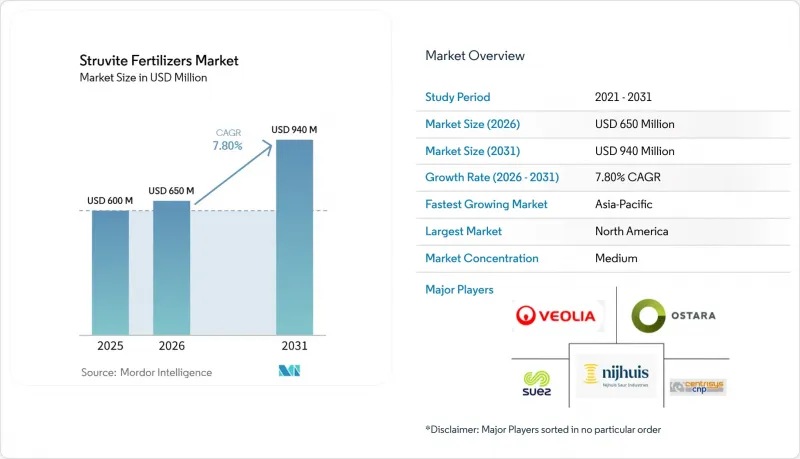
據 Mordor Intelligence 稱,2025 年鳥糞石肥料市場價值 6 億美元,預計到 2031 年將達到 9.4 億美元,而 2026 年為 6.5 億美元,預測期(2026-2031 年)的複合年成長率為 7.80%。
本報告按產品類型(顆粒狀鳥糞石、粉末狀鳥糞石、液體鳥糞石)、應用領域(農業、園藝、草坪/觀賞植物、其他)、作物類型(穀物、水果/蔬菜、其他)和地區(北美、南美、歐洲、亞太、其他)進行細分。市場預測以美元(USD)以金額為準。
全球鳥糞石肥料市場趨勢與洞察
磷供不應求及對進口的依賴
在歐洲,磷被視為戰略性原料,因為化肥供應仍然依賴少數生產國。到2025年,約85%的經濟可開採蘊藏量將集中在摩洛哥和西撒哈拉,而中國將控制從礦場到市場的大部分供應。這種集中度使得依賴進口的地區極易受到政策變動和貿易中斷的影響。在日本、韓國、歐洲和印度,磷酸鹽開採分銷的中斷可能會立即影響公共產業和農業買家的採購計畫。日本正透過修訂《化肥管理法》來推進國內磷回收,該法規定了回收磷產品的廢棄物處置標準,並支持基於污水的營養物回收系統。東京都政府於2024年1月在其東部污泥處理廠啟動了磷回收設施的運作,神戶市計劃在2027會計年度安裝第三套回收裝置,這表明其磷回收業務正在擴張。這些進展表明,這一轉變正從政策討論階段邁向實際的加工能力擴張階段。鳥糞石肥料市場正受益於此趨勢,因為每回收一噸磷,整個計畫對進口磷礦石的依賴程度就會降低。在製定長期承包合約時,尤其是在缺乏穩定國內磷礦石開採的地區,供應穩定性這一考量正變得越來越重要。
透過法規強制回收營養物質
此外,多個大型污水處理系統從自願性營養物回收轉向強制性法規要求,也促進了鳥糞石肥料市場的發展。德國修訂後的《污水污泥條例》規定,服務人口超過5萬的污水處理廠必須在2029年前將污水污泥中的磷含量降低至少50%,或從污水污泥灰中回收80%的磷。這項要求為鳥糞石回收技術開闢了直接途徑,因為磷提取已成為專案強制性要求,而非可選項。在歐洲層面,《歐盟肥料產品法規》和授權法規(EU) 2021/2086將鳥糞石歸類為“第12類成分材料”,允許帶有CE標誌的材料在單一市場內流通,最大限度地減少各國之間的壁壘。在韓國,2025年的一項法律修正案確立了回收磷的「廢棄物處置」途徑,並強制要求大規模都市污水處理廠在2030年前安裝磷回收系統。這些法規有利於鳥糞石肥料市場,因為它們允許污水處理廠營運商在控制污泥處理成本的同時,也能透過肥料生產獲得額外收入。當監管期限與設施的投資週期相吻合時,系統部署往往會分階段進行,而不是小規模試點項目,這有助於更可預測的產能擴張。
與傳統磷肥相比,單位價格較高
在與傳統磷肥在大型農業系統中競爭時,鳥糞石肥料市場面臨明顯的價格挑戰。俄亥俄州立大學2025年的一項實地考察報告顯示,鳥糞石的價格為每磅0.60美元,而磷酸一銨的價格為每磅0.40至0.45美元。然而,該研究也表明,透過降低施用量,長期來看可以實現相近的大豆產量。這種價格差異歸因於結晶設備成本、鎂投入需求以及運輸成本。這是因為許多回收廠都位置在污水處理廠附近,而不是靠近農業需求點。在傳統磷肥獲得公共補貼的國家,這種價格障礙更為突出,進一步擴大了銷售環節的價格差距。雖然鳥糞石的緩釋特性使其在初始種植週期後仍能保持一定的磷肥有效性,從而在多個種植季中提高成本效益,但在年度採購過程中如何有效地傳達這一價值卻是一個挑戰。鳥糞石肥料的推廣應用較為緩慢,因為採購負責人通常只比較發票上的價格,而不是考慮季節性的養分利用效率。因此,市場初期主要集中在那些性能、認證或減少徑流等因素足以抵銷高昂初始成本的應用領域。而要進一步在大面積農地的耕作系統中推廣應用,可能取決於能否加強大規模的農業化學品示範項目,或者能否縮小交付成本的差距。
細分市場分析
到2025年,顆粒狀鳥糞石將佔45.2%的市場佔有率,成為鳥糞石肥料市場中最大的產品形態。其主導地位源自於其與現有撒播機的直接相容性、可安全地施用於發芽作物附近的種子,以及商業生產系統主要圍繞顆粒生產模式建構。俄亥俄州立大學和伊利諾大學的田間研究表明,在穀物種植中,顆粒狀鳥糞石在較低的施用量下即可達到與磷酸一銨相當的產量,這進一步促進了其應用。設備相容性和與農業化學品的親和性使得顆粒狀鳥糞石在大面積農業區佔據了穩固的地位,這也解釋了為什麼其最初的市場規模是由那些無需改變處理方法的農場系統形成的。
液態鳥糞石是成長最快的形態,預計到2031年,該細分市場將以8.8%的複合年成長率成長。這一成長主要由園藝行業推動,該行業以施肥栽培為主,透過滴灌系統標準化地供應水溶性養分,因此固體顆粒肥並不實用。粉末狀鳥糞石介於這兩種形態之間,適用於需要精細均勻施用的特殊用途,例如苗床基材配方和草坪混合料。此外,統一的歐洲肥料框架降低了品質定義和標籤要求的不確定性,並提高了所有形態產品監管的重要性。因此,鳥糞石肥料市場呈現更清晰的分類,分為三個領域:顆粒狀大面積施用、液態精準施用和粉末狀特種應用。
區域分析
北美地區持續保持其作為鳥糞石肥料最大區域市場的地位,2025年市佔率達35.8%。預計到2031年,該地區將以7.0%至8.0%的複合年成長率成長,這得益於成熟的商業化生產和明確的磷回收產品監管措施。美國擁有最發達的商業基礎,Ostara公司位於聖路易斯的工廠在2025年將向中西部和太平洋西北地區的零售商供應CG P2X產品,其國內生產模式降低了關稅風險。加拿大也保持著活躍的市場地位,溫尼伯和其他地區的污水處理廠改造維修已將鳥糞石提取用於商業化生產。雖然南美洲目前市場規模小規模,但預計未來大規模農業和不斷擴大的污水基礎設施將創造新的營養物質回收來源。
在歐洲,隨著監管持續成為市場擴張的主要驅動力,預計市場將持續成長。德國2029年的磷回收強制令正在推動市政投資,布倫瑞克和吉夫霍恩的P-Net計畫正在測試最佳化的沉澱處理流程,以滿足未來污泥的監管標準。比利時約佔歐洲商業鳥糞石產量的16%至20%,NuReSys和AirPrex在生產領域佔據了穩固的地位。荷蘭擁有約50座全面運作中的回收設施,並有部分產能過剩。這意味著,除非農業行銷和採購管道也得到改善,否則供應鏈的發展速度可能會超過需求成長速度。
亞太地區是鳥糞石肥料市場成長最快的地區,預計到2031年複合年成長率將達到9.5%。日本在監管和商業成熟度方面領先於該地區,這得益於2020年對《肥料管理法》的修訂,該修訂為回收磷制定了明確的污染物標準,並支持了國內的回收項目。神戶市正在擴大其再生磷項目,並計劃在2027會計年度安裝更多回收裝置,這表明日本已運作市政規模的磷回收。印度也積極提升國內產能,Thermax公司於2024年4月在浦那開設了一家新的水處理和廢棄物處理解決方案製造工廠,並為該業務設定了10億印度盧比(約1.2億美元)的累積訂單目標。在中東和非洲地區,市場正在擴張,這得益於大規模廢水處理項目,例如 WABAG 的阿吉曼污水生物精煉廠三期工程,該工程日處理能力為 6000 萬升,已於 2026 年 6 月訂單。這表明,未來能夠支持營養物回收設施共址建設的基礎設施規模相當可觀。
其他好處:
- Excel格式的市場預測(ME)表
- 3個月的分析師支持
目錄
第1章:引言
- 研究假設和市場定義
- 調查範圍
第2章:調查方法
第3章執行摘要
第4章 市場狀況
- 市場概覽
- 市場促進因素
- 磷短缺和進口依賴
- 關於營養物回收的監管義務
- 在污水回收中引入循環經濟
- 對低碳和有機認證原料的高需求
- 自動化營養物回收有利於製程整合。
- 回收營養物質的標準化開闢了新的採購管道。
- 市場限制因素
- 與傳統磷肥相比,單位價格較高
- 農民意識薄弱,經銷網路有限
- 對產品品質波動和污染的擔憂。
- 地方政府預算限制及採購週期過長
- 監理情勢
- 技術展望
- 波特五力分析
第5章 市場規模與成長預測
- 依產品類型
- 粒狀鳥糞石
- 粉狀鳥糞石
- 液態鳥糞石
- 透過使用
- 農業
- 園藝
- 草坪和觀賞植物
- 其他用途
- 按作物類型
- 穀類和穀類食品
- 水果和蔬菜
- 油籽/豆類
- 其他作物類型
- 按地區
- 北美洲
- 美國
- 加拿大
- 墨西哥
- 其他北美國家
- 南美洲
- 巴西
- 阿根廷
- 其他南美國家
- 歐洲
- 德國
- 法國
- 英國
- 義大利
- 西班牙
- 俄羅斯
- 土耳其
- 其他歐洲國家
- 亞太地區
- 中國
- 日本
- 印度
- 韓國
- 其他亞太國家
- 中東
- 沙烏地阿拉伯
- 阿拉伯聯合大公國
- 其他中東國家
- 非洲
- 南非
- 埃及
- 其他非洲國家
- 北美洲
第6章 競爭情勢
- 市場集中度
- 策略趨勢
- 市佔率分析
- 公司簡介
- Ostara Nutrient Recovery Technologies Inc.
- Veolia Water Technologies
- SUEZ Water Technologies and Solutions
- CNP-Technology Water and Biosolids Corporation
- Nijhuis Saur Industries
- AirPrex(PCS Pollution Control Service GmbH)
- NuReSys
- Thermax Limited
- WABAG Group
- Xylem Inc.
第7章 市場機會與未來展望
According to Mordor Intelligence, the struvite fertilizers market size was valued at USD 600 million in 2025 and is estimated to grow from USD 650 million in 2026 to reach USD 940 million by 2031, at a CAGR of 7.80% during the forecast period (2026-2031).
This report is Segmented by Product Type (Granular Struvite, Powdered Struvite, and Liquid Struvite), by Application (Agriculture, Horticulture, Turf and Ornamental, and Others), by Crop Type (Cereals and Grains, Fruits and Vegetables, and More), and by Geography (North America, South America, Europe, Asia-Pacific, and More). The Market Forecasts are Provided in Terms of Value in USD.
Global Struvite Fertilizers Market Trends and Insights
Phosphorus Scarcity and Import Dependency
Phosphorus is treated as a strategic raw material in Europe because fertilizer supply remains tied to a narrow group of producing countries. In 2025, Around 85% of economically recoverable reserves are concentrated in Morocco and Western Sahara, while China controls a large share of mine-to-market supply. This concentration exposes import-dependent regions to policy shifts and trade disruptions. For Japan, South Korea, Europe, and India, disruptions in mined phosphate flows can quickly affect procurement planning for both utilities and agricultural buyers. Japan has moved toward domestic recovery through its revised Fertilizer Control Act, which established end-of-waste criteria for recovered phosphorus products and supported wastewater-based nutrient recovery systems. The Tokyo Metropolitan Government commissioned a phosphorus recovery facility at its Eastern Sludge Plant in January 2024, and Kobe City expanded its recycled phosphorus project with a third recovery unit planned for fiscal 2027. These developments indicate that the shift is moving beyond policy discussion into physical capacity buildout. The struvite fertilizers market is benefiting from this trend, as each additional ton of recovered phosphorus reduces reliance on imported rock phosphate throughout a project's life. This supply security consideration is becoming more important in long-term offtake decisions, particularly in regions without stable domestic phosphate mining.
Regulatory Nutrient Recovery Mandates
The struvite fertilizers market is also advancing as nutrient recovery shifts from a voluntary practice to a compliance requirement in several major wastewater systems. Germany's revised Sewage Sludge Ordinance requires wastewater treatment plants above 50,000 population equivalents to either reduce phosphorus content in sewage sludge by at least 50% or recover 80% of phosphorus from sewage sludge ash by 2029. This requirement creates a direct path for struvite recovery technologies by making phosphorus extraction a project necessity rather than a discretionary upgrade. At the European level, the EU Fertilising Products Regulation and Delegated Regulation (EU) 2021/2086 allow struvite under Component Material Category 12, enabling CE-marked material to move across the single market with fewer national barriers. South Korea's 2025 legislative revision created an end-of-waste route for recovered phosphorus and required large municipal wastewater plants to install phosphorus recovery systems by 2030. The struvite fertilizers market benefits from these regulations as wastewater operators can manage sludge handling economics while generating a secondary revenue stream from fertilizer output. When regulatory deadlines align with plant investment cycles, adoption tends to progress in defined steps rather than small trials, supporting more predictable capacity growth.
Higher Unit Cost Versus Conventional Phosphate Fertilizers
The struvite fertilizers market faces a clear pricing challenge when competing against conventional phosphate fertilizers in large-volume crop systems. A 2025 Ohio State University field observation cited struvite at USD 0.60 per pound compared with USD 0.40 to USD 0.45 per pound for monoammonium phosphate, even though the same study indicated that lower application rates could support comparable soybean yields over time. This price gap is rooted in crystallization equipment costs, magnesium input requirements, and freight burdens, as many recovery plants are located at wastewater sites rather than near crop demand centers. The barrier is more pronounced in countries where conventional phosphate fertilizers receive public subsidies, as these widen the cost gap at the point of sale. The slow-release profile of struvite can improve cost effectiveness over multiple seasons, as part of the phosphorus remains available after the first crop cycle, but this value is difficult to communicate within an annual procurement process. Commodity buyers typically compare invoice prices rather than season-by-season nutrient efficiency, which slows adoption. The struvite fertilizers market is therefore advancing first in applications where performance, certification, or runoff reduction can justify a higher upfront price. Wider adoption in broadacre crop systems will likely depend on either stronger agronomic proof at scale or a reduction in the delivered cost gap.
Other drivers and restraints analyzed in the detailed report include:
- Circular Economy Adoption in Wastewater Recovery
- Premium Demand for Low-Carbon and Organic-Approved Inputs
- Limited Farmer Familiarity and Distribution Depth
For complete list of drivers and restraints, kindly check the Table Of Contents.
Segment Analysis
Granular struvite held 45.2% of the market in 2025, making it the largest product format in the struvite fertilizers market. Its dominant position stems from direct compatibility with existing spreaders, seed-safe placement near germinating crops, and the fact that commercial production systems have been built primarily around pellet output. Granular adoption has also been supported by field research from Ohio State University and the University of Illinois, which demonstrated equivalent crop yields to monoammonium phosphate at lower application rates in cereal systems. This combination of equipment compatibility and agronomic familiarity gives granular struvite a strong position in broadacre settings and explains why early market volume has been built through farm systems that require no changes in handling practices.
Liquid struvite is the fastest-growing format, with this segment projected to expand at an 8.8% CAGR through 2031. Growth is being driven by fertigation-based horticulture, where soluble nutrient delivery via drip systems is standard, while solid granules are less practical. Powdered struvite occupies a position between these two formats, suited to specialty applications such as nursery substrate blending and turf establishment mixes where fine, even coverage is required. Product regulation is also becoming more important across all formats, as Europe's harmonized fertilizer framework reduces uncertainty around quality definitions and labeling requirements. As a result, the struvite fertilizers market is seeing a clearer separation between granular large-scale applications, liquid precision uses, and powdered specialty niches.
Complete Report Scope:
- By Product Type
- Granular Struvite
- Powdered Struvite
- Liquid Struvite
- By Application
- Agriculture
- Horticulture
- Turf and Ornamental
- Other Applications
- By Crop Type
- Cereals and Grains
- Fruits and Vegetables
- Oilseeds and Pulses
- Other Crop Types
- By Region
- North America
- United States
- Canada
- Mexico
- Rest of North America
- South America
- Brazil
- Argentina
- Rest of South America
- Europe
- Germany
- France
- United Kingdom
- Italy
- Spain
- Russia
- Turkey
- Rest of Europe
- Asia-Pacific
- China
- Japan
- India
- South Korea
- Rest of Asia-Pacific
- Middle East
- Saudi Arabia
- United Arab Emirates
- Rest of Middle East
- Africa
- South Africa
- Egypt
- Rest of Africa
- North America
Geography Analysis
North America held a 35.8% share in 2025, maintaining its position as the largest regional market for struvite fertilizers. The region is projected to expand at a CAGR of 7.0% to 8.0% through 2031, supported by established commercial production and clearer regulatory treatment for recovered phosphorus products. The United States has the most developed commercial base, with Ostara's St. Louis facility supplying CG P2X to retailers across the Midwest and Pacific Northwest under a domestic production model that reduced tariff exposure in 2025. Canada also remains active, with wastewater upgrades such as Winnipeg's incorporating struvite extraction for commercial output. South America represents a smaller market at present, but large-scale agriculture and expanding wastewater infrastructure are anticipated to create a new supply of recovered nutrients over time.
Europe is projected to grow, with regulation remaining the primary driver of market expansion. Germany's 2029 phosphorus recovery deadline is driving municipal investment, and the P-Net project at Braunschweig and Gifhorn is testing optimized precipitation to meet future sludge limits. Belgium produces an estimated 16% to 20% of Europe's commercial struvite, with NuReSys and AirPrex holding strong positions in the production landscape. The Netherlands, with around 50 full-scale recovery installations and some spare capacity, demonstrates that supply development can advance faster than offtake unless agronomic marketing and procurement channels also improve.
Asia-Pacific is the fastest-growing region in the struvite fertilizers market, with a projected CAGR of 9.5% through 2031. Japan leads the region in regulatory and commercial maturity, as its 2020 Fertilizer Control Act revision established clear contaminant limits for recovered phosphorus and supported domestic recovery projects. Kobe City expanded its recycled phosphorus project and planned an additional recovery unit for fiscal 2027, confirming that municipal-scale recovery is already operational in Japan. India is also building domestic capability, with Thermax opening a new water and waste solutions manufacturing facility in Pune in April 2024, tied to an order book target of INR 1,000 crore (USD 120 million) for the business. The Middle East and Africa are expanding supported by large wastewater projects such as WABAG's 60 MLD Ajman Sewage Biorefinery Plant Phase 3, awarded in June 2026, which illustrates the scale of infrastructure that can eventually support nutrient recovery co-location.
- Ostara Nutrient Recovery Technologies Inc.
- Veolia Water Technologies
- SUEZ Water Technologies and Solutions
- CNP - Technology Water and Biosolids Corporation
- Nijhuis Saur Industries
- AirPrex (P.C.S. Pollution Control Service GmbH)
- NuReSys
- Thermax Limited
- WABAG Group
- Xylem Inc.
Additional Benefits:
- The market estimate (ME) sheet in Excel format
- 3 months of analyst support
TABLE OF CONTENTS
1 Introduction
- 1.1 Study Assumptions and Market Definition
- 1.2 Scope of the Study
2 Research Methodology
3 Executive Summary
4 Market Landscape
- 4.1 Market Overview
- 4.2 Market Drivers
- 4.2.1 Phosphorus Scarcity and Import Dependency
- 4.2.2 Regulatory Nutrient Recovery Mandates
- 4.2.3 Circular Economy Adoption in Wastewater Recovery
- 4.2.4 Premium Demand for Low-Carbon and Organic-Approved Inputs
- 4.2.5 Process Integration Gains From Automated Nutrient Recovery
- 4.2.6 Recovered Nutrient Standardization Opening New Procurement Channels
- 4.3 Market Restraints
- 4.3.1 Higher Unit Cost Versus Conventional Phosphate Fertilizers
- 4.3.2 Limited Farmer Familiarity and Distribution Depth
- 4.3.3 Product Quality Variability and Contamination Concerns
- 4.3.4 Municipal Budget Constraints and Slow Procurement Cycles
- 4.4 Regulatory Landscape
- 4.5 Technological Outlook
- 4.6 Porter's Five Forces Analysis
- 4.6.1 Bargaining Power of Suppliers
- 4.6.2 Bargaining Power of Buyers
- 4.6.3 Threat of New Entrants
- 4.6.4 Threat of Substitutes
- 4.6.5 Intensity of Competitive Rivalry
5 Market Size And Growth Forecasts
- 5.1 By Product Type
- 5.1.1 Granular Struvite
- 5.1.2 Powdered Struvite
- 5.1.3 Liquid Struvite
- 5.2 By Application
- 5.2.1 Agriculture
- 5.2.2 Horticulture
- 5.2.3 Turf and Ornamental
- 5.2.4 Other Applications
- 5.3 By Crop Type
- 5.3.1 Cereals and Grains
- 5.3.2 Fruits and Vegetables
- 5.3.3 Oilseeds and Pulses
- 5.3.4 Other Crop Types
- 5.4 By Region
- 5.4.1 North America
- 5.4.1.1 United States
- 5.4.1.2 Canada
- 5.4.1.3 Mexico
- 5.4.1.4 Rest of North America
- 5.4.2 South America
- 5.4.2.1 Brazil
- 5.4.2.2 Argentina
- 5.4.2.3 Rest of South America
- 5.4.3 Europe
- 5.4.3.1 Germany
- 5.4.3.2 France
- 5.4.3.3 United Kingdom
- 5.4.3.4 Italy
- 5.4.3.5 Spain
- 5.4.3.6 Russia
- 5.4.3.7 Turkey
- 5.4.3.8 Rest of Europe
- 5.4.4 Asia-Pacific
- 5.4.4.1 China
- 5.4.4.2 Japan
- 5.4.4.3 India
- 5.4.4.4 South Korea
- 5.4.4.5 Rest of Asia-Pacific
- 5.4.5 Middle East
- 5.4.5.1 Saudi Arabia
- 5.4.5.2 United Arab Emirates
- 5.4.5.3 Rest of Middle East
- 5.4.6 Africa
- 5.4.6.1 South Africa
- 5.4.6.2 Egypt
- 5.4.6.3 Rest of Africa
- 5.4.1 North America
6 Competitive Landscape
- 6.1 Market Concentration
- 6.2 Strategic Moves
- 6.3 Market Share Analysis
- 6.4 Company Profiles (includes Global Level Overview, Market Level Overview, Core Segments, Financials as available, Strategic Information, Market Rank/Share, Products and Services, Recent Developments)
- 6.4.1 Ostara Nutrient Recovery Technologies Inc.
- 6.4.2 Veolia Water Technologies
- 6.4.3 SUEZ Water Technologies and Solutions
- 6.4.4 CNP - Technology Water and Biosolids Corporation
- 6.4.5 Nijhuis Saur Industries
- 6.4.6 AirPrex (P.C.S. Pollution Control Service GmbH)
- 6.4.7 NuReSys
- 6.4.8 Thermax Limited
- 6.4.9 WABAG Group
- 6.4.10 Xylem Inc.
7 Market Opportunities And Future Outlook

 全球電子廢棄物回收市場規模、佔有率、趨勢和成長分析報告(2026-2034)
 工業資源回收市場預測至2034年-按材料類型、回收流程、來源、服務類型、應用和地區分類的全球分析
 從污水中回收鳥糞石市場:市場機會、成長要素、產業趨勢分析及2026-2035年預測2026-2034年全球電子廢棄物回收再利用服務市場規模、佔有率、趨勢及成長分析報告
 電子廢棄物回收市場:市場規模、佔有率和趨勢分析(按材料、來源、回收過程和地區分類),細分市場預測(2026-2033 年)資源回收市場預測至2034年—按資源類型、廢棄物來源、技術、應用、最終用戶和地區分類的全球分析電子廢棄物中稀有金屬回收市場預測—全球分析(按金屬類型、電子廢棄物來源、回收技術、最終用戶和地區分類)—2034年貴金屬電子廢棄物回收市場機會、成長要素、產業趨勢分析及2026-2035年預測
 2026-2030年全球電子廢棄物回收市場
 2026年全球貴金屬電子廢棄物回收市場報告