


 |
市場調查報告書
商品編碼
2117528
馬來西亞化肥市場:市場佔有率分析、產業趨勢與統計、成長預測(2026-2031)Malaysia Fertilizer - Market Share Analysis, Industry Trends & Statistics, Growth Forecasts (2026 - 2031) |
||||||

※ 本網頁內容可能與最新版本有所差異。詳細情況請與我們聯繫。
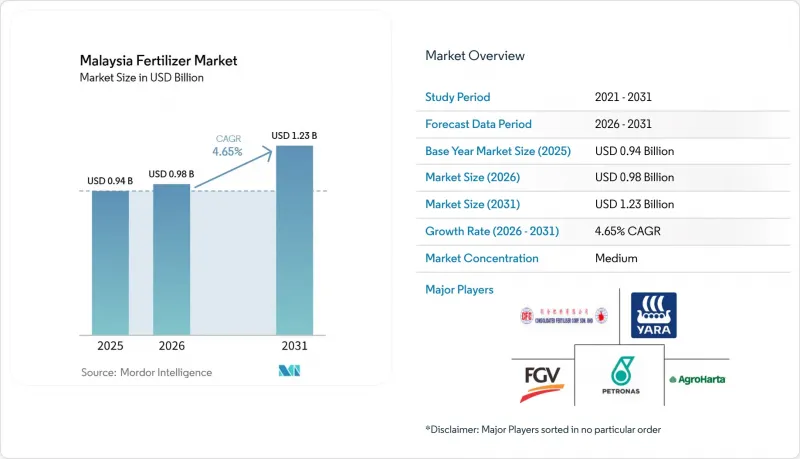
預計馬來西亞化肥市場規模將從 2025 年的 9.4 億美元和 2026 年的 9.8 億美元成長到 2031 年的 12.3 億美元,2026 年至 2031 年的複合年成長率為 4.65%。
本報告按類型(複合肥和單質肥)、形態(常規型和特種型)、施用方法(施肥灌溉、葉面噴布和土壤施用)以及作物類型(田間作物、園藝作物和草坪/觀賞植物)進行分類。市場預測以價值(美元)和數量(公噸)表示。
馬來西亞化肥市場的趨勢與洞察
油棕櫚對營養物質的需求不斷成長
由於油棕櫚在成熟和補種的種植園中持續消耗大量養分,因此它仍然是馬來西亞化肥市場最大的終端用戶支柱。根據國際肥料協會(IFA)統計,2023年馬來西亞氯化鉀進口總量達160萬噸,而2024年棕櫚油價格的上漲支撐了種植園的現金流,使得養分支出高於預期。棕櫚油價格的持續高位也降低了補種老樹的迫切性,因為種植者傾向於維持老樹的產量,而不是暫時休耕土地。這一趨勢穩定了對鉀肥和氮肥的需求,因為即使是成熟的樹木也需要維護和補充施肥才能保持產量。因此,即使在大規模補種週期全面展開之前,馬來西亞化肥市場也已形成了一個穩定的、人工林主導的需求基礎。
政府補貼和生產材料支持
政府支持仍然是穩定馬來西亞化肥市場需求的最重要因素之一。這是因為國內消費的一部分不僅與農場的購買力相關,也與政策支持密切相關。 2025年,農業和糧食安全部撥款22.79億馬幣(約4.849億美元)用於農業補貼,涵蓋水稻種植者的種子、化肥和病蟲害防治。 2026年的撥款額為26.2億馬幣(約5.574億美元),這表明保護糧食生產者免受成本壓力仍然是一項積極的政策優先事項。從2026年1月到2027年12月,天然磷礦石和硫酸鎂的銷售稅和服務稅豁免將進一步降低交付成本,並有助於在馬來西亞化肥市場維持更穩定的補貼需求,即使在價格高企時期也是如此。
對進口原料的高度依賴
由於國內化肥產量無法均衡涵蓋所有營養成分,馬來西亞的化肥市場結構仍脆弱。儘管國內尿素生產在氮肥供應中發揮至關重要的作用,但磷肥卻缺乏類似的保障。截至2026年3月,馬來西亞50%的磷肥進口來自埃及。雖然對某些傳統來源的依賴有所下降,但過度依賴特定供應路線的風險仍然很高。同月,人工林及原產品部啟動了一項旨在尋找替代供應夥伴並開發新供應路線的計劃,表明來源多元化是該部積極主動的政策重點。儘管提案的《化肥法案》可能會加強監管,但在進口多元化取得進展、供應集中度降低之前,馬來西亞的化肥市場仍可能保持脆弱狀態。
細分市場分析
2025年,單一成分肥料在馬來西亞肥料市場佔據最大佔有率,達64.0%,並繼續成為國內需求的核心。尿素、氯化鉀和磷酸二銨因其適用於現有的養分管理方案和大規模田間施肥,仍是油棕櫚、水稻和橡膠種植園的主要肥料。在氮肥領域,尿素在2025年佔據主導地位,吉打州和沙巴州的本地工廠在全球供應中斷的情況下,在維持供應連續性方面發揮關鍵作用。
預計2026年至2031年間,單一肥料的複合年成長率將達到8.6%,成為成長最快的細分市場,這反映出田間營養策略中對糾正營養缺乏的日益重視。阿博拉(Abola)的需求預計將會增加,因為它被用於油棕櫚種植園,以減少花蕾脫落和葉片畸形,從而降低鮮果串的產量。複合肥料正在幫助人工林轉向基於葉片組織分析和系統性田間診斷的更精準的營養管理方案。雖然單一肥料在馬來西亞肥料市場的規模上仍然主導地位,但推動成長的動力正日益轉向營養平衡和營養缺乏管理。
預計到2025年,傳統肥料將佔據馬來西亞肥料市場78.0%的佔有率,這表明馬來西亞肥料市場仍然主要依賴標準顆粒狀肥料的廣泛應用。由於人工林經營者需要在廣泛的耕地面積內管理養分控制方案,因此在許多採購決策中,單位養分成本比施用精準度更為重要。此外,傳統肥料還受益於成熟的物流系統、熟悉的施用方法以及與現有分銷網路的高度相容性。這解釋了為何即使產品技術日益成熟,傳統肥料仍佔據馬來西亞肥料市場的重要佔有率。
預計到2031年,特種肥料將以每年8.1%的速度成長,成為肥料市場中成長最快的細分市場。在油棕苗圃中,緩效肥料越來越受歡迎,因為在幼苗早期生長階段,養分供應的時機至關重要。緩釋和水溶性肥料也非常適合熱帶環境,因為在熱帶地區養分流失更為顯著,作物生長需要更精準的控制。因此,馬來西亞肥料市場正在演變為一種兩極化的結構。雖然傳統肥料在大規模人工林農業中仍然佔據主導地位,但特種肥料正在園藝、育苗和精準養分管理領域中發揮越來越重要的作用。
其他好處:
- Excel格式的市場預測(ME)表
- 3個月的分析師支持
目錄
第1章:引言
- 研究假設和市場定義
- 調查範圍
- 調查方法
第2章:本報告的內容
第3章:執行摘要和主要發現
第4章:主要產業趨勢
- 主要農作物種植面積
- 田間作物
- 園藝作物
- 平均施肥量
- 微量營養素
- 田間作物
- 園藝作物
- 主要營養素
- 田間作物
- 園藝作物
- 次要大元素
- 田間作物
- 園藝作物
- 微量營養素
- 具有灌溉設施的農田
- 法律規範
- 價值鍊和通路分析
- 市場促進因素
- 對油棕櫚的營養需求不斷成長
- 政府對投入材料的補助與支持
- 引進精密農業及施肥灌溉
- 為保障國內生產和庫存所做的努力
- 化肥品質法規與供應鏈監控
- 造林農業中的再造林週期
- 市場限制因素
- 過度依賴進口原料
- 對全球價格波動的影響
- 小規模農戶的價格敏感性
- 在人工林以外的地方使用專用肥料受到限制。
第5章 市場規模與成長預測
- 按類型
- 複雜類型
- 直的
- 微量營養素
- 硼
- 銅
- 鐵
- 錳
- 鉬
- 鋅
- 其他
- 氮基
- 硝酸銨
- 無水氨
- 尿素
- 其他
- 磷酸鹽基
- 磷酸二銨
- 磷酸一銨
- 轉磷酸鹽
- 三重過磷酸鈣石灰
- 其他
- 鉀基
- 氯化鉀
- 硫酸鉀
- 其他
- 次要大量營養元素
- 鈣
- 鎂
- 硫
- 微量營養素
- 按形式
- 傳統的
- 專業
- 控制釋放肥料
- 液體肥料
- 緩效肥料
- 水溶性
- 透過應用方法
- 灌溉
- 葉片表面
- 土壤
- 按作物類型
- 田間作物
- 園藝作物
- 草坪和觀賞植物
第6章 競爭情勢
- 關鍵策略趨勢
- 市佔率分析
- 企業狀況
- 公司簡介
- PETRONAS Chemicals Group Berhad
- Yara International ASA
- FGV Holdings Berhad
- Consolidated Fertiliser Corporation Sdn Bhd
- Agroharta Fertilizer Sdn Bhd
- Sinergi Perdana Sdn Bhd
- Hap Seng Trading
- Syngenta Group
- IFFCO
- Nufarm
- NGEAM Engineering Works Sdn Bhd
- Twin Arrow Fertilizer Sdn Bhd
- BIOTECH BLENDS
- UPL Limited
- The Mosaic Company
第7章:化肥產業相關人員的關鍵策略挑戰
According to Mordor Intelligence, the Malaysia fertilizers market size was expanded from USD 0.94 billion in 2025 and USD 0.98 billion in 2026 to USD 1.23 billion by 2031, registering a CAGR of 4.65% between 2026 and 2031.
This report is Segmented by Type (Complex and Straight), by Form (Conventional and Specialty), by Application Mode (Fertigation, Foliar, and Soil), and by Crop Type (Field Crops, Horticultural Crops, and Turf and Ornamental). The Market Forecasts are Provided in Terms of Value (USD) and Volume (Metric Tons).
Malaysia Fertilizer Market Trends and Insights
Rising Oil Palm Nutrient Demand
Oil palm remains the largest end-use anchor for the Malaysia fertilizer market because it consumes large recurring nutrient volumes across mature and replanted acreage. According to the International Fertilizer Association, muriate of potash imports into Malaysia totaled 1.6 million tons in 2023, and higher crude palm oil prices in 2024 supported estate cash flow and kept nutrient spending more resilient than anticipated. Strong palm oil prices also reduce the urgency to replace aging palms, as growers often prefer to sustain output from older trees rather than temporarily take land out of production. That behavior keeps demand steady for potassic and nitrogenous products because mature stands still require maintenance feeding and corrective nutrient application to sustain bunch output. This gives the Malaysia fertilizer market a stable plantation-led demand base even before a larger replanting cycle starts to move faster.
Government Subsidies and Input Support
Government support remains one of the clearest demand stabilizers in the Malaysia fertilizer market because part of national consumption is linked to policy support instead of only farm-level purchasing ability. The Ministry of Agriculture and Food Security allocated MYR 2.279 billion (USD 484.9 million) in 2025 for agricultural support, covering seeds, fertilizers, and pest control for paddy farmers. In 2026, the allocation stands at MYR 2.62 billion (USD 557.4 million), indicating that shielding food producers from cost pressures remains an active policy priority. The Sales and Service Tax exemption for rock phosphate and magnesium sulfate from January 2026 through December 2027 further reduces delivered cost and helps keep subsidized demand in the Malaysia fertilizer market more stable during periods of price stress.
Heavy Dependence on Imported Raw Materials
The Malaysia fertilizer market still carries a structural vulnerability because domestic production does not cover all nutrient categories evenly. Local urea output provides meaningful nitrogen support, but the same protection does not apply to phosphatic inputs. As of March 2026, Malaysia sources 50% of its phosphatic fertilizer imports from Egypt, maintaining significant corridor concentration risk despite having reduced dependence on some earlier origins. In the same month, the Ministry of Plantation and Commodities moved to secure alternative supply partners and activate new channels, indicating that procurement diversification has become an active policy priority task. The proposed Fertilizer Bill may improve oversight, but the Malaysia fertilizer market will remain vulnerable until import sourcing becomes broader and less concentrated.
Other drivers and restraints analyzed in the detailed report include:
- Precision Farming and Fertigation Adoption
- Domestic Production and Stock Buffering Efforts
- Smallholder Price Sensitivity
For complete list of drivers and restraints, kindly check the Table Of Contents.
Segment Analysis
Straight fertilizers held the largest, 64.0% of the Malaysia fertilizer market share in 2025, which kept the segment at the center of national volume demand. Urea, muriate of potash, and di-ammonium phosphate remained the core products used across oil palm, paddy, and rubber plantations because they fit established nutrient programs and large-scale field application. Within nitrogenous fertilizers, urea dominated the sub-segment in 2025, and domestic plants in Kedah and Sabah helped maintain supply continuity during global disruption.
Straight fertilizers are projected to expand at a CAGR of 8.6% from 2026 to 2031, making them the fastest-growing segment, reflecting the increasing focus on correcting deficiencies in field nutrient strategies. Boron is projected to grow as oil palm estates use it to reduce flower abortion and leaf deformation, both of which can negatively affect fresh fruit bunch performance. Complex fertilizers support estates transitioning toward more precise nutrient programs based on leaf tissue analysis and structured field diagnostics. While straight fertilizers lead the Malaysia fertilizer market in terms of scale, growth is increasingly being driven by nutrient balancing and deficiency management.
Conventional fertilizers held 78.0% of the form segment in 2025, which shows that the Malaysia fertilizer market size still rests on the broad use of standard granular products. Plantation operators manage nutrient programs across very large planted areas, so cost per nutrient unit still matters more than delivery precision in many buying decisions. Conventional products also benefit from established logistics, familiar handling practices, and strong compatibility with the current distributor base. This is why conventional fertilizers continue to hold the larger share of the Malaysia fertilizer market even as product sophistication increases.
Specialty fertilizers are projected to grow at 8.1% through 2031, making them the fastest-growing part of the form split. Controlled-release fertilizers are gaining popularity in oil palm nurseries because nutrient timing is critical during early plant establishment. Slow-release and water-soluble products also fit tropical conditions where nutrient loss can be higher, and crop response needs to be tighter. As a result, the Malaysian fertilizer market is evolving toward a dual structure. Conventional fertilizers continue to dominate large-scale plantation agriculture, while specialty fertilizers are expanding their role in horticulture, nursery production, and precision nutrient management.
Complete Report Scope:
- By Type
- Complex
- Straight
- Micronutrients
- Boron
- Copper
- Iron
- Manganese
- Molybdenum
- Zinc
- Others
- Nitrogenous
- Ammonium Nitrate
- Anhydrous Ammonia
- Urea
- Others
- Phosphatic
- Di-ammonium Phosphate
- Mono Ammonium Phosphate
- Single Super Phosphate
- Triple Superphosphate
- Others
- Potassic
- Muriate of Potash
- Sulphate of Potash
- Others
- Secondary Macronutrients
- Calcium
- Magnesium
- Sulfur
- Micronutrients
- By Form
- Conventional
- Specialty
- Controlled-Release Fertilizer
- Liquid Fertilizer
- Slow-Release Fertilizer
- Water Soluble
- By Application Mode
- Fertigation
- Foliar
- Soil
- By Crop Type
- Field Crops
- Horticultural Crops
- Turf and Ornamental
List of Companies Covered in this Report:
- PETRONAS Chemicals Group Berhad
- Yara International ASA
- FGV Holdings Berhad
- Consolidated Fertiliser Corporation Sdn Bhd
- Agroharta Fertilizer Sdn Bhd
- Sinergi Perdana Sdn Bhd
- Hap Seng Trading
- Syngenta Group
- IFFCO
- Nufarm
- NGEAM Engineering Works Sdn Bhd
- Twin Arrow Fertilizer Sdn Bhd
- BIOTECH BLENDS
- UPL Limited
- The Mosaic Company
Additional Benefits:
- The market estimate (ME) sheet in Excel format
- 3 months of analyst support
TABLE OF CONTENTS
1 Introduction
- 1.1 Study Assumptions & Market Definition
- 1.2 Scope of the Study
- 1.3 Research Methodology
2 Report Offers
3 Executive Summary & Key Findings
4 Key Industry Trends
- 4.1 Acreage of Major Crop Types
- 4.1.1 Field Crops
- 4.1.2 Horticultural Crops
- 4.2 Average Nutrient Application Rates
- 4.2.1 Micronutrients
- 4.2.1.1 Field Crops
- 4.2.1.2 Horticultural Crops
- 4.2.2 Primary Nutrients
- 4.2.2.1 Field Crops
- 4.2.2.2 Horticultural Crops
- 4.2.3 Secondary Macronutrients
- 4.2.3.1 Field Crops
- 4.2.3.2 Horticultural Crops
- 4.2.1 Micronutrients
- 4.3 Agricultural Land Equipped For Irrigation
- 4.4 Regulatory Framework
- 4.5 Value Chain & Distribution Channel Analysis
- 4.6 Market Drivers
- 4.6.1 Rising oil palm nutrient demand
- 4.6.2 Government subsidies and input support
- 4.6.3 Precision farming and fertigation adoption
- 4.6.4 Domestic production and stock buffering efforts
- 4.6.5 Fertilizer quality regulation and supply chain oversight
- 4.6.6 Replanting cycles in plantation agriculture
- 4.7 Market Restraints
- 4.7.1 Heavy dependence on imported raw materials
- 4.7.2 Exposure to global price volatility
- 4.7.3 Smallholder price sensitivity
- 4.7.4 Limited specialty fertilizer penetration beyond plantations
5 Market Size and Growth Forecasts (Value And Volume)
- 5.1 By Type
- 5.1.1 Complex
- 5.1.2 Straight
- 5.1.2.1 Micronutrients
- 5.1.2.1.1 Boron
- 5.1.2.1.2 Copper
- 5.1.2.1.3 Iron
- 5.1.2.1.4 Manganese
- 5.1.2.1.5 Molybdenum
- 5.1.2.1.6 Zinc
- 5.1.2.1.7 Others
- 5.1.2.2 Nitrogenous
- 5.1.2.2.1 Ammonium Nitrate
- 5.1.2.2.2 Anhydrous Ammonia
- 5.1.2.2.3 Urea
- 5.1.2.2.4 Others
- 5.1.2.3 Phosphatic
- 5.1.2.3.1 Di-ammonium Phosphate
- 5.1.2.3.2 Mono Ammonium Phosphate
- 5.1.2.3.3 Single Super Phosphate
- 5.1.2.3.4 Triple Superphosphate
- 5.1.2.3.5 Others
- 5.1.2.4 Potassic
- 5.1.2.4.1 Muriate of Potash
- 5.1.2.4.2 Sulphate of Potash
- 5.1.2.4.3 Others
- 5.1.2.5 Secondary Macronutrients
- 5.1.2.5.1 Calcium
- 5.1.2.5.2 Magnesium
- 5.1.2.5.3 Sulfur
- 5.1.2.1 Micronutrients
- 5.2 By Form
- 5.2.1 Conventional
- 5.2.2 Specialty
- 5.2.2.1 Controlled-Release Fertilizer
- 5.2.2.2 Liquid Fertilizer
- 5.2.2.3 Slow-Release Fertilizer
- 5.2.2.4 Water Soluble
- 5.3 By Application Mode
- 5.3.1 Fertigation
- 5.3.2 Foliar
- 5.3.3 Soil
- 5.4 By Crop Type
- 5.4.1 Field Crops
- 5.4.2 Horticultural Crops
- 5.4.3 Turf and Ornamental
6 Competitive Landscape
- 6.1 Key Strategic Moves
- 6.2 Market Share Analysis
- 6.3 Company Landscape
- 6.4 Company Profiles (Includes Global Level Overview, Market Level Overview, Core Segments, Financials as Available, Strategic Information, Market Rank/Share for Key Companies, Products and Services, and Recent Developments)
- 6.4.1 PETRONAS Chemicals Group Berhad
- 6.4.2 Yara International ASA
- 6.4.3 FGV Holdings Berhad
- 6.4.4 Consolidated Fertiliser Corporation Sdn Bhd
- 6.4.5 Agroharta Fertilizer Sdn Bhd
- 6.4.6 Sinergi Perdana Sdn Bhd
- 6.4.7 Hap Seng Trading
- 6.4.8 Syngenta Group
- 6.4.9 IFFCO
- 6.4.10 Nufarm
- 6.4.11 NGEAM Engineering Works Sdn Bhd
- 6.4.12 Twin Arrow Fertilizer Sdn Bhd
- 6.4.13 BIOTECH BLENDS
- 6.4.14 UPL Limited
- 6.4.15 The Mosaic Company
7 Key Strategic Questions for Fertilizer Stakeholders

 2026年全球氨肥市場報告
 2026-2030年全球磷肥市場
 東南亞化肥市場:市佔率分析、產業趨勢與統計及成長預測(2026-2031年)
 化肥市場規模、佔有率、成長、全球產業分析、區域趨勢及2026-2034年預測。昆蟲衍生肥料市場規模、佔有率、成長、全球產業分析、區域趨勢及2026年至2034年預測。印尼化肥市場:市場佔有率分析、產業趨勢與統計、成長預測(2026-2031)全球昆蟲衍生肥料市場規模、佔有率、趨勢和成長分析報告(2026-2034)綠色氨肥:市場佔有率分析、產業趨勢與統計、成長預測(2026-2031)
 全球控釋肥料市場:按類型、施用方法、功能、產品等級、作物類型、配方和地區分類-預測至2031年2026年全球微粉化肥料市場報告