


 |
市場調查報告書
商品編碼
2117369
美國堆高機租賃:市場佔有率分析、產業趨勢與統計、成長預測(2026-2031)United States Forklift Rental - Market Share Analysis, Industry Trends & Statistics, Growth Forecasts (2026 - 2031) |
||||||

※ 本網頁內容可能與最新版本有所差異。詳細情況請與我們聯繫。
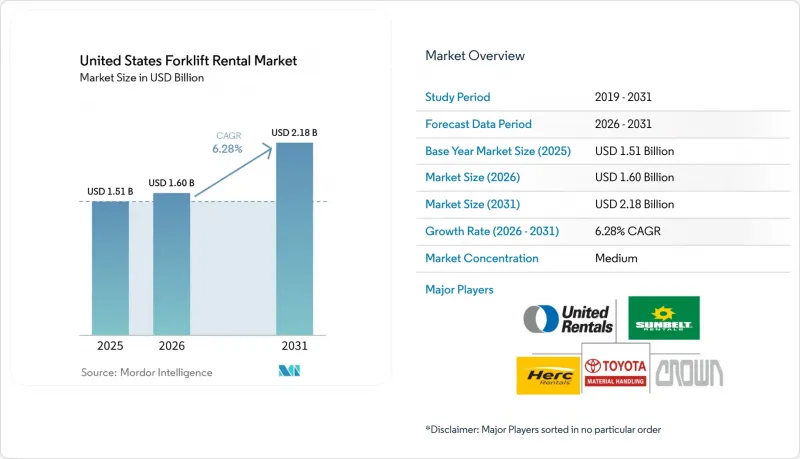
據 Mordor Intelligence 稱,2025 年美國堆高機租賃市場價值 15.1 億美元,預計到 2031 年將從 2026 年的 16 億美元成長到 21.8 億美元,預測期(2026-2031 年)的複合年成長率為 6.28%。
本報告按載重能力(3.5噸以下、3.6至10噸、10噸以上)、租賃期限(短期/即期、中期、長期租賃)、動力來源(電動、內燃機、混合動力)、卡車級(I級、II級等)、終端用戶產業(倉儲物流、建築等)及地區進行細分。市場預測以美元計價。
美國堆高機租賃市場的趨勢與洞察
電子商務倉儲需求爆炸性成長
亞馬遜近期在美國各地開設了多家新的履約中心,每個中心在高峰期的安裝和運作階段都需要租用數十台堆高機。沃爾瑪也對其面向客戶的高科技履約中心進行了大量自動化升級,在其持續擴張階段推動了短期堆高機需求。電商巨頭Gopuff和DoorDash建立了微型倉庫,並使用緊湊型III級托盤搬運車進行短期租賃。這種需求模式與堆高機自有成本並不相符。德克薩斯州物流走廊新建倉庫面積的顯著成長,以及喬治亞的大力貢獻,進一步鞏固了南部地區在美國堆高機租賃市場的主導地位。全國各地履約中心的持續建設為堆高機運轉率提供了穩定的基礎。
在利率上升時期,人們傾向於抑制資本支出。
聯準會將政策利率維持在3.5%至3.75%之間,直至2026年初,這推高了資本資金籌措成本。 Sunbelt Rentals公司報告稱,中期合約收入有所成長,凸顯出客戶從直接購買轉向租賃的顯著趨勢。同時,Alta Equipment公司指出,新堆高機銷售的利潤率正在下降,這進一步凸顯了租賃模式日益成長的吸引力。電動堆高機長期融資的每月付款低於租賃價格,而租賃價格較高是因為其中包含了維護和非計劃更換成本。考慮到停機風險,這縮小了兩者之間的經濟差距。隨著財務長們將資產負債表的柔軟性放在首位,這種情況對美國堆高機租賃市場有利。
預計維護成本和損害賠償
儘管供應商在基本價格中包含免責事項,但許多中小承包商仍將不確定性視為租賃的阻礙,導致他們高估了損壞賠償成本。增加保險會顯著提高每日租金,從而降低與購買二手設備相比的成本優勢。這些摩擦成本顯然限制了美國堆高機租賃市場的潛力,因為區域車隊往往未被充分利用。雖然一些公司正在實施租賃前拍照檢查和遠端資訊處理技術來監控操作員的不當操作,但對於首次租賃用戶而言,仍有知識缺口。
細分市場分析
到2025年,3.5噸以下的堆高機將占美國堆高機租賃市場佔有率的45.87%,預計到2031年將以8.52%的複合年成長率成長。在人口密集的都市區履約中心,這些緊湊型電動托盤搬運車和堆垛機被用於在30英尺寬的通道中移動,而不會影響處理能力。在假期季節,亞馬遜和沃爾瑪經常使用這些設備,並且通常選擇短期租賃合約。雖然重型設備製造商傳統上依賴中型設備,但隨著自動化減少了重複性操作的需求,預計該領域的成長速度將會放緩。
租賃期限因設備容量而異。小型設備主要用於短期租賃,而大型設備則擴大用於長期租賃,尤其是在建設業和鋼鐵搬運行業。豐田的「T-Matics」和皇冠公司的「InfoLink」等系統使租賃公司能夠監控設備使用情況,從而減少意外停機時間並延長資產使用壽命。重型設備領域也正在發生顯著的電氣化轉型。最近,紐瓦克港訂購了大型電池驅動設備,以符合當地的空氣品質法規。
到2025年,受零售、農業和活動物流等季節性需求的推動,短期租賃將占美國堆高機租賃市場的51.87%。然而,隨著微型倉配中心的擴張、資料中心建設的增加以及90至180天調試期的延長,中期合約(期限為1至12個月)預計將以9.04%的複合年成長率成長。這種轉變在自動化網格的引進中尤其明顯,機器人已經接手了部分工作,使得克羅格旗下Ocado試運行的客戶履約中心不再需要堆高機。
聯合租賃公司推出了「靈活租賃」計劃,允許客戶從短期租賃轉為長期合約。此舉涉及追溯性費用調整,旨在對沖預測的不確定性,並確保聯合租賃公司穩定的收入來源。阿爾塔設備公司採取了減少設備庫存的策略性措施。這表明,銷售成長未必源自自然成長,在某些情況下,嚴格的資本週轉會導致供應減少。在旺季,許多短期用戶會選擇購買損壞保險,而簽訂中期合約的客戶則傾向於選擇包含保險的套餐服務,此類服務已包含在每月帳單中。
其他好處:
- Excel格式的市場預測(ME)表
- 3個月的分析師支持
目錄
第1章:引言
- 市場分析與定義的前提條件
- 分析範圍
第2章 分析方法
第3章執行摘要
第4章 市場狀況
- 市場概覽
- 市場促進因素
- 電子商務倉庫需求激增
- 在利率上升時期,人們傾向於抑制資本支出。
- 美國環保署 (EPA) 和加州空氣資源委員會 (CARB) 更嚴格的排放法規正在加速電動堆高機租賃業務的成長。
- OEM 的「車隊即服務」計畫正在推動其進軍租賃市場。
- 利用遠端資訊處理技術的計量收費合約
- 需要靈活車輛配置的臨時微型倉配中心。
- 市場限制因素
- 預計維護成本和損害賠償
- 經濟週期導致的建設工程延誤
- 租賃車輛用鋰離子電池供應緊張
- AMR/AGV 的引進正在蠶食小型堆高機的市場。
- 價值鍊和供應鏈分析
- 監理情勢
- 技術展望
- 波特五力分析
第5章:預測市場規模與成長率
- 負載能力
- 不到3.5噸
- 3.6至10噸
- 超過10噸
- 租賃期
- 短期/即期(少於1個月)
- 中期(1-12個月)
- 長期租賃(3-5年)
- 透過電源
- 電的
- 內燃機(柴油/液化石油氣)
- 混合
- 卡車級
- 一級
- 二類
- 三級
- 四級
- 第五類
- 按最終用途行業分類
- 倉儲/物流
- 建造
- 車
- 食品/飲料
- 航太/國防
- 其他(零售、醫藥等)
- 按地區(美國境內)
- 東北
- 中西部
- 南部
- 西
第6章 競爭情勢
- 市場集中度
- 策略趨勢
- 市佔率分析
- 公司簡介
- United Rentals
- Sunbelt Rentals(Ashtead Group)
- Herc Rentals
- Toyota Material Handling USA
- Crown Equipment Corp.
- Raymond Corporation
- Hyster-Yale Group
- Komatsu Forklift USA
- Mitsubishi Logisnext Americas
- CLARK Material Handling
- Doosan Industrial Vehicle America
- Jungheinrich PROFISHARE(rental)
- Alta Equipment Company
- Briggs Equipment
- EquipmentShare
- BigRentz
- Home Depot Rental
- BlueLine Rentals
- Thompson Lift Truck
第7章 市場機會與未來展望
According to Mordor Intelligence, the United States forklift rental market size was valued at USD 1.51 billion in 2025 and estimated to grow from USD 1.60 billion in 2026 to reach USD 2.18 billion by 2031, at a CAGR of 6.28% during the forecast period (2026-2031).
This report is Segmented by Load Capacity (Less Than 3. 5 T, 3. 6 To 10 T, More Than 10 T), Rental Duration (Short-term/Spot, Mid-Term, Long-Term Lease), Power Source (Electric, Internal Combustion, Hybrid), Truck Class (Class I, Class II, and More), End-Use Industry (Warehousing and Logistics, Construction, and More), and Geography. The Market Forecasts are Provided in Terms of Value (USD).
United States Forklift Rental Market Trends and Insights
Explosive E-commerce Warehousing Demand
Amazon recently opened several new fulfillment centers across the U.S., with each center requiring dozens of rental forklifts during peak installation and ramp-up phases. Walmart invested significantly in automation upgrades for its high-tech customer fulfillment centers, driving short-term forklift demand during extended buildout periods. Quick-commerce giants Gopuff and DoorDash established micro-warehouses, relying on compact Class III pallet jacks rented for short-term periods. This demand pattern does not align with ownership economics. Texas logistics corridors added substantial new warehouse space, while Georgia also contributed significantly, reinforcing the South's leadership in the U.S. forklift rental market. Ongoing construction of fulfillment centers across the country provides a stable foundation for rental fleet utilization.
CAPEX-lite Preference Amid Higher Interest Rates
The Federal Reserve kept its policy rate in the 3.5%-3.75% band through early 2026, inflating equipment-financing costs . Sunbelt Rentals reported an increase in mid-term contract revenue, highlighting a notable shift among customers moving away from direct purchases. Meanwhile, Alta Equipment observed tighter margins on new forklift sales, underscoring the growing allure of rentals. Financing an electric forklift over a long-term period results in a monthly payment that is lower compared to rental rates, which are higher but include maintenance and unscheduled swap-outs. This narrows the economic gap when downtime risk is considered. These conditions favor the United States forklift rental market as CFOs prioritize balance-sheet flexibility.
Perceived Maintenance Liability and Damage Charges
Despite providers embedding waivers in base rates, many small contractors cite uncertainty as a rental deterrent, leading them to overestimate damage fees. Adding insurance can significantly increase daily rates, diminishing the savings compared to purchasing a used unit. With regional fleets often underutilized, it's evident that friction costs are capping the potential of the U.S. forklift rental market. While firms are introducing pre-rental photo audits and telematics to monitor operator misuse, first-time renters still face educational gaps.
Other drivers and restraints analyzed in the detailed report include:
- Stricter U.S. EPA/CARB Emission Rules Accelerating Electric Rentals
- OEM Fleet-as-a-Service Programs Boosting Rental Penetration
- Cyclical Construction Project Delays
For complete list of drivers and restraints, kindly check the Table Of Contents.
Segment Analysis
Less-than-3.5-ton forklifts captured 45.87% of the United States forklift rental market share in 2025 and are forecast to grow at an 8.52% CAGR through 2031. Dense urban fulfillment nodes rely on these compact electric pallet jacks and stackers to navigate 30-foot aisles without compromising throughput. During holiday peaks, Amazon and Walmart frequently utilize such units, often opting for short-term contracts. While manufacturers of heavier goods traditionally relied on mid-range equipment, this segment is projected to grow more slowly as the push for automation reduces the need for repetitive lifting.
Rental duration patterns shift with equipment capacity: smaller models dominate short-term rentals, whereas larger units are increasingly leased for longer periods, especially in construction and steel handling. Systems like Toyota's T-Matics and Crown's InfoLink empower lessors to monitor equipment utilization, reducing unplanned downtime and extending asset life. Even in the heavy equipment segment, there's a noticeable shift towards electric. Recently, Port Newark ordered large battery units to align with regional air-quality regulations.
Short-term rentals accounted for 51.87% of the United States forklift rental market in 2025, driven by seasonal retail, agricultural, and event logistics needs. Yet mid-term contracts spanning 1 to 12 months will advance at a 9.04% CAGR as micro-fulfillment buildouts, data center construction, and 90- to 180-day commissioning activities proliferate. Once the bots took over, Kroger's Ocado-powered customer fulfillment centers no longer needed forklifts, a shift evident during the automated grid's installation.
United Rentals has introduced a "flex lease" that allows customers to convert short-term rentals into extended agreements. This comes with retroactive rate adjustments, providing a hedge against forecast uncertainties and ensuring United Rentals a steady stream of revenue. Alta Equipment made a strategic move by reducing its fleet, underscoring that volume growth isn't always organic; sometimes, a disciplined capital rotation can lead to a reduced supply. During peak seasons, short-term users opt for damage waivers at a high rate, while mid-term clients prefer a bundled service that integrates insurance into their monthly billing.
Complete Report Scope:
- By Load Capacity
- Less than 3.5 T
- 3.6 to 10 T
- More than 10 T
- By Rental Duration
- Short-term/Spot (Less than 1 month)
- Mid-term (1 to 12 months)
- Long-term Lease (3 to 5 years)
- By Power Source
- Electric
- Internal Combustion (Diesel/LPG)
- Hybrid
- By Truck Class
- Class I
- Class II
- Class III
- Class IV
- Class V
- By End-use Industry
- Warehousing and Logistics
- Construction
- Automotive
- Food and Beverage
- Aerospace and Defense
- Others (Retail, Pharma, etc.)
- By Region (U.S.)
- Northeast
- Midwest
- South
- West
List of Companies Covered in this Report:
- United Rentals
- Sunbelt Rentals (Ashtead Group)
- Herc Rentals
- Toyota Material Handling USA
- Crown Equipment Corp.
- Raymond Corporation
- Hyster-Yale Group
- Komatsu Forklift USA
- Mitsubishi Logisnext Americas
- CLARK Material Handling
- Doosan Industrial Vehicle America
- Jungheinrich PROFISHARE (rental)
- Alta Equipment Company
- Briggs Equipment
- EquipmentShare
- BigRentz
- Home Depot Rental
- BlueLine Rentals
- Thompson Lift Truck
Additional Benefits:
- The market estimate (ME) sheet in Excel format
- 3 months of analyst support
TABLE OF CONTENTS
1 Introduction
- 1.1 Study Assumptions and Market Definition
- 1.2 Scope of the Study
2 Research Methodology
3 Executive Summary
4 Market Landscape
- 4.1 Market Overview
- 4.2 Market Drivers
- 4.2.1 Explosive E-Commerce Warehousing Demand
- 4.2.2 CAPEX-Lite Preference Amid Higher Interest Rates
- 4.2.3 Stricter U.S. EPA/CARB Emission Rules Accelerating Electric Rentals
- 4.2.4 OEM Fleet-as-a-Service Programs Boosting Rental Penetration
- 4.2.5 Telematics-Enabled Pay-Per-Use Contracts
- 4.2.6 Pop-Up Micro-Fulfillment Centers Needing Flexible Fleets
- 4.3 Market Restraints
- 4.3.1 Perceived Maintenance Liability and Damage Charges
- 4.3.2 Cyclical Construction Project Delays
- 4.3.3 Lithium-Ion Battery Supply Tightness for Rental Fleets
- 4.3.4 AMR/AGV Adoption Cannibalizing Light-Duty Forklifts
- 4.4 Value/Supply-Chain Analysis
- 4.5 Regulatory Landscape
- 4.6 Technological Outlook
- 4.7 Porter's Five Forces
- 4.7.1 Threat of New Entrants
- 4.7.2 Bargaining Power of Suppliers
- 4.7.3 Bargaining Power of Customers
- 4.7.4 Threat of Substitutes
- 4.7.5 Competitive Rivalry
5 Market Size and Growth Forecasts (Value (USD))
- 5.1 By Load Capacity
- 5.1.1 Less than 3.5 T
- 5.1.2 3.6 to 10 T
- 5.1.3 More than 10 T
- 5.2 By Rental Duration
- 5.2.1 Short-term/Spot (Less than 1 month)
- 5.2.2 Mid-term (1 to 12 months)
- 5.2.3 Long-term Lease (3 to 5 years)
- 5.3 By Power Source
- 5.3.1 Electric
- 5.3.2 Internal Combustion (Diesel/LPG)
- 5.3.3 Hybrid
- 5.4 By Truck Class
- 5.4.1 Class I
- 5.4.2 Class II
- 5.4.3 Class III
- 5.4.4 Class IV
- 5.4.5 Class V
- 5.5 By End-use Industry
- 5.5.1 Warehousing and Logistics
- 5.5.2 Construction
- 5.5.3 Automotive
- 5.5.4 Food and Beverage
- 5.5.5 Aerospace and Defense
- 5.5.6 Others (Retail, Pharma, etc.)
- 5.6 By Region (U.S.)
- 5.6.1 Northeast
- 5.6.2 Midwest
- 5.6.3 South
- 5.6.4 West
6 Competitive Landscape
- 6.1 Market Concentration
- 6.2 Strategic Moves
- 6.3 Market Share Analysis
- 6.4 Company Profiles (Includes Global level Overview, Market level overview, Core Segments, Financials as available, Strategic Information, Market Rank/Share for key companies, Products and Services, and Recent Developments)
- 6.4.1 United Rentals
- 6.4.2 Sunbelt Rentals (Ashtead Group)
- 6.4.3 Herc Rentals
- 6.4.4 Toyota Material Handling USA
- 6.4.5 Crown Equipment Corp.
- 6.4.6 Raymond Corporation
- 6.4.7 Hyster-Yale Group
- 6.4.8 Komatsu Forklift USA
- 6.4.9 Mitsubishi Logisnext Americas
- 6.4.10 CLARK Material Handling
- 6.4.11 Doosan Industrial Vehicle America
- 6.4.12 Jungheinrich PROFISHARE (rental)
- 6.4.13 Alta Equipment Company
- 6.4.14 Briggs Equipment
- 6.4.15 EquipmentShare
- 6.4.16 BigRentz
- 6.4.17 Home Depot Rental
- 6.4.18 BlueLine Rentals
- 6.4.19 Thompson Lift Truck
7 Market Opportunities and Future Outlook
- 7.1 White-space and Unmet-Need Assessment

 堆高機租賃:市場佔有率分析、產業趨勢與統計、成長預測(2026-2031)歐洲旅遊車輛租賃:市場佔有率分析、產業趨勢與統計及成長預測(2026-2031 年)亞太地區旅遊車輛租賃:市場佔有率分析、行業趨勢和統計數據以及成長預測(2026-2031 年)
 印度商用車租賃市場:規模、佔有率、成長、全球產業分析、區域趨勢以及 2026 年至 2034 年的預測。
 2026 年至 2035 年商用車租賃市場的商業機會、成長要素、產業趨勢與預測。
 冷藏車租賃市場分析及預測(至2035年):類型、產品、服務、技術、應用、最終用戶、功能、設備、解決方案對商用車租賃市場進行分析和預測,直至 2035 年:按類型、產品、服務、技術、組件、應用、部署、最終用戶和解決方案進行分析和預測。
 旅遊車輛租賃市場規模、佔有率、趨勢和預測:按車輛類型、預訂方式、最終用戶和地區分類(2026-2034 年)商用車租賃市場規模、佔有率、成長及全球產業分析:按類型、應用和地區分類,並預測至2026-2034年
 堆高機租賃市場:2026-2032年全球市場預測(按型號、負載容量、租賃期限、應用和最終用途行業分類)