


 |
市場調查報告書
商品編碼
2116902
堆高機租賃:市場佔有率分析、產業趨勢與統計、成長預測(2026-2031)Forklift Rental - Market Share Analysis, Industry Trends & Statistics, Growth Forecasts (2026 - 2031) |
||||||

※ 本網頁內容可能與最新版本有所差異。詳細情況請與我們聯繫。
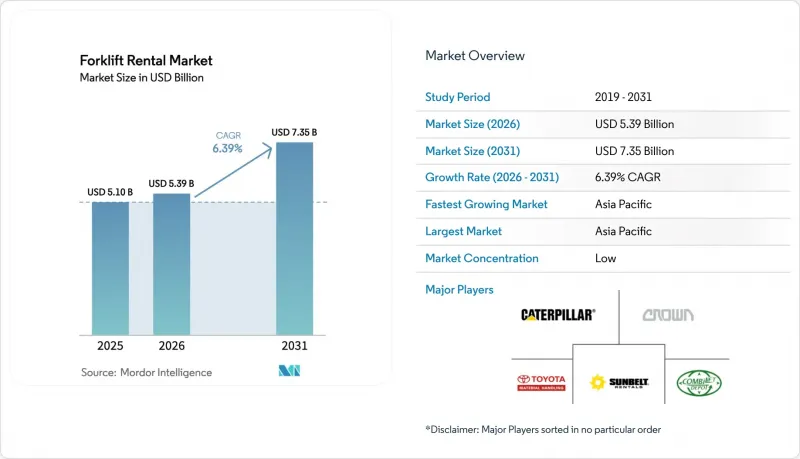
據 Mordor Intelligence 稱,2025 年堆高機租賃市場價值 51 億美元,預計到 2031 年將從 2026 年的 53.9 億美元成長到 73.5 億美元,預測期(2026-2031 年)的複合年成長率為 6.39%。
本報告按載重能力(小於3.5噸、3.6-10噸及以上)、租賃期限(短期及長期/合約)、動力來源(電動、內燃機及其他)、卡車類型(I類-搭乘用電動卡車、II類-窄巷道卡車及其他)、終端用戶產業(倉儲物流、建築及其他)及地區進行細分。市場預測以美元計價。
全球堆高機租賃市場趨勢及洞察
電子商務物流履約發展
亞馬遜龐大的全球履約網路和DHL在自動化領域的巨額投資,推動了旺季期間租賃車輛的擴張,使得可變成本合約比車輛所有權更具吸引力。亞太地區預計將出現顯著的倉儲空間擴張,部分原因是新興市場的強勁貢獻。末端物流中心小包裹處理量的波動,推動了對靈活運力解決方案的需求。租賃供應商正透過提供緊湊型電動堆高機來應對這項挑戰,這些堆高機能夠在狹窄的通道中高效運作,同時保持高承載能力。在整個規劃期內,電子商務的快速成長將繼續推動堆高機租賃市場的發展。
在物料運輸預算中,從資本支出(Capex)轉向營運支出(Opex)。
美國設備租賃與金融協會 (ELFA) 指出,美國物料輸送設備的融資和租賃業務顯著成長,這反映出一種與傳統模式的轉變。金融負責人擴大利用租賃來降低與折舊免稅額和殘值相關的風險。隨著電動和氫動力驅動取代老舊的柴油車型,這種策略確保了企業能夠獲得最新技術。在汽車和消費性電子等行業,由於訂單週期難以預測且生產計劃經常變化,擁有設備通常並非經濟高效的解決方案。此外,租賃協議將維護責任轉移給了出租方,從而有助於企業滿足監管部門的重新認證要求並節省成本。採用總合約的多地點第三方物流(3PL) 營運商進一步推動了堆高機租賃市場的發展,這些合約保證了價格和服務品質的一致性。
建築支出週期
建設產業的波動直接影響堆高機租賃需求,使得租賃公司難以預測收入來源。近期,施工機械市場表現不一,一些大型公司因銷售量下降和終端用戶設備銷售額下滑而導致收入減少。然而,短期前景表明,在經濟狀況改善和利率下調的支撐下,施工機械銷售預計將復甦。此外,聯邦政府對基礎設施項目的大規模投資預計將帶來穩定,許多建築公司已參與其中。儘管有這些利多因素,租賃公司仍面臨諸多挑戰,例如專案延期和材料成本上漲,這些問題依然是許多公司關注的焦點。建築支出的周期性波動往往導致租賃庫存過剩,這體現在近期租賃收入成長放緩,使其成為近年來業績最疲軟的時期之一。
細分市場分析
到2025年,3.6-10噸級堆高機將佔總收入的45.37%,這充分展現了其在生產、物流和建築作業中的多功能性。相較之下,3.5噸以下堆高機預計到2031年將實現10.67%的複合年成長率,這主要得益於土地資源有限的城市,這些城市的設施設計中普遍採用狹窄的通道和高高的貨架。在主要都市區,隨著垂直儲存空間的增加,倉庫擴大採用緊湊型電動堆高機。這些堆高機的設計旨在有效率地在狹窄的通道中穿梭,同時實現高負載能力。此外,先進的電池技術正在改善租賃車輛的經濟性,從而降低整體生命週期成本。
隨著都市區密度增加,小型堆高機租賃的需求預計將以高於其他類別的速度成長。遠端資訊處理技術將使租賃公司能夠最佳化堆高機輪換,確保在需求較低的區域進行高效維護,同時在需求較高的區域保持運作就緒狀態。在工業設施等次市場,大型機械仍然是首選,由於需要擁有專用設備,租賃的普及程度仍然有限。這一趨勢凸顯了堆高機租賃市場正向更移動化和更環保的資產轉變,而小型電動堆高機正是推動這一轉變的主要力量。
預計到2025年,12個月以下的短期租賃將佔總收入的64.73%,主要受建設業租賃協議中很大一部分為長期租賃。較長的租賃期限允許出租人分攤購買成本,從而在不影響盈利的前提下降低每月租金。
靈活的租賃方案允許客戶在初始租賃期結束後短時間內終止契約,從而在可預測性和靈活性之間取得平衡。同樣,由於批量合約簡化了計費流程並允許享受批量折扣,承包商的平均租賃期限也在延長。因此,儘管短期需求對於滿足特定專案的需求高峰仍然至關重要,但由長期合約驅動的堆高機租賃市場仍在持續擴張。
區域分析
預計到2025年,亞太地區將佔全球收入的37.65%,並將在2031年之前維持10.28%的複合年成長率。中國大規模的倉儲建設計畫以及印度物流設施的建成是推動這項快速成長的主要動力。在中國,電子商務的高滲透率導致大型購物節期間租賃車輛數量顯著增加。在日本,新型自動化空間的引入正在加速窄巷道電動堆高機和遠端資訊處理技術的整合,從而緩解人手不足和薪資上漲的問題。
以美國主導的北美地區對銷售額貢獻巨大。該地區為實現零排放目標所做的努力正在加速向電氣化轉型,並推動堆高機租賃市場的成長。同時,加拿大市場需求穩定,尤其是在主要交通走廊沿線。
歐洲佔據了相當大的市場佔有率,主要國家是推動市場成長的主要力量。儘管電動租賃車輛的成本高於傳統車型,但監管政策的變革正在推動租賃車輛的電氣化。該地區的領先企業利用其廣泛的分店網路為全部區域的客戶提供服務。南美洲和中東及非洲地區的市場佔有率雖然較小,但成長勢頭強勁。這主要得益於港口物流的擴張和雄心勃勃的基礎設施項目,這些項目刺激了對專業租賃設備的需求。
其他好處:
- Excel格式的市場預測(ME)表
- 3個月的分析師支持
目錄
第1章:引言
- 研究假設和市場定義
- 調查範圍
第2章:調查方法
第3章執行摘要
第4章 市場狀況
- 市場概覽
- 市場促進因素
- 電子商務物流履約發展
- 在物料輸送預算中,資本支出(Capex)應轉向營運支出(OpEx)。
- 加速採用倉庫自動化
- 由於排放氣體法規的限制,IV級和V級內燃機(ICE)卡車逐步淘汰。
- 引進人工智慧驅動的車輛運行最佳化軟體
- 採用基於訂閱的「按小時收費」模式,使用 OEM(目的地設備製造商)服務。
- 市場限制因素
- 建築支出受經濟週期影響。
- 持證堆高機駕駛人短缺
- 鋰離子電池原料成本上漲
- 原始設備製造商直接租賃車輛正在蠶食獨立租賃公司的車輛保有量。
- 價值供應鏈分析
- 監理情勢
- 技術展望
- 波特五力分析
第5章 市場規模與成長預測
- 負載能力
- 不到3.5噸
- 3.6~10 T
- 超過10噸
- 租賃期
- 短期(少於12個月)
- 長期/合約(12個月或以上)
- 透過電源
- 電的
- 內燃機(柴油/液化石油氣)
- 混合動力/氫能
- 卡車級別
- 一級 - 電動騎手
- 二級 - 狹窄通道類型
- 三級電動手推車
- IV級冰緩衝
- 第五類 - 內燃機(ICE)氣動
- 按最終用途行業分類
- 倉儲/物流
- 建造
- 車
- 食品/飲料
- 航太/國防
- 其他(零售、醫藥等)
- 按地區
- 北美洲
- 美國
- 加拿大
- 其他北美國家
- 南美洲
- 巴西
- 阿根廷
- 其他南美國家
- 歐洲
- 德國
- 英國
- 法國
- 義大利
- 西班牙
- 俄羅斯
- 其他歐洲國家
- 亞太地區
- 中國
- 日本
- 印度
- 韓國
- 澳洲
- 其他亞太國家
- 中東和非洲
- 沙烏地阿拉伯
- 阿拉伯聯合大公國
- 埃及
- 南非
- 其他中東和非洲國家
- 北美洲
第6章 競爭情勢
- 市場集中度
- 策略趨勢
- 市佔率分析
- 公司簡介
- United Rentals Inc.
- Sunbelt Rentals(Ashtead Group)
- Toyota Industries Corp.(Toyota Material Handling)
- Caterpillar Inc.(Cat Rental)
- Herc Rentals Inc.
- Combillift Depot
- Crown Equipment Corp.
- Jungheinrich AG(Rental)
- Mitsubishi Logisnext
- KION Group(Linde, STILL)
- Speedy Hire Plc
- Loxam Group
- Coates Hire
- Boels Rental
- Riwal Holding Group
- BigRentz Inc.
- Sunstate Equipment
- Ahern Rentals
- Komatsu Ltd.(Rental)
第7章 市場機會與未來展望
According to Mordor Intelligence, the forklift rental market size was valued at USD 5.10 billion in 2025 and estimated to grow from USD 5.39 billion in 2026 to reach USD 7.35 billion by 2031, at a CAGR of 6.39% during the forecast period (2026-2031).
This report is Segmented by Load Capacity (Less Than 3. 5 T, 3. 6 To 10 T, and More), Rental Duration (Short-Term and Long-term/Contract), Power Source (Electric, Internal Combustion, and More), Truck Class (Class I - Electric Rider, Class II - Narrow-Aisle, and More), End-Use Industry (Warehousing and Logistics, Construction, and More), and Geography. The Market Forecasts are Provided in Terms of Value (USD).
Global Forklift Rental Market Trends and Insights
E-Commerce Fulfillment Boom
Amazon's extensive global fulfillment network and DHL's significant investment in automation are driving rental fleets to expand during peak periods, making variable-cost agreements more favorable compared to ownership . The Asia-Pacific region is expected to witness substantial growth in warehouse space, with notable contributions from emerging markets. Fluctuations in parcel volumes at last-mile hubs are increasing the demand for flexible capacity solutions. Rental operators are addressing this by offering compact electric models that can operate efficiently in narrow aisles while maintaining high lifting capabilities. The rapid growth of e-commerce continues to shape the development of the forklift rental market over the planning horizon.
Shift from Capex to Opex in Material-Handling Budgets
The Equipment Leasing and Finance Association noted a notable rise in the financing and leasing of material-handling equipment in the United States, reflecting a shift from traditional patterns. Finance leaders are increasingly turning to rentals to mitigate risks associated with depreciation and residual value. This strategy ensures access to the latest technology as advancements like electric and hydrogen drives replace older diesel models. In industries such as automotive and consumer electronics, where order cycles are unpredictable and production schedules frequently change, ownership is often not a cost-effective solution. Moreover, rental agreements transfer maintenance responsibilities to lessors, aligning with regulatory recertification requirements and helping operators reduce expenses. The forklift rental market is further bolstered by multi-site 3PLs adopting master agreements that ensure consistent rates and service quality.
Cyclical Construction Spending
Fluctuations in the construction industry directly influence the demand for forklift rentals, leading to unpredictable revenue streams for rental companies. Recently, the construction equipment market experienced mixed results, with a major player reporting a decline in revenue due to reduced sales volumes and a drop in equipment sales to end users. However, the outlook for the near future indicates a potential rebound in construction equipment sales, supported by improving economic conditions and easing interest rates. Additionally, significant federal investments in infrastructure projects are expected to provide stability, with a notable portion of contractors already engaged in these initiatives. Despite this support, rental companies continue to face challenges such as project delays and rising material costs, which remain a significant concern for many firms. The cyclical nature of construction spending often results in periods of surplus rental inventory, as reflected in the recent slowdown in rental revenue growth, marking one of the weakest performances in recent times.
Other drivers and restraints analyzed in the detailed report include:
- Emission Regulations Phasing-Out Class IV/V ICE Trucks
- AI-driven Fleet-Optimization Software Adoption
- OEM Direct-Leasing Cannibalizing Independent Rental Fleets
For complete list of drivers and restraints, kindly check the Table Of Contents.
Segment Analysis
The 3.6 to 10 ton bracket captured 45.37% of 2025 revenue, affirming its versatility across production, logistics, and construction operations. In contrast, sub-3.5-ton forklifts are on track for a 10.67% CAGR to 2031, supported by land-scarce cities where narrow aisles and high racks dominate facility design. In major urban centers, as vertical storage increases, warehouses are increasingly adopting compact electric forklifts. These forklifts are designed to achieve significant lift heights while efficiently navigating through narrow corridors. Additionally, advanced battery technologies enhance the economic viability for rental fleets, leading to lower overall lifecycle costs.
As urban areas become increasingly densely populated, the demand for compact forklift rentals is expected to grow at a faster pace compared to other categories. Telematics technology enables lessors to optimize forklift rotation, ensuring efficient servicing of quieter locations while maintaining readiness in high-demand areas. Secondary markets, including industrial facilities, still show a preference for larger machines, with rental adoption remaining limited due to the need for specialized equipment ownership. This trend highlights the forklift rental market's shift towards more agile and environmentally friendly assets, with compact electric models driving this transformation.
Short-term rentals with durations of less than 12 months accounted for 64.73% of revenue in 2025, primarily driven by construction and seasonal logistics. However, deals longer than 12 months now post an 8.50% CAGR as large 3PLs execute multi-site agreements that standardize fleet specs and service levels. A significant portion of material-handling leases now spans longer durations. Extended tenures enable lessors to amortize acquisition costs over a longer period, thereby reducing monthly rates without compromising returns.
Flexible rental options enable customers to exit with short notice after the initial period, striking a balance between predictability and agility. Contractors likewise stretch average rental periods as bundled deals simplify billing and unlock volume discounts. As a result, the forklift rental market size attributable to long-term contracts continues to expand, though short-term demand remains vital for project-specific peaks.
Complete Report Scope:
- By Load Capacity
- Less Than 3.5 T
- 3.6 to 10 T
- More Than 10 T
- By Rental Duration
- Short-term (Less Than 12 months)
- Long-term/Contract (More Than 12 months)
- By Power Source
- Electric
- Internal Combustion (Diesel/LPG)
- Hybrid/Hydrogen
- By Truck Class
- Class I - Electric Rider
- Class II - Narrow-Aisle
- Class III - Electric Hand
- Class IV - ICE Cushion
- Class V - ICE Pneumatic
- By End-use Industry
- Warehousing and Logistics
- Construction
- Automotive
- Food and Beverage
- Aerospace and Defense
- Others (Retail, Pharma, etc.)
- By Geography
- North America
- United States
- Canada
- Rest of North America
- South America
- Brazil
- Argentina
- Rest of South America
- Europe
- Germany
- United Kingdom
- France
- Italy
- Spain
- Russia
- Rest of Europe
- Asia-Pacific
- China
- Japan
- India
- South Korea
- Australia
- Rest of Asia-Pacific
- Middle East and Africa
- Saudi Arabia
- United Arab Emirates
- Egypt
- South Africa
- Rest of Middle East and Africa
- North America
Geography Analysis
The Asia-Pacific region commanded 37.65% of global revenue in 2025 and is expected to post a 10.28% CAGR through 2031. China's extensive warehouse pipeline and India's logistics completions are driving this surge. With high e-commerce penetration in China, rental fleets experience significant growth during major shopping events. Japan's introduction of new automated space highlights the integration of narrow-aisle electrics and telematics, addressing labor shortages and rising wages.
North America, led by the United States, contributes significantly to the revenue. The region's push for zero-emission deadlines is accelerating the shift to electric, supporting the growth of the forklift rental market. Meanwhile, Canada maintains a steady demand, particularly along key corridors.
Europe accounts for a substantial portion of the revenue, with leading countries driving the market. Regulatory changes are encouraging rental fleets to adopt electric options, despite the higher costs associated with them compared to traditional units. Dominant players in the region leverage extensive branch networks to serve pan-regional customers. South America and the combined areas of the Middle East and Africa, while contributing a smaller share, are experiencing notable growth. This is driven by expanding port logistics and ambitious infrastructure projects, which are boosting demand for specialty rentals.
- United Rentals Inc.
- Sunbelt Rentals (Ashtead Group)
- Toyota Industries Corp. (Toyota Material Handling)
- Caterpillar Inc. (Cat Rental)
- Herc Rentals Inc.
- Combillift Depot
- Crown Equipment Corp.
- Jungheinrich AG (Rental)
- Mitsubishi Logisnext
- KION Group (Linde, STILL)
- Speedy Hire Plc
- Loxam Group
- Coates Hire
- Boels Rental
- Riwal Holding Group
- BigRentz Inc.
- Sunstate Equipment
- Ahern Rentals
- Komatsu Ltd. (Rental)
Additional Benefits:
- The market estimate (ME) sheet in Excel format
- 3 months of analyst support
TABLE OF CONTENTS
1 Introduction
- 1.1 Study Assumptions and Market Definition
- 1.2 Scope of the Study
2 Research Methodology
3 Executive Summary
4 Market Landscape
- 4.1 Market Overview
- 4.2 Market Drivers
- 4.2.1 E-commerce Fulfilment Boom
- 4.2.2 Shift From Capex to Opex in Material-handling Budgets
- 4.2.3 Accelerated Warehouse Automation Roll-outs
- 4.2.4 Emission Regulations Phasing-out Class IV/V ICE Trucks
- 4.2.5 AI-driven Fleet-optimization Software Adoption
- 4.2.6 Original Equipment Manufacturer Subscription-based "Power-by-the-Hour" Models
- 4.3 Market Restraints
- 4.3.1 Cyclical Construction Spending
- 4.3.2 Tight Labor Pool of Certified Forklift Operators
- 4.3.3 Rising Lithium-ion Battery Raw-material Costs
- 4.3.4 Original Equipment Manufacturer Direct-leasing Cannibalizing Independent Rental Fleet
- 4.4 Value / Supply-Chain Analysis
- 4.5 Regulatory Landscape
- 4.6 Technological Outlook
- 4.7 Porter's Five Forces Analysis
- 4.7.1 Threat of New Entrants
- 4.7.2 Bargaining Power of Buyers
- 4.7.3 Bargaining Power of Suppliers
- 4.7.4 Threat of Substitutes
- 4.7.5 Intensity of Rivalry
5 Market Size and Growth Forecasts (Value, USD)
- 5.1 By Load Capacity
- 5.1.1 Less Than 3.5 T
- 5.1.2 3.6 to 10 T
- 5.1.3 More Than 10 T
- 5.2 By Rental Duration
- 5.2.1 Short-term (Less Than 12 months)
- 5.2.2 Long-term/Contract (More Than 12 months)
- 5.3 By Power Source
- 5.3.1 Electric
- 5.3.2 Internal Combustion (Diesel/LPG)
- 5.3.3 Hybrid/Hydrogen
- 5.4 By Truck Class
- 5.4.1 Class I - Electric Rider
- 5.4.2 Class II - Narrow-Aisle
- 5.4.3 Class III - Electric Hand
- 5.4.4 Class IV - ICE Cushion
- 5.4.5 Class V - ICE Pneumatic
- 5.5 By End-use Industry
- 5.5.1 Warehousing and Logistics
- 5.5.2 Construction
- 5.5.3 Automotive
- 5.5.4 Food and Beverage
- 5.5.5 Aerospace and Defense
- 5.5.6 Others (Retail, Pharma, etc.)
- 5.6 By Geography
- 5.6.1 North America
- 5.6.1.1 United States
- 5.6.1.2 Canada
- 5.6.1.3 Rest of North America
- 5.6.2 South America
- 5.6.2.1 Brazil
- 5.6.2.2 Argentina
- 5.6.2.3 Rest of South America
- 5.6.3 Europe
- 5.6.3.1 Germany
- 5.6.3.2 United Kingdom
- 5.6.3.3 France
- 5.6.3.4 Italy
- 5.6.3.5 Spain
- 5.6.3.6 Russia
- 5.6.3.7 Rest of Europe
- 5.6.4 Asia-Pacific
- 5.6.4.1 China
- 5.6.4.2 Japan
- 5.6.4.3 India
- 5.6.4.4 South Korea
- 5.6.4.5 Australia
- 5.6.4.6 Rest of Asia-Pacific
- 5.6.5 Middle East and Africa
- 5.6.5.1 Saudi Arabia
- 5.6.5.2 United Arab Emirates
- 5.6.5.3 Egypt
- 5.6.5.4 South Africa
- 5.6.5.5 Rest of Middle East and Africa
- 5.6.1 North America
6 Competitive Landscape
- 6.1 Market Concentration
- 6.2 Strategic Moves
- 6.3 Market Share Analysis
- 6.4 Company Profiles (Includes Global level Overview, Market level overview, Core Segments, Financials as available, Strategic Information, Market Rank/Share for key companies, Products and Services, and Recent Developments)
- 6.4.1 United Rentals Inc.
- 6.4.2 Sunbelt Rentals (Ashtead Group)
- 6.4.3 Toyota Industries Corp. (Toyota Material Handling)
- 6.4.4 Caterpillar Inc. (Cat Rental)
- 6.4.5 Herc Rentals Inc.
- 6.4.6 Combillift Depot
- 6.4.7 Crown Equipment Corp.
- 6.4.8 Jungheinrich AG (Rental)
- 6.4.9 Mitsubishi Logisnext
- 6.4.10 KION Group (Linde, STILL)
- 6.4.11 Speedy Hire Plc
- 6.4.12 Loxam Group
- 6.4.13 Coates Hire
- 6.4.14 Boels Rental
- 6.4.15 Riwal Holding Group
- 6.4.16 BigRentz Inc.
- 6.4.17 Sunstate Equipment
- 6.4.18 Ahern Rentals
- 6.4.19 Komatsu Ltd. (Rental)
7 Market Opportunities and Future Outlook
- 7.1 White-space and Unmet-need Assessment

 美國堆高機租賃:市場佔有率分析、產業趨勢與統計、成長預測(2026-2031)歐洲旅遊車輛租賃:市場佔有率分析、產業趨勢與統計及成長預測(2026-2031 年)亞太地區旅遊車輛租賃:市場佔有率分析、行業趨勢和統計數據以及成長預測(2026-2031 年)
 印度商用車租賃市場:規模、佔有率、成長、全球產業分析、區域趨勢以及 2026 年至 2034 年的預測。
 2026 年至 2035 年商用車租賃市場的商業機會、成長要素、產業趨勢與預測。
 冷藏車租賃市場分析及預測(至2035年):類型、產品、服務、技術、應用、最終用戶、功能、設備、解決方案對商用車租賃市場進行分析和預測,直至 2035 年:按類型、產品、服務、技術、組件、應用、部署、最終用戶和解決方案進行分析和預測。
 旅遊車輛租賃市場規模、佔有率、趨勢和預測:按車輛類型、預訂方式、最終用戶和地區分類(2026-2034 年)商用車租賃市場規模、佔有率、成長及全球產業分析:按類型、應用和地區分類,並預測至2026-2034年
 堆高機租賃市場:2026-2032年全球市場預測(按型號、負載容量、租賃期限、應用和最終用途行業分類)