


 |
市場調查報告書
商品編碼
2116599
歐洲旅遊車輛租賃:市場佔有率分析、產業趨勢與統計及成長預測(2026-2031 年)Europe Tourism Vehicle Rental - Market Share Analysis, Industry Trends & Statistics, Growth Forecasts (2026 - 2031) |
||||||

※ 本網頁內容可能與最新版本有所差異。詳細情況請與我們聯繫。
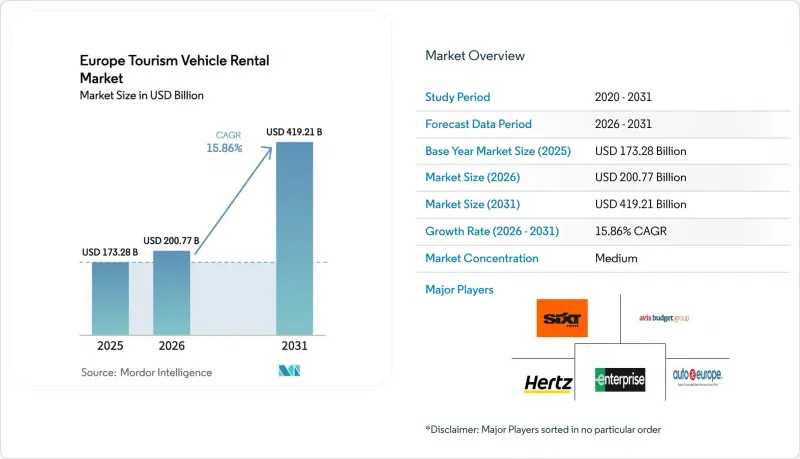
根據 Mordor Intelligence 預測,歐洲旅遊汽車租賃市場規模將從 2025 年的 1,732.8 億美元成長到 2026 年的 2007.7 億美元,然後在 2031 年達到 4192.1 億美元,2026 年至 2031 年的複合成長率為 15.86%。
本報告按應用領域(休閒/旅遊和商務)、預訂管道(線上和線下)、租賃期限(短期和長期)、車輛類型(經濟型/緊湊型、SUV和跨界車以及其他)和國家/地區(英國、德國以及其他)進行分類。市場預測以美元計價。
歐洲旅遊車輛租賃市場的趨勢與洞察
疫情後歐洲休閒的蓬勃發展支撐了對租車的需求。
由於機場航班時刻持續短缺和火車堵塞,遊客的需求正轉向靈活的自駕遊,這使得歐洲旅遊租車市場成為行程規劃中不可或缺的一部分。 2024年,歐盟旅遊設施的住宿住宿次數超過30億人次,創歷史新高,直接轉化為車輛運轉率的提升。西班牙、義大利和法國的遊客數量最多,這為主要機場和市中心門市的租車公司帶來了成長。此外,隨著遊客開始在一次旅行中遊覽多個區域城市,租車公司的平均租期也有所增加。
Z世代旅行者從「擁有」轉向「利用」的轉變
身為數位原住民的Z世代消費者,並不將汽車視為折舊免稅額資產,而是將其視為按需出行解決方案,從而與汽車共享和訂閱服務形成協同效應。調查數據顯示,歐盟12國中57%的非電動車車主對下次購車時選擇電池式電動車持正面態度。總部位於荷蘭的汽車共享平台貢獻了企業會員成長的約五分之一,顯示企業出行預算正逐漸從商務出行轉向休閒出行。
中東歐市場的超低成本大眾運輸阻礙了人們轉向汽車出行。
波蘭、匈牙利和羅馬尼亞政府對巴士和火車票價津貼,使其比每日租車價格便宜高達70%。這種價格差異抑制了遊客租車的意願,尤其是在城市間的短途旅行中。此外,整合了路面電車、地鐵和城際巴士的多模態票務系統正在中東歐城市推廣,提高了用戶的出行便利性。在淡季,由於自由裁量權減少,租車業者面臨客流量下降的困境。一些營運商正透過將閒置車輛重新部署到西方市場來應對這項挑戰,但物流成本正在擠壓利潤空間。
細分市場分析
預計到2025年,休閒市場將佔歐洲旅遊租車市場的66.42%,並在2031年以16.12%的複合年成長率超越整體市場,凸顯其在銷售和成長方面的驅動力。隨著歐盟住宿住宿量在2024年達到30億人次,休閒旅遊領域的預訂量激增。這反映出旅行者更傾向於靈活的自駕遊而非跟團遊,與2023年相比成長了2.2%。區域內旅行佔跨境旅行的70%,延長了平均租賃期限,提高了每份合約的盈利。多城市旅行也增加了單程返程的收入。
休閒需求的成長也得益於歐盟的申根區無縫旅行計劃,該計劃允許遊客駕車穿越多個國家而無需接受邊境檢查。諸如西班牙的「安全旅行」舉措等推廣宣傳活動增強了人們對旅遊目的地的信心,並鼓勵遊客延長停留時間,從而促成長期租車預訂。網路紅人正在推廣自駕遊路線,鼓勵年輕一代效仿,進一步擴大了租車的客戶群。
2025年,線上通路佔租車交易總量的72.84%,預計到2031年將維持16.05%的複合年成長率,鞏固其在客戶獲取方面的主導地位。演算法驅動的整合式搜尋曝光、即時驗證和透明定價是贏得客戶信任的關鍵。 2024年,歐盟《數位市場法案》將Booking Holdings指定為“安全隔離網閘”,這增加了佣金率上漲的可能性。營運商正透過完善直接面對消費者的應用程式來減少對仲介業者的依賴,這些應用程式融合了各種優惠和便利的辦理入住功能。
整合到營運商入口入口網站的動態定價引擎,能夠根據搜尋歷史訊號最佳化價格,從而提升收益。 Free2move 的一體化旅遊應用程式整合了短期租賃、汽車共享和訂閱計劃,提供全球超過 50 萬輛汽車的出行選擇。這類超級應用程式重新定義了預訂流程,使其成為更廣泛的旅遊生態系統的一部分,並提升了客戶終身價值 (CLV)。
其他好處:
- Excel格式的市場預測(ME)表
- 3個月的分析師支持
目錄
第1章:引言
- 研究假設和市場定義
- 調查範圍
第2章:調查方法
第3章執行摘要
第4章 市場狀況
- 市場概覽
- 市場促進因素
- 疫情後歐洲休閒的蓬勃發展支持了租賃需求。
- Z世代旅行者從「擁有」轉向「利用」的轉變
- 由於航空和鐵路運輸能力不足,南歐遊客正轉向自駕遊。
- 對電動車的補貼正在鼓勵租賃車輛的更新換代(2025-2028 年)。
- 動態定價演算法正在推高服務提供者的平均每日費率。
- 5G與車載資訊技術的融合實現了車隊的即時最佳化。
- 市場限制因素
- 中東歐市場的超低成本大眾運輸阻礙了轉換。
- 當地旅遊景點電動車充電基礎建設延誤
- 歐盟的《數位市場法》可能會增加線上旅行社的分銷成本。
- 義大利和西班牙監管機構已提案附加額外費用價格設定上限。
- 價值供應鏈分析
- 監理情勢
- 技術展望
- 波特五力模型
第5章 市場規模與成長預測
- 透過使用
- 休閒/旅遊
- 商業
- 透過預訂管道
- 線上
- 離線
- 租賃期
- 短期
- 長期
- 車輛類型
- 經濟型/緊湊型
- SUV 與跨界車
- 奢華與高階
- 電動車和混合動力汽車
- 國家
- 英國
- 德國
- 義大利
- 法國
- 西班牙
- 其他歐洲國家
第6章 競爭情勢
- 市場集中度
- 策略趨勢
- 市佔率分析
- 公司簡介
- Enterprise Holdings Inc.
- Avis Budget Group
- Europcar Mobility Group
- Hertz Global Holdings Inc.
- Sixt SE
- Booking Holdings Inc.(Rentalcars.com)
- Auto Europe
- OK Mobility
- Virtuo
- Green Motion International
- Getaround
- Carwiz International
第7章 市場機會與未來展望
According to Mordor Intelligence, the Europe tourism vehicle rental market size is expected to grow from USD 173.28 billion in 2025 to USD 200.77 billion in 2026 and is forecast to reach USD 419.21 billion by 2031 at 15.86% CAGR over 2026-2031.
This report is Segmented by Application (Leisure/Tourism and Business), Booking Channel (Online and Offline), Rental Duration (Short-Term and Long-Term), Vehicle Type (Economy/Compact, SUV and Crossover, and More) and Country (United Kingdom, Germany, and More). The Market Forecasts are Provided in Terms of Value (USD).
Europe Tourism Vehicle Rental Market Trends and Insights
Post-pandemic intra-Europe leisure boom sustains rental demand
Demand has tilted toward flexible road trips as airport slot shortages and rail bottlenecks persist, making the Europe tourism vehicle rental market integral to itinerary planning. EU tourist establishments logged more than 3 billion guest-nights in 2024, a record that directly converted into higher fleet utilisation. Spain, Italy, and France captured the bulk of incremental visitors, rewarding operators located at gateway airports and downtown depots. Rental companies also lengthened average contract days because travelers explored multiple secondary cities per trip.
Shift from ownership to usership among Gen Z travellers
Digital-native Gen Z consumers perceive vehicles as on-demand mobility solutions rather than depreciating assets, dovetailing with car-sharing and subscription offers. Survey data show 57% of non-EV drivers across 12 EU states are open to battery-electric usage in the next vehicle decision cycle. Netherlands-based car-share platforms logged around one fifth of the rise in corporate memberships, signalling wider crossover from business mobility budgets to leisure extensions.
Ultra-low-cost public transport in CEE markets hampers conversion
Governments in Poland, Hungary, and Romania subsidise bus and rail fares that undercut daily rental rates by up to 70%. The price gap discourages tourists from booking cars, especially for point-to-point city breaks. Additionally, CEE cities have expanded multimodal ticketing that integrates trams, metro, and inter-city coaches, lowering friction for riders. Rental operators face utilisation dips during shoulder seasons when discretionary spend tightens. Some have responded by repositioning idle vehicles to Western markets, but logistics costs trim margins.
Other drivers and restraints analyzed in the detailed report include:
- Air-rail capacity pinch pushes tourists to road trips in Southern Europe
- Electric-vehicle subsidy schemes favour rental fleet renewals (2025-2028)
- EV charging-infrastructure latency at rural tourist hot-spots
For complete list of drivers and restraints, kindly check the Table Of Contents.
Segment Analysis
The leisure segment accounted for 66.42% of the Europe tourism vehicle rental market in 2025, and it is projected to outpace the overall market with a 16.12% CAGR to 2031, underscoring its dual role as both volume and growth engine. Leisure bookings surged as EU guest-night totals hit 3 billion in 2024, reflecting travelers' preference for flexible road itineraries over group tours, a 2.2% increase compared to 2023. Intraregional trips represented 70% of cross-border flows, extending average rental durations and enhancing yield per contract. Multi-city journeys also increased one-way drop-off revenue.
Leisure growth also benefits from EU push for seamless Schengen travel, allowing tourists to drive across multiple countries without border controls. Promotional campaigns such as Spain's "Travel Safe" initiative strengthened destination confidence, supporting longer stays that align with extended vehicle bookings. Digital influencers amplify road-trip itineraries, inspiring younger segments to replicate similar experiences, further widening the rental funnel.
Online channels captured 72.84% of 2025 rental transactions and are forecast to log a 16.05% CAGR through 2031, cementing their primacy in customer acquisition. Algorithmic meta-search visibility, instant confirmation, and transparent pricing underpin customer trust. The EU Digital Markets Act labelled Booking Holdings a gatekeeper in 2024, raising the likelihood of higher commission structures. Operators mitigate dependence on intermediaries by refining direct-to-consumer apps that bundle rewards and seamless check-in.
Dynamic-pricing engines embedded in operator web portals sharpen revenue capture by tailoring rates to search-history signals. Free2move's all-in-one mobility app offers access to more than 500,000 vehicles worldwide, integrating short-term rental, car-sharing, and subscription plans. Such super-apps reframe bookings as part of broader mobility ecosystems, reinforcing customer lifetime value.
Complete Report Scope:
- By Application
- Leisure / Tourism
- Business
- By Booking Channel
- Online
- Offline
- By Rental Duration
- Short-term
- Long-term
- By Vehicle Type
- Economy/Compact
- SUV and Crossover
- Luxury and Premium
- Electric and Hybrid
- By Country
- United Kingdom
- Germany
- Italy
- France
- Spain
- Rest of Europe
List of Companies Covered in this Report:
- Enterprise Holdings Inc.
- Avis Budget Group
- Europcar Mobility Group
- Hertz Global Holdings Inc.
- Sixt SE
- Booking Holdings Inc. (Rentalcars.com)
- Auto Europe
- OK Mobility
- Virtuo
- Green Motion International
- Getaround
- Carwiz International
Additional Benefits:
- The market estimate (ME) sheet in Excel format
- 3 months of analyst support
TABLE OF CONTENTS
1 Introduction
- 1.1 Study Assumptions and Market Definition
- 1.2 Scope of the Study
2 Research Methodology
3 Executive Summary
4 Market Landscape
- 4.1 Market Overview
- 4.2 Market Drivers
- 4.2.1 Post-pandemic intra-Europe leisure boom sustains rental demand
- 4.2.2 Shift from ownership to usership among Gen-Z travellers
- 4.2.3 Air-rail capacity pinch pushes tourists to road trips in Southern Europe
- 4.2.4 Electric-vehicle subsidy schemes favour rental fleet renewals (2025-2028)
- 4.2.5 Dynamic-pricing algorithms lift average daily rates for operators
- 4.2.6 5G/telematics integration enables real-time fleet optimisation
- 4.3 Market Restraints
- 4.3.1 Ultra-low-cost public transport in CEE markets hampers conversion
- 4.3.2 EV charging-infrastructure latency at rural tourist hot-spots
- 4.3.3 EU Digital Markets Act may raise OTA distribution costs
- 4.3.4 Surge-pricing caps proposed by Italy and Spain regulators
- 4.4 Value/Supply-Chain Analysis
- 4.5 Regulatory Landscape
- 4.6 Technological Outlook
- 4.7 Porter's Five Forces
- 4.7.1 Threat of New Entrants
- 4.7.2 Bargaining Power of Buyers
- 4.7.3 Bargaining Power of Suppliers
- 4.7.4 Threat of Substitutes
- 4.7.5 Intensity of Competitive Rivalry
5 Market Size and Growth Forecasts (Value (USD))
- 5.1 By Application
- 5.1.1 Leisure / Tourism
- 5.1.2 Business
- 5.2 By Booking Channel
- 5.2.1 Online
- 5.2.2 Offline
- 5.3 By Rental Duration
- 5.3.1 Short-term
- 5.3.2 Long-term
- 5.4 By Vehicle Type
- 5.4.1 Economy/Compact
- 5.4.2 SUV and Crossover
- 5.4.3 Luxury and Premium
- 5.4.4 Electric and Hybrid
- 5.5 By Country
- 5.5.1 United Kingdom
- 5.5.2 Germany
- 5.5.3 Italy
- 5.5.4 France
- 5.5.5 Spain
- 5.5.6 Rest of Europe
6 Competitive Landscape
- 6.1 Market Concentration
- 6.2 Strategic Moves
- 6.3 Market Share Analysis
- 6.4 Company Profiles (Includes Global Level Overview, Market Level Overview, Core Segments, Financials as Available, Strategic Information, Market Rank/Share for Key Companies, Products and Services, SWOT Analysis, and Recent Developments)
- 6.4.1 Enterprise Holdings Inc.
- 6.4.2 Avis Budget Group
- 6.4.3 Europcar Mobility Group
- 6.4.4 Hertz Global Holdings Inc.
- 6.4.5 Sixt SE
- 6.4.6 Booking Holdings Inc. (Rentalcars.com)
- 6.4.7 Auto Europe
- 6.4.8 OK Mobility
- 6.4.9 Virtuo
- 6.4.10 Green Motion International
- 6.4.11 Getaround
- 6.4.12 Carwiz International
7 Market Opportunities and Future Outlook
- 7.1 White-space and Unmet-need Assessment

 美國堆高機租賃:市場佔有率分析、產業趨勢與統計、成長預測(2026-2031)堆高機租賃:市場佔有率分析、產業趨勢與統計、成長預測(2026-2031)亞太地區旅遊車輛租賃:市場佔有率分析、行業趨勢和統計數據以及成長預測(2026-2031 年)
 印度商用車租賃市場:規模、佔有率、成長、全球產業分析、區域趨勢以及 2026 年至 2034 年的預測。
 2026 年至 2035 年商用車租賃市場的商業機會、成長要素、產業趨勢與預測。
 冷藏車租賃市場分析及預測(至2035年):類型、產品、服務、技術、應用、最終用戶、功能、設備、解決方案對商用車租賃市場進行分析和預測,直至 2035 年:按類型、產品、服務、技術、組件、應用、部署、最終用戶和解決方案進行分析和預測。
 旅遊車輛租賃市場規模、佔有率、趨勢和預測:按車輛類型、預訂方式、最終用戶和地區分類(2026-2034 年)商用車租賃市場規模、佔有率、成長及全球產業分析:按類型、應用和地區分類,並預測至2026-2034年
 堆高機租賃市場:2026-2032年全球市場預測(按型號、負載容量、租賃期限、應用和最終用途行業分類)