


 |
市場調查報告書
商品編碼
2117253
北美結構化佈線:市場佔有率分析、產業趨勢與統計及成長預測(2026-2031 年)North America Structured Cabling - Market Share Analysis, Industry Trends & Statistics, Growth Forecasts (2026 - 2031) |
||||||

※ 本網頁內容可能與最新版本有所差異。詳細情況請與我們聯繫。
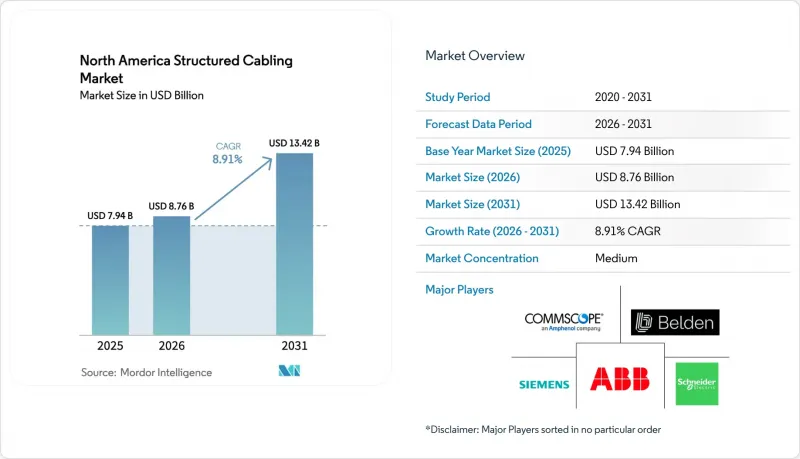
根據 Mordor Intelligence 預測,北美結構化電纜市場預計將從 2025 年的 79.4 億美元成長到 2026 年的 87.6 億美元,到 2031 年達到 134.2 億美元,2026 年至 2031 年的複合年成長率為 8.91%。
本報告依產品類型(銅線和光纖)、線纜類別(5e類、6類等)、組件(線纜、連接設備等)、應用領域(區域網路和資料中心)、終端用戶產業(IT和電信、醫療、製造等)、安裝類型(新安裝、升級和維修)以及地區進行細分。市場預測以美元(USD)計價。
北美結構化電纜市場的趨勢與洞察
超大規模資料中心的擴張
超大規模業者持續興建千兆級園區,預計到2025年中期,美洲在建設施的新增裝置容量將達到7.8吉瓦。亞馬遜在印第安納州投資150億美元的園區和微軟在威斯康辛州投資40億美元的設施,清楚地展現了每新增1兆瓦裝機容量所需的巨額資本投入,每個項目都需要鋪設3至5公里的光纖主幹線纜和10至15公里的銅纜,用於機架頂部連接。美國佔全球超大規模容量的54%,是該地區佈線需求的基石。 TIA-942-B認證要求採用雙通道和N+1佈線管理,這雖然增加了每平方英尺的成本,但也確保了設施能夠面向未來,為Gigabit的升級做好準備。人工智慧最佳化設計,例如位於密西根州、投資70億美元的OpenAI-Oracle設施,需要採用低延遲的脊葉式拓撲結構,這進一步提高了光纖的密度。
過渡到更高頻寬的C20類線纜
到2025年,6A類線纜將占美國銅線銷售的41%,比2023年成長4個百分點。這是因為企業正致力於推廣Gigabit以太網,以突破8條線30公尺的傳輸距離限制。儘管IEEE 802.3df的Gigabit藍圖正在加速資料中心骨幹網路中單模線纜的普及,但由於RJ45介面的普及性和機械耐用性,銅線在水平佈線領域仍佔據著穩固的地位。即將修訂的ANSI/TIA-568標準將引進6B類線纜,將Gigabit傳輸距離擴展至150米,進一步提升銅線在園區骨幹網路的重要性。 Wi-Fi 6E和Wi-Fi 7的升級需要2.5Gigabit上行鏈路,這推動了酒店業和教育機構對老舊5e類入戶線的維修,將閒置線轉化為新的商機。這些因素綜合起來,導致該地區的複合年成長率提高了 1.5 個百分點。
對高效能無線解決方案的需求日益成長
Wi-Fi 6E 和 Wi-Fi 7 正在彌合有線網路和無線網路之間的吞吐量差距,一些公司正在優先考慮高密度網路基地台網路,以減少水平佈線的數量。雖然每個存取點仍然需要兩個 6A 類上行鏈路以實現冗餘,但從 48 連接埠拓撲結構切換到 24 連接埠拓撲結構可以降低整體連接埠密度,並可減少高達 40% 的線纜使用量。美國聯邦通訊委員會 (FCC) 於 2024 年批准 6 GHz 頻段將加速設備更新換代,德勤預測,2023 年前建造的無線基礎設施中,40% 將在 2027 年前被替換。結構化佈線在回程傳輸中仍然發揮著核心作用,但無線優先佈局的柔軟性和較低的初始成本預計將使複合年成長率 (CAGR) 降低 0.7 個百分點。
細分市場分析
到2025年,銅線解決方案仍將佔據北美結構化佈線市場58.13%的佔有率,鞏固其在乙太網路供電(PoE)至關重要的水平鏈路領域的領先地位。然而,隨著Gigabit和Gigabit主幹網路對單模光纖傳輸距離的要求超過100米,光纖銷售額正以每年9.37%的速度成長。 2025年第二季銅價將達到每噸9,513美元,這將擠壓銅產品的利潤空間,並加速遍遠地區專案向光纖的轉型,因為這些專案對原料價格波動較為敏感。
雖然多模光纖OM4和OM5適用於機架間的短距離佈線,但營運商正轉向預先佈線,採用混合主幹網,以便升級到連貫光纖通訊。光纖成本不斷下降、衰減低,加上其在長距離傳輸方面的經濟優勢,使其更具成本效益。銅纜的主要優勢在於其直流供電能力,這在需要透過單一介質同時傳輸資料和90瓦功率的應用場景中至關重要,例如PoE照明和工業乙太網。
到2025年,6類線纜將佔總銷售額的33.89%,而6A類線纜的複合年成長率高達9.89%,這主要得益於Gigabit標準在100公尺以上距離的普及。預計到2025年,6A類線在美國的市佔率將達到41%,這將顯著改變5e線類長期佔據主導地位的局面。 8類線纜的市佔率仍不足5%,由於其30公尺的傳輸距離限制,目前僅限於交換器到伺服器的連接,而且其價格比光纖高出40%至60%,導致投資報酬率較低。
預計6B類線材規範將Gigabit的傳輸距離擴展至150米,將進一步鞏固銅線在園區骨幹網路中的地位,並可能減緩7類線纜的復甦。 7類線纜的普及一直受到非RJ45連接器的使用以及缺乏TIA認證的限制。根據BSRIA的研究,預計到2024年,6A類線纜的全球部署量將成長12%,是所有銅線標準中成長率最高的。這是因為建築業主希望避免重蹈覆轍,避免像升級到Gigabit時那樣出現「投資浪費」的情況。
其他好處:
- Excel格式的市場預測(ME)表
- 3個月的分析師支持
目錄
第1章:引言
- 研究假設和市場定義
- 調查範圍
第2章:調查方法
第3章執行摘要
第4章 市場狀況
- 市場概覽
- 市場促進因素
- 超大規模資料中心正在迅速擴張。
- 過渡到更高頻寬的線纜
- 擴大光纖到府 (FTTH) 和 5G回程傳輸部署
- 智慧建築應用中乙太網路供電 (PoE) 技術的日益普及
- 二線城市邊緣資料中心的激增
- 聯邦政府基礎設施建設資金計劃,用於在農村地區鋪設寬頻電纜
- 市場限制因素
- 對高效能無線解決方案的需求日益成長
- 現有設施維修中複雜且昂貴的安裝工作
- 銅和光纖原料供應鏈的波動
- 技術純熟勞工的持證電纜安裝工人短缺
- 產業價值鏈分析
- 監理情勢
- 技術展望
- 宏觀經濟因素對市場的影響
- COVID-19 對北美結構化電纜市場的影響
- 波特五力分析
- 投資分析
第5章 市場規模與成長預測
- 依產品類型
- 銅
- 銅纜
- 銅連接器
- 纖維
- 光纖電纜(單模)
- 光纖電纜(多模)
- 光纖連接
- 銅
- 按電纜類型
- 5e類
- 第六類
- 6A類
- 7類
- 第八類
- 按組件
- 電纜
- 連接性
- 配線架和交叉連接器
- 機架和機櫃
- 線纜管理配件
- 透過使用
- LAN
- 資料中心
- 按最終用戶行業分類
- IT/通訊
- 銀行、金融服務和保險(BFSI)
- 政府/國防
- 衛生保健
- 製造業
- 商業建築
- 按安裝類型
- 新推出
- 升級和維修
- 國家
- 美國
- 加拿大
- 墨西哥
第6章 競爭情勢
- 市場集中度
- 策略趨勢
- 市佔率分析
- 公司簡介
- Belden Inc.
- The Siemon Company
- Corning Incorporated
- CommScope Inc.
- Anixter Inc.
- Legrand SA
- Panduit Corp.
- Schneider Electric SE
- Siemens AG
- Nexans SA
- Hubbell Incorporated
- Datwyler IT Infra GmbH
- Prysmian Group
- Superior Essex
- HellermannTyton
- Leviton Manufacturing Co., Inc.
- Reichle & De-Massari AG
- Fluke Networks
- Sterlite Technologies Limited
- ABB Ltd.
第7章 市場機會與未來展望
According to Mordor Intelligence, the North America structured cabling market size is expected to increase from USD 7.94 billion in 2025 to USD 8.76 billion in 2026 and reach USD 13.42 billion by 2031, growing at a CAGR of 8.91% over 2026-2031.
This report is Segmented by Product Type (Copper, and Fiber), Cable Category (Category 5e, Category 6, and More), Component (Cables, Connectivity, and More), Application (LAN, and Data Center), End-User Industry (IT and Telecom, Healthcare, Manufacturing, and More), Installation Type (New Installation, and Upgrade and Retrofit), and Geography. Market Forecasts are Provided in Value (USD).
North America Structured Cabling Market Trends and Insights
Growing Expansion of Hyperscale Data Centers
Hyperscale operators continue to commission gigawatt-scale campuses, adding 7.8 gigawatts of power under construction across the Americas by mid-2025. Amazon's USD 15 billion Indiana complex and Microsoft's USD 4 billion Wisconsin build illustrate the capital intensity behind every new megawatt, each pulling 3-5 kilometers of fiber trunk and 10-15 kilometers of copper cabling for top-of-rack links. The United States hosts 54% of global hyperscale capacity, anchoring regional cable demand. TIA-942-B certification, which prescribes dual pathways and N+1 cable management, elevates per-square-foot spending yet future-proofs plants for 800-gigabit upgrades. AI-optimized designs, such as the USD 7 billion OpenAI-Oracle facility in Michigan, require low-latency spine-leaf topologies that further increase fiber density.
Migration to Higher Bandwidth Category Cables
Category 6A accounted for 41% of United States copper sales in 2025, a four-point gain over 2023, as enterprises targeted 10-gigabit Ethernet to avoid the 30-meter ceiling of Category 8. The IEEE 802.3df roadmap toward 800-gigabit Ethernet accelerates single-mode adoption in data-center spines, yet copper remains entrenched in horizontals due to RJ45 familiarity and mechanical durability. Anticipated ANSI/TIA-568 updates may introduce Category 6B, stretching 10-gigabit reach to 150 meters and extending copper's relevance in campus backbones. Wi-Fi 6E and Wi-Fi 7 upgrades, which need 2.5-gigabit uplinks, are prompting retrofits of legacy Category 5e drops in hospitality and education, converting dormant runs into revenue opportunities. These factors collectively add 1.5 percentage points to the regional CAGR.
Rising Demand for High-Performance Wireless Solutions
Wi-Fi 6E and Wi-Fi 7 close the throughput gap between wired and wireless networks, prompting some enterprises to scale back on horizontal cable counts in favor of dense access-point grids. Although each AP still requires dual Category 6A uplinks for redundancy, the switch from 48-port to 24-port topologies cuts total port density, trimming cable volumes by up to 40%. FCC authorization of the 6 GHz band in 2024 accelerated refresh cycles, and Deloitte expects 40% of pre-2023 wireless estates to be swapped by 2027. While structured cabling retains an anchor role for backhaul, the flexibility and lower upfront cost of wireless-first layouts subtract 0.7 percentage points from forecast CAGR.
Other drivers and restraints analyzed in the detailed report include:
- Increasing Fiber-To-The-Home and 5G Backhaul Deployments
- Rising Adoption of Power over Ethernet for Smart Building Applications
- Complex and Costly Installation in Brownfield Retrofits
For complete list of drivers and restraints, kindly check the Table Of Contents.
Segment Analysis
Copper solutions maintained 58.13% of the North America structured cabling market share in 2025, underscoring their dominance in horizontal links, where Power over Ethernet is paramount. However, fiber revenue is growing 9.37% annually as 400-gigabit and 800-gigabit spines demand single-mode reach beyond 100 meters. Copper margins are under pressure from USD 9,513-per-ton pricing in Q2 2025, which accelerated fiber substitution in rural programs sensitive to material swings.
Multi-mode OM4 and OM5 sustain shorter inter-rack runs, yet operators are pre-cabling with hybrid trunks that accommodate coherent optics upgrades. Fiber's falling cost curve, paired with lower attenuation, tilts long-haul economics decisively in its favor. Copper's chief insulation remains its DC power capability, vital for PoE lighting and industrial Ethernet, where a single medium must carry both data and 90 watts of power.
Category 6 cables accounted for 33.89% of revenue in 2025, yet Category 6A is growing at a 9.89% CAGR on the back of 10-gigabit standardization over 100 meters. United States sales share reached 41% in 2025, a clear pivot from Category 5e's historical dominance. Category 8 remains confined below 5% share because its 30-meter ceiling restricts reach to switch-to-server hops, and its 40-60% price premium erodes return on investment versus fiber.
Anticipated Category 6B specifications extending 10-gigabit to 150 meters could entrench copper even deeper into campus backbones, slowing any rebound for Category 7, whose non-RJ45 connectors and lack of TIA endorsement limit acceptance. BSRIA surveys showed Category 6A global installations rising 12% in 2024, the strongest among copper classes, as building owners avoid stranded investment scenarios experienced during the gigabit transition.
Complete Report Scope:
- By Product Type
- Copper
- Copper Cable
- Copper Connectivity
- Fiber
- Fiber Cable (Single-mode)
- Fiber Cable (Multi-mode)
- Fiber Connectivity
- Copper
- By Cable Category
- Category 5e
- Category 6
- Category 6A
- Category 7
- Category 8
- By Component
- Cables
- Connectivity
- Patch Panels and Cross Connects
- Racks and Cabinets
- Cable Management Accessories
- By Application
- LAN
- Data Center
- By End-User Industry
- IT and Telecom
- Banking, Financial Services, and Insurance (BFSI)
- Government and Defense
- Healthcare
- Manufacturing
- Commercial Buildings
- By Installation Type
- New Installation
- Upgrade and Retrofit
- By Country
- United States
- Canada
- Mexico
List of Companies Covered in this Report:
- Belden Inc.
- The Siemon Company
- Corning Incorporated
- CommScope Inc.
- Anixter Inc.
- Legrand S.A.
- Panduit Corp.
- Schneider Electric SE
- Siemens AG
- Nexans S.A.
- Hubbell Incorporated
- Datwyler IT Infra GmbH
- Prysmian Group
- Superior Essex
- HellermannTyton
- Leviton Manufacturing Co., Inc.
- Reichle & De-Massari AG
- Fluke Networks
- Sterlite Technologies Limited
- ABB Ltd.
Additional Benefits:
- The market estimate (ME) sheet in Excel format
- 3 months of analyst support
TABLE OF CONTENTS
1 INTRODUCTION
- 1.1 Study Assumptions and Market Definition
- 1.2 Scope of the Study
2 RESEARCH METHODOLOGY
3 EXECUTIVE SUMMARY
4 MARKET LANDSCAPE
- 4.1 Market Overview
- 4.2 Market Drivers
- 4.2.1 Growing Expansion of Hyperscale Data Centers
- 4.2.2 Migration to Higher Bandwidth Category Cables
- 4.2.3 Increasing Fiber-To-The-Home and 5G Backhaul Deployments
- 4.2.4 Rising Adoption of Power over Ethernet for Smart Building Applications
- 4.2.5 Edge Data Center Proliferation in Tier-2 Cities
- 4.2.6 Federal Infrastructure Funding Incentives for Rural Broadband Cabling
- 4.3 Market Restraints
- 4.3.1 Rising Demand for High-Performance Wireless Solutions
- 4.3.2 Complex and Costly Installation in Brownfield Retrofits
- 4.3.3 Supply Chain Volatility of Copper and Optical Fiber Raw Materials
- 4.3.4 Skilled Labor Shortage in Certified Cabling Installers
- 4.4 Industry Value Chain Analysis
- 4.5 Regulatory Landscape
- 4.6 Technological Outlook
- 4.7 Impact of Macroeconomic Factors on the Market
- 4.8 Impact of COVID-19 on the North America Structured Cabling Market
- 4.9 Porter's Five Forces Analysis
- 4.9.1 Bargaining Power of Suppliers
- 4.9.2 Bargaining Power of Buyers
- 4.9.3 Threat of New Entrants
- 4.9.4 Threat of Substitutes
- 4.9.5 Intensity of Competitive Rivalry
- 4.10 Investment Analysis
5 MARKET SIZE AND GROWTH FORECASTS (VALUE)
- 5.1 By Product Type
- 5.1.1 Copper
- 5.1.1.1 Copper Cable
- 5.1.1.2 Copper Connectivity
- 5.1.2 Fiber
- 5.1.2.1 Fiber Cable (Single-mode)
- 5.1.2.2 Fiber Cable (Multi-mode)
- 5.1.2.3 Fiber Connectivity
- 5.1.1 Copper
- 5.2 By Cable Category
- 5.2.1 Category 5e
- 5.2.2 Category 6
- 5.2.3 Category 6A
- 5.2.4 Category 7
- 5.2.5 Category 8
- 5.3 By Component
- 5.3.1 Cables
- 5.3.2 Connectivity
- 5.3.3 Patch Panels and Cross Connects
- 5.3.4 Racks and Cabinets
- 5.3.5 Cable Management Accessories
- 5.4 By Application
- 5.4.1 LAN
- 5.4.2 Data Center
- 5.5 By End-User Industry
- 5.5.1 IT and Telecom
- 5.5.2 Banking, Financial Services, and Insurance (BFSI)
- 5.5.3 Government and Defense
- 5.5.4 Healthcare
- 5.5.5 Manufacturing
- 5.5.6 Commercial Buildings
- 5.6 By Installation Type
- 5.6.1 New Installation
- 5.6.2 Upgrade and Retrofit
- 5.7 By Country
- 5.7.1 United States
- 5.7.2 Canada
- 5.7.3 Mexico
6 COMPETITIVE LANDSCAPE
- 6.1 Market Concentration
- 6.2 Strategic Moves
- 6.3 Market Share Analysis
- 6.4 Company Profiles (includes Global Level Overview, Market Level Overview, Core Segments, Financials as available, Strategic Information, Market Rank/Share for key companies, Products and Services, and Recent Developments)
- 6.4.1 Belden Inc.
- 6.4.2 The Siemon Company
- 6.4.3 Corning Incorporated
- 6.4.4 CommScope Inc.
- 6.4.5 Anixter Inc.
- 6.4.6 Legrand S.A.
- 6.4.7 Panduit Corp.
- 6.4.8 Schneider Electric SE
- 6.4.9 Siemens AG
- 6.4.10 Nexans S.A.
- 6.4.11 Hubbell Incorporated
- 6.4.12 Datwyler IT Infra GmbH
- 6.4.13 Prysmian Group
- 6.4.14 Superior Essex
- 6.4.15 HellermannTyton
- 6.4.16 Leviton Manufacturing Co., Inc.
- 6.4.17 Reichle & De-Massari AG
- 6.4.18 Fluke Networks
- 6.4.19 Sterlite Technologies Limited
- 6.4.20 ABB Ltd.
7 MARKET OPPORTUNITIES AND FUTURE OUTLOOK
- 7.1 White-Space and Unmet-Need Assessment

 亞太地區結構化佈線:市場佔有率分析、產業趨勢與統計、成長預測(2026-2031)歐洲結構化佈線:市場佔有率分析、產業趨勢與統計及成長預測(2026-2031 年)結構化佈線:市場佔有率分析、行業趨勢和統計數據、成長預測(2026-2031 年)
 結構化佈線市場-2026-2032年全球市場預測
 結構化佈線市場規模、佔有率、成長及全球產業分析:按類型、應用和地區分類的洞察,2026-2034 年預測
 2026年全球結構化佈線市場報告建築整合佈線解決方案市場:按電纜類型、系統元件、安裝類型、應用和最終用戶分類 - 全球預測 2026-2032 年
 結構化佈線市場分析及預測(至2035年):按類型、產品、服務、技術、組件、應用、部署模式、最終用戶和安裝類型分類全球結構化佈線市場規模、佔有率、趨勢和成長分析報告(2026-2034年)
 結構化佈線市場 - 全球產業規模、佔有率、趨勢、機會及預測(按產品類型、應用、線材類別、最終用戶產業、地區和競爭格局分類,2021-2031)