


 |
市場調查報告書
商品編碼
2117227
歐洲結構化佈線:市場佔有率分析、產業趨勢與統計及成長預測(2026-2031 年)Europe Structured Cabling - Market Share Analysis, Industry Trends & Statistics, Growth Forecasts (2026 - 2031) |
||||||

※ 本網頁內容可能與最新版本有所差異。詳細情況請與我們聯繫。
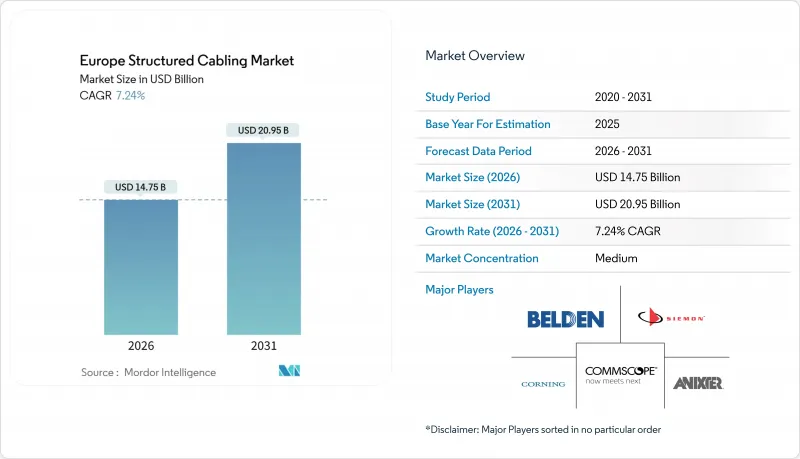
根據 Mordor Intelligence 預測,歐洲結構化佈線市場規模預計將在 2026 年達到 147.5 億美元,到 2031 年達到 209.2 億美元,預測期內複合年成長率為 7.24%。
本報告按製造類型(銅纜、銅纜連接器、單模光纖電纜等)、電纜類別(5e類、6類、6A類等)、應用領域(區域網路、資料中心、園區網路等)、產業(IT及電信、銀行、金融服務和保險、醫療、製造業等)以及國家/地區進行細分。市場預測以美元計價。
歐洲結構化佈線市場的趨勢與洞察
歐洲超大規模資料中心建設擴張
谷歌在迪岑巴赫和哈瑙投資55億歐元(60億美元),以及施瓦茨集團在魯貝瑙投資110億歐元(121億美元)建設人工智慧中心,都清楚地表明,超大規模資料中心項目總資本支出的8%至12%用於結構化佈線預算。每個園區都指定使用8類銅纜作為機架頂部鏈路,並使用單模光纖主幹線連接100公尺以上的線路,從而推動了對864芯MPO組件的需求。 Data4在哈瑙建設的180兆瓦資料中心和Colt DCS在德國建設的117兆瓦國內線路,都積壓了數年的訂單,這要求安裝人員依賴預庫存和認證技術人員。在荷蘭,一條新的跨大西洋海底光纜在阿姆斯特丹登陸,推動了該地區在有限的託管空間內對高密度連接的需求。這些大型企劃加在一起,正在推動歐洲結構化佈線市場大幅擴張,遠遠超過了傳統的企業區域網路更換週期。
PoE和物聯網的快速普及推動了對高頻寬線纜的需求。
自2024年以來,IEEE 802.3bt 90瓦PoE標準已在歐洲物流倉庫和智慧城市先導計畫中大規模部署,照明、攝影機和Wi-Fi 6E等設備被整合到統一的線纜中。 6A類線纜已成為標準,因為其500 MHz頻寬支援100公尺以上的10GBASE-T傳輸,同時最大限度地減少雲台攝影機等設備的電壓降。歐洲連接設施(CEF)數位計畫已為巴塞隆納、阿姆斯特丹和哥本哈根的智慧城市試點計畫撥款,使屏蔽6A類線纜束的短期需求加倍。 Panduit和Siemon正抓住這一機遇,提供可降低通道插入損耗並簡化遠端供電策略的10GBASE-T和TERA連接器系統。 PoE電流的增加也需要重新計算線纜束的填充率。這是因為當導管佔用率超過 40% 時,熱降額會對鄰近導體產生不利影響,導致設施管理人員轉向採用更高等級的 LSZH 護套。
遷移
Wi-Fi 6E 和新興的 Wi-Fi 7 裝置可在 6 GHz 頻段提供多Gigabit的吞吐量,使一些現有辦公室能夠減少新增銅纜線路的密度。法蘭克福和倫敦的金融公司正在試點結合 5G 和衛星鏈路的軟體定義廣域網 (SD-WAN) 疊加網路,這在一定程度上抑制了商業地產對 6A 類線纜的需求。歐洲電信標準化協會 (ETSI) 於 2024 年發布的私人 5G 標準將允許工廠為某些行動裝置省略有線乙太網路。然而,對延遲敏感的工作負載、高頻交易和機器視覺品管仍然依賴確定性的有線鏈路,這為結構化佈線供應商提供了一個可觀的核心市場。
細分市場分析
預計到2026年,隨著超大規模業者強制要求所有超過100公尺的機架間和脊葉鏈路均使用單模光纖,光纖連接的需求將加速成長,該細分市場預計到2031年將以9.02%的複合年成長率成長。在資料中心,864芯MPO主幹網可實現模組化擴展,同時減少30%的占地面積,進而直接提高電源使用效率(PUE)。截至2025年,銅纜仍佔據歐洲結構化佈線市場61.72%的佔有率,這得益於其在支援PoE照明和Wi-Fi 6E升級方面累積的大量6類和6A類部署經驗。此外,銅纜還具有獨特的優勢,能夠透過同一介質同時傳輸資料和90瓦的電力,而光纖若不使用昂貴的混合電纜則無法實現此優勢。在蓬勃發展的歐洲結構化佈線市場中,光纖正在德國的大型園區取代銅纜,Google和Data4等公司強制要求在這些園區採用單模光纖架構。然而,在物流倉庫和傳統園區,6A類線纜仍然是最具成本績效的選擇,凸顯了光纖普及率兩極化的現狀,供應商必須努力平衡這一需求。
銅線的未來發展得益於PoE供電的普及以及RJ45端子相比熔接LC連接器更簡單的連接方式。然而,8類線纜的出現帶來了新的認證難題,高達25,000歐元(約27,400美元)的測試設備限制了安裝人員的能力,尤其是在法蘭克福和阿姆斯特丹等建築密集型地區。光纖不受電磁干擾的影響,因此在汽車和製藥工廠等需要使用變頻驅動器和精密機器人的場所中不可或缺。康寧公司計劃於2024年推出的抗彎曲產品,其彎曲半徑僅5毫米,將進一步縮小空間受限的託管機房的機櫃面積。隨著技術的融合,即使銅纜在PoE密集型建築網路中仍佔據重要地位,光纖也有望提升每個機架的附加價值。
預計到2031年,8條線纜的複合年成長率將達到7.98%。這是因為超大規模資料中心業者認為,8類電纜2GHz的頻寬和30公尺的傳輸距離,無需對整個主幹網路結構進行徹底改造,即可經濟高效地過渡到400Gbps。施瓦茨集團的魯貝瑙人工智慧中心就是一個早期應用8線纜的例子,該中心需要緊湊型高速銅纜來確保機架的空氣流通並容納10萬個GPU。截至2025年,6條線將佔據歐洲結構化佈線市場38.63%的佔有率,這反映了其在辦公室區域網路和教育設施中的廣泛應用。憑藉抗串擾(ACT)屏蔽和500MHz的餘量,6A類線仍然是10GBASE-T和60-90瓦PoE的標準配置,佔據了大多數新建商業設施維修。 7 類和 7A 類線纜與 GG45 連接器不相容,這阻礙了它們的廣泛應用,並限制了它們在特定工業應用中的使用。
認證瓶頸阻礙了8類線纜的普及。 BICSI直到2025年下半年才將2GHz測試納入其課程體系,這意味著能夠檢驗嚴格通道限制的工程師寥寥無幾。在德國的超大規模資料中心,本地人才供應無法滿足需求,迫使承包商要麼從國外引進認證人員,要麼延長專案工期,而這兩種做法都與投資者希望專案儘早完工的目標相悖。同時,由於100MHz頻道無法滿足最新的PoE負載和10GBASE-T的需求,5e類線纜的剩餘市場佔有率正在萎縮。這加速了升級週期,辦公大樓業主直接選擇6A線電纜。歐盟CPR的低煙無鹵(LSZH)要求將6A類和8類線纜的材料成本增加了10-15%,但德國、荷蘭和北歐國家強制要求遵守該要求,促使供應商對LSZH生產進行標準化。
其他好處:
- Excel格式的市場預測(ME)表
- 3個月的分析師支持
目錄
第1章:引言
- 研究假設和市場定義
- 調查範圍
第2章:調查方法
第3章執行摘要
第4章 市場狀況
- 市場概覽
- 市場促進因素
- 歐洲超大規模資料中心的擴張
- PoE和物聯網的快速普及推動了對高頻寬線纜的需求。
- 歐盟數位基礎設施基金(CEF-Digital,復甦基金)
- 高密度 5G回程傳輸需要大量鋪設光纖電纜。
- 歐盟更嚴格的綠建築標準有利於使用低菸無鹵電纜。
- 在工業4.0工廠中實施邊緣微型資料中心
- 市場限制因素
- 遷移
- 現有建築物內光纖電纜維修成本高
- 原物料價格(銅和光學玻璃)波動
- Cat-8認證承包商和測試設備短缺。
- 產業價值鏈分析
- 監理情勢
- 技術展望
- 波特五力分析
第5章 市場規模與成長預測
- 依產品類型
- 銅
- 銅纜
- 銅連接器
- 纖維
- 單模光纖電纜
- 多模光纖電纜
- 光纖連接
- 銅
- 電纜類別
- 5e類
- 第六類
- 6A類
- 7類
- 第八類
- 透過使用
- 區域網路(LAN)
- 資料中心
- 校園網路
- 工業自動化網路
- 按行業分類
- 資訊科技/通訊
- BFSI
- 衛生保健
- 製造業
- 政府/公共部門
- 教育
- 能源公用事業
- 其他工業部門
- 國家
- 英國
- 德國
- 法國
- 義大利
- 西班牙
- 荷蘭
- 北歐國家(丹麥、瑞典、挪威、芬蘭)
- 其他歐洲國家
第6章 競爭情勢
- 市場集中度
- 策略趨勢
- 市佔率分析
- 公司簡介
- Belden Inc.
- CommScope Holding Company, Inc.
- Corning Incorporated
- Schneider Electric SE
- Siemens AG
- Legrand SA
- Prysmian SpA
- Nexans SA
- Panduit Corp.
- The Siemon Company
- Datwyler IT Infra AG
- ABB Ltd
- TE Connectivity Ltd.
- Fujikura Ltd.
- Furukawa Electric Co., Ltd.
- RandM AG(Reichle and De-Massari AG)
- Rosenberger Hochfrequenztechnik GmbH and Co. KG
- HellermannTyton Group PLC
- Huber+Suhner AG
- Draka Communications BV
- Anixter International Inc.
- RiT Tech(Intelligence Solutions)Ltd.
- METZ CONNECT GmbH
- ADVA Optical Networking SE
第7章 市場機會與未來展望
According to Mordor Intelligence, the Europe structured cabling market size stands at USD 14.75 billion in 2026 and is projected to reach USD 20.92 billion by 2031, reflecting a 7.24% CAGR over the forecast period.
This report is Segmented by Product Type (Copper Cable, Copper Connectivity, Single-Mode Fiber Cable, and More), Cable Category (Category 5e, Category 6, Category 6A, and More), Application (LAN, Data Center, Campus Network, and More), Industry Vertical (IT and Telecom, BFSI, Healthcare, Manufacturing, and More), and Country. Market Forecasts are Provided in Terms of Value (USD).
Europe Structured Cabling Market Trends and Insights
Hyperscale Data-Center Build-Outs Across Europe
Google's EUR 5.5 billion (USD 6.0 billion) commitment to Dietzenbach and Hanau and Schwarz Group's EUR 11 billion (USD 12.1 billion) AI hub in Lubbenau epitomize how hyperscale programs embed structured cabling budgets of 8-12% of total capital outlays. Each campus specifies Category 8 copper for top-of-rack links and single-mode fiber trunks exceeding 100 meters, driving demand for 864-fiber MPO assemblies. Data4's 180 MW Hanau complex and Colt DCS's 117 MW German pipeline reinforce a multi-year order book that installers must service with pre-staged inventory and certified labor. The Netherlands amplifies regional demand as new trans-Atlantic cables terminate in Amsterdam, necessitating high-density connectivity that fits within tight colocation footprints. Collectively, these mega-projects significantly expand the addressable Europe structured cabling market beyond historical enterprise LAN refresh cycles.
Rapid Adoption of PoE and IoT Driving Higher-Bandwidth Cabling
IEEE 802.3bt's 90-watt PoE standard ignited large-scale deployments after 2024, when European logistics warehouses and smart-city pilots converged lighting, cameras, and Wi-Fi 6E on unified cabling. Category 6A became the default because its 500 MHz bandwidth supports 10GBASE-T across 100 meters while minimizing voltage drop for devices such as pan-tilt-zoom cameras. The Connecting Europe Facility Digital program earmarked funds for smart-city pilots in Barcelona, Amsterdam, and Copenhagen, multiplying near-term demand for shielded Category 6A bundles. Panduit and Siemon are capitalizing by offering 10GBASE-T and TERA connector systems that reduce channel insertion loss and simplify remote powering strategies. Rising PoE currents also require recalculating cable-bundle fill ratios because thermal derating can impair adjacent conductors when conduit occupancy exceeds 40%, nudging facility managers toward higher-grade LSZH jackets.
Shift Toward Enterprise-Class Wi-Fi and Virtualized Networks
Wi-Fi 6E and emerging Wi-Fi 7 devices deliver multi-gigabit throughput in the 6 GHz band, allowing some brownfield offices to reduce the density of new copper drops. Financial firms in Frankfurt and London are piloting software-defined WAN overlays that mix 5G and satellite links, marginally limiting commercial real-estate demand for Category 6A. Private 5G standards published by ETSI in 2024 enable factories to bypass wired Ethernet for certain mobile assets. However, latency-critical workloads, high-frequency trading, machine-vision quality control, still rely on deterministic wired links, preserving a sizable core addressable to structured cabling vendors.
Other drivers and restraints analyzed in the detailed report include:
- EU Digital-Infrastructure Funding Programs
- 5G Back-Haul Densification
- High Retrofit Cost of Fiber in Brownfield Buildings
For complete list of drivers and restraints, kindly check the Table Of Contents.
Segment Analysis
Fiber connectivity captured accelerating demand in 2026 as hyperscale operators specified single-mode runs for every inter-rack and spine-leaf link exceeding 100 meters, lifting the segment toward a 9.02% CAGR through 2031. Within data centers, 864-fiber MPO trunks enable modular growth while reducing floor-space by 30%, directly contributing to improved power-usage effectiveness metrics. Copper still held 61.72% Europe structured cabling market share in 2025, anchored by vast installed bases of Category 6 and 6A that support PoE lighting and Wi-Fi 6E upgrades. Copper also offers the unique ability to deliver data and 90-watt power over the same medium, an advantage fiber cannot replicate without expensive hybrid cables. The growing Europe structured cabling market continues to see fiber displacing copper in Germany's megacampuses, where Google and Data4 mandate single-mode only architectures. Yet in logistics warehouses and legacy campuses, Category 6A remains the cost-performance sweet spot, highlighting a bifurcated adoption curve that vendors must balance.
Copper's outlook is buoyed by PoE trends and the relative simplicity of RJ45 terminations compared to fusion-spliced LC connectors. However, Category 8's emergence imposes new certification hurdles; test gear costing up to EUR 25,000 (USD 27,400) constrains installer capacity, particularly in Frankfurt and Amsterdam build-hotspots. Fiber's immunity to electromagnetic interference makes it indispensable in automotive and pharmaceutical plants where variable-frequency drives operate alongside precision robots. Corning's 2024 bend-insensitive launch, allowing 5-millimeter radii, further reduces cabinet footprints in space-constrained colocation halls. This technology convergence positions fiber to capture higher value per rack even as copper clings to PoE-heavy building networks.
Category 8 is projected to log a 7.98% CAGR to 2031, because hyperscalers view its 2 GHz bandwidth and 30-meter reach as an economical bridge to 400 Gbps without overhauling entire spine fabrics. Early adopters include Schwarz Group's Lubbenau AI hub, where 100,000 GPUs necessitate compact high-speed copper to facilitate rack airflow. Category 6 dominated 38.63% of Europe structured cabling market share in 2025, reflecting its entrenched use across office LANs and education sites. Category 6A, with alien-crosstalk shielding and 500 MHz headroom, remains the go-to for 10GBASE-T and 60-90-watt PoE, accounting for most new commercial renovations. Category 7 and 7A linger in niche industrial settings due to GG45 connector incompatibilities that deter broader adoption.
Certification bottlenecks hamper Category 8 acceleration. BICSI only folded 2 GHz testing into curricula in late 2025, so few technicians can validate the stringent channel limits. As hyperscale sites in Germany outstrip local labor pools, contractors import certified staff or stretch schedules, neither of which aligns with investors' fast-track targets. Conversely, Category 5e's residual footprint is shrinking because 100 MHz channels cannot sustain modern PoE budgets or 10GBASE-T, catalyzing upgrade cycles where office landlords opt directly for Category 6A. EU CPR LSZH mandates add 10-15% material cost on Category 6A and Category 8, but compliance is non-negotiable in Germany, Netherlands, and Nordics, prompting vendors to standardize LSZH production.
Complete Report Scope:
- By Product Type
- Copper
- Copper Cable
- Copper Connectivity
- Fiber
- Single-Mode Fiber Cable
- Multi-Mode Fiber Cable
- Fiber Connectivity
- Copper
- By Cable Category
- Category 5e
- Category 6
- Category 6A
- Category 7
- Category 8
- By Application
- Local Area Network (LAN)
- Data Center
- Campus Network
- Industrial Automation Networks
- By Industry Vertical
- IT and Telecom
- BFSI
- Healthcare
- Manufacturing
- Government and Public Sector
- Education
- Energy and Utilities
- Other Industry Verticals
- By Country
- United Kingdom
- Germany
- France
- Italy
- Spain
- Netherlands
- Nordics (Denmark, Sweden, Norway, Finland)
- Rest of Europe
List of Companies Covered in this Report:
- Belden Inc.
- CommScope Holding Company, Inc.
- Corning Incorporated
- Schneider Electric SE
- Siemens AG
- Legrand SA
- Prysmian S.p.A.
- Nexans S.A.
- Panduit Corp.
- The Siemon Company
- Datwyler IT Infra AG
- ABB Ltd
- TE Connectivity Ltd.
- Fujikura Ltd.
- Furukawa Electric Co., Ltd.
- RandM AG (Reichle and De-Massari AG)
- Rosenberger Hochfrequenztechnik GmbH and Co. KG
- HellermannTyton Group PLC
- Huber+Suhner AG
- Draka Communications B.V.
- Anixter International Inc.
- RiT Tech (Intelligence Solutions) Ltd.
- METZ CONNECT GmbH
- ADVA Optical Networking SE
Additional Benefits:
- The market estimate (ME) sheet in Excel format
- 3 months of analyst support
TABLE OF CONTENTS
1 INTRODUCTION
- 1.1 Study Assumptions and Market Definition
- 1.2 Scope of the Study
2 RESEARCH METHODOLOGY
3 EXECUTIVE SUMMARY
4 MARKET LANDSCAPE
- 4.1 Market Overview
- 4.2 Market Drivers
- 4.2.1 Hyperscale data-center build-outs across Europe
- 4.2.2 Rapid adoption of PoE and IoT driving higher-bandwidth cabling
- 4.2.3 EU digital-infrastructure funding (CEF-Digital, Recovery Fund)
- 4.2.4 5G back-haul densification requiring fiber-rich cabling
- 4.2.5 Stricter EU green-building codes favoring LSZH cable
- 4.2.6 Edge micro-data-center rollout in Industry 4.0 plants
- 4.3 Market Restraints
- 4.3.1 Shift toward enterprise-class Wi-Fi and virtualized networks
- 4.3.2 High retrofit cost of fiber in brownfield buildings
- 4.3.3 Raw-material price volatility (copper and optical glass)
- 4.3.4 Shortage of Cat-8-certified installers and test gear
- 4.4 Industry Value Chain Analysis
- 4.5 Regulatory Landscape
- 4.6 Technological Outlook
- 4.7 Porter's Five Forces Analysis
- 4.7.1 Bargaining Power of Suppliers
- 4.7.2 Bargaining Power of Buyers
- 4.7.3 Threat of New Entrants
- 4.7.4 Threat of Substitutes
- 4.7.5 Intensity of Competitive Rivalry
5 MARKET SIZE AND GROWTH FORECASTS (VALUE)
- 5.1 By Product Type
- 5.1.1 Copper
- 5.1.1.1 Copper Cable
- 5.1.1.2 Copper Connectivity
- 5.1.2 Fiber
- 5.1.2.1 Single-Mode Fiber Cable
- 5.1.2.2 Multi-Mode Fiber Cable
- 5.1.2.3 Fiber Connectivity
- 5.1.1 Copper
- 5.2 By Cable Category
- 5.2.1 Category 5e
- 5.2.2 Category 6
- 5.2.3 Category 6A
- 5.2.4 Category 7
- 5.2.5 Category 8
- 5.3 By Application
- 5.3.1 Local Area Network (LAN)
- 5.3.2 Data Center
- 5.3.3 Campus Network
- 5.3.4 Industrial Automation Networks
- 5.4 By Industry Vertical
- 5.4.1 IT and Telecom
- 5.4.2 BFSI
- 5.4.3 Healthcare
- 5.4.4 Manufacturing
- 5.4.5 Government and Public Sector
- 5.4.6 Education
- 5.4.7 Energy and Utilities
- 5.4.8 Other Industry Verticals
- 5.5 By Country
- 5.5.1 United Kingdom
- 5.5.2 Germany
- 5.5.3 France
- 5.5.4 Italy
- 5.5.5 Spain
- 5.5.6 Netherlands
- 5.5.7 Nordics (Denmark, Sweden, Norway, Finland)
- 5.5.8 Rest of Europe
6 COMPETITIVE LANDSCAPE
- 6.1 Market Concentration
- 6.2 Strategic Moves
- 6.3 Market Share Analysis
- 6.4 Company Profiles (includes Global level Overview, Market level overview, Core Segments, Financials as available, Strategic Information, Market Rank/Share for key companies, Products and Services, and Recent Developments)
- 6.4.1 Belden Inc.
- 6.4.2 CommScope Holding Company, Inc.
- 6.4.3 Corning Incorporated
- 6.4.4 Schneider Electric SE
- 6.4.5 Siemens AG
- 6.4.6 Legrand SA
- 6.4.7 Prysmian S.p.A.
- 6.4.8 Nexans S.A.
- 6.4.9 Panduit Corp.
- 6.4.10 The Siemon Company
- 6.4.11 Datwyler IT Infra AG
- 6.4.12 ABB Ltd
- 6.4.13 TE Connectivity Ltd.
- 6.4.14 Fujikura Ltd.
- 6.4.15 Furukawa Electric Co., Ltd.
- 6.4.16 RandM AG (Reichle and De-Massari AG)
- 6.4.17 Rosenberger Hochfrequenztechnik GmbH and Co. KG
- 6.4.18 HellermannTyton Group PLC
- 6.4.19 Huber+Suhner AG
- 6.4.20 Draka Communications B.V.
- 6.4.21 Anixter International Inc.
- 6.4.22 RiT Tech (Intelligence Solutions) Ltd.
- 6.4.23 METZ CONNECT GmbH
- 6.4.24 ADVA Optical Networking SE
7 MARKET OPPORTUNITIES AND FUTURE OUTLOOK
- 7.1 White-space and Unmet-Need Assessment

 亞太地區結構化佈線:市場佔有率分析、產業趨勢與統計、成長預測(2026-2031)北美結構化佈線:市場佔有率分析、產業趨勢與統計及成長預測(2026-2031 年)結構化佈線:市場佔有率分析、行業趨勢和統計數據、成長預測(2026-2031 年)
 結構化佈線市場-2026-2032年全球市場預測
 結構化佈線市場規模、佔有率、成長及全球產業分析:按類型、應用和地區分類的洞察,2026-2034 年預測
 2026年全球結構化佈線市場報告建築整合佈線解決方案市場:按電纜類型、系統元件、安裝類型、應用和最終用戶分類 - 全球預測 2026-2032 年
 結構化佈線市場分析及預測(至2035年):按類型、產品、服務、技術、組件、應用、部署模式、最終用戶和安裝類型分類全球結構化佈線市場規模、佔有率、趨勢和成長分析報告(2026-2034年)
 結構化佈線市場 - 全球產業規模、佔有率、趨勢、機會及預測(按產品類型、應用、線材類別、最終用戶產業、地區和競爭格局分類,2021-2031)