


 |
市場調查報告書
商品編碼
2117208
非洲建築化學品:市場佔有率分析、產業趨勢與統計及成長預測(2026-2031 年)Africa Construction Chemicals - Market Share Analysis, Industry Trends & Statistics, Growth Forecasts (2026 - 2031) |
||||||

※ 本網頁內容可能與最新版本有所差異。詳細情況請與我們聯繫。
據 Mordor Intelligence 稱,2026 年非洲建築化學品市場規模估計為 8.2 億美元,預計在預測期(2026-2031 年)內將以 5.07% 的複合年成長率成長,到 2031 年達到 10.5 億美元。
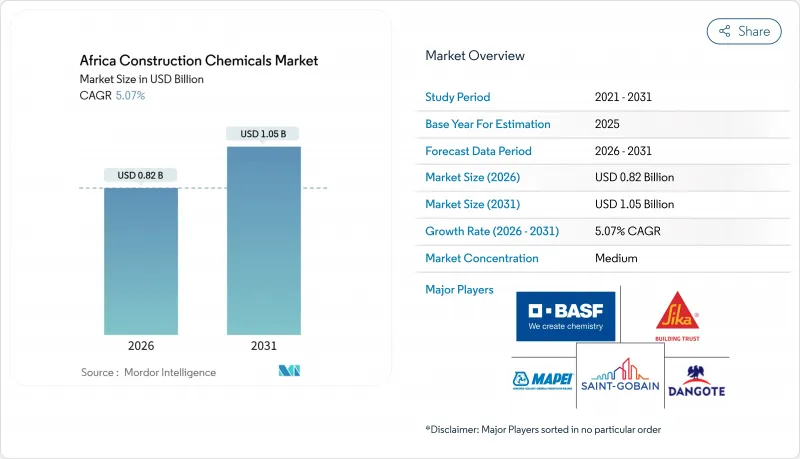
本報告按產品類型(黏合劑、錨栓和水泥漿、混凝土外加劑、混凝土保護塗料、地板樹脂、密封劑等)、終端用戶產業(基礎設施和公共工程、商業、工業、住宅)以及地區(南非、埃及、奈及利亞、摩洛哥和其他非洲國家)進行細分。市場預測以美元計價。
非洲建築化學品市場趨勢與洞察
擴大基礎設施大型企劃儲備
埃及決定在2025年投資180億美元用於基礎建設,光是新行政首都到2030年就需要4,500萬立方公尺混凝土。奈及利亞也呈現類似的趨勢,丹戈特煉油廠正在使用特殊砂漿和塗料來保護混凝土免受碳氫化合物的侵蝕,並為工業設施制定了新的採購標準。由非洲開發銀行資助的摩洛哥馬拉喀什高鐵延伸計畫需要使用低收縮外加劑來抑制板開裂,這提高了技術准入門檻。肯亞拉穆港、南蘇丹和埃塞俄比亞走廊計畫要求化學品供應商必須通過ISO 9001認證,這表明人們越來越重視生命週期價值而非最低成本。建築公司在雨季來臨前大量儲備防水卷材和水泥漿,縮短了前置作業時間,也使擁有國內倉庫的經銷商受益。這些大型企劃共同擴大了非洲建築化學品市場,將高規格基礎設施項目中使用的高品質規範推廣到一般住宅和商業項目。
引入經濟適用住宅政策與城市高密度化
南非的「破土動工」(Breaking New Ground)計畫在2025年前交付了12萬套補貼住宅。每套住房都使用聚合物改質砂漿,符合國家住宅建築商註冊委員會規定的50年耐久性目標。埃及的「社會住宅舉措」(住宅 )旨在到2030年交付100萬套住房,並透過指定預拌瓷磚黏合劑來避免現場混合錯誤,從而集中向認證供應商訂購。奈及利亞的「國家住房基金」(National 住宅 Fund)儘管面臨資金短缺,但仍鼓勵拉各斯和阿布加的私人開發商採用自流平地板材料,以加快房屋交付進度。阿克拉和內羅畢目前正在進行垂直城市密集化建設,與單層住宅開發案相比,每個項目對錨固系統和外牆密封劑的需求量更大。未來幾年可預測的需求使得化學製造商能夠在成長走廊附近設立混合廠,從而降低運輸成本並對沖外匯波動風險。因此,非洲建築化學品市場擁有可靠的住宅需求基礎,這為擴大生產能力的投資提供了支持。
加強對揮發性有機化合物和有害化學物質的監管
在南非,《國家環境管理法》目前將密封劑和塗料中的揮發性有機化合物(VOC)含量限制在50克/公升以內,迫使企業轉向水性化學品。跨國公司可以在全球分攤測試和認證成本,而區域公司則面臨單位成本過高、利潤微薄的困境,被迫停止產品生產。埃及的《工業排放指令》禁止在地板材料樹脂中使用某些鄰苯二甲酸酯,導致商業領域的供應暫時減少。奈及利亞正在製定類似的法規,但由於執法不力,不合規的進口產品混入高級產品中,削弱了建築商的信心。隨著法規越來越接近歐盟標準,那些無法修改配方的公司可能會被排除在需要第三方認證的捐助者資助的基礎設施項目之外。這些合規壓力正在拖累非洲建築化學品市場的成長速度。
細分市場分析
混凝土外加劑仍是非洲大陸預拌混凝土生產商的標準原料,預計2025年將佔非洲建築化學品市場佔有率的24.78%。同時,防水解決方案正以5.72%的複合年成長率成長,直至2031年,這反映出拉各斯和開普敦等易受洪水侵襲的城市正在轉向增強應對氣候變遷的能力。包括開羅地鐵隧道在內的大規模基礎設施項目現在都指定使用SikaProof等整合式膜系統,該系統在澆築過程中嵌入防潮層,從而增加了每立方米混凝土中使用的化學品用量。對能夠自癒微裂縫的結晶質外加劑的需求不斷成長,也推動了從表面塗層向內部防水的轉變。
隨著1970年代至90年代建造的橋樑和水處理設施進入更新周期,對維修和維修產品的需求日益成長。南非一項耗資200億蘭特的橋樑維護計畫正在加速推廣聚合物改質砂漿的應用,這種砂漿可將資產壽命延長15年。超大規模資料中心業者資料中心的建造也帶動了對靜電耗散型地板樹脂的需求。這一細分市場尚未由全球或區域性公司主導,為非洲建築化學品市場創造了一個尚未開發的領域。同時,揮發性有機化合物(VOC)法規為溶劑型防護塗料帶來了挑戰。由於缺乏可比擬的耐久性數據,承包商不願完全轉向水性塗料,導致更換週期延長。
其他好處:
- Excel格式的市場預測(ME)表
- 3個月的分析師支持
目錄
第1章:引言
- 研究假設和市場定義
- 調查範圍
第2章:調查方法
第3章執行摘要
第4章 市場狀況
- 市場概覽
- 市場促進因素
- 擴大大型基礎建設項目儲備
- 引入經濟適用住宅政策與城市發展
- 對高強度、節能結構的需求
- 環保水泥的稅收優惠和隱含碳排放法規
- 有效利用採礦殘渣作為輔助膠凝材料
- 市場限制因素
- 收緊揮發性有機化合物和有害化學物質的監管限值
- 原物料價格波動取決於進口情況
- 仿冒品和不符合規格的產品正在損害承包商的聲譽。
- 價值鏈分析
- 波特五力模型
第5章 市場規模與成長預測
- 依產品類型
- 黏合劑
- 錨固水泥漿
- 混凝土外加劑
- 混凝土保護塗層
- 地板樹脂
- 用於維修和修復的化學品
- 密封劑
- 表面處理化學品
- 防水解決方案
- 按最終用戶行業分類
- 基礎設施和公共工程
- 商業的
- 產業
- 住宅
- 按地區
- 南非
- 埃及
- 奈及利亞
- 摩洛哥
- 其他非洲國家
第6章 競爭情勢
- 市場集中度
- 策略趨勢
- 市佔率和排名分析
- 公司簡介
- BASF
- AfriSam
- Arkema
- CMB
- Conmix
- Dangote Industries Limited
- Dow
- EAMIC
- Portland Cement Plc
- Hemts
- Lafarge
- Mapei
- PPC Ltd
- RowChem Industries Ltd
- Saint-Gobain
- Sika AG
- SOCHEM
第7章 市場機會與未來展望
According to Mordor Intelligence, the Africa construction chemicals market size is estimated at USD 0.82 billion in 2026, and is expected to reach USD 1.05 billion by 2031, at a CAGR of 5.07% during the forecast period (2026-2031).
This report is Segmented by Product Type (Adhesives, Anchors and Grouts, Concrete Admixtures, Concrete Protective Coatings, Flooring Resins, Sealants, and More), End-User Industry (Infrastructure and Public Works, Commercial, Industrial, and Residential), and Geography (South Africa, Egypt, Nigeria, Morocco, and the Rest of Africa). The Market Forecasts are Provided in Terms of Value (USD).
Africa Construction Chemicals Market Trends and Insights
Infrastructure Megaproject Pipeline Expansion
Egypt committed USD 18 billion to infrastructure in 2025, with its New Administrative Capital alone requiring 45 million m3 of concrete through 2030. Similar momentum is visible in Nigeria, where the Dangote Refinery consumed specialty mortars and coatings to protect concrete from hydrocarbons and set new procurement standards for industrial facilities. Morocco's high-speed rail extension to Marrakech, financed by the African Development Bank, demands low-shrinkage admixtures to curb slab cracking, raising technical entry barriers. Kenya's Lamu Port-South Sudan-Ethiopia Corridor requires ISO 9001-certified chemical vendors, signaling a growing preference for lifecycle value rather than lowest cost. Contractors tend to stockpile membranes and grouts ahead of rainy seasons, shortening lead times and rewarding distributors with in-country warehousing. Collectively, these megaprojects enlarge the Africa construction chemicals market by channeling premium specifications from marquee infrastructure into mainstream residential and commercial projects.
Affordable-Housing Policy Roll-Outs and Urban Densification
South Africa's Breaking New Ground program delivered 120,000 subsidized units in 2025, each using polymer-modified mortars that satisfy 50-year durability targets mandated by the National Home Builders Registration Council. Egypt's Social Housing Initiative seeks 1 million units by 2030 and specifies pre-blended tile adhesives to avoid on-site mixing errors, consolidating volume among accredited suppliers. Nigeria's National Housing Fund, despite funding gaps, stimulates private developers in Lagos and Abuja to adopt self-leveling floors that accelerate handover schedules. Accra and Nairobi now pursue vertical densification that consumes more anchoring systems and facade sealants per project than single-level sprawl. Predictable multi-year demand allows chemical producers to site blending plants nearer to growth corridors, cutting freight costs and hedging currency swings. The Africa construction chemicals market, therefore, gains a reliable residential volume base that underpins broader capacity investments.
Tightening VOC and Hazardous-Chemicals Limits
South Africa now caps VOCs in sealants and coatings at 50 g/L under the National Environmental Management Act, forcing a pivot to water-borne chemistries. Multinationals amortize testing and certification globally, but regionals face unworkable unit costs, prompting product discontinuation. Egypt's Industrial Emissions Directive bans select phthalates in flooring resins, temporarily cutting supply in the commercial segment. Nigeria drafts similar rules, yet enforcement gaps allow low-compliance imports to coexist with premium lines, eroding contractor confidence. As regulations converge toward EU standards, firms without reformulation capacity risk exclusion from donor-funded infrastructure that mandates third-party certification. This compliance squeeze subtracts growth points from the Africa construction chemicals market.
Other drivers and restraints analyzed in the detailed report include:
- Demand for High-Strength, Energy-Efficient Structures
- Green-Cement Tax Incentives and Embodied-Carbon Regulation
- Import-Dependent Raw-Material Price Volatility
For complete list of drivers and restraints, kindly check the Table Of Contents.
Segment Analysis
Concrete admixtures captured 24.78% of Africa construction chemicals market share in 2025 because they remain standard inputs for ready-mix producers across the continent. Yet waterproofing solutions are expanding at a 5.72% CAGR through 2031, reflecting a pivot toward climate resilience in flood-prone cities such as Lagos and Cape Town. Large infrastructure projects, including the Cairo Metro tunnels, now specify integrated membrane systems like SikaProof, which embed moisture barriers during casting and elevate chemical intensity per cubic meter of concrete. Growing preference for crystalline admixtures that self-seal micro-cracks also pushes substitution away from surface coatings toward internal waterproofing.
Repair and rehabilitation products gain momentum as bridges and water plants built during the 1970s-1990s reach renewal cycles. South Africa's ZAR 20 billion bridge maintenance backlog accelerates uptake of polymer-modified mortars that extend asset life by 15 years. Data-center construction by hyperscalers fuels demand for electrostatic-dissipative flooring resins, a niche that neither global nor regional players dominate, creating whitespace within the Africa construction chemicals market. Meanwhile, VOC limits challenge solvent-borne protective coatings; contractors remain hesitant to transition fully to water-borne alternatives without equivalent durability data, slowing the replacement cycle.
Complete Report Scope:
- By Product Type
- Adhesives
- Anchors and Grouts
- Concrete Admixtures
- Concrete Protective Coatings
- Flooring Resins
- Repair and Rehabilitation Chemicals
- Sealants
- Surface Treatment Chemicals
- Waterproofing Solutions
- By End-user Industry
- Infrastructure and Public Works
- Commercial
- Industrial
- Residential
- By Geography
- South Africa
- Egypt
- Nigeria
- Morocco
- Rest of Africa
List of Companies Covered in this Report:
- BASF
- AfriSam
- Arkema
- CMB
- Conmix
- Dangote Industries Limited
- Dow
- EAMIC
- Portland Cement Plc
- Hemts
- Lafarge
- Mapei
- PPC Ltd
- RowChem Industries Ltd
- Saint-Gobain
- Sika AG
- SOCHEM
Additional Benefits:
- The market estimate (ME) sheet in Excel format
- 3 months of analyst support
TABLE OF CONTENTS
1 Introduction
- 1.1 Study Assumptions and Market Definition
- 1.2 Scope of the Study
2 Research Methodology
3 Executive Summary
4 Market Landscape
- 4.1 Market Overview
- 4.2 Market Drivers
- 4.2.1 Infrastructure megaproject pipeline expansion
- 4.2.2 Affordable-housing policy roll-outs and urban densification
- 4.2.3 Demand for high-strength, energy-efficient structures
- 4.2.4 Green-cement tax incentives and embodied-carbon regulation
- 4.2.5 Valorisation of mining tailings into supplementary cementitious materials
- 4.3 Market Restraints
- 4.3.1 Tightening VOC and hazardous-chemicals limits
- 4.3.2 Import-dependent raw-material price volatility
- 4.3.3 Counterfeit / sub-spec products eroding contractor confidence
- 4.4 Value Chain Analysis
- 4.5 Porter's Five Forces
- 4.5.1 Bargaining Power of Suppliers
- 4.5.2 Bargaining Power of Buyers
- 4.5.3 Threat of New Entrants
- 4.5.4 Threat of Substitutes
- 4.5.5 Competitive Rivalry
5 Market Size and Growth Forecasts (Value)
- 5.1 By Product Type
- 5.1.1 Adhesives
- 5.1.2 Anchors and Grouts
- 5.1.3 Concrete Admixtures
- 5.1.4 Concrete Protective Coatings
- 5.1.5 Flooring Resins
- 5.1.6 Repair and Rehabilitation Chemicals
- 5.1.7 Sealants
- 5.1.8 Surface Treatment Chemicals
- 5.1.9 Waterproofing Solutions
- 5.2 By End-user Industry
- 5.2.1 Infrastructure and Public Works
- 5.2.2 Commercial
- 5.2.3 Industrial
- 5.2.4 Residential
- 5.3 By Geography
- 5.3.1 South Africa
- 5.3.2 Egypt
- 5.3.3 Nigeria
- 5.3.4 Morocco
- 5.3.5 Rest of Africa
6 Competitive Landscape
- 6.1 Market Concentration
- 6.2 Strategic Moves
- 6.3 Market Share(%)/Ranking Analysis
- 6.4 Company Profiles (includes Global level Overview, Market level overview, Core Segments, Financials as available, Strategic Information, Market Rank/Share for key companies, Products and Services, and Recent Developments)
- 6.4.1 BASF
- 6.4.2 AfriSam
- 6.4.3 Arkema
- 6.4.4 CMB
- 6.4.5 Conmix
- 6.4.6 Dangote Industries Limited
- 6.4.7 Dow
- 6.4.8 EAMIC
- 6.4.9 Portland Cement Plc
- 6.4.10 Hemts
- 6.4.11 Lafarge
- 6.4.12 Mapei
- 6.4.13 PPC Ltd
- 6.4.14 RowChem Industries Ltd
- 6.4.15 Saint-Gobain
- 6.4.16 Sika AG
- 6.4.17 SOCHEM
7 Market Opportunities and Future Outlook
- 7.1 White-space and Unmet-need Assessment
- 7.2 Data-centre boom to drive demand for specialty flooring and coatings

 全球建築化學品市場報告
 建築化學品市場:2026-2032年全球市場預測(依產品類型、技術、劑型、應用、最終用戶、通路和建築類型分類)
 印度建設化學品市場:市場佔有率分析、產業趨勢與統計及成長預測(2026-2031)東南亞建築化學品市場:市場佔有率分析、產業趨勢與統計及成長預測(2026-2031)
 建築化學品市場預測至2034年-按產品類型、化學品類型、應用、最終用途和地區分類的全球分析
 建築化學品市場規模、佔有率和成長分析:黏合劑和密封劑、混凝土外加劑、砂漿和水泥漿、防水化學品、修補和保護劑以及地區分類-2026-2033年產業預測越南建築化學品市場:市場佔有率分析、產業趨勢與統計及成長預測(2026-2031)固定式機械錨栓市場:依產品類型、材料、應用、終端用戶產業及通路分類,全球預測,2026-2032年
 建築化學品市場分析及預測(至2035年):類型、產品、應用、形態、材質類型、技術、最終用戶、功能、安裝類型、解決方案建築化學品:市場佔有率分析、產業趨勢與統計、成長預測(2026-2031)