


 |
市場調查報告書
商品編碼
2116114
北美長途運輸:市場佔有率分析、行業趨勢和統計數據以及成長預測(2026-2031 年)North America Long-haul Transport - Market Share Analysis, Industry Trends & Statistics, Growth Forecasts (2026 - 2031) |
||||||

※ 本網頁內容可能與最新版本有所差異。詳細情況請與我們聯繫。
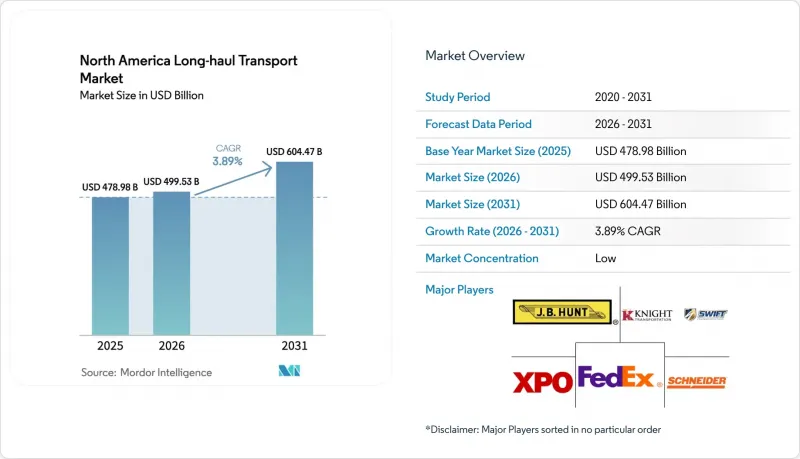
根據 Mordor Intelligence 預測,北美長途運輸市場規模將從 2025 年的 4,789.8 億美元成長到 2026 年的 4995.3 億美元,到 2031 年將達到 6044.7 億美元,2026 年至 2031 年的複合成長率預計為 3.89%。
本報告按最終用戶行業(農業、建築業、製造業、石油天然氣業、批發零售業及其他)、目的地(國內和國際)、整車運輸(FTL 和 LTL)、容器化、貨物組成、溫控以及國家/地區(美國、加拿大、墨西哥及其他)進行細分。市場預測以美元計價。
北美長途運輸市場的趨勢與洞察
電子商務小包裹量激增
2024年,美國線上零售額達1.14兆美元,小包裹處理量超過210億件。這迫使承運商重新規劃長途運輸路線,並轉向繼電器系統,使司機能夠在離家更近的地方工作。綜合快遞業者大力投資建置自動化樞紐,每小時可處理120萬個包裹,從而提升了整個北美長途運輸市場的服務水準。作為回應,整車運輸公司採用了人工智慧驅動的路線最佳化工具,到2025年初,閒置時間減少了4個百分點,降至14%。轉向更小、更頻繁的貨運增加了零擔貨運終端的處理量,但也增加了每磅0.08至0.12美元的處理成本。隨著全通路模式融合了店內取貨和送貨上門,預計到2028年,電子商務在總貨運噸位中的佔有率將穩定在20%左右。
製造業回流國內市場及轉移到鄰國(近岸外包)
2024年,美國製造業建設投資加倍,達到2,280億美元。這主要得益於半導體、電池和製藥相關項目的推動,這些項目將供應鏈從30天的海運縮短至3天的公路運輸。同年,墨西哥吸引了360億美元的外國直接投資,位於新萊昂州和瓜納華托州的工廠根據美墨加協定(USMCA)的原產地規則向美國供應線束和電池模組。 2025年3月,跨境卡車貨運量達到創紀錄的479億美元,證實了對運輸路線的強勁需求。製造業回流增加了運輸的頻率和複雜性,使那些運作保稅堆場並提供短途運輸、倉儲和長途運輸一體化服務的承運商受益。小規模的貨運代理商難以跟上這些綜合服務的步伐,導致北美長途運輸市場整合加劇。
司機嚴重短缺和工資上漲
預計到2025年,不斷上升的退休人數將導致6萬至8萬名司機缺口,大規模貨運公司的離職率將維持在90%以上,中位數年薪將推高至6.2萬美元。聯邦資訊交換中心吊銷駕照導致運輸能力損失,到2024年底,損失量相當於商業擁有者總數的2.5%。招募成本飆升至每位新進員工高達1.2萬美元,擠壓了中小貨運公司的利潤空間。儘管自動駕駛卡車試驗在2024年記錄了250萬英里的商業行駛里程,但試點項目之外的部署仍需要監管框架來確保問責。儘管勞動力短缺持續存在,但合約貨運價格依然堅挺,即使在貨運需求疲軟時期,也持續支撐著北美長途運輸市場。
細分市場分析
到2025年,製造業將佔北美長途運輸市場佔有率的32.30%,反映出汽車和機械設備正穩定流入綜合組裝走廊。批發和零售貿易正以4.41%的複合年成長率(2026-2031年)推動成長,零售商正在重新分配區域履約中心之間的庫存,以加速最後一公里配送。在農業領域,從中西部糧倉到墨西哥灣沿岸出口碼頭的散裝糧食運輸仍然是主要的運輸方式。同時,由於聯邦政府資助的基礎設施建設項目,建築業的運輸量增加了6.8%。受能源產量持平和天然氣價格低迷的影響,石油天然氣、採礦和採石業下降了2.1%,但運輸半導體製造相關化學品的液罐車運輸量部分抵消了這一降幅。包括醫療保健和消費電子在內的其他多元化產業與GDP的整體成長保持同步。
製造業回流正在穩步增加半成品的物流,這促使製造商提高零擔貨運 (LTL) 的頻率,以減少在製品庫存。合規、安全和課責(CSA) 計劃下的安全審核正在收緊承運商的選擇標準,使高評級的承運商比那些僅以價格競爭的競爭對手更具優勢。透過電子商務進行的零售進口持續推動批發業務的發展,尤其是在從西向東的港口到內陸路線上。隨著2026年後財政支持的減少,預計建築相關貨運將恢復正常,但批發通路建造的多元化基礎正在保護北美長途運輸市場免受特定行業衝擊的影響。
2025年,國內航線佔銷售額的62.51%,主要得益於方圓500英里內集中的製造業叢集和大規模消費中心。預計2026年至2031年,國際貨運量將以4.47%的複合年成長率成長,主要得益於美墨加協定(USMCA)實施後,南北間零件運輸量的增加。 2025年3月,跨境貨運量達到479億美元,凸顯了墨西哥和美國之間持續的貨物流動,從而縮短了前置作業時間並降低了庫存成本。同月,運往加拿大的貨運量達368億美元,雙向運輸量龐大,涵蓋木材、汽車零件和能源產品等多種貨物。
拉雷多、埃爾帕索和底特律附近的保稅倉庫能夠提供一體化解決方案,從而實現比標準幹線運輸更高的費率。雖然外匯風險會帶來複雜性,但對於擁有多幣種自動開票系統的承運商而言,它也提供了提高獲利能力的機會。國內貨運容易受到司機離職率上升的影響,而海關瓶頸仍是國際路線面臨的最大風險。墨西哥和加拿大電子記錄設備 (ELD) 標準的統一正在縮短邊境停留時間,提高周轉率,並增強北美長途運輸市場對跨境運輸公司的前景。
其他好處
- Excel格式的市場預測(ME)表
- 3個月的分析師支持
目錄
第1章:引言
- 研究假設和市場定義
- 調查範圍
第2章:調查方法
第3章執行摘要
第4章 市場狀況
- 市場概覽
- 按經濟活動分類的GDP構成
- 按經濟活動分類的GDP成長率
- 經濟表現及概覽
- 電子商務產業的趨勢
- 製造業的發展趨勢
- 運輸和倉儲部門的GDP
- 物流績效
- 道路長度
- 出口趨勢
- 進口趨勢
- 燃油價格趨勢
- 卡車運輸營運成本
- 按車輛類型分類的卡車擁有數量
- 主要卡車供應商
- 陸上負載容量趨勢
- 陸上貨運價格趨勢
- 按交通方式分享
- 通貨膨脹
- 法律規範
- 價值鍊和通路分析
- 市場促進因素
- 電子商務小包裹量激增
- 製造業回流(將製造業遷回日本)和轉移到鄰國(近岸外包)
- 美墨加協定下跨境貿易的擴張
- 擴大藥品和生技藥品的低溫運輸
- 透過引擎和空氣動力學特性提高燃油效率
- 人工智慧驅動的回程傳輸和托運人匹配平台
- 市場限制因素
- 促進要素嚴重短缺和工資上漲
- 柴油價格波動
- 橋樑和高速公路通行費飆升
- ESG驅動的早期車輛電氣化資本投資
- 市場上的技術創新
- 波特五力分析
第5章 市場規模與成長預測
- 終端用戶產業
- 農業、漁業、林業
- 建造
- 製造業
- 石油和天然氣、採礦和採石
- 批發和零售
- 其他
- 目的地
- 國內的
- 國際的
- 卡車裝載
- 整車運輸 (FTL)
- 小批量裝載(LTL)
- 容器化
- 貨櫃運輸
- 非貨櫃運輸
- 貨物組成
- 流體貨物
- 固體貨物
- 溫度控制
- 無溫度控制
- 具備溫度控制功能
- 國家
- 美國
- 加拿大
- 墨西哥
- 其他北美國家
第6章 競爭情勢
- 市場集中度
- 關鍵策略趨勢
- 市佔率分析
- 公司簡介
- AP Moller-Maersk
- ArcBest
- CH Robinson
- Canada Cartage
- CMA CGM Group(including CEVA Logistics)
- DHL Group
- DSV A/S(De Sammensluttede Vognmand af Air and Sea)
- FedEx
- JB Hunt Transport, Inc.
- Knight-Swift Transportation Holdings, Inc.
- Landstar System, Inc.
- Old Dominion Freight Line
- Penske Corporation
- Ryder System, Inc.
- Schneider National, Inc.
- Transportes Marva
- Traxion
- United Parcel Service of America, Inc.(UPS)
- Werner Enterprises Inc.
- XPO, Inc.
第7章 市場機會與未來展望
According to Mordor Intelligence, the North America long-haul transport market size is expected to increase from USD 478.98 billion in 2025 to USD 499.53 billion in 2026 and reach USD 604.47 billion by 2031, growing at a CAGR of 3.89% over 2026-2031.
This report is Segmented by End User Industry (Agriculture, Construction, Manufacturing, Oil and Gas, Wholesale and Retail Trade, and Others), Destination (Domestic and International), Truckload Specification (FTL and LTL), Containerization, Goods Configuration, Temperature Control, and Geography (United States, Canada, Mexico, and More). The Market Forecasts are in Value (USD).
North America Long-haul Transport Market Trends and Insights
E-commerce Parcel Volume Surge
United States online retail sales touched USD 1.14 trillion in 2024, driving parcel counts past 21 billion units and forcing carriers to restructure linehaul legs into relay runs that keep drivers closer to home. Integrated express players invested heavily in automated hubs capable of processing 1.2 million pieces per hour, raising service benchmarks for the broader North America long-haul transport market. Truckload fleets responded by embedding AI route-optimization tools that trimmed empty-mile ratios four points to 14% in early 2025. The mix shift toward smaller, more frequent shipments expanded LTL terminal traffic but added handling costs of USD 0.08 to USD 0.12 per pound. E-commerce share of total freight tonnage is projected to stabilize near 20% by 2028 as omnichannel models blend store pickups with home deliveries.
Manufacturing Reshoring and Near-Shoring
United States manufacturing construction outlays doubled to USD 228 billion in 2024, largely for semiconductor, battery, and pharmaceutical projects that shorten supply chains from 30-day ocean legs to three-day truck hauls. Mexico attracted USD 36 billion in foreign direct investment the same year, with plants in Nuevo Leon and Guanajuato funneling wire harnesses and battery modules northbound under USMCA content rules. Cross-border truck freight hit a record USD 47.9 billion in March 2025, underscoring resilient lane demand. Reshoring lifts shipment frequency and complexity, rewarding carriers that operate bonded yards and offer bundled drayage, warehousing, and linehaul services. Smaller brokers struggle to match this integrated suite, spurring consolidation in the North America long-haul transport market.
Acute Driver Shortage and Wage Inflation
Retirements accelerated a shortfall that reached 60,000 to 80,000 drivers in 2025, keeping turnover above 90% at large truckload fleets and pushing median pay to USD 62,000. Federal clearinghouse disqualifications removed capacity equal to 2.5% of the commercial-license pool by year-end 2024. Recruiting costs soared to as high as USD 12,000 per new hire, which squeezed smaller carriers' margins. Autonomous truck trials logged 2.5 million commercial miles in 2024 yet await rulemaking on liability frameworks before scaling beyond pilots. As the labor gap persists, contract rates remain sticky, underpinning the North America long-haul transport market even in periods of soft freight demand.
Other drivers and restraints analyzed in the detailed report include:
- Cross-Border Trade Growth under USMCA
- Cold-Chain Pharma and Biologics Expansion
- Volatile Diesel Prices
For complete list of drivers and restraints, kindly check the Table Of Contents.
Segment Analysis
Manufacturing generated 32.30% of the North America long-haul transport market share in 2025, reflecting consistent automotive and machinery flows into integrated assembly corridors. Wholesale and Retail Trade leads growth at a 4.41% CAGR (2026-2031) as retailers redistribute inventory across regional fulfillment centers for faster final-mile execution. Agriculture continues to rely on bulk grain moves from Midwest elevators to Gulf export terminals, while construction traffic rose 6.8% on federally funded infrastructure work. Oil and Gas, Mining, and Quarrying softened 2.1% due to flat energy output and subdued natural-gas pricing, but fluid-grade tanker carriers partially offset weakness through chemical shipments tied to semiconductor fabrication. Other diversified verticals, including health care and consumer electronics, aligned with broader GDP expansions.
Reshoring has steadily increased intermediate-goods flows, prompting manufacturers to contract more frequent LTL runs that reduce in-process inventory. Safety audits under the Compliance, Safety, Accountability (CSA) program sharpen carrier selection criteria, elevating well-scored fleets above price-only competitors. E-commerce retail imports continue to reinforce the wholesale segment's momentum, especially on west-to-east, port-to-inland corridors. As fiscal support cools post-2026, construction freight is likely to normalize, yet the diversified base built by the wholesale channel keeps the North America long-haul transport market insulated from sector-specific shocks.
Domestic lanes comprised 62.51% of 2025 revenue, driven by dense manufacturing clusters and large consumption centers located within a 500-mile radius. International traffic is forecast to expand at a 4.47% CAGR (2026-2031) as USMCA compliance embeds more north-south component shipments. March 2025 cross-border freight tallied USD 47.9 billion, underlining sustained Mexico-United States flows that shorten lead times and cut inventory costs. Canadian traffic of USD 36.8 billion in the same month emphasized diversified bidirectional volumes of lumber, auto parts, and energy products.
Bonded warehousing near Laredo, El Paso, and Detroit allows integrated solutions that command premiums over plain linehaul. Currency-exchange exposure introduces complexity but offers margin plays for carriers with automated invoicing in multiple denominations. Domestic freight faces higher exposure to driver turnover, while customs bottlenecks remain the prime risk on international lanes. Harmonized electronic-logging-device standards across Mexico and Canada reduce border dwell times and improve asset turns, strengthening the North America long-haul transport market outlook for cross-border specialists.
Complete Report Scope:
- End User Industry
- Agriculture, Fishing, and Forestry
- Construction
- Manufacturing
- Oil and Gas, Mining and Quarrying
- Wholesale and Retail Trade
- Others
- Destination
- Domestic
- International
- Truckload Specification
- Full-Truck-Load (FTL)
- Less than-Truck-Load (LTL)
- Containerization
- Containerized
- Non-Containerized
- Goods Configuration
- Fluid Goods
- Solid Goods
- Temperature Control
- Non-Temperature Controlled
- Temperature Controlled
- Country
- United States
- Canada
- Mexico
- Rest of North America
List of Companies Covered in this Report:
- A.P. Moller - Maersk
- ArcBest
- C.H. Robinson
- Canada Cartage
- CMA CGM Group (including CEVA Logistics)
- DHL Group
- DSV A/S (De Sammensluttede Vognmand af Air and Sea)
- FedEx
- J.B. Hunt Transport, Inc.
- Knight-Swift Transportation Holdings, Inc.
- Landstar System, Inc.
- Old Dominion Freight Line
- Penske Corporation
- Ryder System, Inc.
- Schneider National, Inc.
- Transportes Marva
- Traxion
- United Parcel Service of America, Inc. (UPS)
- Werner Enterprises Inc.
- XPO, Inc.
Additional Benefits:
- The market estimate (ME) sheet in Excel format
- 3 months of analyst support
TABLE OF CONTENTS
1 Introduction
- 1.1 Study Assumptions and Market Definition
- 1.2 Scope of the Study
2 Research Methodology
3 Executive Summary
4 Market Landscape
- 4.1 Market Overview
- 4.2 GDP Distribution by Economic Activity
- 4.3 GDP Growth by Economic Activity
- 4.4 Economic Performance and Profile
- 4.4.1 Trends in E-Commerce Industry
- 4.4.2 Trends in Manufacturing Industry
- 4.5 Transport and Storage Sector GDP
- 4.6 Logistics Performance
- 4.7 Length of Roads
- 4.8 Export Trends
- 4.9 Import Trends
- 4.10 Fuel Pricing Trends
- 4.11 Trucking Operational Costs
- 4.12 Trucking Fleet Size by Type
- 4.13 Major Truck Suppliers
- 4.14 Road Freight Tonnage Trends
- 4.15 Road Freight Pricing Trends
- 4.16 Modal Share
- 4.17 Inflation
- 4.18 Regulatory Framework
- 4.19 Value Chain and Distribution Channel Analysis
- 4.20 Market Drivers
- 4.20.1 E-Commerce Parcel Volume Surge
- 4.20.2 Manufacturing Reshoring and Near-Shoring
- 4.20.3 Cross-Border Trade Growth under USMCA
- 4.20.4 Cold-Chain Pharma and Biologics Expansion
- 4.20.5 Engine and Aerodynamics Fuel-Efficiency Gains
- 4.20.6 AI-Enabled Back-Haul and Load-Matching Platforms
- 4.21 Market Restraints
- 4.21.1 Acute Driver Shortage and Wage Inflation
- 4.21.2 Volatile Diesel Prices
- 4.21.3 Escalating Bridge and Highway Tolls
- 4.21.4 ESG-Driven Early Fleet-Electrification CAPEX
- 4.22 Technology Innovations in the Market
- 4.23 Porter's Five Forces Analysis
- 4.23.1 Threat of New Entrants
- 4.23.2 Bargaining Power of Buyers
- 4.23.3 Bargaining Power of Suppliers
- 4.23.4 Threat of Substitutes
- 4.23.5 Competitive Rivalry
5 Market Size and Growth Forecasts (Value, USD)
- 5.1 End User Industry
- 5.1.1 Agriculture, Fishing, and Forestry
- 5.1.2 Construction
- 5.1.3 Manufacturing
- 5.1.4 Oil and Gas, Mining and Quarrying
- 5.1.5 Wholesale and Retail Trade
- 5.1.6 Others
- 5.2 Destination
- 5.2.1 Domestic
- 5.2.2 International
- 5.3 Truckload Specification
- 5.3.1 Full-Truck-Load (FTL)
- 5.3.2 Less than-Truck-Load (LTL)
- 5.4 Containerization
- 5.4.1 Containerized
- 5.4.2 Non-Containerized
- 5.5 Goods Configuration
- 5.5.1 Fluid Goods
- 5.5.2 Solid Goods
- 5.6 Temperature Control
- 5.6.1 Non-Temperature Controlled
- 5.6.2 Temperature Controlled
- 5.7 Country
- 5.7.1 United States
- 5.7.2 Canada
- 5.7.3 Mexico
- 5.7.4 Rest of North America
6 Competitive Landscape
- 6.1 Market Concentration
- 6.2 Key Strategic Moves
- 6.3 Market Share Analysis
- 6.4 Company Profiles (Includes Global Level Overview, Market Level Overview, Core Segments, Financials as Available, Strategic Information, Market Rank/Share for Key Companies, Products and Services, and Recent Developments)
- 6.4.1 A.P. Moller - Maersk
- 6.4.2 ArcBest
- 6.4.3 C.H. Robinson
- 6.4.4 Canada Cartage
- 6.4.5 CMA CGM Group (including CEVA Logistics)
- 6.4.6 DHL Group
- 6.4.7 DSV A/S (De Sammensluttede Vognmand af Air and Sea)
- 6.4.8 FedEx
- 6.4.9 J.B. Hunt Transport, Inc.
- 6.4.10 Knight-Swift Transportation Holdings, Inc.
- 6.4.11 Landstar System, Inc.
- 6.4.12 Old Dominion Freight Line
- 6.4.13 Penske Corporation
- 6.4.14 Ryder System, Inc.
- 6.4.15 Schneider National, Inc.
- 6.4.16 Transportes Marva
- 6.4.17 Traxion
- 6.4.18 United Parcel Service of America, Inc. (UPS)
- 6.4.19 Werner Enterprises Inc.
- 6.4.20 XPO, Inc.
7 Market Opportunities and Future Outlook
- 7.1 White-Space and Unmet-Need Assessment


