


 |
市場調查報告書
商品編碼
2115881
聚酯基熱熔膠:市場佔有率分析、行業趨勢和統計數據以及成長預測(黏合劑年)Polyester Hot Melt Adhesives - Market Share Analysis, Industry Trends & Statistics, Growth Forecasts (2026 - 2031) |
||||||

※ 本網頁內容可能與最新版本有所差異。詳細情況請與我們聯繫。
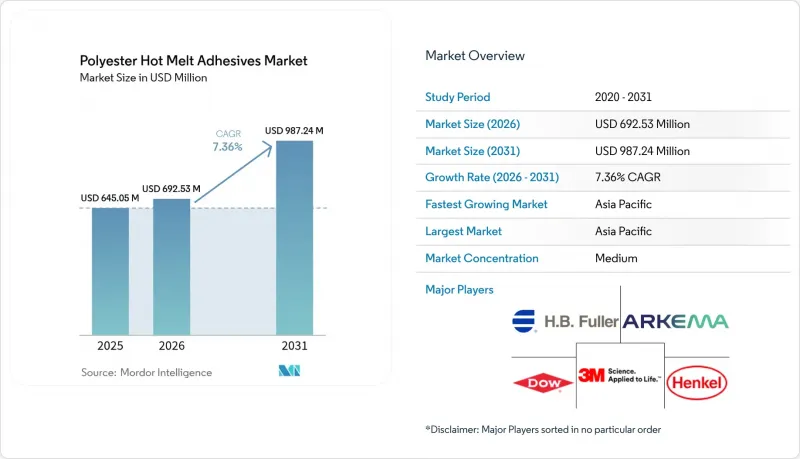
根據 Mordor Intelligence 預測,聚酯基熱熔膠的市場規模預計將從 2025 年的 6.4505 億美元成長到 2026 年的 6.9253 億美元,到 2031 年將達到 9.8724 億美元,2026 年至 2031 年的複合年成長率為 7.36%。
本報告按應用(工業組裝、食品和醫療包裝等)、樹脂化學(芳香族聚酯、脂肪族聚酯等)、形態(顆粒/顆粒物、塊狀/片狀物等)、最終用途行業(包裝、汽車和運輸、其他)以及地區(亞太地區、北美、歐洲、南美、中東和非洲)進行分類。
全球聚酯黏合劑市場趨勢及洞察
對無溶劑包裝黏合劑的需求日益成長
包裝製造商正從溶劑型複合材料轉向100%固態聚酯熱熔膠,以消除溶劑排放並降低能耗。漢高、陶氏和科騰近期透過引進生物基Tackfire,在不影響食品接觸安全性的前提下,將其TECHNOMELT系列產品的碳足跡降低了25%。由於歐盟VOC法規日益嚴格,這一轉變正在加速,而加工商則受益於更快的生產線和無需昂貴的溶劑回收設備。此外,聚酯配方還具有更好的金屬化薄膜黏合性和更強的防潮性,使其成為極具吸引力的高級阻隔包裝材料。
與車輛減重相關的附著力要求
汽車製造商致力於研發輕量化和電動車,他們依賴聚酯基黏合劑來連接鋁、碳纖維和先進鋼材等材料,這些材料無法透過鉚接或焊接實現經濟高效的連接。這些熱塑性黏合劑能夠承受快速的溫度變化和潮濕振動,並便於零件在使用壽命結束後進行拆卸回收。隨著電動車中電力電子設備密度的不斷提高,引擎室內的熱應力也日益增大。針對度C環境最佳化的聚酯基黏合劑能夠在保持機械完整性的同時,安全地隔離電池模組。
替代方案的可用性
木質素基熱熔膠、反應型聚氨酯和先進的氰基丙烯酸酯在某些應用中性能可與聚酯媲美甚至更優,因此吸引了那些追求更低成本和更高環保性的買家的注意。隨著這些替代材料的普及,聚酯供應商的定價權將受到限制,如果技術差異很小,新計畫可能會轉向這些替代材料。
細分市場分析
工業組裝領域仍佔據聚酯黏合劑市場最大的佔有率,預計到2025年將維持35.20%的市場佔有率,位居美元聚酯黏合劑市場規模排名榜首。汽車黏接是該領域的主導應用,因為黏合劑能夠黏接多種材料結構並承受整個生命週期內的極端溫度變化至關重要。隨著汽車電氣化的發展,引擎室內的最高溫度不斷升高,進一步增加了對耐熱聚酯熱熔膠的需求。其他工業應用包括家用電器、家具和過濾器的組裝,所有這些應用都受益於快速固化和清潔黏合劑的優勢。
食品和醫療包裝是成長最快的應用領域,預計到2031年將以8.24%的複合年成長率成長。品牌商更傾向於使用無溶劑、低氣味的黏合劑,這類黏合劑既能降低生產線的能源消耗,又能滿足嚴格的轉型標準。用於殺菌袋和蓋膜的可剝離熱封塗層象徵著工業組裝和包裝功能的融合。電子包裝和熱封塗層正在推動市場多元化發展,而紡織複合材料則作為一個新興領域脫穎而出,它兼具軟性黏合性、透氣性和耐洗性。
到2025年,芳香族聚酯將佔銷售額的46.00%,其價值在於高玻璃化轉變溫度、內聚強度以及在汽車和電子設備中優異的耐工性。聚酯熱熔膠黏合劑能佔據市場主導地位,得益於數十年的最佳化、易於取得的原料以及豐富的配方經驗。
然而,生物基和半生物基聚酯是成長最快的化學品領域,複合年成長率高達 8.22%。供應商正利用植物來源羧酸、再生 PET 和二氧化碳基中間體來減少碳足跡,同時又不影響機械性質。消費品和醫療設備產業的客戶將永續性放在首位,而監管壓力將削弱對石油化學產品的依賴,從而降低傳統的成本優勢。脂肪族聚酯用於一些特定的可生物分解或可堆肥應用,而共聚酯化學品則透過微調結晶質和熔體黏度來最佳化基材的潤濕性和可返工性。隨著持續的研發推動性能和永續性標準的不斷提高,聚酯黏合劑市場依然充滿活力。
區域分析
預計到2025年,亞太地區將佔全球銷售額的39.60%,並在2031年之前以8.12%的複合年成長率成長。中國電動車生產的擴張、印度智慧型手機組裝廠的興建以及日本高精度電子工廠的建設,都對聚酯基黏合劑有著龐大的需求。區域政府正大力推動對先進材料的投資,這促使漢高和西卡等公司擴大在當地的產能。此舉縮短了交貨週期,並將技術支援融入客戶的產品開發流程中。預計到2025年,Pidilite Industries的合併淨銷售額將達到123.37億印度盧比(約合14.8億美元),這印證了該地區市場需求的成熟。
北美仍然是創新中心,在推動輕量化汽車發展方面雄心勃勃,同時在生物基化學技術領域處於領先地位。隨著歐盟法規限制二異氰酸酯和高揮發性有機化合物(VOC)材料的使用,聚酯基熱熔膠正成為主要解決方案。這兩個地區都在與學術機構和新創公司合作,大規模生產二氧化碳衍生的單體,展現了其在循環經濟黏合劑領域的領導地位。
儘管南美、中東和非洲的交易量較小,但其潛力尚未充分開發。基礎設施的擴建和包裝食品產業的成長正在推動該技術的更廣泛應用。隨著區域加工商對其設施進行現代化改造並引入無溶劑生產線,聚酯熱熔膠供應商正在獲得多年期合約和待開發區項目,從而增強其全球網路的韌性。
其他好處:
- Excel格式的市場預測(ME)表
- 3個月的分析師支持
目錄
第1章:引言
- 研究假設和市場定義
- 調查範圍
第2章:調查方法
第3章執行摘要
第4章 市場狀況
- 市場概覽
- 市場促進因素
- 對無溶劑包裝黏合劑的需求日益成長
- 汽車應用中輕質黏合劑的要求
- 小型化電子元件的成長
- 穿戴式智慧紡織品的興起
- 醫用級低溫薄膜黏合劑
- 市場限制因素
- 替代方案的可用性
- 石油化學產品二檸檬酸鹽和乙二醇的價格波動很大。
- 原料成本和生產成本上漲
- 價值鏈分析
- 波特五力模型
第5章 市場規模與成長預測
- 透過使用
- 工業組裝
- 車
- 其他
- 食品和醫療包裝
- 電氣和電子元件
- 熱封塗層
- 纖維層壓材料
- 其他
- 工業組裝
- 通過樹脂化學
- 芳香聚酯
- 脂肪族聚酯
- 共聚酯
- 生物基/部分生物基聚酯
- 按形式
- 顆粒/粒狀物
- 砌塊/板
- 戳
- 電影/網路
- 粉末/微球
- 按最終用途行業分類
- 包裝(食品、醫療、工業)
- 汽車和交通運輸
- 電子與電機工程
- 紡織品和鞋類
- 家具和木工
- 其他
- 按地區
- 亞太地區
- 中國
- 印度
- 日本
- 韓國
- 其他亞太國家
- 北美洲
- 美國
- 加拿大
- 墨西哥
- 歐洲
- 德國
- 英國
- 義大利
- 法國
- 其他歐洲國家
- 南美洲
- 巴西
- 阿根廷
- 其他南美國家
- 中東和非洲
- 沙烏地阿拉伯
- 南非
- 其他中東和非洲國家
- 亞太地區
第6章 競爭情勢
- 市場集中度
- 策略趨勢
- 市佔率分析
- 公司簡介
- 3M
- Arkema(Bostik)
- Avery Dennison Corporation
- Beardow Adams Ltd.
- Buhnen GmbH & Co. KG
- Cattie Adhesives
- Dow
- Dymax Corporation
- Evonik Industries AG
- HB Fuller Company
- HellermannTyton
- Henkel AG & Co. KGaA
- Jowat SE
- Nihon Matai Co., Ltd.
- Sika AG
- Spiderbond Adhesives Co., Ltd.
- Toagosei Co., Ltd.
第7章 市場機會與未來展望
According to Mordor Intelligence, the polyester hot melt adhesives market size is expected to grow from USD 645.05 million in 2025 to USD 692.53 million in 2026 and is forecast to reach USD 987.24 million by 2031 at 7.36% CAGR over 2026-2031.
This report is Segmented by Application (Industrial Assembly, Food & Medical Packaging, and More), Resin Chemistry (Aromatic Polyester, Aliphatic Polyester, and More), Form (Pellets/Granules, Blocks/Slabs, and More), End-Use Industry (Packaging, Automotive & Transportation, and More), and Geography (Asia-Pacific, North America, Europe, South America, Middle East and Africa).
Global Polyester Hot Melt Adhesives Market Trends and Insights
Rising Demand for Solvent-Free Packaging Adhesives
Packaging producers are eliminating solvent emissions and cutting energy use by shifting from solvent-borne laminating products to 100% solids polyester hot melts. Henkel, Dow, and Kraton recently cut the carbon footprint of the TECHNOMELT range by 25% by introducing bio-based tackifiers without sacrificing food-contact safety. Tightening EU VOC limits further accelerates this switch, while converters benefit from quicker line speeds and the elimination of costly solvent-recovery equipment. Polyester formulations also improve adhesion to metallised films and enhance moisture resistance, making them attractive for premium barrier packaging.
Lightweight Automotive Bonding Requirements
Vehicle makers pursuing weight reduction and electrification rely on polyester hot melts to join aluminium, carbon fibre, and advanced steels that cannot be riveted or welded cost-effectively. These thermoplastic adhesives withstand wide temperature swings, damp vibration, and allow easier component disassembly for end-of-life recycling. Increasing power-electronics density in electric vehicles heightens under-hood thermal stress; polyester chemistries tailored for 150 °C service safely insulate battery modules while maintaining mechanical integrity.
Availability of Substitutes
Lignin-based hot melts, reactive polyurethane systems, and advanced cyanoacrylates match or exceed polyester performance in certain uses and attract buyers seeking lower cost or higher green content. As these alternatives scale, they cap pricing power for polyester suppliers and can divert new projects when technical differences are minimal.
Other drivers and restraints analyzed in the detailed report include:
- Growth in Miniaturised Electronic Components
- Wearable Smart-Textile Bonding Emergence
- Volatile Petrochemical Diacid & Glycol Prices
For complete list of drivers and restraints, kindly check the Table Of Contents.
Segment Analysis
Industrial assembly remains the largest slice of the polyester hot melt adhesives market, holding 35.20% share in 2025 and topping the USD polyester hot melt adhesives market size rankings. Automotive bonding dominates this segment, where the adhesive's ability to unite multi-material structures and survive life-cycle temperature extremes is critical. Vehicle electrification raises peak under-hood temperatures, further reinforcing the need for thermally resilient polyester hot melts. Other industrial uses include appliance, furniture, and filter assembly, each benefiting from fast set times and clean processing.
Food and medical packaging is the fastest-growing application, advancing at an 8.24% CAGR through 2031. Brand owners favour solvent-free, low-odour adhesives that meet stringent migration limits while reducing line energy demand. Peelable heat-seal coatings for retort pouches and lidding films illustrate the crossover between industrial assembly and packaging functions. Electronics packaging and heat-seal coatings add diversity, while textile laminates offer an emerging arena where flexible adhesion, breathability, and wash resistance converge.
Aromatic polyester commands 46.00% of 2025 revenues, prized for high glass-transition temperature, cohesive strength, and resistance to automotive and electronic operating conditions. The polyester hot melt adhesives market share advantage stems from decades of optimisation, ready availability of raw materials, and broad formulation know-how.
Bio-based and partially bio-based polyester, however, is the fastest-growing chemistry at 8.22% CAGR. Suppliers leverage plant-derived diacids, recycled PET, and CO2-based intermediates to cut carbon footprint without losing mechanical performance. Customers in consumer goods and medical devices value the sustainability story, and legislative pressure on petrochemical dependence will narrow legacy cost advantages. Aliphatic polyester serves niche biodegradable or compostable end-uses, while copolyester chemistries fine-tune crystallinity and melt viscosity for tailored substrate wet-out or reworkability. Continuous R&D keeps the polyester hot melt adhesives market dynamic as performance and sustainability benchmarks rise in tandem.
Complete Report Scope:
- By Application
- Industrial Assembly
- Automotive
- Others
- Food and Medical Packaging
- Electrical and Electronics Components
- Heat-Seal Coatings
- Textile Laminates
- Others
- Industrial Assembly
- By Resin Chemistry
- Aromatic Polyester
- Aliphatic Polyester
- Copolyester
- Bio-based/Partially Bio-based Polyester
- By Form
- Pellets/Granules
- Blocks/Slabs
- Sticks
- Film/Web
- Powder/Microspheres
- By End-use Industry
- Packaging (Food, Medical, Industrial)
- Automotive and Transportation
- Electronics and Electrical
- Textile and Footwear
- Furniture and Woodworking
- Others
- By Geography
- Asia-Pacific
- China
- India
- Japan
- South Korea
- Rest of Asia-Pacific
- North America
- United States
- Canada
- Mexico
- Europe
- Germany
- United Kingdom
- Italy
- France
- Rest of Europe
- South America
- Brazil
- Argentina
- Rest of South America
- Middle East and Africa
- Saudi Arabia
- South Africa
- Rest of Middle East and Africa
- Asia-Pacific
Geography Analysis
Asia Pacific held 39.60% of global sales in 2025 and is on track for an 8.12% CAGR to 2031. China's electric-vehicle buildout, India's smartphone assembly hubs, and Japan's high-precision electronics plants all consume large volumes of polyester hot melts. Regional authorities promote investment in advanced materials, encouraging Henkel and Sika to add local capacity, which shortens delivery cycles and integrates technical support into customers' product-development workflows. Consolidated net sales at Pidilite Industries reached INR 12,337 crore (USD 1.48 billion) in 2025, underscoring the region's maturing demand base.
North America remains an innovation powerhouse, driving stringent automotive lightweighting targets and pioneering bio-based chemistries. EU regulations steer materials away from diisocyanates and high-VOCs, making polyester hot melts a go-to solution. Both regions collaborate with academia and start-ups to scale CO2-derived monomers, showcasing leadership in circular-economy adhesives.
South America, the Middle East, and Africa register smaller volumes but represent untapped potential. Infrastructure expansion and growing packaged-food sectors support wider adoption. As regional converters modernise equipment and embrace solvent-free lines, polyester hot melt suppliers win green-field projects that lock in multi-year contract volumes and strengthen global network resilience.
- 3M
- Arkema (Bostik)
- Avery Dennison Corporation
- Beardow Adams Ltd.
- Buhnen GmbH & Co. KG
- Cattie Adhesives
- Dow
- Dymax Corporation
- Evonik Industries AG
- H.B. Fuller Company
- HellermannTyton
- Henkel AG & Co. KGaA
- Jowat SE
- Nihon Matai Co., Ltd.
- Sika AG
- Spiderbond Adhesives Co., Ltd.
- Toagosei Co., Ltd.
Additional Benefits:
- The market estimate (ME) sheet in Excel format
- 3 months of analyst support
TABLE OF CONTENTS
1 Introduction
- 1.1 Study Assumptions and Market Definition
- 1.2 Scope of the Study
2 Research Methodology
3 Executive Summary
4 Market Landscape
- 4.1 Market Overview
- 4.2 Market Drivers
- 4.2.1 Rising demand for solvent-free packaging adhesives
- 4.2.2 Lightweight automotive bonding requirements
- 4.2.3 Growth in miniaturised electronic components
- 4.2.4 Wearable smart-textile bonding emergence
- 4.2.5 Medical-grade low-temperature film adhesives
- 4.3 Market Restraints
- 4.3.1 Availiablity Of subsitutes
- 4.3.2 Volatile petrochemical diacid and glycol prices
- 4.3.3 High Raw Material and Production Costs
- 4.4 Value Chain Analysis
- 4.5 Porter's Five Forces
- 4.5.1 Bargaining Power of Suppliers
- 4.5.2 Bargaining Power of Buyers
- 4.5.3 Threat of New Entrants
- 4.5.4 Threat of Substitutes
- 4.5.5 Degree of Competition
5 Market Size and Growth Forecasts (Value)
- 5.1 By Application
- 5.1.1 Industrial Assembly
- 5.1.1.1 Automotive
- 5.1.1.2 Others
- 5.1.2 Food and Medical Packaging
- 5.1.3 Electrical and Electronics Components
- 5.1.4 Heat-Seal Coatings
- 5.1.5 Textile Laminates
- 5.1.6 Others
- 5.1.1 Industrial Assembly
- 5.2 By Resin Chemistry
- 5.2.1 Aromatic Polyester
- 5.2.2 Aliphatic Polyester
- 5.2.3 Copolyester
- 5.2.4 Bio-based/Partially Bio-based Polyester
- 5.3 By Form
- 5.3.1 Pellets/Granules
- 5.3.2 Blocks/Slabs
- 5.3.3 Sticks
- 5.3.4 Film/Web
- 5.3.5 Powder/Microspheres
- 5.4 By End-use Industry
- 5.4.1 Packaging (Food, Medical, Industrial)
- 5.4.2 Automotive and Transportation
- 5.4.3 Electronics and Electrical
- 5.4.4 Textile and Footwear
- 5.4.5 Furniture and Woodworking
- 5.4.6 Others
- 5.5 By Geography
- 5.5.1 Asia-Pacific
- 5.5.1.1 China
- 5.5.1.2 India
- 5.5.1.3 Japan
- 5.5.1.4 South Korea
- 5.5.1.5 Rest of Asia-Pacific
- 5.5.2 North America
- 5.5.2.1 United States
- 5.5.2.2 Canada
- 5.5.2.3 Mexico
- 5.5.3 Europe
- 5.5.3.1 Germany
- 5.5.3.2 United Kingdom
- 5.5.3.3 Italy
- 5.5.3.4 France
- 5.5.3.5 Rest of Europe
- 5.5.4 South America
- 5.5.4.1 Brazil
- 5.5.4.2 Argentina
- 5.5.4.3 Rest of South America
- 5.5.5 Middle East and Africa
- 5.5.5.1 Saudi Arabia
- 5.5.5.2 South Africa
- 5.5.5.3 Rest of Middle East and Africa
- 5.5.1 Asia-Pacific
6 Competitive Landscape
- 6.1 Market Concentration
- 6.2 Strategic Moves
- 6.3 Market Share Analysis
- 6.4 Company Profiles (includes Global level Overview, Market level overview, Core Segments, Financials as available, Strategic Information, Market Rank/Share for key companies, Products and Services, and Recent Developments)
- 6.4.1 3M
- 6.4.2 Arkema (Bostik)
- 6.4.3 Avery Dennison Corporation
- 6.4.4 Beardow Adams Ltd.
- 6.4.5 Buhnen GmbH & Co. KG
- 6.4.6 Cattie Adhesives
- 6.4.7 Dow
- 6.4.8 Dymax Corporation
- 6.4.9 Evonik Industries AG
- 6.4.10 H.B. Fuller Company
- 6.4.11 HellermannTyton
- 6.4.12 Henkel AG & Co. KGaA
- 6.4.13 Jowat SE
- 6.4.14 Nihon Matai Co., Ltd.
- 6.4.15 Sika AG
- 6.4.16 Spiderbond Adhesives Co., Ltd.
- 6.4.17 Toagosei Co., Ltd.
7 Market Opportunities and Future Outlook
- 7.1 White-space and Unmet-Need Assessment
- 7.2 Sustainability and Bio-Based Innovations

 結構膠帶市場:全球市場預測,2026-2032年
 熱熔膠黏合劑報告:趨勢、預測與競爭分析(至2035年)
 黏合劑:市場佔有率分析、產業趨勢與統計、成長預測(2026-2031)聚氨酯(PU)熱熔膠:市場佔有率分析、行業趨勢和統計數據以及成長黏合劑(2026-2031)熱熔膠市場:依技術、形態、黏合機制、溫度類型、終端應用產業和分銷管道分類-2026 - 2032年全球市場預測熱熔膠帶市場:按產品類型、黏合劑樹脂類型、厚度、應用和分銷管道分類-全球預測,2026-2032年熱熔膠市場:依產品、原料、應用、最終用途、國家及地區黏合劑-全球產業分析、市場規模、市場佔有率及2026年至2033年預測
 熱熔膠市場規模、佔有率和成長分析:按材料(基體樹脂)、產品形式、最終用途產業、分銷管道和地區分類-2026 - 2033年產業預測
 熱熔膠市場規模、佔有率和趨勢分析報告:按產品、原料、應用、地區和細分市場黏合劑(2026-2033 年)聚酯熱熔膠市場規模、佔有率和趨勢分析報告:按黏合劑、地區和細分市場預測(2026-2033 年)