


 |
市場調查報告書
商品編碼
2113779
黏合劑:市場佔有率分析、產業趨勢與統計、成長預測(2026-2031)Hot-melt Adhesives - Market Share Analysis, Industry Trends & Statistics, Growth Forecasts (2026 - 2031) |
||||||

※ 本網頁內容可能與最新版本有所差異。詳細情況請與我們聯繫。
據 Mordor Intelligence 稱,2025 年黏合劑市場價值為 96 億美元,預計到 2031 年將達到 134.2 億美元,而 2026 年為 101.5 億美元,預測期(2026-2031 年)的複合年成長率為 5.74%。
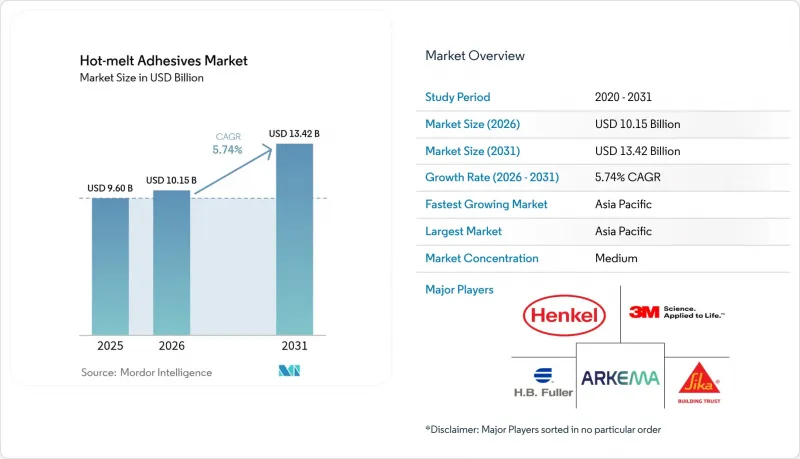
本報告按樹脂類型(乙烯-醋酸乙烯酯共聚物、苯乙烯嵌段共聚物及其他樹脂)、終端用戶行業(紙板及包裝、建築施工、電氣電子設備及其他終端用戶行業)和地區(亞太地區、北美地區、歐洲地區、南美地區以及中東和非洲地區)進行細分。市場預測以美元計價。
全球熱熔膠黏合劑趨勢及洞察
高速運作線中從溶劑型系統向熱熔系統的過渡。
該生產線採用「按需熔化」系統,消除了溶劑揮發,並在整個生產過程中保持穩定的黏度,從而將生產週期縮短了40-60%。 Robatech的Volta平台符合REACH和FDA食品接觸法規,同時降低了30%的能耗,是飲料多包裝和零食袋裝食品生產廠設備升級的典範。
亞洲電子商務履約中心的爆炸性成長正在推動對環保包裝黏合劑的需求。
預計到2024年,中國將處理超過1,300億小包裹,履約中心必須使用可在180天內分解的澱粉基熱熔膠,以減輕掩埋的負擔。印度和東南亞國協正在效仿,並要求瓦楞紙板生產商引入高速膠合機,以支援低溫生物複合工藝,從而防止瓦楞紙板即使在潮濕氣候下也發生翹曲。
Tackfire樹脂的價格波動與原油價格相關
C5和C9烴基黏合劑佔傳統配方的15-25%,在2024年能源危機期間價格波動幅度達30-40%。大型買家已簽訂多年供貨契約,而中小加工商則面臨利潤率下降或減少黏合劑用量的風險,並且在潮濕的運輸環境中存在粘合失效的風險。
細分市場分析
預計到2025年,EVA將佔據黏合劑市場59.10%的佔有率,並將以每年6.25%的速度成長至2031年。 EVA兼具柔軟性、黏合性和成本優勢,因此深受加工商青睞。此外,加工商沿著數十年的狹縫式和噴塗設備也抑制了他們轉向競爭對手產品的意願。同時,亞洲和北美豐富的原料資源也為該領域提供了緩衝,使其免受局部供應衝擊的影響。
隨著永續發展目標的日益提高,買家正轉向使用含65%可再生原料的茂金屬基聚烯,例如陶氏化學的「AFFINITY RE」。該產品在保持黏合強度的同時,可減少40-50%的碳足跡。熱塑性聚氨酯因其耐磨性(可承受10萬次彎曲循環)而在鞋類行業市場佔有率不斷成長。特種聚醯胺和聚醯亞胺具有EVA或SBC所不具備的高溫穩定性,適用於電子產品的灌封應用,但由於價格昂貴,其銷售量仍處於小眾市場。
區域分析
預計到2025年,亞太地區將佔據48.20%的市場佔有率,這主要得益於連接聚合物裂解裝置、黏合纖維反應器和大規模瓦楞紙板生產線的一體化供應鏈。中國的加工企業毗鄰行動電話和消費性電子工廠,透過確保黏合劑的即時供應,最大限度地減少了加熱槽的閒置時間。印度消費品產業的蓬勃發展推動了對全溫相容瓦楞紙封裝的需求,而東南亞則受益於印刷電路基板向精密噴塗製程的轉變。
北美買家優先考慮卓越性能和永續性。美國汽車製造商指定使用反應型聚烯,以便於拆解報廢車輛;加拿大則利用林業殘餘物作為原料,生產以妥爾油為基的黏合劑纖維,從而減少對石化燃料。墨西哥的加工廠(出口加工廠)正在擴大區域生產規模,增設家用電器組裝,這些電器需要使用耐熱衝擊黏合劑。
歐洲嚴格的VOC(揮發性有機化合物)法規正在加速從溶劑型層壓黏合劑轉向熔融型黏合劑的轉變。德國汽車製造商正在共同開發採用聚氨酯(PUR)的輕量化駕駛座模組,這些模組已通過碰撞脈衝測試。在英國,重點是可堆肥的袋封膠,以滿足市政垃圾管理目標;北歐公司正在利用生物煉製廠供應可再生蠟,從而減少二氧化碳排放。南美和中東及非洲(MEA)地區雖然發展落後,但也正在投資基礎設施隔熱包裝和消費品包裝材料。然而,外匯波動有時會抑制進口需求。
其他好處:
- Excel格式的市場預測(ME)表
- 3個月的分析師支持
目錄
第1章:引言
- 研究假設和市場定義
- 調查範圍
第2章:調查方法
第3章執行摘要
第4章 市場狀況
- 市場概覽
- 市場促進因素
- 運作包裝生產線中從溶劑型系統轉向熱熔系統的過渡。
- 亞洲電子商務履約中心的爆炸性成長,帶動了環保箱體密封黏合劑的需求增加。
- 生物基樹脂(大豆、妥爾油、澱粉)產能的激增,正在開闢一個新的高階細分市場。
- 家具和床墊生產的自動化正在推動對 PUR 和 MPO 熱熔膠的需求。
- 電動車減重和電池模組黏接要求
- 市場限制因素
- Tackfire樹脂的價格波動與原油價格相關
- 與結構環氧樹脂相比,其耐熱溫度範圍有其限制。
- 歐盟加強對傳統SBC增黏劑中VOC的監管
- 價值鏈分析
- 波特五力模型
第5章 市場規模與成長預測
- 依樹脂類型
- 乙烯-醋酸乙烯酯共聚物(EVA)
- 苯乙烯基嵌段共聚物(SBC)
- 熱塑性聚氨酯(TPU)
- 其他樹脂類型
- 按最終用戶行業分類
- 紙張、紙板、包裝
- 建築/施工
- 木工和細木工
- 汽車和運輸業
- 鞋類和皮革
- 衛生保健
- 電氣和電子設備
- 其他終端用戶產業
- 按地區
- 亞太地區
- 中國
- 印度
- 日本
- 韓國
- 東南亞國協
- 其他亞太國家
- 北美洲
- 美國
- 加拿大
- 墨西哥
- 歐洲
- 德國
- 英國
- 法國
- 義大利
- 俄羅斯
- 北歐國家
- 其他歐洲國家
- 南美洲
- 巴西
- 阿根廷
- 其他南美國家
- 中東和非洲
- 沙烏地阿拉伯
- 南非
- 其他中東和非洲國家
- 亞太地區
第6章 競爭情勢
- 市場集中度
- 策略趨勢
- 市佔率和排名分析
- 公司簡介
- 3M
- Arkema
- Ashland
- Avery Dennison Corporation
- Daubert Chemical Company
- Dow
- Franklin International
- HB Fuller Company
- Henkel AG & Co. KGaA
- Hexcel Corporation
- Huntsman
- Jowat Corporation
- KLEIBERIT SE & Co. KG
- NANPAO RESINS CHEMICAL GROUP
- Paramelt BV
- Pidilite Industries Limited
- Power Adhesives Ltd.
- Sika AG
第7章 市場機會與未來展望
According to Mordor Intelligence, the hot-melt adhesives market size was valued at USD 9.60 billion in 2025 and estimated to grow from USD 10.15 billion in 2026 to reach USD 13.42 billion by 2031, at a CAGR of 5.74% during the forecast period (2026-2031).
This report is Segmented by Resin Type (Ethylene-Vinyl Acetate, Styrenic Block Copolymers, and Other Resin Types), End-User Industry (Paper Board and Packaging, Building and Construction, Electrical and Electronic Appliances, Other End-User Industries), and Geography (Asia-Pacific, North America, Europe, South America, and Middle East and Africa). The Market Forecasts are Provided in Terms of Value (USD).
Global Hot-melt Adhesives Market Trends and Insights
Shift from Solvent-Borne to Hot-Melt Systems in Fast-Moving Packaging Lines
Production lines have cut cycle times by 40-60% by eliminating solvent flash-off and adopting melt-on-demand units that keep viscosity stable for entire shifts. Robatech's Volta platform trims energy draw by 30% while meeting REACH and FDA food-contact rules, making it a template for upgrades across beverage multipack and snack pouch plants.
Explosive Growth of Asian E-Commerce Fulfilment Hubs Demanding Eco-Friendly Case-Sealing Adhesives
China processed more than 130 billion parcels in 2024, and fulfilment centers specify starch-based hot melts that compost within 180 days, curbing landfill loads. India and ASEAN follow, pushing corrugators to install high-speed gluers compatible with low-temperature bio-formulations that prevent board warping in humid climates.
Crude-Oil-Linked Price Volatility of Tackifier Resins
C5 and C9 hydrocarbon tackifiers make up 15-25% of conventional formulations and saw 30-40% price swings during 2024 energy shocks. Large buyers secure multi-year supply contracts; smaller converters absorb margin squeeze or reduce adhesive load rates, risking bond failure in humid transit environments.
Other drivers and restraints analyzed in the detailed report include:
- Surge in Bio-Based Resin Capacity (Soy, Tall-Oil, Starch) Unlocking New Premium Niches
- Automation of Furniture and Mattress Production Driving PUR and MPO Hot-Melts
- Limited Heat-Resistance Window Versus Structural Epoxies
For complete list of drivers and restraints, kindly check the Table Of Contents.
Segment Analysis
EVA accounted for 59.10% of the hot melt adhesives market size in 2025 and is forecast to compound at 6.25% annually to 2031. Its balance of flexibility, adhesion, and cost keeps converters loyal, and decades of installed slot-die and spray equipment dampen switching incentives. The segment also benefits from a deep feedstock base in Asia and North America that cushions against isolated supply shocks.
Heightened sustainability goals push buyers toward metallocene polyolefins with 65% renewable content, such as Dow's AFFINITY RE, which cuts carbon footprint by 40-50% while matching bond strength. Thermoplastic polyurethane captures share in footwear, offering abrasion resistance that withstands 100,000 flex cycles. Specialty polyamides and polyimides cater to electronics potting, leveraging high-temperature stability that EVA and SBC cannot match, but volumes remain niche due to price premiums.
Complete Report Scope:
- By Resin Type
- Ethylene-Vinyl Acetate (EVA)
- Styrenic Block Copolymers (SBC)
- Thermoplastic Polyurethane (TPU)
- Other Resin Types
- By End-user Industry
- Paper, Board, and Packaging
- Building and Construction
- Woodworking and Joinery
- Automotive and Transportation
- Footwear and Leather
- Healthcare
- Electrical and Electronic Appliances
- Other End-User Industries
- By Geography
- Asia-Pacific
- China
- India
- Japan
- South Korea
- ASEAN Countries
- Rest of Asia-Pacific
- North America
- United States
- Canada
- Mexico
- Europe
- Germany
- United Kingdom
- France
- Italy
- Russia
- NORDIC Countries
- Rest of Europe
- South America
- Brazil
- Argentina
- Rest of South America
- Middle East and Africa
- Saudi Arabia
- South Africa
- Rest of Middle East and Africa
- Asia-Pacific
Geography Analysis
Asia-Pacific's 48.20% dominance in 2025 stems from integrated supply corridors linking polymer crackers, tackifier reactors, and high-volume corrugators. Chinese converters sit adjacent to cell phone and appliance plants, ensuring just-in-time adhesive deliveries that minimize heated-tank idle time. India's consumer-goods boom lifts demand for all-temperature carton sealing, and Southeast Asia benefits from printed-circuit board migration that needs precision jetting.
North American buyers prioritize premium performance and sustainability. U.S. automakers specify reactive polyolefins that permit end-of-life dismantling, while Canadian forestry residuals feed tall-oil tackifier streams that lower fossil intensity. Mexico's maquiladoras amplify regional volumes with appliance assembly lines that require thermal-shock-resistant bonds.
Europe's stringent VOC caps accelerate substitution of solvented laminating adhesives with melt-based grades. German vehicle makers co-develop lightweight cockpit modules using PUR that passes crash pulse tests. The United Kingdom focuses on compostable bag seals to meet municipal waste targets, and Nordic players leverage bio-refineries to supply renewable waxes that trim CO2 footprints. South America and MEA trail but invest in infrastructure insulation and consumer goods packaging, though currency volatility periodically tempers import demand.
- 3M
- Arkema
- Ashland
- Avery Dennison Corporation
- Daubert Chemical Company
- Dow
- Franklin International
- H.B. Fuller Company
- Henkel AG & Co. KGaA
- Hexcel Corporation
- Huntsman
- Jowat Corporation
- KLEIBERIT SE & Co. KG
- NANPAO RESINS CHEMICAL GROUP
- Paramelt B.V.
- Pidilite Industries Limited
- Power Adhesives Ltd.
- Sika AG
Additional Benefits:
- The market estimate (ME) sheet in Excel format
- 3 months of analyst support
TABLE OF CONTENTS
1 Introduction
- 1.1 Study Assumptions and Market Definition
- 1.2 Scope of the Study
2 Research Methodology
3 Executive Summary
4 Market Landscape
- 4.1 Market Overview
- 4.2 Market Drivers
- 4.2.1 Shift From Solvent-Borne to Hot-Melt Systems in Fast-Moving Packaging Lines
- 4.2.2 Explosive Growth of Asian E-Commerce Fulfilment Hubs Demanding Eco-Friendly Case-Sealing Adhesives
- 4.2.3 Surge in Bio-Based Resin Capacity (Soy, Tall-Oil, Starch) Unlocking New Premium Niches
- 4.2.4 Automation of Furniture and Mattress Production Driving PUR And MPO Hot-Melts
- 4.2.5 EV Lightweighting and Battery Module Bonding Requirements
- 4.3 Market Restraints
- 4.3.1 Crude-Oil-Linked Price Volatility of Tackifier Resins
- 4.3.2 Limited Heat-Resistance Window Versus Structural Epoxies
- 4.3.3 Growing VOC Scrutiny on Traditional SBC Tackifiers In EU
- 4.4 Value Chain Analysis
- 4.5 Porter's Five Forces
- 4.5.1 Bargaining Power of Suppliers
- 4.5.2 Bargaining Power of Buyers
- 4.5.3 Threat of New Entrants
- 4.5.4 Threat of Substitutes
- 4.5.5 Competitive Rivalry
5 Market Size and Growth Forecasts (Value)
- 5.1 By Resin Type
- 5.1.1 Ethylene-Vinyl Acetate (EVA)
- 5.1.2 Styrenic Block Copolymers (SBC)
- 5.1.3 Thermoplastic Polyurethane (TPU)
- 5.1.4 Other Resin Types
- 5.2 By End-user Industry
- 5.2.1 Paper, Board, and Packaging
- 5.2.2 Building and Construction
- 5.2.3 Woodworking and Joinery
- 5.2.4 Automotive and Transportation
- 5.2.5 Footwear and Leather
- 5.2.6 Healthcare
- 5.2.7 Electrical and Electronic Appliances
- 5.2.8 Other End-User Industries
- 5.3 By Geography
- 5.3.1 Asia-Pacific
- 5.3.1.1 China
- 5.3.1.2 India
- 5.3.1.3 Japan
- 5.3.1.4 South Korea
- 5.3.1.5 ASEAN Countries
- 5.3.1.6 Rest of Asia-Pacific
- 5.3.2 North America
- 5.3.2.1 United States
- 5.3.2.2 Canada
- 5.3.2.3 Mexico
- 5.3.3 Europe
- 5.3.3.1 Germany
- 5.3.3.2 United Kingdom
- 5.3.3.3 France
- 5.3.3.4 Italy
- 5.3.3.5 Russia
- 5.3.3.6 NORDIC Countries
- 5.3.3.7 Rest of Europe
- 5.3.4 South America
- 5.3.4.1 Brazil
- 5.3.4.2 Argentina
- 5.3.4.3 Rest of South America
- 5.3.5 Middle East and Africa
- 5.3.5.1 Saudi Arabia
- 5.3.5.2 South Africa
- 5.3.5.3 Rest of Middle East and Africa
- 5.3.1 Asia-Pacific
6 Competitive Landscape
- 6.1 Market Concentration
- 6.2 Strategic Moves
- 6.3 Market Share (%)/Ranking Analysis
- 6.4 Company Profiles (includes Global level Overview, Market level overview, Core Segments, Financials as available, Strategic Information, Market Rank/Share, Products and Services, Recent Developments)
- 6.4.1 3M
- 6.4.2 Arkema
- 6.4.3 Ashland
- 6.4.4 Avery Dennison Corporation
- 6.4.5 Daubert Chemical Company
- 6.4.6 Dow
- 6.4.7 Franklin International
- 6.4.8 H.B. Fuller Company
- 6.4.9 Henkel AG & Co. KGaA
- 6.4.10 Hexcel Corporation
- 6.4.11 Huntsman
- 6.4.12 Jowat Corporation
- 6.4.13 KLEIBERIT SE & Co. KG
- 6.4.14 NANPAO RESINS CHEMICAL GROUP
- 6.4.15 Paramelt B.V.
- 6.4.16 Pidilite Industries Limited
- 6.4.17 Power Adhesives Ltd.
- 6.4.18 Sika AG
7 Market Opportunities and Future Outlook
- 7.1 White-space and Unmet-need Assessment

 聚酯基熱熔膠:市場佔有率分析、行業趨勢和統計數據以及成長預測(黏合劑年)
 結構膠帶市場:全球市場預測,2026-2032年
 熱熔膠黏合劑報告:趨勢、預測與競爭分析(至2035年)聚氨酯(PU)熱熔膠:市場佔有率分析、行業趨勢和統計數據以及成長黏合劑(2026-2031)熱熔膠市場:依技術、形態、黏合機制、溫度類型、終端應用產業和分銷管道分類-2026 - 2032年全球市場預測熱熔膠帶市場:按產品類型、黏合劑樹脂類型、厚度、應用和分銷管道分類-全球預測,2026-2032年熱熔膠市場:依產品、原料、應用、最終用途、國家及地區黏合劑-全球產業分析、市場規模、市場佔有率及2026年至2033年預測
 熱熔膠市場規模、佔有率和成長分析:按材料(基體樹脂)、產品形式、最終用途產業、分銷管道和地區分類-2026 - 2033年產業預測
 熱熔膠市場規模、佔有率和趨勢分析報告:按產品、原料、應用、地區和細分市場黏合劑(2026-2033 年)聚酯熱熔膠市場規模、佔有率和趨勢分析報告:按黏合劑、地區和細分市場預測(2026-2033 年)