


 |
市場調查報告書
商品編碼
2113325
聚氨酯(PU)熱熔膠:市場佔有率分析、行業趨勢和統計數據以及成長黏合劑(2026-2031)Polyurethane (PU) Hot-melt Adhesive - Market Share Analysis, Industry Trends & Statistics, Growth Forecasts (2026 - 2031) |
||||||

※ 本網頁內容可能與最新版本有所差異。詳細情況請與我們聯繫。
據 Mordor Intelligence 稱,聚氨酯黏合劑市場預計到 2026 年價值 21.2 億美元,高於 2025 年的 19.7 億美元,預計到 2031 年將達到 30.3 億美元。
預計從 2026 年到 2031 年,其複合年成長率將達到 7.43%。
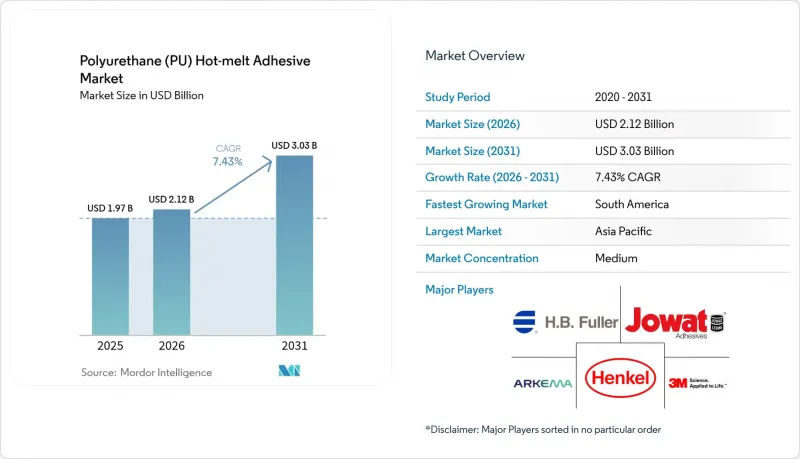
本報告按類型(反應型、非反應型)、應用領域(紙張、紙板、包裝、電子電氣、汽車、家具及木工、鞋類、醫療保健、紡織品、書籍裝訂及其他)和地區(亞太地區、北美地區、歐洲地區、南美地區、中東和非洲)進行細分。市場預測以美元計價。
全球聚氨酯(PU)熱熔膠黏合劑趨勢及洞察
電子商務自動化正在推動對包裝箱封口的需求。
自動化履約中心全天候運作,需要使用能夠提供即時初始黏合強度的黏合劑,以便在幾秒鐘內將紙板轉移到下游工序,避免生產線黏合劑或重新封膠。反應型聚氨酯熱熔膠的性能優於乙烯-醋酸乙烯酯共聚物 (EVA) 黏合劑,因為它在更寬的溫度範圍內保持了固有強度,即使在非恆溫物流中心也能確保穩定的密封效果。其均勻的黏度也使其適用於「按需熔化」分配器,避免了儲罐燒焦並減少了清潔停機時間。這是高速裝箱系統整合商重點關注的關鍵指標。隨著物流營運商維修現有生產線以適應不斷成長的 SKU 並保持當前的人事費用,諾信公司報告稱其「即插即用」熔膠機系列的訂單實現了兩位數的成長。由於許多小包裹現在都要經過輸送機加速、自動分離和機器人分揀,黏合劑必須能夠承受反覆的動態負荷,否則傳統的熔膠很容易被剝離。因此,每當電子商務倉庫增加新的分類通道或實施能夠檢測即使是輕微密封缺陷的物聯網品質監控系統時,聚氨酯黏合劑市場都會受益。
低溫PUR黏合劑是電子設備小型化的關鍵材料。
行動電話製造商、穿戴式裝置專家以及汽車產業的一級供應商擴大設計間隙小於1毫米的組件,而傳統黏合劑無法承受160 度C或更高的應用溫度。新型聚氨酯熱熔膠的流動溫度為100-120 度C,可避免細間距球柵陣列(BGA)中的焊料疲勞,並透過交聯和熱循環保持其耐久性。折疊式顯示器和軟性印刷電路板在反覆彎曲過程中會承受剪切應力和剝離應力,但聚氨酯的斷裂伸長率比環氧樹脂或丙烯酸類產品更能滿足疲勞需求。 5G天線的設備機殼也需要透過電磁相容性(EMC)測試。目前,特殊的聚氨酯熱熔膠(PUR 黏合劑)採用片狀導電填料,可在不增加重量的情況下提供局部屏蔽。在醫療用電子設備,由於需要進行伽馬射線輻照和高壓釜滅菌等消毒循環,聚氨酯是一種極具吸引力的材料,因為它能抵抗水解劣化並保持粘合表面的完整性。隨著邊緣運算模組在各個產品類型中的廣泛應用,聚氨酯黏合劑市場在各個需要外形規格和溫度控管的細分領域都找到了新的需求。
MDI和TDI之間的價格波動給利潤率帶來了壓力。
2023年至2025年間,由於美國生產停工和中國貿易措施導致的供應中斷,迫使買家轉向現貨市場,造成MDI價格波動高達45%。小規模的黏合劑加工商由於缺乏長期契約,難以將這些價格上漲轉嫁給受年度價格表約束的包裝和木工客戶。陶氏化學在德克薩斯州投資5億美元的擴建計畫已於2024年底運作,但由於物流限制和生產擴張試運行階段,預計改善將是一個漸進的過程。此外,美元外匯波動進一步削弱了巴西和印度化合物生產商的購買力,這些生產商的合約以該地貨幣計價。這些因素疊加起來可能會擠壓毛利率,可能會推遲對新混煉生產線的投資,並暫時減緩聚氨酯黏合劑市場的成長動能。
細分市場分析
預計到2025年,反應型樹脂將持續保持主導地位,佔據全球市場62.12%的佔有率。這是因為水分引發的交聯反應賦予了反應型樹脂熱塑性樹脂所不具備的耐熱性、耐濕性和耐化學性。目前,領先的供應商正在添加矽烷基清除劑,以抑制點膠過程中游離異氰酸酯的釋放,從而在不影響性能的前提下,滿足新的歐洲職場暴露標準。非反應型樹脂的複合年成長率預計將達到7.89%,這表明即使在瓦楞紙箱封口和纖維複合等對永久粘合要求不高的領域,可重複使用性和可回收性也至關重要。
在這兩大類別中,對混合化學技術的投資正在模糊即時黏合和延遲固化之間的界線。漢高銷售的微量釋放反應型聚氨酯黏合劑,在24小時後即可達到超過10 MPa的拉伸剪切強度,同時將單體二異氰酸酯含量保持在0.1%以下。同時,配方研發人員正在開發具有快速結晶特性的熱塑性聚氨酯共混物,使其在完全濕氣固化前即可達到接近生產線的速度。這種創新動能確保聚氨酯黏合劑市場將繼續專注於研發,力求在性能的兩端都達到最佳狀態。
區域分析
預計到2025年,亞太地區將佔全球銷售額的45.78%。這主要得益於中國移動設備出口和印度汽車組裝對反應型聚氨酯(PUR)預聚物的高需求。在日本成熟的醫療設備生態系中,用於微導管和成像探針的低黏度、超高純度PUR黏合劑享有高價。在韓國,低拉絲PUR熱熔膠被廣泛應用於儲存晶片製造廠的底部填充和蓋板黏合製程中,即使在經濟低迷時期也能支撐其消費。
在北美,瓦楞紙包裝和家具製造業對熱熔膠設備的需求依然強勁。該地區嚴格的揮發性有機化合物(VOC)法規推動了符合LEED(能源與環境設計先鋒獎)室內空氣品質標準的低排放量聚氨酯(PUR)膠棒的普及,使得聚氨酯黏合劑市場能夠保持其相對於混合型熱熔膠產品的市場佔有率。墨西哥的近岸外包趨勢正促使家電供應商複製亞洲的生產線,這些生產線同樣需要低溫塗覆的聚氨酯配方。
歐洲憑藉在永續性的領先地位,與其他地區形成差異化優勢。黏合劑買家通常要求揭露「從搖籃到大門」的碳足跡,這促使聚氨酯(PUR)供應商通過獨立檢測機構獲得生物基含量認證。德國和西班牙的汽車產業叢集正在指定使用與聚丙烯內裝基材相容的黏合劑,以促進單一材料回收。南美洲的複合年成長率(CAGR)最高,達7.67%。這是因為巴西的建築業和食品加工廠完全跳過了溶劑型體系,直接轉向聚氨酯(PUR),以滿足出口市場的安全標準。儘管宏觀經濟存在波動,但這些趨勢確保了聚氨酯黏合劑市場在地理上保持多元化,並充滿機會。
其他好處
- Excel格式的市場預測(ME)表
- 3個月的分析師支持
目錄
第1章:引言
- 研究假設和市場定義
- 調查範圍
第2章:調查方法
第3章執行摘要
第4章 市場狀況
- 市場概覽
- 市場促進因素
- 電子商務的自動化正在推動包裝封條的需求增加。
- 低溫PUR HMA是電子設備小型化所必需的。
- 揮發性有機化合物引發了人們對溶劑型黏合劑的摒棄。
- 輕量化汽車和模組化內飾
- 生物基多元醇獲得永續性認證。
- 市場限制因素
- MDI和TDI價格的波動給利潤率帶來了壓力。
- 加強對接觸遊離異氰酸酯的監管
- 特殊低黏度反應膠供不應求
- 價值鏈分析
- 波特五力模型
第5章 市場規模與成長預測
- 按類型
- 反應性
- 無回應
- 透過使用
- 紙張、紙板、包裝
- 電子與電機工程
- 車
- 家具和木工
- 鞋類
- 衛生保健
- 紡織品
- 書籍裝訂
- 其他
- 按地區
- 亞太地區
- 中國
- 印度
- 日本
- 韓國
- 其他亞太國家
- 北美洲
- 美國
- 加拿大
- 墨西哥
- 歐洲
- 德國
- 英國
- 法國
- 義大利
- 俄羅斯
- 其他歐洲國家
- 南美洲
- 巴西
- 阿根廷
- 其他南美國家
- 中東和非洲
- 沙烏地阿拉伯
- 南非
- 其他中東和非洲國家
- 亞太地區
第6章 競爭情勢
- 市場集中度
- 策略趨勢
- 市佔率和排名分析
- 公司簡介
- 3M
- Arkema
- BASF
- BC Adhesives
- Chemence
- Collano Adhesives
- DIC CORPORATION
- Franklin International
- HB Fuller Company
- Henkel Corporation
- HRANIPEX Czech Republic ks
- Huntsman
- IFS Industries Inc.
- Jowat SE
- KLEIBERIT SE & Co. KG
- Sika AG
- Tex Year Industries Inc.
- Toyo-Morton
第7章 市場機會與未來展望
According to Mordor Intelligence, polyurethane hot-melt adhesive market size in 2026 is estimated at USD 2.12 billion, growing from 2025 value of USD 1.97 billion with 2031 projections showing USD 3.03 billion, growing at 7.43% CAGR over 2026-2031.
This report is Segmented by Type (Reactive and Non-Reactive), Application (Paper Board and Packaging, Electronics and Electrical, Automotive, Furniture and Woodworking, Footwear, Healthcare, Textiles, Bookbinding, and Other Applications), and Geography (Asia-Pacific, North America, Europe, South America, and Middle East and Africa). The Market Forecasts are Provided in Terms of Value (USD).
Global Polyurethane (PU) Hot-melt Adhesive Market Trends and Insights
E-commerce Automation Boosting Case-Sealing Demand
Automated fulfillment centers operate around the clock and require adhesives that develop instant green strength so cartons can be moved downstream within seconds without causing line stoppages or tape rework. Reactive polyurethane hot melts outperform ethylene-vinyl acetate (EVA) grades by retaining cohesive strength across a wider temperature envelope, enabling consistent seals even in unconditioned distribution hubs. Uniform viscosity also facilitates melt-on-demand dispensing equipment, which eliminates tank charring and reduces downtime for cleaning, a top metric tracked by integrators of high-speed case packers. Nordson has reported double-digit order growth for its plug-and-play melter series as logistics operators retrofit legacy lines to handle SKU proliferation while keeping labor inputs flat. Because many parcels now encounter conveyor acceleration, automated singulation, and robotic sortation, adhesives must withstand repetitive dynamic loads that can easily peel traditional hot melts. Therefore, the polyurethane hot melt adhesives market benefits each time an e-commerce warehouse adds new sort lanes or adopts IoT-enabled quality monitoring that flags even minor seal failures.
Electronics Miniaturization Requires Low-Temperature PUR HMAs
Handset makers, wearables specialists, and automotive Tier 1 suppliers increasingly design assemblies with sub-millimeter gaps that cannot tolerate the 160 °C-plus application temperatures associated with legacy hot melts. Newly formulated polyurethane grades flow at 100-120 °C, avoiding solder fatigue on fine-pitch ball-grid arrays while still crosslinking to provide permanence through thermal cycling. Foldable displays and flexible printed circuits generate shear and peel stresses during repeated bends, and polyurethane's elongation at break satisfies that fatigue requirement better than epoxy or acrylic solutions. Device cabins that house 5G antennas must also meet electromagnetic compatibility tests; specialty PUR HMAs (Polyurethane Hot Melt Adhesives) now incorporate plate-like conductive fillers that create local shielding without adding weight. In medical electronics, sterilization via gamma irradiation or autoclave cycles makes polyurethane attractive because it resists hydrolytic degradation and retains bond line integrity. With edge-computing modules proliferating in every product category, the polyurethane hot melt adhesives market finds fresh outlets wherever small form factors and heat management converge.
MDI/TDI Price Volatility Squeezes Margins
Prices for MDI swung 45% between 2023 and 2025 as outages in the United States and trade actions in China disrupted flows and pushed buyers into the spot market. Smaller adhesive converters without long-term contracts struggle to pass through such spikes to packaging or woodworking customers bound by annual price lists. Dow's USD 500 million expansion in Texas came online in late 2024, yet logistical constraints and commissioning ramp-ups mean relief will phase in gradually. Currency fluctuations against the US dollar further eroded purchasing power for Brazil and India formulators, denominated in local contracts. The net effect trims gross margins and can delay capex for new blending lines, temporarily muting growth trajectories in the polyurethane hot melt adhesives market.
Other drivers and restraints analyzed in the detailed report include:
- VOC-Driven Shift Away from Solvent-Borne Adhesives
- Automotive Lightweighting and Modular Interiors
- Stricter Free-Isocyanate Exposure Regulations
For complete list of drivers and restraints, kindly check the Table Of Contents.
Segment Analysis
In 2025, reactive grades commanded 62.12% of worldwide value, a leadership position they will maintain because their moisture-induced crosslinking locks in heat, moisture, and chemical resistance unattainable with thermoplastic analogs. Market-leading suppliers now add silane scavengers that curb free-isocyanate release during dispensing, satisfying new European workplace thresholds without eroding performance. Non-reactive variants are forecast to record a 7.89% CAGR, illustrating that repositionability and recyclability also matter in sectors such as corrugated-case sealing or textile lamination, where permanent bonds are not mandatory.
Across both categories, investments in hybrid chemistries blur lines between instant tack and deferred cure. Henkel markets micro-emission reactive PUR HMAs that keep monomeric di-isocyanate below 0.1% yet achieve tensile shear greater than 10 MPa after 24 hours. Concurrently, formulators develop thermoplastic PUR blends with rapid crystallization that permit near-line-speed handling before complete moisture cure. Such innovation dynamics assure that the polyurethane hot melt adhesives market will continue funneling R&D into both performance extremes.
Complete Report Scope:
- By Type
- Reactive
- Non-Reactive
- By Application
- Paper, Board, and Packaging
- Electronics and Electrical
- Automotive
- Furniture and Woodworking
- Footwear
- Healthcare
- Textiles
- Bookbinding
- Other Applications
- By Geography
- Asia-Pacific
- China
- India
- Japan
- South Korea
- Rest of Asia-Pacific
- North America
- United States
- Canada
- Mexico
- Europe
- Germany
- United Kingdom
- France
- Italy
- Russia
- Rest of Europe
- South America
- Brazil
- Argentina
- Rest of South America
- Middle East and Africa
- Saudi Arabia
- South Africa
- Rest of Middle East and Africa
- Asia-Pacific
Geography Analysis
Asia-Pacific generated 45.78% of global turnover in 2025 as China's handheld device exports and India's auto assembly lines pulled tanker volumes of reactive PUR prepolymers. Japan's mature medical-device ecosystem commands premium pricing for low-viscosity, ultra-pure grades that flow into micro-catheters and imaging probes. South Korea's memory-chip fabs lean on low-stringing PUR HMAs for under-fill and lid-attach processes, bolstering consumption even during cyclical downturns.
North America maintains a large installed base of hot-melt equipment in corrugated packaging and furniture manufacturing. The region's tight VOC regulations favor micro-emission PUR sticks that achieve LEED (Leadership in Energy and Environmental Design) indoor-air benchmarks, helping the polyurethane hot melt adhesives market defend share against hybrid hot melts. Mexico's near-shoring wave encourages consumer-electronics suppliers to replicate Asian production lines, requiring the same low-application-temperature PUR formulas.
Europe differentiates itself through sustainability leadership. Adhesive buyers often request full cradle-to-gate carbon footprints, prompting PUR suppliers to certify bio-based content through independent labs. Automotive clusters in Germany and Spain specify adhesives compatible with polypropylene interior substrates to facilitate single-material recycling. South America exhibits the fastest regional CAGR at 7.67% because Brazilian construction and packaged-food plants are skipping solvent systems altogether and leaping straight to PUR to meet export-market safety codes. Even with macroeconomic volatility, these dynamics guarantee that the polyurethane hot melt adhesives market remains geographically diversified and opportunity-rich.
- 3M
- Arkema
- BASF
- BC Adhesives
- Chemence
- Collano Adhesives
- DIC CORPORATION
- Franklin International
- H.B. Fuller Company
- Henkel Corporation
- HRANIPEX Czech Republic k.s.
- Huntsman
- IFS Industries Inc.
- Jowat SE
- KLEIBERIT SE & Co. KG
- Sika AG
- Tex Year Industries Inc.
- Toyo-Morton
Additional Benefits:
- The market estimate (ME) sheet in Excel format
- 3 months of analyst support
TABLE OF CONTENTS
1 Introduction
- 1.1 Study Assumptions and Market Definition
- 1.2 Scope of the Study
2 Research Methodology
3 Executive Summary
4 Market Landscape
- 4.1 Market Overview
- 4.2 Market Drivers
- 4.2.1 E-commerce automation boosting case-sealing demand
- 4.2.2 Electronics miniaturization requires low-temp PUR HMAs
- 4.2.3 VOC-driven shift away from solvent-borne adhesives
- 4.2.4 Automotive lightweighting and modular interiors
- 4.2.5 Bio-based polyols win sustainability labels
- 4.3 Market Restraints
- 4.3.1 MDI/TDI price volatility squeezes margins
- 4.3.2 Stricter free-isocyanate exposure regulations
- 4.3.3 Scarcity of specialty low-viscosity reactive tackifiers
- 4.4 Value Chain Analysis
- 4.5 Porter's Five Forces
- 4.5.1 Bargaining Power of Suppliers
- 4.5.2 Bargaining Power of Buyers
- 4.5.3 Threat of New Entrants
- 4.5.4 Threat of Substitutes
- 4.5.5 Degree of Competition
5 Market Size and Growth Forecasts (Value)
- 5.1 By Type
- 5.1.1 Reactive
- 5.1.2 Non-Reactive
- 5.2 By Application
- 5.2.1 Paper, Board, and Packaging
- 5.2.2 Electronics and Electrical
- 5.2.3 Automotive
- 5.2.4 Furniture and Woodworking
- 5.2.5 Footwear
- 5.2.6 Healthcare
- 5.2.7 Textiles
- 5.2.8 Bookbinding
- 5.2.9 Other Applications
- 5.3 By Geography
- 5.3.1 Asia-Pacific
- 5.3.1.1 China
- 5.3.1.2 India
- 5.3.1.3 Japan
- 5.3.1.4 South Korea
- 5.3.1.5 Rest of Asia-Pacific
- 5.3.2 North America
- 5.3.2.1 United States
- 5.3.2.2 Canada
- 5.3.2.3 Mexico
- 5.3.3 Europe
- 5.3.3.1 Germany
- 5.3.3.2 United Kingdom
- 5.3.3.3 France
- 5.3.3.4 Italy
- 5.3.3.5 Russia
- 5.3.3.6 Rest of Europe
- 5.3.4 South America
- 5.3.4.1 Brazil
- 5.3.4.2 Argentina
- 5.3.4.3 Rest of South America
- 5.3.5 Middle East and Africa
- 5.3.5.1 Saudi Arabia
- 5.3.5.2 South Africa
- 5.3.5.3 Rest of Middle East and Africa
- 5.3.1 Asia-Pacific
6 Competitive Landscape
- 6.1 Market Concentration
- 6.2 Strategic Moves
- 6.3 Market Share (%)/Ranking Analysis
- 6.4 Company Profiles (includes Global level Overview, Market level overview, Core Segments, Financials as available, Strategic Information, Market Rank/Share for key companies, Products and Services, and Recent Developments)
- 6.4.1 3M
- 6.4.2 Arkema
- 6.4.3 BASF
- 6.4.4 BC Adhesives
- 6.4.5 Chemence
- 6.4.6 Collano Adhesives
- 6.4.7 DIC CORPORATION
- 6.4.8 Franklin International
- 6.4.9 H.B. Fuller Company
- 6.4.10 Henkel Corporation
- 6.4.11 HRANIPEX Czech Republic k.s.
- 6.4.12 Huntsman
- 6.4.13 IFS Industries Inc.
- 6.4.14 Jowat SE
- 6.4.15 KLEIBERIT SE & Co. KG
- 6.4.16 Sika AG
- 6.4.17 Tex Year Industries Inc.
- 6.4.18 Toyo-Morton
7 Market Opportunities and Future Outlook
- 7.1 White-space and Unmet-Need Assessment

 聚酯基熱熔膠:市場佔有率分析、行業趨勢和統計數據以及成長預測(黏合劑年)
 結構膠帶市場:全球市場預測,2026-2032年
 熱熔膠黏合劑報告:趨勢、預測與競爭分析(至2035年)黏合劑:市場佔有率分析、產業趨勢與統計、成長預測(2026-2031)熱熔膠市場:依技術、形態、黏合機制、溫度類型、終端應用產業和分銷管道分類-2026 - 2032年全球市場預測熱熔膠帶市場:按產品類型、黏合劑樹脂類型、厚度、應用和分銷管道分類-全球預測,2026-2032年熱熔膠市場:依產品、原料、應用、最終用途、國家及地區黏合劑-全球產業分析、市場規模、市場佔有率及2026年至2033年預測
 熱熔膠市場規模、佔有率和成長分析:按材料(基體樹脂)、產品形式、最終用途產業、分銷管道和地區分類-2026 - 2033年產業預測
 熱熔膠市場規模、佔有率和趨勢分析報告:按產品、原料、應用、地區和細分市場黏合劑(2026-2033 年)聚酯熱熔膠市場規模、佔有率和趨勢分析報告:按黏合劑、地區和細分市場預測(2026-2033 年)