


 |
市場調查報告書
商品編碼
2115137
印度微灌系統:市場佔有率分析、行業趨勢和統計數據以及成長預測(2026-2031 年)India Micro Irrigation Systems - Market Share Analysis, Industry Trends & Statistics, Growth Forecasts (2026 - 2031) |
||||||

※ 本網頁內容可能與最新版本有所差異。詳細情況請與我們聯繫。
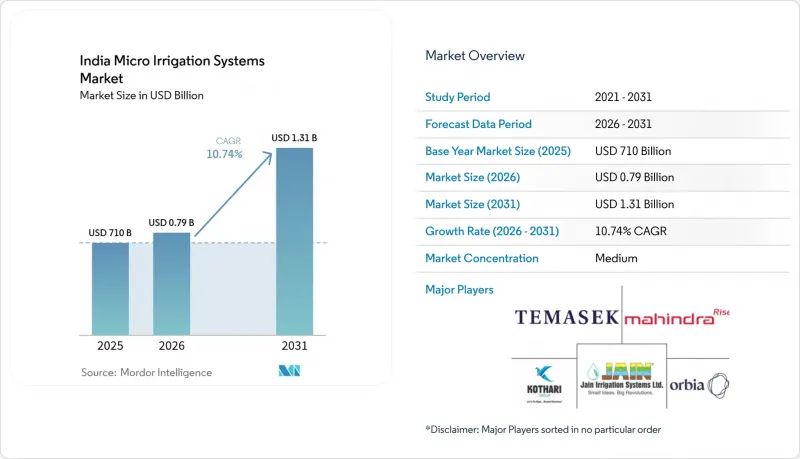
據 Mordor Intelligence 稱,印度微灌系統市場預計到 2026 年價值 7.8625 億美元,高於 2025 年的 7.1 億美元,預計到 2031 年將達到 13.1 億美元。
預計 2026 年至 2031 年的複合年成長率為 10.74%。
本報告按灌溉方式(例如滴灌系統)、應用領域(例如田間作物、蔬菜、種植作物)、最終用戶(例如露天農場、溫室、垂直農場)和邦/州(例如拉賈斯坦邦、馬哈拉斯特拉邦、安得拉邦、古吉拉突邦、古吉拉特邦、泰米爾納德邦、中央邦)進行細分。市場預測以美元計價。
印度微灌系統市場趨勢與洞察。
政府補貼正在擴大微灌技術的應用。
2025-2026財政年度聯邦預算將農業撥款增加至211億美元(1.75兆印度盧比)。微灌基金批准了5.69億美元(472.474兆印度盧比)的低利率貸款,各邦正利用這些資金補貼50%至95%的設備成本。內閣批准的「灌溉區開發和水資源管理現代化」計畫為加壓管道網路追加了1.92億美元(1600兆印度盧比)的投資,減少了25%的水損。在「滴水增產」舉措下的示範田中,節水率達50%至90%,鼓勵其他農民採用此技術。透過綜合運用這些財政措施,高價值作物的投資回收期縮短至不到三個種植季,從而擴大了印度微灌系統的市場。
印度中西部地區地下水壓力日益加劇
由於每年約有2,300億立方公尺的水被抽取,地下水位正以每年1.5公分的速度下降,流入孟加拉灣的河川流量也以每秒1,200立方公尺的速度減少。儘管馬哈拉斯特拉邦擁有印度最高的堤防密度,但其灌溉農田僅佔18%,這暴露出供需之間存在巨大缺口。旁遮普邦禁止種植耗水量大的雜交水稻等政策措施,凸顯了全國範圍內向高效灌溉轉型的必要性。在地下水嚴重枯竭的地區,農民現在將精準灌溉視為應對禁水令風險的保障,這推動了印度微灌系統市場的擴張。
前期實施成本高
一套完整的滴灌系統成本從361萬美元到36.1萬美元(3萬到300萬印度盧比)不等,具體價格取決於耕地面積和自動化程度。對於擁有不到2公頃土地的86%的農民來說,這是一筆不小的負擔。即使有50%的補貼,糧食種植的投資回收期也可能超過5年,阻礙了滴灌系統的普及。雖然硬體成本的下降和批量折扣正在縮小這一差距,但需求彈性仍然高度依賴融資管道,這減緩了印度微灌系統市場的成長。
細分市場分析
2025年,滴灌將佔據印度微灌系統市場44.35%的佔有率,為穀物、棉花和園藝作物帶來12%至84%的節水率和20%至50%的增產。像Jain Irrigation Systems Ltd的「JAIN LOGIC」這樣的智慧自動化公司正在整合土壤濕度遙測和氣象數據,以提高30%的用水效率。噴灌系統仍用於在廣闊的農田上種植主要作物,因為均勻的冠層濕度至關重要,但其成長速度落後於噴霧技術。受溫室需求的推動,噴霧技術到2031年將以16.98%的複合年成長率成長。噴霧技術可以將冠層溫度冷卻到攝氏4度C以下,這對於垂直農場種植的生菜和異國香草至關重要。所有裝置中物聯網控制器的加入,以及預測性維護功能的提升,進一步擴大了印度高階微灌系統市場。
商業溫室營運商報告稱,升級到感測器控制電磁閥後,產量顯著提高,用水量也大幅減少。對防堵塞迷宮式設計、壓力補償式發送器和抗紫外線聚合物的持續研發,延長了使用壽命,並降低了整體擁有成本 (TCO)。因此,印度微灌系統市場正從簡單的重力式水平管道轉向數據驅動、低維護的架構。
其他好處:
- Excel格式的市場預測(ME)表
- 3個月的分析師支持
目錄
第1章:引言
- 研究假設和市場定義
- 調查範圍
第2章:調查方法
第3章執行摘要
第4章 市場狀況
- 市場概覽
- 市場促進因素
- 政府補貼正在擴大微灌技術的應用。
- 印度中西部地區地下水壓力日益加劇
- 水果種植區迅速轉向施肥和灌溉
- 成套銷售太陽能水泵可以降低營運成本。
- 郊區出口導引型園藝產業叢集
- 農業金融科技的「先買後付(BNPL)」模式降低了資本支出。
- 市場限制因素
- 前期實施成本高
- 頻繁的阻塞和維護問題
- 售後服務網分散
- 在暗區引入了新的地下水開採限制。
- 監理情勢
- 技術展望
- 波特五力分析
第5章 市場規模與成長預測
- 依機制類型
- 滴灌系統
- 噴水灌溉系統
- 噴霧型
- 按應用程式類型
- 田間作物
- 種植作物
- 蔬菜
- 果園和葡萄園
- 草坪和觀賞植物
- 最終用戶
- 開放式農場
- 溫室
- 垂直農業
- 按州
- 拉賈斯坦邦
- 馬哈拉斯特拉邦
- 安得拉邦
- 卡納塔克邦
- 古吉拉突邦
- 泰米爾納德邦
- 中央邦
- 北方邦
- 特倫甘納邦
- 印度其他地區
第6章 競爭情勢
- 市場集中度
- 策略趨勢
- 市佔率分析
- 公司簡介
- Jain Irrigation Systems Ltd
- Netafim(Orbia Advance Corporation)
- Mahindra & Mahindra Ltd
- Rivulis(Temasek)
- Kothari Group
- Finolex Plasson
- Rain Bird Corporation
- Valley Irrigation(Valmont Industries, Inc.)
- Lindsay Corporation
- The Toro Company
- Supreme Industries Limited
- Captain Polyplast Ltd
- Blurain
第7章 市場機會與未來展望
According to Mordor Intelligence, India micro irrigation systems market size in 2026 is estimated at USD 786.25 million, growing from 2025 value of USD 710 million with 2031 projections showing USD 1.31 billion, growing at 10.74% CAGR over 2026-2031.
This report is Segmented by Mechanism Type (Drip Irrigation System and More), by Application Type (Field Crops, Vegetables, Plantation Crops, and More), by End User (Open Field Farms, Greenhouses, and Vertical Farms), and by State (Rajasthan, Maharashtra, Andhra Pradesh, Karnataka, Gujarat, Tamil Nadu, Madhya Pradesh, and More). The Market Forecasts are Provided in Terms of Value (USD).
India Micro Irrigation Systems Market Trends and Insights
Government Subsidies Are Scaling Micro Irrigation Adoption
The Union Budget 2025-26 lifted the agriculture allocation to USD 21.1 billion (INR 1.75 trillion). The Micro Irrigation Fund has approved USD 569 million ( INR 4,724.74 crore) in low-interest loans that states leverage for 50%-95% equipment subsidies. The Cabinet-cleared Modernisation of Command Area Development and Water Management scheme added USD 192 million (INR 1,600 crore) for pressurized pipe networks, cutting conveyance losses by 25%. Demonstration plots under the Per Drop More Crop initiative show 50%-90% water savings, encouraging peer adoption. Together, these fiscal tools compress payback to fewer than three seasons for high-value crops and enlarge the India micro irrigation systems market.
Accelerating Groundwater Stress in West-Central India
Annual withdrawals near 230 billion cubic meters have lowered aquifers by 1.5 centimeters per year, curbing streamflow into the Bay of Bengal by 1,200 cubic meters per second. Maharashtra irrigates just 18% of its farmland despite having India's highest dam density, exposing a stark demand-supply gap. Policy responses such as Punjab's ban on water-intensive hybrid paddy underscore a nationwide pivot toward efficient irrigation. Farmers in depletion hotspots now view precision watering as insurance against pumping-ban risk, boosting the India micro irrigation systems market.
High Upfront Installation Cost
Complete drip packages cost between USD 361-361,000 (INR 30,000-30 lakh) depending on acreage and automation, a heavy lift for the 86% of farmers who own under two hectares. Even after a 50% subsidy, the payback for cereals can exceed five years, deterring adoption. Declining hardware costs and volume discounts are narrowing the gap, but demand elasticity remains sensitive to credit availability, slowing India micro irrigation systems market growth.
Other drivers and restraints analyzed in the detailed report include:
- Solar-Powered Pump Bundling Cuts Operating Expenditure
- Peri-Urban Export-Oriented Horticulture Clusters
- Frequent Clogging and Maintenance Issues
For complete list of drivers and restraints, kindly check the Table Of Contents.
Segment Analysis
Drip irrigation retained a 44.35% India micro irrigation systems market share in 2025, delivering 12%-84% water savings and 20%-50% yield gains across cereals, cotton, and horticulture. Smart automation players such as Jain Irrigation Systems Ltd's JAIN LOGIC integrate soil-moisture telemetry and weather data, lifting water-productivity ratios by 30%. Sprinkler sets continue serving broadacre staples where uniform canopy wetting is critical, but growth trails fogging, which is rising 16.98% CAGR to 2031 on greenhouse demand. Fogging enables sub-4°C canopy cooling, vital for lettuce and exotic herbs grown inside vertical farms. IoT-ready controllers across all mechanisms add predictive maintenance capabilities, further expanding the India micro irrigation systems market size for premium kits.
Commercial greenhouse operators report significant output increases and substantial extra water savings after upgrading to sensor-controlled solenoid valves. Continuous research and development in anti-clog labyrinth design, pressure-compensating emitters, and UV-resistant polymers is extending field life, bolstering total cost-of-ownership economics. Consequently, the India micro irrigation systems market is shifting from simple gravity-fed lateral lines toward data-centric, low-maintenance architectures.
Complete Report Scope:
- By Mechanism Type
- Drip Irrigation System
- Sprinkler Irrigation System
- Fogging
- By Application Type
- Field Crops
- Plantation Crops
- Vegetable Crops
- Orchards and Vineyards
- Turfs and Ornamentals
- By End User
- Open Field Farms
- Greenhouses
- Vertical Farms
- By State
- Rajasthan
- Maharashtra
- Andhra Pradesh
- Karnataka
- Gujarat
- Tamil Nadu
- Madhya Pradesh
- Uttar Pradesh
- Telangana
- Rest of India
List of Companies Covered in this Report:
- Jain Irrigation Systems Ltd
- Netafim (Orbia Advance Corporation)
- Mahindra & Mahindra Ltd
- Rivulis (Temasek)
- Kothari Group
- Finolex Plasson
- Rain Bird Corporation
- Valley Irrigation (Valmont Industries, Inc.)
- Lindsay Corporation
- The Toro Company
- Supreme Industries Limited
- Captain Polyplast Ltd
- Blurain
Additional Benefits:
- The market estimate (ME) sheet in Excel format
- 3 months of analyst support
TABLE OF CONTENTS
1 Introduction
- 1.1 Study Assumptions and Market Definition
- 1.2 Scope of the Study
2 Research Methodology
3 Executive Summary
4 Market Landscape
- 4.1 Market Overview
- 4.2 Market Drivers
- 4.2.1 Government Subsidies Are Scaling Micro Irrigation Adoption
- 4.2.2 Accelerating Groundwater Stress in West-Central India
- 4.2.3 Rapid Shift to Fertigation in Fruit Belts
- 4.2.4 Solar-Powered Pump Bundling Cuts Operating Expenditure
- 4.2.5 Peri-Urban Export-Oriented Horticulture Clusters
- 4.2.6 Ag-Fintech Buy-Now-Pay-Later (BNPL) Models Easing Capital Expense
- 4.3 Market Restraints
- 4.3.1 High Upfront Installation Cost
- 4.3.2 Frequent Clogging and Maintenance Issues
- 4.3.3 Fragmented After-Sales Service Network
- 4.3.4 Emerging Groundwater Extraction Caps in Dark-Zone Blocks
- 4.4 Regulatory Landscape
- 4.5 Technological Outlook
- 4.6 Porter's Five Forces Analysis
- 4.6.1 Bargaining Power of Suppliers
- 4.6.2 Bargaining Power of Buyers
- 4.6.3 Threat of New Entrants
- 4.6.4 Threat of Substitute Products
- 4.6.5 Intensity of Competitive Rivalry
5 Market Size and Growth Forecasts (Value)
- 5.1 By Mechanism Type
- 5.1.1 Drip Irrigation System
- 5.1.2 Sprinkler Irrigation System
- 5.1.3 Fogging
- 5.2 By Application Type
- 5.2.1 Field Crops
- 5.2.2 Plantation Crops
- 5.2.3 Vegetable Crops
- 5.2.4 Orchards and Vineyards
- 5.2.5 Turfs and Ornamentals
- 5.3 By End User
- 5.3.1 Open Field Farms
- 5.3.2 Greenhouses
- 5.3.3 Vertical Farms
- 5.4 By State
- 5.4.1 Rajasthan
- 5.4.2 Maharashtra
- 5.4.3 Andhra Pradesh
- 5.4.4 Karnataka
- 5.4.5 Gujarat
- 5.4.6 Tamil Nadu
- 5.4.7 Madhya Pradesh
- 5.4.8 Uttar Pradesh
- 5.4.9 Telangana
- 5.4.10 Rest of India
6 Competitive Landscape
- 6.1 Market Concentration
- 6.2 Strategic Moves
- 6.3 Market Share Analysis
- 6.4 Company Profiles (Includes Global Level Overview, Market Level Overview, Core Segments, Financials as Available, Strategic Information, Market Rank/Share, Products and Services, and Recent Developments)
- 6.4.1 Jain Irrigation Systems Ltd
- 6.4.2 Netafim (Orbia Advance Corporation)
- 6.4.3 Mahindra & Mahindra Ltd
- 6.4.4 Rivulis (Temasek)
- 6.4.5 Kothari Group
- 6.4.6 Finolex Plasson
- 6.4.7 Rain Bird Corporation
- 6.4.8 Valley Irrigation (Valmont Industries, Inc.)
- 6.4.9 Lindsay Corporation
- 6.4.10 The Toro Company
- 6.4.11 Supreme Industries Limited
- 6.4.12 Captain Polyplast Ltd
- 6.4.13 Blurain
7 Market Opportunities and Future Outlook

 微灌系統:市場佔有率分析、產業趨勢與統計、成長預測(2026-2031 年)
 微灌系統市場:2026-2032 年全球市場預測,按作物類型、系統類型、組件、安裝類型、應用、最終用戶和分銷管道分類。
 微灌系統市場:按類型、作物、應用和地區分類的規模、佔有率、前景和機會分析(2025-2032 年)
 2026年全球微灌系統市場報告
 全球微灌系統市場規模、佔有率、趨勢和成長分析報告(2026-2034年)
 微灌系統市場報告:按類型、作物類型、最終用戶和地區分類(2026-2034 年)
 微灌系統市場-全球產業規模、佔有率、趨勢、機會與預測:按類型、作物類型、地區和競爭格局分類,2021-2031年
 微灌系統市場規模、佔有率及成長分析(按類型、作物類型、最終用戶和地區分類)-2026-2033年產業預測
 全球微灌溉系統市場:2032 年預測 - 按類型、組件、作物類型、分銷管道、栽培技術、最終用戶和地區進行分析
 微灌系統市場機會、成長動力、產業趨勢分析及 2025 - 2034 年預測