


 |
市場調查報告書
商品編碼
2113761
微灌系統:市場佔有率分析、產業趨勢與統計、成長預測(2026-2031 年)Micro-Irrigation Systems - Market Share Analysis, Industry Trends & Statistics, Growth Forecasts (2026 - 2031) |
||||||

※ 本網頁內容可能與最新版本有所差異。詳細情況請與我們聯繫。
預計到 2026 年,微灌系統市場規模將達到 161 億美元,到 2031 年將達到約 225 億美元,複合年成長率為 7%。
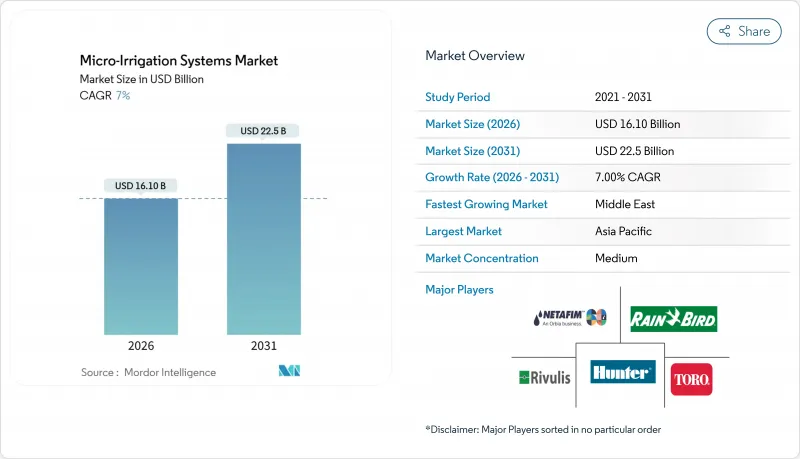
本報告按灌溉方式(滴灌、微噴水灌溉等)、組件(滴頭和發送器、管道和滴灌管線等)、作物類型(田間作物等)、最終用戶(小規模農戶、大型商業農場等)和地區(北美、歐洲等)進行細分。市場規模和預測均以美元計價。
全球微灌注系統市場趨勢及洞察
政府對節水農業的補貼
公共資金正在縮短投資回收期,並擴大無抵押農民的採用範圍。印度的「總理農業灌溉計畫」(Pradhan Mantri Krishi Sinchayee Yojana)已在2025會計年度撥款400億印度盧比(約4.8億美元),為小規模農戶補貼高達55%的系統成本,涵蓋範圍積達50萬公頃。中國已向易受乾旱影響的省份提供150億元人民幣(約21億美元)的津貼。沙烏地阿拉伯的「2030願景」將50%的資本支出分配給椰棗和蔬菜生產商。這些獎勵降低了實際資本成本,即使在商品價格低迷時期也能使投資可行。目前,相關要求強調感測器的捆綁銷售,這正在加速數位化普及。隨著各國在日益嚴峻的水資源限制下追求糧食安全目標,補貼勢頭可能會持續下去,從而支撐對微灌系統的長期需求。
水資源短缺日益嚴重,乾旱頻繁
已有17個國家過度抽取了超過80%的可再生淡水資源,這給各國帶來了結構性壓力,促使它們從重力式漫灌轉向加壓精準灌溉。在摩洛哥,經歷了30年來最嚴重的乾旱之後,政府強制要求新建果園採用滴灌,並承諾在2028年前逐步淘汰漫灌系統。 2025年,加州監管機構收緊了沙加緬度-聖華金Delta的水權,推動了杏仁和開心果園向地下滴灌的轉變。提高用水效率是關鍵因素。蔬菜滴灌每公頃用水量為3000立方米,而小麥漫灌則需8000立方米,但蔬菜的毛利是小麥的三倍。這種經濟優勢將促使乾旱地區重新評估作物選擇,並在未來十年推動微灌系統市場的發展。
小規模農戶初始成本高
承包滴灌系統的成本在每公頃1,200美元至1,800美元之間,相當於南亞和東非地區耕地面積不到2公頃的農民6至12個月的淨農業收入。即使有50%的補貼,生產者也不得不將原本用於種子和化肥等必需品的寶貴資金挪為他用。此外,土地所有權的不穩定性使得農民更不願意投資,他們擔心在收回成本之前就會失去土地。模組化套件降低了准入門檻,但卻降低了水力發電效率,並增加了維護的複雜性。在撒哈拉以南非洲,農業貸款佔銀行貸款的比例不到5%,而無擔保貸款的利率超過20%,這限制了農民獲得融資的機會。除非資金籌措創新能夠迅速普及,否則高昂的價格衝擊將持續阻礙微灌系統市場的滲透。
細分市場分析
滴灌技術用途廣泛,涵蓋農作物種植、果園栽培和蔬菜種植等多種領域,預計2025年將佔微灌系統市場銷售額的約55%。在多年生作物種植者優先考慮減少蒸發和減少機械作業的推動下,地下滴灌預計將超越所有其他灌溉方式,到2031年年複合成長率(CAGR)將達到9%。 2025年,加州大學的試驗報告顯示,在杏仁園中使用地下滴灌後,蒸騰作用減少了22%,每公頃節水180立方公尺。雖然地下安裝會增加每公頃300至500美元的額外成本,但其低維護成本和15年的使用壽命使其成為一種經濟高效的灌溉方式。成本績效支持正在加速這一轉變,例如加州的《永續地下水管理法案》將抽水上限與已證實的用水效率掛鉤。同時,在以色列,內蓋夫地區的新果園必須採用地下滴灌系統,並輔以資金和技術支援。由於這些持續的監管措施,地下滴灌已成為最佳實踐標準,並在微灌系統市場中持續擴大市場佔有率。
地面安裝噴灌在柑橘、酪梨和易受霜凍影響的果園中仍發揮重要作用,但其高蒸發率會阻礙作物生長。滴灌主要用於苗圃和公共綠地,應用並不廣泛。儘管如此,創新仍在繼續,Valmont 2024 型低壓滴灌帶的工作壓力僅為 4-6 psi,因此深受面臨能源價格波動的美國中西部地區玉米和大豆種植戶的青睞。
預計控制器和感測器將以11.2%的複合年成長率成長至2031年,成為成長最快的產品,這反映了市場從硬體銷售向資訊服務的轉變。滴灌器和發送器佔據市場主導地位,佔銷售額的34%,這主要歸功於其壓力補償和虹吸防止設計,這些設計對於即使在坡地上也能實現均勻灌溉至關重要。來自中國擠出生產線的巨大價格壓力正推動管材市場轉型為具有紫外線穩定功能的高級產品。過濾器和施肥灌溉系統在水質問題和營養法規重疊的地區表現最佳,尤其是在蔬菜高密度種植區。水泵、閥門和配件完善了系統配置,節能升級產品正逐步提升其市場佔有率。
數位化帶來的經濟效益正惠及各種規模的農場。西班牙佔地200公頃的番茄農場投資4.5萬美元維修感測器,僅用18個月就收回了投資,用水量減少了14%,化肥用量減少了10%,人事費用降低了87%。隨著電容式探頭價格降至80美元以下,物聯網模組價格降至50美元以下,印度和非洲的團購組織正在聯合採購設備並共用資料。供應商現在透過補貼感測器價格來留住訂閱式儀錶板的用戶,這提高了微灌系統產業的客戶終身價值(CLV)。
區域分析
到2025年,亞太地區將佔全球銷售額的45%,並持續維持微灌系統市場的基石地位。印度計劃在2026年1000萬公頃土地上推廣微灌技術,聯邦和邦政府將提供補貼,最高可達成本的55%。中國已投資200億元人民幣(約28億美元)在黃河流域和塔里木河流域擴大微灌系統的部署,以應對地下水枯竭問題。國內製造商,如Jain Irrigation和Chinadrip,提供具有成本競爭力的組件,並已建立本地服務網路和備件供應。雖然日本、韓國和澳洲的微灌普及率很高,但由於耕地有限,絕對銷售量仍然小規模。
預計2031年,中東地區的年均複合成長率將達到9%,為全球最快成長速度。沙烏地阿拉伯的「2030願景」旨在促進國內蔬菜生產,並提供50%的資本補貼。同時,阿拉伯聯合大公國(阿拉伯聯合大公國)在其「2051年糧食安全戰略」下,力爭將國內糧食產量提高50%。以色列正透過區域水資源共用協議,向鄰國輸出其地下滴灌技術,進而提升創新水準。海水淡化水的高鹽度會加速發送器磨損,但利雅德和特拉維夫的研究中心正在研究耐腐蝕聚合物。
在歐洲,西班牙、義大利和希臘正在維修葡萄園和橄欖園,以符合通用農業政策(CAP)的節水標準,從而帶動市場快速成長。德國和法國正在投資保護性耕作,以降低人事費用並控制硝酸鹽徑流。北美市場成長顯著,尤其是在加州和亞利桑那州等地下水管理日益嚴格的州。南美洲市場也呈現強勁成長,主要得益於巴西甘蔗種植和阿根廷咖啡種植的轉型。非洲市場的成長則主要由捐助者資助的、面向肯亞、衣索比亞和塞內加爾小規模農戶的微灌系統推廣所推動,但普及率仍然較低,顯示微灌系統市場仍有巨大的發展潛力。
其他好處:
- Excel格式的市場預測(ME)表
- 3個月的分析師支持
目錄
第1章:引言
- 研究假設和市場定義
- 調查範圍
第2章:調查方法
第3章執行摘要
第4章 市場狀況
- 市場概覽
- 市場促進因素
- 政府對節水農業的補貼
- 水資源短缺日益嚴重,乾旱頻繁
- 需要最大限度地提高每滴水的產量
- 擴大精密農業和智慧農業工具的應用
- 太陽能微灌系統正變得越來越普及。
- 小規模農戶的計量型微灌資金籌措模式。
- 市場限制因素
- 對小規模農戶來說,初始投入成本相對較高。
- 與噴嘴堵塞和維護相關的問題。
- 熟練的微灌技術人員短缺
- 廢舊塑膠管材廢棄物管理面臨的挑戰
- 監理情勢
- 技術展望
- 波特五力模型
第5章 市場規模與成長預測
- 透過灌溉法
- 滴灌
- 微噴水灌溉
- 地下滴灌
- 鼓泡灌溉
- 按組件
- 滴頭和發送器
- 導管和靜脈輸液管
- 過濾和施肥灌溉系統
- 閥門和壓力調節器
- 控制器和感測器
- 水泵及配件
- 按作物類型
- 田間作物
- 果園和葡萄園
- 種植作物
- 蔬菜
- 草坪和觀賞植物
- 最終用戶
- 小規模農戶
- 大型商業農場
- 溫室
- 景觀和草坪
- 其他
- 按地區
- 北美洲
- 美國
- 加拿大
- 其他北美國家
- 南美洲
- 巴西
- 阿根廷
- 其他南美國家
- 歐洲
- 德國
- 法國
- 義大利
- 西班牙
- 俄羅斯
- 其他歐洲國家
- 亞太地區
- 中國
- 印度
- 日本
- 澳洲
- 韓國
- 其他亞太國家
- 中東
- 沙烏地阿拉伯
- 阿拉伯聯合大公國
- 其他中東國家
- 非洲
- 南非
- 埃及
- 其他非洲國家
- 北美洲
第6章 競爭情勢
- 市場集中度
- 策略趨勢
- 市佔率分析
- 公司簡介
- Netafim Ltd.(Orbia Advance Corporation)
- Rivulis Irrigation Ltd.(Temasek Holdings)
- The Toro Company
- Rain Bird Corporation
- Hunter Industries
- Valmont Industries Inc.
- N-Drip
- Mahindra EPC Irrigation Ltd.(Mahindra Group)
- Nelson Irrigation Corporation
- Antelco Pty Ltd.
- Chinadrip Irrigation Equipment Co. Ltd.
- Irritec SpA
- Elgo Irrigation Ltd.
- Raindrip Inc.(NDS Inc.)
- Lindsay Corporation
第7章 市場機會與未來展望
According to Mordor Intelligence, the micro irrigation systems market size stood at USD 16.1 billion in 2026 and is projected to reach nearly USD 22.5 billion by 2031, registering a 7% CAGR.
This report is Segmented by Mechanism (Drip Irrigation, Micro-Sprinkler Irrigation, and More), by Component (Drippers and Emitters, Tubing and Drip Lines, and More), by Crop Type (Field Crops, and More), by End User (Smallholder Farms, Large Commercial Farms, and More) and by Geography (North America, Europe, and More). The Market Sizes and Forecasts are Provided in Terms of Value (USD).
Global Micro-Irrigation Systems Market Trends and Insights
Government Subsidies for Water-Efficient Agriculture
Public funding is compressing payback periods and expanding adoption among farmers lacking collateral. India's Pradhan Mantri Krishi Sinchayee Yojana allocated INR 40 billion (USD 480 million) in fiscal 2025 to subsidize up to 55% of the system costs for smallholders, covering an additional 500,000 hectares. China disbursed CNY 15 billion (USD 2.1 billion) in grants to drought-prone provinces. Saudi Arabia's Vision 2030 allocates 50% of its capital expenditure to date palm and vegetable growers. These incentives reduce the effective cost of capital, making investments viable even during periods of commodity price slumps. Requirements now emphasize sensor bundles, which accelerate digital penetration. Subsidy momentum is likely to continue as countries pursue food security goals under tightening water budgets, supporting long-term demand for micro irrigation systems.
Intensifying Water Scarcity and Drought Frequency
Seventeen countries have already withdrawn more than 80% of their renewable freshwater resources, creating structural pressure to switch from gravity flood to pressurized precision delivery. Morocco, following its worst drought in 30 years, now mandates the use of drip irrigation in new orchards and vows to phase out flood irrigation systems by 2028. California's regulators tightened pumping rights in the Sacramento-San Joaquin Delta in 2025, catalyzing conversions to subsurface drip irrigation in almond and pistachio orchards. Water-productivity gains are decisive, as drip-irrigated vegetables consume 3,000 m3 per hectare, versus 8,000 m3 for flood-irrigated wheat, yet deliver triple the gross margin. This economic arbitrage is reshaping crop choices across arid zones, propelling the micro irrigation systems market through the decade.
High Upfront Installation Cost for Small Farmers
Turnkey drip systems run USD 1,200-1,800 per hectare, equal to 6-12 months of net farm income for landholdings under 2 hectares in South Asia or East Africa. Even after a 50% subsidy, growers must divert scarce liquidity from essentials such as seed and fertilizer. Land-tenure uncertainty further depresses the willingness to invest because farmers fear losing plots before recouping their capital. Modular kits lower entry thresholds, but they sacrifice hydraulic efficiency and complicate maintenance. In sub-Saharan Africa, agriculture accounts for less than 5% of bank lending, unsecured interest rates exceed 20%, limiting credit uptake. Unless financing innovations spread swiftly, sticker shock will continue to slow penetration in the micro irrigation systems market.
Other drivers and restraints analyzed in the detailed report include:
- Need to Maximize Crop Yield per Drop
- Rising Adoption of Precision Agriculture and Smart Farming Tools
- Emitter Clogging and Maintenance Complexity
For complete list of drivers and restraints, kindly check the Table Of Contents.
Segment Analysis
Drip technology accounted for about 55% of the 2025 revenue in the micro irrigation systems market, supported by its versatility across row crops, orchards, and vegetables. Subsurface drip irrigation outpaces all categories at a 9% CAGR through 2031, spurred by permanent-crop growers who value evaporation cuts and reduced equipment traffic. In 2025, a University of California trial reported 22% lower evapotranspiration in subsurface-drip almonds, resulting in a savings of 180 m3 per hectare. Although subsurface installation adds USD 300-500 per hectare, lower upkeep and 15-year lifespans tip the cost-benefit in favor of buried tape. Policy levers amplify the shift as California's Sustainable Groundwater Management Act ties pumping caps to proven water efficiency. Meanwhile, Israel mandates subsurface systems in new Negev orchards, pairing loans with technical assistance. This steady regulatory drumbeat solidifies subsurface drip as a best-practice standard, expanding its share of the micro irrigation systems market.
Surface micro-sprinklers remain key in citrus, avocado, and frost-prone orchards, but their growth is hindered due to higher evaporation rates. Bubbler irrigation is primarily used in nurseries and public landscapes, yielding modest volumes. Nonetheless, innovation continues as Valmont's 2024 low-pressure tape operates at just 4-6 psi, appealing to Midwest corn and soybean growers facing energy-price volatility.
Controllers and sensors are projected to grow the fastest at an 11.2% CAGR through 2031, reflecting a shift from hardware sales to data services. Drippers and emitters dominate the market, accounting for 34% of revenue, due to their pressure-compensating and anti-siphon designs, which are essential for uniform discharge across slopes. Tubing faces intense price pressure from Chinese extrusion lines, prompting high-end suppliers to shift toward UV-stabilized, premium products. Filters and fertigation systems perform optimally where water quality issues and nutrient regulations intersect, particularly in high-intensity vegetable production areas. Pumps, valves, and accessories complete the system architecture, with energy-efficient upgrades capturing an incremental share.
Digitization economics resonate across farm sizes. A 200-hectare Spanish tomato complex recouped its USD 45,000 sensor retrofit investment in 18 months by reducing water usage by 14%, fertilizer usage by 10%, and labor costs by 87%. As capacitance probes drop below USD 80 and IoT modules under USD 50, cooperative buying circles in India and Africa pool equipment to share data. Vendors now subsidize sensors to lock customers into subscription dashboards, increasing customer lifetime value in the micro irrigation systems industry.
Complete Report Scope:
- By Irrigation Type
- Drip Irrigation
- Micro-sprinkler Irrigation
- Subsurface Drip Irrigation
- Bubbler Irrigation
- By Component
- Drippers and Emitters
- Tubing and Drip Lines
- Filters and Fertigation Systems
- Valves and Pressure Regulators
- Controllers and Sensors
- Pumps and Accessories
- By Crop Type
- Field Crops
- Orchard and Vineyards
- Plantation Crops
- Vegetables
- Turf and Ornamental
- By End User
- Smallholder Farms
- Large Commercial Farms
- Greenhouses
- Landscape and Turf
- Others
- By Geography
- North America
- United States
- Canada
- Rest of North America
- South America
- Brazil
- Argentina
- Rest of South America
- Europe
- Germany
- France
- Italy
- Spain
- Russia
- Rest of Europe
- Asia-Pacific
- China
- India
- Japan
- Australia
- South Korea
- Rest of Asia-Pacific
- Middle East
- Saudi Arabia
- United Arab Emirates
- Rest of Middle East
- Africa
- South Africa
- Egypt
- Rest of Africa
- North America
Geography Analysis
The Asia-Pacific region contributed 45% of the 2025 revenue and remains the anchor of the micro irrigation systems market. India aims to equip 10 million hectares with micro-irrigation by 2026, supported by federal and state subsidies that cover up to 55% of the costs. China invested CNY 20 billion (USD 2.8 billion) to expand coverage in the Yellow River and Tarim River basins, countering groundwater depletion. Domestic manufacturers, such as Jain Irrigation and Chinadrip, supply cost-competitive components, ensuring local service networks and spare part availability. Japan, South Korea, and Australia post high penetration but smaller absolute volumes due to limited arable land.
The Middle East is projected to post a 9% CAGR through 2031, the fastest worldwide. Saudi Arabia's Vision 2030 targets domestic vegetable output and offers 50% capital subsidies, while the United Arab Emirates aims for a 50% rise in local food production under its Food Security Strategy 2051. Israel exports subsurface drip know-how to neighbors under regional water-sharing agreements, elevating the innovation baseline. High salinity in desalinated water accelerates emitter wear, but research centers in Riyadh and Tel Aviv are trialing corrosion-resistant polymers.
Europe is expanding at a high growth rate as Spain, Italy, and Greece retrofit vineyards and olive groves to comply with the Common Agricultural Policy's water-efficiency metrics. Germany and France invest in protected horticulture to mitigate labor costs and nitrate runoff. North America is experiencing significant growth, led by California and Arizona, where groundwater regulations are tightening. South America posts a strong growth, fueled by conversions in Brazilian sugarcane and Argentine coffee. Africa's growth is driven by donor-funded smallholder kits in Kenya, Ethiopia, and Senegal, yet penetration remains low, indicating untapped potential for the micro irrigation systems market.
- Netafim Ltd. (Orbia Advance Corporation)
- Rivulis Irrigation Ltd. (Temasek Holdings)
- The Toro Company
- Rain Bird Corporation
- Hunter Industries
- Valmont Industries Inc.
- N-Drip
- Mahindra EPC Irrigation Ltd. (Mahindra Group)
- Nelson Irrigation Corporation
- Antelco Pty Ltd.
- Chinadrip Irrigation Equipment Co. Ltd.
- Irritec S.p.A.
- Elgo Irrigation Ltd.
- Raindrip Inc. (NDS Inc.)
- Lindsay Corporation
Additional Benefits:
- The market estimate (ME) sheet in Excel format
- 3 months of analyst support
TABLE OF CONTENTS
1 Introduction
- 1.1 Study Assumptions and Market Definition
- 1.2 Scope of the Study
2 Research Methodology
3 Executive Summary
4 Market Landscape
- 4.1 Market Overview
- 4.2 Market Drivers
- 4.2.1 Government subsidies for water-efficient agriculture
- 4.2.2 Intensifying water scarcity and drought frequency
- 4.2.3 Need to maximize crop yield per drop
- 4.2.4 Rising adoption of precision agriculture and smart farming tools
- 4.2.5 Solar-powered micro-irrigation packages gaining traction
- 4.2.6 Pay-as-you-go micro-irrigation financing models for smallholders
- 4.3 Market Restraints
- 4.3.1 High upfront installation cost for small farmers
- 4.3.2 Emitter clogging and maintenance issues
- 4.3.3 Shortage of skilled micro-irrigation technicians
- 4.3.4 End-of-life plastic tubing waste management issues
- 4.4 Regulatory Landscape
- 4.5 Technological Outlook
- 4.6 Porter's Five Forces
- 4.6.1 Threat of New Entrants
- 4.6.2 Bargaining Power of Suppliers
- 4.6.3 Bargaining Power of Buyers
- 4.6.4 Threat of Substitutes
- 4.6.5 Intensity of Competitive Rivalry
5 Market Size and Growth Forecasts (Value)
- 5.1 By Irrigation Type
- 5.1.1 Drip Irrigation
- 5.1.2 Micro-sprinkler Irrigation
- 5.1.3 Subsurface Drip Irrigation
- 5.1.4 Bubbler Irrigation
- 5.2 By Component
- 5.2.1 Drippers and Emitters
- 5.2.2 Tubing and Drip Lines
- 5.2.3 Filters and Fertigation Systems
- 5.2.4 Valves and Pressure Regulators
- 5.2.5 Controllers and Sensors
- 5.2.6 Pumps and Accessories
- 5.3 By Crop Type
- 5.3.1 Field Crops
- 5.3.2 Orchard and Vineyards
- 5.3.3 Plantation Crops
- 5.3.4 Vegetables
- 5.3.5 Turf and Ornamental
- 5.4 By End User
- 5.4.1 Smallholder Farms
- 5.4.2 Large Commercial Farms
- 5.4.3 Greenhouses
- 5.4.4 Landscape and Turf
- 5.4.5 Others
- 5.5 By Geography
- 5.5.1 North America
- 5.5.1.1 United States
- 5.5.1.2 Canada
- 5.5.1.3 Rest of North America
- 5.5.2 South America
- 5.5.2.1 Brazil
- 5.5.2.2 Argentina
- 5.5.2.3 Rest of South America
- 5.5.3 Europe
- 5.5.3.1 Germany
- 5.5.3.2 France
- 5.5.3.3 Italy
- 5.5.3.4 Spain
- 5.5.3.5 Russia
- 5.5.3.6 Rest of Europe
- 5.5.4 Asia-Pacific
- 5.5.4.1 China
- 5.5.4.2 India
- 5.5.4.3 Japan
- 5.5.4.4 Australia
- 5.5.4.5 South Korea
- 5.5.4.6 Rest of Asia-Pacific
- 5.5.5 Middle East
- 5.5.5.1 Saudi Arabia
- 5.5.5.2 United Arab Emirates
- 5.5.5.3 Rest of Middle East
- 5.5.6 Africa
- 5.5.6.1 South Africa
- 5.5.6.2 Egypt
- 5.5.6.3 Rest of Africa
- 5.5.1 North America
6 Competitive Landscape
- 6.1 Market Concentration
- 6.2 Strategic Moves
- 6.3 Market Share Analysis
- 6.4 Company Profiles (includes Global Level Overview, Market Level Overview, Core Segments, Financials as Available, Strategic Information, Market Rank/Share for Key Companies, Products and Services, and Recent Developments)
- 6.4.1 Netafim Ltd. (Orbia Advance Corporation)
- 6.4.2 Rivulis Irrigation Ltd. (Temasek Holdings)
- 6.4.3 The Toro Company
- 6.4.4 Rain Bird Corporation
- 6.4.5 Hunter Industries
- 6.4.6 Valmont Industries Inc.
- 6.4.7 N-Drip
- 6.4.8 Mahindra EPC Irrigation Ltd. (Mahindra Group)
- 6.4.9 Nelson Irrigation Corporation
- 6.4.10 Antelco Pty Ltd.
- 6.4.11 Chinadrip Irrigation Equipment Co. Ltd.
- 6.4.12 Irritec S.p.A.
- 6.4.13 Elgo Irrigation Ltd.
- 6.4.14 Raindrip Inc. (NDS Inc.)
- 6.4.15 Lindsay Corporation
7 Market Opportunities and Future Outlook

 印度微灌系統:市場佔有率分析、行業趨勢和統計數據以及成長預測(2026-2031 年)
 微灌系統市場:2026-2032 年全球市場預測,按作物類型、系統類型、組件、安裝類型、應用、最終用戶和分銷管道分類。
 微灌系統市場:按類型、作物、應用和地區分類的規模、佔有率、前景和機會分析(2025-2032 年)
 2026年全球微灌系統市場報告
 全球微灌系統市場規模、佔有率、趨勢和成長分析報告(2026-2034年)
 微灌系統市場報告:按類型、作物類型、最終用戶和地區分類(2026-2034 年)
 微灌系統市場-全球產業規模、佔有率、趨勢、機會與預測:按類型、作物類型、地區和競爭格局分類,2021-2031年
 微灌系統市場規模、佔有率及成長分析(按類型、作物類型、最終用戶和地區分類)-2026-2033年產業預測
 全球微灌溉系統市場:2032 年預測 - 按類型、組件、作物類型、分銷管道、栽培技術、最終用戶和地區進行分析
 微灌系統市場機會、成長動力、產業趨勢分析及 2025 - 2034 年預測