

 |
市場調查報告書
商品編碼
2114595
石油和天然氣中游:市場佔有率分析、行業趨勢和統計數據、成長預測(2026-2031 年)Oil And Gas Midstream - Market Share Analysis, Industry Trends & Statistics, Growth Forecasts (2026 - 2031) |
||||||

※ 本網頁內容可能與最新版本有所差異。詳細情況請與我們聯繫。
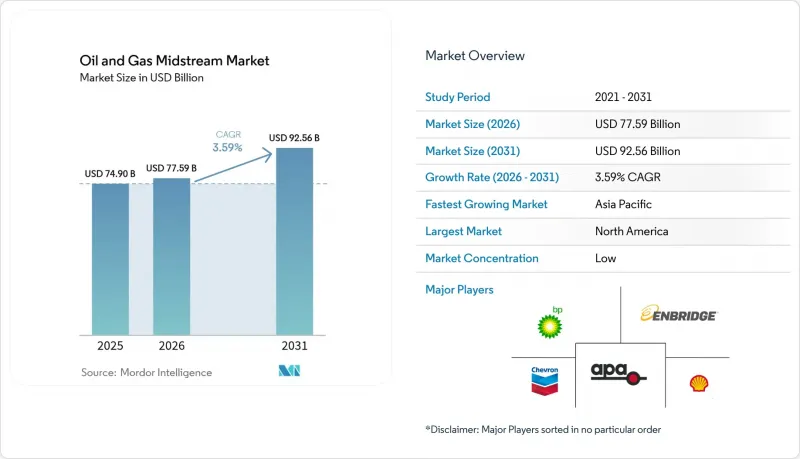
據 Mordor Intelligence 稱,2025 年中游油氣市場價值為 749 億美元,預計到 2031 年將達到 925.6 億美元,而 2026 年為 775.9 億美元,預測期(2026-2031 年)複合年成長率為 3.59%。
本報告按基礎設施(管道、碼頭、倉儲設施)、產品類型(原油、天然氣、成品油、液化天然氣)、服務類型(管道建設、管道維護和維修、儲存和處理服務、運輸和物流)以及地區(北美、歐洲、亞太地區、南美、中東和非洲)進行分類。
全球油氣中游市場趨勢與洞察。
美國液化天然氣出口能力迅速成長
在美國,隨著墨西哥灣沿岸新終端的投入運作,預計到2028年,液化天然氣(LNG)出口能力將增加80%。這些項目將使美國在2030年供應全球約三分之一的LNG,從而刺激對上游收集、加工和乾線管道基礎設施的投資。切尼爾能源公司(Cheniere Energy)公佈,2025年第二季銷售額為46億美元,淨利潤為16億美元,這凸顯了基於長期照付不議合約的強勁獲利前景。儘管聯邦能源監管委員會(FERC)的批准將決定建設進度,但有利的合約條款和亞洲不斷成長的需求正確保最終投資決策按計劃進行。液化天然氣開發商正擴大與中游有限合夥企業(MLP)合作,以確保氣源供應並減輕其資產負債表的負擔。
亞洲天然氣需求的成長正在改變全球天然氣分配格局。
摩根士丹利預測,到2030年,亞洲天然氣消費量將以每年5%的速度成長,遠高於歐洲1%的成長速度。中國計劃在2024年進口7,900萬噸液化天然氣(LNG),並計畫在2030年將其管道網路連接起來,新增1.5億人口。印度預計2024年LNG進口量將達到2,700萬噸,比2023年增加20%,符合其五年內為3,000萬新增用戶提供天然氣的計畫。進口量的成長正在推動再氣化終端、儲氣庫和末端發行網路的建設。這波需求浪潮正在促使運輸路線進行重組,推動長期運輸合約的簽訂,並支撐與LNG價格掛鉤的中游價格。同時,這也促使美國出口商簽訂允許靈活選擇目的地的契約,以利用套利機會。
由於環境、社會及公司治理(ESG)因素,資金短缺問題日益惡化。
大型銀行持續收緊對石化燃料的貸款,吸引中型貸款機構和私募股權公司填補由此產生的資金缺口。隨著業者將提高票面利率與甲烷排放強度目標掛鉤,永續發展債券正日益受到關注。 Mission Secure 的報告指出,加強網路安全措施的設施每年每個站點可節省 5 萬美元的保險費用,部分抵銷不斷上漲的資金籌措利差。專案開發商也正在探索官民合作關係,以平衡能源安全目標與環境法規。資金籌措延遲導致專案累計應急預算,從而延長了投資回收期。
細分市場分析
預計到2025年,中游油氣管道市場規模將達到337.2億美元,佔市場佔有率的45.02%,鞏固其核心地位。同時,由於電網需要靈活的天然氣提取來彌補可再生能源的間歇性,儲氣產業預計將以5.14%的複合年成長率在基礎設施類別中實現最高成長。恩斯托公司(Enstor)位於密西西比州的樞紐擴建項目預計到2028年將使運作天然氣量增加到563億立方英尺,成長2.5倍,凸顯了投資者對地下儲氣庫資產的興趣。恩林克公司(EnLink)的傑斐遜島儲氣庫計畫根據一項長期照付不議合約新增80億立方英尺的容量,這凸顯了公共產業客戶對季節性平衡的重視程度。地下儲氣庫專案受益於有利的地質條件、低營運成本以及夏季注入和冬季提取價差帶來的套利收益。
終端在支援液化天然氣進出口和沿海成品油分銷方面發揮著至關重要的作用。保加利亞的奇倫工廠於2024年將其加工能力提高了20%,以增強區域供應的韌性。杜拜授予貝克休斯公司有史以來最大的綜合壓縮機契約,用於馬爾加姆擴建項目,以應對太陽能發電帶來的波動性需求。終端運營商正在整合自動化和先進的測量技術,以減少蒸發氣損失並遵守國際海事組織(IMO)的規定。這些投資共同推動了油氣中游市場的擴張,增加了收費收入來源,並提高了管網可靠性。
區域分析
預計2025年,北美中游油氣市場規模將達226.4億美元,市佔率將達30.22%。這一成長主要得益於成熟的管網、清晰的監管以及強大的液化天然氣出口管道。二疊紀盆地集輸設施的擴建,例如馬特洪峰快線(Matterhorn Express)項目,以及Enterprise公司對米德蘭盆地的收購,都凸顯了該行業正從待開發區項目轉向最佳化項目。設備現代化改造和棕地設施改造的資本支出佔總支出的很大一部分,同時,由於運輸安全管理局(TSA)強制執行網路安全法規,合規相關預算也在增加。
預計到2031年,亞太地區將以4.74%的複合年成長率成長,成為該地區成長最快的地區,這主要得益於煤炭向天然氣的加速轉型。各國正致力於提高管道入戶率並建造抑低尖峰負載倉儲設施,這推動了對鋼管的需求以及壓縮站的部署。由於液化天然氣進口增速超過國內供應增速,因此需要與亨利樞紐價格掛鉤的彈性合約結構,而非與石油價格掛鉤的「日韓基準價格」。地緣政治多元化策略優先考慮從美國和卡達進口液化天然氣,以降低對單一供應商的依賴風險,並增加航次租船交易量。
在歐洲,由於能源安全狀況日益嚴峻以及優先發展氫能網路的脫碳需求,成長將較為溫和。在南美洲,對海上鹽鹽層下氣田開發的投資正在穩步推進,尤其是在巴西。在中東和非洲,利用模組化浮體式天然氣(FMLNG)開發偏遠天然氣田是推動成長的主要動力,而區域倉儲設施的擴建則起到了緩衝季節性需求高峰的作用。這些地域分佈廣泛的投資共同支撐了中游油氣市場的均衡成長。
其他好處:
- Excel格式的市場預測(ME)表
- 3個月的分析師支持
目錄
第1章:引言
- 研究假設和市場定義
- 調查範圍
第2章:調查方法
第3章執行摘要
第4章 市場狀況
- 市場概覽
- 市場促進因素
- 美國液化天然氣出口能力快速擴張
- 亞洲對天然氣需求的不斷成長正在改變全球天然氣分配格局。
- 在北美,用管道運輸原油取代鐵路運輸。
- 對老化需要更換的陸上管道進行資本支出(CAPEX)。
- 歐洲強制氫燃料摻混趨勢
- 為未充分利用的天然氣資產引入模組化浮式液化天然氣(FLNG)
- 市場限制因素
- 資本短缺加劇是由環境、社會和治理(ESG)因素所驅動的。
- 原油價格前景的波動正在抑制對長期合約的需求。
- 中階資產的網路安全威脅溢價
- 區域主導的針對新管道工程的禁令
- 供應鏈分析
- 監理情勢
- 技術展望
- 石油和天然氣產業運作中管道長度展望
- 主要中游項目訊息
- 波特五力模型
第5章 市場規模與成長預測
- 透過基礎設施
- 管道
- 終端
- 倉儲設施(地下和地上)
- 依產品類型
- 原油
- 天然氣
- 精煉產品
- LNG
- 按服務類型
- 管道建置
- 管道維護和維修
- 倉儲及搬運服務
- 運輸/物流
- 按地區
- 北美洲
- 美國
- 加拿大
- 墨西哥
- 歐洲
- 挪威
- 英國
- 俄羅斯
- 荷蘭
- 德國
- 其他歐洲國家
- 亞太地區
- 中國
- 印度
- 日本
- 韓國
- 東南亞國協
- 澳洲
- 其他亞太國家
- 南美洲
- 巴西
- 阿根廷
- 哥倫比亞
- 其他南美國家
- 中東和非洲
- 沙烏地阿拉伯
- 阿拉伯聯合大公國
- 卡達
- 奈及利亞
- 南非
- 其他中東和非洲國家
- 北美洲
第6章 競爭情勢
- 市場集中度
- 策略趨勢(併購、聯盟、購電協議)
- 市場佔有率分析(主要公司的市場排名和佔有率)
- 公司簡介
- Enbridge Inc.
- Kinder Morgan Inc.
- Enterprise Products Partners LP
- TC Energy Corporation
- Williams Companies Inc.
- Energy Transfer LP
- Plains All American Pipeline LP
- ONEOK Inc.
- Magellan Midstream Partners LP
- Cheniere Energy Inc.
- Pembina Pipeline Corporation
- Chevron Corporation
- BP plc
- Shell plc
- Gazprom
- Saudi Aramco(Aramco Midstream)
- QatarEnergy
- APA Group
- Baker Hughes Company(Midstream Solutions)
- Eni SpA(Midstream)
第7章 市場機會與未來展望
According to Mordor Intelligence, the oil and gas midstream market size was valued at USD 74.90 billion in 2025 and estimated to grow from USD 77.59 billion in 2026 to reach USD 92.56 billion by 2031, at a CAGR of 3.59% during the forecast period (2026-2031).
This report is Segmented by Infrastructure (Pipelines, Terminals, and Storage Facilities), Product Type (Crude Oil, Natural Gas, Refined Products, and LNG), Service Type (Pipeline Construction, Pipeline Maintenance and Repair, Storage and Handling Services, and Transportation and Logistics), and Geography (North America, Europe, Asia Pacific, South America, and Middle East and Africa).
Global Oil And Gas Midstream Market Trends and Insights
Surging U.S. LNG export capacity build-out
U.S. LNG export capacity is on track to rise 80% by 2028 as new Gulf Coast terminals come online. The projects enable the country to supply nearly one-third of global LNG by 2030, spurring investments in upstream gathering, processing, and trunkline infrastructure. Cheniere Energy reported USD 4.6 billion Q2 2025 revenue alongside USD 1.6 billion net income, highlighting robust earnings visibility under long-term take-or-pay agreements. Federal Energy Regulatory Commission approvals dictate construction pacing, yet favorable contract coverage and rising Asian demand keep final investment decisions on track. Liquefaction developers are increasingly partnering with midstream MLPs to secure feed gas and reduce balance-sheet strain.
Rising Asian gas demand shifting global flow patterns
Morgan Stanley projects 5% annual Asian gas consumption growth through 2030, dwarfing 1% in Europe. China imported 79 million tonnes of LNG in 2024 and plans to connect 150 million more residents to pipelines by 2030. India's 27 million-tonne LNG tally in 2024, up 20% from 2023, aligns with a five-year plan to serve 30 million new consumers. Rising imports stimulate the construction of regasification terminals, storage caverns, and last-mile distribution grids. The demand wave reshapes shipping routes, drives longer-tenor offtake agreements, and underpins LNG-linked midstream tariffs. It also encourages U.S. exporters to secure destination-flexible contracts that capitalize on arbitrage.
Heightened ESG-driven capital scarcity
Large banks continue to tighten their lending to fossil fuels, prompting mid-tier lenders and private equity firms to bridge the resulting funding gaps. Sustainability-linked bonds are gaining traction as operators tie coupon step-ups to methane intensity targets. Mission Secure reports that cyber-hardened facilities cut insurance costs by USD 50,000 per site each year, partially offsetting higher financing spreads. Project developers also explore public-private partnerships to align energy-security goals with environmental mandates. Delays in capital formation lead to contingency budgets and extend payback periods.
Other drivers and restraints analyzed in the detailed report include:
- Crude-by-rail replacement with pipelines
- Aging onshore pipelines requiring replacement CAPEX
- Volatile oil price outlook dampening long-term contracts
For complete list of drivers and restraints, kindly check the Table Of Contents.
Segment Analysis
The oil and gas midstream market size for pipelines stood at USD 33.72 billion in 2025, equal to 45.02% share, confirming the segment's backbone status. Storage, however, is projected to expand at a 5.14% CAGR, the fastest among infrastructure categories, as power grids need flexible gas withdrawal to balance renewable intermittency. Enstor's Mississippi Hub expansion is expected to increase working gas to 56.3 Bcf by 2028, a 2.5-fold increase that highlights investor interest in cavern assets. EnLink's Jefferson Island Storage will add 8 Bcf capacity under long-term take-or-pay agreements, highlighting how utility customers value seasonal balancing. Cavern projects benefit from favorable geology, low operating cost, and revenue uplift from arbitrage trading between summer injection and winter withdrawal spreads.
Terminals play a critical role in supporting LNG imports, exports, and coastal refined product distribution. Bulgaria's Chiren facility completed a 20% capacity step-up in 2024 to fortify regional supply resilience. Dubai awarded Baker Hughes its largest integrated compressor contract for the Margham expansion to manage solar-driven demand swings. Terminal operators integrate automation and advanced metering to trim boil-off gas losses and comply with International Maritime Organization regulations. Combined, these investments expand the oil and gas midstream market by raising fee-based revenue streams and enhancing network reliability.
Complete Report Scope:
- By Infrastructure
- Pipelines
- Terminals
- Storage Facilities (Underground and Above-ground)
- By Product Type
- Crude Oil
- Natural Gas
- Refined Products
- LNG
- By Service Type
- Pipeline Construction
- Pipeline Maintenance and Repair
- Storage and Handling Services
- Transportation and Logistics
- By Geography
- North America
- United States
- Canada
- Mexico
- Europe
- Norway
- United Kingdom
- Russia
- Netherlands
- Germany
- Rest of Europe
- Asia Pacific
- China
- India
- Japan
- South Korea
- ASEAN Countries
- Australia
- Rest of Asia Pacific
- South America
- Brazil
- Argentina
- Colombia
- Rest of South America
- Middle East and Africa
- Saudi Arabia
- United Arab Emirates
- Qatar
- Nigeria
- South Africa
- Rest of Middle East and Africa
- North America
Geography Analysis
North America's oil and gas midstream market size reached USD 22.64 billion in 2025, accounting for a 30.22% share, driven by established networks, regulatory clarity, and robust LNG export pipelines. Permian Basin gathering buildouts, such as Matterhorn Express, and Enterprise's Midland Basin acquisitions, highlight a pivot from greenfield to optimization projects. Replacement CAPEX and brownfield loopings dominate spend, while cybersecurity mandates from the Transportation Security Administration widen compliance budgets.
The Asia-Pacific region advances at a 4.74% CAGR through 2031, the swiftest among all regions, as coal-to-gas switching accelerates. Countries target household pipeline penetration and peak-shaving storage, driving demand for steel pipes and the rollout of compressive stations. LNG import share eclipses indigenous supply growth, prompting flexible contract structures indexed to Henry Hub rather than oil-linked Japan Korea Marker prices. Geopolitical diversification strategies favor U.S. and Qatari cargoes, reducing the risk of single-supplier dependence and increasing voyage-charter activity.
Europe moderates as energy-security upgrades converge with decarbonization imperatives that prioritize hydrogen networks. South America channels investment to offshore pre-salt gas monetization, notably in Brazil. The Middle East and Africa rely on modular floating LNG to monetize remote fields, while regional storage expansions act as a buffer against seasonal demand spikes. Collectively, these geographically diverse investments sustain a balanced growth profile for the oil and gas midstream market.
- Enbridge Inc.
- Kinder Morgan Inc.
- Enterprise Products Partners L.P.
- TC Energy Corporation
- Williams Companies Inc.
- Energy Transfer L.P.
- Plains All American Pipeline L.P.
- ONEOK Inc.
- Magellan Midstream Partners L.P.
- Cheniere Energy Inc.
- Pembina Pipeline Corporation
- Chevron Corporation
- BP p.l.c.
- Shell p.l.c.
- Gazprom
- Saudi Aramco (Aramco Midstream)
- QatarEnergy
- APA Group
- Baker Hughes Company (Midstream Solutions)
- Eni S.p.A. (Midstream)
Additional Benefits:
- The market estimate (ME) sheet in Excel format
- 3 months of analyst support
TABLE OF CONTENTS
1 Introduction
- 1.1 Study Assumptions & Market Definition
- 1.2 Scope of the Study
2 Research Methodology
3 Executive Summary
4 Market Landscape
- 4.1 Market Overview
- 4.2 Market Drivers
- 4.2.1 Surging U.S. LNG export capacity build-out
- 4.2.2 Rising Asian gas demand shifting global flow patterns
- 4.2.3 North American crude-by-rail replacement with pipelines
- 4.2.4 Aging onshore pipelines requiring replacement CAPEX
- 4.2.5 Indigenous hydrogen blending mandates in Europe
- 4.2.6 Modular FLNG deployment for stranded gas assets
- 4.3 Market Restraints
- 4.3.1 Heightened ESG-driven capital scarcity
- 4.3.2 Volatile oil price outlook dampening long-term contracts
- 4.3.3 Cyber-security threat premium on midstream assets
- 4.3.4 Community-led legal injunctions on new pipelines
- 4.4 Supply-Chain Analysis
- 4.5 Regulatory Landscape
- 4.6 Technological Outlook
- 4.7 Oil & Gas Operating Pipeline Length Outlook
- 4.8 Key Midstream Projects Information
- 4.9 Porters Five Forces
- 4.9.1 Bargaining Power of Suppliers
- 4.9.2 Bargaining Power of Buyers/Consumers
- 4.9.3 Threat of New Entrants
- 4.9.4 Threat of Substitute Products & Services
- 4.9.5 Intensity of Competitive Rivalry
5 Market Size & Growth Forecasts
- 5.1 By Infrastructure
- 5.1.1 Pipelines
- 5.1.2 Terminals
- 5.1.3 Storage Facilities (Underground and Above-ground)
- 5.2 By Product Type
- 5.2.1 Crude Oil
- 5.2.2 Natural Gas
- 5.2.3 Refined Products
- 5.2.4 LNG
- 5.3 By Service Type
- 5.3.1 Pipeline Construction
- 5.3.2 Pipeline Maintenance and Repair
- 5.3.3 Storage and Handling Services
- 5.3.4 Transportation and Logistics
- 5.4 By Geography
- 5.4.1 North America
- 5.4.1.1 United States
- 5.4.1.2 Canada
- 5.4.1.3 Mexico
- 5.4.2 Europe
- 5.4.2.1 Norway
- 5.4.2.2 United Kingdom
- 5.4.2.3 Russia
- 5.4.2.4 Netherlands
- 5.4.2.5 Germany
- 5.4.2.6 Rest of Europe
- 5.4.3 Asia Pacific
- 5.4.3.1 China
- 5.4.3.2 India
- 5.4.3.3 Japan
- 5.4.3.4 South Korea
- 5.4.3.5 ASEAN Countries
- 5.4.3.6 Australia
- 5.4.3.7 Rest of Asia Pacific
- 5.4.4 South America
- 5.4.4.1 Brazil
- 5.4.4.2 Argentina
- 5.4.4.3 Colombia
- 5.4.4.4 Rest of South America
- 5.4.5 Middle East and Africa
- 5.4.5.1 Saudi Arabia
- 5.4.5.2 United Arab Emirates
- 5.4.5.3 Qatar
- 5.4.5.4 Nigeria
- 5.4.5.5 South Africa
- 5.4.5.6 Rest of Middle East and Africa
- 5.4.1 North America
6 Competitive Landscape
- 6.1 Market Concentration
- 6.2 Strategic Moves (M&A, Partnerships, PPAs)
- 6.3 Market Share Analysis (Market Rank/Share for key companies)
- 6.4 Company Profiles (includes Global level Overview, Market level overview, Core Segments, Financials as available, Strategic Information, Products & Services, and Recent Developments)
- 6.4.1 Enbridge Inc.
- 6.4.2 Kinder Morgan Inc.
- 6.4.3 Enterprise Products Partners L.P.
- 6.4.4 TC Energy Corporation
- 6.4.5 Williams Companies Inc.
- 6.4.6 Energy Transfer L.P.
- 6.4.7 Plains All American Pipeline L.P.
- 6.4.8 ONEOK Inc.
- 6.4.9 Magellan Midstream Partners L.P.
- 6.4.10 Cheniere Energy Inc.
- 6.4.11 Pembina Pipeline Corporation
- 6.4.12 Chevron Corporation
- 6.4.13 BP p.l.c.
- 6.4.14 Shell p.l.c.
- 6.4.15 Gazprom
- 6.4.16 Saudi Aramco (Aramco Midstream)
- 6.4.17 QatarEnergy
- 6.4.18 APA Group
- 6.4.19 Baker Hughes Company (Midstream Solutions)
- 6.4.20 Eni S.p.A. (Midstream)
7 Market Opportunities & Future Outlook
- 7.1 White-Space & Unmet-Need Assessment


