


 |
市場調查報告書
商品編碼
2114270
歐洲生物肥料:市場佔有率分析、產業趨勢與統計及成長預測(2026-2031 年)Europe Biofertilizers - Market Share Analysis, Industry Trends & Statistics, Growth Forecasts (2026 - 2031) |
||||||

※ 本網頁內容可能與最新版本有所差異。詳細情況請與我們聯繫。
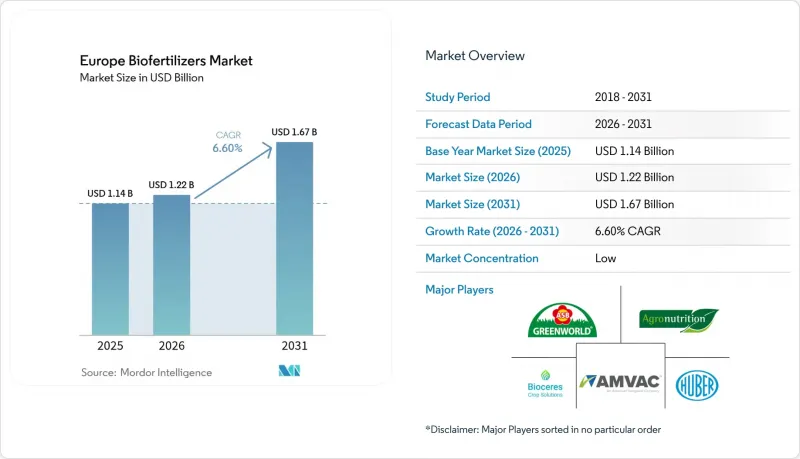
根據 Mordor Intelligence 預測,歐洲生物肥料市場規模將從 2025 年的 11.4 億美元成長到 2026 年的 12.2 億美元,然後在 2031 年達到 16.7 億美元,2026 年至 2031 年的複合年成長率為 6.6%。
本報告按形態(根瘤菌、固氮螺菌、固氮菌、菌根、磷酸鹽細菌及其他生物肥料)、作物類型(大田作物、園藝作物和經濟作物)以及地區(德國、英國、法國、西班牙、俄羅斯、義大利、荷蘭、土耳其及其他歐洲國家)進行細分。市場預測以價值(美元)和數量(公噸)呈現。
歐洲生物肥料市場的趨勢與洞察
歐盟在「從農場到餐桌」的計劃中強制要求擴大有機農田面積。
「從農場到餐桌」政策旨在將25%的農地改造為有機耕作,將使約1700萬公頃的土地轉向有機農業。這項擴張將對用於固氮和磷活化的微生物製劑產生前所未有的需求。德國和法國等國政府已將此項義務納入其國家戰略,並制定了明確的時間表,以指導經銷商和合作社的採購計劃。與此相關的資金涵蓋農民培訓、示範田和結果檢驗,從而縮短了農民採用有機肥料的學習曲線。由於許多生產者在依賴化肥數十年後面臨陡峭的學習曲線,因此,提供農業技術服務和材料銷售相結合的供應商正在迅速贏得客戶的忠誠。市場資訊顯示,隨著生產者在春季施肥高峰期前確保供應,微生物產品的季前預訂量增加,凸顯了這項義務對歐洲生物肥料市場的推動作用。
歐盟嚴格的碳排放和營養物質管制
每公頃170公斤氮的硝酸鹽施用上限以及每噸二氧化碳當量26.5至31.8美元的新碳附加稅正在即時改變農民的預算計算。在最易受硝酸鹽污染影響的地區,丹麥和荷蘭的農民報告稱,自2019年以來,他們透過使用可釋放殘餘磷的磷酸鹽溶解性細菌,已能夠減少40%至50%的化肥用量。由於監管機構將碳排放稅與歐盟排放交易體系(EU ETS)掛鉤,合成氨的價格上漲已成定局,穀物和油菜籽生產商正在努力實現營養來源多元化,以防處罰力度進一步增加。將氮肥施用記錄與補貼資格掛鉤的持續監測要求,進一步促使農民轉向更環保的生技藥品。這兩項政策迫使微生物產品供應商透過第三方田間試驗來驗證其關於碳和營養效率的說法,此舉顯然使他們與競爭對手區分開來。
現場表現的差異
多地試驗表明,作物產量反應存在15%至40%的差異。這是因為微生物的存活取決於土壤pH值、顆粒大小和水分狀況,而地中海壤土和北歐黏土的這些條件差異顯著。在波蘭和匈牙利的沙質土壤中,夏季快速乾燥會降低微生物的生存能力,導致糧食生產者利益不穩定。在法國北部,早春的寒流使菌根真菌的定殖率降低了近一半,抑制了植物在最需要磷的時候對磷的吸收。這種差異迫使農民在各自的農場進行條帶試驗,導致田間推廣應用延遲,訂單成長緩慢。目前,供應商將土壤檢測套組和諮詢服務打包銷售以建立信任,但這些服務的擴充性仍然是一項挑戰。
細分市場分析
到2025年,菌根真菌將佔據歐洲生物肥料市場62.30%的主導地位,預計這一領域將保持主導地位至2031年,這主要得益於其已被證實的磷活化和土壤結構強化能力。根瘤菌雖然起步規模較小,但預計將以7.12%的複合年成長率成為成長最快的生物肥料之一。這主要得益於通用農業政策(CAP)生態計畫下的補貼,該計畫鼓勵擴大依賴生物固氮的豆科作物的輪作,並降低旨在向有機農業轉型的農場的合成肥料投入成本。這兩類生物肥料滿足了成員國對養分釋放和永續性的要求,從而推動了歐洲生物肥料市場規模的擴張。
固氮固氮螺菌)持續保持顯著的市場佔有率,並處於穩定成長的態勢。其促進作物生長的特性,能夠改善根系結構和養分吸收,使其成為穀物種植的理想選擇。芽孢桿菌屬(Bacillus)和其他多菌株混合物也在穩步成長,並佔據了較大的市場佔有率,因為特色蔬菜種植者正在尋求具有廣譜功效的解決方案。固氮菌)和磷酸鹽可溶性細菌具有固碳優勢,隨著土壤信用市場的成熟,它們未來有望大幅提升市場佔有率。這些小規模領域的持續專利申請活動凸顯了創新的深度,預計將逐步擴大歐洲生物肥料市場的佔有率,使其超越目前主導的真菌和根瘤菌產品。
其他好處:
- Excel格式的市場預測(ME)表
- 3個月的分析師支持
目錄
第1章:引言
- 研究假設和市場定義
- 調查範圍
- 調查方法
第2章:本報告的內容
第3章:執行摘要和主要發現
第4章:主要產業趨勢
- 有機耕作面積
- 人均有機產品支出
- 法律規範
- 德國
- 英國
- 法國
- 西班牙
- 俄羅斯
- 義大利
- 荷蘭
- 土耳其
- 價值鍊和通路分析
- 市場促進因素
- 歐盟「從農場到餐桌」有機農田面積強制規定
- 歐盟嚴格的碳排放和營養物法規
- 消費者對有機農產品的需求日益成長
- CAP生態計劃補貼
- 利用微生物實現土壤碳權貨幣化
- 利用昆蟲廢棄物的循環營養夥伴關係
- 市場限制因素
- 現場表現的差異
- 生鮮食品保存期限管理物流
- 歐盟各地品種報名手續延誤
- 快速的產業重組引發通路衝突
第5章 市場規模與成長預測
- 按形式
- 根瘤菌
- 固氮螺菌
- 固氮菌
- 菌根
- 磷酸鹽可溶性細菌
- 其他生物肥料
- 按作物類型
- 大田作物
- 園藝作物
- 經濟作物
- 國家
- 德國
- 英國
- 法國
- 西班牙
- 俄羅斯
- 義大利
- 荷蘭
- 土耳其
- 其他歐洲國家
第6章 競爭情勢
- 關鍵策略趨勢
- 市佔率分析
- 企業狀況
- 公司簡介。
- Sustane Natural Fertilizer
- Agronutrition SA
- Biolchim SpA
- Koppert Biological Systems BV
- Lallemand Inc.
- Novonesis A/S
- Groundwork BioAg Ltd.
- Premier Tech Ltd.
- Andermatt Biocontrol AG
- Corteva, Inc.
- Rizobacter Argentina SA
- Valent BioSciences LLC
- UPL Ltd.
- Sikko Industries Ltd.
- Plant Health Care plc
第7章 農業生技公司執行長面臨的關鍵策略挑戰
According to Mordor Intelligence, the Europe biofertilizer market size is expected to grow from USD 1.14 billion in 2025 to USD 1.22 billion in 2026 and is forecast to reach USD 1.67 billion by 2031 at 6.6% CAGR over 2026-2031.
This report is Segmented by Form (Rhizobium, Azospirillum, Azotobacter, Mycorrhiza, Phosphate-Solubilizing Bacteria, and Other Biofertilizer), Crop Type (Row Crops, Horticultural Crops, and Cash Crops), and Geography (Germany, United Kingdom, France, Spain, Russia, Italy, Netherlands, Turkey, and Rest of Europe). The Market Forecasts are Provided in Terms of Value (USD) and Volume (Metric Tons).
Europe Biofertilizers Market Trends and Insights
EU Farm to Fork Organic-Area Mandate
The 25% organic farmland target under Farm to Fork shifts roughly 17 million additional hectares into biological management, an expansion that requires unprecedented volumes of microbial inoculants for nitrogen fixation and phosphorus mobilization. Governments such as Germany and France have embedded the mandate into national strategies, creating clear timelines that shape procurement planning for distributors and cooperatives. Funding streams tied to the mandate cover farmer training, demonstration plots, and outcome verification which together shorten adoption learning curves. Suppliers that bundle agronomy services with input sales gain early loyalty because many growers face steep learning curves after decades of synthetic fertilizer dependence. Market intelligence points to rising pre-season booking of microbial products as growers secure supply in advance of peak spring applications, a pattern that underscores the mandate's pull effect on the Europe biofertilizer market.
Restrictive EU Carbon and Nutrient Regulations
The nitrate cap of 170 kg N per hectare and emergent carbon fees of USD 26.5-31.8 per ton of CO2 equivalent are altering farm budget math in real time. Danish and Dutch growers, operating in some of the strictest nitrate-vulnerable zones, now document fertilizer savings of 40-50% since 2019 by leaning on phosphate-solubilizing bacteria that unlock residual phosphorus. Because regulators index carbon fees to the EU Emissions Trading System, cost escalators on synthetic ammonia are widely expected, prompting cereal and rapeseed growers to diversify nutrient sources before penalties bite deeper. Continuous monitoring requirements that tie nitrogen application records to subsidy eligibility further reinforce the switch to low-impact biologicals. These twin policies push microbial suppliers to validate carbon and nutrient efficiency claims through third-party field trials, a move that sharpens competitive differentiation.
Field-Performance Variability
Multisite trials show yield responses ranging 15-40% because microbial survival hinges on pH, texture, and moisture profiles that differ sharply from Mediterranean loams to Nordic clays. In sandy soils of Poland and Hungary, rapid desiccation during summer lowers microbial persistence, creating inconsistent returns for cereal growers. Early spring cold snaps cut mycorrhizal colonization by up to half in Northern France, curbing phosphorus uptake exactly when plants need it. This variability compels farmers to conduct on-farm strip trials, a practice that delays full-field uptake and slows order volumes. Suppliers now co-pack soil test kits and advisory services to build trust; however, service scalability remains a bottleneck.
Other drivers and restraints analyzed in the detailed report include:
- Rising Consumer Demand for Organic Produce
- CAP Eco-Scheme Subsidies
- Live-Culture Shelf-Life Logistics
For complete list of drivers and restraints, kindly check the Table Of Contents.
Segment Analysis
Mycorrhizal fungi held a commanding 62.30% of Europe biofertilizer market share in 2025, and the segment is anticipated to maintain leadership through 2031 on the back of its proven ability to mobilize phosphorus and strengthen soil structure. Rhizobium, although starting from a smaller base, is projected to post the fastest 7.12% CAGR as CAP eco-scheme payments encourage wider legume rotations that rely on biological nitrogen fixation, cutting synthetic input costs for organic transition farms. Together, these two categories set the pace for expanding Europe biofertilizer market size by meeting both nutrient release and sustainability requirements across member states.
Azospirillum retains a prominent share and is tracking a stable growth path, favored in cereal fields where its growth-promoting traits improve root architecture and nutrient uptake. Bacillus-based and other multi-strain blends account for significant share with a steady growth as specialty vegetable growers look for broad-spectrum solutions. Azotobacter and phosphate-solubilizing bacteria's carbon-sequestration upside positions them for future jumps once soil-credit markets mature. Continuous patent activity across these smaller segments underscores the innovation depth that will gradually broaden Europe biofertilizer market share beyond today's dominant fungal and rhizobial products.
Complete Report Scope:
- By Form
- Rhizobium
- Azospirillum
- Azotobacter
- Mycorrhiza
- Phosphate-Solubilizing Bacteria
- Other Biofertilizer
- By Crop Type
- Row Crops
- Horticultural Crops
- Cash Crops
- By Country
- Germany
- United Kingdom
- France
- Spain
- Russia
- Italy
- Netherlands
- Turkey
- Rest of Europe
List of Companies Covered in this Report:
- Sustane Natural Fertilizer
- Agronutrition S.A.
- Biolchim S.p.A.
- Koppert Biological Systems B.V.
- Lallemand Inc.
- Novonesis A/S
- Groundwork BioAg Ltd.
- Premier Tech Ltd.
- Andermatt Biocontrol AG
- Corteva, Inc.
- Rizobacter Argentina S.A.
- Valent BioSciences LLC
- UPL Ltd.
- Sikko Industries Ltd.
- Plant Health Care plc
Additional Benefits:
- The market estimate (ME) sheet in Excel format
- 3 months of analyst support
TABLE OF CONTENTS
1 INTRODUCTION
- 1.1 Study Assumptions and Market Definition
- 1.2 Scope of the Study
- 1.3 Research Methodology
2 REPORT OFFERS
3 EXECUTIVE SUMMARY & KEY FINDINGS
4 KEY INDUSTRY TRENDS
- 4.1 Area Under Organic Cultivation
- 4.2 Per Capita Spending On Organic Products
- 4.3 Regulatory Framework
- 4.3.1 Germany
- 4.3.2 United Kingdom
- 4.3.3 France
- 4.3.4 Spain
- 4.3.5 Russia
- 4.3.6 Italy
- 4.3.7 Netherlands
- 4.3.8 Turkey
- 4.4 Value Chain & Distribution Channel Analysis
- 4.5 Market Drivers
- 4.5.1 EU Farm to Fork organic area mandate
- 4.5.2 Restrictive EU carbon & nutrient regulations
- 4.5.3 Rising consumer demand for organic produce
- 4.5.4 CAP eco scheme subsidies
- 4.5.5 Soil carbon credit monetization via microbes
- 4.5.6 Insect frass circular nutrient partnerships
- 4.6 Market Restraints
- 4.6.1 Field performance variability
- 4.6.2 Live culture shelf-life logistics
- 4.6.3 Slow pan EU strain registration process
- 4.6.4 Channel conflict from rapid consolidation
5 MARKET SIZE & GROWTH FORECASTS (VALUE AND VOLUME)
- 5.1 By Form
- 5.1.1 Rhizobium
- 5.1.2 Azospirillum
- 5.1.3 Azotobacter
- 5.1.4 Mycorrhiza
- 5.1.5 Phosphate-Solubilizing Bacteria
- 5.1.6 Other Biofertilizer
- 5.2 By Crop Type
- 5.2.1 Row Crops
- 5.2.2 Horticultural Crops
- 5.2.3 Cash Crops
- 5.3 By Country
- 5.3.1 Germany
- 5.3.2 United Kingdom
- 5.3.3 France
- 5.3.4 Spain
- 5.3.5 Russia
- 5.3.6 Italy
- 5.3.7 Netherlands
- 5.3.8 Turkey
- 5.3.9 Rest of Europe
6 COMPETITIVE LANDSCAPE
- 6.1 Key Strategic Moves
- 6.2 Market Share Analysis
- 6.3 Company Landscape
- 6.4 Company Profiles (Includes Global Level Overview, Market Level Overview, Core Business Segments, Financials, Headcount, Key Information, Market Rank, Market Share, Products and Services, and Analysis of Recent Developments).
- 6.4.1 Sustane Natural Fertilizer
- 6.4.2 Agronutrition S.A.
- 6.4.3 Biolchim S.p.A.
- 6.4.4 Koppert Biological Systems B.V.
- 6.4.5 Lallemand Inc.
- 6.4.6 Novonesis A/S
- 6.4.7 Groundwork BioAg Ltd.
- 6.4.8 Premier Tech Ltd.
- 6.4.9 Andermatt Biocontrol AG
- 6.4.10 Corteva, Inc.
- 6.4.11 Rizobacter Argentina S.A.
- 6.4.12 Valent BioSciences LLC
- 6.4.13 UPL Ltd.
- 6.4.14 Sikko Industries Ltd.
- 6.4.15 Plant Health Care plc
7 KEY STRATEGIC QUESTIONS FOR AGRICULTURAL BIOLOGICALS CEOS

 2026-2030年全球生物肥料市場
 化肥工程解決方案市場-2026-2032年全球預測
 2034年生物肥料微生物材料市場預測-按微生物類型、製劑形式、作物類型、應用、最終用戶和地區分類的全球分析
 歐洲生物來源有機肥料:市場佔有率分析、產業趨勢與統計及成長預測(2026-2031 年)以固氮菌的生物肥料市場-2026-2032年全球市場預測生物來源肥料:市場佔有率分析、行業趨勢和統計數據以及成長預測(2026-2031 年)生物肥料市場-2026-2032年全球市場預測生物肥料市場預測至2034年—按產品類型、作物類型、微生物、配方、應用方法和地區分類的全球分析中東和非洲生物肥料:市場佔有率分析、行業趨勢和統計數據以及成長預測(2026-2031 年)
 基於固氮菌的生物肥料市場規模、佔有率和成長分析:按產品形式、作物類型、應用方法、最終用戶、銷售管道、分銷通路和地區分類-2026-2033年產業預測