


 |
市場調查報告書
商品編碼
2113793
歐洲生物來源有機肥料:市場佔有率分析、產業趨勢與統計及成長預測(2026-2031 年)Europe Biological Organic Fertilizers - Market Share Analysis, Industry Trends & Statistics, Growth Forecasts (2026 - 2031) |
||||||

※ 本網頁內容可能與最新版本有所差異。詳細情況請與我們聯繫。
據 Mordor Intelligence 稱,2026 年歐洲生物來源肥料市場規模估計為 5.7169 億美元,高於 2025 年的 5.2 億美元,預計到 2031 年將達到 9.176 億美元。
預計從 2026 年到 2031 年,其複合年成長率將達到 9.94%。
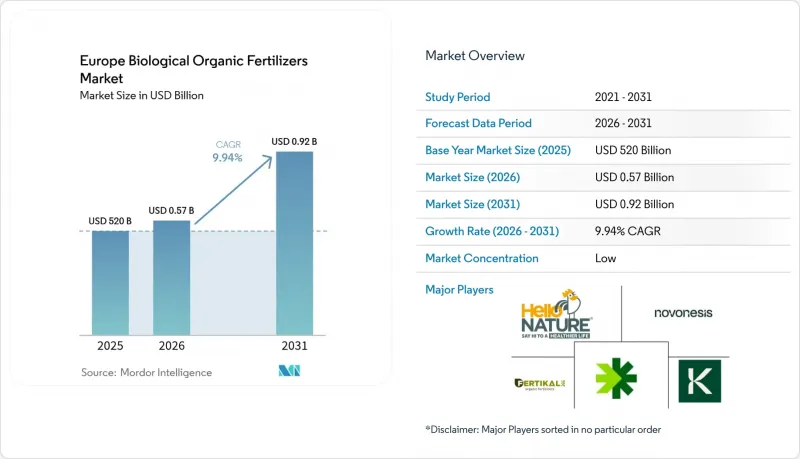
本報告按類型(微生物和有機殘留物)、形態(乾燥和液體)、作物類型(穀物、水果和蔬菜、油籽和豆類等)、施用方法(土壤施用、施肥和灌溉等)以及地區(德國、英國等)進行細分。市場預測以美元計價。
歐洲生物來源有機肥料市場的趨勢與洞察
歐盟的「從農場到餐桌」舉措和有機農田利用的推廣
綠色新政要求到2030年,歐盟四分之一的農地必須轉為有機耕作,這將使認證面積在2024年增加兩倍,並從根本上提升對生物來源肥料的需求。各國政府正透過預算支持這項擴張;德國已累計3,000萬歐元(約3,200萬美元)用於農場堆肥津貼,法國到2024年認證面積也增加了14%。利用有機殘渣製成的產品在有效利用農場廢棄物方面具有最大優勢,而2019/848號法規規定的快速產品核可正在加速微生物菌株的市場推廣。雖然可追溯性框架正在加強合規性,但東歐地區執行情況的不一致可能會阻礙其統一推廣。
歐盟正在收緊合成肥料營養物質徑流的限制。
修訂後的硝酸鹽法規將脆弱地區的氮肥允許限量降低至每公頃170公斤,迫使生產商從尿素轉向緩釋厭氧消化殘渣和微生物磷溶劑。德國法規增加了基於收支平衡的處罰措施,預計2024年液態厭氧消化殘渣的銷售量將增加22%。在荷蘭,磷肥用量的減少正推動園藝業轉向使用芽孢桿菌和木黴屬細菌的混合配方。畜牧業集中地區的合規風險更高,這使得沼氣合作社和專業接種劑供應商在供應鏈中佔據優勢。
大宗有機材料的運輸成本高
由於營養密度低,運輸堆肥和消化殘渣超過200公里,每噸成本高達25歐元(27美元),遠高於尿素的運輸成本,阻礙了其在偏遠糧食產區的推廣應用。 2024年柴油價格較前一年上漲18%,進一步加劇了運輸成本的上漲。雖然製粒可以減少體積,但生產線的成本在5000歐元至200萬歐元(5400美元至210萬美元)之間,除大規模合作社外,難以推廣,從而進一步擴大了主要產區與周邊地區之間的差距。
細分市場分析
到2025年,有機殘渣肥料將佔據57.45%的市場。這主要得益於堆肥、牲畜糞便和消化殘渣的成熟通路,這些管道有助於降低糧食和作物輪作的每公頃成本。隨著零售商限制合成殘渣的使用,以及2019/1009號規則將核准期限縮短一半,微生物產品預計將以12.55%的複合年成長率超越其他產品。來自丹麥的田間數據顯示,耐寒芽孢桿菌菌株可使小麥產量提高8%。
雖然殘渣的使用在運輸和營養成分均勻性方面存在挑戰,但微生物產品則存在保存期限和農民信任度方面的問題。諸如Symborg和Fertiberia於2024年達成的協議等商品搭售舉措,旨在利用傳統分銷管道將接種劑納入主流應用。昆蟲排泄物模糊了界限,將豐富的微生物和有機質結合在一個SKU(庫存單位)中,在溫室蔬菜和觀賞植物領域開闢了一片新天地,這表明歐洲生物來源有機肥料市場正在向混合解決方案發展。
截至2025年,乾粉產品將維持63.20%的市場佔有率,這反映了數十年來在1.8億公頃耕地上使用噴灑設備的經驗。同時,液體產品成長最快,複合年成長率達14.61%。西班牙和義大利對施肥和灌溉系統的維修,使得阿爾梅里亞大學的一項試驗顯示氮素淋失減少了23%。預計到2031年,歐洲液體生物來源肥料的市場規模將達到相當可觀的水平。 Coppert公司用於溫室番茄的液體木黴菌產品在2024年的銷售額成長了35%。
在儲存和施用規模至關重要的場合,乾粉類產品仍然不可或缺。德國和法國近期產能的提升意味著顆粒狀堆肥目前已佔乾粉類肥料市場佔有率的18%。生產商正擴大將乾粉肥料與液體追肥結合使用,尤其是在高價值園藝領域。精通這兩種產品的供應商將在歐洲生物來源有機肥料市場中佔據差異化的需求曲線。
其他好處:
- Excel格式的市場預測(ME)表
- 3個月的分析師支持
目錄
第1章:引言
- 研究假設和市場定義
- 調查範圍
第2章:調查方法
第3章執行摘要
第4章 市場狀況
- 市場概覽
- 市場促進因素
- 歐盟的「從農場到餐桌」計劃和推廣有機農田利用。
- 歐盟正在收緊合成肥料營養物質徑流的限制。
- 厭氧消化殘渣供應鏈的快速擴張
- 將昆蟲糞便衍生肥料生產廠擴大到商業規模
- 通用農業政策(CAP)生態計畫:碳農業補助
- 精準施肥正在推動對液體生物肥料的需求。
- 市場限制因素
- 大宗有機材料的運輸成本高
- 歐盟內部營養成分差異大,缺乏品質標準。
- 微生物接種劑保存期限短
- 泥炭開採的限制正在限制經認證的原料供應。
- 監理情勢
- 技術展望
- 波特五力分析
第5章 市場規模與成長預測
- 按類型
- 微生物
- 有機殘留物
- 按形式
- 乾燥
- 液體
- 按作物類型
- 穀類和穀類食品
- 水果和蔬菜
- 油籽/豆類
- 經濟作物
- 草坪和觀賞植物
- 透過應用方法
- 土壤施用
- 施肥和灌溉
- 葉面噴布
- 按地區
- 德國
- 法國
- 義大利
- 西班牙
- 英國
- 俄羅斯
- 其他歐洲國家
第6章 競爭情勢
- 市場集中度
- 策略趨勢
- 市佔率分析
- 公司簡介
- Hello Nature International Srl(Italpollina SpA)
- Fertikal NV
- Novonesis Group
- RovensaNext
- Koppert Biological Systems BV
- ILSA SpA
- Sustane Natural Fertilizer Inc.
- Andermatt Group AG
- Symborg, Inc.
- Lallemand Inc.
- Darling Ingredients Inc.(NatureSafe)
- Tata Chemicals Europe(Tata Chemicals Ltd.)
- BASF SE
- Corteva Agriscience
- BioBest Group
- DE SANGOSSE Group
第7章 市場機會與未來展望
According to Mordor Intelligence, Europe biological organic fertilizers market size in 2026 is estimated at USD 571.69 million, growing from 2025 value of USD 520 million with 2031 projections showing USD 917.6 million, growing at 9.94% CAGR over 2026-2031.
This report is Segmented by Type (Microorganisms and Organic Residues), by Form (Dry and Liquid), by Crop Type (Cereals and Grains, Fruits and Vegetables, Oilseeds and Pulses, and More), by Application Method (Soil Broadcasting, Fertigation, and More), and by Geography (Germany, United Kingdom, and More). The Market Forecasts are Provided in Terms of Value (USD).
Europe Biological Organic Fertilizers Market Trends and Insights
European Union Farm-to-Fork Initiative and Organic Land Use Promotion
The Green Deal stipulates that one-quarter of European Union farmland must be organic by 2030, tripling 2024 certified acreage and structurally lifting biological fertilizer demand . National budgets back the ramp-up, Germany earmarked EUR 30 million (USD 32 million) for on-farm composting subsidies, and France logged a 14% jump in certified hectares in 2024. Organic-residue inputs benefit most because they valorize farm waste, yet faster product approvals under Regulation 2019/848 also accelerate microbial-strain launches. Traceability frameworks tighten compliance, though uneven enforcement in Eastern Europe could delay uniform uptake.
Stricter European Union Nutrient-Loss Caps on Synthetic Fertilizers
Revised nitrate rules trim allowable nitrogen to 170 kg per hectare in vulnerable zones, forcing growers to replace urea with slow-release digestate and microbial phosphorus-solubilizers . Germany's ordinance adds balance-sheet penalties, pushing liquid digestate sales up 22% in 2024. Netherlands phosphorus cutbacks are steering horticulture toward Bacillus and Trichoderma blends. Compliance risk is rising for livestock-dense areas, giving supply-chain leverage to biogas cooperatives and inoculant specialists.
High Transport Costs for Bulky Organic Inputs
Low nutrient density means moving compost or digestate 200 km can cost EUR 25 (USD 27) per metric ton, dwarfing urea freight bills and deterring adoption in remote grain belts. Diesel was up 18% year-on-year in 2024, compounding freight inflation. Pelletization shrinks volume, but lines cost EUR 0.5-2 million (USD 0.54-2.1 million), affordable mainly to large co-ops, widening the gap between core and fringe regions.
Other drivers and restraints analyzed in the detailed report include:
- Rapid Expansion of Anaerobic-Digestate Supply Chains
- Precision Fertigation Driving Liquid Biofertilizer Demand
- Nutrient Variability and Lack of European Union-wide Quality Standard
For complete list of drivers and restraints, kindly check the Table Of Contents.
Segment Analysis
Organic-residue fertilizers accounted for 57.45% of the market share in 2025 revenue, driven by established compost, manure, and digestate channels that help maintain low costs per hectare in cereal and grain rotations. Microorganism products are set to outpace at a 12.55% CAGR as retailers penalize synthetic residues and Regulation 2019/1009 halves approval times. Field data from Denmark showed cold-tolerant Bacillus strains lifting wheat yields 8%.
Residue inputs encounter challenges related to haulage and nutrient uniformity, while microbial products face issues with shelf life and farmer trust. Bundling initiatives, such as the 2024 agreement between Symborg and Fertiberia, aim to integrate inoculants into mainstream use by leveraging conventional distribution channels. Insect frass blurs the line, bringing microbial richness and organic matter in one Stock Keeping Unit (SKU) and carving niches in greenhouse vegetables and ornamentals, indicating that the Europe biological organic fertilizers market will evolve toward hybrid solutions.
Dry products kept a 63.20% share in 2025, reflecting decades of broadcast machinery across 180 million hectares of arable land. Liquids, however, are rising fastest with a CAGR of 14.61%. Fertigation retrofits in Spain and Italy reduced nitrogen leaching by 23% in University of Almeria trials. The Europe biological organic fertilizers market size for liquids is set to reach a significant market value by 2031. Koppert recorded a 35% sales jump in 2024 on liquid Trichoderma for greenhouse tomatoes.
Dry formats remain crucial where storage and spreading scale matter. Pelletized manure now covers 18% of the dry segment after recent capacity additions in Germany and France. Growers increasingly pair a dry base with liquid top-dressings, particularly in high-value horticulture. Suppliers that master both lines will capture differentiated demand curves across the Europe biological organic fertilizers market.
Complete Report Scope:
- By Type
- Microorganism
- Organic-Residues
- By Form
- Dry
- Liquid
- By Crop Type
- Cereals and Grains
- Fruits and Vegetables
- Oilseeds and Pulses
- Commercial Crops
- Turf and Ornamentals
- By Application Method
- Soil Broadcasting
- Fertigation
- Foliar Spray
- By Geography
- Germany
- France
- Italy
- Spain
- United Kingdom
- Russia
- Rest of Europe
List of Companies Covered in this Report:
- Hello Nature International Srl (Italpollina S.p.A.)
- Fertikal N.V.
- Novonesis Group
- RovensaNext
- Koppert Biological Systems BV
- ILSA S.p.A.
- Sustane Natural Fertilizer Inc.
- Andermatt Group AG
- Symborg, Inc.
- Lallemand Inc.
- Darling Ingredients Inc. (NatureSafe)
- Tata Chemicals Europe (Tata Chemicals Ltd.)
- BASF SE
- Corteva Agriscience
- BioBest Group
- DE SANGOSSE Group
Additional Benefits:
- The market estimate (ME) sheet in Excel format
- 3 months of analyst support
TABLE OF CONTENTS
1 Introduction
- 1.1 Study Assumptions and Market Definition
- 1.2 Scope of the Study
2 Research Methodology
3 Executive Summary
4 Market Landscape
- 4.1 Market Overview
- 4.2 Market Drivers
- 4.2.1 European Union Farm-to-Fork Initiative and Organic Land Use Promotion
- 4.2.2 Stricter European Union Nutrient-Loss Caps on Synthetic Fertilizers
- 4.2.3 Rapid Expansion of Anaerobic-Digestate Supply Chains
- 4.2.4 Commercial Scale-Up of Insect-Frass Fertilizer Plants
- 4.2.5 Common Agricultural Policy (CAP) Eco-scheme Carbon-Farming Payments
- 4.2.6 Precision Fertigation Driving Liquid Biofertilizer Demand
- 4.3 Market Restraints
- 4.3.1 High Transport Costs for Bulky Organic Inputs
- 4.3.2 Nutrient Variability and Lack of European Union-wide Quality Standard
- 4.3.3 Limited Shelf-Life of Microbial Inoculants
- 4.3.4 Peat Extraction Limits Constrain Certified Feedstocks
- 4.4 Regulatory Landscape
- 4.5 Technological Outlook
- 4.6 Porter's Five Forces Analysis
- 4.6.1 Bargaining Power of Suppliers
- 4.6.2 Bargaining Power of Buyers
- 4.6.3 Threat of New Entrants
- 4.6.4 Threat of Substitutes
- 4.6.5 Intensity of Competitive Rivalry
5 Market Size & Growth Forecasts (Value)
- 5.1 By Type
- 5.1.1 Microorganism
- 5.1.2 Organic-Residues
- 5.2 By Form
- 5.2.1 Dry
- 5.2.2 Liquid
- 5.3 By Crop Type
- 5.3.1 Cereals and Grains
- 5.3.2 Fruits and Vegetables
- 5.3.3 Oilseeds and Pulses
- 5.3.4 Commercial Crops
- 5.3.5 Turf and Ornamentals
- 5.4 By Application Method
- 5.4.1 Soil Broadcasting
- 5.4.2 Fertigation
- 5.4.3 Foliar Spray
- 5.5 By Geography
- 5.5.1 Germany
- 5.5.2 France
- 5.5.3 Italy
- 5.5.4 Spain
- 5.5.5 United Kingdom
- 5.5.6 Russia
- 5.5.7 Rest of Europe
6 Competitive Landscape
- 6.1 Market Concentration
- 6.2 Strategic Moves
- 6.3 Market Share Analysis
- 6.4 Company Profiles (Includes Global Level Overview, Market Level Overview, Core Segments, Financials as Available, Strategic Information, Market Rank/Share for Key Companies, Products & Services, and Recent Developments)
- 6.4.1 Hello Nature International Srl (Italpollina S.p.A.)
- 6.4.2 Fertikal N.V.
- 6.4.3 Novonesis Group
- 6.4.4 RovensaNext
- 6.4.5 Koppert Biological Systems BV
- 6.4.6 ILSA S.p.A.
- 6.4.7 Sustane Natural Fertilizer Inc.
- 6.4.8 Andermatt Group AG
- 6.4.9 Symborg, Inc.
- 6.4.10 Lallemand Inc.
- 6.4.11 Darling Ingredients Inc. (NatureSafe)
- 6.4.12 Tata Chemicals Europe (Tata Chemicals Ltd.)
- 6.4.13 BASF SE
- 6.4.14 Corteva Agriscience
- 6.4.15 BioBest Group
- 6.4.16 DE SANGOSSE Group
7 Market Opportunities & Future Outlook

 2026-2030年全球生物肥料市場
 化肥工程解決方案市場-2026-2032年全球預測
 2034年生物肥料微生物材料市場預測-按微生物類型、製劑形式、作物類型、應用、最終用戶和地區分類的全球分析
 歐洲生物肥料:市場佔有率分析、產業趨勢與統計及成長預測(2026-2031 年)以固氮菌的生物肥料市場-2026-2032年全球市場預測生物來源肥料:市場佔有率分析、行業趨勢和統計數據以及成長預測(2026-2031 年)生物肥料市場-2026-2032年全球市場預測生物肥料市場預測至2034年—按產品類型、作物類型、微生物、配方、應用方法和地區分類的全球分析中東和非洲生物肥料:市場佔有率分析、行業趨勢和統計數據以及成長預測(2026-2031 年)
 基於固氮菌的生物肥料市場規模、佔有率和成長分析:按產品形式、作物類型、應用方法、最終用戶、銷售管道、分銷通路和地區分類-2026-2033年產業預測