


 |
市場調查報告書
商品編碼
2113943
歐洲輸送機:市場佔有率分析、行業趨勢和統計數據、成長預測(2026-2031 年)Europe Conveyors - Market Share Analysis, Industry Trends & Statistics, Growth Forecasts (2026 - 2031) |
||||||

※ 本網頁內容可能與最新版本有所差異。詳細情況請與我們聯繫。
根據 Mordor Intelligence 預測,歐洲輸送機市場規模將從 2025 年的 33.3 億美元成長到 2026 年的 35.3 億美元,然後在 2031 年達到 47.1 億美元,2026 年至 2031 年的複合年成長率為 5.98%。
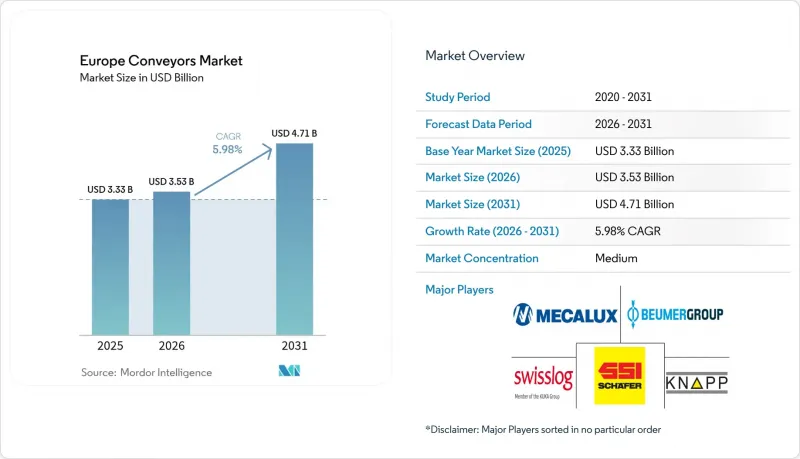
本報告按產品類型(輸送帶、滾筒、托盤等)、終端用戶行業(機場、電子商務/零售、汽車製造等)、裝載類型(單元貨載、散裝裝載)、自動化程度(手動、半自動、全自動)、服務(安裝、預防性維護、預測性維護)和國家/地區進行細分。市場預測以美元(USD)為單位。
歐洲輸送機市場的趨勢與洞察
電子商務當日送達的爆炸性成長
2024年,歐盟小包裹量成長了18%,都市區電商當日達率達22%。為了因應這一成長,零售商在城市中心15公里半徑內開設了微型倉配中心。每個中心都配備了高速分類傳送帶,每小時可處理5000至8000個小包裹。 Ocado位於波蘭Ocean倉庫的「智慧平台」透過架空傳送帶將週轉箱運送到機器人揀貨站,從而在一個地點即可處理4萬個SKU。亞馬遜投資7億歐元(約8.155億美元)用於網路擴張,在德國、法國和西班牙新增了1,000多台移動機器人和配套傳送帶。分散式履約中心的激增提高了每平方公尺的傳送帶密度,而可整合到自動化倉庫系統的模組化佈局也更受歡迎。增值稅規則的簡化簡化了海關程序,使得跨境電子商務在 2024 年成長了 12%,並增加了對歐盟分揀中心處理能力的需求。
西歐人事費用不斷上漲
2024年,德國製造業薪資上漲5.2%,法國上漲5.1%,英國上漲4.8%,這給勞動密集型倉儲業務的獲利能力帶來了壓力。歐盟的最低工資指令將最低工資設定為中位數的60%,消除了人工堆疊作業中廉價勞動力的優勢。以SSI Schaefer公司為例,輸送機的自動化使其員工人數減少了30%至50%,並縮短了投資回收期。汽車製造商改造了高架輸送機,使其能夠按順序輸送零件,從而將組裝週期縮短了15%,並減輕了重複性勞損。北歐國家的勞動力短缺問題日益嚴重,瑞典製造業的職缺與求職者比例在2024年將達到6.8%。這推動了對整合協作機器人的輸送機的需求,這些機器人可以由單一操作員透過單一主機進行監控。
先進的系統需要大量的初始投資。
具備視覺引導分類功能的全自動輸送機的成本為每米500至800美元,而半自動輸送機的成本為每米150至250美元,這阻礙了南歐和東歐中小企業採用該技術。一個2000平方公尺的履約中心大約需要1200公尺的輸送機,而實施智慧平台的初始成本為60萬至96萬美元。租賃模式仍處於早期階段,2024年只有12%的項目以營運費用的形式資金籌措,這意味著大多數買家仍透過資本預算進行融資。歐洲央行(ECB)的存款利率在2024年年中升至3.25%,這將增加資金籌措,尤其是在波蘭和捷克共和國,這兩個國家的時薪徘徊在12至15美元左右。根據 2023/1791 號指令強制執行的節能改善工作,每公尺將產生 50 至 100 美元的額外成本,進一步增加了專案的總成本。
細分市場分析
從2026年到2031年,架空輸送機市場預計將以8.17%的複合年成長率成長,超過其他所有類型的輸送機,這主要得益於油漆廠和無塵室等場所對占地面積的競爭日益激烈。 2025年,皮帶輸送機的銷售額佔比達到38.96%,這主要得益於食品加工和小包裹分揀行業的應用,在這些行業中,不規則形狀的貨物需要在平坦的表面上進行輕柔輸送。滾筒輸送機憑藉其零壓力堆積系統,可防止零件在停止時受損,從而為汽車的最終組裝提供支援。托盤輸送機用於在散裝倉庫中運輸超過一噸的貨物,而專門設計的螺旋型和爬升式輸送機則用於在夾層之間升降貨物。英特羅的即插即用模組可將安裝時間縮短30%,因此深受需要在換型過程中最大限度減少停機時間的業者的青睞。
在歐洲輸送機市場,對便於與機器人噴塗單元整合、實現均勻塗層並減少過噴、同時保持±2毫米定位精度的架空式輸送機的需求日益成長。在製藥業,天花板軌道輸送機更受歡迎,因為它們無需地面支撐,從而避免了微生物滋生,並有助於無塵室驗證。專用的螺旋式輸送機可上下移動數層,其安裝面積僅為傾斜式輸送帶的三分之一,從而釋放了倉庫通道,方便AGV(自動導引車)通行。為符合2023/1230號法規的要求,架空式輸送機製造商必須增加冗餘安全繼電器和雲端文檔,這會增加每台設備8000至15000美元的成本,但能確保未來的網路安全防護。
預計到2031年,電子商務和零售業的複合年成長率將達到8.95%,兩小時內送達的目標推動了都市區高密度微型倉配中心的建設。機場產業在2025年將維持28.41%的市場佔有率,這得益於布魯塞爾和蘇黎世行李系統的全面改造(日處理量高達5萬件行李)。汽車產業的電動車工廠正依靠同步傳送帶按順序輸送電池組和電力電子元件,從而減少生產線旁的庫存。食品製造商正在投資符合EHEDG標準的模組化不銹鋼傳送帶,以縮短清洗時間。
在歐洲的EC輸送機市場,視覺引導分類器與連接至穿梭式儲存系統的料斗式環路結合,在2.5公尺/小時的速度下實現了99.8%的分類精度。在德國KNAPP的工廠,整合了210台穿梭機和1800公尺的輸送機,每小時可處理12,000條訂單。在製藥廠,輸送機整合了自動偵測功能,以每分鐘600個單位的速度檢驗管瓶灌裝量、瓶蓋擰緊扭力和標籤位置。在波蘭和西班牙的礦場,重型皮帶仍然是沿著數公里長的線路以超過1000噸/小時的速度輸送骨材的首選。
其他好處:
- Excel格式的市場預測(ME)表
- 3個月的分析師支持
目錄
第1章:引言
- 研究假設和市場定義
- 調查範圍
第2章:調查方法
第3章執行摘要
第4章 市場狀況
- 市場概覽
- 市場促進因素
- 西歐人事費用不斷上漲
- 當日達履約。
- 歐盟更嚴格的食品安全法規促使衛生傳送系統得到更廣泛的應用。
- 歐盟基於復甦和韌性基金的自動化支持補貼
- 利用工業物聯網向預測性維護合約過渡
- 永續性法規正在推動輸送機的維修,使其更加節能。
- 市場限制因素
- 對先進系統進行大量初始資本投資
- 熟練的輸送機維護技術人員短缺
- 歐盟法規的不一致阻礙了跨境標準化。
- 來自自主移動機器人的競爭日益激烈
- 產業價值/價值鏈分析
- 監理情勢
- 技術展望
- 宏觀經濟因素對市場的影響
- 波特五力分析
第5章 市場規模與成長預測
- 依產品類型
- 腰帶
- 滾筒
- 調色盤
- 開賣
- 特殊類型(螺旋式、攀爬式、分類式)
- 按最終用戶行業分類
- 飛機場
- 電子商務與零售
- 汽車製造
- 一般製造業
- 食品/飲料
- 製藥
- 散裝物料的開採和處理
- 負載類型
- 單元貨載
- 散貨路
- 按自動化級別
- 手動的
- 半自動
- 全自動/智慧輸送機
- 按服務
- 安裝
- 預防性維護
- 利用工業物聯網進行預測性維護/維護
- 國家
- 西歐
- 英國
- 法國
- 德國
- 義大利
- 西班牙
- 北歐的
- 北歐的
- 比荷盧經濟聯盟
- 東歐
- 波蘭
- 捷克共和國
- 其他東歐國家
- 西歐
第6章 競爭情勢
- 市場集中度
- 策略趨勢
- 市佔率分析
- 公司簡介
- Daifuku Co. Ltd.
- SSI Schaefer AG
- Mecalux SA
- Beumer Group GmbH and Co. KG
- KNAPP AG
- Swisslog AG(KUKA AG)
- Viastore Systems GmbH
- Kardex Holding AG
- Honeywell Intelligrated Inc.
- Interroll Holding AG
- Vanderlande Industries BV
- Bosch Rexroth AG
- Fives SAS
- Siemens Logistics GmbH
- FlexLink AB
- TGW Logistics Group GmbH
- Dematic GmbH
- Buhler Group
- Rulmeca Holding SpA
- Jervis B. Webb Company
第7章 市場機會與未來展望
According to Mordor Intelligence, the Europe conveyors market size is expected to grow from USD 3.33 billion in 2025 to USD 3.53 billion in 2026 and is forecast to reach USD 4.71 billion by 2031 at 5.98% CAGR over 2026-2031.
This report is Segmented by Product Type (Belt, Roller, Pallet, and More), End-User Industry (Airport, E-Commerce and Retail, Automotive Manufacturing, and More), Load Type (Unit Load, and Bulk Load), Automation Level (Manual, Semi-Automated, and Fully Automated), Service (Installation, Preventive Maintenance, and Predictive Maintenance), and Country. The Market Forecasts are Provided in Terms of Value (USD).
Europe Conveyors Market Trends and Insights
Explosive Growth of Same-Day E-Commerce Fulfillment
Parcel volumes in the European Union increased 18% during 2024, pushing same-day delivery penetration in urban e-commerce to 22%. Retailers responded by opening micro-fulfillment centers within 15 kilometers of city centers, each fitted with high-speed sortation conveyors that handle 5,000-8,000 parcels per hour. Ocado's Smart Platform at Auchan's Polish facility routes totes via a grid of overhead conveyors to robotic pick stations, enabling 40,000 stock-keeping units to flow through a single site. Amazon's EUR 700 million (815.5 USD million) network expansion added more than 1,000 mobile robots and complementary conveyor lines across Germany, France, and Spain. The spread of decentralized fulfillment nodes is boosting conveyor density per square meter, favoring modular layouts that bolt onto automated storage and retrieval systems. Cross-border e-commerce grew 12% in 2024 after simplified VAT rules streamlined customs clearance, elevating throughput demands at EU sortation hubs.
Rising Labor Costs Across Western Europe
Manufacturing wages rose 5.2% in Germany, 5.1% in France, and 4.8% in the United Kingdom during 2024, compressing margins in labor-intensive warehousing. The EU minimum-wage directive set a floor at 60% of median pay, eliminating cheap-labor advantages for manual palletizing. SSI Schaefer installations demonstrate 30-50% headcount cuts after conveyor automation, improving return-on-investment timelines. Automotive producers retrofit overhead conveyors to move parts just-in-sequence, trimming assembly cycle times 15% and reducing repetitive-strain injuries. Labor shortages are acute in the Nordics, where Sweden's manufacturing vacancy rate reached 6.8% in 2024, driving demand for conveyors integrated with collaborative robots that one operator can oversee from a single console
High Up-Front Capital Expenditure for Advanced Systems
Fully automated conveyors with vision-guided sortation cost USD 500-800 per linear meter, versus USD 150-250 for semi-automated belts, deterring small and medium-sized enterprises in Southern and Eastern Europe. A 2,000 m2 fulfillment center needs roughly 1,200 meters of conveyor, translating to USD 600,000-960,000 upfront for smart platforms. Leasing models remain nascent; only 12% of 2024 projects were financed as operating expenses, so most buyers still fund through capital budgets. European Central Bank deposit rates at 3.25% in mid-2024 lifted financing costs, lengthening payback periods especially in Poland and the Czech Republic where wages hover at USD 12-15 per hour. Energy-efficiency retrofits mandated under Directive 2023/1791 add USD 50-100 per meter, further inflating project totals.
Other drivers and restraints analyzed in the detailed report include:
- Automation Subsidies Under EU Recovery and Resilience Facility
- Shift Toward Predictive-Maintenance Contracts Powered by IIoT
- Rising Competition From Autonomous Mobile Robots
For complete list of drivers and restraints, kindly check the Table Of Contents.
Segment Analysis
Overhead conveyors are projected to expand at 8.17% CAGR between 2026 and 2031, outpacing all other variants as paint shops and cleanrooms fight for floor space. Belt units commanded 38.96% of 2025 revenue, underpinned by food processing and parcel sortation, where flat surfaces handle irregular packages gently. Roller lines support automotive final assembly with zero-pressure accumulation that prevents part damage during stoppages. Pallet conveyors move loads exceeding one ton in bulk warehouses, while specialty spiral or climbing designs elevate products between mezzanine levels. Interroll's plug-and-play modules cut installation time 30%, appealing to operators who must minimize downtime during changeovers.
Europe conveyors market demand for overhead designs is rising because they integrate easily with robotic paint-cells, maintaining +-2 mm positioning for uniform coats and less overspray. Pharmaceuticals favor ceiling-mounted tracks that eliminate floor supports harboring microbes, easing cleanroom validation. Specialty spiral units, climbing several floors, consume a third of the footprint required by inclined belts, freeing warehouse aisles for AGV traffic. Compliance with Regulation 2023/1230 obliges overhead makers to add redundant safety relays and cloud-accessible documentation, adding USD 8,000-15,000 per install but ensuring future cybersecurity readiness
E-commerce and retail lines will post a 8.95% CAGR through 2031 as two-hour delivery targets spur dense urban micro-fulfillment centers. Airports retained 28.41% share in 2025, underpinned by Brussels and Zurich baggage-system overhauls processing up to 50,000 bags daily. Automotive EV plants rely on synchronised conveyors to deliver battery packs and power electronics just-in-sequence, trimming line-side inventory. Food manufacturers invest in stainless-steel modular belts complying with EHEDG to cut wash-down time.
Europe conveyors market solutions for e-commerce couple vision-guided diverters achieving 99.8% sort accuracy at 2.5 m/s with tote-based loops tied to shuttle storage. KNAPP's German facility merges 210 shuttles and 1,800 meters of conveyors to fill 12,000 order lines per hour. Pharmaceutical plants integrate conveyors with automated inspection, verifying vial fill, cap torque, and label placement at 600 units per minute. Mining sites in Poland and Spain still favor heavy-duty belts moving over 1,000 t/h of aggregates along multi-kilometer routes.
Complete Report Scope:
- By Product Type
- Belt
- Roller
- Pallet
- Overhead
- Specialty (Spiral, Climbing, Sorting)
- By End-User Industry
- Airport
- E-Commerce and Retail
- Automotive Manufacturing
- General Manufacturing
- Food and Beverage
- Pharmaceuticals
- Mining and Bulk-Handling
- By Load Type
- Unit Load
- Bulk Load
- By Automation Level
- Manual
- Semi-Automated
- Fully Automated / Smart Conveyors
- By Service
- Installation
- Preventive Maintenance
- Predictive / IIoT-Enabled Maintenance
- By Country
- Western Europe
- United Kingdom
- France
- Germany
- Italy
- Spain
- Northern Europe
- Nordics
- Benelux
- Eastern Europe
- Poland
- Czech Republic
- Rest of Eastern Europe
- Western Europe
List of Companies Covered in this Report:
- Daifuku Co. Ltd.
- SSI Schaefer AG
- Mecalux S.A.
- Beumer Group GmbH and Co. KG
- KNAPP AG
- Swisslog AG (KUKA AG)
- Viastore Systems GmbH
- Kardex Holding AG
- Honeywell Intelligrated Inc.
- Interroll Holding AG
- Vanderlande Industries B.V.
- Bosch Rexroth AG
- Fives SAS
- Siemens Logistics GmbH
- FlexLink AB
- TGW Logistics Group GmbH
- Dematic GmbH
- Buhler Group
- Rulmeca Holding S.p.A.
- Jervis B. Webb Company
Additional Benefits:
- The market estimate (ME) sheet in Excel format
- 3 months of analyst support
TABLE OF CONTENTS
1 INTRODUCTION
- 1.1 Study Assumptions and Market Definition
- 1.2 Scope of the Study
2 RESEARCH METHODOLOGY
3 EXECUTIVE SUMMARY
4 MARKET LANDSCAPE
- 4.1 Market Overview
- 4.2 Market Drivers
- 4.2.1 Rising Labor Costs Across Western Europe
- 4.2.2 Explosive Growth of Same-Day E-Commerce Fulfilment
- 4.2.3 Tightening EU Food-Safety Regulations Prompting Hygienic Conveyor Adoption
- 4.2.4 Automation Subsidies Under EU Recovery and Resilience Facility
- 4.2.5 Shift Toward Predictive-Maintenance Contracts Powered by IIoT
- 4.2.6 Sustainability Mandates Driving Energy-Efficient Conveyor Retrofits
- 4.3 Market Restraints
- 4.3.1 High Up-Front Capital Expenditure for Advanced Systems
- 4.3.2 Shortage of Skilled Conveyor-Maintenance Technicians
- 4.3.3 Fragmented EU Regulations Hindering Cross-Border Standardisation
- 4.3.4 Rising Competition From Autonomous Mobile Robots
- 4.4 Industry Value / Supply-Chain Analysis
- 4.5 Regulatory Landscape
- 4.6 Technological Outlook
- 4.7 Impact of Macroeconomic Factors on the Market
- 4.8 Porter's Five Forces Analysis
- 4.8.1 Bargaining Power of Suppliers
- 4.8.2 Bargaining Power of Buyers
- 4.8.3 Threat of New Entrants
- 4.8.4 Intensity of Competitive Rivalry
- 4.8.5 Threat of Substitutes
5 MARKET SIZE AND GROWTH FORECASTS (VALUE)
- 5.1 By Product Type
- 5.1.1 Belt
- 5.1.2 Roller
- 5.1.3 Pallet
- 5.1.4 Overhead
- 5.1.5 Specialty (Spiral, Climbing, Sorting)
- 5.2 By End-User Industry
- 5.2.1 Airport
- 5.2.2 E-Commerce and Retail
- 5.2.3 Automotive Manufacturing
- 5.2.4 General Manufacturing
- 5.2.5 Food and Beverage
- 5.2.6 Pharmaceuticals
- 5.2.7 Mining and Bulk-Handling
- 5.3 By Load Type
- 5.3.1 Unit Load
- 5.3.2 Bulk Load
- 5.4 By Automation Level
- 5.4.1 Manual
- 5.4.2 Semi-Automated
- 5.4.3 Fully Automated / Smart Conveyors
- 5.5 By Service
- 5.5.1 Installation
- 5.5.2 Preventive Maintenance
- 5.5.3 Predictive / IIoT-Enabled Maintenance
- 5.6 By Country
- 5.6.1 Western Europe
- 5.6.1.1 United Kingdom
- 5.6.1.2 France
- 5.6.1.3 Germany
- 5.6.1.4 Italy
- 5.6.1.5 Spain
- 5.6.2 Northern Europe
- 5.6.2.1 Nordics
- 5.6.2.2 Benelux
- 5.6.3 Eastern Europe
- 5.6.3.1 Poland
- 5.6.3.2 Czech Republic
- 5.6.3.3 Rest of Eastern Europe
- 5.6.1 Western Europe
6 COMPETITIVE LANDSCAPE
- 6.1 Market Concentration
- 6.2 Strategic Moves
- 6.3 Market Share Analysis
- 6.4 Company Profiles (includes Global Level Overview, Market Level Overview, Core Segments, Financials as Available, Strategic Information, Market Rank/Share for Key Companies, Products and Services, and Recent Developments)
- 6.4.1 Daifuku Co. Ltd.
- 6.4.2 SSI Schaefer AG
- 6.4.3 Mecalux S.A.
- 6.4.4 Beumer Group GmbH and Co. KG
- 6.4.5 KNAPP AG
- 6.4.6 Swisslog AG (KUKA AG)
- 6.4.7 Viastore Systems GmbH
- 6.4.8 Kardex Holding AG
- 6.4.9 Honeywell Intelligrated Inc.
- 6.4.10 Interroll Holding AG
- 6.4.11 Vanderlande Industries B.V.
- 6.4.12 Bosch Rexroth AG
- 6.4.13 Fives SAS
- 6.4.14 Siemens Logistics GmbH
- 6.4.15 FlexLink AB
- 6.4.16 TGW Logistics Group GmbH
- 6.4.17 Dematic GmbH
- 6.4.18 Buhler Group
- 6.4.19 Rulmeca Holding S.p.A.
- 6.4.20 Jervis B. Webb Company
7 MARKET OPPORTUNITIES AND FUTURE OUTLOOK
- 7.1 White-Space and Unmet-Need Assessment

 螺旋輸送機市場規模、佔有率和成長分析:按輸送機類型、螺旋類型、應用、最終用戶產業、營運方式和地區分類-2026-2033年產業預測
 冷凍食品輸送機系統市場規模、佔有率和成長分析:按輸送機類型、應用、食品類型、最終用戶和地區分類-2026-2033年產業預測
 升降輸送機市場規模、佔有率和成長分析:按輸送機類型、應用、最終用戶、驅動系統和地區分類-2026-2033年產業預測
 滅菌輸送機市場規模、佔有率和成長分析:按輸送機類型、滅菌技術、應用、最終用戶、自動化程度和地區分類-2026-2033年產業預測
 智慧輸送機自動化市場預測至2034年-按輸送機類型、組件、自動化程度、應用、最終用戶和地區分類的全球分析
 輸送系統市場規模、佔有率、成長、全球產業分析、區域趨勢及2026-2034年預測。
 中東和非洲輸送機市場:市場佔有率分析、行業趨勢和統計數據以及成長預測(2026-2031 年)亞太地區輸送機:市場佔有率分析、產業趨勢與統計及成長預測(2026-2031 年)輸送機:市場佔有率分析、行業趨勢和統計數據、成長預測(2026-2031 年)
 振動輸送機市場-2026-2032年全球市場預測