


 |
市場調查報告書
商品編碼
2113938
輸送機:市場佔有率分析、行業趨勢和統計數據、成長預測(2026-2031 年)Conveyors - Market Share Analysis, Industry Trends & Statistics, Growth Forecasts (2026 - 2031) |
||||||

※ 本網頁內容可能與最新版本有所差異。詳細情況請與我們聯繫。
據 Mordor Intelligence 稱,預計到 2026 年,輸送機市值將達到 100.9 億美元,高於 2025 年的 96.6 億美元,預計到 2031 年將達到 125.3 億美元。
預計 2026 年至 2031 年的複合年成長率為 4.43%。
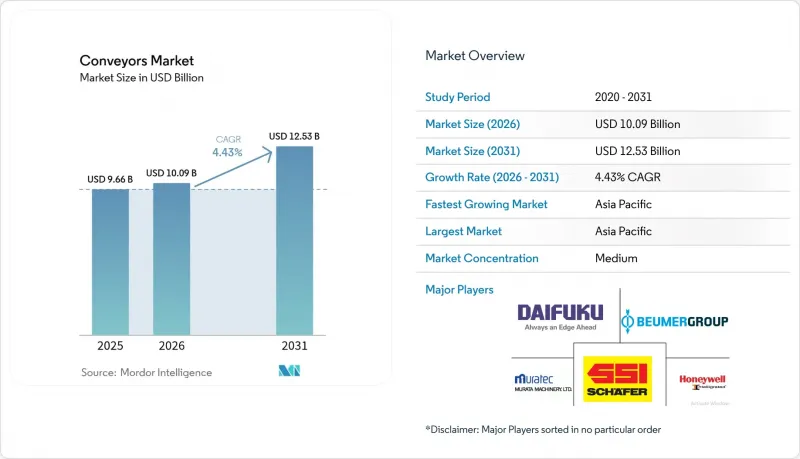
本報告按產品類型(傳送帶、滾筒、托盤、架空輸送機、板條/鏈條及其他)、負載類型(單元搬運、散裝搬運)、終端用戶行業(機場、零售/電商、汽車及其他)、系統配置(固定/線性、模組化/軟性)、組件(輸送設備、驅動裝置/控制設備、軟體/分析)和地區進行細分。市場預測以美元(USD)計價。
全球輸送機市場趨勢及洞察
電子商務履約中心快速擴張
在都市區微型倉配中心,對能夠在最小占地面積內每小時分揀超過7,200個包裹的輸送機平台有著迫切的需求。亞馬遜咖啡館在泰國的門市便是這模式的典範,它採用模組化的Interroll系統,每天在4000家門市處理2萬個包裹。高吞吐量的交叉傳送帶分類機能夠實現當日送達,而垂直佈局則最大限度地提高了在空間有限的亞洲特大城市中的體積吞吐量。開發商指定使用即插即用的輸送機模組,以便在無需土木工程的情況下輕鬆搬遷設施。這些需求支撐著穩健的設備升級週期,並鞏固了輸送機系統市場作為「最後一公里」物流支柱的地位。
食品飲料工廠對自動化運輸的需求日益成長
加工商不再僅僅滿足於遵守衛生標準,而是致力於最佳化端到端的加工能力。巴拉吉威化餅公司透過啟用輕柔處理產品的滾筒輸送帶生產線,消除了意外停機時間。配備視覺系統的輸送機進行即時缺陷檢測,從而減少了人工檢查。在大量生產的零嘴零食包裝過程中,多元化食品公司的「DirectDrive」螺旋輸送機現在可以連續運作48小時,徹底解決了先前常見的機械故障問題。模組化塑膠傳送帶延長了使用壽命,而新興的植物來源產品生產線則需要高度靈活的佈局,以處理水分含量不同的易碎產品。
初始投資額高(資本支出)且投資回報期長
即使內部收益率 (IRR) 高達 15%,再生驅動裝置的投資也需要六年才能收回,這對於融資流緊張的公司來說是一個障礙。鋼材價格在每噸 870 美元到 950 美元之間波動,使得預算編制變得困難。雖然租賃模式存在,但在信貸市場緊張的地區,其應用受到限制。這些成本挑戰阻礙了高階設備在輸送機系統市場的廣泛應用。
細分市場分析
預計到2025年,皮帶輸送機將維持38.60%的市場佔有率,成為採礦、食品和一般製造業生產線的核心。位於德克薩斯州的Dune Express公司已充分證明了皮帶輸送機的高效性,該公司每年輸送1300萬噸貨物,運輸距離達42英里,相當於減少了25000次卡車運輸。隨著工廠更有效利用占地面積並提高工人安全,架空輸送機市場正以7.85%的複合年成長率快速成長。滾筒輸送系統利用模組化框架的優勢,使其適用於可重建的組裝,而托盤輸送線則用於汽車行業的精密作業。在所有類別中,智慧感測器的引入已將預測性維護的準確率提高到95%以上。
隨著永續採礦和散裝物流項目的推進,皮帶式輸送機系統市場預計將持續成長。同時,架空式輸送機憑藉其空間利用率最大化的優勢,市佔率正逐漸擴大。節能型振動輸送機僅需傳統輸送機20%的驅動力,體現了跨領域的創新。板條式和鍊式輸送機在重型車輛生產中仍然佔據重要地位,但其成長正受到市場對更柔軟性替代方案日益成長的需求的限制。
到2025年,單元搬運將佔需求的63.55%,這主要得益於電子商務和離散製造工作流程對產品輕柔搬運和無壓儲存的重視。具備視覺輔助缺陷偵測功能的系統目前也開始承擔分類任務,同時提升了安全性。散裝搬運雖然規模較小,但其複合年成長率將超過單元搬運,達到8.32%,這主要得益於大宗商品市場的成長和農業的現代化。隨著工廠需要能夠處理托盤和顆粒狀原料的基礎設施,混合設備的引入正在打破傳統的界限。
在採礦領域,TAKRAF的Collahuasi計畫凸顯了對大批量物料處理能力的強勁需求。在製藥業的無塵室中,能夠以每小時11,100公升以上的速度輸送物料並保持無菌狀態的真空輸送機至關重要。這兩個趨勢為輸送機系統市場帶來了多元化的收入來源。
區域分析
到2025年,亞太地區將佔據輸送機系統市場37.65%的佔有率,主要得益於中國、印度和東南亞製造群的擴張。DAIFUKU CO. LTD.在印度新建的工廠凸顯了當地汽車和電子產業日益成長的需求。中國持續為礦業和港口基礎設施部署大型散裝輸送帶,而印度則正利用SAMARTH Udyog等設施加速推動智慧工廠維修。半導體產業的投資增加推動了對無塵室輸送機的需求,而日本長達310英里的貨運網路則彰顯了其在大型企劃上的雄心。
中東地區正以8.55%的複合年成長率成長,物流多元化策略為其發展帶來正面影響。在「沙烏地阿拉伯2030願景」的指導下,沙烏地阿拉伯政府已投資1,066億美元用於建造貨運走廊,例如奧克薩貢(Oxagon)項目,這將推動對高容量輸送機和港口輸送機的需求。預計到2025年,阿拉伯聯合大公國的物流市場規模將達到200.3億美元,將帶動倉儲自動化領域的投資,預計到2025年,該領域的投資額將達到16億美元。
在北美和歐洲,受美國能源局(DOE) 的能源效率津貼和歐盟的碳排放法規的推動,老舊設施的現代化改造正在穩步推進。再生驅動系統正被早期採用,尤其是在歐洲,由於環境法規的限制,投資報酬率 (ROI) 的計算尤其重要。在南美和非洲,隨著採礦和港口計畫的發展,再生驅動系統也呈現局部成長的趨勢,但由於資金限制,採用能夠廣泛運用分析功能的系統的進程仍然滯後。
其他好處
- Excel格式的市場預測(ME)表
- 3個月的分析師支持
目錄
第1章:引言
- 研究假設和市場定義
- 調查範圍
第2章:調查方法
第3章執行摘要
第4章 市場狀況
- 市場概覽
- 市場促進因素
- 電子商務履約中心快速擴張
- 食品飲料工廠對自動化運輸的需求日益成長
- 機場客流量的增加推高了對行李輸送機的需求。
- 政府支持工業4.0現代化的措施
- 都市區微型倉配需要緊湊型模組化輸送機
- 利用能量再生輸送機驅動裝置。
- 市場限制因素
- 初始投資額高(資本支出)且投資回報期長
- 由於維修和安裝流程整合過程中存在風險,導致生產停工。
- AMR/AGV正在成為一種替代技術。
- OT-IT輸送機控制網路中的網路安全漏洞
- 監理情勢
- 技術展望
- 波特五力分析
第5章 市場規模與成長預測
- 依產品類型
- 腰帶
- 滾筒
- 調色盤
- 開賣
- 板條鏈
- 螺桿和氣壓
- 按道路類型
- 單元處理
- 散裝搬運
- 按最終用戶行業分類
- 飛機場
- 零售與電子商務
- 車
- 飲食
- 製藥
- 採礦和採石
- 製造業(離散型和流程型)
- 其他
- 系統配置
- 固定/線性
- 模組化/靈活型
- 按組件
- 輸送設備
- 驅動裝置和控制設備
- 軟體和分析
- 按地區
- 北美洲
- 美國
- 加拿大
- 墨西哥
- 南美洲
- 巴西
- 阿根廷
- 其他南美國家
- 歐洲
- 德國
- 法國
- 義大利
- 英國
- 西班牙
- 其他歐洲國家
- 亞太地區
- 中國
- 日本
- 印度
- 韓國
- 澳洲
- 其他亞太國家
- 中東
- 沙烏地阿拉伯
- 阿拉伯聯合大公國
- 土耳其
- 以色列
- 其他中東國家
- 非洲
- 南非
- 埃及
- 其他非洲國家
- 北美洲
第6章 競爭情勢
- 市場集中度
- 策略趨勢
- 市佔率分析
- 公司簡介
- Daifuku Co., Ltd.
- SSI Schaefer AG
- Murata Machinery Ltd.
- Mecalux SA
- BEUMER Group GmbH & Co. KG
- KNAPP AG
- Swisslog AG(KUKA)
- Honeywell Intelligrated
- Flexco
- Vanderlande Industries
- Dematic(KION Group)
- Interroll Holding AG
- Fives Group
- TGW Logistics Group
- Hytrol Conveyor Company
- Bastian Solutions Inc.
- Siemens Logistics
- Martin Engineering
- Dorner Manufacturing
- Intralox LLC
第7章 市場機會與未來展望
According to Mordor Intelligence, conveyors market size in 2026 is estimated at USD 10.09 billion, growing from 2025 value of USD 9.66 billion with 2031 projections showing USD 12.53 billion, growing at 4.43% CAGR over 2026-2031.
This report is Segmented by Product Type (Belt, Roller, Pallet, Overhead, Slat/Chain and More), Load Type (Unit Handling, Bulk Handling), End-User Industry (Airport, Retail and E-Commerce, Automotive and More), System Configuration (Fixed/Linear, Modular/Flexible), Component (Conveying Equipment, Drives and Controls, Software and Analytics), and Geography. The Market Forecasts are Provided in Terms of Value (USD).
Global Conveyors Market Trends and Insights
Rapid growth of e-commerce fulfillment centres
Urban micro-fulfillment nodes now need conveyor platforms that sort more than 7,200 boxes per hour while occupying minimal floor area. Cafe Amazon's Thailand hub shows the model, handling 20,000 boxes a day across 4,000 outlets via a modular Interroll system. High-throughput crossbelt sorters keep same-day delivery promises, and vertical layouts maximize cubic throughput in space-restricted Asian megacities. Developers specify plug-and-play conveyor modules so that facilities can be re-arranged without civil works. These requirements sustain robust equipment replacement cycles and reinforce the conveyor systems market as a backbone of last-mile logistics.
Increasing demand for automated handling in food and beverage plants
Processors move beyond hygiene compliance toward end-to-end throughput optimization. Balaji Wafers reached zero unplanned downtime by shifting to Activated Roller Belt lines that maintain gentle product handling. Vision-equipped conveyors conduct real-time defect checks, shrinking manual inspection. In high-volume snack packaging, DirectDrive spirals now run for 48 hours straight at Diversified Foods, eliminating historic mechanical failures. Modular plastic belting extends service life, and emerging plant-based product lines require adaptable layouts able to process fragile items with varying moisture profiles.
High upfront CAPEX and long ROI periods
Even with 15% internal rates of return, energy-regenerative drives need six years to recoup capital, a hurdle for cash-constrained firms. Steel price swings between USD 870-950 per ton complicate budgeting. Leasing models exist, yet adoption lags in regions with tight credit markets. This cost tension restrains premium equipment penetration within the conveyor systems market.
Other drivers and restraints analyzed in the detailed report include:
- Rising airport passenger volumes boosting baggage-handling conveyors
- Government incentives for Industry 4.0 modernisation
- AMRs and AGVs emerging as substitute technologies
For complete list of drivers and restraints, kindly check the Table Of Contents.
Segment Analysis
Belt conveyors retained 38.60% share in 2025, a cornerstone of mining, food and general manufacturing lines. The Dune Express in Texas proves belt scale, moving 13 million tons annually across 42 miles and removing 25,000 truck trips. Overhead variants lift at an 7.85% CAGR as factories open floor space and improve worker safety. Roller systems benefit from modular frames suited to reconfigurable assembly, while pallet lines serve precision automotive tasks. Across categories, smart sensors push predictive maintenance accuracy above 95%.
The conveyor systems market size for belt solutions is projected to expand alongside sustainable mining and bulk logistics projects, whereas overhead designs capture incremental share by maximizing cubic utilization. Energy-efficient vibratory designs need only 20% of traditional drive force, reflecting cross-segment innovation. Slat and chain lines remain embedded in heavy vehicle production, yet their growth is tempered by rising demand for flexible alternatives.
Unit handling represented 63.55% of 2025 demand, driven by e-commerce and discrete manufacturing workflows that value gentle product control and zero-pressure accumulation. Systems with vision-assisted defect detection now handle classification tasks while improving safety. Bulk handling, though smaller, will outpace unit growth at 8.32% CAGR, keyed to commodities growth and agriculture modernisation. Hybrid installations blur boundaries as plants seek infrastructure able to switch between pallets and granular feed.
In mining, TAKRAF's Collahuasi project underlines heavy-duty bulk capacity requirements. Pharmaceutical cleanrooms depend on vacuum conveyors transferring more than 11,100 liters per hour while preserving sterility. These dual paths sustain diversified revenue streams within the conveyor systems market.
Complete Report Scope:
- By Product Type
- Belt
- Roller
- Pallet
- Overhead
- Slat / Chain
- Screw and Pneumatic
- By Load Type
- Unit Handling
- Bulk Handling
- By End-User Industry
- Airport
- Retail and E-commerce
- Automotive
- Food and Beverage
- Pharmaceuticals
- Mining and Quarrying
- Manufacturing (Discrete and Process)
- Others
- By System Configuration
- Fixed / Linear
- Modular / Flexible
- By Component
- Conveying Equipment
- Drives and Controls
- Software and Analytics
- By Region
- North America
- United States
- Canada
- Mexico
- South America
- Brazil
- Argentina
- Rest of South America
- Europe
- Germany
- France
- Italy
- United Kingdom
- Spain
- Rest of Europe
- Asia-Pacific
- China
- Japan
- India
- South Korea
- Australia
- Rest of Asia-Pacific
- Middle East
- Saudi Arabia
- United Arab Emirates
- Turkey
- Israel
- Rest of Middle East
- Africa
- South Africa
- Egypt
- Rest of Africa
- North America
Geography Analysis
Asia-Pacific accounted for 37.65% of the conveyor systems market in 2025, anchored by expanding manufacturing clusters in China, India, and Southeast Asia. Daifuku's new Indian factory underscores rising local demand from automotive and electronics verticals. China continues to install heavy-duty bulk belts in mining and port infrastructure, while India leverages SAMARTH Udyog facilities to accelerate smart-factory retrofits. Cleanroom conveyor demand rises with semiconductor investment, and Japan's 310-mile freight line spotlights megaproject ambition.
The Middle East, growing at an 8.55% CAGR, benefits from logistics diversification agendas. Saudi Vision 2030 dedicates USD 106.6 billion to freight corridors such as Oxagon, driving need for high-capacity sortation and port conveyors. The UAE logistics market, valued at USD 20.03 billion in 2025, underpins warehouse automation outlays forecast at USD 1.6 billion by 2025.
North America and Europe continue to modernize legacy installations, spurred by DOE energy-efficiency grants and EU carbon regulations. Regenerative drives see early uptake, especially in Europe where green mandates elevate ROI calculations. South America and Africa show pockets of growth tied to mining and port projects, yet capital constraints slow adoption of analytics-heavy systems.
- Daifuku Co., Ltd.
- SSI Schaefer AG
- Murata Machinery Ltd.
- Mecalux S.A.
- BEUMER Group GmbH & Co. KG
- KNAPP AG
- Swisslog AG (KUKA)
- Honeywell Intelligrated
- Flexco
- Vanderlande Industries
- Dematic (KION Group)
- Interroll Holding AG
- Fives Group
- TGW Logistics Group
- Hytrol Conveyor Company
- Bastian Solutions Inc.
- Siemens Logistics
- Martin Engineering
- Dorner Manufacturing
- Intralox L.L.C.
Additional Benefits:
- The market estimate (ME) sheet in Excel format
- 3 months of analyst support
TABLE OF CONTENTS
1 INTRODUCTION
- 1.1 Study Assumptions and Market Definition
- 1.2 Scope of the Study
2 RESEARCH METHODOLOGY
3 EXECUTIVE SUMMARY
4 MARKET LANDSCAPE
- 4.1 Market Overview
- 4.2 Market Drivers
- 4.2.1 Rapid growth of e-commerce fulfilment centres
- 4.2.2 Increasing demand for automated handling in food and beverage plants
- 4.2.3 Rising airport passenger volumes boosting baggage-handling conveyors
- 4.2.4 Government incentives for Industry 4.0 modernisation
- 4.2.5 Urban micro-fulfilment requires compact modular conveyors
- 4.2.6 Energy-regenerative conveyor drives support ESG targets
- 4.3 Market Restraints
- 4.3.1 High upfront CAPEX and long ROI periods
- 4.3.2 Retrofit integration risk causing production downtime
- 4.3.3 AMRs and AGVs emerging as substitute technologies
- 4.3.4 OT-IT cyber-vulnerabilities in conveyor control networks
- 4.4 Regulatory Landscape
- 4.5 Technological Outlook
- 4.6 Porter's Five Forces Analysis
- 4.6.1 Threat of New Entrants
- 4.6.2 Bargaining Power of Buyers
- 4.6.3 Bargaining Power of Suppliers
- 4.6.4 Threat of Substitutes
- 4.6.5 Intensity of Competitive Rivalry
5 MARKET SIZE AND GROWTH FORECASTS (VALUE)
- 5.1 By Product Type
- 5.1.1 Belt
- 5.1.2 Roller
- 5.1.3 Pallet
- 5.1.4 Overhead
- 5.1.5 Slat / Chain
- 5.1.6 Screw and Pneumatic
- 5.2 By Load Type
- 5.2.1 Unit Handling
- 5.2.2 Bulk Handling
- 5.3 By End-User Industry
- 5.3.1 Airport
- 5.3.2 Retail and E-commerce
- 5.3.3 Automotive
- 5.3.4 Food and Beverage
- 5.3.5 Pharmaceuticals
- 5.3.6 Mining and Quarrying
- 5.3.7 Manufacturing (Discrete and Process)
- 5.3.8 Others
- 5.4 By System Configuration
- 5.4.1 Fixed / Linear
- 5.4.2 Modular / Flexible
- 5.5 By Component
- 5.5.1 Conveying Equipment
- 5.5.2 Drives and Controls
- 5.5.3 Software and Analytics
- 5.6 By Region
- 5.6.1 North America
- 5.6.1.1 United States
- 5.6.1.2 Canada
- 5.6.1.3 Mexico
- 5.6.2 South America
- 5.6.2.1 Brazil
- 5.6.2.2 Argentina
- 5.6.2.3 Rest of South America
- 5.6.3 Europe
- 5.6.3.1 Germany
- 5.6.3.2 France
- 5.6.3.3 Italy
- 5.6.3.4 United Kingdom
- 5.6.3.5 Spain
- 5.6.3.6 Rest of Europe
- 5.6.4 Asia-Pacific
- 5.6.4.1 China
- 5.6.4.2 Japan
- 5.6.4.3 India
- 5.6.4.4 South Korea
- 5.6.4.5 Australia
- 5.6.4.6 Rest of Asia-Pacific
- 5.6.5 Middle East
- 5.6.5.1 Saudi Arabia
- 5.6.5.2 United Arab Emirates
- 5.6.5.3 Turkey
- 5.6.5.4 Israel
- 5.6.5.5 Rest of Middle East
- 5.6.6 Africa
- 5.6.6.1 South Africa
- 5.6.6.2 Egypt
- 5.6.6.3 Rest of Africa
- 5.6.1 North America
6 COMPETITIVE LANDSCAPE
- 6.1 Market Concentration
- 6.2 Strategic Moves
- 6.3 Market Share Analysis
- 6.4 Company Profiles (includes Global level Overview, Market level overview, Core Segments, Financials as available, Strategic Information, Market Rank/Share for key companies, Products and Services, and Recent Developments)
- 6.4.1 Daifuku Co., Ltd.
- 6.4.2 SSI Schaefer AG
- 6.4.3 Murata Machinery Ltd.
- 6.4.4 Mecalux S.A.
- 6.4.5 BEUMER Group GmbH & Co. KG
- 6.4.6 KNAPP AG
- 6.4.7 Swisslog AG (KUKA)
- 6.4.8 Honeywell Intelligrated
- 6.4.9 Flexco
- 6.4.10 Vanderlande Industries
- 6.4.11 Dematic (KION Group)
- 6.4.12 Interroll Holding AG
- 6.4.13 Fives Group
- 6.4.14 TGW Logistics Group
- 6.4.15 Hytrol Conveyor Company
- 6.4.16 Bastian Solutions Inc.
- 6.4.17 Siemens Logistics
- 6.4.18 Martin Engineering
- 6.4.19 Dorner Manufacturing
- 6.4.20 Intralox L.L.C.
7 MARKET OPPORTUNITIES AND FUTURE OUTLOOK
- 7.1 White-Space and Unmet-Need Assessment

 螺旋輸送機市場規模、佔有率和成長分析:按輸送機類型、螺旋類型、應用、最終用戶產業、營運方式和地區分類-2026-2033年產業預測
 冷凍食品輸送機系統市場規模、佔有率和成長分析:按輸送機類型、應用、食品類型、最終用戶和地區分類-2026-2033年產業預測
 升降輸送機市場規模、佔有率和成長分析:按輸送機類型、應用、最終用戶、驅動系統和地區分類-2026-2033年產業預測
 滅菌輸送機市場規模、佔有率和成長分析:按輸送機類型、滅菌技術、應用、最終用戶、自動化程度和地區分類-2026-2033年產業預測
 智慧輸送機自動化市場預測至2034年-按輸送機類型、組件、自動化程度、應用、最終用戶和地區分類的全球分析
 輸送系統市場規模、佔有率、成長、全球產業分析、區域趨勢及2026-2034年預測。
 中東和非洲輸送機市場:市場佔有率分析、行業趨勢和統計數據以及成長預測(2026-2031 年)亞太地區輸送機:市場佔有率分析、產業趨勢與統計及成長預測(2026-2031 年)歐洲輸送機:市場佔有率分析、行業趨勢和統計數據、成長預測(2026-2031 年)
 振動輸送機市場-2026-2032年全球市場預測