


 |
市場調查報告書
商品編碼
2113937
亞太地區輸送機:市場佔有率分析、產業趨勢與統計及成長預測(2026-2031 年)Asia-Pacific Conveyors - Market Share Analysis, Industry Trends & Statistics, Growth Forecasts (2026 - 2031) |
||||||

※ 本網頁內容可能與最新版本有所差異。詳細情況請與我們聯繫。
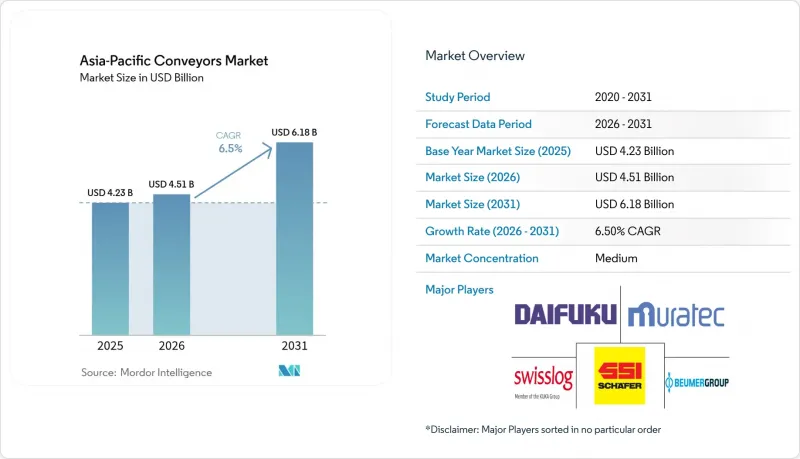
根據 Mordor Intelligence 預測,亞太輸送機市場規模將從 2025 年的 42.3 億美元成長到 2026 年的 45.1 億美元,然後在 2031 年達到 61.8 億美元,2026 年至 2031 年的複合年成長率為 6.50%。
本報告按產品類型(傳送帶、滾筒、托盤、架空式、鏈條)、安裝方式(落地式、架空式、其他)、負載類型(散裝負載、單元貨載)、終端用戶行業(機場、零售/電商、汽車、製造、食品飲料、製藥、採礦、其他)和國家/地區進行細分。市場預測以美元(USD)為單位。
亞太地區輸送機市場趨勢與洞察
亞太地區電子商務倉庫的快速擴張
為了實現當日達和隔天達的目標,小包裹運輸公司紛紛引入高速交叉傳送帶分揀機和綿延數公里的輸送機,甚至在曾經依靠人工勞動、工資差距來彌補損失的次市場也不例外。 Coupang於2024年在韓國開設了三個新的履約中心,每個中心每小時可處理12,000個小包裹。這些中心採用與自主移動機器人協同工作的架空輸送機。京東物流在中國開設了八個自動化區域樞紐,這些樞紐結合了架空傳送帶和移動機器人,實現了兩小時內送達的目標。大創位於馬來西亞的奈利倉庫佔地100萬平方英尺,運作了一條4.2公里長的輸送機,每周可運輸120萬個包裹,減少了68%的人工搬運。在澳大利亞,Woolworths和Coles投資8億澳元建造自動化中心,將訂單到出貨的週期從48小時縮短至18小時。這些項目正在擴大亞太市場對輸送機的基本需求,並鞏固輸送機作為最後一公里物流關鍵基礎設施的地位。
對製造自動化和工業4.0的投資
預計2024年,亞洲將部署415,400台工業機器人,佔全球整體的73%。輸送機作為連接機器人取放、檢測和包裝等操作的“紐帶”,發揮著至關重要的作用。豐田汽車公司刈谷工廠將RFID讀取器整合到模組化鍊式輸送機中,每班次可追蹤18,000個零件,準確率高達99.8%。越南的數位經濟藍圖旨在2025年實現300億美元的製造業出口額,吸引外資投資自動化設備,尤其是輸送機運轉率直接影響產量的領域。泰國投資促進委員會(BOI)迅速批准了42個智慧工廠項目,總額達860億泰銖,其中高達22%的資金將用於物料輸送系統。這些發展表明,亞太地區的輸送機市場正在維持與工業4.0要求相符的技術更新週期。
高水準系統需要大量的初始資本投入。
一個佔地 20 萬平方英尺的承包自動化中心,包括分類機和軟體,造價在 800 萬至 2500 萬美元之間,這對印度和印尼的中小型企業 (SME) 來說是一筆不小的負擔。英特羅 (Interroll) 的「RollerDrive」系統允許領先部署 25% 的計畫產能,並可後續擴展,從而減輕融資負擔。德馬泰克 (Dematic) 正在印度試行「按揀貨付費」模式,將投資轉化為營運支出 (OPEX),並實現了每件處理商品 0.12 至 0.18 美元的收費收費系統。然而,在印度尼西亞,高達 15% 的進口關稅推高了零件價格,而且由於缺乏明確的擁有成本計算方法,導致新用戶在前 18 個月的運轉率低於 65%。
細分市場分析
在汽車和電子生產線中,機器人和檢測站的佔地面積至關重要,架空輸送機市場預計到2031年將以7.12%的複合年成長率成長,成為所有產品類型中成長最快的。遠大公司的單軌輸送機能夠以30公尺/分鐘的速度輸送50-150公斤的貨物,目前已在中國14家汽車工廠投入使用,用於整合噴漆和組裝流程。 SSI Schaefer公司的「RackBot」平台在日本一家電子製造地實現了每1000平方公尺3萬個料箱的高密度堆放。皮帶輸送系統主要服務於採礦和食品加工等需要長距離運輸的應用領域,預計到2025年將佔亞太地區重型散貨輸送機市場42.24%的銷售額,佔據亞太地區輸送機市場的大部分佔有率。
在澳洲皮爾巴拉地區,皮帶輸送機的應用持續成長。 Big Roller公司的陸上運輸設計旨在減少60%的能源損耗。 Fenner公司的iBelt皮帶磨損測量儀利用超音波預測皮帶磨損情況,進而將鐵礦石開採作業中意外停機時間減少28%。滾筒輸送機仍然是小包裹處理的主要方式,而托盤式和鍊式輸送機則滿足了冷藏倉庫和嚴苛加工環境的需求。
隨著都市區租金上漲,架空式起重機的複合年成長率預計將達到7.45%。同時,由於其結構簡單、承載能力強,地面式起重機預計到2025年仍將維持60.12%的市場佔有率。新加坡土地市場有限,推動了架空式起重機的維修,從而釋放出地面空間用於套件組裝。 Swisslog公司的「Vectura」起重機在澳洲的冷庫中運作,最大作業高度可達45米,並可在低至-28 度C的環境下工作。在汽車生產線上,嵌入式地面鏈條仍然是消除高度差、實現無階梯運輸的關鍵。
在亞太地區的輸送機市場,隨著微型倉配中心優先考慮體積效率,架空輸送系統市場預計將會擴張。紐西蘭的Caldex升降機在最大限度地減少面積的同時,將儲存容量提高了30%。同時,採礦業仍偏好寬度達2,400毫米的寬幅地面輸送帶。地面鏈條在車輛噴漆和組裝過程中也發揮著重要作用,用於運輸車身。
其他好處
- Excel格式的市場預測(ME)表
- 3個月的分析師支持
目錄
第1章:引言
- 研究假設和市場定義
- 調查範圍
第2章:調查方法
第3章執行摘要
第4章 市場狀況
- 市場概覽
- 市場促進因素
- 亞太地區電子商務倉庫的快速擴張
- 對製造自動化和工業4.0的投資
- 政府主導的物流基礎設施現代化計劃
- 人事費用上升正在推動自動化運輸系統的應用。
- 亞洲二、三線城市微型倉配中心維修
- 減排法規支援節能型輸送機。
- 市場限制因素
- 高水準系統需要大量的初始資本投入。
- 熟練維修人員短缺
- 人口密集都市區倉庫的空間限制
- 特種橡膠和鋼絲進口關稅的變化
- 產業價值鏈分析
- 監理情勢
- 技術展望
- 波特五力分析
第5章 市場規模與成長預測
- 依產品類型
- 腰帶
- 滾筒
- 調色盤
- 開賣
- 鏈
- 按安裝類型
- 落地式
- 架空類型
- 地板嵌入式
- 按道路類型
- 散貨路
- 單元貨載
- 按最終用戶行業分類
- 飛機場
- 零售與電子商務
- 車
- 製造業
- 飲食
- 製藥
- 礦業
- 物流/第三方物流
- 其他
- 國家
- 澳洲
- 中國
- 印度
- 日本
- 印尼
- 馬來西亞
- 新加坡
- 韓國
- 台灣
- 亞太其他地區
第6章 競爭情勢
- 市場集中度
- 策略趨勢
- 市佔率分析
- 公司簡介
- Daifuku Co., Ltd.
- Murata Machinery, Ltd.
- SSI Schafer AG
- Swisslog Holding AG
- BEUMER Group GmbH and Co. KG
- KNAPP AG
- Honeywell Intelligrated Inc.
- Kardex Holding AG
- FlexLink AB
- Interroll Holding AG
- Bastian Solutions LLC
- Godrej Consoveyo Logistics Automation Ltd.
- Armstrong Limited
- Siemens AG(Logistics)
- Fives Group
- TGW Logistics Group GmbH
- Vanderlande Industries BV
- Dematic Corp(KION Group)
- Toyota Industries Corporation
- Mahindra Tsubaki Conveyor Systems Pvt. Ltd.
- Yokohama Rubber Co., Ltd.
- Habasit AG
- Continental AG
第7章 市場機會與未來展望
According to Mordor Intelligence, the Asia-Pacific conveyors market size is expected to grow from USD 4.23 billion in 2025 to USD 4.51 billion in 2026 and is forecast to reach USD 6.18 billion by 2031 at 6.50% CAGR over 2026-2031.
This report is Segmented by Product Type (Belt, Roller, Pallet, Overhead, and Chain), Installation Type (Floor, Overhead, and More), Load Type (Bulk Load and Unit Load), End-User Industry (Airport, Retail and E-Commerce, Automotive, Manufacturing, Food and Beverage, Pharmaceuticals, Mining, and More), and Country. The Market Forecasts are Provided in Terms of Value (USD).
Asia-Pacific Conveyors Market Trends and Insights
Rapid E-commerce Warehouse Expansion Across Asia-Pacific
Same-day and next-day shipping commitments are prompting parcel operators to install high-speed cross-belt sorters and multi-kilometer conveyor spines even in secondary markets where wage arbitrage once offset manual handling. Coupang added three Korean fulfillment centers in 2024, each capable of processing 12,000 parcels per hour, utilizing overhead conveyors that integrate with autonomous mobile robots. JD Logistics has opened eight automated regional hubs in China that utilize a combination of overhead belts and mobile robots to achieve 2-hour delivery windows. Daiso's 1 million ft2 Nilai facility in Malaysia runs 4.2 km of belts to move 1.2 million cartons weekly, lowering manual lifts by 68%. In Australia, Woolworths and Coles invested AUD 800 million in automated centers that cut order-to-dispatch cycles from 48 hours to 18 hours. Together, these projects amplify baseline demand in the Asia-Pacific conveyors market and solidify conveyors as mission-critical infrastructure for last-mile logistics.
Manufacturing Sector Automation and Industry 4.0 Investments
Asia installed 415,400 industrial robots in 2024, 73% of global volume, embedding conveyors as the connective tissue for robotic pick-and-place, inspection, and packaging tasks. Toyota Industries' Kariya plant integrated modular chain conveyors with RFID readers to trace 18,000 components per shift at 99.8% accuracy. Vietnam's digital-economy roadmap targets USD 30 billion in manufacturing exports by 2025, drawing foreign automation capex where conveyor uptime is tied directly to yield. Thailand's Board of Investment fast-tracked 42 smart-factory projects worth THB 86 billion in 2024, earmarking up to 22% for material-handling systems BOI.GO.TH. Such moves keep the Asia-Pacific conveyor market on a technology-refresh cycle aligned with Industry 4.0 mandates.
High Initial Capital Expenditure for Advanced Systems
Turnkey automated centers spanning 200,000 ft2 can cost USD 8 million-25 million once sorters and software are included, a hurdle for small firms in India or Indonesia. Interroll's RollerDrive lets users install 25% of planned capacity upfront and expand later, easing cash pressure. Dematic piloted a pay-per-pick model in India that shifts investment to opex at USD 0.12-0.18 per unit handled. Nevertheless, import duties that reach 15% in Indonesia inflate component prices, and opaque ownership-cost calculations leave new adopters facing utilization rates below 65% in the first 18 months.
Other drivers and restraints analyzed in the detailed report include:
- Government Logistics-Infrastructure Modernization Programs
- Rising Labor Costs Prompting Automated Handling
- Skilled Maintenance Workforce Shortage
For complete list of drivers and restraints, kindly check the Table Of Contents.
Segment Analysis
Overhead conveyors are forecast to grow at 7.12% CAGR to 2031, the quickest among product categories, as automotive and electronics lines value floor clearance for robots and inspection stations. Yuanda's monorails, which can carry 50-150 kg at 30 m/min, have been installed at 14 Chinese auto plants to align paint-shop flow with assembly. SSI Schafer's RackBot platforms in Japanese electronics sites achieve densities of 30,000 totes per 1,000 m2. Belt systems still commanded 42.24% of 2025 revenue by serving long-haul mining and food-processing applications, and they anchor much of the Asia-Pacific conveyors market size in the heavy bulk segment.
Belt installations persist in Australia's Pilbara, where Big Roller's overland designs aim for 60% lower energy loss. Fenner's iBelt gauge uses ultrasonics to predict belt wear and has cut unscheduled stoppages 28% in iron-ore operations. Roller conveyors remain the workhorse of parcel handling, while pallet and chain designs address the needs of cold storage and harsh processing environments.
Overhead systems are set for a 7.45% CAGR as urban rents escalate; floor solutions still held 60.12% share in 2025 due to simplicity and heavy-load capability. Singapore's dense land market has catalyzed overhead retrofits, freeing up ground-level space for kitting. Swisslog's Vectura cranes in Australian cold stores operate at -28 °C and reach a height of 45 m. In-floor chains stay indispensable on automotive lines where flush transfers remove height transitions.
The Asia-Pacific conveyors market size for overhead systems is poised to widen as micro-fulfillment centers prioritize cubic efficiency. Kardex lifts in New Zealand improved storage 30% with minimal footprint. However, mining still favors broad floor belts up to 2,400 mm wide, and in-floor chains power vehicle bodies through the paint and final assembly stages.
Complete Report Scope:
- By Product Type
- Belt
- Roller
- Pallet
- Overhead
- Chain
- By Installation Type
- Floor
- Overhead
- In-floor
- By Load Type
- Bulk Load
- Unit Load
- By End-User Industry
- Airport
- Retail and E-commerce
- Automotive
- Manufacturing
- Food and Beverage
- Pharmaceuticals
- Mining
- Logistics and 3PL
- Other End-User Industries
- By Country
- Australia
- China
- India
- Japan
- Indonesia
- Malaysia
- Singapore
- South Korea
- Taiwan
- Rest of Asia-Pacific
List of Companies Covered in this Report:
- Daifuku Co., Ltd.
- Murata Machinery, Ltd.
- SSI Schafer AG
- Swisslog Holding AG
- BEUMER Group GmbH and Co. KG
- KNAPP AG
- Honeywell Intelligrated Inc.
- Kardex Holding AG
- FlexLink AB
- Interroll Holding AG
- Bastian Solutions LLC
- Godrej Consoveyo Logistics Automation Ltd.
- Armstrong Limited
- Siemens AG (Logistics)
- Fives Group
- TGW Logistics Group GmbH
- Vanderlande Industries B.V.
- Dematic Corp (KION Group)
- Toyota Industries Corporation
- Mahindra Tsubaki Conveyor Systems Pvt. Ltd.
- Yokohama Rubber Co., Ltd.
- Habasit AG
- Continental AG
Additional Benefits:
- The market estimate (ME) sheet in Excel format
- 3 months of analyst support
TABLE OF CONTENTS
1 INTRODUCTION
- 1.1 Study Assumptions and Market Definition
- 1.2 Scope of the Study
2 RESEARCH METHODOLOGY
3 EXECUTIVE SUMMARY
4 MARKET LANDSCAPE
- 4.1 Market Overview
- 4.2 Market Drivers
- 4.2.1 Rapid E-Commerce Warehouse Expansion Across Asia-Pacific
- 4.2.2 Manufacturing Sector Automation And Industry 4.0 Investments
- 4.2.3 Government Logistics-Infrastructure Modernization Programs
- 4.2.4 Rising Labor Costs Prompting Adoption Of Automated Handling
- 4.2.5 Micro-Fulfillment Retrofits In Tier-2/3 Asian Cities
- 4.2.6 Carbon-Reduction Mandates Favoring Energy-Efficient Conveyors
- 4.3 Market Restraints
- 4.3.1 High Initial Capital Expenditure For Advanced Systems
- 4.3.2 Skilled Maintenance Workforce Shortage
- 4.3.3 Space Constraints In Dense Urban Warehouses
- 4.3.4 Import-Tariff Volatility On Specialty Rubber and Steel Cord
- 4.4 Industry Value Chain Analysis
- 4.5 Regulatory Landscape
- 4.6 Technological Outlook
- 4.7 Porter's Five Forces Analysis
- 4.7.1 Threat of New Entrants
- 4.7.2 Bargaining Power of Buyers
- 4.7.3 Bargaining Power of Suppliers
- 4.7.4 Threat of Substitutes
- 4.7.5 Intensity of Competitive Rivalry
5 MARKET SIZE AND GROWTH FORECASTS (VALUE)
- 5.1 By Product Type
- 5.1.1 Belt
- 5.1.2 Roller
- 5.1.3 Pallet
- 5.1.4 Overhead
- 5.1.5 Chain
- 5.2 By Installation Type
- 5.2.1 Floor
- 5.2.2 Overhead
- 5.2.3 In-floor
- 5.3 By Load Type
- 5.3.1 Bulk Load
- 5.3.2 Unit Load
- 5.4 By End-User Industry
- 5.4.1 Airport
- 5.4.2 Retail and E-commerce
- 5.4.3 Automotive
- 5.4.4 Manufacturing
- 5.4.5 Food and Beverage
- 5.4.6 Pharmaceuticals
- 5.4.7 Mining
- 5.4.8 Logistics and 3PL
- 5.4.9 Other End-User Industries
- 5.5 By Country
- 5.5.1 Australia
- 5.5.2 China
- 5.5.3 India
- 5.5.4 Japan
- 5.5.5 Indonesia
- 5.5.6 Malaysia
- 5.5.7 Singapore
- 5.5.8 South Korea
- 5.5.9 Taiwan
- 5.5.10 Rest of Asia-Pacific
6 COMPETITIVE LANDSCAPE
- 6.1 Market Concentration
- 6.2 Strategic Moves
- 6.3 Market Share Analysis
- 6.4 Company Profiles {(includes Global level Overview, Market level overview, Core Segments, Financials as available, Strategic Information, Market Rank/Share for key companies, Products and Services, and Recent Developments)}
- 6.4.1 Daifuku Co., Ltd.
- 6.4.2 Murata Machinery, Ltd.
- 6.4.3 SSI Schafer AG
- 6.4.4 Swisslog Holding AG
- 6.4.5 BEUMER Group GmbH and Co. KG
- 6.4.6 KNAPP AG
- 6.4.7 Honeywell Intelligrated Inc.
- 6.4.8 Kardex Holding AG
- 6.4.9 FlexLink AB
- 6.4.10 Interroll Holding AG
- 6.4.11 Bastian Solutions LLC
- 6.4.12 Godrej Consoveyo Logistics Automation Ltd.
- 6.4.13 Armstrong Limited
- 6.4.14 Siemens AG (Logistics)
- 6.4.15 Fives Group
- 6.4.16 TGW Logistics Group GmbH
- 6.4.17 Vanderlande Industries B.V.
- 6.4.18 Dematic Corp (KION Group)
- 6.4.19 Toyota Industries Corporation
- 6.4.20 Mahindra Tsubaki Conveyor Systems Pvt. Ltd.
- 6.4.21 Yokohama Rubber Co., Ltd.
- 6.4.22 Habasit AG
- 6.4.23 Continental AG
7 MARKET OPPORTUNITIES AND FUTURE OUTLOOK
- 7.1 White-space and Unmet-Need Assessment

 螺旋輸送機市場規模、佔有率和成長分析:按輸送機類型、螺旋類型、應用、最終用戶產業、營運方式和地區分類-2026-2033年產業預測
 冷凍食品輸送機系統市場規模、佔有率和成長分析:按輸送機類型、應用、食品類型、最終用戶和地區分類-2026-2033年產業預測
 升降輸送機市場規模、佔有率和成長分析:按輸送機類型、應用、最終用戶、驅動系統和地區分類-2026-2033年產業預測
 滅菌輸送機市場規模、佔有率和成長分析:按輸送機類型、滅菌技術、應用、最終用戶、自動化程度和地區分類-2026-2033年產業預測
 智慧輸送機自動化市場預測至2034年-按輸送機類型、組件、自動化程度、應用、最終用戶和地區分類的全球分析
 輸送系統市場規模、佔有率、成長、全球產業分析、區域趨勢及2026-2034年預測。
 中東和非洲輸送機市場:市場佔有率分析、行業趨勢和統計數據以及成長預測(2026-2031 年)歐洲輸送機:市場佔有率分析、行業趨勢和統計數據、成長預測(2026-2031 年)輸送機:市場佔有率分析、行業趨勢和統計數據、成長預測(2026-2031 年)
 振動輸送機市場-2026-2032年全球市場預測